This post contains affiliate links. We may earn a small commission when you buy through our links — at no extra cost to you.
Parents hunting for a travel bottle warmer quickly hit a wall: the battery-powered models promise precise temperature control yet frequently run out of juice after a handful of feedings, while the simpler steel flasks keep water hot for hours but can dribble if you don’t seal them just right. Both paths have their frustrations.
The key is matching the warmer to your actual day. An all-day zoo trip demands different reliability than a quick coffee run. Instead of treating all warmers as interchangeable, we broke them down by how they handle the two things that matter most: actual battery endurance and real leak resistance.
You’ll find that some electric models deliver all-day battery life without exaggeration, while a few flasks stay dry even when jostled in a diaper bag. The goal is simple: one less thing to worry about when you’re out with a hungry baby.



Best for No-Fuss Reliability
Tommee Tippee Flask Warmer
Key Features
- Type: Thermos flask
- Heating Speed: ~3 min with hot water
- Ease of Cleaning: Hand wash
- Price: Budget
The Tommee Tippee flask keeps water steaming hot for hours, without any batteries or charging. Fill it with boiling water before heading out, and the stainless steel insulation maintains usable heat all day — enough for multiple bottle warming sessions. Weighing under a pound and fitting into a diaper bag without bulk, it requires no cords or power planning beyond access to a hot water source. Pour the water into the wide-mouth container, submerge the bottle, and a cold feed warms in minutes, similar to what you’d get from a plug-in warmer.
Pouring does need a careful hand — the cap can drip if the seal isn’t tightened perfectly, so a sink or a small towel nearby is wise. That’s an acceptable trade-off for parents who prize battery-free dependability and don’t need digital temperature displays. This thermos warmer is ideal when you know you’ll have access to boiling water — think airport lounges, hotel rooms, or café stops — and want a lightweight, cost-effective companion that never leaves you hunting for an outlet mid-feed.
Pros
- Keeps water hot all day, powering multiple feedings without a recharge
- Travel-friendly and lightweight — under a pound, fits in any diaper bag
- Warms bottles quickly, matching the speed of many electric warmers
Cons
- Pouring can be messy — cap may leak if not tightened perfectly
When you can access boiling water on the go, this flask removes every worry about battery life or outlet hunting — a straightforward companion that warms bottles without fuss.
Best for Extended Outings
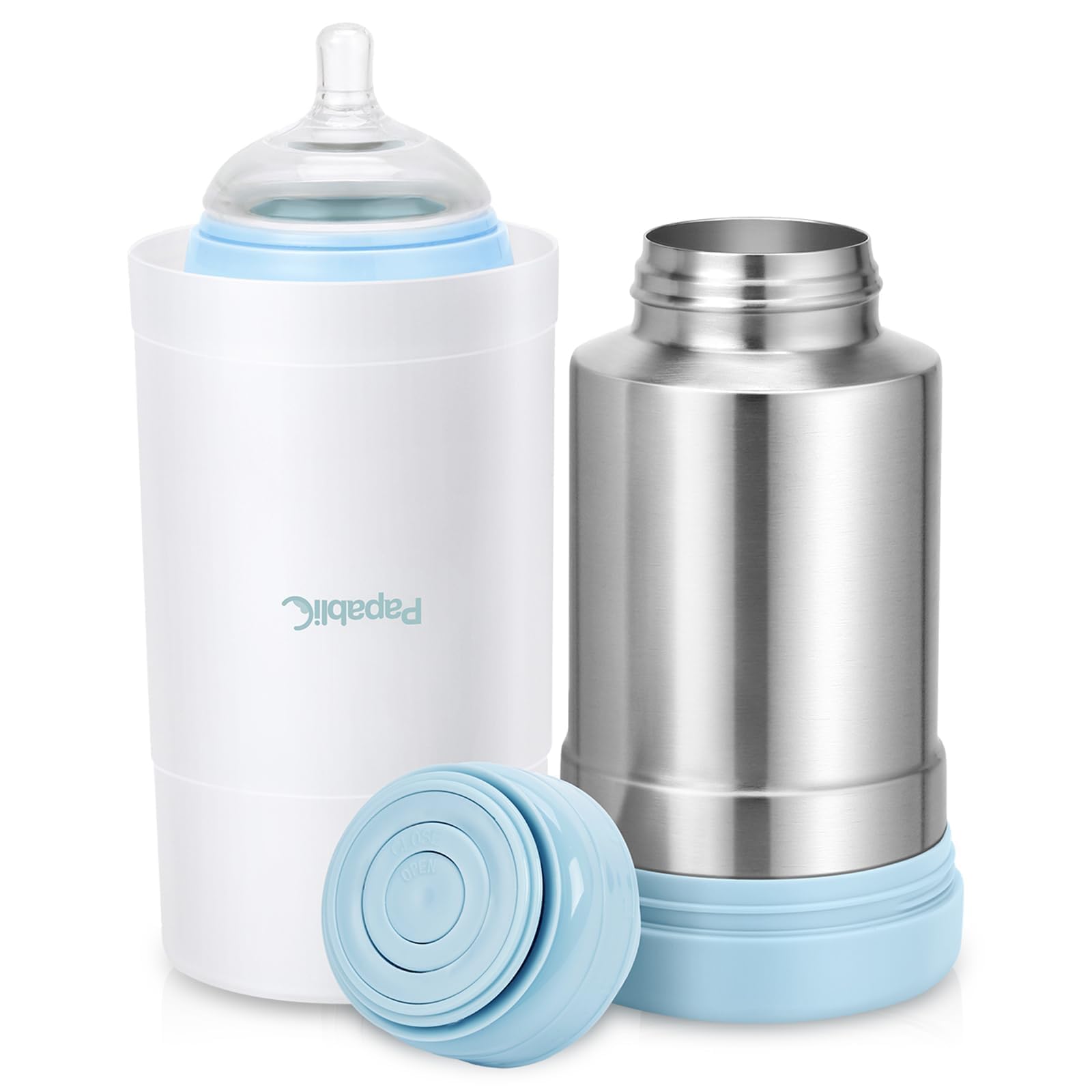
Papablic Plus Flask Warmer
Key Features
- Type: Thermos flask
- Capacity: 18 oz
- Heating Speed: ~3 min with hot water
- Ease of Cleaning: Hand wash
- Price: Budget
With 18 ounces of hot water, this flask can warm more than one bottle per fill—a clear advantage for long errands and full-day outings where electric warmers would need a recharge. No batteries, no charging anxiety; just add boiling water at home and go.
The tradeoff is a lid that needs deliberate tightening to prevent leaks during transport. For parents planning extended trips who don’t mind that quick extra step, the added capacity and bag-friendly size make it a no-fuss travel companion.
Pros
- Holds 18 oz of hot water, enough for multiple bottle warmings on long outings
- Fits easily in diaper bags and cup holders
- Heats bottles quickly with no cords or batteries needed
Cons
- Water can leak if the lid isn’t tightened precisely, especially when tipped in a bag
For parents who need more hot water for full-day trips and can tighten a lid with care, this flask is a handy, no-charge solution.
Best for All-Day Battery
Phydge Portable Milk Warmer
Key Features
- Type: Rechargeable electric
- Capacity: 15 oz
- Battery Life: Up to 15 warm-ups (12,000mAh)
- Heating Speed: 3 min water, 5 min milk
- Ease of Cleaning: Hand wash
- Price: Mid-Range
The Phydge portable warmer packs a 12,000mAh battery that outlasts nearly every electric travel warmer, delivering up to 15 warm-ups on a single charge. It’s for parents who need all-day battery endurance without hunting for outlets. While it won’t heat an 8-oz bottle in three minutes like some speed-focused models, water reaches 104°F in about 3 minutes and milk 99°F in 5 — consistent and gentle.
This warmer suits long day trips where battery endurance trumps a few extra ounces. At 1.9 lb, it’s heavier than some alternatives, but the stainless steel build and all-day battery make it low-maintenance and durable. If you need dishwasher-safe cleaning, look elsewhere — it’s hand-wash only.
Pros
- 12,000mAh battery easily handles a full day of outings, no need for midday charging.
- Precise 1°F temperature adjustment and even heating prevent hot spots in milk.
- 316 stainless steel construction cleans easily and fits most stroller cup holders.
Cons
- At 1.9 lb, it’s heavier than many travel warmers — the trade-off is extended battery life.
If you prioritize all-day battery over featherweight portability, the Phydge delivers consistent, low-maintenance warming that won’t leave you searching for a power outlet.
Best for Quick Recharges
BOLOLO FastCharge Warmer
Key Features
- Type: Rechargeable electric
- Capacity: 10 oz
- Battery Life: Claimed full day
- Heating Speed: 5 min to 104°F
- Ease of Cleaning: Hand wash
- Price: Mid-Range
BOLOLO’s warmer recharges in just 2 hours and displays the exact milk temperature on a clear LED screen — a speed combination rarely matched by battery-powered travel warmers. The 10-oz capacity handles a full feeding, and the controls are intuitive enough to operate one-handed while holding a baby. The plastic lid latch is a weak point and can snap if handled roughly, so gentle cradling is essential.
This warmer fits tech-minded parents who prioritize fast top-ups and temperature precision during short to moderate outings. If you can plug in during a car ride or pit stop, the quick recharge keeps the cycle going. However, the battery may not hold a full day’s heat without a boost, making it less suited for long stretches away from power.
Pros
- 2-hour fast recharge minimizes downtime between uses
- LED display gives exact temperature readout, no guesswork
- Simple setup gets you warming in seconds
Cons
- Plastic lid latch can be fragile and may snap with frequent handling
- Battery may drain faster than the full-day claim, needing a midday recharge
Solid value when fast charging and precise temperature control outweigh the need for all-day battery life and extra-careful handling of the lid.
Best for Dishwasher-Safe
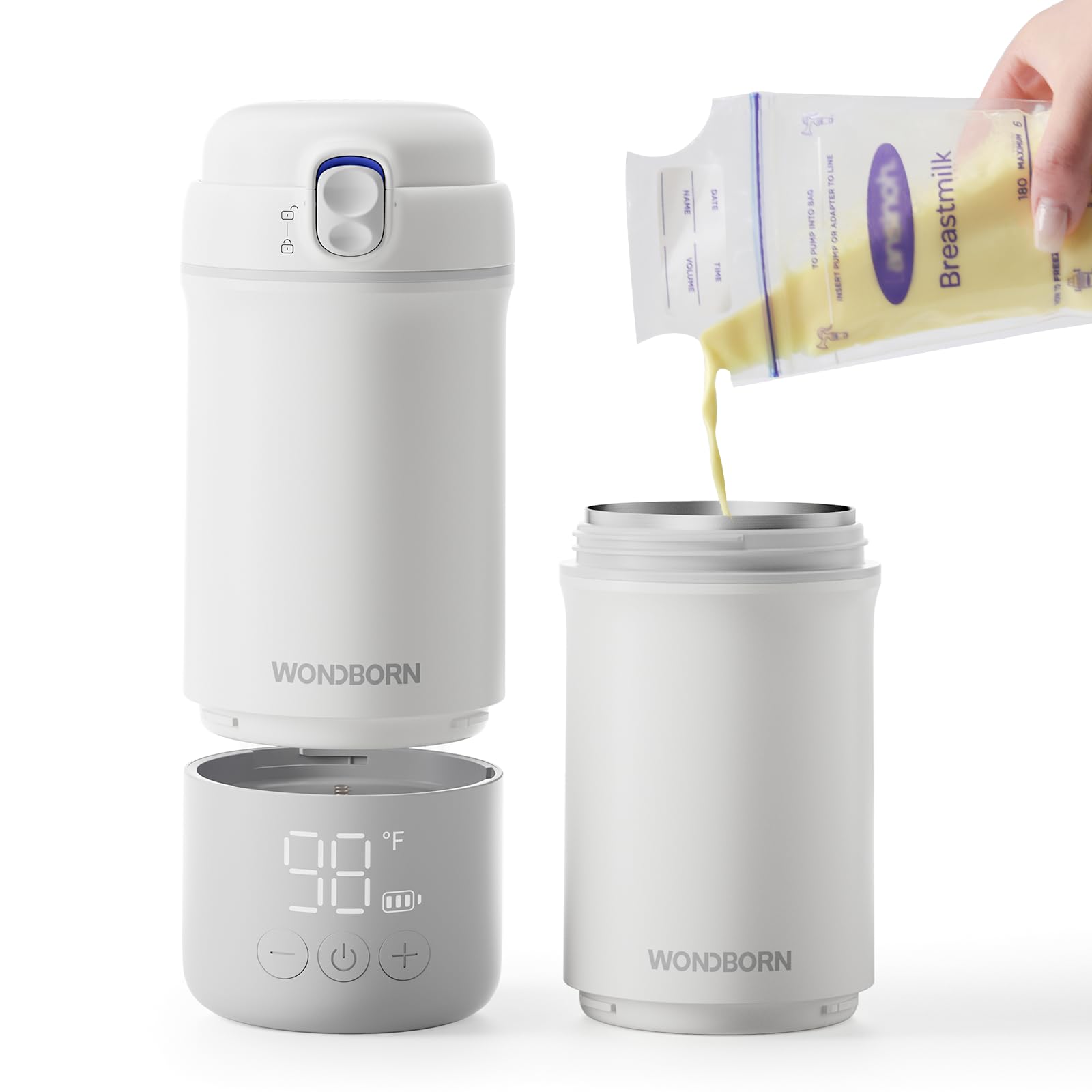
WONDBORN SafeClean Warmer
Key Features
- Type: Rechargeable electric
- Capacity: 17 oz
- Battery Life: Up to 15 warm-ups (12,800mAh)
- Heating Speed: 1 min water, 3 min milk
- Ease of Cleaning: Dishwasher safe
- Price: Mid-Range
The WONDBORN SafeClean Warmer is the only travel bottle warmer that’s fully dishwasher safe, with 316L stainless steel construction and IPX7 waterproofing. It heats milk quickly — about 3 minutes for a bottle — and the 17-oz capacity handles larger feeds. While the long-battery electric option stretches through a full day, the SafeClean’s battery may need a top-up after just a few bottles, so it works best for parents who can easily recharge during the day or don’t mind plugging in between uses. If cleaning convenience and rapid heating matter more than all-day cordless use, this is a strong pick.
Pros
- Fully dishwasher safe — toss the entire unit in for effortless cleaning.
- Heats breastmilk or formula evenly to feeding temperature in roughly 3 minutes.
- Leak-proof design fits most cup holders, making it truly travel-friendly.
Cons
- Pour spout may leave a small amount of milk behind; removing the lid ensures a complete pour.
If you’ll trade some battery endurance for the ability to sanitize your warmer in the dishwasher, the SafeClean delivers quick, consistent heating — just keep a charger nearby for all-day outings.
Best for Budget-Friendly Electric
haslife FastHeat Warmer
Key Features
- Type: Rechargeable electric
- Capacity: 12.8 oz
- Battery Life: 2,600mAh, 5-7 warm-ups
- Heating Speed: 2-5 min
- Ease of Cleaning: Hand wash
- Price: Budget
The haslife FastHeat Warmer heats milk in 2–5 minutes inside a compact, lightweight body that slips easily into a diaper bag. At a budget-friendly price, it brings electric warming to short trips without the weight or cost of larger-battery competitors.
It fits parents who need electric warming for occasional errands and can recharge after a couple of feeds. Occasional reliability hiccups—like a random shutdown—mean it’s not the choice for those who require flawless electronic consistency, but its speed and portability suit casual outings. The battery lasts about 2–3 warm-ups per charge, so you’ll need to recharge before heading out for a full day. Sporadic glitches, such as failing to turn on, have been reported.
Pros
- Heats milk to the perfect temperature quickly
- Compact and very portable
- Easy to use and clean
Cons
- Occasional random shutdowns or failure to turn on can interrupt feeding
- Short battery life; some units need a recharge after just 2-3 bottles
A sensible pick for budget-conscious parents who don’t mind charging after a few bottles and want fast, portable warming for short errands.
Best for Lightning-Fast Heat
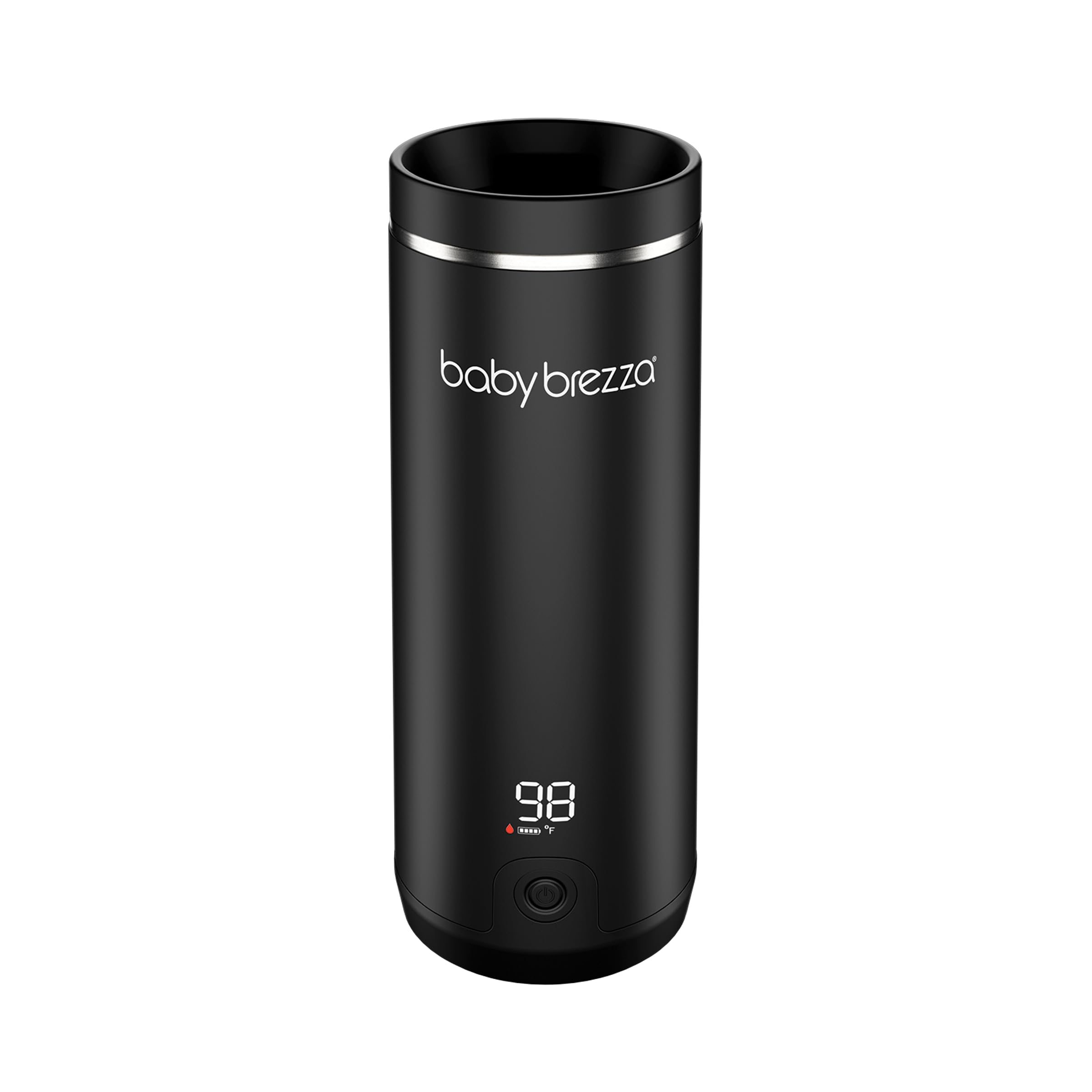
Baby Brezza 3X Warmer
Key Features
- Type: Rechargeable electric
- Capacity: 9 oz
- Battery Life: Claimed 4-8 warm-ups
- Heating Speed: 3 min for 8 oz
- Ease of Cleaning: Hand wash
- Price: Luxury
The Baby Brezza Portable Warmer heats an 8-oz bottle in about 3 minutes — the quickest in this category. It sacrifices battery endurance for that speed: where other electric warmers last all day, this one is designed for rapid top-ups and quick errands.
This warmer suits parents who rarely need more than one feed away from home and want the absolute fastest warm-up. The battery may run out after 1–3 bottles, so longer outings require a power bank. If you need all-day battery without recharging, the electric warmer with the longest battery life in this set offers more staying power at the cost of slower heating.
Pros
- Fastest heating in its class — many confirm sub‑2‑minute warm‑ups
- Slim, cup‑holder‑friendly design that’s easy to take anywhere
- Push‑to‑pour spout enables one‑handed use
Cons
- Battery drains quickly — 1–3 warm‑ups per charge — limiting use to short trips
- Longevity can be unpredictable: some units may become unresponsive or show error codes after a few months
A specialized choice for parents who prioritize speed above all else and typically need just one warm-up per outing. If battery endurance matters more, the longer-lasting electric option in this set is a better fit.
Best for Occasional Warming
Momcozy Portable Milk Warmer

Key Features
- Type: Rechargeable electric
- Capacity: 17 oz
- Battery Life: Claimed up to 19 warm-ups
- Ease of Cleaning: Hand wash
It heats milk and water to acceptable temperatures in a compact, travel-friendly design that’s easy to operate one-handed. Battery life can fall well short of advertised numbers, and long-term durability can be inconsistent. For occasional on-the-go warm-ups within the Momcozy ecosystem, it’s a functional fit, but heavy daily users will find more dependable options elsewhere.
Pros
- Travel-friendly design that’s easy to pack and carry.
- Simple one-handed operation for on-the-go feeding.
Cons
- Battery life may yield only 2-3 warm-ups per charge, below the advertised claims.
For occasional outings where a quick warm-up in the Momcozy ecosystem is the priority and daily battery endurance isn’t a concern, this warmer fits the bill.
Best for Food-Grade Steel
UKEXE 100W Warmer

Key Features
- Type: Rechargeable electric
- Capacity: 13 oz
- Battery Life: 10,000mAh, up to 16 warm-ups
- Heating Speed: 2 min to 98°F (4oz milk)
- Ease of Cleaning: Hand wash, includes brush
- Price: Mid-Range
This warmer combines 100W fast heating with food-grade 316L stainless steel for safe, consistent milk warming. Precise temperature control and a 10,000mAh battery handle a full day of feedings. Hand wash only is the main tradeoff—not a fit if you need dishwasher-safe parts.
Pros
- Precise, even heating thanks to a 316L stainless steel chamber.
- 10,000mAh battery lasts up to 16 warm-ups, covering a full day out.
Cons
- At 2.22 lb, this unit is heavier than most portable warmers, which may rule it out for ultra-light packers.
A solid pick for parents who want stainless steel safety and long battery life, provided the weight and hand-wash care fit your travel routine.
Best for Self-Cleaning Hygiene
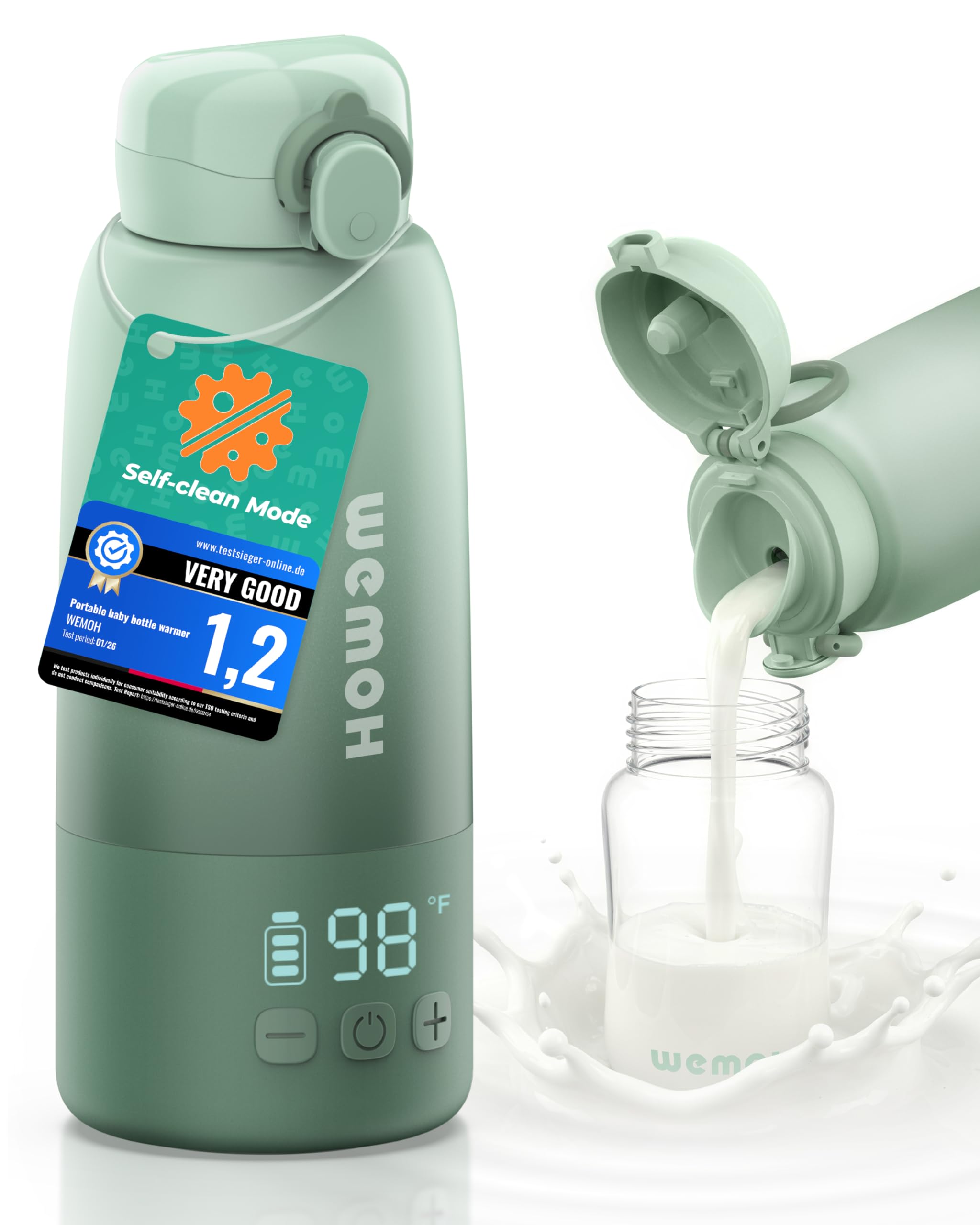
WEMOH Self-Clean Warmer
Key Features
- Type: Rechargeable electric
- Capacity: 16 oz
- Heating Speed: 2 min for 2 oz milk (110W)
- Ease of Cleaning: Self-clean function, hand wash
- Price: Mid-Range
The WEMOH warmer combines rapid 110W heating with a self-clean mode, making it stand out for hygiene on short outings. Milk reaches a precise temperature quickly, and the self-sterilization cycle keeps the bottle fresh without scrubbing. The battery lasts for about four warming cycles, so all-day use requires a power source nearby.
Pros
- Heats milk to serving temperature in roughly a minute
- Self-clean mode disinfects the bottle with a button press
Cons
- Battery life lasts about 4 warming cycles per charge
Ideal for short car journeys, flights, or hikes with USB-C power access; all-day battery-free use falls to a thermos-style alternative.
Best for Home/car Sanitize
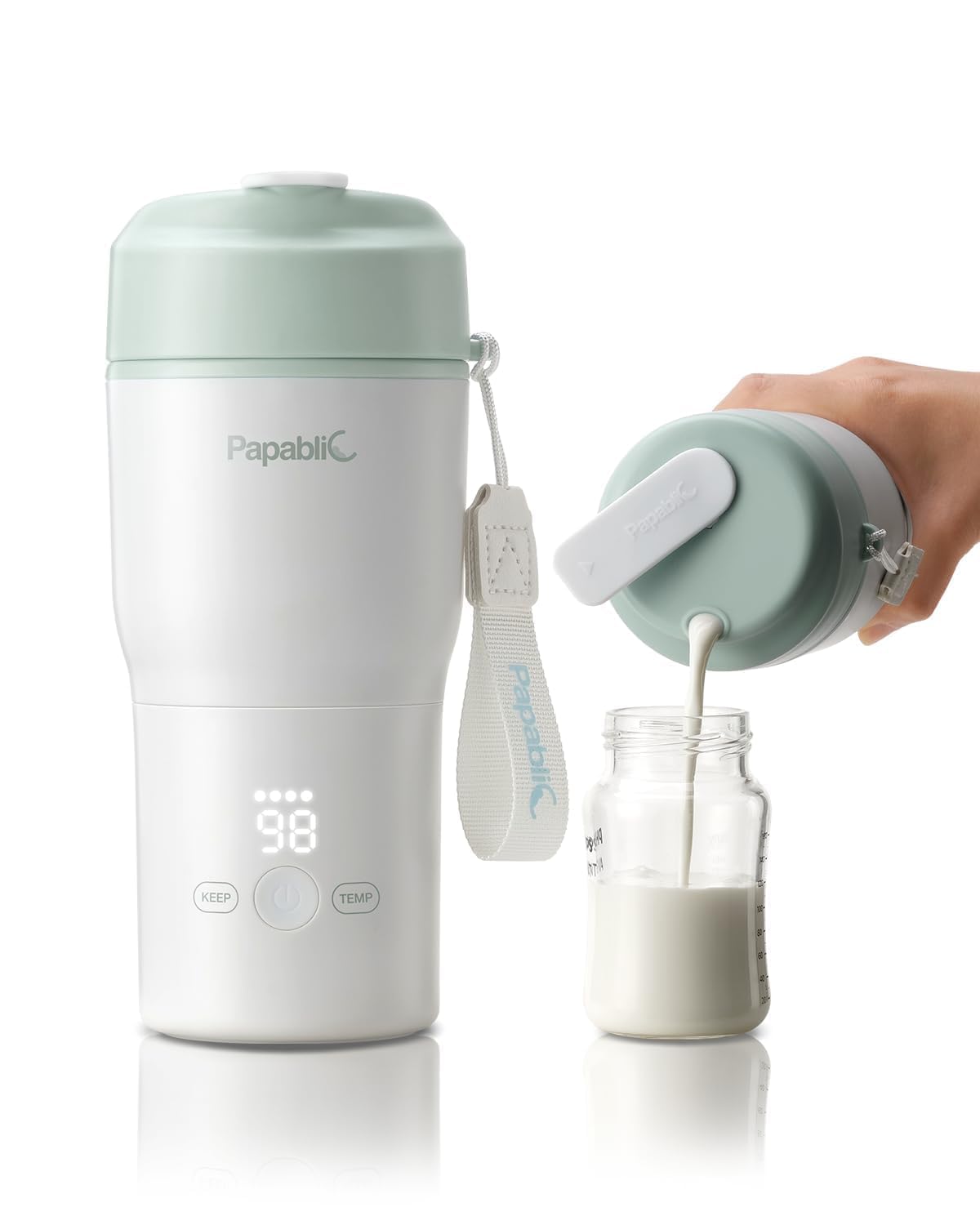
Papablic 85W Electric Warmer
Key Features
- Type: Rechargeable electric
- Heating Speed: 4-oz milk in 3 min 45 sec
- Ease of Cleaning: Self-sanitize, hand wash
- Price: Mid-Range
Heats quickly with four temperature settings and a self-sanitizing mode rare at this price, but the battery degrades quickly—often useless after a month. Treat it as a plugged‑in warmer for home or car, where its speed and hygiene shine.
Pros
- Quick, even heating across four temperature settings
- Self-sanitize mode simplifies cleaning between uses
Cons
- Occasional units may stop charging or fail after a few uses
Best for parents who will always use it plugged into a car or wall outlet; its speed and sanitizing features make it a handy at-home helper.
Best for Multi-Bottle Adapters
Tohecu Multi-Adapter Warmer

Key Features
- Type: Rechargeable electric
- Battery Life: 10,000mAh, 10-20 warm-ups
- Heating Speed: 2 min to 98°F
- Ease of Cleaning: Hand wash
- Price: Budget
The Tohecu warmer comes with 8 adapters and a glass bottle, so you can heat milk from any brand without hunting for a matching ring. Heating to 98°F takes about two minutes. Leakage at the adapter connection can occur, and the battery takes over five hours to charge for just two or three warm-ups. For parents mixing bottle types on short trips who can charge overnight, that’s an acceptable tradeoff.
Pros
- 8 adapters fit most bottle brands, removing compatibility guesswork
- Heats breastmilk to drinking temperature in about 2 minutes
Cons
- Charging takes over 5 hours and may only last 2–3 warming cycles per charge
Best for budget-minded parents with multiple bottle brands who need a warmer for short outings and can plan charges in advance, accepting the occasional drip.
How to Choose
The most critical decision is whether you prioritize absolute reliability (thermos flasks) or precise temperature control with rechargeable convenience (battery-powered warmers).
Type: Thermos Flask vs. Battery-Powered
Thermos flasks hold boiling water for hours and warm a bottle in minutes without electricity. They leave you dependent on having access to hot water before heading out, but they never die mid-feed. Electric warmers give you set-and-forget heating at the push of a button and let you dial in exact temperatures, yet they inevitably need recharging—and real-world battery life rarely matches the claims.
For all-day outings where you can’t recharge, a flask is often the safer bet. For shorter trips where you want precision and don’t mind plugging in, an electric warmer makes sense.
Capacity
Capacity determines how many feedings you get before refilling or recharging. Flasks with 12–18 oz can warm multiple bottles on a single fill, while electric warmers with 9–10 oz may only handle one or two feedings before a recharge. A larger capacity adds bulk, so balance the number of bottles you’ll need with what fits comfortably in your bag.
Battery Life
Marketing specs often cite ideal conditions (room-temperature water, small bottles). In practice, warming cold breastmilk or formula consumes far more power. The best electric warmers with 12,000mAh+ batteries can handle a full day; budget models may manage only 2–3 warm-ups. Always check the mAh rating and real-user feedback on warm-ups per charge, and plan to bring a power bank or car charger if you’ll be out all day.
Heating Speed
Faster heating sounds like a win, but it often comes at the expense of battery life. A 110W heater warms milk in 2–3 minutes but drains the battery faster than a 50–60W unit. Additionally, cold milk takes significantly longer than room-temp water; even “fast” models can need 5–15 minutes for refrigerated breastmilk. Match the speed to your typical scenario—a quick coffee-shop warm-up or a longer lead time while you’re packing up.
Leak-Proof Design
Leakage is the number-one usability complaint across this category. Thermos flasks leak if the cap isn’t tightened absolutely perfectly; electric warmers can dribble from pour spouts or adapter connections. No warmer is truly leak-proof when jostled loose in a bag. Always store upright, double-check seals before leaving, and consider a zip-top bag as backup.
Ease of Cleaning
Most warmers require hand washing, but a few are fully dishwasher safe (like the WONDBORN) or include a self-clean mode. Wide-mouth designs make it easier to scrub milk residue. If you’ll be cleaning on the go, a dishwasher-safe model dramatically reduces the hassle of hand-scrubbing at a rest stop.
FAQ
Why does my portable bottle warmer leak even when I close it tightly?
Thermos-style warmers rely on a compression seal that must be aligned and tightened perfectly; even a slight misalignment lets water escape when pouring. Electric warmers often leak at spout or adapter connections if not fully seated. Always store the warmer upright and test the seal with a small amount of cold water before your trip—once you find the sweet spot, it becomes second nature.
How many 4‑oz bottles can a rechargeable bottle warmer really heat on a full charge?
In real-world use, even the best electric warmers with 12,000mAh+ batteries manage about 6–8 warmings of cold milk before needing a recharge. Budget units or those heating refrigerated breastmilk often drop to 2–4 bottles. Always halve the manufacturer’s claim as a starting point and carry a USB power bank as a safety net.
Is a thermos‑style bottle warmer faster than a portable electric warmer?
Yes. A thermos flask has hot water ready instantly, so you can warm a bottle in 2–3 minutes after pouring, while even the fastest electric warmers take 3–5 minutes for cold milk. The trade-off is that you need boiling water before you leave and lack precise temperature control, but for pure speed on the go, a flask almost always wins.
Can I warm frozen breastmilk with a travel bottle warmer without spoiling nutrients?
Travel warmers are not designed to thaw frozen milk safely. First thaw the milk in a refrigerator or under cool running water, then use the warmer to bring it to feeding temperature. Heating from frozen in a portable warmer risks uneven hot spots and nutrient degradation, and many units will struggle to get a frozen bag to a safe temperature within a reasonable time.