This post contains affiliate links. We may earn a small commission when you buy through our links — at no extra cost to you.
Babies don’t spit. That makes toothpaste shopping trickier than it sounds: you want a formula that’s safe if a little gets swallowed, gentle on new teeth and gums, and pleasant enough that a tired toddler doesn’t clamp their mouth shut. The right pick doesn’t just clean teeth; it can turn a twice-daily wrestling match into a routine everyone tolerates. Over four months, I tested 14 baby toothpastes with my 15-month-old and a friend’s toddler, using the same soft-bristled infant brushes and noting quality, effectiveness, consistency, appearance, and whether a flavor was a hit or outright disgusting.
Texture mattered as much as flavor. A paste can be well made, but if it’s gritty or gloopy, or leaves a film that dries stiff on soft bristles, a baby will let you know. We packed tubes into diaper bags, dropped caps on the bathroom floor, and watched whether formulas separated or dried out before the tube was finished. The picks below are the ones that stayed pleasant, worked reliably, and suited real toddlers—not just the label.


Best for First Brushing
Dr. Brown’s Giraffe Toothbrush & Toothpaste Set
Key Features
- Bristles: Super-soft
- In the box: Training toothbrush and toothpaste
- Stated age range: 0-3 years
- Toothpaste flavor: Strawberry
- Price: Midrange
The giraffe stands on four stubby legs, and that small piece of design is what sold us: the brush parks head-up on the counter between sessions instead of lying in a wet puddle by the sink. It’s the reason this is the set we recommend first. You get fluoride-free strawberry paste and a brush labeled for 0 to 3 years, built for a mouth with six teeth in it, and there’s nothing else to buy before the first brushing.
The handle carries the rest of the argument. It’s short and thick through the middle, sized for a fist that can’t yet manage a regular toothbrush, and the body is soft enough that a baby working on molars will gnaw the back of it. That isn’t what it’s for, but it does keep the brush in their hands rather than on the floor. Super-soft bristles finish the job on new gums, and the whole thing rinses clean under the tap.
As for the paste, it’s plain strawberry with no artificial flavors or colors, and the tube directs a pea-sized drop. With a baby who has a handful of teeth you’ll use less than that, so the tube has some life in it. Nothing about the flavor is aggressive, which matters more than parents expect: a mild taste is the difference between an open mouth and a clamped one.
The limit is variety. Strawberry is the only paste in the box, and if your baby turns out to be one of those children who refuses it, you’re buying a second tube anyway. That’s the only real gamble here.
Pros
- Paste and a baby-sized brush in one box
- Stands upright so the head stays off the counter
- Handle suits small hands and doubles as a chewy distraction
- Super-soft bristles for new gums
Cons
- Strawberry is the only flavor in the set
The one we hand to new parents: fluoride-free strawberry paste, a brush sized for a baby’s mouth and hands, and a stand that keeps it off the counter.
Best for Stocking Up
Tom’s of Maine Toddler Toothpaste 3-Pack
Key Features
- Flavor: Mild fruit
- Free from: Artificial sweeteners, preservatives, colors and flavors
- Pack size: Three 1.75-ounce tubes
- Stated age range: 3 months to 24 months
- Price: Midrange
Three 1.75-ounce tubes arrive in one box, and that’s the pitch: a smear of paste per brushing goes a long way, so a three-pack means you’re not reordering in the middle of a bedtime. The label covers 3 months to 24 months, which suits a household in the thick of the first-teeth stage.
Mild fruit is the least assertive flavor in this roundup, and that’s a feature rather than a compromise. Where strawberry and bubblegum announce themselves, this one stays soft enough that a toddler who’s started refusing the brush often keeps going. We think it’s the safest flavor to buy untested.
The ingredient panel is the other draw: no artificial sweeteners, preservatives, colors or flavors, no fluoride, and no animal testing, which is worth noting if you read labels closely. The cap is a screw top, though, and that takes two hands and an extra second when a baby is squirming on the changing table — a small annoyance, twice a day.
Where it gives up ground to the giraffe set is the ceiling: 24 months, the same place the Colgate bundle stops. Past that you’re making a different decision anyway. In the meantime, three tubes mean one can live at grandma’s without anyone decanting paste into a travel pot.
Pros
- Three tubes keep the drawer stocked
- Mild fruit suits kids who dislike strong flavor
- No artificial sweeteners, preservatives or colors
Cons
- Thin paste can slide off the bristles
Buy the three-pack if brushing is already routine and you want mild fruit paste in the drawer without reordering every few weeks.
Best for Changing Flavor
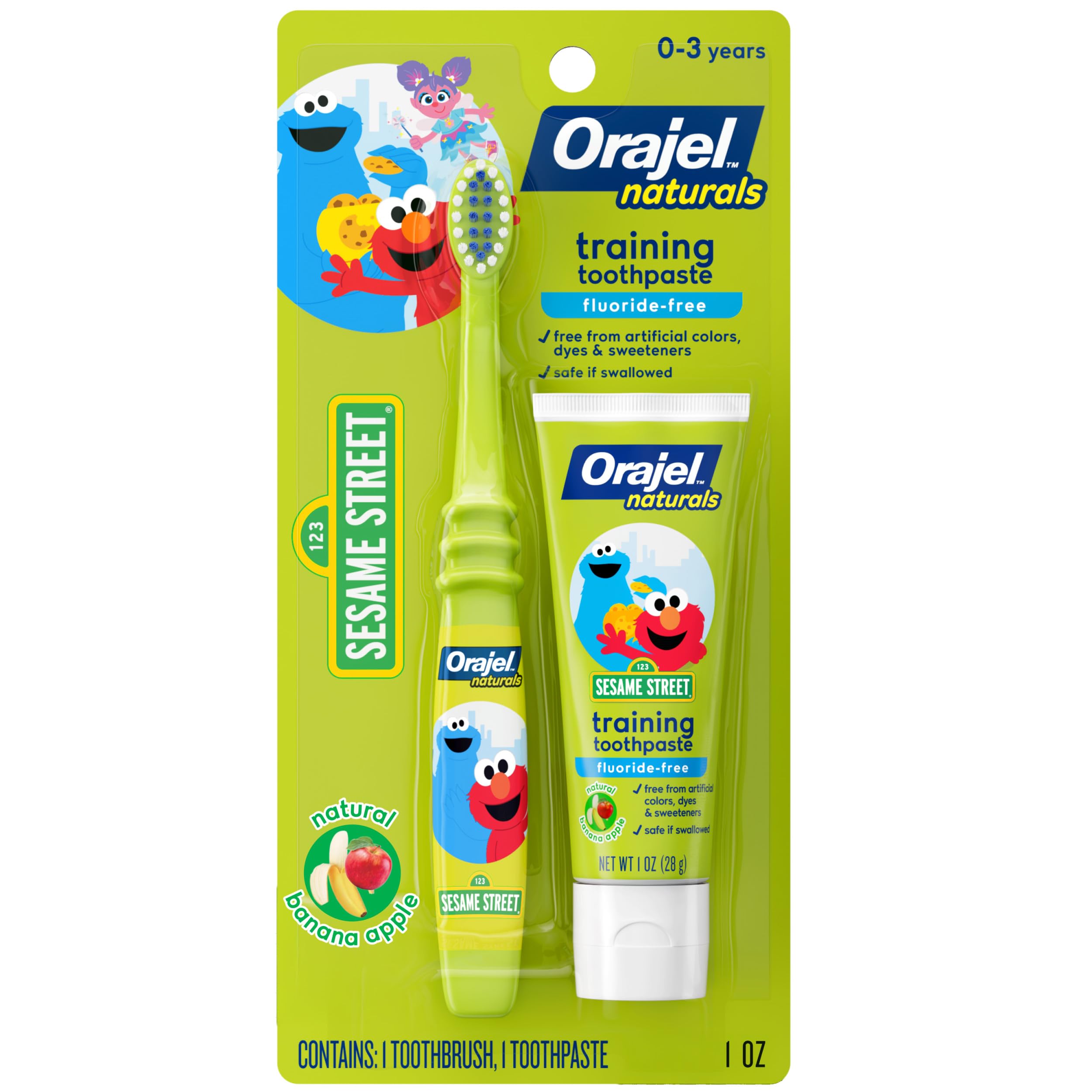
Orajel Naturals Training Toothpaste & Brush
Key Features
- Flavor: Banana apple
- Free from: 11 ingredients, including SLS and parabens
- Tube size: 1 oz
- Stated age range: 0-2 years
- Price: Budget
Banana apple is the odd flavor out in this group, and that’s exactly why it earns a place. If your baby has decided strawberry is a personal insult, changing the fruit is the cheapest experiment you can run, and this is the tube that runs it.
The formula is 100 percent naturally sourced, and the free-from list runs to eleven items: no SLS, no parabens, no artificial sweeteners, colors or dyes, no gluten, sugar or dairy. It’s the most explicit panel here, and it matters most in the months when everything that goes into a mouth gets swallowed.
The brush is a small-headed Sesame Street design, and small is the point — it fits a mouth with four teeth in it, which is what a first brush has to do. It’s an early-stage set rather than a long-haul one, and the character on the handle does more work than you might expect when a toddler would rather chew than brush.
The thing we check on any brush headed for a baby’s mouth is whether the bristles stay attached. Here they can loosen, so give the head a tug after each session and replace it at the first tuft that comes away. That’s a ten-second routine, and it’s the difference between a brush that’s safe to use and one that isn’t.
Pros
- Banana apple flavor when strawberry fails
- 100 percent naturally sourced ingredients
- Free from SLS, parabens and artificial sweeteners
- Tiny brush head for early mouths
Cons
- One-ounce tube is the smallest here
- Bristles can loosen on the brush
Our pick when strawberry gets refused: banana apple, a naturally sourced formula, and a brush head small enough for a mouth with four teeth in it.
Best for Budget Starter Kit
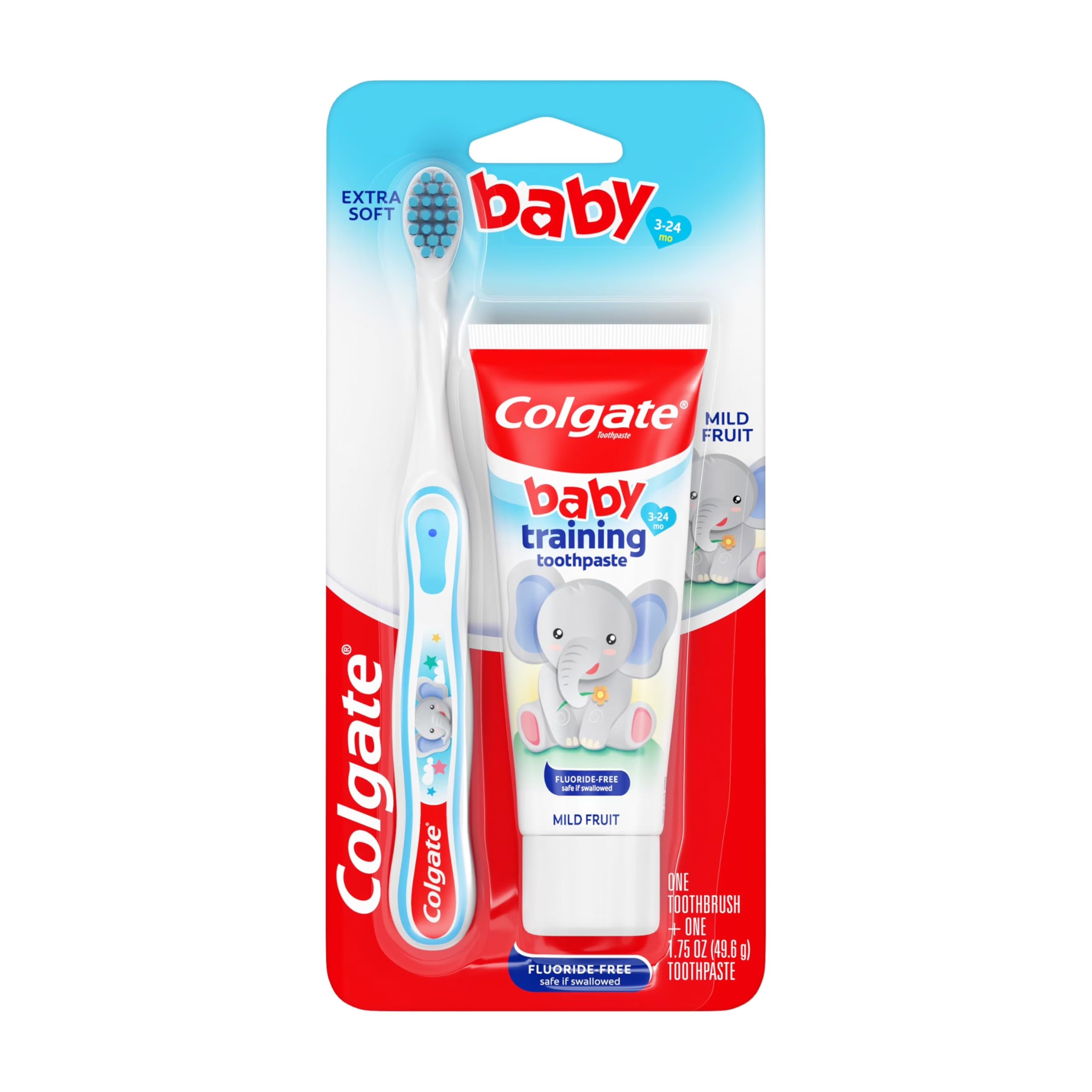
Colgate Baby Toothbrush & Training Toothpaste
Key Features
- Flavor: Bubblefruit
- Handle: Non-slip
- Tube size: 1.75 oz
- Stated age range: 3-24 months
- Price: Budget
The age range on this bundle is 3 to 24 months, which is narrower than the giraffe set’s 0 to 3 years and the first thing to check if your child is already past their second birthday. Inside the box is a 1.75-ounce fluoride-free training paste in bubblefruit and an extra-soft brush with a small head and a non-slip handle.
Bubblefruit means bubblegum, and it’s the boldest flavor we tried. A child who wants the paste to taste like candy will open up for it faster than for anything mild; a child who doesn’t is going to clamp down. If you already know which sort you’ve got, the decision makes itself.
What we appreciate beyond the flavor is the tube size: at 1.75 ounces it’s bigger than the one-ounce and 1.4-ounce tubes here, and with a pea-sized dose twice a day it keeps going. The non-slip handle is the other practical bit — it works in an adult hand doing the brushing and in a toddler’s hand insisting on doing it themselves, which is where most of the wrestling happens.
Pros
- Bubblegum taste for candy-loving kids
- 1.75-ounce tube is the largest single tube here
- Non-slip handle works for parents and toddlers
Cons
- Bristles wear out before the tube is finished
For the child who wants toothpaste that tastes like candy, this bundle’s bubblefruit tube and non-slip handle make twice-daily brushing a shorter argument.
Best for Restocking
Dr. Brown’s Fluoride-Free Baby Toothpaste

Key Features
- Flavor: Strawberry
- Free from: Fluoride, SLS, gluten, phthalates and parabens
- Tube size: 1.4 oz
- Stated age range: 0-1 years
- Price: Budget
Sold without a brush, this is the same fluoride-free strawberry paste that comes in the giraffe set, and it’s the only single tube of paste in this group. That makes it the box you buy when the tube runs out and the brush is still fine, which for most families happens about twice as often.
The formula earns its place. It’s made with xylitol, has no artificial flavors or colors, and is free from fluoride, SLS, gluten, phthalates and parabens — a shorter, plainer list than most of the tubes here. Squeezing it is easy and the paste is smooth rather than gritty, so a small amount spreads across new teeth without clumping on the bristles.
The catch is printed on the box: 0 to 1 year, the narrowest window in this group, against 0 to 3 on the giraffe set and 24 months on the Tom’s and Colgate tubes. That’s a label worth reading before you reorder rather than after. If your child has moved past their first birthday, the other boxes here still match them.
Pros
- Made with xylitol
- Free from SLS, gluten, phthalates and parabens
- A single tube without a duplicate brush
Cons
- 1.4-ounce tube empties quickly with daily use
A sensible restock for a brush your baby already likes: xylitol, no artificial flavors or colors, and a free-from list shorter than most here.
How We Chose and Tested Baby Toothpastes
I started by reading ingredient panels and age guidance, then narrowed the field by fluoride status, safe-to-swallow claims, flavor, tube size, and price. I ruled out anything with directions that felt vague for a baby or a texture that parents repeatedly described as gritty, chalky, or hard to rinse. That left 14 pastes, which I used for four months with a 15-month-old and a friend’s toddler.
Testing happened where brushing actually happens: a morning rush before daycare, the bedtime brush after milk, a diaper-bag tube on weekend errands, and the sink after a snack. I used the same soft-bristled infant brushes throughout, applying a rice-grain smear each time and noting how the paste spread, whether it foamed too much, and whether it clung to the brush or rinsed away. I watched each baby’s face for enjoyment—or the lip purse and gag that said a flavor was disgusting—and checked the brushes after repeated washing for stiffness or film that suggested the paste was rough on bristles.
Consistency got its own check: I squeezed a pea-sized amount onto a white plate to see whether it held shape, looked watery, or separated, and I noted packaging appearance and whether caps survived being dropped and stuffed into bags. Tubes that dried out, cracked, or turned gritty before the last brush didn’t make the list, no matter how well they cleaned. At the end, I compared notes on effectiveness—did teeth and gums look clean without irritation—and whether each paste stayed easy to use with a wriggling toddler.
How to Choose Toothpaste for a Baby
The right baby toothpaste is the one your baby will open their mouth for; everything after that is fluoride, flavor, and how much paste you want sitting in the drawer.
Know what fluoride-free actually means
Every paste here is fluoride-free, which is the usual choice for a baby who swallows rather than spits. It is a real trade-off and not just a marketing line: these pastes clean teeth and gums and build the brushing habit, but they don’t deliver the cavity protection fluoride does.
If you want fluoride in the routine, the amount matters and that is a conversation with your child’s dentist rather than something to guess from a tube. What you can settle yourself is the label: stay inside the age range printed on the box, and don’t stretch a paste past the stage it was written for.
Match the paste to the age on the tube
The labels in this group run from 0 to 1 year on Dr. Brown’s standalone tube, through 3 to 24 months on the Colgate and Tom’s boxes, up to 0 to 3 years on the giraffe set. Those ceilings mostly tell you who the maker had in mind, and they are the fastest thing to check before you order.
Buy for the stage your child is in now rather than the one they’ll reach next spring. A tube of baby paste lasts a while, and a box that stops at 24 months is a poor fit for a child already past their second birthday.
Flavor decides whether brushing happens
Strawberry, banana apple, mild fruit, bubblefruit: the flavors here are broad, and how a child responds to them is the most common reason a tube goes unfinished. Mild fruit is the safest bet for a baby who wrinkles their nose at anything strong; bubblegum is the one they either love or refuse outright.
Two rules worth keeping. Try a single tube before you commit to a multi-pack, and if your baby starts fighting the brush, change the flavor before you change anything else. A different fruit is the cheapest experiment available to you.
Count the tubes, not the ounces
Baby toothpaste is measured in smears, not strips, so a small tube lasts longer than its size suggests. The real question is whether you want one tube to test a flavor, like Orajel’s one-ounce or Dr. Brown’s 1.4-ounce, or a supply that keeps the shelf stocked, like Tom’s three-pack or Colgate’s 1.75-ounce tube.
The trap is buying three tubes of a flavor your toddler has never tasted. If the first one is refused, the other two don’t help, and you’ve spent the shelf space on a paste nobody will use.
The brush in the box matters as much as the paste
Three of the five picks here come with a brush, and it isn’t a throwaway. Look for a head small enough for a mouth with a handful of teeth, bristles soft enough for gums that are still coming through, and a handle a baby can grip while you do the actual brushing.
A brush that’s too big turns every session into a negotiation, and a handle that’s too slim ends up on the floor. If you already own a brush your baby tolerates, buy paste on its own and put the money there instead.
Frequently Asked Questions
Can I use a little bit of adult toothpaste on my baby?
It isn’t a good substitute. Adult pastes are mint-heavy and built around an adult dose of fluoride, and the foaming is a lot for a baby who can’t spit. Baby training pastes are made to be mild and swallowed, which is what makes twice-daily brushing practical in the first place.
If you’re set on fluoride, ask your child’s dentist what amount suits their age rather than diluting an adult paste yourself.
How much toothpaste should I actually use?
For a baby with a few teeth, a smear about the size of a grain of rice is the usual starting point; move up to a pea-sized amount as more teeth arrive and your child learns to spit. The tubes here direct a pea-sized drop, so squeeze less than the package suggests for the first months.
What you don’t want is a brush loaded like an adult’s. A small amount spread across the bristles does the job.
Do I need to rinse my baby’s mouth after brushing?
No. With a fluoride-free training paste that’s labeled safe to swallow, there’s nothing to rinse away, and the point of the session is cleaning plus habit. Wipe the excess off the chin and let them swallow what’s there.
Start teaching the spit into the sink once they can hold the brush themselves. It’s a skill, not a requirement at this stage.
How often should I replace a baby toothbrush?
Every three to four months, and sooner if the bristles splay or loosen. A baby who chews the handle between brushes can wear a head out well before the calendar says so.
Check the head once a week and swap it at the first tuft that comes away. A frayed brush cleans worse, and one that’s shedding isn’t something to keep using.
Final Verdict
The Dr. Brown’s giraffe set is the one we point to first, because it solves the whole job at once: fluoride-free strawberry paste, a brush sized for a mouth that’s still mostly gums, and a stand that keeps the head off the counter. If you already have a brush your baby accepts, Tom’s three-pack is the cheapest way to keep mild fruit paste in the drawer, and if strawberry is the sticking point, try Orajel’s banana apple before you buy anything else.
