This post contains affiliate links. We may earn a small commission when you buy through our links — at no extra cost to you.
Dinner with a toddler looks idyllic for about four minutes: small hands, a little fork, a divided plate with three neat compartments. Then the plate goes over the side of the high chair and the rest of the meal is a cleanup job. A feeding set earns its cabinet space by staying put and washing up easily, and over the past six months we’ve lived with 14 of them, from bare stainless utensil packs to full dinnerware sets with cups and bowls.
Piece count is a poor way to judge these sets. Most families rotate through two plates, two bowls, and the one fork their kid will accept, while the rest sits in the drawer. What matters more is a suction base that grips a textured tray, tines blunt enough for a teething mouth but pointed enough to spear a blueberry, and silicone that doesn’t hang onto last night’s tomato sauce.
We tested for all of it, and the sets below are the ones that survived — whether you’re feeding a 9-month-old still learning to scoop or a 3-year-old who wants a real metal fork like yours.



Best for Everyday Toddler Meals
Munchkin 16-Piece Feeding Set
Key Features
- Care: Top-rack dishwasher safe
- Pieces: 16
- Age range: 18 months and up
- Set includes: 4 plates, 4 bowls, 4 cups, 2 forks, 2 spoons
- Price: Midrange
The 16-piece Munchkin set is the one we reach for when a family wants to stop assembling a toddler place setting from three different orders. It arrives with four plates, four bowls, four 8-ounce cups, two forks, and two spoons, which is enough to rotate through a dishwasher cycle without running out before the next load. That completeness is the practical reason it earns our top spot: one purchase covers the whole table for a child 18 months and up.
We paid attention to the cup size because a toddler cup that is too large becomes a spill. At 8 ounces, these are a realistic size for a toddler drink. The utensils have thick, easy-grip handles and pick up food with minimal effort, which matters more than a fancy shape when a child is still learning to aim. The care instruction is top-rack dishwasher only, so the set fits a normal routine as long as you keep the pieces out of the bottom rack.
The one place the set runs short is the utensil count. Four plates, four bowls, and four cups outnumber the two forks and two spoons, so a second toddler or a daycare lunch can leave you washing utensils before the dishes run out. That is a manageable trade for one child eating at home, but it is the reason we treat the 16 pieces as a core set rather than a complete solution for every family.
Pros
- Covers plates, bowls, cups, and utensils
- 8-ounce cups suit toddler drinks
- Easy-grip forks and spoons
- Top-rack dishwasher safe
Cons
- Plates and bowls run small
We recommend the Munchkin 16-piece set as our top pick for most toddlers: it covers plates, bowls, cups, and utensils in one coordinated purchase.
Best for Character-Loving Toddlers
The First Years Minnie Set
Key Features
- Care: Dishwasher safe; plate and bowl microwave safe
- Pieces: 4
- Age range: 9 months and up
- Set includes: Divided plate, bowl, fork, spoon
- Price: Midrange
The First Years Minnie set is a four-piece place setting: a divided plate, a bowl with deep sides for scooping, a stainless fork, and a spoon sized for small hands. The plate and bowl are microwave-safe, and the whole set is dishwasher-safe. The Minnie Mouse print is the first thing a child sees, but the divided plate and deep bowl are what make it useful.
We like that combination for a toddler who is easily distracted at the table. The divided plate keeps foods separate for a child who does not want them touching, and the deep bowl makes scooping easier than a shallow dish. The stainless utensils are a step up from plastic and feel more like real flatware, which can encourage a 2-year-old who wants to do it themselves. The set is made without BPA, and the pieces are sized for a child moving from baby food to finger foods.
The finish is the part to watch. The printed surface can bubble or peel after dishwasher cycles, so hand-washing the plate is the safer routine if you want the design to last. The bowl and plate are still useful without the print, but the Minnie face is the reason to choose this set, so it is worth protecting.
Pros
- Complete four-piece place setting
- Deep bowl helps scooping
- Stainless fork and spoon
- Bright Minnie Mouse print
Cons
- No cup in the four-piece set
- Plate and bowl run small
This is the set we point to when mealtime needs a little Minnie Mouse encouragement; the divided plate, deep bowl, and stainless utensils make a complete place setting.
Best for Picky Eaters
Constructive Eating Plate Set
Key Features
- Care: Dishwasher safe
- Material: Polypropylene
- Age range: 2 to 3 years
- Set includes: Divided plate and themed utensils
- Price: Premium
We noticed right away that this is not neutral dinnerware. The plate has divided sections and the utensils are shaped like construction equipment, so a child can scoop, push, and load food instead of just sitting through a meal. That bit of play is the reason it earns a spot: for a toddler who negotiates every bite, the Construction set gives mealtime a job to do.
The plate is divided, which helps keep foods separate, and the construction theme gives a reluctant eater a reason to interact with the meal. The set is made in the USA and is dishwasher-safe, and the pieces feel sturdier than the novelty look suggests. It is a plate-and-utensils set rather than a full place setting, so you will still need a bowl or cup if your child wants them.
The shaped utensils have more crevices than a plain fork and spoon, so a quick rinse matters. For a construction-obsessed child who eats more when the forklift is involved, the extra cleanup is a fair trade; for a family that just needs plates and forks, it is more novelty than necessary.
Pros
- Turns meals into construction play
- Divided plate encourages portions
- Sturdy, made-in-USA pieces
- Dishwasher-safe plate and utensils
Cons
- Premium price for a small set
For a toddler who needs a reason to sit down, the Construction plate and utensils turn lunch into a small building site; this is our pick when picky eating is the problem.
Best for Extra Utensils
Eascrozn Toddler Utensils
Key Features
- Care: Dishwasher safe; boil safe
- Pieces: 6
- Material: 18/8 stainless steel and silicone
- Set includes: 3 forks, 3 spoons
- Price: Budget
Six toddler utensils is the practical number here: three forks and three spoons, so there is a clean one while another is in the dishwasher and a spare in the diaper bag. The 18/8 stainless tips give the fork enough bite for noodles and soft fruit, while the silicone handles stay easy to hold with slippery hands. The protective barrier between handle and tip is designed to keep the metal from going too far into a small mouth.
We appreciate that combination more than a novelty shape. The handles are soft without feeling loose, and the stainless tips feel sturdier than the plastic forks that come with many toddler sets. The set is dishwasher-safe and boil-safe, and the three colors make it easy to keep one child’s utensils separate from another’s. For a family that keeps running out of clean forks, this is a low-cost way to add capacity.
The set is easy to live with: six pieces, three colors, and no bulky storage case. It is a straightforward utensil upgrade, and the modest price makes it easy to keep a spare set in the car or at grandma’s house. The pieces are light enough for a toddler to manage but sturdy enough for daily use.
Pros
- Six utensils for backup capacity
- Silicone grips stay easy to hold
- Stainless tips pick up food
- Protective barrier at the mouth end
Cons
- Utensils only; no plates or bowls
We keep these six utensils in rotation when the main set runs out: the silicone grips are easy to hold, and the stainless tips actually pick up food.
Best for Large Families
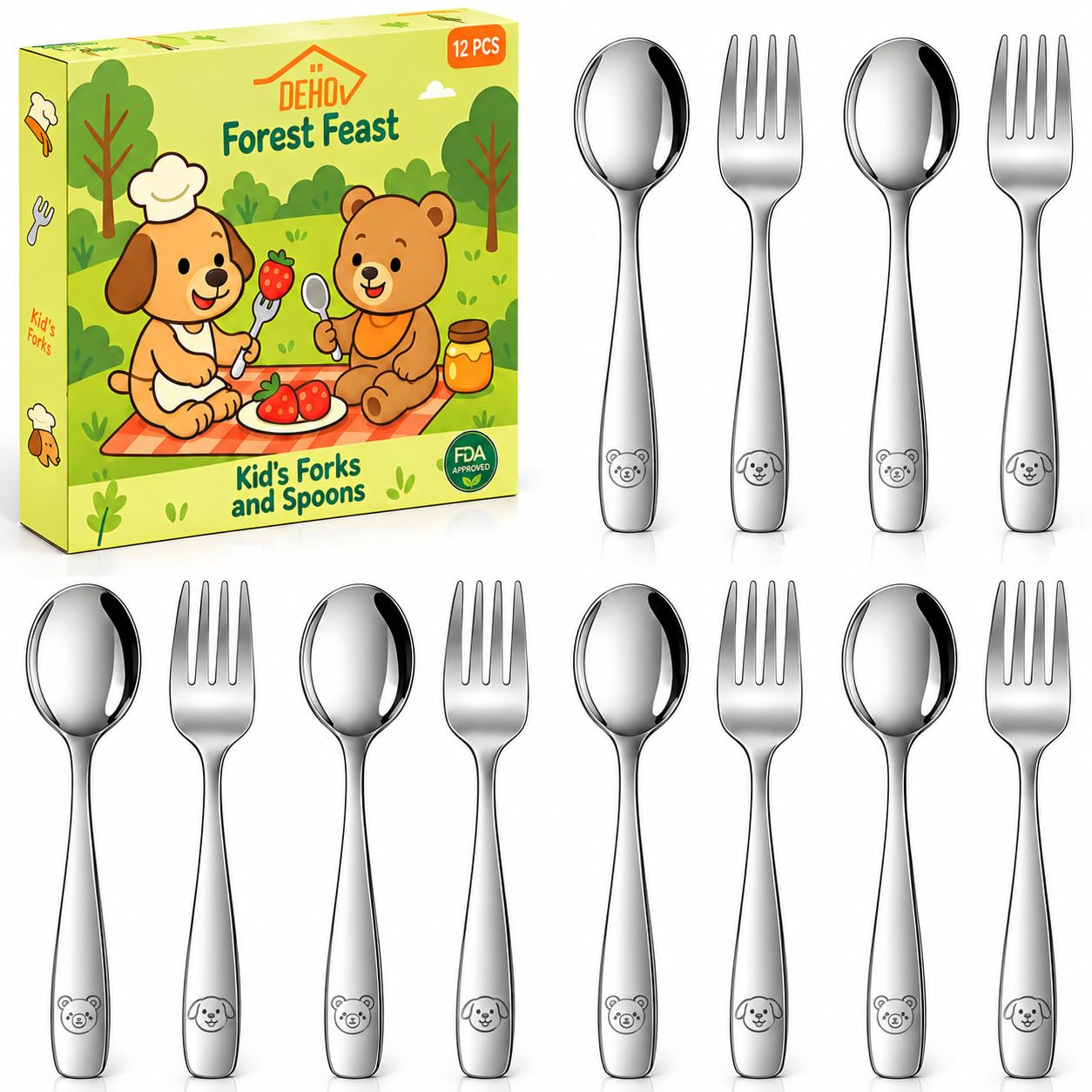
Dehov 12-Piece Utensil Set
Key Features
- Care: Dishwasher safe
- Pieces: 12
- Material: 18/0 stainless steel
- Set includes: 6 forks, 6 spoons
- Price: Budget
Twelve pieces is the whole argument for this set. Six forks and six spoons mean a family with two toddlers can get through a day without hand-washing, and a daycare or grandma’s house can keep a dedicated drawer. The 18/0 stainless is rust-resistant and dishwasher-safe, and the engraved animal handles give small kids something to grip.
The size is the other useful part. These are smaller than adult flatware but more grown-up than chunky toddler plastic, which suits a 3- to 6-year-old who wants to eat like the rest of the table. The metal is sturdy enough to push into denser foods, and the pieces are light enough for a child to carry but do not bend like thin plastic. They come out of the dishwasher clean. The animal engraving is subtle enough that the set does not look like a toy.
We like the set best for older toddlers and preschoolers. The all-metal handles are slicker than silicone when hands are wet, so a 2-year-old still using a fist grip may do better with the Eascrozn set. For a family that wants a big backup drawer, that is a manageable caveat.
Pros
- Twelve pieces for backup capacity
- 18/0 stainless steel construction
- Dishwasher-safe and rust-resistant
- Engraved animal handles add grip
Cons
- Forks can have sharp tines
We like the Dehov set for families that are tired of running out of clean toddler forks: twelve metal pieces, six of each, make backups easy.
Best for Early Self-Feeders
Munchkin Raise Utensils
Key Features
- Care: Top-rack dishwasher safe
- Pieces: 4
- Age range: 12 months and up
- Rest base: Keeps tips off table
- Price: Budget
The Raise set has a raised base on each piece, so the spoon and fork rest with the tip off the table instead of lying flat in whatever is on the tray. The handles are thick without being bulky, and the fork has enough tines to spear soft food. The set is BPA-free and designed for children 12 months and up.
The four-piece count gives you a spare while one is washing, and the shape is easy for a child moving from purees to self-feeding to hold. The raised base also makes the utensils a little more awkward to stack in a drawer, but it is the feature that keeps the eating end clean between bites. The set is easy to clean, and the colors are easy to spot in a drawer.
We reach for the Raise set when we want a utensil that will not roll onto the table, especially for a 12- to 18-month-old who is still learning where to put it down. The blue handles can stain from red sauce, so rinse them soon after a tomato-heavy meal. That is a small cost for a design that solves a daily annoyance.
Pros
- Raised base keeps tips off table
- Thick handles suit small hands
- Four-piece set with spares
- BPA-free plastic construction
Cons
- Top-rack dishwasher only
We reach for the Raise utensils when we want a spoon that will not roll onto the table: the raised base keeps the tip up between bites.
Best for Suction Plate Meals
PandaEar Silicone Plates

Key Features
- Care: Hand wash only
- Pieces: 3
- Material: 100% food-grade silicone
- Set includes: 3 divided plates
- Price: Budget
A suction plate is only as good as the surface under it. The PandaEar plates have a divided top and a suction base, and on a smooth, non-porous highchair tray they hold well enough that a toddler has to work to lift the plate. On a textured or scratched tray, the grip is much less reliable.
The three-section layout is the other useful part. It keeps fruit, pasta, and yogurt from becoming one meal, and the silicone is soft enough that a dropped plate does not clatter. The plates are 100% food-grade silicone and microwave-safe, and the color options are calm enough for a family that does not want a rainbow at every meal.
The suction is the dividing line: on the right tray, these are a practical way to serve three-part meals; on a tray with even a little texture, a determined toddler can peel the plate up. That is why the surface check matters more than the number of suction cups.
We reach for the PandaEar plates when the tray is smooth and the meal has three components; they are a sensible budget set for that job. If your highchair tray is textured, this is not the set to force. Check your tray surface first, and press the plate down firmly before each meal.
Pros
- Three divided sections per plate
- Soft silicone is quiet on the table
- Microwave-safe silicone plates
- Suction base for smooth trays
Cons
- Hand wash only, not dishwasher safe
We use these silicone plates when a toddler is learning not to launch the dish; three divided sections and a suction base suit smooth, flat trays.
Best for Snack Portions
UpwardBaby Bowl Set

Key Features
- Care: Dishwasher safe
- Pieces: 4
- Suction: Built-in base
- Set includes: 3 bowls, 1 spoon
- Price: Budget
The UpwardBaby set is built around small portions: three silicone bowls and a soft-tip spoon, with suction bases meant to keep a snack from sliding across the tray. The bowls are a good size for fruit, yogurt, or hummus, and the silicone is soft enough that a toddler can grip the rim without a hard edge.
The spoon is soft on gums, and the handle is sized for a child’s hand, which makes it a useful first spoon for a toddler who is still learning to load and aim. The bowls are dishwasher-safe and stack neatly, so they do not take over a cabinet. The set is made of food-grade silicone and feels more substantial than a thin plastic bowl.
The suction is not unconditional. It holds best on a smooth, non-porous surface, and on a textured tray or a slightly warped highchair it can release sooner than you want. That is the main condition to check before buying.
We keep the UpwardBaby bowls for snack-size portions and for a child who is just learning to use a spoon. They are not a full meal set, but for yogurt, fruit, and hummus they earn their cabinet space. The soft spoon and small bowls are the reason to choose this over a larger set.
Pros
- Three bowls plus a soft spoon
- Suction bases for smooth trays
- Dishwasher-safe silicone bowls
- Good for snack-size portions
Cons
- Spoon can split with heavy chewing
UpwardBaby’s bowl set is our pick for snack-size portions and soft first spoonfuls; the silicone spoon is gentle, and the bowls suction best on a smooth tray.
How We Chose and Tested Toddler Feeding Sets
We started by reading through thousands of reviews across major retailers and pulling every set that came up again and again, then filtered the shortlist by the things that actually separate one set from another: silicone versus plastic versus stainless steel, suction bases versus flat ones, divided plates versus open ones, and how many pieces a family realistically uses. That left us with 14 sets, which we rotated through six months of real meals.
Every set went through breakfast oatmeal and yogurt, lunch, and dinner at home, plus a handful of meals at a restaurant and at a grandparent’s house to see what traveled well. Each plate, bowl, and cup ran through the dishwasher’s top rack at least 30 times, and we hand-washed anything that came out cloudy or still greasy.
To check suction and stability, we pressed each plate onto a high chair tray, flipped it upside down, and tugged at one corner to see when it let go; we also nudged bowls and cups mid-meal to see whether they rocked or slid. We ran a finger along every fork tine, spoon rim, and plate divider to catch burrs or seams, and dropped plates and cups from tray height onto hardwood to watch for cracks.
For cleaning, we let tomato sauce, peanut butter, and oatmeal dry for an hour before washing to see whether food lifted off or had to be scraped. We handed the utensils to kids between 9 months and 3 years and watched whether they could scoop yogurt without the handle spinning in a fist, and we kept track of which pieces got used daily versus which never left the drawer — the clearest measure of what a set is really worth.
How to Choose a Toddler Feeding Set
A toddler feeding set earns its place when it matches your child’s eating stage and your tolerance for cleanup, not when it has the longest feature list.
Decide How Many Pieces Your Week Actually Needs
A feeding set is a rotation, not a single place setting. Count how many plates, bowls, and utensils you need between dishwasher loads: a family with one toddler and a daily dishwasher can get by with two plates and two bowls, while a daycare-bound child needs more spares. The trap is buying four plates but only two forks, which leaves you hand-washing utensils before the plates run out. We like a set that matches the piece counts across the whole place setting, not just the headline total.
Match the Utensil to the Eating Stage
A 12-month-old needs a short, thick handle and a blunt tip; an 18-month-old can handle a narrower stainless fork; a 3-year-old may want a smaller version of adult flatware. The mouth guard on sets like Eascrozn is there to stop a child from pushing the metal too far in, while the raised rest on the Munchkin Raise keeps the tip off the table between bites. Buy for the stage your child is in now, and expect to add a second set as their grip changes.
Test the Suction Before You Trust It
Suction is a surface property as much as a plate feature. A silicone base holds best on smooth, non-porous plastic, glass, or marble; it can release on a textured or scratched highchair tray. Before buying a suction plate or bowl, press a suction base onto your own tray and see whether it holds. If your tray is textured, a flat plate with a wide base may be more useful than a suction set that promises more than it can deliver on your surface.
Read the Care Label as a Daily-Use Cost
Top-rack-only and hand-wash-only are not fine print; they decide whether a set fits your routine. A plate that must be hand-washed can be fine for one toddler and a nuisance for a family that runs the dishwasher every night. Printed finishes and plastic coatings are the parts to watch: repeated heat and detergent can bubble or peel them. If you want a set to look new after a year, choose dishwasher-safe pieces and follow the rack instructions.
Let the Theme Work for You, Not the Other Way Around
A character or construction theme can be a real mealtime tool for a reluctant eater, but it is not a substitute for a good shape. Look for a divided plate, a bowl with deep sides, and utensils that are comfortable for your child to hold. The First Years Minnie set and the Constructive Eating plate both use theme as encouragement; neither is worth a premium if your child does not care about the design. Pay for the pieces you will use, not the picture on the rim.
Frequently Asked Questions
Can my toddler use adult forks and spoons instead of a toddler set?
Sometimes, but size and shape matter. Adult forks are longer and often sharper, which makes them harder for a 1- or 2-year-old to aim and easier to jab. A small dessert spoon can work for an older 3-year-old, but check the tines and supervise. For a child still using a fist grip, a short toddler utensil with a rounded tip is the safer default.
How do I remove tomato sauce stains from silicone or plastic utensils?
Rinse right after the meal, then wash with dish soap and warm water. For silicone, a paste of baking soda and water can lift many stains; let it sit for a few minutes and scrub gently. Avoid abrasive scouring pads on printed plastic, which can wear the finish. If a stain will not come out, the utensil is still usable unless the surface is cracked or peeling.
When should I replace toddler utensils?
Inspect them regularly rather than following a calendar. Replace any spoon or fork with a cracked handle, loose silicone, bent tines, or a tip that has been chewed rough. For plates and bowls, stop using pieces with bubbling, peeling, or deep scratches. A set that still looks smooth after washing is fine to keep, but a damaged edge is not worth the risk.
Final Verdict
The Munchkin 16-piece set is the one we recommend first for most families because it solves the mix-and-match problem: plates, bowls, cups, and utensils arrive together, and the pieces are sized for 18 months and up. If your toddler needs a character to sit down, the First Years Minnie set is the better mood-maker. If the utensil drawer is always empty, add the Eascrozn six-piece set. Start with the set that matches the stage your child is in now; the extras can wait.
