This post contains affiliate links. We may earn a small commission when you buy through our links — at no extra cost to you.
A nursery looks peaceful in photos: a crib, a glider, a few neatly folded onesies. Then the baby shower gifts arrive, the diaper boxes stack up, and suddenly every surface is covered in things that need a home. Good nursery storage isn’t about making a room look catalog-perfect; it’s about creating a system that lets you find a clean swaddle at 2 a.m. without waking the baby.
Over 10 months, we tested 12 storage pieces—bins, baskets, cube organizers, and small dressers—in real nurseries, not staged showrooms. We filled each one with the usual clutter: diapers, wipes, sleep sacks, books, and the odd collection of teethers. We paid attention to capacity and how well each piece organized a changing table or closet, plus quality, appearance, value, and whether the size worked in tight corners. Stability mattered as soon as a toddler started pulling up, and we kept notes on assembly and missing parts. The picks below are the ones that held up and made the room easier to live in.



Best for One-Station Diapering
PeraBella Diaper Caddy
Key Features
- Footprint: 16"W x 10"D x 7"H
- Compartments: 12, with 3 removable dividers
- Outer pockets: 8
- Stated capacity: 1050 cubic inches
- Price: Midrange
Twelve compartments, eight pockets around the outside, and three dividers you can lift out and reposition: the PeraBella is the most organized caddy in this guide, and the one we reach for when a changing station has to work in more than one room. The long handles are reinforced, so a full load doesn’t dig into your hand on the stairs, and the plush sherpa exterior is soft enough that you won’t mind it sitting out on the couch between changes.
The outside is where it earns the top spot. Eight wide pockets put wipes, a thermometer, diaper bags and a tube of cream on the perimeter while the middle holds the diaper stack and a spare outfit — the difference between a caddy you rummage through and one you can operate one-handed in the dark. A small teddy charm comes in the box, which is a nicer detail than it sounds when the caddy is going to someone else.
It also has a life after diapering. Once the wipes move to the bathroom, the same basket becomes a toy and book tote, and the sherpa-and-canvas look doesn’t announce itself as baby gear the way a printed bin does — a small thing that means you keep using something you already paid for.
Pros
- Eight outer pockets keep wipes and cream in reach
- Twelve compartments with three removable dividers
- Reinforced handles carry a full load between rooms
Cons
- Flexible dividers bow when the middle is packed
Our default nursery buy: twelve compartments and eight outer pockets turn any corner into a working changing station, and the handles make moving it upstairs painless.
Best for Styled Nurseries
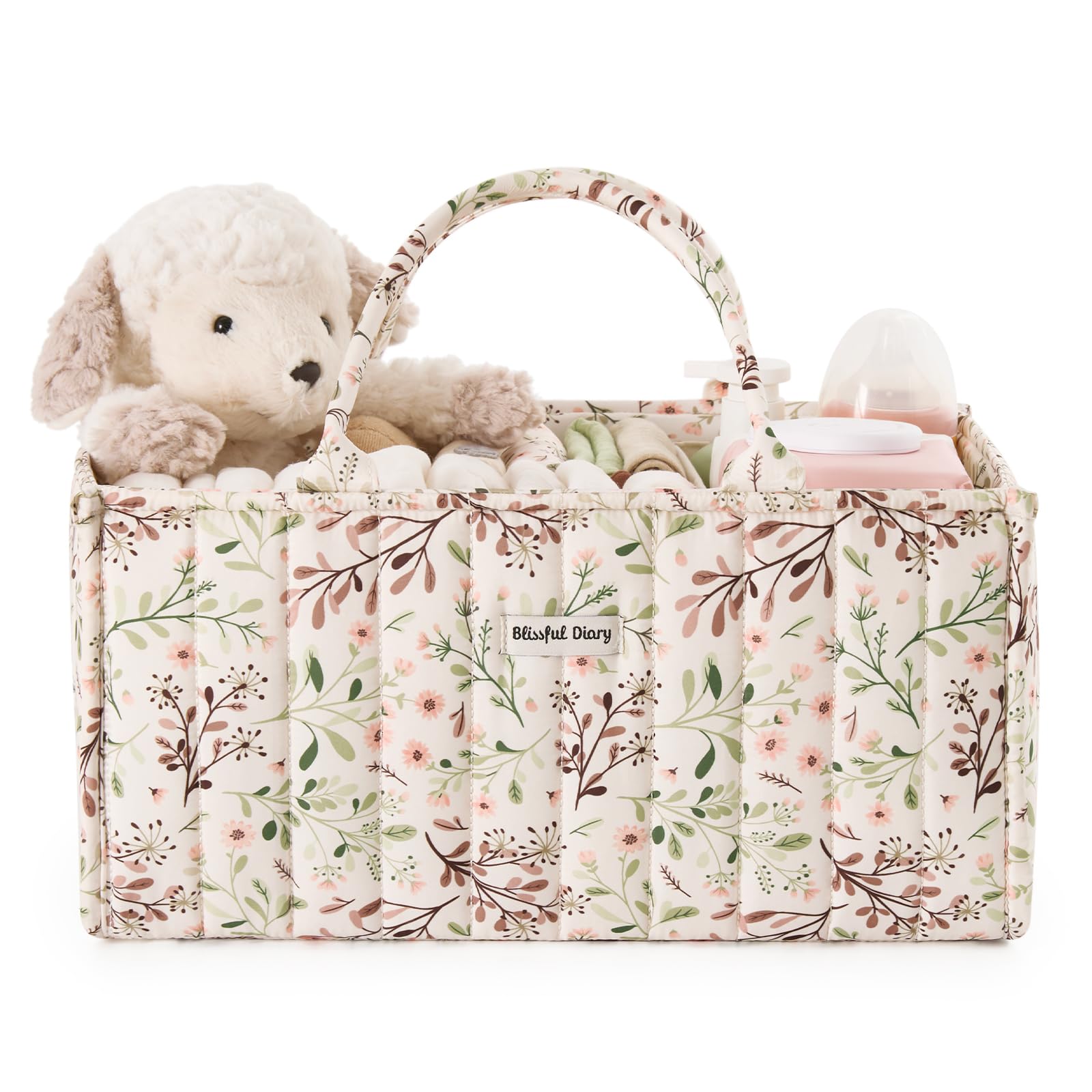
Blissful Diary Floral Caddy
Key Features
- Weight: 16 oz
- Exterior: Polyester, daisy print
- Interior: 2 compartments, removable dividers
- Footprint: 15"W x 10"D x 7"H
- Price: Midrange
Our top pick wins on pockets; this one wins on the shelf. The Blissful Diary is a firm-sided box in a daisy print — 15 inches wide, 10 deep, 7 tall — and it’s the caddy that stays out on the dresser instead of getting tucked into a closet. You’ll look at it several times a day for two years, and this is the one in the guide that’s honestly nice to look at.
What earns it a place beyond the print is the walls. The firm sides are the reason the dividers actually divide: a soft caddy collapses around whatever you put in it and the compartments stop meaning anything, while this one stands up on its own even half full. The dividers lift out, so you can run it as two bays or split it for diapers on one side and clothes on the other.
The gap is the outside. There are no exterior pockets, so wipes, a thermometer and a spare pacifier all live in the main bay, and you’ll be moving a stack of diapers to get at the cream. Two interior bays also means less sorting than the twelve-compartment caddy — fine if you’re carrying a day’s supply rather than the whole dresser.
Pros
- Firm walls stay upright even when half full
- Removable dividers create two workable bays
- Daisy print reads as nursery decor
Cons
- No exterior pockets for wipes or small items
Buy it because you’ll look at it every day: a daisy-print caddy with firm sides that holds a day of diapers, as long as you can live without outer pockets.
Best for Tiny Rooms
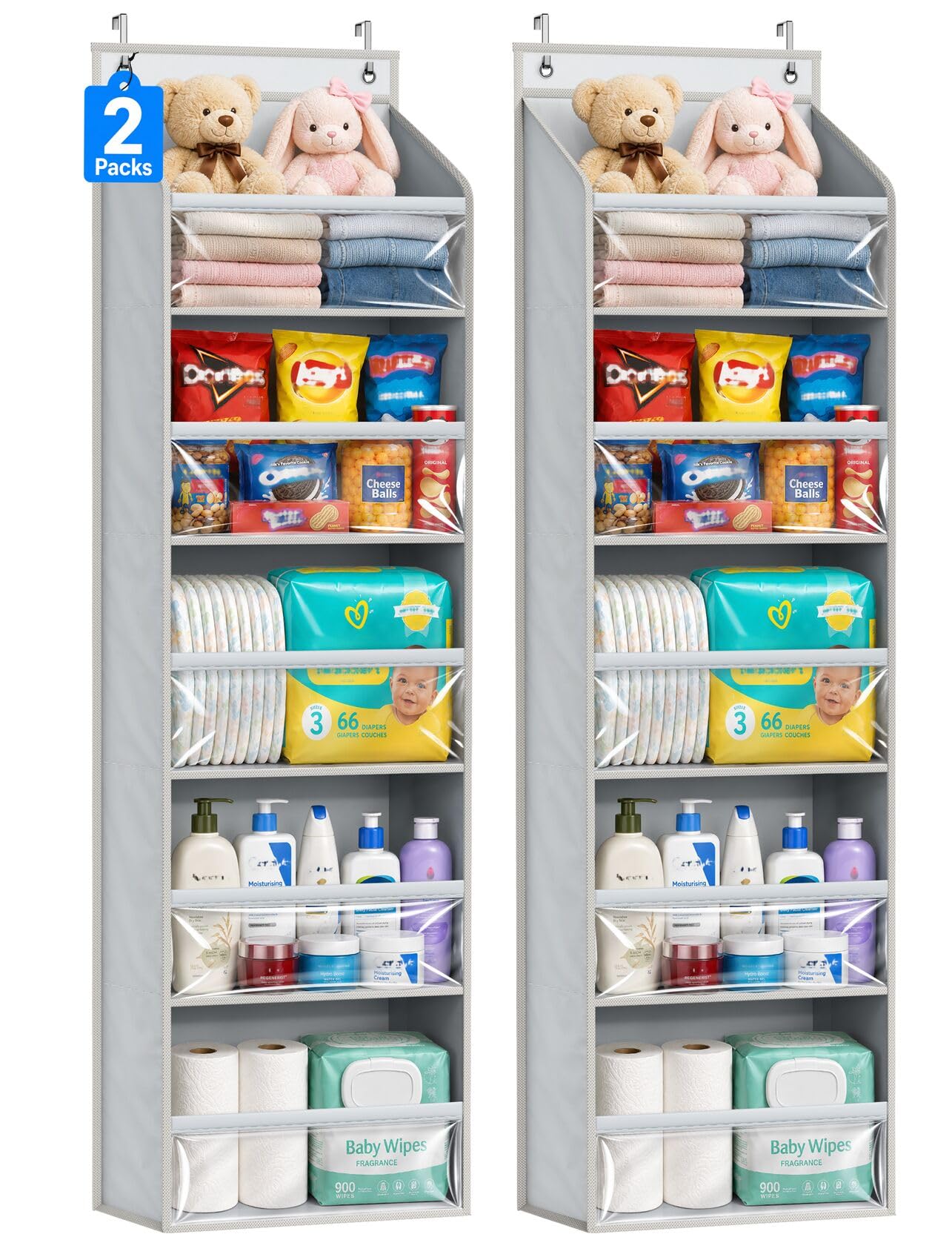
AOODA Over-the-Door Organizer
Key Features
- Shelves: 5 per unit, 2 units
- Shelf gap: 5.9 inches
- Load rating: 34 lb
- Size per unit: 24.4"W x 6.5"D x 53.3"H
- Price: Budget
When the nursery floor is gone, the back of the door is the last storage you own. The AOODA set gives you two over-door organizers, each 24.4 inches wide, 6.5 deep and 53.3 tall, with five shelves and clear front windows so you can see a row of diapers or a stack of onesies without unhooking anything. One goes on the nursery door; the other tends to end up in the bathroom or the pantry, which is the real argument for buying two at once.
The 5.9-inch gap between shelves is the number to look at. It takes a tall bottle, a wipes box, or a pair of toddler shoes standing upright — most pocket organizers are pitched at shoes lying flat and waste half their depth. Oxford fabric over a PP board base holds the shelf shape, and the 34-pound rating covers a serious diaper stock without the unit curling forward.
Loading it takes more thought than it looks. Even weight top to bottom keeps the unit flat against the door; pile all the wipes on the top shelf and it leans away every time the door swings. That’s the whole adjustment period, and it takes about a week to find the arrangement that stays put. Two of these on two doors did more for a cramped nursery than any single piece of furniture in this guide.
Pros
- Two organizers in every pack
- 5.9-inch shelf gaps fit bottles standing up
- Clear fronts show what’s inside at a glance
- 34-pound rating holds a real diaper stock
Cons
- Hooks don’t fit thick or overhanging doors
The pick for a room with no floor left: two five-shelf organizers that turn closet doors into a diaper wall, provided your doors are thin enough for the hooks.
Best for Plushie Overflow
Woodure Stuffed Animal Zoo
Key Features
- Assembly: No tools required
- Material: Pine wood
- Assembled size: 15.7"L x 15.7"W x 53.5"H
- Stated capacity: Over 40 stuffed animals
- Price: Midrange
This is the biggest thing in the guide and the only pick built for one job. A 15.7-inch square of corner and 53.5 inches of pine holds more than 40 stuffed animals between elastic cords — stacked like a zoo, visible, and low enough in the bottom rows that a three-year-old can pull one out and put it back without pulling the whole pile down. If the plush has outgrown every basket in the house, this is the piece that ends the argument.
Assembly needs no tools, which stops sounding like marketing when you’re doing it at nine at night. The uprights and rods go together by hand and the elastic cords do the actual holding; the part worth knowing is that a cord can twist as you string it, and a twisted cord holds its row less neatly. Straighten each one as you go and the animals sit in even lines.
The frame is tall and light, so put a wall anchor in before you fill it. A toddler using a rung as a step is entirely foreseeable, and this isn’t furniture that should be tested that way. The pine is also unfinished, which means it takes paint or a wood marker if the natural look doesn’t suit the room.
Pros
- Holds more than 40 stuffed animals
- No-tool assembly
- Children can reach and re-file their own toys
- Pine frame reads as furniture, not a bin
Cons
- Top row is out of reach for small children
Our pick for a plush mountain: a corner rack that holds 40-plus stuffed animals where a child can reach them, in exchange for one square of floor.
Best for Laundry and Blankets
JMvicyroam 60L Rope Hamper
Key Features
- Care: Machine wash in a laundry bag
- Size: 15"L x 15"W x 20"H
- Volume: 60 liters
- Folded thickness: About 4 inches
- Price: Budget
A week of baby laundry is heavier than it looks, and the handles are what sold us: two thick rope grips woven into the basket rather than stitched on, so they don’t bite into your fingers on the stairs. It’s 20 inches tall and 15 across — 60 liters — which takes roughly a week of baby clothes or three to five thick blankets.
The whole basket goes in the machine. Bag it, run a gentle cycle, air dry, and reshape it while it’s still damp. That’s the part we appreciated most, because a fabric hamper you can only spot-clean starts to hold a smell that nobody warns you about, and this is the only pick here you can launder as a unit.
Expect it to arrive creased. It ships folded, and the folds take a few days of being stuffed full of bedding to relax — fill it immediately rather than letting it sit empty in a corner. The rope is soft enough that a full basket still stands on its own, which is the point of the reinforcement.
It also folds to about four inches thick when empty, and that’s the reason it’s in the guide at all. A hamper is the one piece of nursery storage you’ll still be using in five years; this one can go flat in a closet between loads, or move to the bathroom when the nursery becomes a big-kid room.
Pros
- Whole basket is machine washable
- Woven rope handles carry a full load
- Folds to about four inches when empty
- Holds a week of laundry or five blankets
Cons
- Slumps when less than half full
Our hamper pick: a 60-liter rope basket with handles that hold up on the stairs and the rare ability to be washed whole.
Best for Closet Size Sorting
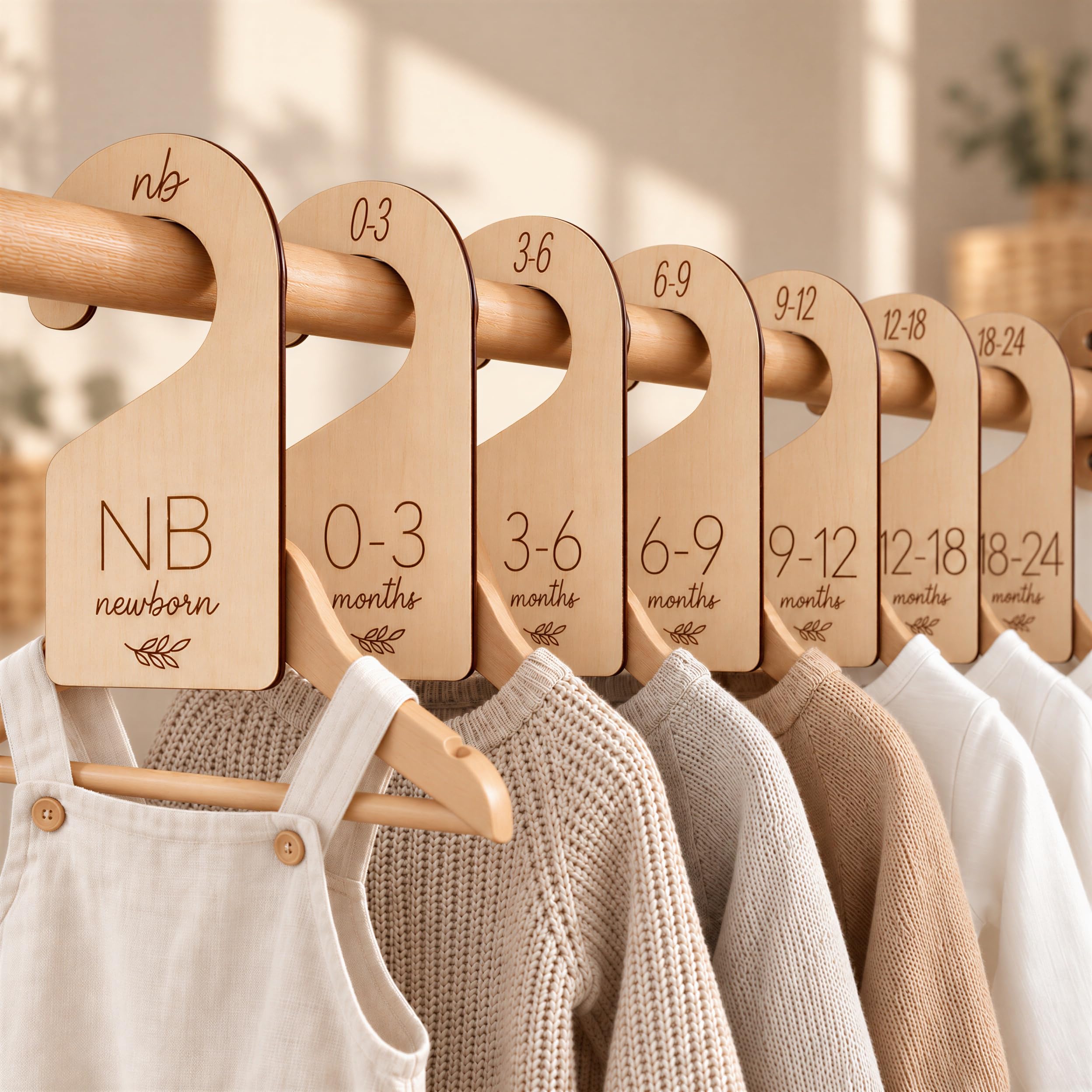
KIBAGA Wooden Closet Dividers
Key Features
- Set: 7 dividers
- Size: 7"L x 3.5"W
- Material: Wood, double-sided
- Size range: Newborn to 24 months
- Price: Budget
A nursery closet is a filing problem before it’s a storage problem. Seven wooden dividers, 7 by 3.5 inches, labeled newborn through 24 months, slide onto the closet rod and turn a rail of tiny clothes into something you can read at a glance — which matters at two in the morning, when you’re hunting a 3-month sleeper in a closet that is somehow mostly 0-3.
The wood is why we chose these over the printed plastic cards that chip and smell of the warehouse for a week. The labels are printed on both faces, so you can read them walking into the closet or reaching past the rail, and a 3.5-inch tab barely registers next to the coats sharing the rod.
There’s no assembly and no footprint, which is more than we can say for most of this guide, and at this size they make a genuinely useful shower gift — a small, flat, unglamorous thing a new parent uses every day for two years and never thinks to buy for themselves.
Pros
- Seven sizes from newborn to 24 months
- Labels read from either side of the rail
- Solid wood, no smell out of the pack
- No assembly and almost no rod space
Cons
- Size range stops at 24 months
The cheapest way to make a nursery closet legible: seven double-sided wooden dividers from newborn to 24 months that you slide on and forget.
Best for Baby Clothes Drawers
Criusia Drawer Organizers

Key Features
- Set: 10 bins, 3 sizes
- Bases: Removable PP boards
- Fabric: Non-woven, odorless
- Height: 4.5 inches
- Price: Budget
The baby shower ends and you’re left with forty tiny garments in four sizes and no idea what’s where. Ten fold-flat bins in three sizes is the fix we reach for first: 4.5 inches high, non-woven fabric over a removable board in the base, each one keeping its walls as you slide it in and out of a drawer.
The sizing is what makes the set work. Small squares take socks, mitts and hats; the long bays take folded sleepers and leggings; and because they’re ten separate pieces, you can lay them out around the drawer you actually own instead of the one in the product photo. When the clothes grow, pull the boards and the whole set folds flat in a cupboard.
They come out of the package with no smell, which sounds like a small thing until you’re putting newborn clothes into something that smells like a warehouse. The fabric is thin — this is a lightweight organizer, not a rigid box — so a bin overstuffed with sleepers will bulge at the sides. Pack loosely and the shape holds.
What the set does better than dividers is containment: a divider keeps a pile in its lane, but a bin lets you lift an entire category out onto the changing table and put it back. For clothes a baby outgrows every few weeks, that’s the difference between a tidy drawer and a sorted one.
Pros
- Ten bins in three sizes
- Bases come out so bins fold flat
- No smell out of the package
- Fits standard dresser drawers at 4.5 inches high
Cons
- Some sets arrive short a base board
Ten fold-flat bins in three sizes make a dresser drawer genuinely sorted, and it’s one of the least expensive ways here to stop hunting for a matching sock.
Best for Corner Plush Storage
mirolam Stuffed Animal Hammock

Key Features
- Size: 41.5"L x 55.2"W x 41.5"H
- Material: Cotton
- Mounting: Wall anchors and hooks included
- Load limit: 10 lb
- Price: Budget
Ten pounds of stuffed animals, off the floor, in a corner you weren’t using. The net stretches 41.5 inches along each wall and 55 inches across the front, hangs from two anchored hooks, and holds a crowd of plush — one of the few things in this guide that adds storage without adding furniture.
Installation is two hooks and the anchors that come in the box, and the net hangs slack until you load it. Pack the big animals along the bottom first; it tightens as the weight comes on and the smaller ones settle on top. What we noticed afterwards was the bed: the pile that used to live on the mattress ended up in the corner, still within reach, and the floor stayed clear enough to cross in the dark.
The net is smaller than the corner in your head. Thirty large plushies will not fit, and the 41.5-inch span is measured along the walls, not across them, so measure the corner and count the animals before you pick a size. If the collection is already out of hand, go up rather than hoping.
Ten pounds is the number that decides it, and a shelf of big bears reaches that faster than you expect. For a moderate collection in a room with a free corner, it’s the cheapest storage here and the least obtrusive — nothing else in this guide disappears into the architecture the way a corner net does.
Pros
- Adds storage with no floor footprint
- Anchors and hooks included
- Cotton net looks handmade, not utility
- Gets plush off the bed and floor
Cons
- 10-pound load limit caps bigger collections
The least obtrusive way to get plush off the floor: a corner net that holds up to ten pounds of stuffed animals and takes no floor at all.
How We Tested Nursery Storage
I started with a shortlist of storage pieces that were actually sized for nurseries—bins and baskets that fit on changing tables or closet shelves, cube organizers, and compact drawer units. I filtered by exterior dimensions, listed capacity, materials, assembly requirements, and price, then cut anything that seemed too flimsy for daily use or too large for a typical nursery corner. That left 12 pieces, which we rotated through real nurseries over 10 months.
Each piece went into the same kinds of spots you’d use it: beside the changing pad, inside a closet, under a window, and next to the glider. We loaded them with diapers, wipes, sleep sacks, books, and toys, then noted how much fit without overflowing and whether we could still find things quickly during a middle-of-the-night change. For quality, we checked seams, joints, drawer glides, and how surfaces held up after weekly wipe-downs; for appearance, we watched whether finishes showed scuffs or looked out of place as the room evolved.
Stability got its own test: we nudged each piece, pulled open drawers and bins, and watched what happened when a toddler used the edge to stand. We measured footprints against tight wall spaces and closet shelves, and we assembled everything ourselves, keeping the hardware bags in view so we’d notice missing parts before the first diaper run. We also compared what each piece cost against how it held up and how much it actually stored, since a beautiful bin that dents in a month isn’t a good value.
How to Choose Nursery Storage
Nursery storage is decided by where a thing lives and who has to reach it, not by how many compartments the listing promises.
Start with the surface, not the container
Everything here is one of four things: something that hangs on a wall, something that hangs over a door, something that stands on the floor, or something that slides into a drawer. Your room picks the category, not the other way around. A corner net needs two usable walls and a solid anchor point; a floor rack needs a 15.7-inch square you can spare; drawer bins need a drawer deep enough for a 4.5-inch wall of fabric.
Measure three things before you shop: the free wall or door width, the depth you can give up, and the height of the person reaching in. The AOODA units are only 6.5 inches deep, which is why they work on a hallway door rather than eating the room.
Match the container to what it holds
A diaper caddy and a dresser drawer are doing different jobs and shouldn’t be judged the same way. The caddy is the day’s working stock — diapers, wipes, cream, one outfit, a burp cloth — and it has to be light enough to carry one-handed and open enough to reach into without looking. The drawer is the warehouse, sorted by size.
That’s why pocket count matters on a caddy and shelf spacing matters on an over-door unit. Eight outer pockets keep the small things out of the main bay; a 5.9-inch shelf gap takes bottles standing upright instead of wasting the depth. Buy the caddy for reach and the bin for volume.
Buy at the height of the person who cleans up
The person who has to put things back is shorter than you. Open bins, a low shelf and the bottom rows of a plush rack all pass the same test: can a two-year-old return something without help? Lidded boxes fail it, and so does anything above about three feet. Storage a child can’t reach becomes storage you maintain.
The flip side is safety. Anything that hangs — nets, over-door straps, organizers — belongs away from the crib and off the wall the crib backs onto, and a tall rack or shelf should be anchored to the wall before it’s filled, not after.
Plan for the end of the phase
Nursery storage either outlives the nursery or it doesn’t, and both are fine if you buy deliberately. Dividers labeled newborn to 24 months are excellent and finished in two years; a caddy becomes a toy tote; a rope hamper moves to the bathroom and keeps working.
Our rule: keep the single-phase pieces cheap — dividers, drawer bins, a wall net — and spend on the ones that convert, because those are the purchases you’re still using when the crib is gone.
Frequently Asked Questions
Is it safe to hang a toy hammock above a crib?
No. Keep nets, cords and over-door straps out of the crib and off the wall the crib backs onto — anything a baby could reach, grab or become tangled in has no place in the sleep space. Hang a hammock in a different corner, using the supplied anchors into framing where you can, at a height an adult can load.
How do I get the creases out of a new rope basket?
Stuff it. Rope baskets ship folded, and a few days packed full of bedding or towels is usually enough to relax the folds. If they linger, follow the care label: bag it, wash on a gentle cycle, air dry, and reshape it by hand while it’s still damp. Fill it as soon as it arrives rather than letting it sit empty, which is when the creases set.
How often does nursery storage need cleaning?
More often than the packaging suggests. A cloth hamper holds odors, so run it through a gentle cycle about once a month; wipe a caddy down weekly, since cream and spit-up get into the seams; and empty and wipe drawer bins each time the baby changes size. If a basket smells when it’s empty, it needs washing.
Final Verdict
If you buy one thing from this guide before the baby arrives, make it the PeraBella caddy. Twelve compartments and eight outer pockets turn any flat surface into a working changing station, and the handles mean the station follows you downstairs.
A room with no floor left should start with the AOODA two-pack instead — two doors, ten shelves, nothing on the carpet. And if the plush pile is already winning, skip both and buy the Woodure rack: it’s the only pick here that gives a child a way to put things back by themselves.
