This post contains affiliate links. We may earn a small commission when you buy through our links — at no extra cost to you.
A water table earns its keep in that stretch of July when the sprinkler has lost its novelty and the kiddie pool has become a leaf trap. It gives a toddler a whole afternoon of pouring, splashing, and negotiating over the same plastic boat, all in four inches of water instead of two feet. What it shouldn’t do is tip the moment a 3-year-old leans on the rim, or take forty minutes and three wrong turns with an Allen wrench to put together.
I spent a full summer with 12 of them, and the pattern was hard to miss. The sturdy ones have wide, splayed legs and seams that actually hold water; the wobbly ones announce themselves the first time a kid leans in. Assembly is where most models lose the morning, with screws that cross-thread and predrilled holes that don’t line up with the parts they’re meant to join. Value, it turns out, shows up in the second summer rather than on the box, so the picks below are the ones I’d buy again.
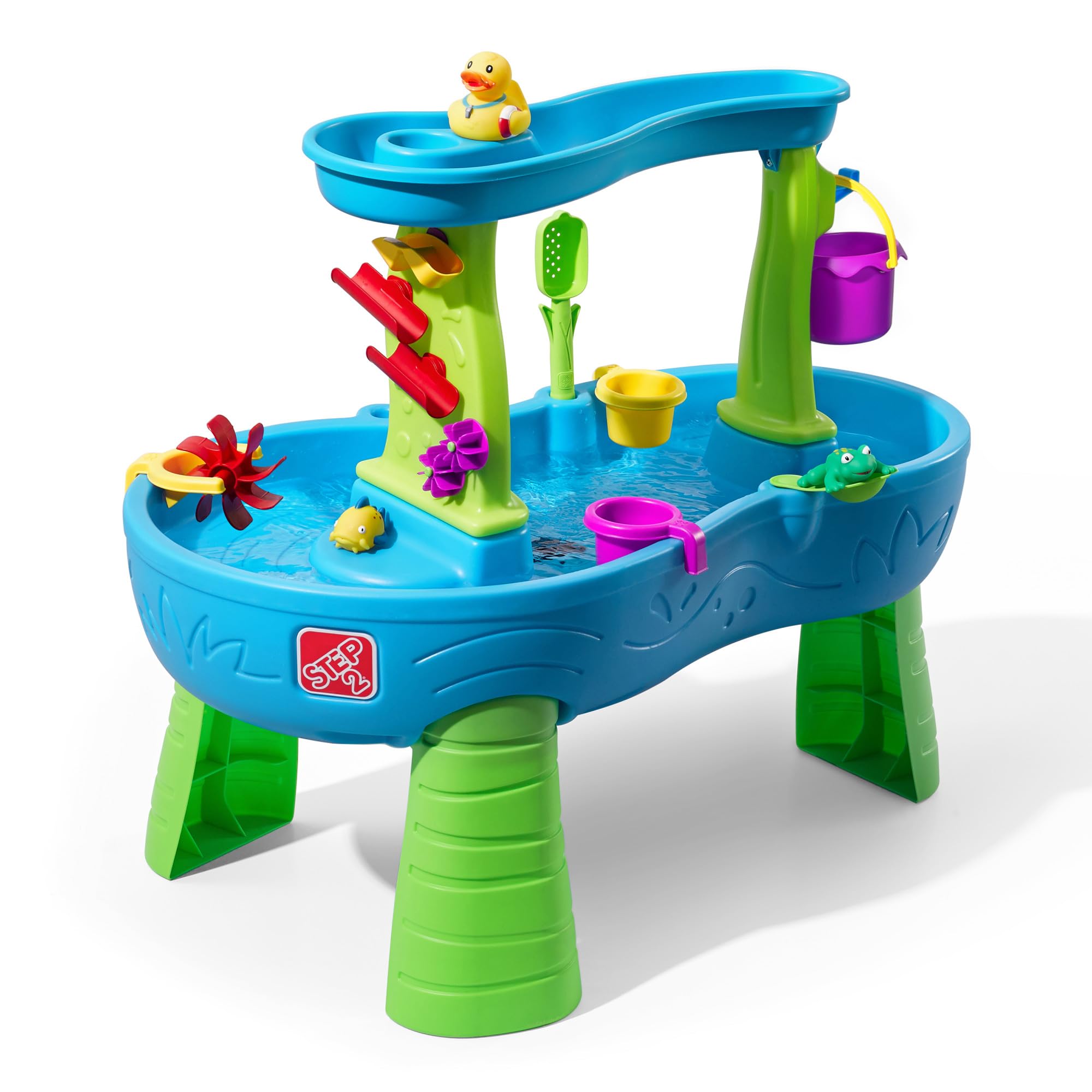


Best for All-Round Water Play
Step2 Rain Showers Splash Pond
Key Features
- Accessory count: 13 pieces
- Recommended age: 18 months – 10 years
- Number of players: 1 – 4
- Assembled dimensions: 39.02 x 24.02 x 32.01 inches
- Price: Premium
The top of this table is a little water machine: scoop from the pond, pour into the waterfall tray, and the maze of spinners, ramps, and buckets starts moving. That cause-and-effect loop is why it earns our top spot. The 13-piece kit gives kids a bucket, cups, squirters, a strainer, a flipper, and rearrangeable maze pieces, so the setup changes without buying anything else.
Room matters, too. The table is rated for one to four players and for ages 18 months to 10 years, which is a wider spread than most of the picks here. We found two toddlers could stand at the basin without elbowing each other out, and the taller waterfall side gave older kids something to reach for. Against the Dino Dig, this one is water-only; against the Magic Flower, it is more about moving water than one big reveal.
Stability is the quiet reason we keep recommending it. The wide base and 6.8-kilogram body feel planted when the basin is full, and the plastic has held up to outdoor play without feeling brittle. Cleanup is straightforward: wipe the parts, pull the drain, and let it dry. The three-year warranty is also reassuring for a toy that lives outside. Keep it on level ground and within arm’s reach; it is stable, but it is not a climbing frame.
Assembly is the one chore. The screw holes are not predrilled, so budget some patience and a screwdriver. Once it is together, though, the table feels solid, and the 13-piece kit is generous enough that we keep the smaller pieces in a bin between sessions. That bin is the only extra we needed.
Pros
- 13-piece cause-and-effect waterfall maze
- Room for up to four players
- Wide 39-inch footprint feels stable
- Three-year limited warranty
Cons
We recommend it for mixed-age groups because the 13-piece waterfall maze gives toddlers and older kids a clear cause-and-effect loop, and the wide basin stays planted.
Best for Sand and Water
Step2 Dino Dig Sand & Water
Key Features
- Sand capacity: 20 lb
- Water capacity: 4 gallons
- Recommended age: 24 – 60 months
- Assembled dimensions: 33.07 x 29.53 x 29.92 inches
- Price: Midrange
The Dino Dig is the pick for the family that wants sand and water in one table. Its basin is split into two sides, so one child can dig while another pours, and the seven-piece set adds dinosaur figures and tools that fit the theme. The listed capacity is 4 gallons of water or 20 pounds of sand, which is enough for real scooping, not just a token puddle.
We liked that the separate sides give the table a longer attention span than a water-only basin. A toddler can move from pouring to burying a dinosaur without leaving the table, and the divided layout gives two kids a natural boundary. The 24-to-60-month age range is narrower than the top pick’s, so this is more of a preschool table than a family table for older kids.
The double-walled plastic and screw-together frame give it a solid feel once the sides are loaded. The trade-off is that the two-part layout is fixed; you cannot turn it into one big water basin for a splash-heavy session. If your child wants to build and dig, that is the right trade. If they mostly want to pour and watch things spin, the Rain Showers gives them more of that action. The three-year warranty matches the top pick’s, which is reassuring for an outdoor toy.
Pros
- Separate sand and water play sides
- Holds 4 gallons of water or 20 pounds of sand
- Seven dino-themed accessories included
- Three-year limited warranty
Cons
We recommend this one when sand matters as much as water: two separate play sides, a 4-gallon or 20-pound capacity, and seven dino-themed tools.
Best for Multi-Kid Play
Little Tikes Magic Flower
Key Features
- Accessory count: 10+ pieces
- Recommended age: 24 months – 6 years
- Number of players: 4
- Built-in activities: 5
- Price: Midrange
The blooming flower is the whole show. Water the center and the petals rise, and we like that it gives the table a clear payoff beyond scooping and splashing. Around it, Little Tikes builds four platforms with five activities, including spinning turtles, a frog fountain, floating ducks, and swimming fish. The 10-plus accessories give kids plenty to move from one platform to another.
We like this one for a patio with several kids because the play is distributed around the table instead of concentrated in one waterfall. Four children can work at different levels, and the flower gives them a shared moment when someone fills it. It is a more social table than the Spiralin’ Seas, and it has more built-in variety than the Rain Showers.
The height is the thing to check. The flower sits above the lower play stations, so a small toddler can use the bottom platforms while an older child works the center. The 24-month age minimum makes sense; a child who is still unsteady on their feet will need help reaching the best part. The four-player rating is optimistic for very small children, but it is realistic for a pair of preschoolers.
Pros
- Blooming flower gives play a payoff
- Four platforms with five activities
- 10-plus accessories included
- Room for four players
Cons
- Assembly can be fussy
We recommend it for a patio with several kids: four platforms, a blooming flower, and 10-plus accessories give everyone a station and a shared centerpiece.
Best for Budget Splash
Little Tikes Spiralin’ Seas
Key Features
- Warranty: 90 days
- Play features: Spiral, Ferris wheel
- Recommended age: 24 months – 6 years
- Number of players: 1
- Price: Budget
This is the lowest-priced table in our group, and the design is built around two simple waterpark tricks: a spiral drop and a turning Ferris wheel. Kids send play pieces down the spiral and watch them circle into the water, or turn the wheel to scoop and release them. It is a narrower idea than the waterfall tables, but it gives a toddler a clear repeatable game.
The round table is light enough to move around the yard, and assembly is simple enough that one person can handle it. The 24-month-to-6-year age range covers the toddler years well. It is not the table for a big group; the play is centered on one spiral and one wheel, so a second child tends to wait rather than find their own station.
We think it is the right first water table for a small patio or a grandparent’s house. It does not have the accessory count or the built-in variety of the Rain Showers, and the 90-day warranty is short. But it gets a toddler pouring, dropping, and chasing water without a big setup. The spiral and wheel are the whole toy; if that loop holds your child’s attention, you do not need to spend more.
Pros
- Lowest-priced pick in this group
- Spiral and Ferris wheel are easy to understand
- Light 12-pound body
Cons
- Drain plug can leak
- Parts can pop off
We recommend it as the budget first table: the spiral and Ferris wheel give toddlers a repeatable game without the footprint or cost of the bigger picks.
Best for Compact Travel
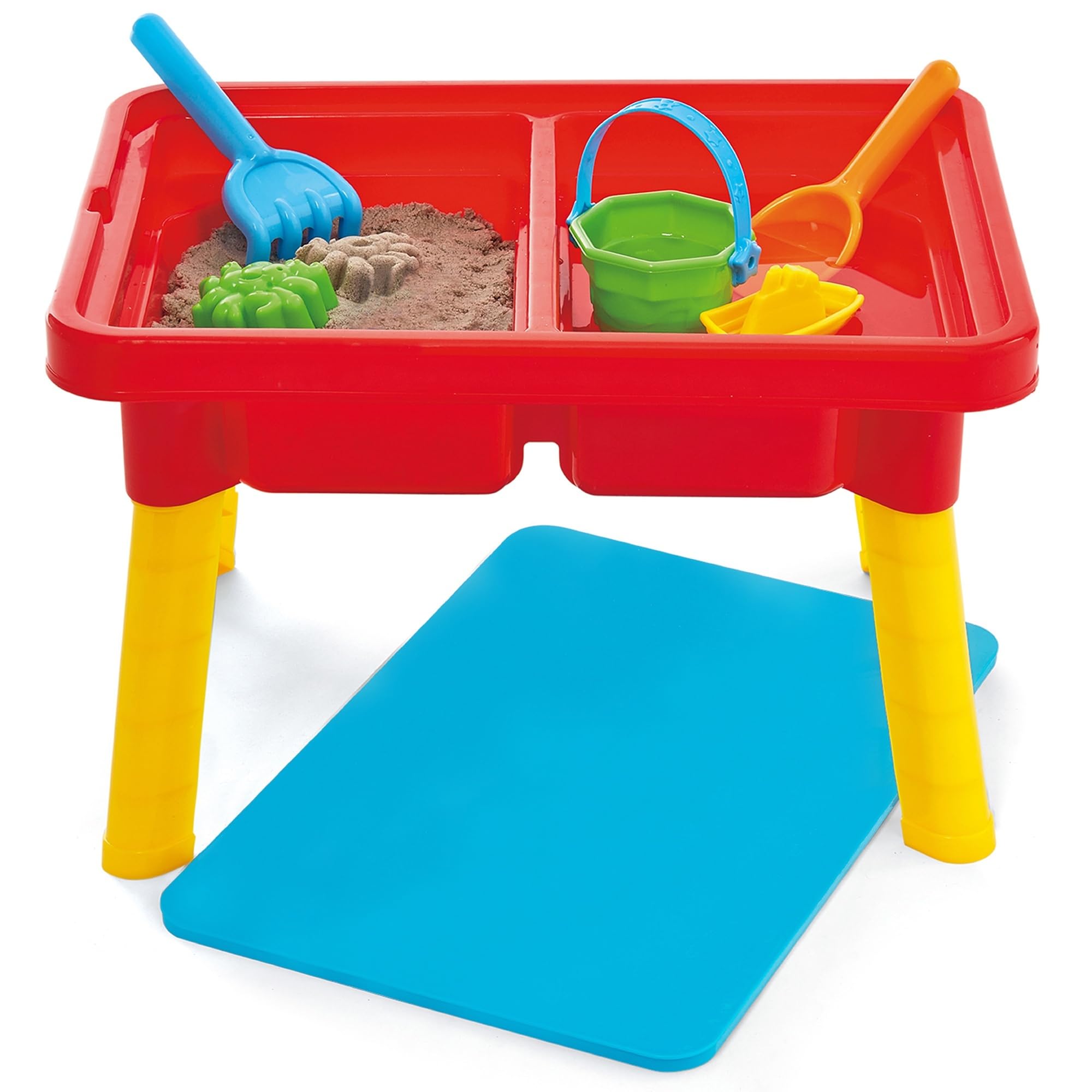
Kidoozie Sand ‘n Splash
Key Features
- Play wells: Two
- Recommended age: 24 months – 8 years
- Assembled dimensions: 17 x 12.5 x 11 inches
- Included accessories: Rake, shovel, bucket, mold, boat
- Price: Budget
The Kidoozie is the smallest table here, and that is the point. It is a two-well sensory tray on removable legs, with a dual-sided lid that covers the compartments and a set of tools for scooping and building. The 17-inch width makes it a toddler station rather than a patio centerpiece.
We like it for travel and small spaces. The legs come off, the lid traps the pieces, and the whole thing is light enough to move from the yard to the trunk without a second trip. The two wells let you keep water on one side and sand on the other, which gives you more variety than a single-well tray.
The size sets the age range. A 2-year-old can stand or kneel at it comfortably; a 4-year-old will be bending over to play, and the 24-month-to-8-year age rating is more optimistic than the table’s height suggests. It is not the table for a tall preschooler or a group. The lid is the detail we appreciate most: it turns the table into a storage box and keeps the next rain from filling the wells.
Pros
- Compact 17-inch tray with removable legs
- Dual wells with a storage lid
- Inexpensive first sensory table
Cons
- Legs can wobble or fall out
We recommend it as a compact first sensory table for a toddler or a travel kit, with the caveat that its small size and light legs suit 1- and 2-year-olds best.
How We Tested the Best Kids Water Tables
We started by reading specs and customer reviews on more than 30 water tables, then filtered for the things that decide whether one gets used or gets stored: a working drain plug, a footprint that fits a normal patio, a height range appropriate for toddlers through early elementary age, and a price that stays in the mid-range. From that list we bought 12 and ran them from May through September.
The testing happened where these things actually live — a small backyard, a concrete patio, and a driveway, with my 1-year-old and 4-year-old plus a rotating cast of neighborhood kids. I assembled each one solo with only the included tools and timed it, noting whether the predrilled holes lined up or needed reaming and whether the instructions matched the parts in the box. Then I filled each to its recommended line and checked the seams and drain plug for drips over the following day, pressed down on the rim the way a kid does when climbing in, and ran a tape along the length and width to see how much room each really took up.
Over four months, the tables stayed outside through sun, rain, and a few hailstorms. I watched for fading, hairline cracks, mildew in the crevices, and legs that went wobbly by August, and I paid attention to which ones the kids went back to without prompting — the strongest signal of whether the accessories and design were worth anything. Draining and refilling happened constantly, which is how the leaky plugs and awkward spouts revealed themselves.
How to Choose a Kids Water Table
The right water table is the one your child can reach comfortably, fill without help, and drain before the water turns into a science experiment.
Choose the play format first
A water-only table like the Rain Showers keeps the basin simple and the action focused on pouring, spinning, and splashing. A sand-and-water table like the Dino Dig gives you two textures and a reason to scoop, but sand travels; the water side will get gritty unless you keep the sides separate. If your child is a builder, the combo earns its cleanup. If your child mostly wants to splash, water-only is easier to live with.
Do not buy a water-only table planning to add sand. The drain and narrow passages are not made for it, and you will spend more time unclogging than playing. We prefer a real divider and a cover if you want both materials.
Measure the footprint and the standing height
Table size is not just about yard space. A wide table like the Rain Showers gives two or three kids room to stand side by side; a compact tray like the Kidoozie is a toddler-sized station that an older child has to bend over to use. Check the play height against your child’s standing height, not just the age on the box.
Compact in a listing can mean small for a 4-year-old, not just easy to store. We check the longest side first and compare it with the patio space you want to give up. If you need to move the table often, leave room to walk around it.
Look closely at assembly, drainage, and stability
Assembly is where water tables earn their complaints. Some require starting screws into plastic with no predrilled holes; that is a one-time job, but it is easier with two people and a proper screwdriver. Drain plugs are the other weak point: a plug that does not seat can leak, so check it before you fill.
Stability matters once the basin is full. A wide base and a heavier body help, while a tall tower on thin legs can wobble. We fill the table halfway first and watch for leaks before committing to a full basin.
Decide how much storage and shade you need
Lids, covers, folding designs, and umbrellas change how much of your patio the table owns. A lid keeps leaves and toys out and can double as a play surface; an umbrella or a shaded spot matters if the table sits in direct sun. Folding or removable legs help if you pack it for camping or store it in a garage.
None of these features replace draining and drying the basin. We treat shade as a placement decision first: if you have no shade, put the table under a tree or awning rather than rely on a small toy umbrella.
Plan for water safety and cleanup
Standing water is the part of water play that needs an adult. We empty the basin after each session, rinse the drain, and store the table where it will not collect rain. A quick wipe of the plastic and accessories keeps the table from turning slimy; a mild household cleaner is enough.
If the table has a drain plug, check that it is seated before filling and open it fully when you are done. A table that drains cleanly is easier to use every day, and that matters more than an extra accessory.
Frequently Asked Questions
Can I use a kids water table indoors?
Yes, if you treat it as a sensory bin rather than a pool. Use a shallow layer of water on a hard floor or a large towel, keep it away from carpet and electronics, and empty it right after play. The Kidoozie’s lid and dual wells make it the easiest of our picks to move inside.
How much water should I put in?
Start shallow, with enough water for scooping and pouring but not to the rim. The Dino Dig lists a 4-gallon capacity, but you do not need to fill it that high for play. A few inches is easier to manage and less likely to slosh over; add more only if the play features need it.
Will a full-size water table fit in my car?
Usually not assembled. A full-size table like the Rain Showers measures about 39 by 24 by 32 inches, so it is a patio piece rather than a back-seat toy. If you need to travel, choose a compact model: the Kidoozie is 17 by 12.5 by 11 inches and its legs come off.
Final Verdict
The Step2 Rain Showers Splash Pond is the table we recommend first because it gives a mixed-age group the most to do without requiring a sandbox setup: a 13-piece waterfall maze, room for four, and a basin that feels planted. If your child wants to dig as much as splash, choose the Dino Dig, with its separate sand and water sides. For a small patio or a first table, the Kidoozie is the compact choice, provided you accept its wobblier legs.