This post contains affiliate links. We may earn a small commission when you buy through our links — at no extra cost to you.
Every summer follows the same script: the kids hit the water at noon, and by 12:40 the float they fought over is limp on the deck, hissing from a seam. I’ve bought the tempting ring by the register before, and it never makes it to August. A pool toy worth buying isn’t the biggest thing on the shelf — it holds air, survives a drag across concrete, fits in the bag you actually carry, and stays fun once the novelty of being wet wears off.
This year my team and I put 18 toys through three months of real summer: backyard pool afternoons, a week at a lake, and one long-suffering inflatable kiddie pool. A rotating crew of neighborhood kids handled most of the field testing. The ones that got grabbed first were rarely the priciest, but they all had a one-way valve, a seam that didn’t need supervising, and enough buoyancy to hold a kid who climbs on sideways. What follows is what still had air in it on Labor Day.


Best for Toddlers and Preschoolers
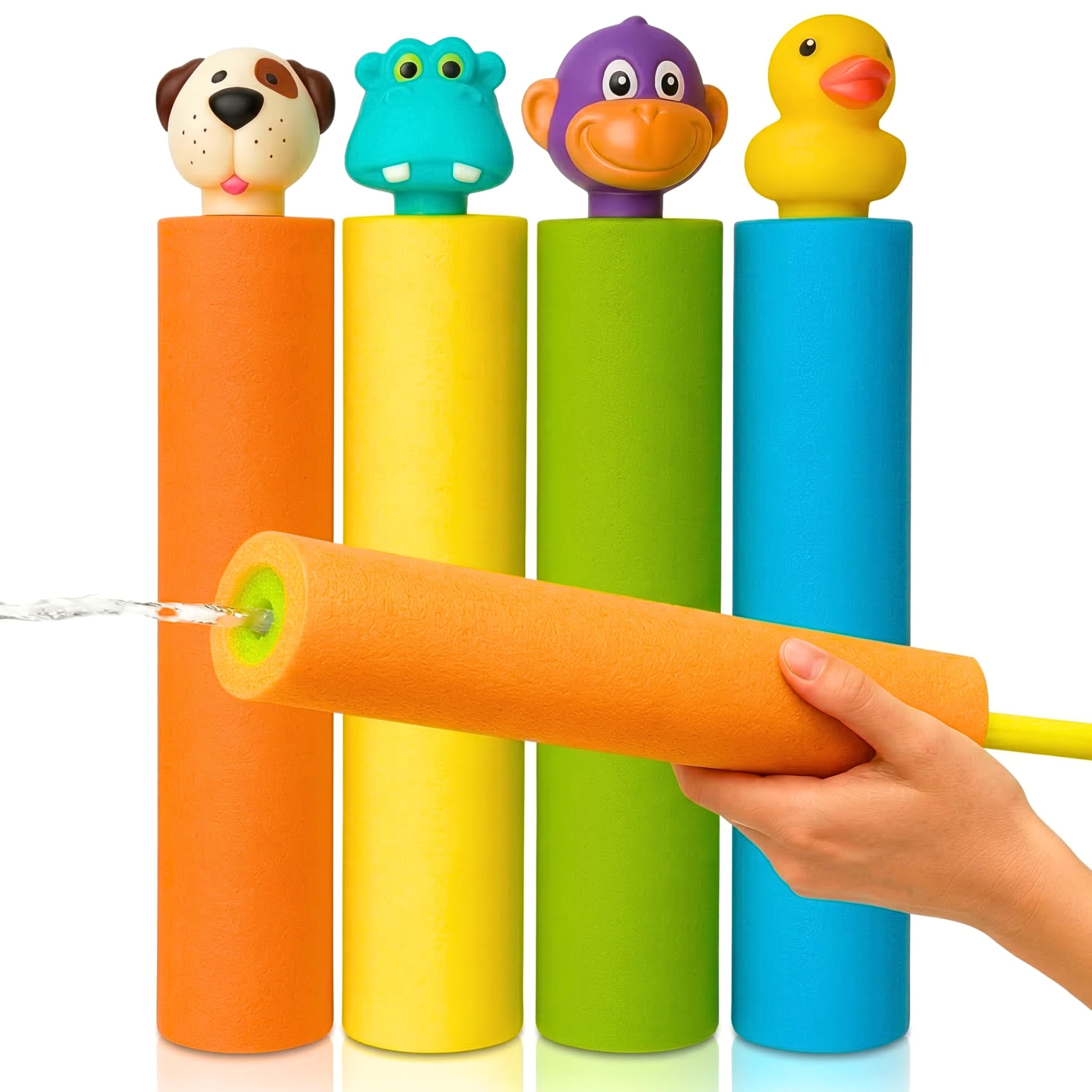
Atlasonix Animal Blasters 4-Pack
Key Features
- Material: PVC
- Maximum range: 30 feet
- Item dimensions: 8 x 4 x 3 inches
- Blasters per set: 4
- Price: Budget
The test that settled this set came early: we handed one to the youngest kid in our group and waited to see whether she needed us. She worked it out at the pool steps and spent the rest of the afternoon reloading on her own. That self-sufficiency is why these four foam blasters are our top pick — a pool toy that needs an adult’s hands stops being fun the moment the adult sits down.
The mechanism is a pull-back handle rather than a trigger: pull to load, push to fire, no pumping and nothing small to lose in the grass. The listed maximum range is 30 feet, which is more than the width of most backyard pools; the useful distance, deck to far side, sits comfortably inside it. The animal heads are genuinely charming, and four colors mean kids can claim one before the argument starts.
Against the noodle-style blasters further down this list, these give up some water per shot and a little range in exchange for being workable by a four-year-old — a trade worth making for the under-six crowd. They’re light enough to vanish into a beach bag, and losing one to the deep end isn’t a tragedy. That’s the set we keep packed for the years when swimming lessons are still happening.
Pros
- Small kids can load and fire unaided
- Four colors, so nobody argues over whose
- Light enough to live in a beach bag
Cons
- Only four blasters per set
The set we hand a three-year-old without hovering: four blasters that fill and fire without adult help, and enough range to be worth aiming.
Best for Backyard Pool Families
GoSports Splash Hoop PRO
Key Features
- Material: HDPE
- Backboard: 34 x 25 inches
- Setup time: 3 minutes
- Rim diameter: 14 inches
- Price: Premium
A 34-inch backboard and a 14-inch rim are why this reads as a real basketball hoop rather than pool furniture. It’s molded plastic rather than inflatable, it sits on the pool edge with the base weighted by water from a garden hose, and assembly is quick by the standards of anything with a backboard — the company claims three minutes, we didn’t clock it, and nothing about the build needed a second adult.
What you’re buying is permanence. This is the one thing here that stays out all summer and gets picked up every day, and it’s the only pick on this list that pulls in teenagers and adults who had no intention of getting in the water. If you have your own pool, it’s the best thing here for turning a swim into a game; if you don’t, it’s a large object with nowhere to live.
The fasteners are the weak point. The screws and anchors holding the pole and backboard together can work loose over a season, so check and tighten them before the first swim and again in late summer. The plastic itself handles sun and chlorine well — that’s the part of this hoop that lasts.
Placement decides how much you use it. Set it where a miss drops into the water rather than onto the patio, and on a flat edge, because a hoop that rocks ruins a close game. The included pump earns its place too: a ball kept firm bounces off the backboard true, while a soft one dies on the rim.
Pros
- Full-size backboard and rim
- Sets up without tools in minutes
- Gets teenagers and adults in the water
Cons
- Needs a pool edge of your own
- Takes up deck space all summer
If your pool has a firm edge and a family that lives on it, this is the upgrade that gets used every single day.
Best for Learning to Dive
SwimWays Mr. Ray Dive and Catch
Key Features
- Includes: Mr. Ray net and fish figures
- Set weight: 5.28 oz
- Figure size: 6 x 0.5 x 1 inches
- Recommended age: 5 years and up
- Price: Midrange
The net is the whole idea, and it’s what turns a handful of sinking plastic into a game. Toss the fish figures in, hand over the net, and a child who can’t yet grab a toy before it drifts can still scoop one up — which means the dive lasts long enough to count as practice. For a swimmer just learning to put their face in the water, this is the pick we reach for before any of the prettier character sets.
It arrives smaller than the photos suggest: the figures are 6 inches long and the net is sized for one small hand. That’s a feature for a four-year-old and a frustration for a seven-year-old who wants a race, so treat it as learn-to-dive kit. The figures also sink at different rates — some drop, some hang just under the surface — which spreads the challenge across a range of ages, whether or not that was the plan.
It’s also the one thing here that survives winter. The figures work in the bath, the whole set weighs five ounces, and it packs into a suitcase without a second thought. Compared with plain dive sticks you’re paying for the net and a character license, and the net is the part that earns the money.
Pros
- The net lets new swimmers succeed
- Works in the bath, beach, and pool
- Packs into a suitcase at five ounces
Cons
- Net is small for scooping several figures
For a kid learning to go under, the net is the difference between a dive and a game they can win.
Best for No-Mess Water Fights
Reusable Magnetic Water Balloons
Key Features
- Diameter: 2.68 inches
- Includes: Storage mesh bag
- Material: Silicone
- Balloons per pack: 12
- Price: Midrange
Anyone who has hosted a water balloon fight knows the second act: a lawn covered in latex scraps that the kids lose interest in long before the yard is clean. Twelve silicone balloons replace the whole ritual. Throw one and the magnetic seam gives, dumping its water on contact; dunk it shut again and it’s loaded.
The filling is what sold us. Open, dunk, shut — a three-year-old can manage the entire sequence, so a kid who can’t yet tie a shoe keeps herself armed all afternoon. The mesh bag matters more than it sounds, because twelve loose silicone balls rolling around a beach bag is a treasure hunt.
Our verdict is that this is the best change you can make to a water fight: the cost moves from per-fight to once, the cleanup disappears, and nothing ends up in the trash by four o’clock. Twelve covers two kids and a parent rather than a whole street, so plan on a second pack if your yard fills up.
Pros
- No latex scraps to pick up
- Toddlers can refill them alone
- One purchase replaces a summer of balloons
Cons
- Hits land softer than latex
Buy it if you’re the one who picks latex scraps out of the grass; it’s the only splash fight here that ends without a cleanup.
Best for Group Pool Battles
Max Liquidator Water Blasters 6-Pack
Key Features
- Set weight: 14.5 oz
- Maximum range: 30 feet
- Recommended age: 6 to 18 years
- Blasters per set: 6
- Price: Midrange
Six is the number that matters. A pack of six means nobody at the party stands on the deck waiting a turn, and the noodle-style body floats when it’s dropped, which it will be. Pull the handle back to load, push it forward to fire — the whole thing is legible to a kid in about a minute.
That pull handle also throws water further than the little animal blasters, and the extra distance is what makes these the right pick for kids who can already swim and want a chase. Our top pick is the set for small hands; this is the set for the seven-to-twelve crowd who want to hit someone on the far side of the pool.
The foam is where they give out. Bodies split and the handle seals weaken, and a pack that lives outside in the sun all summer may not see a second one. Buy it as a season’s worth of afternoons rather than an heirloom, and six kids armed for the summer is money well spent.
Pros
- Six blasters arm a whole playdate
- Longer range than the small sets
- Floats when dropped
Cons
- Shorter than the product photos suggest
Six blasters, one for every kid who turns up: the pack that turns a playdate into two teams.
Best for Pool Parties
JOYIN Fruit Ring Tubes 3-Pack

Key Features
- Material: Vinyl
- Ring diameter: 32 inches
- Rings per set: 3
- Weight capacity: 220 lb
- Price: Budget
Three rings, three fruits, 32 inches across: the watermelon, kiwi and lemon are pool-party dressing as much as pool toys, and a stack of them beside the deck does more for a summer afternoon’s look than anything else here.
Size needs adjusting before you buy. Thirty-two inches and a 220-pound capacity sounds adult, but these suit kids and smaller adults — a big man sits through one rather than floating on it. That’s a specification to read rather than a fault.
What we like most is the arithmetic: three rings, three kids, one purchase. Inflate them the day before you need them, because a few arrive losing air from the first fill, and keep the repair patch in the pool bag so a puncture on the deck doesn’t end the afternoon.
Pros
- Three floats for the price of one
- Bright colors for party photos
- Repair patch included
Cons
- Best for kids and smaller adults
- Some rings lose air from new
Three bright floats for roughly what one serious pool toy costs — the party pick you won’t wince at leaving outside.
Best for Teens and Adults
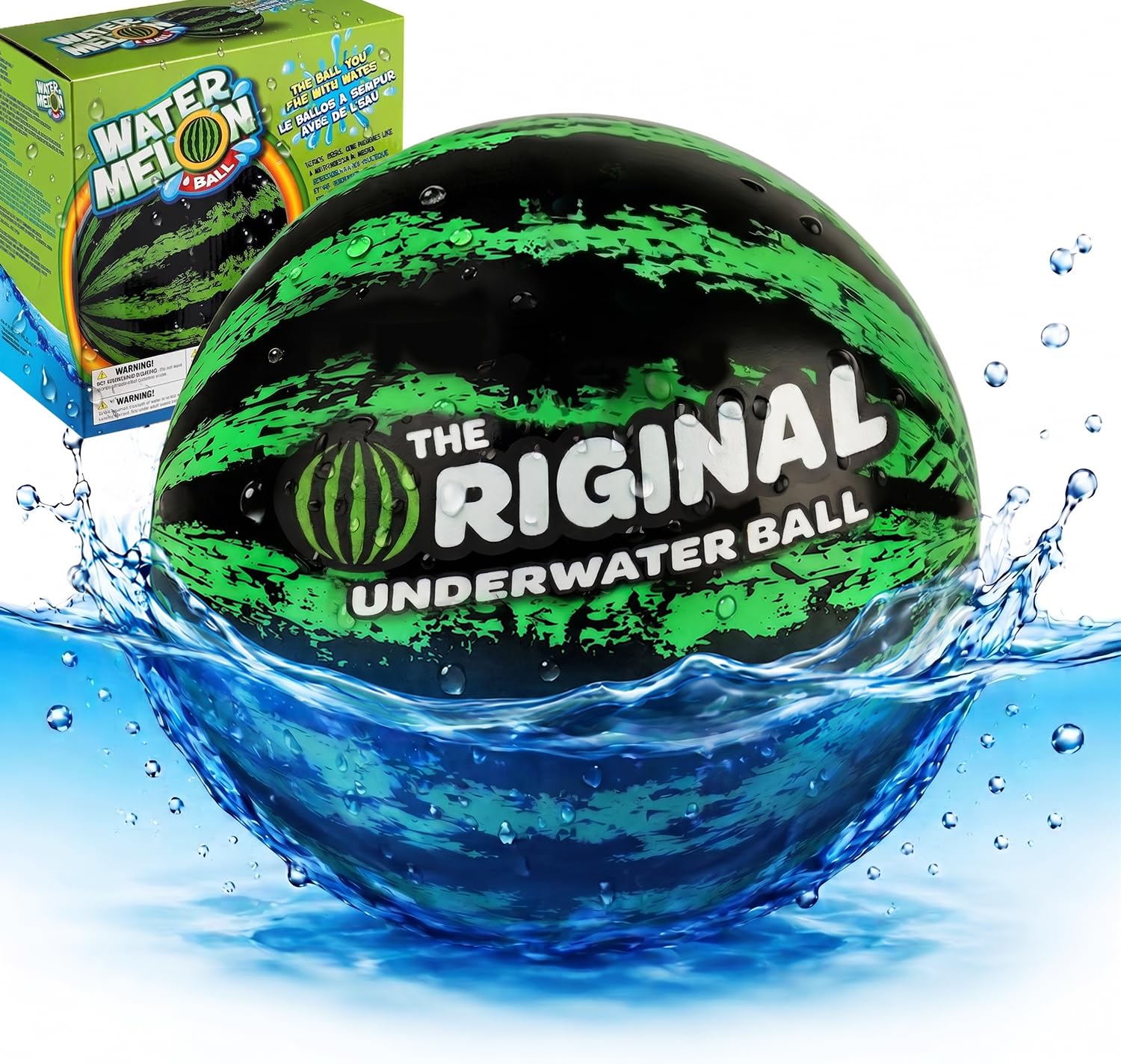
Watermelon Ball
Key Features
- Diameter: 9 inches
- Includes: Ball, hose adaptor, two filling needles, instructions
- Material: Vinyl
- Recommended age: 8 years and up
- Price: Midrange
Fill it from a hose and it becomes the strangest toy on this list: heavy enough to sink, light enough to shove back up, so it can be dribbled across the bottom of the pool and passed underwater. Kids who can swim down to the deep end love it, and they invent games with it that nobody designed.
It’s also the one we handle with a rule attached. Filled, it weighs enough that a direct hit above the surface stings, and a thrown one can hurt a smaller kid. Underwater it’s a completely different object — passed, rolled, shot at a floating hoop — so ours stays below the waterline and the kids take turns fetching it.
Buoyancy is the part to get right. As designed it hangs just under the surface and rises slowly when it’s pushed down, which is what makes underwater passing work; a ball that sits on the bottom and stays there isn’t doing the trick. Follow the included filling instructions exactly and give it time rather than a glance.
This is the teen-and-adult pick, and it gets the biggest reaction from kids already confident in deep water. It isn’t a toddler toy — the listing says eight and up, which is about right. If your swimmer is still in the shallow end, come back to this one in two summers.
Pros
- Underwater passing and dribbling really work
- Draws in teens and adults
- Sturdy once filled
Cons
- Heavy enough to hurt if thrown above water
- Needs a hose to fill
The one here that teens and adults fight over: a ball that hangs under the surface and rewards kids who can already swim down to get it.
Best for Party Favors
JOYIN Beach Balls 12-Pack

Key Features
- Material: PVC
- Ball size: 12-inch half-perimeter
- Balls per pack: 12
- Recommended age: 36 months and up
- Price: Budget
Twelve inches is not twelve inches. The listing measures these at a 12-inch half-perimeter, which is the distance around half the inflated ball; work it through and you land close to eight inches across. That’s why these turn up as toddler-sized balls rather than the beach balls in the photos.
Once you know that, the pack makes sense: twelve small, bright, inexpensive balls for a party, a photo, or a one-year-old who wants to throw something that won’t hurt. They come individually wrapped, which makes them gift-bag filler as much as pool toys.
Inflate them the day before. A share of them go lopsided or lose air straight away, and setting the bad ones aside in the garage is a good deal easier than discovering them at the party with four-year-olds in line.
This is a party supply, not an addition to the toy library, and bought that way twelve of them beat two proper beach balls the kids will fight over. Our advice is to buy it for the event and keep two in the car for the rest of the summer.
Pros
- Twelve balls cover a whole party
- Small enough for toddler hands
- Individually wrapped for favors
Cons
- A few arrive lopsided or leaking
A dozen toddler-sized balls to hand out, lose, and not mourn — buy it for the party, not for the beach bag.
How We Tested 18 Pool Toys Over One Summer
We built the shortlist from retailer bestseller lists, parenting forums, and the pool bags of families we know, then filtered for clear age guidance, a valve that works with a standard hand pump, and a packed size that fits a beach bag. That left 18 toys — rings, dive sets, noodles, and a few inflatable riders — tested over three months in a backyard kiddie pool, a shallow in-ground pool, and on a lake trip where everything got dragged over sand and rocks.
Each toy was inflated firm on day one, then checked daily for a week and weekly after that; we also measured across the widest point with a tape measure to catch the slow leaks a squeeze test misses. Durability got tested the way kids actually treat things — dragged over a concrete patio, sat on by adults, and left inflated in direct sun for hours. We logged seams that started to separate, handles that tore at the weld, and plastic that clouded or cracked, and a toy was out the moment it stopped holding air.
Buoyancy we tested by loading, not eyeballing: an adult pressed each toy under in the shallow end to see how much weight it took before it tipped, and we watched whether a 60-pound kid could climb on from the side without flipping it. Ease of use came down to a stopwatch — time to inflate with a hand pump, breaths required for a lung-powered fill, and whether the valve stayed sealed with the cap off. We weighed each toy packed in a tote and had a 7-year-old haul it from the car to the water. Playability was a tally: which toy got picked first and how long it held attention before it was abandoned on the deck, which is also where value shook out — the winners were still in one piece by Labor Day.
How to Choose Kids Pool Toys
The age on the box tells you less than what the toy does when it hits the water, so start there and work back to the kid you’re buying for.
Start with what it does in the water
Pool toys do one of three jobs: they sink on purpose, they float, or they hold a kid up. Dive figures and the Watermelon Ball belong to the first group; blasters and beach balls to the second; rings and ride-ons to the third. A dive toy that bobs is a broken dive toy, and a blaster that sinks is a lost one.
Decide which job you actually need before you shop. Most families end up with one of each, which is why a good pool bag reads like a kit rather than a single splurge — something to chase, something to throw, and something to lie on.
Age grades are about skill, not birthdays
A 5-and-up label on a dive set usually means the child can swim down and hold their breath, not that they turned five this month. If your kid is still learning to put their face in, a scoop net or a figure that hangs just under the surface lets them practice without the frustration of losing the toy every time.
Foam blasters and small balls work a year or two earlier than the printed age suggests. Buying a summer ahead of the skill is how good toys end up at the bottom of the toy bin.
Inflatable or solid: know what you’re signing up for
Inflatables are cheap, pack flat, and eventually leak at a seam — that’s the deal rather than a flaw in one particular product. Solid dive figures and foam blasters survive the season but can lose an arm, a handle, or a coat of paint.
Buy inflatables in packs so one failure doesn’t end the afternoon, keep the repair patch somewhere you can find it, and inflate anything new a day early so the leakers reveal themselves on your schedule rather than at the party.
Buy for the group you actually host
The pool toy that gets ignored is the one there’s only one of. If your kids regularly swim with cousins or neighbors, count heads and buy packs — four blasters, six blasters, twelve balls — rather than one premium item that starts a queue.
The exception is anything meant to be shared by everyone at once, like a poolside hoop. There, one good one beats three cheap ones, because the game is the point and nobody owns a turn.
Frequently Asked Questions
Can you take pool toys to a public pool or on vacation?
Small dive figures, scoop nets, and hand-held blasters are usually fine, and they pack flat in a suitcase. What gets stopped at the gate is anything big and inflatable — rings, ride-ons, and a poolside basketball hoop all need a pool of your own.
Check the posted rules or call ahead before you pack. A deflated ring that never leaves the car is a wasted pound of luggage.
How do you keep pool toys from going moldy or smelling?
Rinse everything in fresh water, shake it out, and let it dry in the sun before it goes back in the bag. A mesh bag hung on a fence post does the job and takes ten seconds.
Fabric and mesh suffer most — the net on a dive set is the piece that mildews fastest if it’s balled up wet. Chlorine and salt both stay in foam and cloth, so the quick rinse after every swim is the whole trick.
How do you set up a Watermelon Ball?
It ships with a hose adaptor and two filling needles. You fill it from a garden hose, following the included instructions, and it’s ready when it hangs just under the surface rather than bobbing on top.
Do it at home before you leave. It needs a tap and a stretch of time, and a half-filled ball handed over at the pool steps isn’t the toy anyone wanted.
Final Verdict
Start with the Atlasonix blasters. Four of them, workable by a three-year-old, and the toy that gets picked up at the start of every swim rather than the first ten minutes of it. If you have your own pool and the deck space, the GoSports hoop is the upgrade that turns an afternoon into a daily game; if your kid is just learning to go under, buy the Mr. Ray net before anything with a character on it. Everything else here is a good second purchase.
