This post contains affiliate links. We may earn a small commission when you buy through our links — at no extra cost to you.
A bunk bed answers an arithmetic problem — two kids, one bedroom, nowhere to put a second mattress — and creates a new one: someone is now sleeping up in the air, and you’re the one lying awake doing guardrail math. The reassuring part is that height, rails, and ladders are all things you can check before you buy, and the differences between frames stop being subtle the moment you stand in front of one.
Over the past eight months, my team and I built eight bunk beds, some in a shared kids’ room and some in a spare room that doubles as a guest room, with kids from 4 to 13 climbing in and out of them. Two things surprised me. Mattress thickness matters as much as rail height — put a thick pillow-top on the top bunk and a full-length guardrail suddenly clears it by almost nothing. And the ladder gets used less than you’d expect; kids hop and cut corners, which is where the stair-and-drawer models earn their keep.
What follows are the ones that stayed quiet and solid, that took a standard mattress without a fight, and that were worth the hours of assembly. Some lean toward storage, a couple toward looks you won’t want to hide behind a door, and at least one is built for adults as much as kids.



Best for Everyday Kids’ Rooms
Storkcraft Long Horn
Key Features
- Height: 61.3 in
- Weight limit: 225 lb
- Certification: GREENGUARD Gold
- Mattress size: Twin over twin
- Price: Midrange
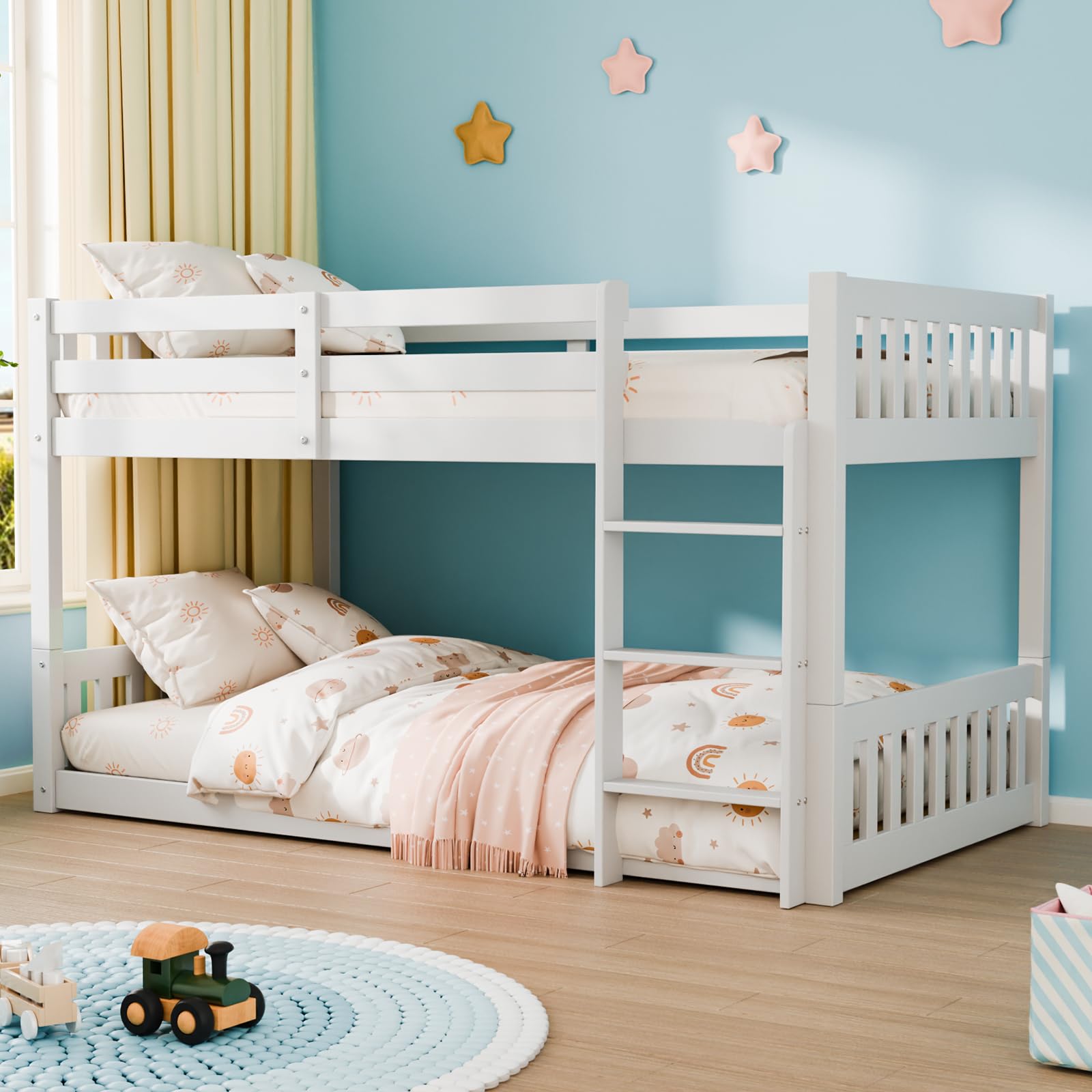
The detail that settled this one for us is printed on the box: GREENGUARD Gold certification. In a small bedroom with the door shut, a frame screened for the volatile organic compounds that make new furniture smell is worth more than a nicer headboard. Set that beside rubberwood solids, a slat base that skips the box spring, and the option to unstack the whole thing into two separate twin beds, and you have the bunk we recommend to most families.
The ladder is the part we came back to. It leans rather than dropping straight down, which gives a small kid a real chance of climbing up unassisted, and the rungs are wide enough for an adult foot when you go up to change the sheets. At 61.3 inches the top rail sits at standard height — low enough to reach, high enough that the bottom bunk has usable space above the floor.
Wood bunks settle. Keep the included wrench somewhere you can find it and go around the bolts after the first week or two, and the frame stays quiet instead of developing the shimmy that makes a bunk feel cheap. The espresso paint is the other thing to know about: it scuffs, and a bed shared by two kids collects scuffs.
The 225-pound weight limit is the number that keeps this a kids’ bed. If an adult will be climbing to the top bunk, or two full-size teenagers need to sleep here, the metal frames further down this list do that job better. For everyone else, this is the one that keeps earning its place as the kids grow.
Pros
- GREENGUARD Gold certified for kids’ rooms
- Converts into two separate twin beds
- Angled ladder is easier for small kids
- No box spring required
Cons
- 225-pound limit is low for adults
- Painted espresso finish scuffs
The one we recommend to most families: solid wood, GREENGUARD Gold certified, and it splits into two twin beds when your kids want their own rooms.
Best for Low Ceilings
JOYMOR Low Twin Bunk
Key Features
- Height: 47.64 in
- Weight limit: 264.5 lb
- Mattress size: Twin over twin
- Guardrail height: 11 in
- Price: Midrange
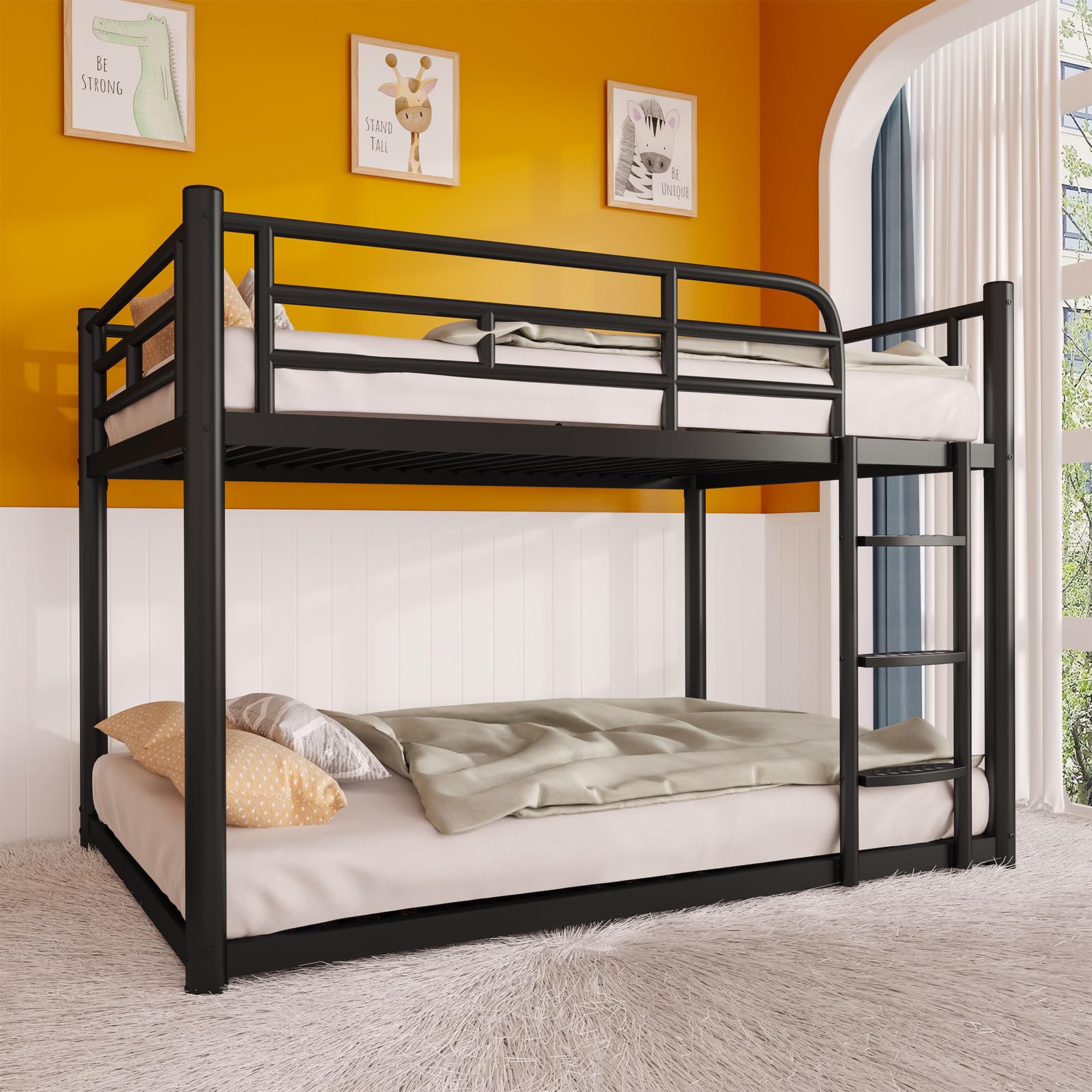
Forty-seven inches is the whole argument. The top rail sits at roughly shoulder height on an average adult, so you can change the sheets without a step stool, a nervous four-year-old can be talked onto the ladder, and a ceiling fan stops being a reason to rule out a bunk bed at all.
The frame is solid pine with hardwood slats, rated to 264.5 pounds, and the ladder bolts to either end so it doesn’t have to fight the door swing. Guardrails run the full length at 11 inches, which we think is generous for a bed this low — the rail is doing more work here than on a tall frame, because nobody is falling far.
We point families with kids under eight here before any full-height bunk, and the trade-offs come with that low profile: there’s almost no space underneath for bins, and a wood frame this size still moves when a nine-year-old launches onto the top bunk. Put a wall strap on it and plan a second tightening pass, and it settles down.
Pros
- Low 47.6-inch frame suits low ceilings
- Reversible ladder fits either end
- Full-length 11-inch guardrails
- Solid pine with hardwood slats
Cons
- Almost no storage space underneath
- Needs a 4- to 6-inch mattress
The bunk we point to for a low ceiling or a kid who isn’t ready for a full-height climb, with a top rail you can reach without a stool.
Best for Teens and Adults
Mixcous Twin XL Over Queen
Key Features
- Height: 65.6 in
- Ladder: EVA-padded steps
- Weight limits: 400 lb top, 600 lb bottom
- Mattress sizes: Twin XL over queen
- Price: Midrange
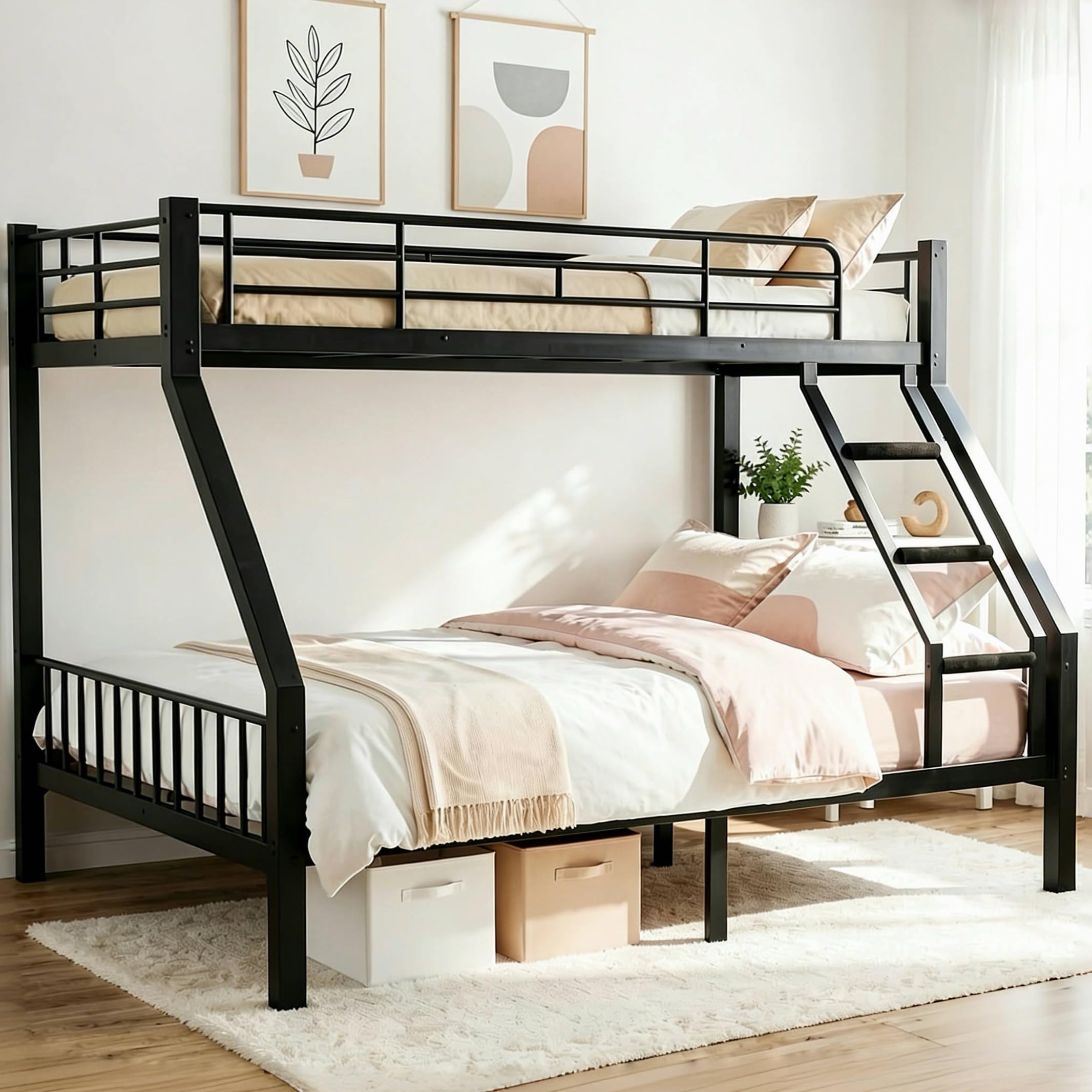
Twin-over-twin bunks stop working the year a teenager’s feet hang off the end of the mattress. This frame solves that with a five-inch-longer twin XL on top and a queen underneath, and the bottom bunk’s 600-pound limit is the most generous here by a wide margin.
It is a large piece of furniture — 82.7 inches long and 63 inches wide — so it wants the wall space of a real bed rather than the corner of a nursery, and we think that space is well spent. The bottom bunk is a genuine adult bed, the angled ladder has EVA-padded steps that don’t bite bare feet on a nighttime trip, and the slats fasten down rather than resting loose in brackets.
For a guest room, a tall teenager, or an adult moving back into a family house, this is the shape that works, and the 88-pound frame is manageable for two people to carry upstairs. Budget for two mattresses in two different sizes, and treat the top bunk as a bed for one rather than a shared one.
Pros
- Queen bottom bunk rated to 600 pounds
- Twin XL top fits taller sleepers
- Padded angled ladder steps
- Slats fasten down to limit squeaks
Cons
- Requires mattresses in two different sizes
- 63-inch width needs a real wall
The bunk we recommend when a teenager or an adult sleeps in the room, with a queen bottom rated to 600 pounds and a twin XL up top.
Best for Two Big Sleepers
AUEYTVR Full Over Full
Key Features
- Slats: 20 metal slats per bunk
- Height: 65.35 in
- Mattress size: Full over full
- Guardrail height: 10 in
- Price: Midrange
A full-over-full changes who can sleep over. Two full-size mattresses mean a teenager, an adult guest, or two little kids sharing the bottom bunk, and it’s the configuration to choose when the bunk has to keep working well past elementary school.
We like what’s underneath the mattresses most. Twenty metal slats per bunk do the support work without a box spring, the 70-pound frame is light enough for two people to walk upstairs, and the whole thing sits at 65.35 inches — standard height, not a tower. Assembly is one of the easier jobs in this group, and the black finish looks like the listing photos.
The guardrail is the thing to plan around. Ten inches of rail is the shortest here, and a deep mattress eats most of it, so keep the top mattress thin. A pillow-top up there leaves very little between a sleeper and the floor, and the rail stops being the reason anyone stays in.
Pros
- Full-size bunks for teens and guests
- 20 metal slats per bunk
- Manageable 70-pound frame
- Standard 65-inch height
Cons
- Short 10-inch guardrail limits mattress depth
Two full-size bunks for a family that needs the beds to last through the teenage years, at a price that undercuts the wood frames here.
Best for Budget Metal Build
Karl home Metal Twin
Key Features
- Weight limit: 400 lb
- Mattress size: Twin over twin
- Guardrail height: 13 in
- Under-bed clearance: 10.4 in
- Price: Budget
Flat-pack metal bunks live or die on their paperwork, and this one is mostly there: parts arrive labeled, the tools come in the box, and the diagrams are the weak link. Read the whole sheet before you sort the rails, because the left and right sides look nearly identical. Get past that and you have the value pick among the plain metal twins here — 13-inch guardrails, 18 steel slats per bunk, and a 400-pound limit.
The proportions are what make it work in a shared room. There’s 10.4 inches of clearance under the bottom bunk for bins and shoes, the built-in ladder keeps the footprint narrow, and the white powder coat reads calmer than the black frames in this group. The maker recommends a 5- to 8-inch mattress, which is the thickness to buy.
One thing we insist on: anchor it to the wall. A metal bunk this tall moves when a kid swings onto the ladder, and the strap is what turns a shaker into a bed you stop thinking about. It’s a kids’ and young teens’ bed — the 400-pound figure is the frame’s ceiling, not an invitation for adults to move in.
Pros
- 13-inch guardrails on the upper bunk
- 10.4 inches of under-bed clearance
- Labeled parts and tools included
- White finish suits a shared room
Cons
- Instructions are the weak point
Our pick when the budget is tight and the room is small: a white metal twin-over-twin with tall rails and real under-bed clearance.
Best for Young Climbers
GIANTEX Wood Floor Bunk
Key Features
- Access: 3-step storage stairs
- Height: 50.5 in
- Weight limit: 200 lb
- Mattress size: Twin over twin
- Price: Premium
This is the most expensive bed in this guide, and what the money buys is a staircase. Three steps with storage built into them replace the ladder entirely, which is the biggest single difference between this bunk and every other one here.
It matters more than it sounds. A four-year-old can walk up flat treads holding a stuffed animal; a ladder asks for both hands and some nerve at bedtime. The frame sits low at 50.5 inches, the guardrails run the full length at 12.5 inches, and the top bunk stays within arm’s reach when you’re changing sheets.
The 200-pound limit is the lowest here, and that settles who this bed is for: children, not teenagers and not adults. It arrives in two boxes, the build takes most of an afternoon, and the storage in the staircase swallows the books and toys that would otherwise live on the floor.
We think the staircase earns its premium in a house with a preschooler and a tight bedroom, where the ladder is the piece of bunk-bed ownership that goes wrong. If your kids are past eight, a metal frame does the same job for less money and the stairs stop being worth paying for.
Pros
- Staircase with built-in storage
- Low 50.5-inch frame
- 12.5-inch full-length guardrails
- Solid wood construction
Cons
- 200-pound limit rules out teenagers
- Premium price for a kids-only bed
Worth the money if a preschooler needs to get up and down alone: the staircase and low frame remove the part of bunk beds that goes wrong at night.
Best for Playful Small Kids
VIAGDO House Bunk
Key Features
- Height: 78 in
- Storage: 3 drawers, 2 shelves
- Weight limit: 400 lb
- Mattress size: Twin over twin
- Price: Budget
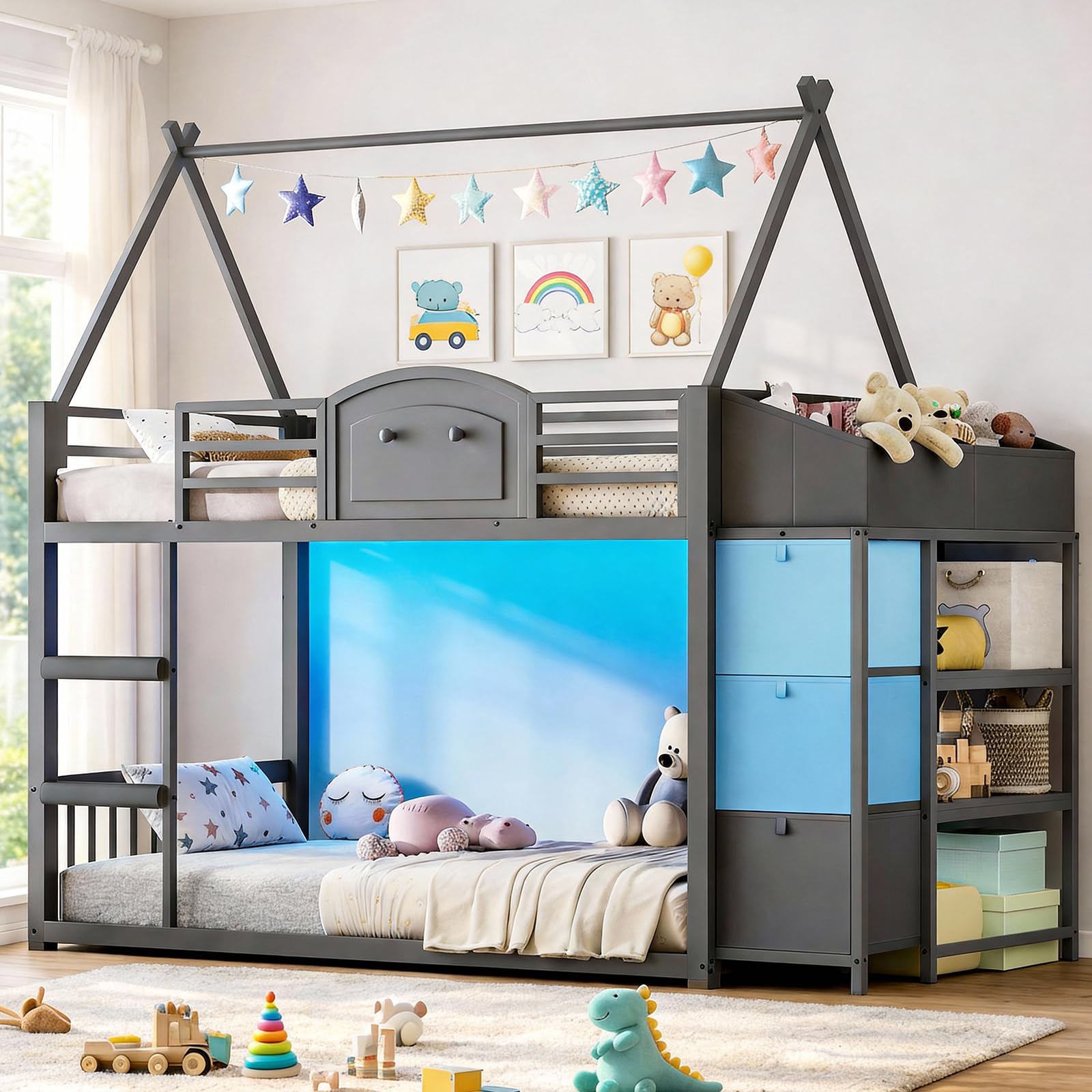
The roof is the point. Kids hang lights and paper garlands from it, drape a sheet over it, and treat the top bunk as a room of their own — which matters if you’re asking two kids to share one bedroom and want the bed to feel like a reward instead of a compromise.
Underneath the shape it’s more practical than it looks: three fabric drawers in a color fade, a two-tier shelf at one end, and an LED strip that syncs to music. The stairs have flat treads, the bunks sit low, and the frame is rated to 400 pounds — details we didn’t expect from a bed shaped like a house.
Measure the wall before you order. The staircase pushes the footprint to 90.4 inches long, the longest here, and the roof takes the overall height to 78 inches, so this is not the bed for a sloped ceiling, a dormer, or a ceiling fan.
We like it best for four- to eight-year-olds who will actually use the shelves and climb the stairs instead of swinging off a ladder. It’s the least expensive bunk here, and the design is doing the work rather than the hardware — treat it as a first bunk bed, not the one your kids take to college.
Pros
- House roof kids can decorate
- Stairs instead of a ladder
- Three drawers and two shelves
- LED strip with music sync
Cons
- Long 90.4-inch footprint needs wall space
- 78-inch roof needs ceiling clearance
The one we point to for young kids sharing a room, where a house-shaped frame with stairs and drawers does more for bedtime than expensive hardware.
Best for Rooms without Closets
BTHFST Low Bunk with Storage

Key Features
- Storage: 6 drawers, 2 shelves
- Lighting: RGB LED strip
- Weight limit: 440 lb
- Mattress size: Twin over twin
- Price: Budget
Six drawers and two shelves is a lot of storage to build into a bunk, and it is the reason to look at this one. The drawers sit under the bottom bunk, the shelves stack at one end, and the storage can go on either side, so the bed works with the door and the closet rather than against them.
The rest is a low metal twin-over-twin: a 48.5-inch top rail, a 13.8-inch guardrail, a 440-pound limit, and slats that keep the mattresses up without a box spring. The LED strip runs to a claimed 60,000 colors and syncs to music — a feature kids lobby for and parents tolerate.
We recommend it where storage is the problem the bunk is meant to solve and the kids are young. Assembly is where it asks for patience: the pieces are numbered, but holes and locking hardware don’t always line up first time, so leave every bolt loose until the frame is square, then tighten from the middle out.
The 440-pound limit is the highest of the low bunks here, which means it takes two teenagers where a wood low bunk would not, and the frame is rated for it rather than merely surviving it. It’s the least charming bed in this guide and the one that does two jobs.
Pros
- Six drawers and two shelves
- 440-pound weight limit
- Low 48.5-inch frame
- Storage fits on either side
Cons
- Drawers take floor space a plain bunk leaves
Our pick when the room has no closet: six drawers and two shelves built into a low twin-over-twin that also carries a 440-pound rating.
How We Tested the Best Bunk Beds
We started with every bunk bed we could find that published a real weight capacity, shipped with a full-length guardrail, and came in more than one mattress size, then read through the reviews for the complaints that repeat: wobble, stripped bolts, splintered edges, ladders that sit too far from the frame. That pool got cut to eight frames across wood and metal, low-profile and standard height, ladder and staircase, storage and no storage.
Assembly came first. Two adults built each bed, timed it, and noted exactly where the instructions lost us — unlabeled hardware bags, a step that skips a page, a ladder mount that only makes sense after you’ve done it wrong once. We checked every bolt on day one, at month three, and at month eight, and recorded which frames had worked loose or started to squeak when a 60-pound kid flopped onto the top bunk.
Then we lived with them. Kids from 4 to 13 climbed up and down for eight months, through sleepovers, sick days, and the occasional unauthorized wrestling match. We measured how far each guardrail sat above an 8-inch mattress, checked the gap between mattress and frame in every size we tested (twin, twin XL, full, queen), and shook each frame hard from the corner to see what shifted. Under-bed drawers got loaded with toys and books, the stairs got walked barefoot, and the built-in lights got switched on and off in the dark to find out whether they were genuinely useful or just decoration.
Finally, value and appearance: we compared what the higher prices actually bought — thicker posts, better hardware, storage that doesn’t sag — and inspected the paint and finish at the ladder and along the rails for chips and scuffs after eight months of being climbed on. The frames that were still tight and still looked presentable are the ones that made the list.
How to Choose a Bunk Bed
The decision that matters most isn’t wood versus metal — it’s how high the top bunk sits and how a kid gets up there.
Height and Ceiling Clearance
The frames here fall into three bands: low bunks at 47 to 51 inches, standard frames at 61 to 66, and one house-shaped outlier at 78. A low bunk is the easier sell for a young kid, the only sensible choice under a sloped ceiling or a fan, and far easier to make. A standard-height frame gives you usable floor underneath — about ten inches on the metal models that list it — and reads as a bigger kid’s bed.
Whichever you pick, add the mattress depth to the frame height, then add the height of a child sitting up. Measuring the frame and forgetting the ceiling is the mistake we see most.
Ladders, Stairs, and the Space They Need
A ladder is compact; a staircase is safer for a four-year-old and much longer. The stair models here run 90 to 94.5 inches front to back, against 77 to 83 for the ladder frames, so a stair bunk needs a wall that can take it. It also won’t turn a hallway corner once it’s built, so assemble it in the room it will live in.
If the room is tight, wide angled ladder rungs are a better compromise than a staircase wedged against a dresser.
Match the Mattress to the Sleeper
Twin bunks suit kids; twin XL and full bunks are what teenagers and adult guests need; a queen bottom turns a bunk into something a couple can use. Thickness matters as much as size, because the guardrail is measured from the frame: the beds here recommend anything from 4 to 8 inches, and a deep pillow-top on a 10-inch rail leaves very little between a sleeper and the floor.
Buy the mattress with the bed rather than after it. A frame chosen around a mattress you already own beats one you have to re-outfit.
Weight Limits and Wall Anchoring
Every bunk here prints a limit, and the range is wide: 200 pounds on the wood floor bunk, 400 to 440 on most metal frames, 600 on the queen bottom of our adult pick. Read that number as the bed’s ceiling, not a target — a 200-pound frame is a kids’ bed however solid it feels on the first night.
Then anchor it. A tall metal frame moves when a kid swings onto the ladder, and the wall strap that ships with most of these is the difference between a bed you notice and one you forget. On carpet, expect to go around the bolts once more after it settles.
Storage and Extras
Drawers, shelves, and light strips are what sell a bunk to a kid, and they are also what costs floor space or adds assembly time. Storage built under a low bunk genuinely replaces a dresser in a room without a closet; a light strip is a novelty that will be admired for a fortnight and then left on all night. Pay for the storage, treat the lights as a bonus.
Frequently Asked Questions
How long does it take to assemble a bunk bed?
Plan on an afternoon and a second adult. Most of these frames are a couple of hours of straightforward work with the tools in the box, and the stair models run longer because the staircase is effectively its own sub-assembly.
Check the box count on the listing before delivery day. The wood stair bunk here ships in two, and they don’t always land on the same afternoon.
What’s the difference between a bunk bed and a loft bed?
A bunk bed stacks two sleeping surfaces. A loft bed lifts one mattress and leaves the space below open for a desk, a couch, or play. If two people need to sleep in one room, you want a bunk; if one kid needs floor space, a loft is the more efficient shape.
The quick check is the number of mattresses the frame takes: two means a bunk, one means a loft.
Can a bunk bed be separated into two beds?
Only if the frame is designed for it. In this group the Storkcraft Long Horn is the one that unstack into two freestanding twin beds; the rest are built as a single stacked unit and cannot be split without new hardware.
If splitting the beds later is part of your plan, make sure the listing says convertible — that capability comes from a specific set of end pieces, not from the fact that the frame is wood.
Are metal bunk beds noisier than wood?
Material matters less than how the slats and rails meet. A steel frame whose slats fasten down and whose joints get tightened after the first week runs quiet; a frame that rests its slats loose in brackets will rattle whatever it’s made of.
If squeaks would bother you, look for slats described as fastened or noise-reducing, and padded ladder steps — several metal frames here list both.
Final Verdict
We recommend the Storkcraft Long Horn to most families, because it does the two things a bunk has to do: it gets a kid up and down safely, and it keeps working after they stop wanting to share a room. If the ceiling is low or your kids are under eight, the JOYMOR low bunk is the safer, easier buy at four feet.
And if a teenager or an adult is sleeping up top, skip both and go to the Mixcous twin XL over queen, where the bottom bunk is a real bed and the 600-pound rating says so.
