This post contains affiliate links. We may earn a small commission when you buy through our links — at no extra cost to you.
A playard sheet is the least interesting thing you’ll buy for a playard, right up until a corner pops loose at 2 a.m. and you’re leaning over a half-asleep baby trying to smooth fabric back under the mattress. A good one fixes all of that: it hugs the mattress, stays put through kicking and rolling, and feels soft enough that nobody wakes up with a waffle pattern pressed into their cheek.
I’ve washed my way through 14 sets over the past four months — jersey knits, silky microfibers, printed cotton two- and three-packs — and the differences come down to stretch and pocket depth more than anything printed on the label. One thing worth knowing before you buy: thin isn’t automatically bad. A sheet has to be thin and stretchy to wrap a playard mattress snugly and let air through, and the ones that failed us were thin and limp, not thin and springy.
What follows held up through repeated hot washes and still looked good enough to leave on when company came. Prints and fabrics are a matter of taste; staying put is not.



Best for Standard Playards
BROLEX Elephant & Whale 2-Pack
Key Features
- Size: 38 x 26 in
- Fabric: Jersey polyester
- Sheets per pack: 2
- Price: Budget
A standard playard pad measures about 38 inches by 26, and that is the size BROLEX cuts to. It pulls over the factory pad in one motion, corners first and then the long sides, and there is enough give in the jersey to stretch across a thin waterproof layer underneath, which is the setup most of us end up with after the first overnight leak.
What keeps this at the top for us is how the stretch pulls evenly from every side: the sheet lies flat across the middle of the pad instead of riding up into a ridge by morning. The jersey is soft in a well-worn T-shirt way and thin enough that a warm room does not turn into a sweaty one, and it has held its shape through our wash rotation with the elastic still gripping.
The elephant-and-whale print is cheerful without taking over a nursery, and two sheets per pack means one is on the pad while the other is in the laundry, which is the difference between a quick change and a wait. If you want a natural fiber against your baby’s face, the cotton set below is the one; everything else here is hard to argue with.
Pros
- Fits a standard 38 x 26 playard pad
- Soft, stretchy jersey hand
- Two sheets per pack for rotation
Cons
- Polyester jersey, not cotton
- Underside can pill with heavy washing
For most playards, this is the sheet we tell people to buy first: a true 38-by-26 fit, a soft jersey hand, and two per pack so there is always a clean one.
Best for Cotton-First Nurseries
Cuddly Cubs Cotton 2-Pack
Key Features
- Size: 39 x 27 in
- Fabric: 100% jersey cotton
- Certification: OEKO-TEX certified
- Sheets per pack: 2
- Price: Premium
Cotton jersey behaves differently from the polyester blends that make up most of this list, and that is why we reach for this set when the playard is where a baby sleeps every night rather than naps twice a week. It breathes, it does not take on that slick feel after a dozen washes, and it is OEKO-TEX certified, which is the kind of paperwork worth having on a surface a face presses into.
The 39-by-27 cut is the largest here, which suits a thicker aftermarket mattress; on a bare factory pad there is some slack at the edges, because cotton jersey has less four-way stretch than a spandex blend. Check it against your own pad on day one. If it is baggy, drop to a 38-by-26 sheet rather than leaving loose fabric around a sleeping baby.
Washing is where it earns its money. Warm water and low heat bring it out soft rather than stiff, with the dots and chevrons still crisp, and the cotton gets a little more pliable each time instead of pilling. Registered sets also carry a lifetime replacement promise, which is unusual in a category where most sheets are sold as-is.
Pros
- Breathable 100% jersey cotton
- OEKO-TEX certified
- Softens with each wash
Cons
- Most expensive set here
- Cotton wants low-heat drying
We think it is worth the extra outlay if cotton against your baby’s skin matters: breathable, OEKO-TEX certified, and it softens rather than pills with washing.
Best for Backup Rotation
FIEMOL 3-Pack Microfiber
Key Features
- Size: 38 x 26 in
- Fabric: Microfiber knit
- Certification: OEKO-TEX certified
- Sheets per pack: 3
- Price: Midrange
Three sheets sounds like overkill until the first stomach bug. On a bad night you strip one, wipe the pad, and put the playard back together without starting a load of laundry at 2 a.m., and the dirty sheet can wait until morning like a sensible person’s laundry does.
The fabric is a microfiber knit with a satin-ish glide, stretchy enough that the corners go on without a fight, and the six-inch pockets clear a pad plus a thin protector. It is OEKO-TEX certified and CPSC-compliant, pre-shrunk, and double-stitched at the edges, and the 38-by-26 cut is the standard playard size rather than a near miss.
What we like most is the arithmetic of a rotation: three sheets in the same size, in prints that are pretty without being precious, so there is always a clean one in the drawer and never a reason to run a load at midnight. If you only want two, the BROLEX set has the softer hand; if you have ever changed bedding with a crying baby on your hip, three is the number that ends the argument.
Pros
- Three sheets per pack
- OEKO-TEX certified and pre-shrunk
- Six-inch pockets clear a protector
Cons
- Thin, slightly see-through knit
- This set’s prints run pink and floral
Buy the three-pack if you would rather not run a wash cycle at 2 a.m.: we like having three certified, stretchy sheets so two are always in the drawer.
Best for Tight Budgets
Yoofoss Green & Giraffe 2-Pack
Key Features
- Size: 38 x 26 in
- Fabric: 95% polyester, 5% spandex
- Pocket depth: 5 in
- Sheets per pack: 2
- Price: Budget
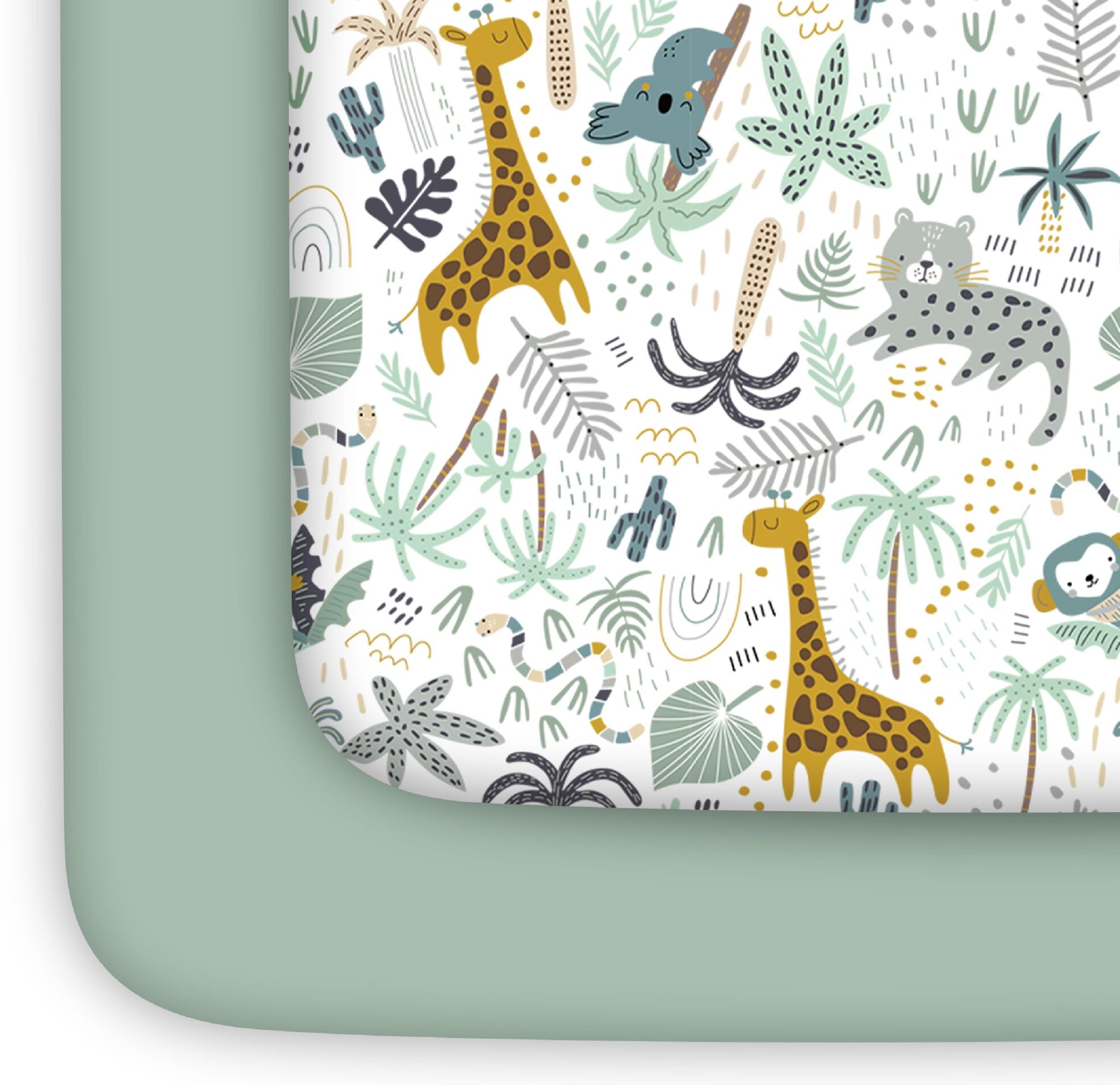
Cheap does not have to mean cheap-feeling, and this set makes the case. The 38-by-26 cut is the standard playard size, the microfiber-spandex blend has a soft, faintly brushed hand that reads closer to flannel than to the slick jersey of the pricier sets, and it pulls over a factory pad in one go.
Two sheets come in the pack, a muted green and a giraffe print, and both came out of the dryer the right shape after repeated washing. What we appreciate most is that nothing announces the price: no scratchy surface, no plastic shine, no corners popping off the pad overnight. We think of it as the set for the second playard, the one at grandma’s house that gets used four times a year and never gets its own laundry day.
Pros
- Soft, brushed microfiber hand
- Standard 38 x 26 fit
- Holds shape through washing
Cons
- Five-inch pockets leave less room for thick pads
The set we hand to anyone watching the budget: a standard 38-by-26 fit, a brushed-soft hand, and nothing about it that announces what it cost.
Best for Thick Mattresses
GRSSDER Dinosaur 2-Pack
Key Features
- Size: 38 x 24 in
- Fabric: 95% polyester, 5% spandex
- Pocket depth: 6 in
- Sheets per pack: 2
- Price: Midrange
The number to notice here is 38 by 24, not the 38 by 26 of a standard playard pad. That sounds like a problem and mostly is not: the jersey is 5% spandex and stretches four ways, so the width comes out of the fabric rather than out of slack. On a fat aftermarket mattress, the kind that turns a playard into something a toddler will actually sleep on, that is exactly what we want, because the sheet ends up taut instead of straining.
The six-inch pockets clear a pad, a protector, and a quilted cover together, and the elastic runs all the way around rather than just at the corners, which is the difference between a sheet that stays put and one you re-tuck at naptime. The dinosaurs are the kind of print a two-year-old points at, and the color has held through repeated washing without much fading.
The flip side of all that stretch is that a thin factory pad gives it nothing to hug, so you will see a few soft wrinkles at the edges. If your playard mattress is the one-inch pad that came in the box, a true 38-by-26 sheet sits tidier; if you have upgraded the mattress, this is the set that handles it.
Pros
- Four-way stretch over thick mattresses
- Six-inch pockets with elastic all around
- Print holds color through washing
Cons
- 38 x 24 cut relies on stretch to cover
Our pick for a playard with a thick aftermarket mattress: the four-way stretch and six-inch pockets swallow pads that leave other sheets straining at the corners.
Best for Nursery Style
TotAha Floral 2-Pack
Key Features
- Size: 38 x 24 in
- Fabric: Jersey knit
- Sheets per pack: 2
- Price: Midrange
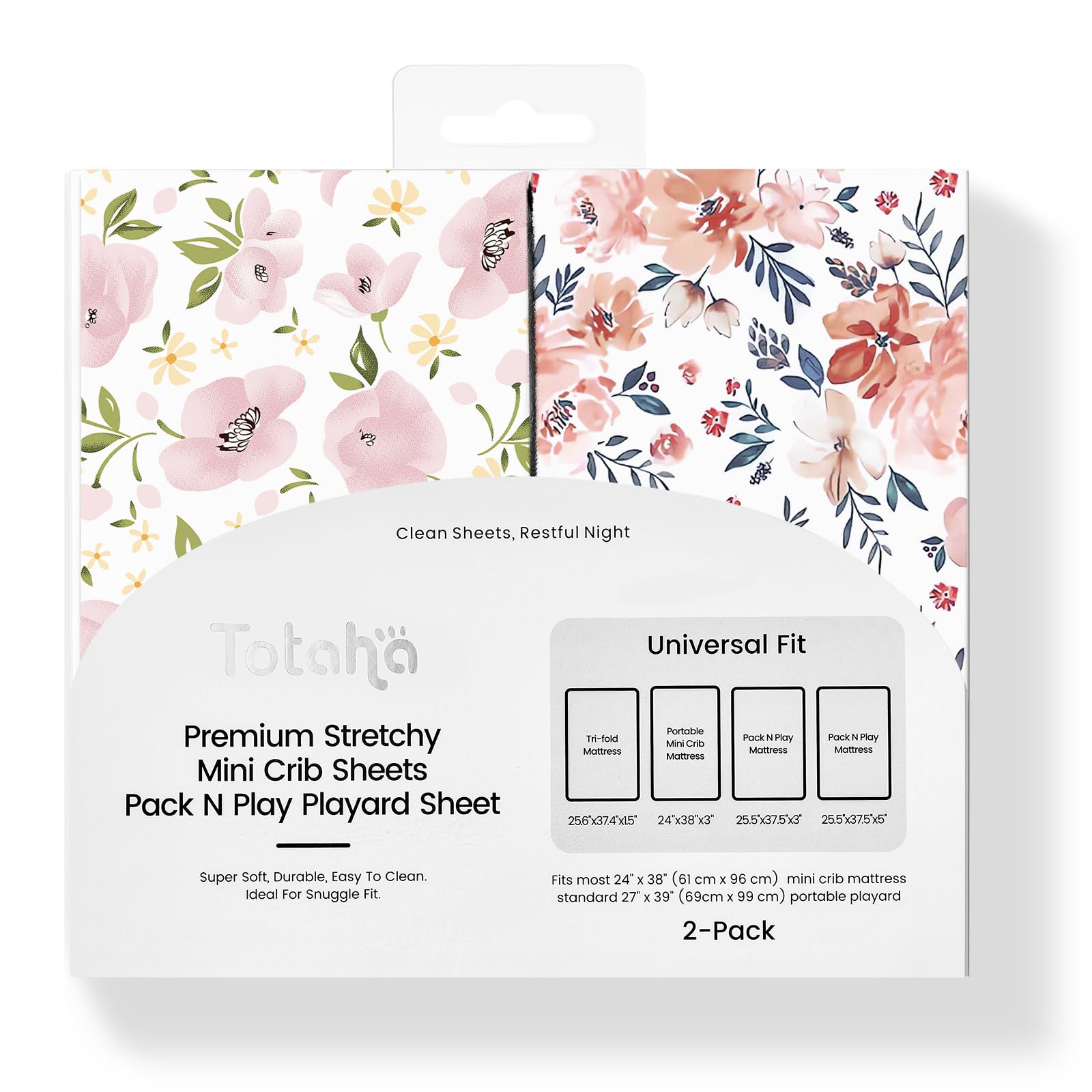
Some sheets are bought for the fabric and some for how the nursery looks, and this set is honest about being the second kind. The Meredith floral and pale pink prints are the most pulled-together thing in this group: the playard stops looking like a piece of equipment and starts looking like part of the room.
The fabric holds up its end, too. It is a silky jersey knit that feels cooler against a cheek than the microfiber sets, with enough stretch to go on without a fight, and it softened rather than pilled through our washing.
Two things need checking before you buy. The width is 38 by 24 rather than 38 by 26, so size it against your actual pad, especially if you have added a mattress pad underneath. And the seams are the weak point: they can come apart after a handful of washes, so wash cool and keep the dryer on low.
For a playard parked in the living room, that is an easy trade to make, because you are buying a look as much as a sheet and this is the best-looking set here. Confirm the width first, though; pretty does not help if the corners are fighting the pad.
Pros
- Best-looking prints in this group
- Silky jersey knit feels cool
- Stays soft through washing
Cons
- Narrower 38 x 24 cut
We like these for a playard that sits in the living room, where the prints do the decorating; just check your pad’s width before ordering.
Best for Daycare Spares
GUNTAIL Love & Pink 2-Pack

Key Features
- Size: 38 x 26 in
- Fabric: Microfiber
- Pocket depth: 6 in
- Sheets per pack: 2
- Price: Budget
Pink hearts, a two-pack, and a price that makes it an easy add-on. For a spare set that lives in a daycare bag, that is most of the pitch, and the 38-by-26 cut with six-inch pockets puts it on the same standard numbers as sheets that cost noticeably more.
The microfiber is woven tight with a slight sheen, closer to a performance fabric than the brushed jersey of the Yoofoss set. It stretches over a pad plus a thin protector without tearing at the corners, which is more than we expected at this end of the market, and the print held its color through a few washes.
Think of it as the second-string set: the playard at grandma’s, the one that gets folded into a bag and forgotten until Friday. For the bed your baby sleeps in every night, the jersey sets above are the better buy.
Pros
- Standard 38 x 26 fit, six-inch pockets
- Stretches over a pad and protector
- Holds color in the wash
Cons
- Thin, slick microfiber hand
We treat this as the spare-set buy: daycare bags and grandparents’ houses, as long as a thinner, slicker hand than the jersey picks does not bother you.
How We Tested Playard Sheets
We started by rounding up every playard sheet we could find that was actually sized for a standard 38-by-26-inch playard mattress or the 27-by-39-inch mini crib footprint, then narrowed the field to sets with deep pockets, stretchy knit construction, and colorways you wouldn’t mind looking at twice a day. We compared cost per sheet rather than per bundle, since most of these sell in two- and three-packs and the pack price hides a lot. That left 14 sets, which we rotated through four months of real use.
Those sets lived on our playards the way sheets actually live: through naps, overnight sleep, a stomach bug, and one memorable diaper blowout that sent a sheet straight to the laundry at 5 a.m. Every set went through at least 10 hot washes and tumble dries, because that’s the honest test — a sheet can feel wonderful new and turn into a pilled, shrunken rag by week three.
I stretched each one over the mattress pad solo, without a second pair of hands, and noted how much fabric was left to tuck underneath; the skimpy ones came off a corner the first time I lifted the mattress to change it. For softness, I handled every sheet before the first wash and again after the fifth, and I held each one up to a lamp to see how much light came through — thin fabric that felt springy held up fine, thin fabric that felt limp didn’t survive the rotation. After every wash I checked seams, elastic, and color, watching for faded prints, stretched-out corners, and that limpness that tells you the knit has given up.
How to Choose Playard Sheets
Playard sheets are the cheapest part of the setup and the one that decides whether a 2 a.m. change takes thirty seconds or twenty minutes, and the most common mistake is buying the wrong size for the pad you actually own.
Match the sheet to the pad, not the box
Whether you call them playard sheets or Pack n Play sheets, the size that matters is the mattress they go on. A factory pad runs about 38 by 26 inches, while aftermarket playard mattresses can measure 39 by 27 and sit three or four inches deep. Measure yours once and shop against that number rather than the playard’s model name.
The failure runs both ways. A sheet cut for a thin pad fights a thick one at the corners, and a sheet cut for a thick mattress hangs loose on a factory pad, which is the outcome to avoid on a sleep surface.
Pocket depth and stretch
Pocket depth decides whether a sheet clears your mattress plus anything layered under it. Five-inch pockets suit a bare factory pad; six inches is what you want if you add a waterproof layer, which is the single best way to keep a playard mattress out of the trash. Stretch matters just as much, because a jersey knit with a little spandex pulls over the corners while a stiff cotton has to be worked on.
Test the whole stack before the first overnight: put the protector on, put the sheet over it, and confirm every corner still reaches under the pad with the surface flat.
Elastic coverage and a flat sleep surface
Elastic all the way around beats elastic at the corners. A full perimeter holds the sheet flat through a night of rolling; corner-only grip can go slack across the middle. If a new sheet wrinkles into a ridge within an hour, that is a sizing problem rather than a laundry problem, and no amount of tugging fixes a cut that is too large. Size down instead.
Jersey, microfiber, or cotton
Jersey polyester with spandex is what most of this list uses, and it earns the spot: it stretches, it survives washing without much shrinkage, and it costs the least. Microfiber reads slicker and can be thin enough to see light through. Cotton jersey is the breathable natural option and softens with age, but it has less give, wants a warm wash and a low dryer, and costs more.
Buy cotton when breathability against the skin is the priority; buy a blend when you want the sheet to go on without a fight.
How many sheets you actually need
Two is the working minimum: one on the pad, one clean. Three is better if the playard is the primary sleep spot, because a stomach bug at 2 a.m. does not wait for a wash cycle, and a spare set costs far less than replacing a soaked mattress. Skip the single-sheet purchase; the night you need a backup is the night you will not have one.
Frequently Asked Questions
Do playard sheets fit mini cribs?
Often, because the footprint is close: a mini crib mattress runs about 38 by 24 inches against a playard pad’s 38 by 26. The difference is depth. Mini crib mattresses are commonly four to six inches thick while a playard pad is one to three, so a sheet with a five-inch pocket may not reach around the mini crib mattress even though the corners line up.
Compare the pocket depth on the listing with the thickness of the mattress before you order.
Will playard sheets shrink in the wash?
Blends shrink least, especially pre-shrunk microfiber, and jersey knits tighten the most, which you notice first at the corners. Wash warm and tumble on low; high heat is what turns a snug sheet into a two-person job. Most knits relax a little once they are back on the pad.
Can I use a regular crib sheet on a playard mattress?
No. A standard crib sheet is built for a 52-by-28-inch mattress and a playard pad is roughly 38 by 26, so the corners will not reach the underside and the middle goes slack. That is a sizing mismatch no amount of tucking fixes.
Look for a sheet labeled for playards or Pack n Play use and check the listed dimensions against your pad.
Final Verdict
Most families should start with the BROLEX two-pack. It is cut to the standard 38-by-26 pad, it lies flat instead of bunching, and the second sheet means a midnight change never waits on the dryer.
The exception is a playard running a thick aftermarket mattress, where GRSSDER’s four-way stretch and six-inch pockets do the job more cleanly. If cotton against the skin matters more than price, Cuddly Cubs is the step up.
