This post contains affiliate links. We may earn a small commission when you buy through our links — at no extra cost to you.
A speaker shaped like a Pokéball looks like a sure thing to a seven-year-old and like a plastic paperweight to most parents. Fair — I’ve heard character speakers buzz, crackle, and quit by week two. But the good ones do something genuinely useful: they give your kid their own music and audiobooks without giving up your phone, and they survive the backpack, the yard, and the drop onto the kitchen floor.
The spec that matters isn’t the wattage on the box. It’s whether the speaker reconnects to a tablet without an adult standing over it, whether the buttons make sense to a preschooler, and whether the volume goes quiet enough for bedtime. Lights are fun right up until your kid wants them off at 8 p.m., and two speakers paired in stereo beat one every time.
We’ve lived with 14 of these over the past three months — licensed characters, light-up minis, a few animal shapes — running batteries flat, pairing them in twos, and letting kids be rough with them. Below are the ones worth the shelf space.



Best for Whole-House Play
eKids Pokemon Pokeball Speaker
Key Features
- Charging: USB-C cable included
- Dimensions: 3.01"D x 2.96"W x 2.84"H
- Wireless range: Up to 100 feet
- Listed playtime: Up to 10 hours
- Price: Midrange
A hundred feet of range is the number that sold us. That’s far enough for a tablet charging on the kitchen counter while the speaker ends up in a bedroom down the hall, and it’s the widest reach here — most of the others top out around 30 feet. Add a listed 10-hour playtime and the Pokeball is the speaker that handles a whole house without being carried from room to room.
The size is the rest of the argument. At roughly three inches across and eight ounces, it takes up less shelf than a paperback and stays put when a kid grabs it. The housing mixes metal and plastic, giving it more heft than the palm-sized picks here, and the graphic means it still looks like something when it’s switched off — which is how a speaker ends up living on a shelf instead of in a drawer.
Sound is honest for a three-inch driver. Dialogue in a cartoon and vocals in a song both come through cleanly at the volume a kid actually uses, and the stereo output gives it a little more width than the mono speakers in this group. It’s a bedroom, kitchen, and playroom speaker, which is where kids do most of their listening anyway.
Two practical touches earn their keep. The speakerphone means a kid can answer a call from a grandparent with one button, and USB-C charging means one cable type for the tablet and the speaker. The controls are flush touch panels rather than raised buttons, which is one less thing to snap off in a bag.
Pros
- 100-foot range, the widest in this group
- 10 hours of listed playtime
- Speakerphone and USB-C charging
- Doubles as room decor between charges
Cons
- No water resistance for bath or pool
- One-year warranty versus two on some picks
The one we recommend for most families: 10 hours of listed playtime, a 100-foot range that reaches the next room, and a shell kids want on their shelf.
Best for Playrooms and Classrooms
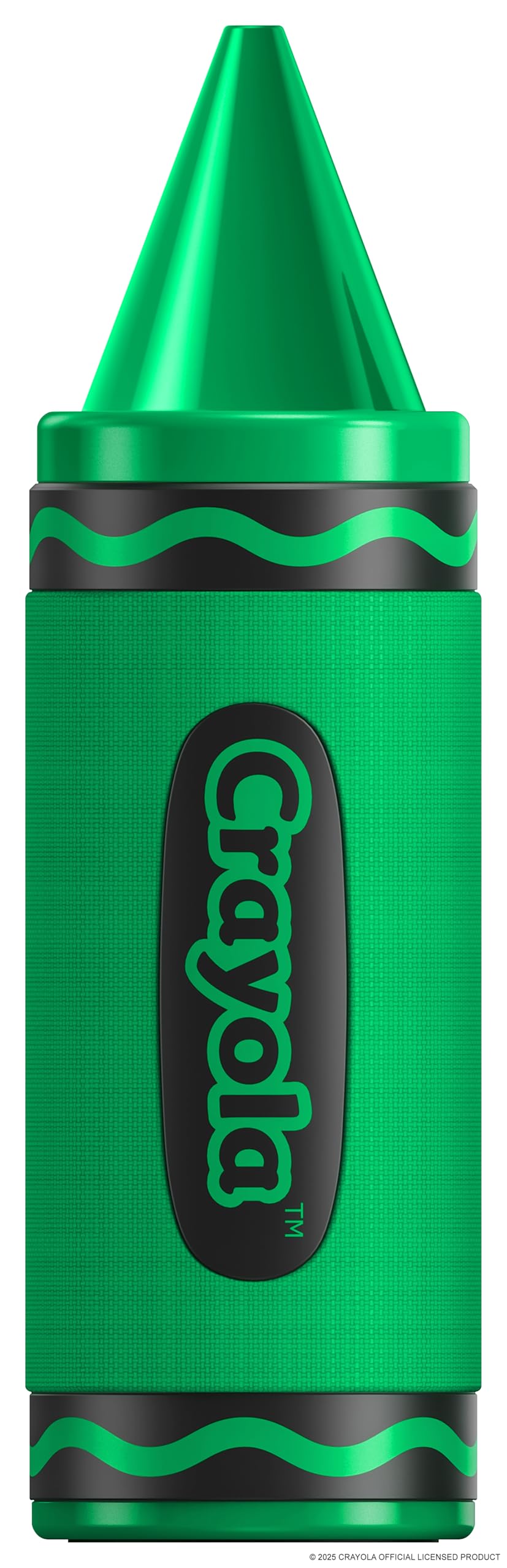
Crayola Crayon Bluetooth Speaker
Key Features
- Height: 9.3 inches
- Drivers: Dual 5W
- Peak power: 20 watts
- Listed playtime: 3 hours
- Price: Midrange
Nine inches of crayon is an odd thing to set on a shelf until you see it there. The speaker stands about as tall as a travel tumbler and weighs in around a pound, and the crayon body — blue, green, yellow, or red — reads as classroom decor rather than another black cylinder. This is the one kids point at before they hear a note.
Loudness is why it earns a spot. The dual 5W drivers give it the most usable volume in this group, enough to carry a playroom or a circle of preschoolers without straining. That’s a different job from the palm-sized speakers here, which are for one kid at a desk; this one is for a room, and it’s the pick we point to when a teacher or a parent asks what will actually be heard.
It’s also the most useful of these in a screen-free room. There’s an FM radio built in, so a kid can have music without a tablet, and pairing a second crayon gives you real left-right stereo. Between the radio and the size, it fits a classroom shelf rather than a backpack.
Pros
- Most usable volume in this group
- Built-in FM radio for screen-free listening
- Stereo pairing with a second crayon
- Crayon shape that works as decor
Cons
- Just 3 hours of playtime per charge
- Tall, light body is easy to knock over
Buy this one when the speaker has to fill a room: dual 5W drivers deliver the most usable volume here, and the crayon shape earns its shelf space.
Best for Backpack and Travel
Bitty Boomers Spider-Man Speaker
Key Features
- Charging: Micro-USB cable included
- Stereo pairing: Two speakers
- Wireless range: 30 feet
- Listed playtime: Over 4 hours
- Price: Midrange
If the Pokeball is a shelf speaker, this one is a pocket speaker. At about two inches and under three ounces, Spider-Man clips to a backpack strap with the included lanyard and rides there without a kid noticing the weight — and that’s the whole reason it stays in the lineup despite being the smallest thing here.
A 3W driver in a body that small has limits, and this one stays on the right side of them. It’s louder than a two-inch speaker has any business being, clear at the volume a kid uses at a desk or in a car seat, and thin once you ask it to fill a room. Range is 30 feet, roughly as far as a kid gets from a parent’s phone in the same house, and two of them pair for stereo when siblings need to share.
The strap is the part that makes it work. On a backpack, a handlebar, or a belt loop, the speaker goes where the kid goes and comes back, and the small housing slides into a coat pocket when the strap gets in the way. Of the picks here, it’s the one built for the walk to school rather than the shelf.
Pros
- About two inches and under three ounces
- Lanyard clips to a backpack or bike
- Two speakers pair for stereo
Cons
- Micro-USB instead of USB-C
- About four hours of playtime
For the kid who carries everything, this is the pick: about two inches tall, under three ounces, and a lanyard that keeps it on the backpack.
Best for Budget Gifting
LENRUE A64 Mini Speaker
Key Features
- Lights: Colorful, switchable
- Warranty: 2 years
- Bluetooth: 5.2
- Output power: 3 watts
- Price: Budget
The light ring is the first thing anyone notices: a band of colored LEDs around the edge that pulses with the music, with its own button to change modes and — the part that matters at bedtime — to switch it off. A light-up speaker that can’t be turned off is a bedtime problem, and this one can be.
Sound is a 3W driver doing a 3W driver’s job: clear at desk distance, thin across a room. Bluetooth 5.2, a lanyard, and pairing for a second speaker round out a package that costs less than anything else in this guide, and the light show is the part kids remember and ask for again.
That combination is why we recommend it. The lights are the feature a five-year-old actually cares about, and the price means buying two — one for the desk, one for a gift bag — doesn’t feel like a splurge. A two-year warranty backs it, which is more coverage than most of the character speakers here offer.
Pros
- Colorful light ring with an off switch
- Least expensive speaker in this group
- Bluetooth 5.2 and stereo pairing
- Two-year warranty
Cons
- Battery life falls short of a full day
- Strap and buttons are the weak points
Cheapest of the bunch and still fun: kids get a light ring that pulses with the music, and you get a switch that turns it off.
Best for Desk and Nightstand
gingo Cute Cat Speaker

Key Features
- Weight: 2.4 oz
- Pairing: Two-speaker stereo
- Bluetooth: 5.3
- Microphone: Built in
- Price: Budget
The tail is the whole idea. It’s soft silicone, it wiggles when music plays, and it blinks while the speaker is on — a detail that turns an inexpensive speaker into something closer to a pet, and one that gets distracting on a nightstand in a dark room.
At 2.4 ounces and roughly egg-sized, it’s a desk toy that happens to play music, and we like it for exactly that: a nightstand, a homework desk, a shelf beside a bed. It isn’t the speaker for a family room, and at this size it doesn’t pretend to be.
The rest is ordinary but complete: Bluetooth 5.3, a built-in mic for hands-free calls, and pairing with a second cat if you want stereo. Where it earns its place is the bottom of a gift bag or the corner of a desk — small enough to be an easy yes, charming enough that a kid keeps it out instead of stowing it.
Pros
- Wiggling, blinking silicone tail
- 2.4 ounces and egg-sized
- Bluetooth 5.3 with a built-in mic
Cons
- Modest volume suits a desk, not a room
- 40-hour playtime claim is hard to believe
A desk pet rather than a family speaker — charming, tiny, and best for a kid who wants something of their own on the nightstand.
Best for Younger Kids
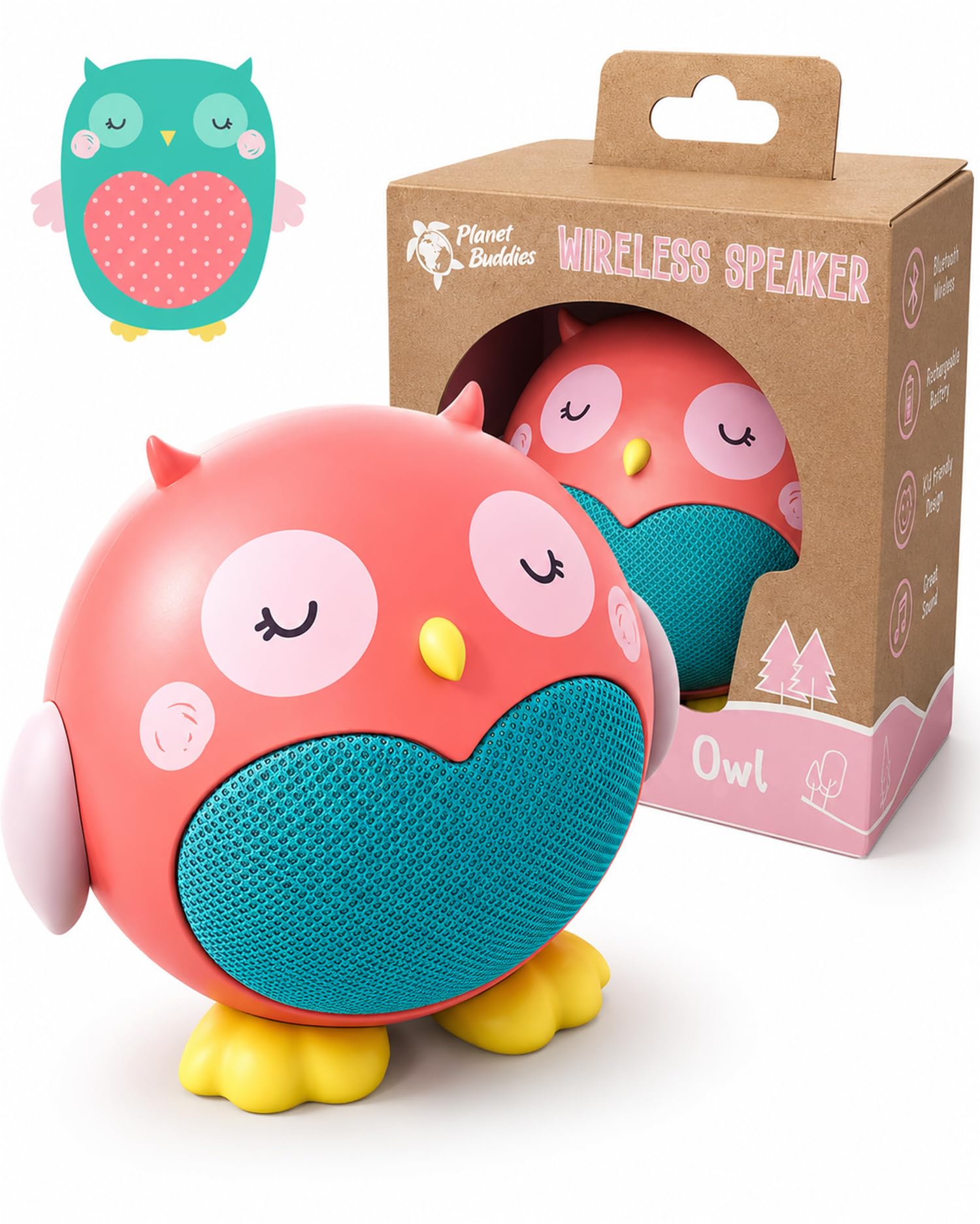
Planet Buddies Owl Speaker
Key Features
- Housing: 50% recycled plastic
- Warranty: 2 years
- Dimensions: 3.6"D x 3.4"W x 4"H
- Wireless range: 33 feet
- Price: Budget
Fifty percent recycled plastic and a two-year warranty are the two facts that separate this owl from everything else here. The housing is made partly from recycled material, the packaging follows suit, and the coverage is double what the character speakers offer — for a small speaker that will get dropped, that’s the more useful kind of green.
The rest is sensible rather than flashy. It’s four inches tall in an owl shape, with a 3W driver, a 33-foot range, and a built-in directional mic that makes it usable for calls with a grandparent. Two of them pair for stereo, and the controls are touch rather than raised buttons.
We think this is the best first speaker for a younger kid: the owl reads friendly rather than licensed, and 3W is right for a bedside table or a car ride. The listed 60-hour playtime is the figure to discount — plan on charging it weekly rather than monthly — and the recycled housing counts for something in a category that’s mostly plastic and character art.
Pros
- 50% recycled plastic housing
- Two-year warranty
- Built-in mic and stereo pairing
Cons
- Four hours to fully charge
The pick for a younger kid or a low-plastic household: a friendly owl shape, a built-in mic, and two years of coverage.
What Three Months of Testing Kids’ Speakers Looked Like
We pulled every kids’ Bluetooth speaker we could find at major retailers that was small enough for a child to carry one-handed and priced so a parent wouldn’t wince if it got left at a friend’s house, then filtered for a rechargeable battery, real volume buttons, and a design a kid would actually pick up. Fourteen made the cut. We spent three months with them — kitchen counters, nightstands, backpacks, car seats, the yard, and a birthday party where we paired two together.
Each one played the same short playlist, an audiobook chapter, and a podcast. We listened at arm’s length and from across a yard, noting which turned harsh or muddy when a kid cranked them. We checked the bottom of the volume range too, since a speaker that jumps from whisper to loud is useless at bedtime, and tested whether the lights could be switched off.
Then we stopped being careful. We dropped each speaker from kid height onto tile and hardwood, stuffed it in a backpack beside a water bottle and a lunch box, and let a six-year-old work the buttons unsupervised. On the character models we tugged at ears, fins, and antennae to see what was molded into the shell and what was glued on.
For battery life, we charged each speaker fully, ran it at kid volume until it died, and timed it, then noted whether it recharged over USB-C. Connectivity got the honest test: we unpaired the speaker, handed it and a tablet to a child, and timed how long it took to get music playing without help. We also weighed price against battery and build, because a cheap speaker that dies in a month isn’t a bargain.
How to Choose a Bluetooth Speaker for Kids
The speaker a kid actually keeps is usually the one with the fewest things to break, and the numbers printed biggest on the box rarely tell you anything about that.
Playtime and Charging Beat Wattage
Wattage on a kids’ speaker box is closer to marketing than measurement; 3W and 20W stickers show up on speakers that sound nearly the same at the volume a child actually uses. Playtime and charging are what change your week. Where a playtime is listed at all, these picks run from 3 hours to 10, and that gap is the difference between a speaker that lives near an outlet and one that goes in a backpack. A couple of listings claim 40 or 60 hours, which is worth discounting for a speaker this size.
Match the cable, too. Most of these charge over USB-C, but at least one still ships with Micro-USB, which means a second cable living in the kitchen drawer forever.
Size, Straps, and Where It Will Live
Start with where the speaker will spend most of its time. A shelf speaker can be bigger and heavier — the 9.3-inch Crayola crayon covers a room but won’t travel — while a take-along one needs a strap and a weight nearer three ounces. A lanyard is the detail that turns a mini Bluetooth speaker into something a kid carries; without one it sinks to the bottom of a bag and stays there. Look at the strap before you look at the design.
Power, Room Size, and Small Ears
A 3W speaker is right for a bedside, a car seat, or a desk, and it gets thin past that. A dual-driver speaker like the Crayola can carry a playroom or a circle of preschoolers, and it’s overkill on a nightstand. Match the speaker to the room rather than to the number on the box.
For younger kids, set the volume yourself and keep the speaker at arm’s length instead of beside an ear. At close range even a small driver is louder than you expect, and the volume ceiling here is your job, not the speaker’s.
Ruggedness, Water, and the Warranty
These take drops, juice, and the inside of a backpack, and almost none of them are built like a rugged outdoor speaker. Water resistance is rare in this group and usually means splash-resistant at best, so keep the bathroom sink and the pool deck off the list unless the listing carries a real IP rating. Warranty length is the most honest durability signal you get before you buy: coverage here runs from one year to two, and the two-year terms cost nothing extra.
Does the Design Actually Matter?
Half of why a kid uses a speaker is that they want to pick it up. A crayon, a Pokeball, or a cat with a wiggling tail gets carried from room to room; a plain black cylinder stays on the shelf. If two speakers sound similar, the look is a legitimate tiebreaker — just make sure the design isn’t the only thing on offer, because a character shell doesn’t fix a three-hour battery or a strap that gives out.
Frequently Asked Questions
Can a kid use one of these without a phone or tablet?
Not for streaming. Every speaker here is a Bluetooth device, so it needs a phone, tablet, or laptop as the source, usually within 30 to 100 feet. The exception is the Crayola crayon, which has an FM radio built in — a real option if you want music in a kid’s room without handing over a screen.
If screen-free listening is the goal, set the radio preset once and let the kid work the dial from there.
Can two of these pair together for stereo sound?
Five of the six list a two-speaker stereo mode, and the pairing only works between two matching models. Buy a matching pair rather than two different speakers, then set them a few feet apart — closer than that and the left-right effect collapses into one blob of sound.
Is a kids’ Bluetooth speaker worth it if we already have a smart speaker?
If the music never leaves the kitchen, no. The reason to buy one is portability: it goes in the car, the yard, or a grandparent’s house with no Wi-Fi setup and no account. If your kid listens in one room, the smart speaker already covers it; if listening happens in six rooms and a backyard, a battery-powered one earns the shelf space.
Final Verdict
The eKids Pokemon Pokeball is our default recommendation because it solves the two problems that make kid speakers annoying: it reaches the next room at 100 feet, and it plays for a listed 10 hours, so it isn’t begging for a cable every afternoon. It also looks like something a kid wants to leave out, which is how a speaker gets used instead of forgotten.
Buy the Crayola crayon instead if the speaker belongs to a playroom or a classroom and volume matters more than travel; buy the Bitty Boomers if it needs to survive a backpack. Everything else here is a narrower answer to the same question.
