This post contains affiliate links. We may earn a small commission when you buy through our links — at no extra cost to you.
Making baby food at home sounds wholesome until you’re scraping sweet potato out of a steamer basket at 7 a.m. while a hungry baby watches. A good baby food maker should shrink that whole process—steam, blend, serve, clean—into something you can do half-asleep. The right one turns a bag of carrots into a week of smooth purees without coating the counter; the wrong one adds a sink of fiddly parts and a texture you have to rescue with a fork. Over the past six months, we’ve put 12 baby food makers through that exact morning routine, plus plenty of messy weeknights.
What surprised me most is how much the little things matter: a lid that seals without a fight, a bowl that doesn’t stain orange after the first carrot batch, and a bottle warmer setting that actually earns its counter space. Value isn’t just the sticker price, either—it’s whether the machine replaces your steamer and blender or just gives you one more thing to wash. We looked for models that felt sturdy after repeated dishwasher cycles and safe for a baby’s first bites, not just clever on the box. The picks below are the ones that made homemade baby food feel like a routine instead of a project.



Best for One-Machine Purees
EVLA’S Baby Food Maker
Key Features
- Wattage: 300 watts
- Controls: Touch screen
- Included: Six reusable pouches
- Functions: Steam, blend, self-clean, sanitize
- Price: Premium
This is the baby food maker we tell friends to buy, and the reason is the least glamorous function on the dial: the self-clean cycle. Add water, press the icon, and the machine flushes out the chamber it just cooked in, so a batch made at seven in the morning doesn’t have to be dealt with at seven in the morning. Nothing about it is fiddly to take apart, and there’s no stack of inserts to disassemble, which is the difference between a habit and a chore.
Cooking and pureeing in the same bowl is the whole argument for a machine like this, and EVLA’S gets the handoff right: the food steams where it will be blended, so nothing hot gets poured between vessels. The 300-watt motor sits mid-pack here and didn’t struggle with anything we gave it; sweet potato, apple and peas all came out smooth enough for a first spoon. The touch panel’s presets take the counting out of it, and the self-clean cycle means the machine is neutral rather than soaking when you get back to it.
It’s one of the pricier machines in the group, and the six pouches in the box are your storage for the first few weeks. If you plan to freeze in volume, add trays. Beyond that there is very little to complain about, which is rare here, where something usually rattles, leaks or quits early. What settled it for us is the number of steps between a raw carrot and a full pouch: three, and one of them is pressing a button.
Pros
- Steams, blends and self-cleans in one bowl
- Simple parts, nothing fiddly to disassemble
- Presets remove the guesswork
- Six reusable pouches included
Cons
- Pricier than the compact single-batch machines
Buy it if you want the whole job, steam to sanitize, done by one machine you can rinse and run. It’s the one we recommend to most parents.
Best for Stain-Free Steaming
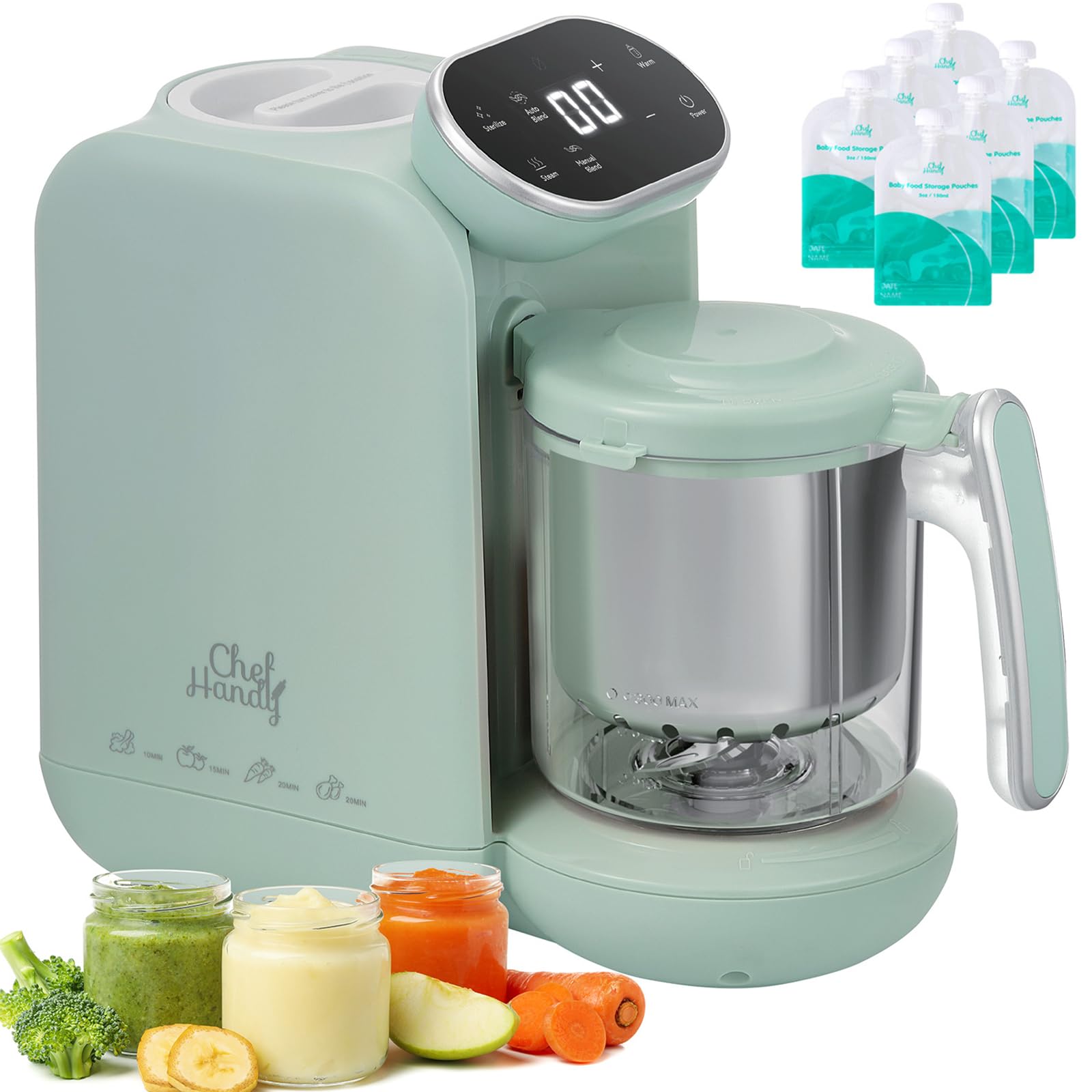
Chefhandy Baby Food Maker
Key Features
- Cleaning: Hand wash
- Functions: Steam, auto blend, manual blend, bottle warmer, sterilizer
- Steam basket: Stainless steel
- Bowl capacity: 0.75 liters
- Price: Midrange
Every other steam-and-blend machine in this guide puts the food in a plastic basket. Chefhandy uses stainless steel, which sounds like a footnote until you have steamed a carrot: the basket rinses clean, while clear plastic takes on a permanent orange tint that no amount of scrubbing lifts.
That single difference is why we rate it the best of these for anyone whose freezer fills up with squash and sweet potato, and the rest of the machine holds up. Steaming, automatic blending, manual blending, bottle warming and sterilizing are all here, the 0.75-liter bowl holds a few days of portions without becoming a storage problem, and 300 watts handled everything we steamed. We used the manual blend more than we expected; holding the button lets you stop short of smooth, which starts to matter once a baby is ready for texture.
Two practical notes. The bowl, basket and blade are hand-wash only, which is the price of steel instead of plastic, and the silicone seal under the blade is the wear part. Check it now and then and replace it when it stiffens, and the bowl keeps its seal instead of leaking into the base.
Pros
- Stainless basket resists stains and odor
- Five functions including bottle warming and sterilizing
- Costs less than our top pick
Cons
- Hand-wash only, no dishwasher cycle
Choose this one if orange plastic bothers you: the steel basket steams clean and the manual blend gives you real texture control. Just plan on washing it by hand.
Best for Small Kitchens
Grownsy Baby Food Maker
Key Features
- Capacity: 300 ml
- Blend modes: Automatic and manual
- Bowl material: BPA-free Tritan
- Price: Midrange
If the counter is already contested territory, this is the machine that fits: a 300-milliliter bowl, a body that doesn’t ask for much room, and a weight that makes lifting it out of a cupboard unremarkable. For one baby eating a few ounces at a time, that is the right size.
It earns the space by steaming properly. The basket sits above the water rather than in it, so vegetables cook in steam instead of simmering, and the bowl underneath catches the drips; pour them back before blending and the puree tastes of the vegetable rather than of water. Tritan is the bowl material and it is BPA-free, and two modes cover the texture job: an automatic cycle for smooth, a manual one when you want to stop short.
Where we come out on it: right for one baby, wrong if you’re stocking a freezer, because a single apple fills the basket and a week’s worth of portions takes two or three rounds. Durability is the softer spot, with some units quitting inside six months, and the plastic basket keeps the color of what you steam. If the batch size or the tint would nag at you, the Chefhandy’s steel basket and larger bowl solve both for less money.
Pros
- Small footprint suits tight counters
- Elevated basket steams rather than boils
- Automatic and manual blending modes
Cons
- Plastic basket holds onto stains
For one baby working through first tastes, the small bowl and narrow body make more sense than a big machine. Expect to steam in two rounds.
Best for Set-And-Forget Batches
NutriBullet Baby Steam + Blend
Key Features
- Speeds: 3
- Wattage: 450 watts
- Cleaning: Bowl and lid dishwasher-safe
- Functions: Steam, blend, pulse, auto steam and blend
- Price: Premium
We put a chopped apple in, turned the dial to the automatic cycle, and came back to a bowl of puree and a machine that had already switched itself off.
That cycle is the pitch, and it holds up. The Steam + Blend cooks the food in the same bowl it later blends in, with the waiting built into the program, so there is no transferring hot food and no guessing at timers. The dial has three useful positions and no screen, which is a relief if you have ever stood in front of an appliance decoding icons before six in the morning.
At 450 watts it is the most powerful of the compact machines here, and it is the only one in the group whose bowl and lid go in the dishwasher, with just the blade to wipe by hand. The 2- and 4-ounce cups suit the first weeks of solids, when a batch is measured in spoonfuls rather than portions.
Where it gives ground is longevity. It is the lowest-rated pick here at 4.4 stars, some units stop working within a couple of months, and the plastic takes on color from orange foods. None of that changes how much we like using it; it changes how much confidence we have in year two. Buy it for the fuss-free cycle and the dishwasher, and keep the receipt.
Pros
- One dial runs the whole steam-and-blend cycle
- 450 watts, the strongest compact here
- Bowl and lid are dishwasher-safe
- 2- and 4-ounce storage cups included
Cons
- Some units stop working within months
- Plastic stains with orange foods
The least fussy all-in-one here: one dial, an automatic cycle, a dishwasher-safe bowl. A good buy if you want set-and-forget and can accept a shorter track record.
Best for Batch Cooking
Babymoov Duo Meal Station
Key Features
- Speeds: 3
- Wattage: 500 watts
- Warranty: Lifetime
- Functions: Steam, blend, defrost, sterilize, reheat, warm bottles
- Price: Premium
The Duo Meal Station is the most expensive machine here, and the only one we think justifies a premium, provided you are cooking for two babies or batch-cooking a month at a time. It steams on separate levels at once, so a vegetable and a protein cook together with their juices collecting instead of evaporating, and the blender bowl sits ready underneath.
The rest of the specification sheet backs up the price. The bowl takes 4.6 pounds of ingredients, three speeds move you from rough chop to smooth, and the 500-watt motor is the strongest in this guide. It also warms bottles, defrosts, sterilizes and reheats, which means it stays on the counter long after purees are finished. A lifetime warranty is unusual enough in this category to count as a feature in itself.
It needs headroom: at 15.6 inches tall it will not slide under a cabinet, so measure the gap above your counter before you claim a spot. And this is a category where machines quit, which is exactly what the warranty covers, so register it and keep the receipt. If the height works and you cook in volume, the simultaneous steaming is the one thing nothing else here does.
Pros
- Steams two levels at once
- Largest bowl and strongest motor here
- Lifetime warranty
Cons
- Some units stop working early
Buy it if you’re cooking for two babies or freezing in bulk: it steams and blends at once, and the lifetime warranty has your back. It is the priciest here.
Best for Value All-In-One
Momyeasy Baby Food Maker

Key Features
- Wattage: 300 watts
- Cleaning: Dishwasher-safe parts
- Functions: Steam, blend, defrost, bottle warmer, self-clean
- Water tank: Stainless steel
- Price: Midrange
The bottle warmer is the feature to be skeptical about. It works by standing the bottle in the same water tank that steams the food, so it heats slowly and unevenly, which is not what anyone wants at three in the morning.
Purees are a different story, which is why it made the list. Five functions sit on a touch panel, including steam, blend, defrost and a self-clean cycle, and there is a stainless water tank that will not rust and a removable blade so you can clean underneath it properly. The bowl and lid go in the dishwasher. For the money it is the most machine in this guide: the automatic blend turned out smooth puree without babysitting, and the manual option is there for the chunkier stage.
What holds it back is reliability, the one part of its record that is not clean; some units arrive dead or fail within the first months, and that is why it sits below the EVLA’S despite doing much the same job. As a second machine for a grandparent’s house, or a first one on a tight budget, it makes sense.
Pros
- Five functions on one touch panel
- Stainless water tank and removable blade
- Least expensive steam-and-blend with self-clean here
Cons
- Bottle warmer is slow and uneven
- Some units arrive dead or fail early
The cheapest way to get steam, blend and a self-clean cycle in one machine, provided you treat the bottle warmer as decoration.
Best for Starter Kit
Nuby Mighty Blender

Key Features
- Blades: Two: blend and mill
- Pieces: 22-piece set
- Wattage: 200 watts
- Steaming: Microwave basket
- Price: Budget
Twenty-two pieces come in the Nuby box: a 200-watt base, a batch bowl, a short cup, stay-fresh lids, a spatula, a cookbook, a microwave steaming basket and two blades instead of one. The second is a milling blade for oats, rice and porridge, the kind of job you would otherwise buy a separate grinder for.
Where the cooking happens is the thing to understand before you buy. There is no heating element, so vegetables steam in the microwave in the supplied basket and then go into the bowl. That is a fair trade for the price: you get prep, storage and feeding kit in one box and give up the one-button promise of the all-in-ones.
For a first machine, we think it earns its place. The kit covers what a new parent needs in the first months, the cookbook is a real starting point rather than a leaflet, and the milling blade adds a use that outlasts purees. Blending is fine for soft fruit and cooked vegetables; thicker, fibrous mixtures need a stir to reach the blades.
The motor is the weak point. Some units stop within a few months, and they tend to go suddenly rather than gradually. Treat it as a first machine rather than a last one and it is good value; expect it to see one baby through weaning and you will be fine.
Pros
- 22 pieces cover prep, storage and feeding
- Milling blade handles oats and porridge
- Costs less than the steam-and-blend machines here
Cons
- No built-in steamer, microwave required
- Some motors fail within months
Nuby’s kit suits anyone who already microwaves vegetables: two blades, a cookbook, and everything down to the spatula, for less than the all-in-ones.
Best for Budget Blending
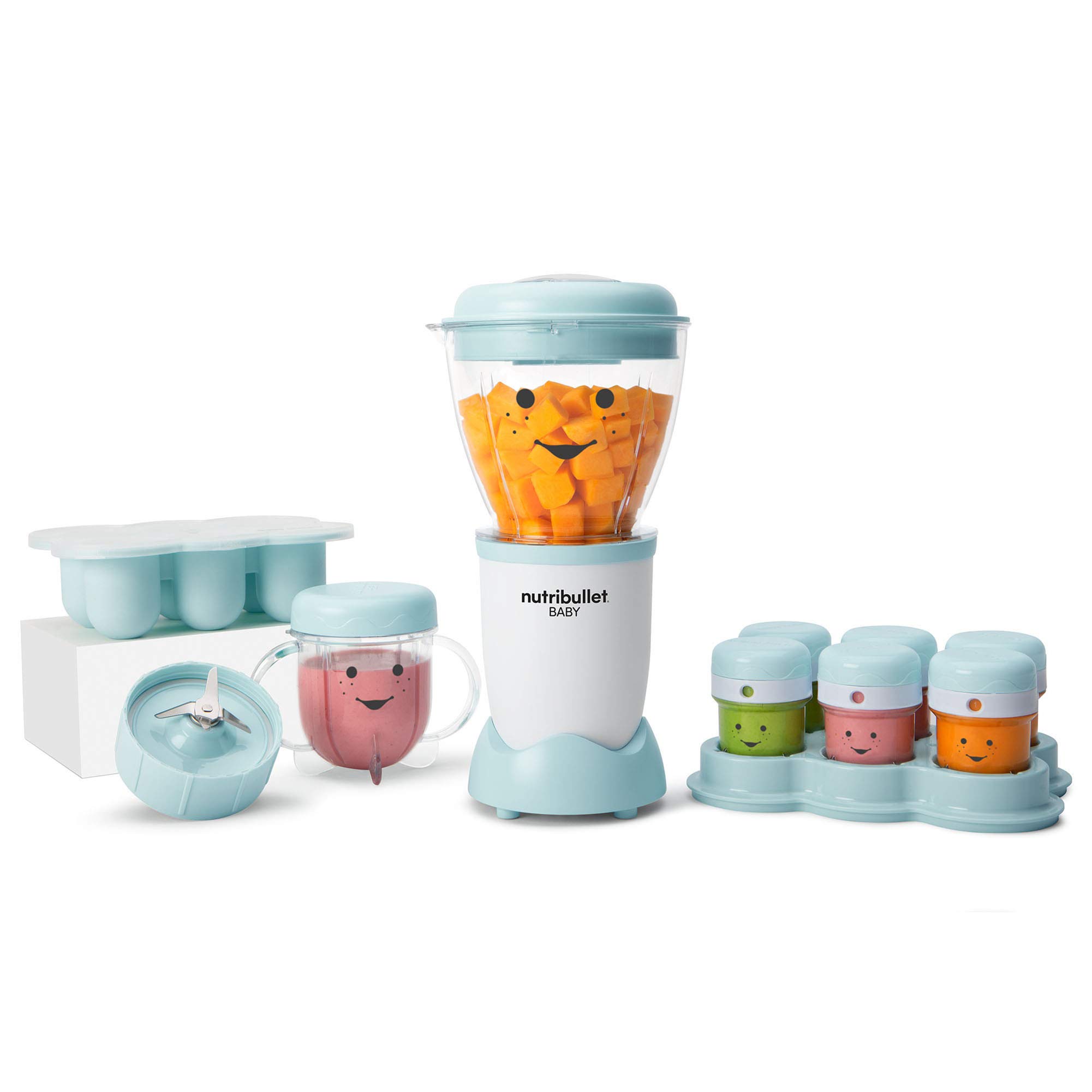
NutriBullet Baby Complete System
Key Features
- Wattage: 200 watts
- Cleaning: Dishwasher-safe
- Included: Storage cups with date dial, freezer tray
- Batch bowl: 32 oz
- Price: Budget
The part of this kit we underrated is the storage: a stack of small cups with a date dial on the lid, so a batch of puree gets portioned, dated and put away in the same five minutes you made it. That sounds trivial until you are the person deciding whether the tub at the back of the fridge is still good.
It is a blender, not a cooker. There is no steam basket and no heating element, so you roast, boil or microwave the food first, then blend it in the 32-ounce batch bowl and portion it into the cups. The bowl is larger than the compact single-batch machines here, which means a whole squash goes in at once, and everything except the blade base is dishwasher-safe.
Blending is fine for soft, wet mixtures and less convincing for thick or fibrous ones. The food climbs the sides and sits above the blade until you stop and scrape, and first-stage smoothness needs more liquid than you expect. The blade base is the wear point underneath, and it is worth handling gently rather than dunking.
So: the one to buy if you already cook for the family and want to turn a portion of it into baby food without adding a second appliance. It is the least expensive complete blending and storage package here, and the storage is what makes it useful rather than the motor. If you want one machine that does the whole job, this is not it.
Pros
- Date-dial storage cups included
- 32-ounce bowl handles big batches
- Cheapest full blending-and-storage kit here
Cons
- No steaming or heating built in
- Blade coupling wears out
A blender and storage kit in one box, and the sensible buy if you already cook and freeze in batches. It doesn’t steam anything.
How We Tested Baby Food Makers
We started by pulling together the baby food makers that show up most often in registry lists and parent forums, then narrowed the shortlist by size, price, and the features that matter when you’re feeding a baby every day—steam-plus-blend capability, dishwasher-safe parts, and a bottle warmer if the machine claimed one. We tested 12 units over six months in our own kitchens, running them through Sunday batch sessions with sweet potatoes, apples, and carrots, weekday evening purees after daycare pickup, and the occasional early-morning bottle warm-up.
Every machine had to earn its spot on the counter. We timed the full cycle from raw ingredient to puree, including setup and the cleanup that followed, and noted whether the controls made sense one-handed while balancing a baby on a hip. After each batch we disassembled every part that touched food, washed it by hand and in the dishwasher, and checked the seams and lid gaskets for trapped puree. We also watched for staining after bright orange and purple batches—a bowl that kept a carrot halo after three washes lost points.
Blending performance got a separate pass: we ran the same cooked carrot and chicken mixtures through each machine and noted whether the texture came out smooth enough for a first-stage eater or needed scraping and re-blending. Reliability and durability mattered as much as the first batch—we kept using the machines week after week, watching for stalls, loose latches, and blades that dulled after repeated washing. To judge value, we compared what each unit actually replaced (a steamer, a blender, a bottle warmer) against how much counter space and cleanup it added. And because this is baby gear, we checked that food-contact parts felt solid, had no sharp edges, and held up to the dishwasher without warping.
How to Choose a Baby Food Maker
The machine you’ll still be using at eight months is the one that’s easy to clean, not the one with the longest feature list, so start with the parts count and work backwards.
Steam-and-blend, or a blender you already own?
An all-in-one cooks the food and purees it in the same bowl, and that is the only real reason to pay for one. A blender-only system such as the NutriBullet Baby Complete still needs a pot, a steamer basket or a microwave before it can do anything at all. If you already cook vegetables for the rest of the family, that extra step is small and a blender plus storage covers you for less. If you’re starting from raw and want one bowl to wash, the all-in-ones earn their keep. The trap is buying a complete system and discovering the cooking half was never included.
Count the parts, not the presets
Nobody stops making baby food because the puree was the wrong shade of smooth. They stop because there are five pieces to wash at ten at night. A self-clean cycle rinses the cooking chamber, not the lid, blade or seal, so check how many parts need hands on them and whether they are dishwasher-safe. The EVLA’S and the NutriBullet Steam + Blend take their bowls in the top rack; the Chefhandy is hand-wash only. If you know you won’t stand at the sink, weight that above any preset.
Match the bowl to the batch you make
A 300-milliliter bowl such as the Grownsy’s suits a baby who eats a few ounces fresh each day, and it fits on a crowded counter. Big ones, like a 32-ounce blender jar or the Babymoov’s 4.6-pound bowl, suit a Sunday spent filling the freezer. The trap runs the other way too: a big bowl does not make small amounts easier, because blades need enough food to reach them and a few spoonfuls in a wide jar mostly spin. Decide whether you are cooking fresh daily or batching weekly, then pick the bowl that matches.
Texture control for the stage you’re in
First purees want smooth, and by eight or nine months you want to leave lumps in deliberately. Presets give you the first and can keep you there. What matters is a manual blend or pulse you control, or several speeds: the NutriBullet’s three, the Babymoov’s three, the Chefhandy’s manual button. If you plan to move through textures rather than stop at puree, that control is worth more than an extra automatic program you never press.
Materials, stains and how long it lasts
Steam baskets take on the color of carrot and sweet potato, and plastic ones keep it. Stainless steel, as on the Chefhandy, doesn’t, and that is the whole argument for it. The bigger question is lifespan. Motors, lids and silicone seals are what fail on these machines, often inside the first year, and the category’s record is not good. Buy where the return window is usable, register the warranty, and treat a longer warranty as a real feature rather than small print.
Frequently Asked Questions
How long does homemade baby food keep?
In a sealed container in the fridge, about three days; in the freezer, up to three months. Freeze in portions small enough to thaw one at a time, using the little cups that come with these machines or an ice-cube tray, then thaw overnight in the fridge and reheat thoroughly, stirring and testing the temperature before it goes near the baby.
Do I need filtered water in the steamer?
If your tap water is hard, yes. It’s the mineral scale rather than the water itself that clogs a steam chamber and shortens the machine’s life. Bottled or filtered water cuts the buildup, and each maker specifies its own descaling method, so follow the one in your manual rather than a generic vinegar routine, since tank materials differ.
Is it actually cheaper than buying jars?
Per portion, usually. A squash or a bag of carrots makes several days of food, and the machine earns its price back over a few months of daily use. What kills the saving is waste: batches frozen and forgotten, or a machine that quits early. Cook in amounts you’ll finish within a month and the economics hold.
Final Verdict
If you want one machine to do the whole job, the EVLA’S is the answer. It steams, blends, self-cleans and sanitizes, and it is the pick here with nothing but praise behind it.
Spend the difference on the Chefhandy instead if a plastic basket turning orange would bother you every single day; its steel basket is the fix and it costs less. For twins or a freezer you intend to fill, the Babymoov’s simultaneous two-level steaming is the one feature worth the premium.
