This post contains affiliate links. We may earn a small commission when you buy through our links — at no extra cost to you.
A diaper leak has a way of announcing itself at the worst possible moment—mid-nap, mid-errand, or just as you sit down. The right diaper keeps up with all of it: the overnight stretch, the post-feeding blowout, the wiggly toddler mid-change. More than absorbency alone, what matters is fit that stays snug at the legs and waist, materials that don’t leave skin angry, and a cost per change you can live with. Fail any one of those and you’ll regret the whole box.
Over the past three months, we’ve tested 14 diaper brands—big names, store labels, and newer options—on the same babies through naps, overnights, stroller walks, and car-seat commutes. The best ones weren’t the thickest or the most expensive; they stayed put, locked wetness away, held together after hours of wear, and left skin calm. Fit matters as much as absorbency, too: a diaper that gaps at the leg cuffs will leak even if it’s otherwise excellent. Below are the ones that earned a spot in the changing caddy.


Best for Newborn Everyday
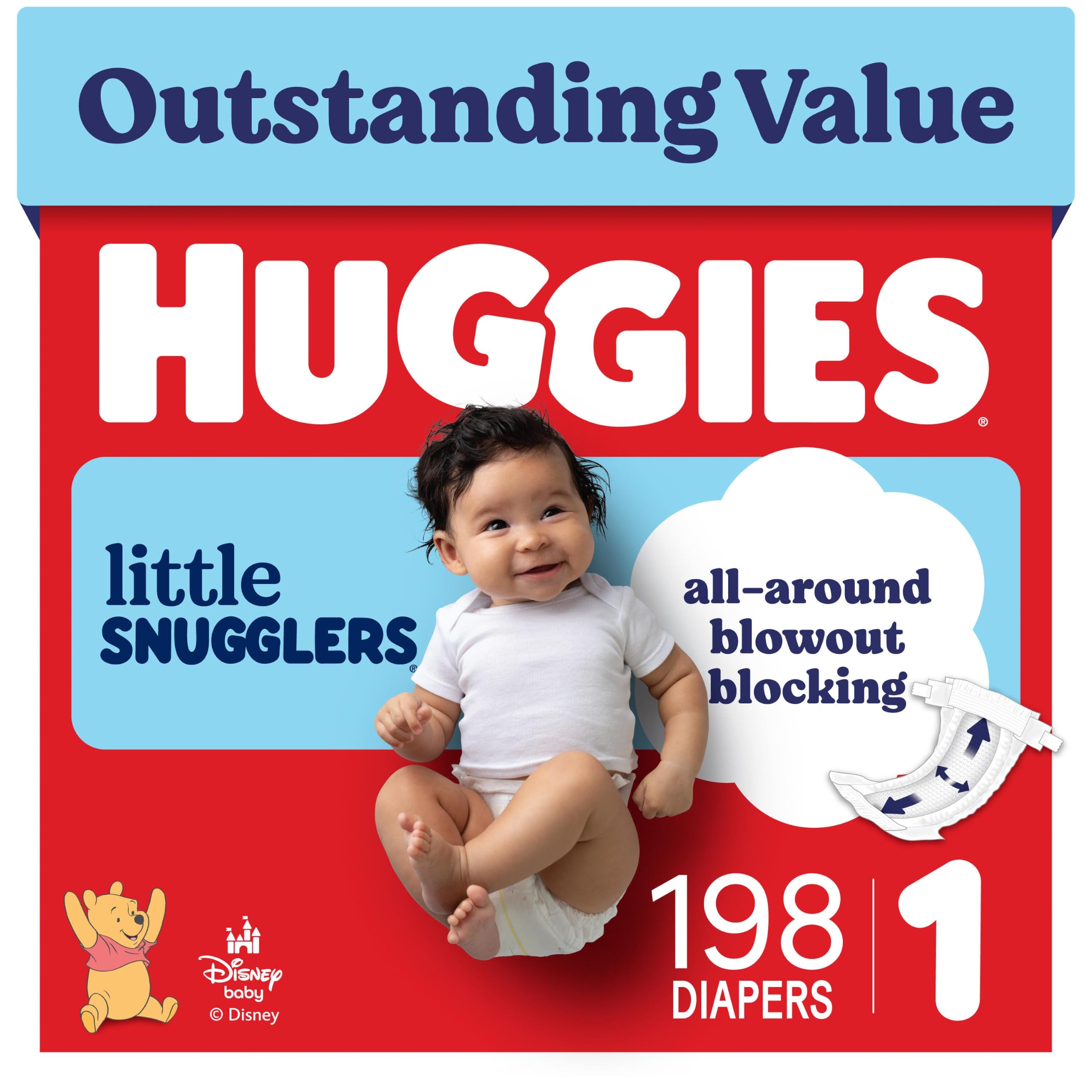
Huggies Little Snugglers Size 1
Key Features
- Pack count: 198 (6 packs of 33)
- Size and weight: Size 1 (8-14 lbs)
- Absorbency system: FastAbsorb
- Blowout protection: Front and back blockers, sizes 1-2
- Price: Midrange
Front and back blowout barriers in the same diaper is the detail that decided this one for us. Huggies bills the front-and-back blocker as something the other leading brands do not offer in sizes 1 and 2, and it is the end of the diaper nobody thinks about until a baby who sleeps on their tummy ruins a onesie. Size 1 covers 8 to 14 lbs, which is the window between coming home and outgrowing the bassinet.
Fit is where it pulls ahead of the rest of this set. The waistband stretches without digging in, the leg cuffs sit close, and softness has the strongest record of any diaper here — a real consideration for something a newborn wears most of the day. Absorbency carried through long naps while we were using it, and the wetness indicator is easy to read in a dim room, which is the only light you will have at 4 a.m.
One structural caveat: the front and back blockers exist only on sizes 1 and 2, so the size 3 you buy in a few months is a different diaper with a different leak defense. That is not a reason to avoid it, just a reason not to assume the toddler version behaves like this one. And 198 is a lot of diaper for a size babies leave behind quickly; if you are buying before the birth, start with a smaller pack and save the big box for once you know the fit.
Pros
- Front and back blowout blockers on sizes 1 and 2
- Softest of the diapers we compared
- Fit and leak protection hold through long naps
Cons
- Blowout blockers stop at size 2
For newborns, this is the diaper we recommend first: front and back blowout blockers on size 1, and the steadiest leak and skin record in this set.
Best for Newborn Alternative
Pampers Swaddlers Size 1
Key Features
- Free of: Parabens, elemental chlorine, latex
- Pack count: 198
- Size and weight: Size 1 (8-14 lbs)
- Skin credentials: Fragrance free, hypoallergenic
- Price: Midrange
Same size, same 198 count, a different cut: Swaddlers is the diaper to try when Little Snugglers leaves red marks around the legs or a gap at the back. The two land in the same price territory per change, so the decision comes down to how your baby is built rather than what the box costs.
We rank it just behind our top pick, for a reason that shows up in the two dimensions that matter most. Absorbency and overall effectiveness are strong — the core takes a heavy wetting, and overnight is a claim this one can back up. Leak protection is less consistent than the Huggies, though, and the misses come at the leg rather than the back, which is a fit problem more than an absorbency one. Fan the cuffs out properly and the gap closes.
Skin is the other watch item. Swaddlers is fragrance free, hypoallergenic, and accredited by the Skin Health Alliance, and it is free of parabens, elemental chlorine, and latex — on paper the cleanest ingredient list here. It can still bring out a reaction in some babies, so open a smaller pack first and give it a week rather than committing to a 198-count box on day one. The wetness indicator is one of the clearer ones, which sounds trivial until you are changing a diaper in the dark.
Pros
- Fragrance free and hypoallergenic, with Skin Health Alliance accreditation
- Absorbent core handles heavy wettings and overnight
- Clear wetness indicator for night changes
Cons
- Leak protection trails our top pick at the leg
The newborn diaper to try when the Huggies cut leaves marks or gaps; just open a small pack first, because leaks and skin reactions are where it trails.
Best for Active Toddlers
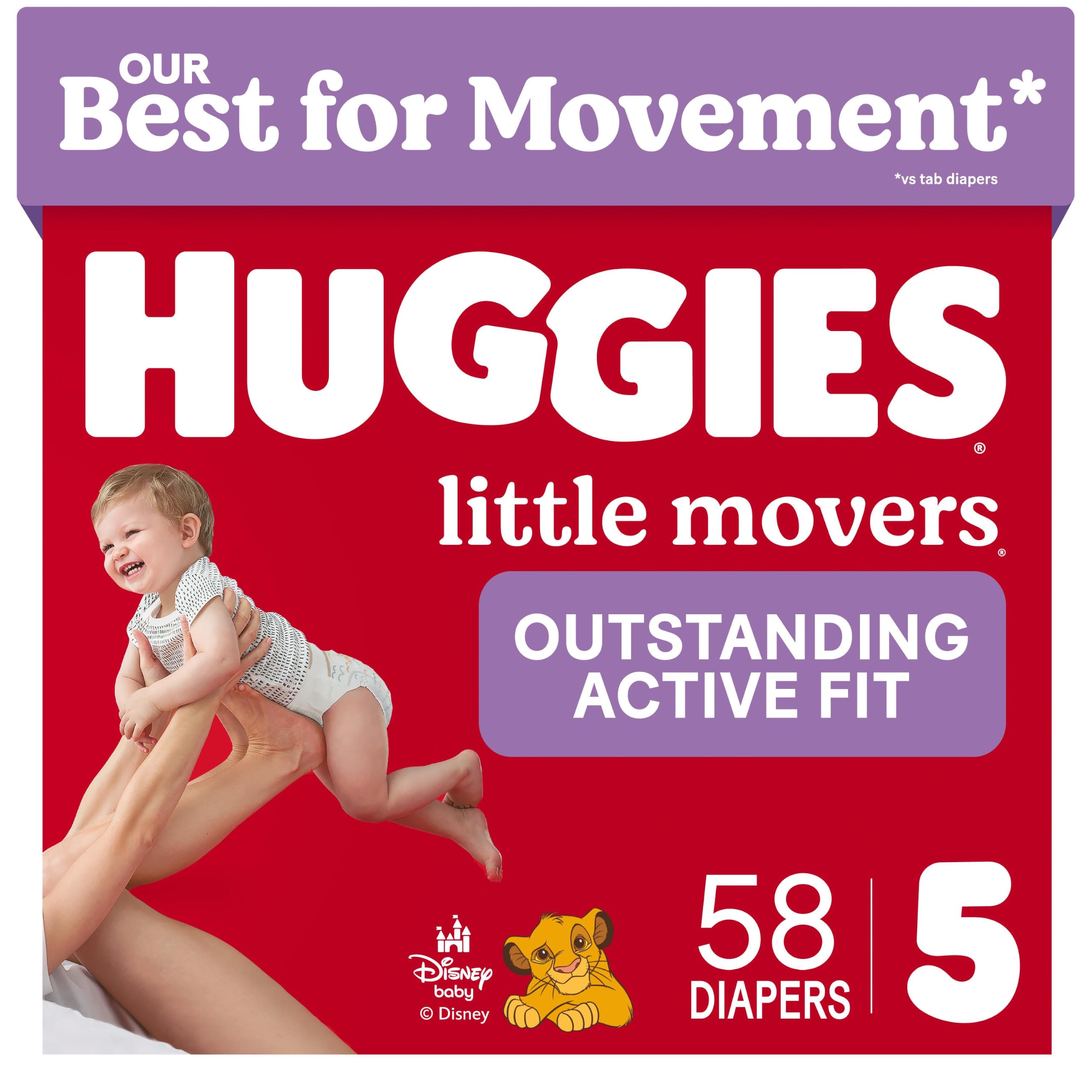
Huggies Little Movers Size 5
Key Features
- Size: 5
- Fragrance: Fragrance free, no parabens
- Waistband: Designed to prevent leaks
- Pack count: 58
- Price: Premium
A toddler who will not lie down for a change is a different diapering problem, and Little Movers is the one here built around it. The waistband is the whole design story: it is cut to stay where you put it through crawling, climbing, and the stiff-leg protest, and it is what keeps a full diaper from sliding down mid-errand.
Size 5, 58 to the box, fragrance free and made without parabens. The fragrance point earns more at this size than at newborn — a toddler spends a twelve-hour night and then a full day in these, and unscented is one less thing against their skin. Huggies claims up to zero leaks and blowouts, and in our use the waistband was the part doing the work: a diaper that stays put does not gap at the leg when they fold into a car seat.
The cost is the obvious one. It is the most expensive per change in this set, which is what the fit and the low-count box buy you — 58 means you are not committing to a case of something that might not suit. The other thing to watch is sizing rather than design: the waistband helps a diaper stay on a moving baby, but it will not make a size 4 fit a baby who has outgrown it. Move up when the tabs start meeting in the middle, not when the leaks begin.
Pros
- Waistband designed to stay put on the move
- Fragrance free and made without parabens
Cons
- Highest cost per change in this set
- Can cause rashes in sensitive babies
For a baby who is already pulling up and fighting lie-down changes, this is the diaper we reach for: a waistband built for movement and a fragrance-free build.
Best for Overnight Sleep
Pampers ZZZ Overnight Size 3
Key Features
- Absorbency: 50% more absorbent zones
- Pack count: 66
- Protection: Blowout barrier and LeakGuard
- Size and weight: Size 3 (13-26 lbs)
- Price: Premium
The case for a dedicated overnight diaper only becomes obvious after a run of 3 a.m. sheet changes. Pampers ZZZ is built for that stretch: 50% more absorbent zones than the brand’s everyday diaper, a blowout barrier, an all-around LeakGuard, and a liner meant to lock wetness away — size 3, 13 to 26 lbs, 66 to the box.
Read the claims carefully. The three-times-drier figure is measured against a size-4 leading value brand, not against the premium diaper you may already be using, so do not expect the jump the box implies if you are moving up from Swaddlers. What the extra zones genuinely buy is capacity, and capacity is what a ten-hour stretch needs. The fit itself is a normal size-3 cut; more absorbency does not rescue a diaper that is gaping at the leg.
We treat it as a second diaper rather than a replacement. If your everyday diaper already gets you to morning dry, this is protection you are paying for and not using. If you are washing sheets twice a week, one of these a day is the cheaper habit, and it is the single change that most reliably turns a broken night into a full one. Babies who still take a bottle overnight will test any diaper’s limit, and on those nights a change before you go to bed does more than a bigger diaper.
Pros
- Extra absorbent zones for ten-hour stretches
- Blowout barrier plus all-around LeakGuard
- Hypoallergenic and Skin Health Alliance accredited
Cons
- Costs more per change than a daytime diaper
Worth it only once your everyday diaper is already failing overnight; then this is the fix we recommend, one diaper a day in a normal size-3 fit.
Best for Bulk Daytime Value
Luvs Platinum Protection Size 6

Key Features
- Pack count: 144
- Leak guards: Triple Leakguards
- Size and weight: Size S6 (23-44 lb)
- Wetness indicator: Turns blue when wet
- Price: Midrange
Luvs is Procter & Gamble’s value line, the same manufacturer behind Pampers, and Platinum Protection is the version that adds triple leakguards and a wetness indicator. Size S6 covers 23 to 44 lb, and a 144-count box goes a long way with a toddler who is outgrowing the changing table anyway.
For daytime, the arithmetic is hard to argue with: it is the lowest cost per change in this set and it does the job on a two-to-three-hour change cycle. The sides stretch, the indicator turns blue when it is wet, and nothing about it feels like a compromise you are making for the price — until you push it past what it is built for.
That limit is the long stretch. The leakguards handle a normal change interval comfortably; what they are not built for is the volume of a full night, and a toddler who sleeps on their side will find the weak spot first. The tabs are the other fussy part — they want a firm second press on a wriggling change, and they are the first thing to check if you are getting gaps at the waist. Buy Luvs for the eight changes a day and keep something heavier for the tenth.
Pros
- Lowest cost per change in this set
- Triple Leakguards and a working wetness indicator
Cons
- Tabs need a firm press to stay put
The value pick: the lowest cost per change here, with triple guards and a wetness indicator that suit daytime and short trips rather than a long night.
How We Tested 14 Diaper Brands Through Overnights, Naps, and Outings
We started by building a shortlist from the diapers shoppers actually buy: bestsellers, store brands, and newer labels with strong review records, then filtered for size ranges, materials, absorbency claims, and cost per diaper. That left 14 brands, which we tested for three months with a group of parent testers and their babies. Each diaper went into the same rotation—overnight sleep, naps, tummy time, active crawling, stroller walks, and car-seat commutes—so we could compare them under the conditions where leaks and fit issues usually show up.
Fit came first: we checked whether the waistband and leg cuffs sat flush without digging in, whether tabs refastened cleanly after a mid-change adjustment, and whether the diaper stayed in place after a baby crawled, sat, or squirmed. For absorbency and leak-proofing, we noted how quickly liquid wicked away from the surface, whether the front or back felt damp after a long stretch, and where leaks appeared—leg cuffs, waist, or through the core. We also tracked blowout containment, how the diaper held together when wet, and any sagging after several hours.
Skin compatibility got its own check: after each change, we looked for redness, dryness, or fussiness around the waist and legs, and we noted whether fragrances or materials seemed to bother sensitive skin. Value came down to cost per diaper measured against real performance—how many changes a diaper actually handled before it needed swapping. We included familiar brands alongside store labels and newer options, and we compared construction details like tabs, lining, and wetness indicators. The diapers that rose to the top were the ones that stayed snug, contained messes, and kept skin calm without costing more than they needed to.
How to Choose Baby Diapers
Fit and change frequency decide more of your diaper bill than brand loyalty does, and the two of them change faster than most parents expect.
A Size Is a Window, Not a Stage
Size 1 tops out at 8 to 14 lbs, and a baby gaining well can cross that line while there are still twenty diapers in the box. Judge by fit rather than the calendar: red marks at the waist and thighs mean you have run out of room, while a diaper that gapes at the leg and leaks within an hour means the size is too big.
The trap with bulk buying is committing to 198 diapers of a size you have never had on your baby. Open one pack, give it a week, then stock up. Keep a part-used box of the old size for nights, where a slightly small diaper often still does the job.
Back Blowouts and Leg Leaks Are Different Problems
A blowout that climbs the back is a containment problem, and it is the one design detail worth paying attention to. Huggies puts a blocker at the front and back waistband on Little Snugglers in sizes 1 and 2, which is why the newborn version leads this list.
A leak at the thigh is a fit problem. Run a finger around the leg cuff to lift the ruffle out before you fasten the tabs, and check the tabs are level rather than pulled up toward the waist. No absorbency claim fixes a gap at the leg.
Day and Night Are Two Different Purchases
Most babies do fine with one diaper around the clock, and if yours wakes up dry, an overnight diaper is money you do not need to spend. The calculation changes when you are changing sheets twice a week: Pampers ZZZ carries 50% more absorbent zones than the brand’s everyday diaper, and one of those a day is cheaper than the laundry.
Buy overnight diapers in the size your baby is in now rather than a size up, and keep them for the long stretch only. Using them for daytime changes spends the premium on a diaper you are about to take off.
What Fragrance Free Actually Promises
Fragrance free, hypoallergenic, and free of parabens, elemental chlorine, or latex are claims about what is in the diaper, not a promise your baby’s skin will agree with it. Every diaper here has caused a reaction in some babies, including the ones with the cleanest ingredient lists.
What the claims buy you is a narrower set of suspects: if a rash appears, you can rule out added scent. Start a new diaper over a small stretch of the day rather than a full 24 hours, and give a reaction two or three days to settle before deciding.
Cost Per Change Beats the Box Price
Divide the box price by the count and you get the only number that matters for something you use eight times a day. The gap between a value line and a premium one is real but small per change, which is why the sensible split is usually a cheaper diaper for daytime and a premium one overnight, when a single failure costs you a sheet change at 3 a.m.
Luvs Platinum Protection sits at the value end of this set and does the job on a short change cycle; Little Movers is the expensive one, and it earns that on a moving toddler. Buy the small box first, always.
Frequently Asked Questions
How often does a newborn need a diaper change?
Plan on a change every two to three hours, plus straight after any bowel movement. Newborns are not bothered by a wet diaper the way older babies are, so a check at every feed is the practical routine rather than waiting for a signal.
The wetness indicator on a diaper like Little Snugglers or Swaddlers is genuinely useful in the first weeks, when you are still learning the rhythm. Once you know it, you will stop looking at the line.
Do pull-on diapers work before potty training?
They do, once your baby stands up for changes and treats a diaper change as a wrestling match. A pull-on is faster on a wriggling toddler and survives a day of climbing.
For a baby who still lies down, though, taped diapers are easier and cheaper, and the taped option for a crawling baby is a fitted diaper like Little Movers rather than a pull-on.
Can I switch diaper brands if the first box does not work out?
Yes, and there is nothing to be gained by forcing a fit that leaves marks or leaks. Change one thing at a time — the diaper, not the diaper and the wipes and the cream in the same week — and give the new one three or four days.
Keep one unopened pack from the old brand so you can go back if the switch brings a rash, and buy the smallest available count while you are testing.
Final Verdict
Two things decide our top pick: a blowout blocker at the front as well as the back, which is an unusual thing to find spelled out in size 1, and the most consistent record on leaks and skin of anything here. For a newborn, buy Huggies Little Snugglers and do not look further.
If your baby soaks through by morning, add Pampers ZZZ as the one diaper a day that has to work harder. And if the Huggies cut leaves marks or gaps, Swaddlers is the same size and count in a different shape.
