This post contains affiliate links. We may earn a small commission when you buy through our links — at no extra cost to you.
My first prenatal vitamin was the size of my thumbnail, chalky, and genuinely hard to get down — and on the mornings I felt queasy, I didn’t even try. That’s usually how people end up holding a bottle of gummies instead: not because they wanted candy, but because a vitamin you’ll actually take every day beats a fancier one that stays in the cabinet.
What gummies don’t fix on their own is the label math. Most are dosed at two gummies per serving, so a bottle that looks enormous can be a six-week supply, and almost none of them contain iron — worth knowing before you assume one bottle covers everything your provider asked for. Texture matters more than shoppers expect, too: some are waxy and dense, others soften as you chew, and a few clump into a sticky mass after a week in a warm car.
Over the past six months, my team and I have worked through 12 gummy prenatals — before breakfast, with coffee, and from the bottom of a tote bag — tracking taste, chew, how our stomachs felt afterward, and what the labels actually deliver. The ones worth your money are below.


Best for a Daily Staple
Vitafusion Prenatal Gummies
Key Features
- Count: 90 gummies
- Flavor: Raspberry lemonade
- Serving: 2 gummies daily
- Key nutrients: Folate and DHA
The reason to buy a gummy prenatal is that you’ll actually take it, and that is the problem Vitafusion solves. Two raspberry-lemonade gummies carry folate and DHA and go down like candy rather than like a vitamin — no chalk, no metallic aftertaste, no water required. The formula is made without gluten, dairy, high fructose corn syrup, artificial sweeteners, and synthetic FD&C dyes, so nothing in it tastes like a compromise.
What earns it the top spot is how well it holds up in the first trimester, when nausea decides everything else. This is the gummy that stays down on mornings when a pill comes straight back up, mild enough that taking it never becomes the worst part of the day and the flavor doesn’t linger afterward. A 90-count bottle is 45 days at two a day, a stretch long enough to settle into the habit without committing to a year of it.
The catches are the ones every gummy shares. Folate and DHA per serving are worth checking against what your provider recommends, because gummy servings tend to run lighter than tablet doses, and there’s no iron here — as with almost every chew, that has to come from somewhere else. Heat is the other risk: a bottle that rides in a warm truck can arrive fused into a single lump, so open it the day it lands and get a replacement if it’s a solid block.
Pros
- Flavor that doesn’t wear off over nine months
- Two-gummy dose with folate and DHA
- Easy on a queasy stomach
- No artificial dyes, sweeteners, or HFCS
Cons
- Bottles can arrive melted together
- One bottle lasts only 45 days
We recommend it as the default because the flavor and the easy two-gummy dose are what keep a daily prenatal going for nine months.
Best for Citrus Lovers
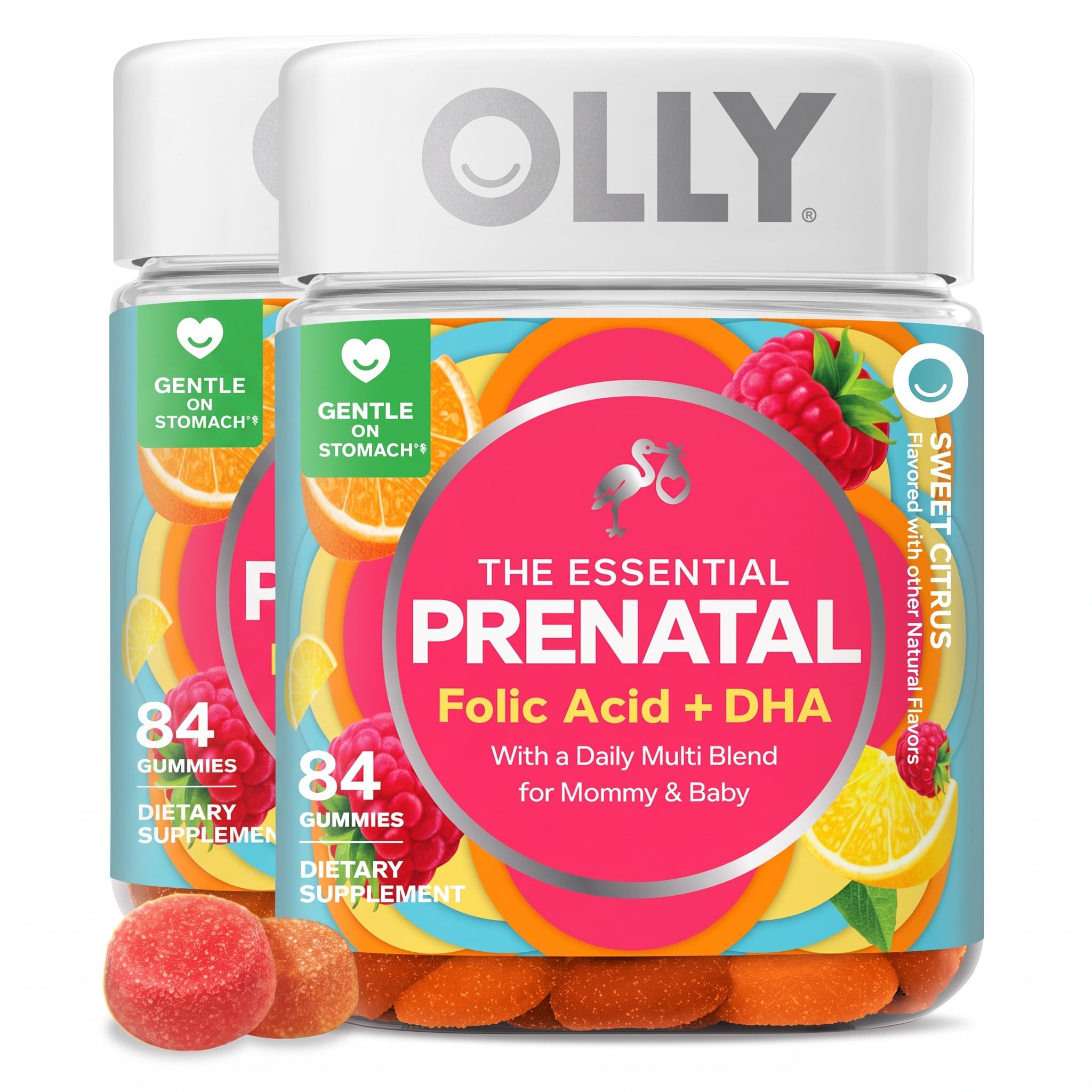
OLLY Prenatal Multivitamin Gummy
Key Features
- Count: 84 gummies per bottle, 2 bottles
- Flavor: Sweet citrus
- Serving: 2 gummies daily
- Key nutrients: Folic acid, DHA, vitamins A and D
- Price: Midrange
Sweet citrus, not berry. That is the whole argument for OLLY if you have already burned out on the raspberry and mixed-berry flavors that fill this shelf. The gummies are chewy with a fine sugar coating, closer to a fruit chew than to a supplement, and the routine is two a day with no food or water. Inside is folic acid, omega-3 DHA, and vitamins A and D.
The coating is part of why they’re easy to keep taking, and it’s also what leaves a little grit against your back teeth if you don’t rinse afterward. The smell is genuinely divisive: the same citrus note that reads fresh to one person reads like the inside of a vitamin bottle to another. In the nausea phase, when smells set you off before flavors do, that is worth knowing before you open a two-bottle pack.
Where OLLY earns its place is the daily habit. The flavor is strong enough to look forward to and the dose is easy to remember, which is most of the battle in early pregnancy. Folic acid instead of methylated folate is the trade-off, and there’s no iron, so the rest of your plan still carries that. The two bottles work out to roughly three months, a sensible way to buy once you know the flavor agrees with you.
Pros
- Citrus flavor is a break from berry
- Folic acid, DHA, and vitamins A and D
- No food or water needed
- Two bottles, about three months
Cons
- Sugar coating leaves grit on your teeth
- Strong citrus smell can turn your stomach
Buy it if berry flavors have already worn thin — we think the citrus is the easiest gummy here to take every day without dread.
Best for Organic, Vegan Diets
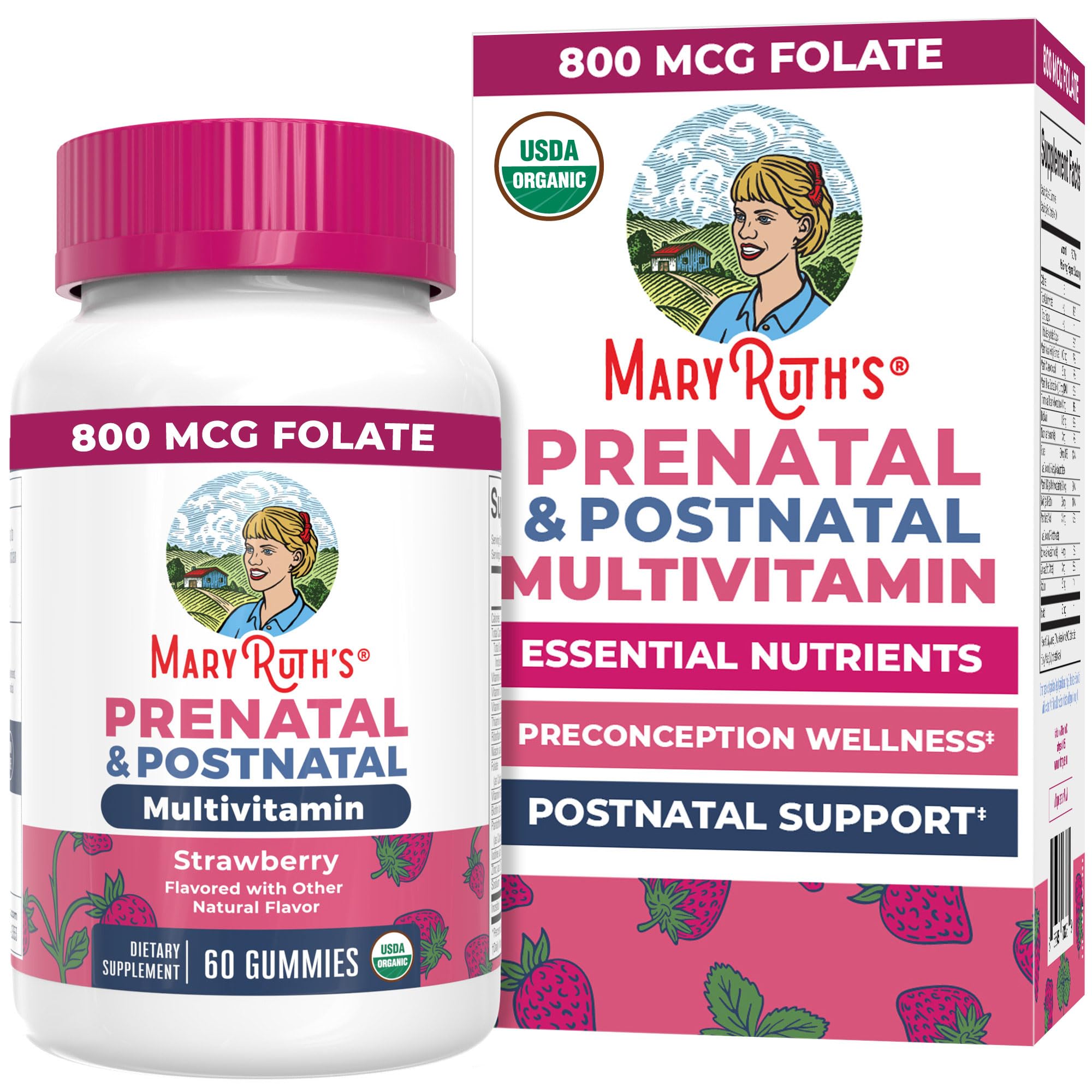
MaryRuth’s Organic Prenatal Gummies
Key Features
- Count: 60 gummies
- Folate: 800 mcg methylated folate
- Serving: 2 gummies daily
- Certified: USDA Organic, Non-GMO, vegan
- Price: Premium
The label is why we recommend MaryRuth’s: USDA Organic, pectin-based, vegan, and built on 800 mcg of methylated folate — calcium L-5-methyltetrahydrofolate — rather than ordinary folic acid. Add methyl B12, six more B vitamins, vitamins A, C, and D, zinc, and iodine, and you have the most deliberate formula in this group. Two strawberry gummies a day, with 60 to a bottle, so a 30-day supply.
It also behaves like a treat without tasting like one. The strawberry is sweet without the syrupy edge some gummies carry, the chew is soft rather than rubbery, and it doesn’t leave the sticky film a sugar-coated gummy can. It’s the gentlest of these on a queasy stomach in our experience, with no lingering aftertaste — which is the entire point of choosing a gummy over a tablet.
What you pay for is all of that, and it comes out as the highest cost per gummy here. The bottle lasts a month, so the expense is monthly rather than occasional, which is the one thing that gives us pause about recommending it as a staple. The other reason to choose it: it’s labeled for preconception through postpartum, so you don’t have to switch products when the pregnancy ends.
Pros
- USDA Organic, Non-GMO, vegan, and pectin-based
- 800 mcg of methylated folate
- Gentle on a queasy stomach
- Labeled for prenatal and postnatal use
Cons
- Highest cost per gummy here
- Bottle lasts only 30 days
Our pick for anyone who wants an organic, vegan, methylated-folate prenatal and doesn’t mind paying for it every month.
Best for Budget-Minded Buyers
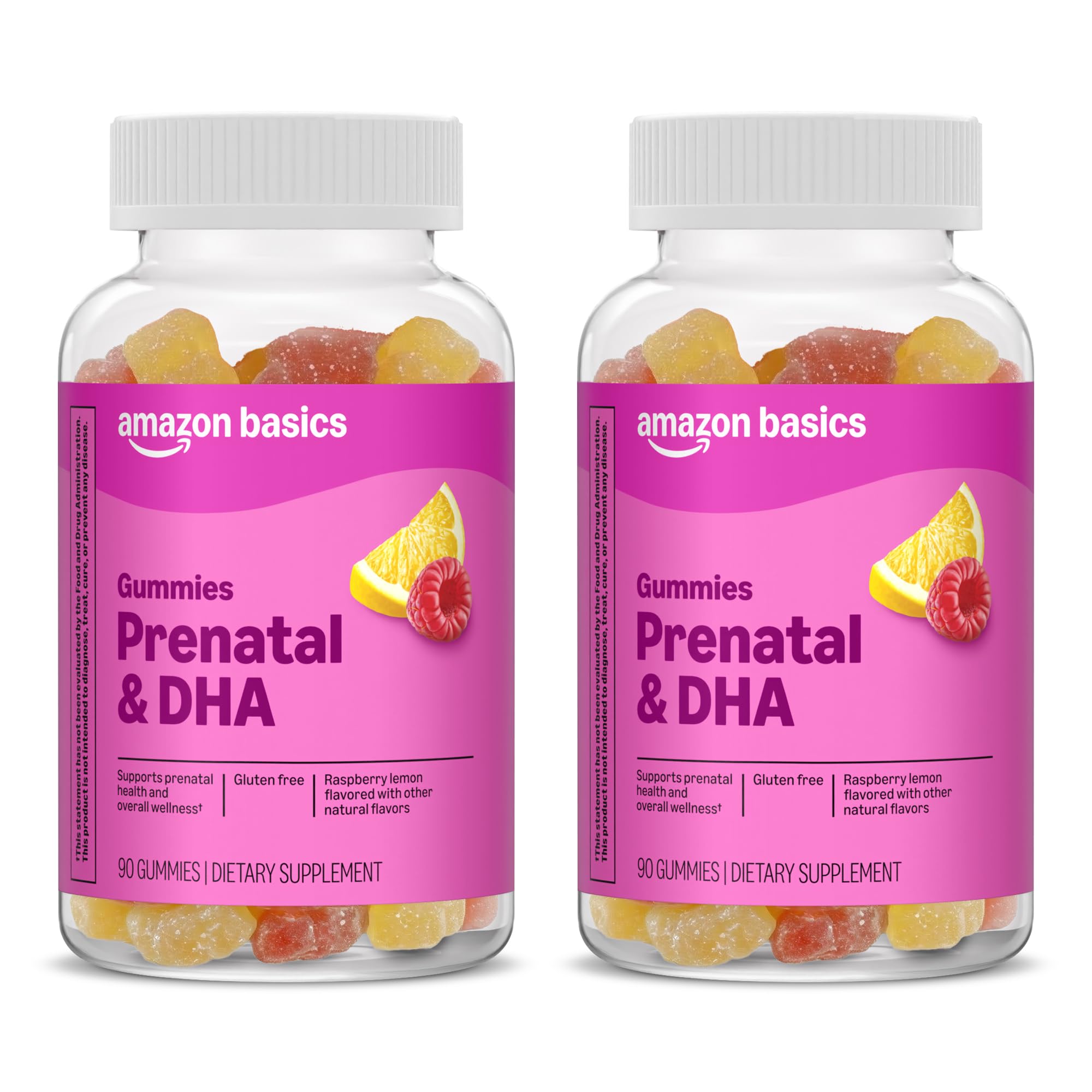
Amazon Basics Prenatal & DHA Gummy
Key Features
- Count: 90 gummies per bottle, 2 bottles
- Flavor: Raspberry and lemon
- Texture: Soft jelly
- Price: Budget
Two 90-count bottles of raspberry-lemon gummies, and the pair costs less than most of the single bottles in this guide. That’s the pitch, and it’s a good one for a supplement you’ll be buying month after month rather than once.
The gummies are a soft jelly, softer than a fruit snack, and that splits people cleanly: if you like a chew that gives way immediately, they’re pleasant; if you want something with resistance, they read as mushy. Raspberry and lemon are both mild, and there are no artificial colors or sweeteners to leave an aftertaste. The label even carries its own warning about heat, which tells you what kind of gummy this is — one that fuses into a block if it ships in a warm month.
On price, nothing here beats it, which is exactly why we keep it on the list. The stomach reports are the least consistent of any pick in this group, with nausea and heartburn turning up alongside people who take two before bed without any trouble at all. If you already know gummies sit well with you, this is the cheapest way to keep the habit; if you’re newly pregnant and sensitive, start somewhere else and come back to it.
Pros
- Lowest daily cost in the guide
- Soft jelly chew goes down easily
- Two large bottles per pack
- No artificial colors or sweeteners
Cons
- Can bring on nausea in sensitive stomachs
- Turns mushy and fuses in heat
The value pick: if gummies already sit well with you, this is the least expensive way here to take one every day.
Best for Firm-Chew Fans
Centrum Prenatal Multivitamin Gummies
Key Features
- Count: 60 gummies
- Flavor: Mixed berry and orange
- Key nutrients: DHA, folic acid, iodine
- Price: Midrange
Where most gummies in this guide are soft, Centrum’s are firm, with a sugar coating that gives you something to chew rather than something to swallow. The flavor is mixed berry and orange, and the orange is the unusual note in a category addicted to berry. Inside are DHA, folic acid, and iodine, with no high fructose corn syrup, synthetic dyes, or artificial flavors or sweeteners, and the whole thing is gluten free.
We like it for the texture as much as anything else. If soft gummies make you gag — and in a bad first trimester texture often turns your stomach before flavor does — a firmer chew is the difference between finishing the bottle and leaving it on the counter. It’s a plain, mid-priced option from a name most shoppers already recognize, the kind of bottle you can grab at a drugstore without studying it.
The bottle is 60 gummies, a shorter supply than the two-packs here, so reordering comes around sooner than you expect. Everything else about it is unremarkable in the way a daily vitamin should be: it does its job, the flavor doesn’t overstay, and there’s no learning curve.
Pros
- Firm chew for people who dislike soft gummies
- DHA, folic acid, and iodine together
- No synthetic dyes or artificial sweeteners
- Orange-and-berry flavor is a nice change
Cons
- 60-count bottle runs out sooner
We point people to it when soft gummies turn their stomach — a firm chew, a solid nutrient list, and a flavor that isn’t berry-first.
Best for Nutrient Breadth
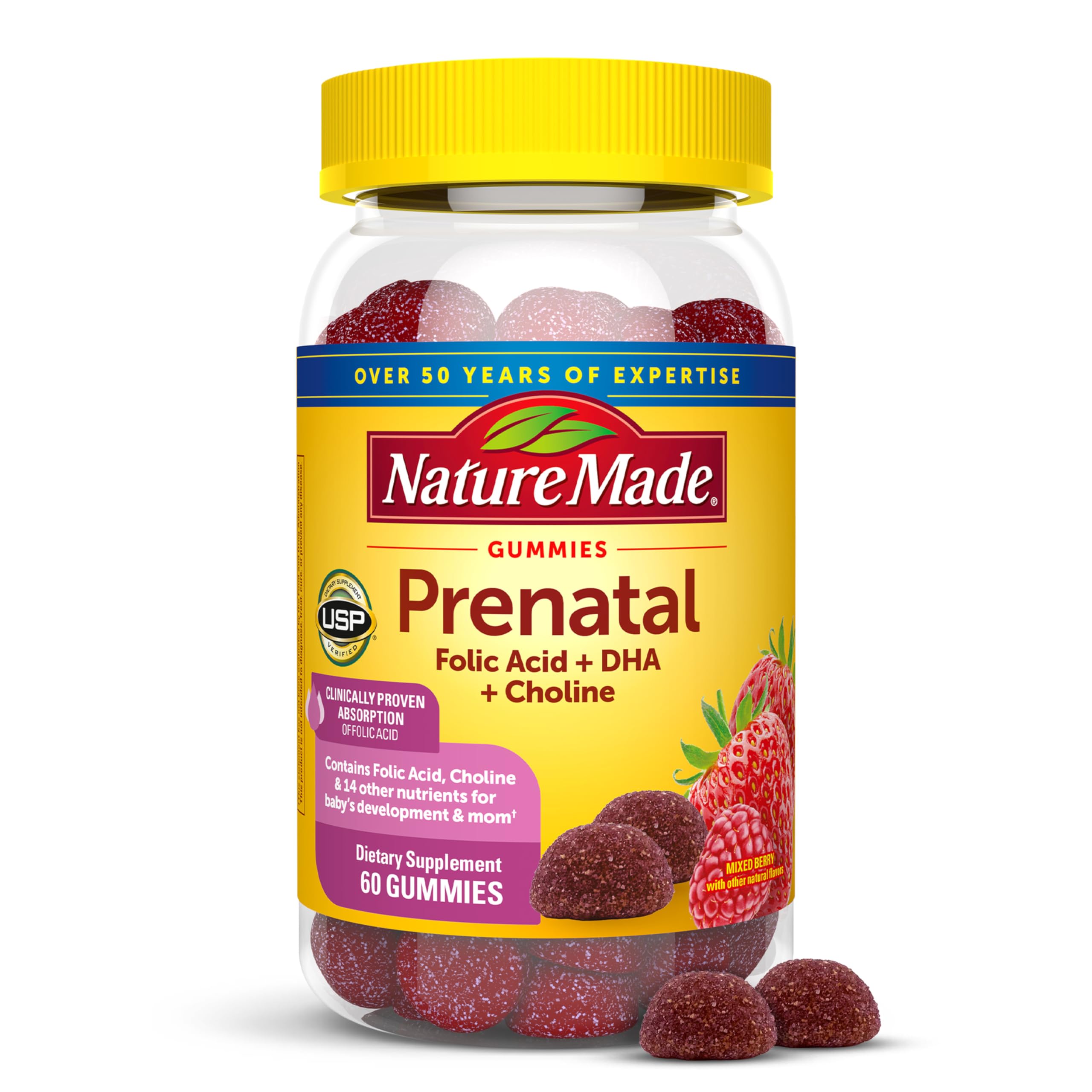
Nature Made Prenatal Gummies
Key Features
- Count: 60 gummies
- Supply: 30 days
- Serving: 2 gummies daily
- Key nutrients: Choline, DHA, folic acid
- Price: Midrange
Choline is the nutrient most gummies here skip, and Nature Made puts it in the bottle alongside DHA and folic acid, plus magnesium, biotin, and 15 other nutrients. That breadth is why it stays on our list: if you want a gummy that behaves more like a full prenatal multivitamin than a folate-and-DHA snack, this is the one to look at. Two gummies a day, 60 to a bottle, a 30-day supply.
Choline is worth a sentence of explanation because it’s easy to skim past on a panel. It works alongside folate and DHA in the nutrients that support a baby’s brain and spinal cord development, and it’s the one most gummy formulas leave out because it doesn’t bring much flavor of its own. Getting it in the same gummy as the DHA means one less bottle on the counter every morning.
The rest is ordinary in the best way: no artificial flavors, no synthetic dyes, no high fructose corn syrup, no artificial sweeteners, and gluten free. There’s one bottle size and a 30-day supply, so it’s a monthly buy rather than a quarterly one. You pick this one for the panel, not for the experience of eating it — and for a supplement, that’s a reasonable way to shop.
Pros
- Choline alongside DHA and folic acid
- 15 other nutrients beyond the basics
- No artificial flavors, dyes, or sweeteners
- Two-gummy daily dose
Cons
- Bottle lasts only 30 days
Choose it for the label: choline, DHA, and folic acid in one gummy, with more named nutrients than most of the bottles here.
Best for Vegan, Organic Focus
Garden of Life Organics Prenatal Gummies
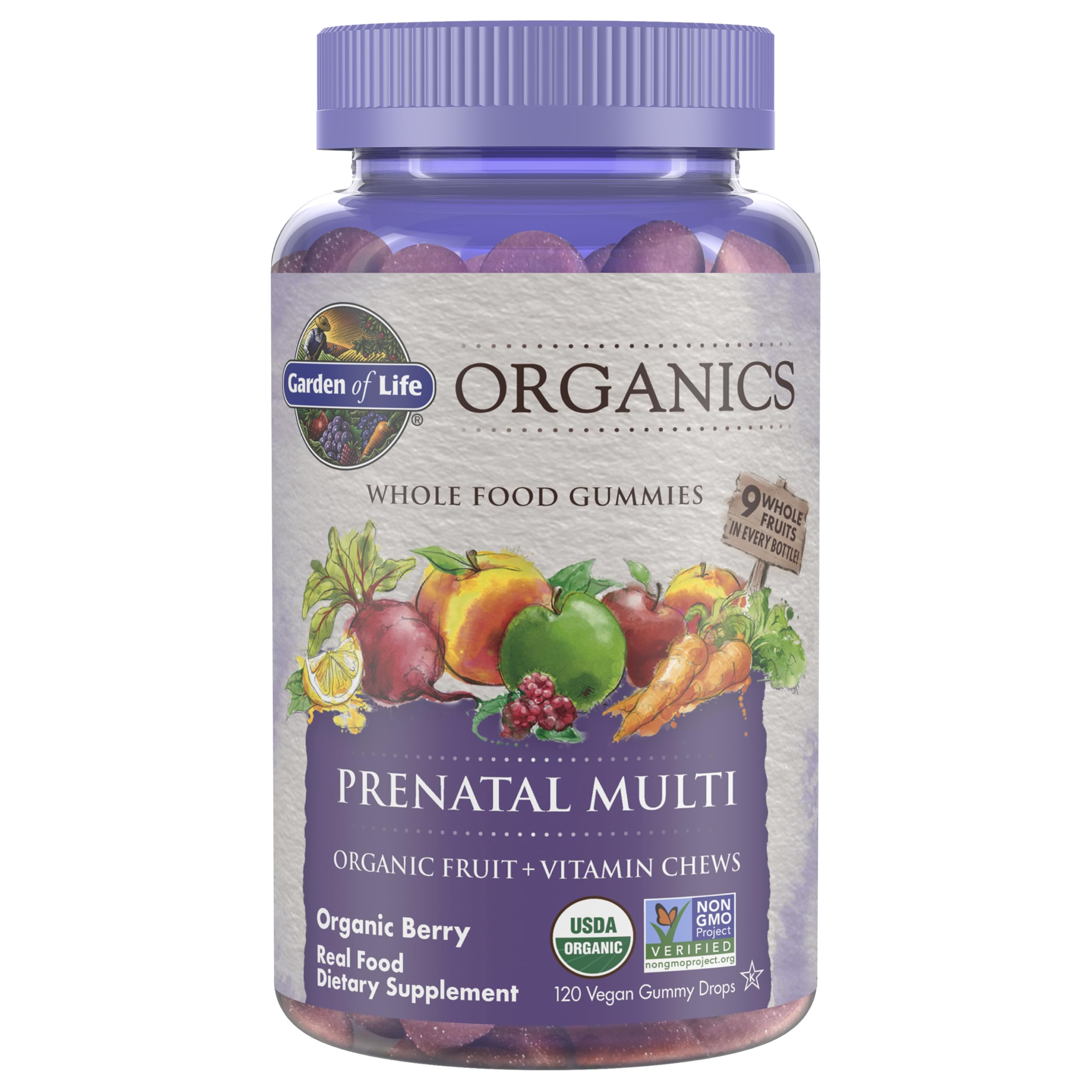
Key Features
- Folate: 100% DV from organic lemon peel
- Supply: 30 days
- Serving: 4 gummies daily
- Certified: USDA Organic, Non-GMO, vegan
Four gummies a day, not two. That’s the first thing to know about Garden of Life’s prenatal, and for plenty of people it ends the conversation — four chews is a lot when two already feels like a chore. If you don’t mind it, the payoff is a certified organic formula with 100% DV folate from organic lemon peel, 800 IU of vegan D3 from lichen, and more than 100% DV of B6 and B12 across the serving.
The certifications are the real story: USDA Organic, Non-GMO Project Verified, vegan, NSF Certified Gluten-Free, and Kosher, with no artificial colors or preservatives. Nothing else in this group stacks that many third-party labels on one bottle, which is exactly why it’s our pick for an organic pregnancy.
The berry flavor divides people. It reads sour and a little medicinal rather than like candy, which is the risk you run with a whole-food formula instead of a confection. The gummies also clump in the jar, so you’ll be prying them apart more often than you would like, and a bottle that’s been warm is worse.
So the calculation is honest: you trade convenience and a candy-ish chew for the cleanest label in this guide, and four gummies is the price of getting folate and D3 from organic and vegan sources. Anyone who has been eating organic through pregnancy and doesn’t mind a longer routine will find that trade worth it; anyone who struggled to remember two gummies should start with a bottle that asks for less.
Pros
- USDA Organic, Non-GMO, vegan, and Kosher
- Folate from organic lemon peel
- Vegan D3 from lichen
- No artificial colors or preservatives
Cons
- Four gummies per serving
- Gummies clump together in the jar
We recommend it to shoppers who want certified organic, vegan ingredients and will accept four gummies a day to get them.
Best for Trying a Gummy
Nature’s Bounty Prenatal Gummies

Key Features
- Count: 50 gummies
- Flavor: Mixed berry
- Supply: 25 servings
- Key nutrients: Folate, iodine, DHA and EPA from fish oil
- Price: Budget
Fifty gummies, 25 servings — the smallest bottle in this guide, and the reason we kept it. If you’ve never taken a gummy prenatal and you’re not sure your stomach will cooperate, a small bottle answers the question for less than any other pick here, and it answers it in under a month.
The formula is more interesting than the size suggests. You get 100% DV of folate and iodine, omega-3 DHA and EPA from fish oil, and vitamins A, C, D, and E with zinc — a longer nutrient list than several bigger bottles in this group. Mixed berry is the flavor, and it’s mild rather than sharp, which matters when everything tastes off.
Texture is the weak spot. The chew runs from soft and pleasant to hard and crystallized depending on the bottle, so a fresh one and a tired one are noticeably different experiences. It doesn’t ruin the supplement, but it does make you less likely to reach for it on a morning when you’re already queasy.
Buy it as a trial run rather than a staple. It’s the least expensive bottle here, the fish-oil DHA is a real difference from the rest of this group, and 25 servings is enough to learn whether the format suits you. Once you know, a bigger bottle gives you better value — but you will have spent less finding out, which is the whole point of a small one.
Pros
- Smallest bottle and lowest entry cost here
- Folate and iodine at 100% DV
- Fish-oil DHA and EPA
- Broader nutrient list than its size suggests
Cons
- Texture varies from soft to hard
- Only 25 servings per bottle
We see it as a low-cost trial bottle: enough gummies to learn whether a prenatal chew works for you, without a three-month commitment.
How We Tested Prenatal Gummies
We started with the gummy prenatals sold at drugstores and the ones with the deepest review bases online, then narrowed to bottles that list both folate and DHA on the label, keeping a mix of organic, vegan, and store-brand options so the lineup looked like what’s actually on the shelf. Twelve bottles went out to testers for six months.
Each tester took a bottle home and used it the way they really would: first thing in the morning on an empty stomach, alongside coffee, and after dinner. We logged whether the flavor read as real fruit or hard candy, how fast each gummy broke down while chewing, whether it left a waxy film or grit on the teeth, and whether the aftertaste hung around. We also wrote down the mornings a gummy sat badly and what we’d eaten beforehand.
Because nausea is usually the reason people switch, we deliberately took each one on an empty stomach at least three times and noted whether it went down easy or turned our stomachs. We counted out servings against the bottle’s stated day supply, kept track of whether we actually remembered to take two gummies instead of one, and rated how easily the cap opened one-handed.
Melting got its own test: a bottle of each sat on a sunny windowsill for a week and spent an afternoon in a hot car, after which we checked for fused gummies, sweating, and grit. Finally we read every panel side by side for folate, DHA, iodine, and vitamin D, flagged that iron is missing from nearly all of them, and divided the bottle count by the serving size to see what a day actually costs.
How to Choose Gummy Prenatal Vitamins
Flavor is what keeps you taking them, but the label is what decides whether a gummy can stand in for the tablet your provider recommended.
What a Gummy Can and Can’t Replace
Start with the gap. None of the gummies here lists iron, and that isn’t an oversight — iron tastes metallic and is hard to build into a chew. If your provider wants you on iron, a gummy sits alongside that plan rather than replacing it. Choline and calcium tend to run thin as well. Read the Supplement Facts against whatever your provider recommended and treat that panel as the deciding document, not the flavor name on the front.
Folate: Which Form, and How Much
Folic acid is the standard form and the one most of these bottles use; MaryRuth’s goes its own way with 800 mcg of methylated folate, which is the form some women specifically look for. Either can be a reasonable choice, so long as you compare the amount per serving rather than per gummy. The full dose usually assumes you take the whole serving — two gummies, or four in Garden of Life’s case — and that changes the math fast.
Two Gummies a Day or Four
Dose burden is the most underrated specification in this category. Two gummies is a habit you can keep in a purse; four is a ritual, and Garden of Life is the one here that asks for it. The count on the bottle means nothing until you divide by the serving size: a 60-count bottle is about a month at two a day and about two weeks at four. Divide before you compare prices, because the cost per day is the number that matters.
Texture Decides Whether You Finish the Bottle
Nausea is why most people switch to a gummy in the first place, and texture often turns a queasy stomach before flavor does. This group runs from a soft jelly (Amazon Basics) to a firm, sugar-coated chew (Centrum) to a tacky gummy that can cling to your back teeth (OLLY). If mush makes you gag, buy firm; if resistance does, buy soft. If you’re already queasy, order the smallest size available and open it the day it arrives.
Heat, Clumping, and Storage
Gummies are the most heat-sensitive supplement on the shelf, and every pick here has arrived fused into one lump for somebody. Amazon Basics prints the warning on the label; the rest don’t. Open the bottle as soon as it lands, keep it in a cool, dark cabinet rather than a sunny counter, and move it to the fridge in summer — cold firms a soft gummy back up. If a bottle arrives as a solid block, ask for a replacement instead of digging it out with a knife.
Frequently Asked Questions
Can I take gummy prenatal vitamins before pregnancy and after the baby arrives?
Yes. Most of these are labeled for before, during, and after pregnancy, and folate matters most in the months before conception, when the neural tube forms. Postpartum the same nutrients still earn their place, especially DHA and iodine if you’re nursing. MaryRuth’s is the one here sold explicitly as prenatal and postnatal. Once you’re no longer pregnant or nursing, a standard multivitamin covers the same ground for less.
Do gummy prenatal vitamins contain gelatin?
Some do — gelatin is a common way to get a chewy set. If you avoid animal products, MaryRuth’s is labeled pectin-based and vegan, and Garden of Life is certified vegan. For the others, the ingredient list on the back is the only reliable answer; a fruit-flavored front label tells you nothing about what makes the gummy chewy.
Can you take more than the serving size on the bottle?
No. Two gummies, or four with Garden of Life, is the full serving the label is built around. Extra gummies add vitamins A and D and folate you don’t need and buy you nothing. Because they taste like candy, keep the bottle out of reach of children rather than on a low shelf where a toddler can help themselves.
Final Verdict
For most people the answer is Vitafusion: two raspberry-lemonade gummies a day, folate and DHA inside, and a flavor mild enough to keep going through a rough first trimester. If certified organic ingredients and methylated folate matter more than price, MaryRuth’s earns the upgrade. If you’re simply holding costs down, the Amazon Basics two-pack is the cheapest daily habit in the guide.
