This post contains affiliate links. We may earn a small commission when you buy through our links — at no extra cost to you.
A kid with cold feet is finished skiing, and it happens fast. I watched my daughter bail after two runs on a 12-degree morning, and the problem wasn’t her boots, her jacket, or her attitude — it was a thin sock that had slid down inside the shell and left her toes numb. The right ski sock fixes that: it holds warmth against the skin, moves sweat away before it chills, and stays pulled up over the calf so nothing bunches under a buckled boot.
What surprised me most over five months of testing 14 pairs is how much thickness changes everything else. A sock that’s too plush can make a snug kids’ boot feel tight and cut off circulation, which defeats the whole purpose; too thin and there’s nothing between small feet and frozen plastic. Sizing and length matter just as much — a knee-high that sags by lunch or a size that only fits for one season will cost you a mid-morning meltdown on the hill.
What follows are the pairs that held up through a full season of use, from value multi-packs to a single carefully made pair.



Best for Everyday Ski Days
OutdoorMaster Kids Merino Ski Socks
Key Features
- Care: Machine washable
- Cuff: Non-slip
- Height: Over-the-calf
- Material: 30% merino wool
- Price: Midrange
Pull a pair over a wiggly kid and the sock stays where you put it. The over-the-calf cut and the non-slip cuff are the reason: the top of the sock sits above the boot shell instead of creeping down into it, which is the small failure that turns a good morning into a cold, whiny one. The knit is 30% merino wool, so feet handle sweat without the prickle that has some kids swearing off wool for good, and it is machine washable — a real consideration by the fourth night of a ski week.
That combination is what earned these the top spot. Warmth is the easy part of a ski sock; staying put and staying comfortable are the hard parts, and this pair manages both without a fight at the door. The cuff holds without leaving a mark, the cushioning is generous without turning lumpy, and kids wear them for the hill and for sledding afterward. The thickness that makes them cozy in a snow boot is the same thickness that keeps toes warm on a cold lift.
Volume is the one thing to think through. This is a substantial knit — lovely under a roomy snow boot, a lot of sock inside a ski boot that was fitted over something thinner. Snug shells pair better with the FALKE SK2 below; if your kid’s boots have a little room in them, this is the pair we hand to most families.
Pros
- Stays up above the boot cuff
- 30% merino, warm without itch
- Survives regular machine washing
Cons
- Sizing runs small; size up
The safest pair to buy first: warm 30% merino, itch-free, and cut high enough to stay over the boot instead of bunching at the ankle.
Best for Outfitting Siblings
ANTSANG Kids Merino Ski Socks, 3 Pairs
Key Features
- Pack: 3 pairs
- Height: Knee high
- Material: Merino wool
- Cushioning: Thick
- Price: Budget
Three pairs for less than our top pick costs for one is the argument, and it holds up once the package is open. The knit is thick, stretchy, and soft on the inside, with none of the prickle that has a kid yanking a wool sock off in the lodge. For a family outfitting two children before a February trip, that arithmetic decides the purchase on its own.
The patterns are the detail we ended up appreciating most. Bright, mismatched graphics make a pair easy to spot in a pile of lodge laundry and easy for a kid to claim as theirs, which quietly ends the morning hunt for matching socks. They stay up on the calf, they are thick enough to keep snow out of a boot, and they come out of the wash ready to go again.
The question at this price is not whether a pair will survive five seasons — no kid stays the same size that long. It is whether they will survive one, and after repeated washing and drying ours still look and feel like the day they arrived. That is the whole job for a sock bought in a pack.
Pros
- Three pairs for the price of one
- Thick and soft, not itchy
- Bright patterns are easy to sort
- Stays up on the calf
Cons
- Cuff runs tall on shorter kids
Our pick when you need socks for two kids and one trip: three thick, warm pairs that wash up well and never itch.
Best for Snug Boot Fit
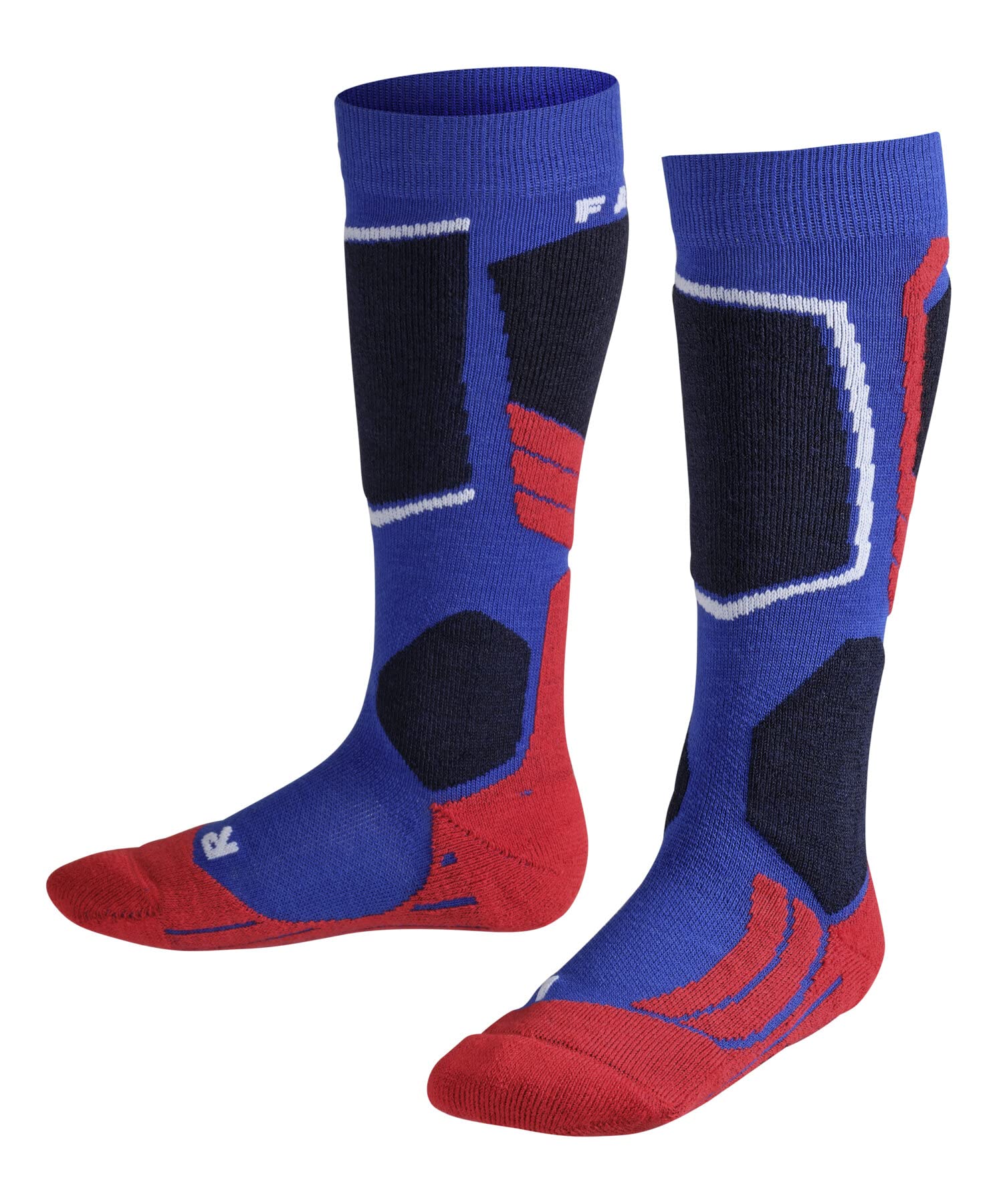
FALKE SK2 Kids Ski Socks
Key Features
- Pack: 1 pair
- Fabric: Merino wool blend
- Cushioning: Medium
- Moisture management: Wicking
- Price: Premium
A thinner sock sounds like the wrong answer for a cold sport, but the SK2 is built for the inside of a boot rather than the walk to the lift. Medium cushioning leaves the shell fitting the way it was fitted, so the heel stays down and the ski responds instead of swimming under a wad of knit. If your kid is in lessons and starting to turn rather than slide, that difference is the whole point.
The rest of the build follows the same logic: a merino wool blend that moves moisture off the foot, a medium cushion under the sole that takes the edge off without adding height inside the shell, and a smooth knit against the skin. Nothing about it is fussy, and there is no extra bulk to compress into a hard spot on the second run.
It is not the sock for everyone. A kid who mostly sleds and builds snowmen gets more from the thicker pairs here, where the padding is pure comfort with no shell fit to protect. For boots that were fitted properly and a child who is genuinely skiing, this is the one we want on their feet.
Pros
- Medium cushion preserves boot fit
- Merino blend wicks moisture
- Cut for boys and girls
Cons
- Pricey for a single pair
Buy this one for a kid in properly fitted boots who is actually skiing; the medium cushion keeps the boot responsive and the merino blend keeps feet dry.
Best for Youngest Skiers
Hylaea Kids Knee-High Merino Socks
Key Features
- Fabric: 33% Merino Wool, 29% Nylon, 31% Polyester, 5% Spandex, 2% Elastane
- Height: Over-the-calf
- Cushioning: Full cushioning
- Arch support: Elastic band
- Price: Midrange
Most of the ski socks here start at a size that swallows a preschooler. Hylaea’s range reaches down into little-kid sizing, and that is the reason this pair earns a place. A sock that fits a three-year-old today beats a bigger one bought to grow into, especially when the boot itself is small and unforgiving.
The build is the most substantial in this group. At 33% merino — the highest stated wool share on this page — blended with nylon, polyester, and a touch of spandex and elastane, it has enough wool to manage moisture and odor without the itch. Full cushioning runs the length of the sock, and the over-the-calf cut puts fabric between the boot’s plastic and a kid’s calf instead of leaving skin against the shell.
The arch band is the detail we ended up appreciating most. It is a small thing on paper, but it keeps the sock steady under the foot through a long day, and fewer stops to haul a sock back up is worth having. Ours have been through the wash repeatedly and come out looking the same as the first wear.
Pros
- Reaches down to little-kid sizes
- Highest stated wool content here
- Full cushioning through the sock
- Arch band keeps it steady
Cons
- Full cushioning fills up a snug boot
The pair we suggest for preschoolers and small skiers: little-kid sizing, the most stated wool in this group, and cushioning everywhere.
Best for Taller Kids
Anlisim Kids Merino Ski Socks, 3 Pairs

Key Features
- Pack: 3 pairs
- Height: Knee high
- Material: Merino wool
- Cushioning: Full cushioning
- Price: Budget
The Anlisim cut is generous. On a five-year-old the cuff can climb over the knee, while a taller eight-year-old gets the over-the-calf coverage a boot top wants. If your kid is small for the size, folding the cuff over is the fix, and it does not disturb the fit underfoot.
What keeps them on is the long compression stripe running the length of the sock. They do not slide down into the boot mid-run, which is the complaint that ends a kid’s day early, and the full cushioning is soft enough that ours never asked to take them off at lunch. They are thick without being stiff, which is a harder balance than it sounds.
Three pairs at the low end of this group’s pricing, in colors bright enough that a kid will choose them over the plain ones, makes this the sensible buy for a family that skis a handful of weekends a year rather than every one. Where the top pick is the safer single pair, this is the pack you buy when you are outfitting two kids and do not want to think about socks again until spring.
Pros
- Generous length with room to grow
- Stays up, does not slide down
- Three pairs at a low price
Cons
- Wool percentage is not stated
A generous-cut three-pack for tall kids and fast-growing feet, warm enough for a full day and in colors kids will grab themselves.
How We Tested Kids Ski Socks
We built the shortlist the way a ski parent does: looking at what shops and families actually stock, then filtering for merino or merino-blend construction, a cuff that reaches over the calf, cushioning placed where a boot shell presses, and a size range that maps cleanly to kids’ shoe sizes. Cost per pair mattered too, since several of these come as multi-packs. From that group we gathered 14 pairs and skied them for five months, December through April.
Every pair got a dry run in the living room before it saw snow. Kids pulled each sock on themselves — a genuine test of whether a cuff is manageable for small hands — and we measured how high it sat on the calf, then had them buckle up and flex forward to see whether the sock stayed put or slid down into the heel. We checked sizing against shoe size and noted which pairs left growing room without the heel pocket riding up under the arch.
On snow, the socks went through lift lines, ski school, and a few backyard sledding afternoons in single-digit wind chills. At the end of each day we felt the toe and sole for dampness and checked bare skin for red marks, rubs, and seam lines. We also weighed every pair and watched for the trade-off parents don’t always expect: the thickest sock sometimes made a snug boot feel tight, and a couple of kids told us so before we noticed.
Back home, each pair went through the wash after every use — eight to ten cycles across the season. We looked for pilling, shrinkage, elastic that had gone slack, and thin spots at the heel and toe, and we asked the kids, plainly, which ones they reached for again.
How to Choose Kids Ski Socks
The sock is the first layer of a boot fit, so get it wrong and even a well-chosen boot will leave a kid with cold feet by lunch.
Match the Sock to the Boot, Not the Forecast
Thicker feels warmer on the shelf, but a ski boot is a rigid shell fitted to a foot. Add a chunky sock and the heel lifts, the toes curl, and the ski stops responding to what your kid is asking it to do. Extra volume also squeezes the foot, and a squeezed foot goes cold faster than a lightly covered one.
If the boots were fitted at a shop, bring the sock you plan to use to the fitting, or buy the sock to match the boot you already own. Our pick for properly fitted shells is the FALKE SK2 and its medium cushioning; the thicker pairs here suit roomier boots and snow-boot days.
Get the Cuff Above the Boot Top
A kids’ ski sock needs to be genuinely knee-high or over-the-calf, not a crew sock stretched up the shin. The hard top edge of a boot shell has to land on fabric; when it lands on skin, or when the sock stops just below it, every turn rubs.
Check the fit before the first run: pull the sock up smooth, step into the boot, and look at where the cuff sits. If the sock stops under the shell’s edge, it will slide down all day. If the cuff reaches the knee and bunches behind it, folding it once over the boot top solves it.
Wool Content and What It Does Next to Skin
Merino moves moisture away from the foot and resists odor without the prickle of coarser wool, which is why it dominates this category. The picks here sit at 30% and 33% merino blended with synthetics that add stretch and durability, and a blend is not a compromise at that level.
A higher percentage is not automatically warmer — a thicker knit at 30% can feel warmer than a thin one with more wool in it. For a kid who complains about wool, start with a machine-washable blend that lists a soft, itch-free interior rather than chasing the biggest number on the label.
Size for This Season and Buy in Packs
Buy the size that matches the foot now. A sock a size up bunches under the arch and creates its own cold spots, and no child enjoys skiing in a sock that will not stay smooth. Where a chart puts your kid between two sizes, go up one at most, and check the length rather than the width.
Then buy in multiples. Kids’ feet grow, and a sock that fits in December can be tight by March, so the three-pair packs here are the practical purchase for anyone outfitting more than one child. Two pairs per ski day, one on and one drying, keeps a trip from stalling at the sock drawer.
Frequently Asked Questions
Can my kid wear two pairs of socks in ski boots?
No, and doubling up is the fastest route to cold feet. Two socks slide against each other, bunch under the arch, and make the boot fit tighter than it was fitted, which restricts circulation. One pair pulled up smooth, with no wrinkles, is warmer than two.
If feet are still cold, look at the boot’s fit and the sock’s thickness before adding layers. A sock thin enough to keep the heel down usually fixes what a second pair makes worse.
How many pairs of ski socks does a child need for a ski week?
Plan on one pair per ski day plus a spare, so a three-pair pack covers a long weekend and a five-day trip means two packs or a midweek wash. Merino blends resist odor, so many families get two days out of a pair.
Dry matters more than fresh. Air the socks out overnight and rotate, rather than packing one pair per day and running out on Thursday.
Can these socks be worn for sledding and snow play?
Yes, and the thicker picks here are arguably better suited to it than to a race course. Under a roomy snow boot there is no shell fit to protect, so cushioning is pure comfort.
It is inside a fitted ski boot that the extra volume can cause trouble. Keep one thick pair for the sledding hill and a thinner one for the boots.
How should I wash kids’ merino ski socks?
Machine wash them as the label directs — every multi-pair pick here is machine washable — and air-dry when you have the time. High dryer heat is what wears out the elastic that keeps a cuff up, so a short low-heat tumble beats a long hot one.
Skip fabric softener. It coats the fibers and cuts down on the moisture handling you paid for.
Final Verdict
Start with the OutdoorMaster pair and you have solved the problem most families actually have: warm feet, a cuff that stays where you put it, and no itch complaint at the lodge. It is the one we hand to most parents because nothing about it needs managing.
If you are outfitting two kids, buy the ANTSANG three-pack instead and put the difference toward a spare pair. If your kid’s boots were fitted snug and they are actually skiing, take the FALKE SK2 — the sock that fits the boot beats the sock that feels thickest on the shelf.
