This post contains affiliate links. We may earn a small commission when you buy through our links — at no extra cost to you.
A play parachute looks like an inexpensive piece of nylon until 20 kids grab the handles and pull in opposite directions. That’s when you find out what you bought: whether the handles are sewn into a reinforced hem or tacked onto a single layer, and whether the stitching holds. I’ve watched a handle tear free on the second use of one that looked perfectly fine in the package. A good one gets a whole group playing one game, no turns and no waiting.
My team and I spent three months putting 12 play parachutes through gym classes, backyard parties, and park afternoons, from six-foot canopies to ones that need a whole class to lift. Handle count has to keep pace with the diameter, or the middle sags for lack of hands. Bright rainbow canopies got grabbed first every time; paler ones sat in the bag. What separates a good value from a bad buy is how the fabric and handles survive a season of being stuffed into a bag, and the picks below are the ones I’d hand to a gym teacher.


Best for Full Group Play
Sonyabecca 12-Foot Play Parachute
Key Features
- Size: 12-foot diameter
- Handles: 12 reinforced web handles
- Storage: Carry bag included
- Material: 210T polyester taffeta
- Price: Midrange
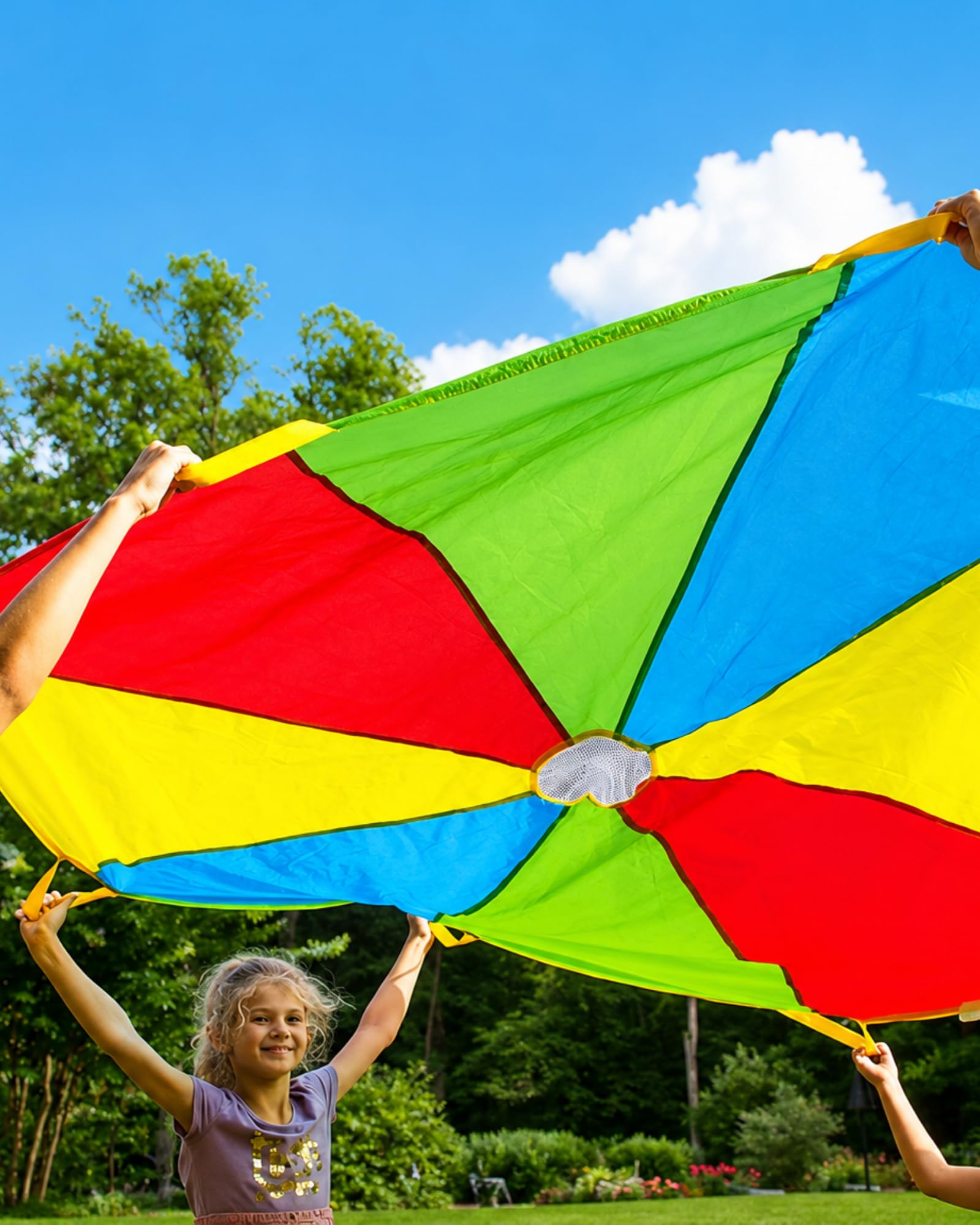
A 12-foot parachute should feel like a group activity, not a tablecloth with handles, and this Sonyabecca is the one that hits that mark for us. The canopy is 12 feet across, with 12 reinforced web handles spaced around the edge, so a dozen kids can each take a grip without elbowing for a spot. The 210T polyester taffeta is light enough to lift and billow, and the mesh center gives the air somewhere to go instead of letting the canopy fight the group.
We paid close attention to the handle attachments because that is where a play parachute takes the most abuse. The reinforced web handles and mesh center are the right construction for tugging games, and the fabric has enough body to stay open when the group lifts together. It is not a heavy gym mat of a parachute; that is a good thing for kids who need to get it moving.
The 12-foot size is the reason this is our top pick: it works for a classroom, a birthday party, or a yard full of cousins, while packing down into the included carry bag. For a family with two or three kids, the 8-foot Sonyabecca is easier to manage, but for the group play most people are shopping for, this is the more useful canopy. The stuff sack is snug, so folding it takes a little patience; a pillowcase is an easier target when the game is over.
Pros
- Twelve handles for a full group
- Light fabric with a mesh center
- Good group size for classes and parties
- Included carry bag for storage
Cons
- Needs a clear 12-foot play area
For a full class or party, the Sonyabecca 12-foot is the canopy we recommend: 12 handles, a light 210T body, and enough room for real group games.
Best for Heavy Daily Use
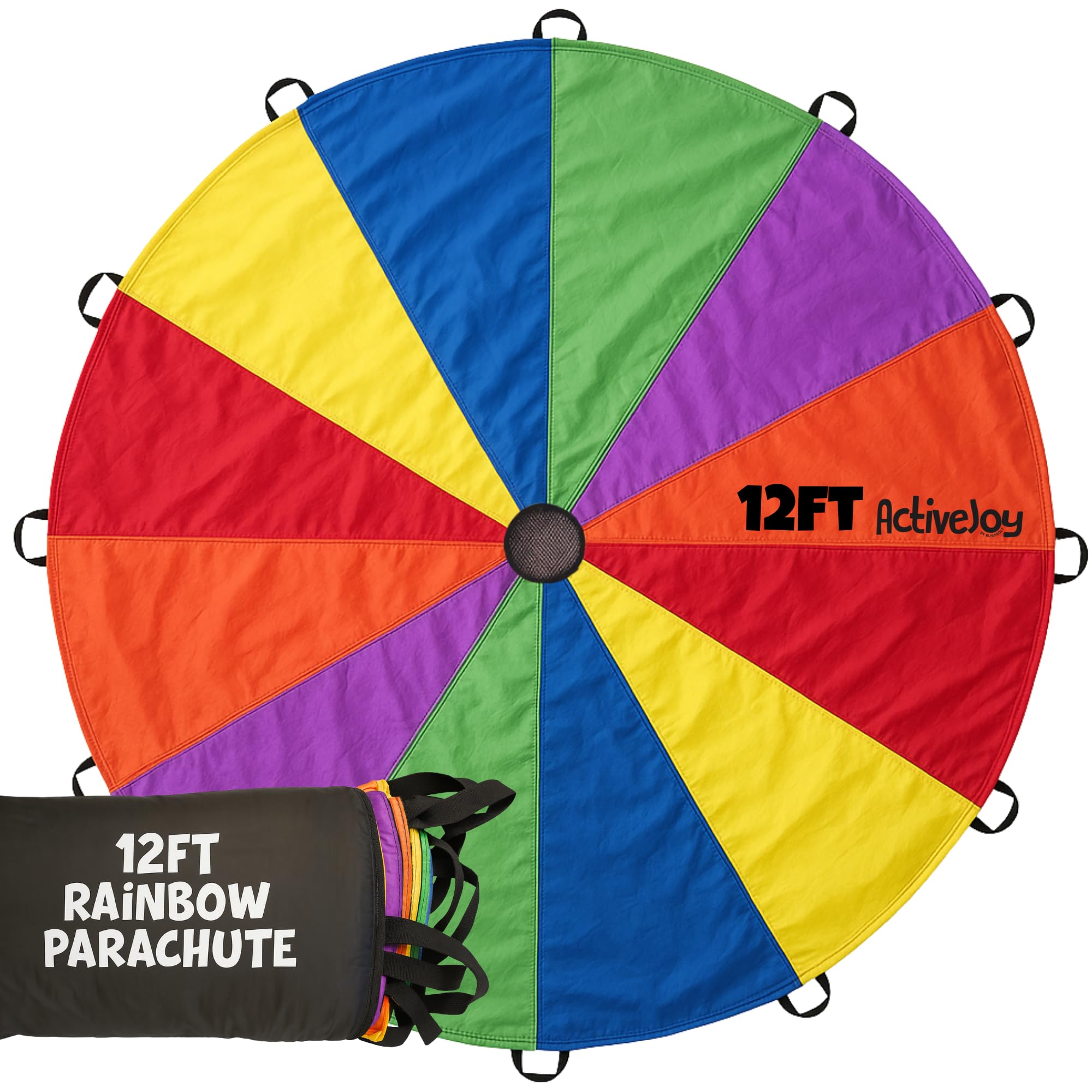
Activejoy 12-Foot Parachute
Key Features
- Size: 12-foot diameter
- Handles: 12 double-stitched handles
- Included: Activity guide
- Material: 210T polyester
- Price: Midrange
Double cross-stitching is the construction detail on this 12-foot Activejoy: the handles are reinforced at the perimeter, and the 210T polyester canopy is finished in a full rainbow. On a play parachute, that stitching is not decoration; it is what holds up when a group pulls in different directions.
We like the confidence that reinforcement gives a group that plays often. At 12 feet with 12 handles, the canopy gives a full class room to spread out, and the perimeter handles give each child a clear place to hold on. The edge stays organized even when a dozen kids are moving at once, which is the difference between a game and a pile of fabric. The fabric is light enough for younger elementary kids to lift, but it does not feel like a disposable party favor.
The included activity guide is a real convenience for a teacher or a parent who does not want to invent a game on the spot; it gives you a starting point for popcorn, mushroom, and the usual parachute games. For a group that meets every week, that ready-to-go support makes this one feel like classroom equipment rather than a novelty. If you already have a game plan, the guide is a bonus; if you are new to parachute games, it is the difference between a successful first session and a lot of standing around.
Pros
- Double-stitched handle attachments
- Included activity guide for ready-made games
- Twelve-foot size for a full class
- Light 210T polyester canopy
Cons
- Three-month warranty is short
When your group plays hard, we trust the Activejoy’s double-stitched handles and 12-foot canopy to hold up to frequent use.
Best for Smaller Groups
Sonyabecca 8-Foot Play Parachute
Key Features
- Size: 8-foot diameter
- Handles: Evenly spaced web handles
- Storage: Carry bag included
- Material: 210T polyester taffeta
- Price: Budget
If a dozen kids are not in the room, the 8-foot Sonyabecca makes more sense than our top pick. The smaller canopy is sized for a family or a small class, and the evenly spaced handles give four to eight kids a comfortable grip without the edge sagging between them. It is the size we reach for when the group is closer to six than twelve.
The 210T polyester taffeta and reinforced mesh center are the same basic recipe as the 12-foot version, so it still lifts and packs easily; the difference is how much room you give up. We found the 8-foot size easier to steer around a playroom, and the included carry bag makes it a take-along option for grandparents or a park day. When the guest list is six kids and a couple of adults, the canopy stays off the floor and the games keep moving.
For a family with younger kids, this is the Goldilocks parachute: big enough for a real group game, small enough that two adults can manage it without a gym. Keep rough tug-of-war games off the schedule; the reinforced web handles are made for normal group play, not a pulling contest. The eight-foot size is also easier to store on a shelf between uses.
Pros
- Eight-foot size suits smaller groups
- Evenly spaced web handles
- Packs into an included carry bag
- Mesh center keeps air moving
Cons
- Fabric feels lighter than premium picks
For a family or small class, we like the 8-foot Sonyabecca for real group play without a gym-sized canopy; it is the easier size to live with.
Best for Toddlers and Playrooms
Play Platoon 6-Foot Parachute
Key Features
- Size: 6-foot diameter
- Center: Reinforced mesh
- Handles: 8 reinforced handles
- Recommended age: 36 months to 10 years
- Price: Budget
Six feet sounds too small for a play parachute until you picture a toddler circle in a living room. The Play Platoon is a toddler-scale canopy: 6 feet across, eight reinforced handles, and a reinforced mesh center that lets air through when little kids lift it. It is also the size that fits a preschool circle without asking anyone to rearrange the furniture.
We like it for the age when a 12-footer is more space than the group can use. The smaller size makes it useful: it fits in a playroom, a preschool circle, or a suitcase for a mission trip, and eight handles are enough for a small group to play without a traffic jam at the edge. The handle attachments are the weak point if older kids start pulling hard; keep the games calm and this canopy does what it is meant to do.
For grandparents, a small daycare, or a family with a toddler and a preschooler, this is the parachute that gets used rather than stored. It is also the easiest of our picks to pack away, and the mesh center means you can still play the classic games on a smaller scale. The six-foot size is less intimidating for a child who has never held a parachute before.
Pros
- Six-foot size fits toddlers
- Eight reinforced handles for small hands
- Reinforced mesh center improves airflow
- Packs small for travel
Cons
- Too small for full classes
We recommend the Play Platoon for toddlers and tight spaces; this compact six-footer gets a small group moving without overwhelming the room.
Best for Classroom Games
GSi 12-Foot Rainbow Parachute

Key Features
- Size: 12-foot diameter
- Handles: 12 handles
- Handle ratio: 1:1
- Recommended age: 3 years and up
- Price: Premium
GSi does one thing that catches a teacher’s eye: a 1:1 handle-to-size ratio, so the 12-foot parachute has 12 handles rather than a generic ring of straps. The rainbow parachute pattern is the classic playground look, and the polyester canopy is built for indoor and outdoor use. The 12-foot size gives a dozen children a place to hold on, and the bright panels make the edge easy to see.
We like the way that layout keeps a group organized, and the 12-foot size is big enough for a class to spread out. What holds the GSi back is the handle construction: the pull points can fail under hard use, and that is the one part of a parachute no game can work around. For calm classroom games, it is a capable canopy; for rough tugging, the Activejoy’s reinforced stitching is the better bet.
The carry bag is included, and the 12-foot canopy still folds down to a shelf-friendly bundle. If a school wants a parachute that looks like the one in the gym closet, GSi is the recognizable choice; the one-handle-per-foot layout is also easy to teach to a substitute.
Pros
- One handle per foot of canopy
- Classic rainbow playground panels
- Included carry bag for storage
- Indoor and outdoor use
Cons
- Costs more than similar 12-foot picks
We see the GSi as a familiar classroom parachute with a sensible one-handle-per-foot layout, best for calm group games rather than rough tugging.
How We Chose and Tested the Best Play Parachutes
We started with a long list of every play parachute we could find in sizes from six feet up to 35, then cut anything that didn’t state both its diameter and its handle count, and anything where the photos showed handles stitched straight onto a single-layer hem with nothing reinforcing it underneath. That left 12 parachutes, which we used for three months.
Testing happened where parachutes actually get used: a school gymnasium with a class of second graders, a backyard with a family of five, a park with a dozen kids on a Saturday, and a beach afternoon where one spent hours staked out as shade. To check the handles, we hung a 20-pound sandbag from each one for a full minute and then looked at the seam; a few pulled a visible ripple into the fabric, and one tore loose at the second handle we tried. We also counted handles and measured the spacing between them against the listed diameter, which tells you how much canopy each kid is really holding.
For material, we felt for a ripstop grid, ran a thumbnail along the hem to check for loose threads, and stuffed each parachute back into its sack 20 times to see which edges started to fray. On size, we set each canopy up with six kids and then with 20, watching whether the center collapsed or the edge lifted cleanly, then folded it to see if it went back in the bag without a fight. Color we judged the way kids do — we laid several out at once and let the group pick. Versatility was the easiest to score: we used them as tents, picnic blankets, and a sunshade, noting which ones needed two adults and which a kid could drag out solo, and once the three months were up we weighed price against handle count and fabric heft.
How to Choose a Play Parachute
The right play parachute is the one that gives every child a handle without turning your living room into an obstacle course.
Size Comes First
The diameter decides how many children can hold on without crowding. A 6-foot canopy is a toddler or small-playroom size; an 8-foot model suits a family or a small class; a 12-foot parachute is the better fit for a full class, a party, or a dozen kids who each want a handle. We start with the group, not the guest list, and count the children who will actually take a grip.
A 12-foot parachute needs at least a 12-foot-wide clear area, plus room to step back and lift. Measure the longest open wall or lawn before you order, and remember that a low ceiling or a ceiling fan can turn a lively game into a repair bill. If the space is tight, go smaller rather than buying a canopy that never gets opened.
Handles Are the Wear Point
Count handles against the number of kids who will play, but do not stop there. A handle is a pull point, and the stitching that attaches it matters more than a generous count. We put reinforced web handles and double cross-stitching ahead of a higher handle count; a parachute with 12 handles on single stitching can still fail when the group pulls in different directions.
Spacing matters too. Evenly spaced handles let children switch places without everyone letting go at once, and they keep the canopy from bunching in one spot. For mixed ages, put the youngest children between two older ones and keep the first few games gentle.
Fabric and Airflow
The common 210T polyester taffeta is a sensible middle ground: light enough for kids to lift, sturdy enough to pack and unfold without feeling like tissue paper. We prefer a reinforced mesh center because it gives air somewhere to escape, which keeps the canopy from ballooning and makes the classic lift-and-drop games easier to control.
Look at the seams and the mesh ring rather than the color alone. A canopy that feels stiff may be harder for small children to wave, while a very thin one can snag. Color is still useful for visibility, but it is not a durability feature.
Age, Supervision, and Group Fit
Most play parachutes are aimed at ages 3 and up, and that is a reasonable starting point: a child needs to hold a handle and follow a group direction. Younger toddlers can join with an adult at the edge, but they may not keep a grip through a fast game. Check the maker’s age rating before you buy, and plan on adult supervision.
Older kids can handle a larger canopy and more vigorous games, but the handle attachments still set the limit. A 6-foot parachute is not a bad parachute because it is small; it is the wrong one for a full elementary class. Match the size and the pace to the group.
Storage and Where You’ll Use It
A carry bag is useful, but the fit of the bag matters. A 12-foot parachute can be a wrestling match to stuff back into a small sack; a pillowcase or open tote is a forgiving alternative. Check the folded size if the parachute will live in a closet, a car trunk, or a teacher’s cabinet.
Indoors, clear a room with a high ceiling and no overhead fixtures. Outdoors, choose a calm day and a lawn without sharp sticks or rocks; a parachute catches wind like a sail. The best storage spot is the one that makes you willing to get it out again.
Frequently Asked Questions
What games can you play with a play parachute?
Start with popcorn: put a few soft balls or beanbags in the center and have the group shake the canopy. For mushroom, everyone lifts together, then steps under as the fabric comes down. Keep the first rounds slow for ages 3 to 5, and use lighter objects so no one gets hit.
Can adults join in on a play parachute?
Yes, and a few adults help keep a large canopy moving. Grown-ups should take a handle gently rather than yank, especially with younger children on the other side. A 12-foot parachute has room for a couple of adults; a 6-foot model is better left to the kids.
How do you clean a play parachute?
Spot-clean with mild soap and water, rinse with a damp cloth, and air-dry it completely before folding. Skip the dryer, which can damage the fabric or mesh, and check the care label first. For a full wash, follow the maker’s instructions rather than guessing.
Final Verdict
For most families, classrooms, and party groups, the Sonyabecca 12-foot parachute is the one we recommend: 12 handles around a 12-foot canopy, a light 210T polyester body, and a mesh center that keeps the air moving. It gives a full group a real game without the bulk of a gym-only parachute.
If you expect hard daily use and want extra reinforcement at the handles, the Activejoy is the upgrade. For a playroom, a toddler group, or a grandparent’s house, the Play Platoon 6-foot is the compact choice. Start with the group size, then pick the handle construction you need.
