This post contains affiliate links. We may earn a small commission when you buy through our links — at no extra cost to you.
A hopper ball is about as low-tech as a toy gets: a fat vinyl balloon with a handle molded on top. That simplicity is exactly why the differences are easy to miss in a product photo — until a kid climbs onto one that’s inflated too soft, leans forward, and slides clean off the front onto the driveway. I’ve been the parent picking up that kid.
What separates a good one from a frustrating one comes down to unglamorous things: how thick the vinyl is at the seam, whether the handle holds when a kid yanks it sideways, and how well the ball keeps its air after a week parked in the garage. Size matters more than color, too — an 18-inch ball that fits a 4-year-old will feel like a wobbling dinner plate under a 9-year-old. We inflated and lived with 14 hopper balls over three months, from toddler-sized up to a 29-inch adult version, and the pattern held.
A cheap pump with a poor nozzle fit will cost you more patience than the ball costs money, so that counted too. Below are the ones actually worth bouncing on.
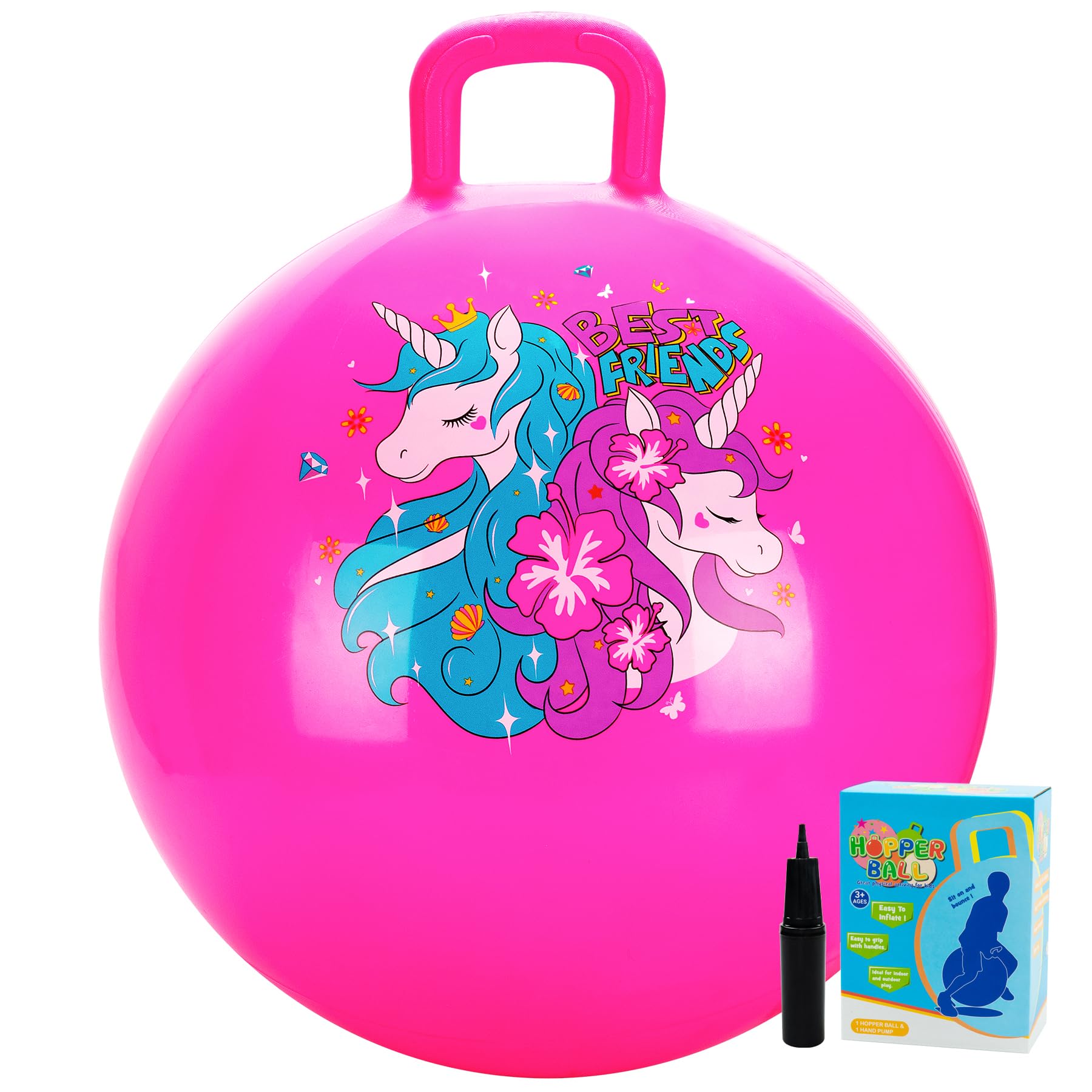


Best for Young Kids
U&C Planet Unicorn Hopper Ball
Key Features
- Included: Hand pump and gift box
- Age range: 3 to 6 years
- Inflated size: 18 in
- Price: Midrange
The best part of this ball is the small stuff in the box: a hand pump, spare air stoppers, and a little tool for pulling the plug back out. The plug is the piece that fails first on any inflatable hopper. It works loose, the ball goes soft overnight, and the toy ends up in the garage with a slow leak nobody can find. Spare stoppers cost a manufacturer almost nothing and save a toy’s life, and this is the only ball here that ships with them.
We paid closer attention to the valve than to the print on every ball in this group, and this is the one where nothing goes wrong. The 18-inch shell is thick PVC with a non-slip base and a single handle sized for a small hand, and the 3-to-6 label lands where a hopper ball actually gets used hard: indoors on carpet first, then out into the yard. Leaks and popping barely come up at all here, which is not true of every ball on this page, and the included pump means it is rideable the day it arrives.
Two things to think around. The ball runs generous for 18 inches, so it can be too much for a small 2-year-old and suits a tall 5-year-old better; letting a little air out settles that. And the pink unicorn is the only finish, which is a delight for one kid and an instant no from another. AppleRound’s cloud blue is the neutral answer if the print is the problem, as long as the rider is old enough for a 20-inch ball.
Pros
- Pump, spare stoppers, and a plug puller included
- Thick PVC shell with a non-slip base
- Clean record on leaks and popping
Cons
- Only sold in a pink unicorn print
Our pick for most families with a 3- to 6-year-old: thick PVC, a non-slip base, and the fewest complaints about leaks or popping in this group.
Best for Big Kids
AppleRound Hippity Hop Ball
Key Features
- Included: Two-way air pump
- Age range: 7 to 10 years
- Weight limit: 200 lb
- Inflated size: 20 in / 50 cm
- Price: Budget
Two hundred pounds is an unusual rating on a kids’ hopper ball, and it is why this 20-inch AppleRound earns a place: a 10-year-old, a teenager, and an adult who wants one backyard race can all use the same ball. That range keeps a toy in circulation instead of in the donate pile. We like it for the back half of childhood, when an 18-inch ball starts to feel like a kiddie toy and a bigger kid needs a bigger bounce.
The diameter does the rest of the work. Twenty inches puts the seat higher off the floor than an 18-inch ball, which is what longer legs want, and the 7-to-10 age range on the box matches it. A two-way hand pump comes in the box so it is usable on arrival, the grab handle is easy to find without looking down, and the cloud print is the most neutral finish here, which matters if you are buying for a kid with opinions.
Air is the inconsistent part. Most of these hold pressure fine, and a share of them go soft at the plug within the first week. Treat that as a return rather than something to live with: inflate it fully and leave it overnight before the packaging goes out. When it does hold, the bounce is excellent and the price is among the lowest here, so this is a lot of ball for the money.
Pros
- 200-pound rating covers kids and adults
- 20-inch diameter sized for ages 7 to 10
- Two-way air pump in the box
Cons
- Air retention is the weak spot
Buy this one when the rider is 7 to 10 or a grown-up wants a turn: a 200-pound rating and 20 inches of ball for one of the lowest prices here.
Best for Siblings
ZOOJOY Hopper Ball
Key Features
- Material: Thick PVC
- Age range: 3 to 8 years
- Weight limit: 220 lb (100 kg)
- Inflated size: 18 in / 45 cm
- Price: Midrange
The ZOOJOY is the same 18 inches as our top pick, and the two sit close enough on price that the decision comes down to two numbers: the 3-to-8 age range and the 220-pound weight limit. That limit is the highest of any kids’ ball in this group, which matters the moment an older sibling or a teenager decides to have a turn.
Everything else is the same class of ball. Thick PVC, a single loop handle with molded texture where the fingers close, and a base with a grip pattern that keeps it from skating across a wood floor. The purple cloud print is cheerful without being tied to a character your kid will outgrow, and the hand pump in the box is the same basic type everyone ships — nothing fancy, but it works and it is there.
The case for it over the top pick is time: 3 to 8 covers more years, and the extra 20 pounds of headroom means a heavy 8-year-old keeps going after the smaller balls have been handed down. The caution is durability. A ball that goes soft overnight or gives at the seam is the failure to watch for here, and it declares itself in the first weeks rather than the second year, so inflate it, let the kids be rough with it, and keep the packaging until you know.
Pros
- Highest weight limit of the kids’ balls here
- Labeled 3 to 8, a wider span than the top pick
- Textured handle and non-slip base
Cons
- Durability is uneven under hard bouncing
The pick for a household where an older or heavier kid will be first in line, thanks to a 220-pound limit and a 3-to-8 range that lasts.
Best for Adults
WALIKI Adult Hopper Ball
Key Features
- Included: Air pump
- Rider height: 5 ft 4 in to 6 ft 4 in
- Weight limit: 250 lb
- Inflated size: 29 in
- Price: Premium
Twenty-nine inches is a different product, not a bigger version of the same one. WALIKI sizes this ball for riders from 5-foot-4 to 6-foot-4 and up to 250 pounds, which puts the seat high enough that an adult can bounce rather than squat. We like it for exactly one job — the grown-up who keeps eyeing the kids’ hippity hop ball — and it does that job without embarrassment.
It ships with a hand pump, weighs a bit over two pounds, deflates flat enough to live in a closet between parties, and wears an emoji print that reads as deliberately silly rather than trying to be cool. Deflating is the storage answer, because a 29-inch ball left inflated is a piece of furniture. Nobody under 5-foot-4 belongs on it, whatever the marketing says about not borrowing your kid’s: a shorter rider cannot reach the floor, and that is how ankles get turned. This is the one ball here that belongs to the adults and nobody else.
Pros
- Sized for adults, not just bigger kids
- Air pump included and deflates flat
- 30-day warranty against defects
Cons
- Inflation is inconsistent; not all reach 29 inches
The only genuinely adult-sized ball here: 29 inches for riders up to 6-foot-4 and 250 pounds, so grown-ups stop borrowing the kids’ ball.
Best for Older Kids
PlayZap Hopper Ball
Key Features
- Included: Hand pump
- Material: PVC
- Age range: 10 years and up
- Inflated size: 22 in / 55 cm
- Price: Premium
The label says 10 and up, and the 22-inch shell is built to that number: a tall 11-year-old who has outgrown an 18-inch ball gets to sit with knees bent rather than folded to the chest. What the label does not say is how much ball this is. A 5-year-old perched on 22 inches is a fall waiting to happen, so the age range here is worth following rather than working around.
For the 10-to-13 stretch, this is the ball we reach for. Durability is the most encouraging in this group, with few early pops or slow leaks turning up, and the handle is reinforced where the loop meets the shell — exactly the place a hopper ball tears first. Purple clouds, a hand pump in the box, and gift-ready packaging mean a birthday-morning present is rideable by lunch.
The trade-offs are footprint and money. It is the priciest kids’ ball here, and a 22-inch ball claims floor space whenever it is inflated and not in use. For a kid who will be on it daily for two or three years, both are fair. For a family buying a first hopper ball for a 4-year-old, they are not: that is an 18-inch purchase, and one of the cheaper ones.
Pros
- 22 inches gives older kids real legroom
- Strongest durability picture in this group
- Hand pump included for same-day setup
Cons
- Inflated diameter can come up short of 22 inches
The right ball for a 10- to 13-year-old: 22 inches of legroom, the strongest durability showing here, and a reinforced handle where these balls usually tear.
Best for First Hopper
Flybar Hopper Ball
Key Features
- Included: Hand pump and measuring tape
- Age range: 3 years and up
- Weight limit: 165 lb (75 kg)
- Inflated size: 18 in / 45 cm (Small)
- Price: Budget
Flybar is the least expensive ball here, and it is the only one that ships with a measuring tape. That second detail says a lot about the first: this is a ball pitched at people who want to get the inflation right without guessing, and a tape settles the question of whether it is actually at 18 inches or just feels firm.
The Small is 18 inches for ages 3 and up with a 165-pound limit; the Medium goes to 22 inches for ages 6 and up and carries more weight. The frog print is the friendliest design in the group, the handle has a textured non-slip surface sized for small hands, and in the hand the vinyl feels more pliable than the stiffest shells here, which is kinder to bare legs on a summer afternoon.
The 165-pound ceiling is the lowest of any kids’ ball on this page. That rules it out as a shared ball for a teenager or an adult and makes it a stretch for a sturdy 9-year-old. For a 3- or 4-year-old who will outgrow it before it wears out, the number never comes into play, and the one-year warranty is more coverage than any other ball here states.
So the budget pick is a real pick rather than a compromise: a pump, a tape, a warranty, and a ball that bounces properly. Start with the Small for a preschooler, and move up to the Medium when their knees start climbing toward the handle.
Pros
- Includes a pump and a measuring tape
- Lowest price in this group
- One-year warranty against defects
Cons
- Air retention is the least reliable here
The budget pick we actually recommend: a pump, a measuring tape, and a one-year warranty for the least money, as long as nobody over 165 pounds will ride it.
Best for Toddlers
Little Tikes Hopper

Key Features
- Valve: Recessed, re-inflatable
- Age range: 4 to 8 years
- Inflated size: 18 in
- Price: Midrange
The valve on the Little Tikes ball sits recessed into the shell instead of standing proud of the surface, and that small choice is the most thoughtful thing about it. A plug below the surface has nothing to catch on and nothing to pick at, which is exactly the wrong combination for a toy that spends its life on the floor getting sat on.
The rest is old-school and sturdy. Heavy-gauge vinyl, a ball that shrugs off toddler bouncing and a session on the driveway, and durability is the strongest thing about it. It is light enough for a small kid to carry and small enough that they can get on and off without help, which is more of a factor at this age than any print.
The catch is the label. Little Tikes says 4 to 8, and the ball reads smaller than that: a tall 6-year-old will have their knees up around the handle. In practice it fits the bottom of that range and a little below it, so a small 4-year-old or a tall 3-year-old is the sweet spot. Buy it for the youngest rider in the house and move to a 20-inch ball when they start school.
Pros
- Recessed valve resists knocks and picking
- Durable vinyl holds up to toddler use
- Light and small enough for a preschooler
Cons
- No pump in the box
Our pick for a small 3- or 4-year-old: heavy-gauge vinyl and a recessed valve, with a size that suits the bottom of its age range rather than the top.
Best for Tweens
EVERICH TOY Hopper Ball

Key Features
- Handle: Single loop
- Age range: 7 to 12 years
- Inflated size: 20 in
- Price: Midrange
EVERICH makes a point of the wall thickness, and that is the claim worth testing first. The shell does feel denser than the lightest balls here, and a thicker wall is the difference between a ball that survives a summer and one that does not, especially with a heavier kid landing on it a few hundred times a week.
The rest is well-mannered: a single loop handle a kid can hold without gripping hard, a textured base that slows the slide on smooth floors, and a cloud print that matches the rest of the category. The 7-to-12 age label fits a 20-inch ball, and the price sits in the middle of this group rather than at either end.
Durability is where it wobbles, and the surface is usually the reason. A hole in the first day or two is the failure this ball is known for, and it nearly always traces back to gravel, a rough driveway, or a furniture corner rather than the seam itself. On carpet and grass it is a different story, and that is the setting to buy it for.
For a 7- to 12-year-old who will bounce indoors and on the lawn, it is a solid second choice behind the AppleRound, which covers the same age range with a published 200-pound limit and a much longer track record. The case for this one is the denser shell and the handle, not the paperwork.
Pros
- Single loop handle is easy for small hands
- Textured base slows sliding on smooth floors
- Denser shell than the lightest balls here
Cons
- Inflated size can land short of 20 inches
A solid second choice for a 7- to 12-year-old: a denser shell and an easy handle, best kept on carpet and grass where punctures are less likely.
How We Tested Hopper Balls
We started with a shortlist built from spec pages: stated diameter, the age range the maker recommends, whether a pump and nozzle came in the box, and how the handle was attached. Anything that couldn’t be inflated with what shipped in the package got set aside. That left 14 balls, which we tested over three months with kids from 3 to 10 and a couple of adults on the largest size.
Every ball was inflated with its own pump. We counted strokes and timed how long it took to reach a firm, rideable round, then checked whether the nozzle stayed seated or popped off mid-inflate. We measured the diameter right after inflation and again eight days later to see which ones quietly sagged, and noted which needed topping off before a second use.
Riding happened where these actually live: living room rug, driveway, sidewalk, and backyard grass. We watched whether a kid could mount unassisted, counted hops across a set distance, and paid attention to what happened on a forward lean — a slow slide, a sideways tip, or a save. Handles got yanked hard on purpose to see if the mount stayed put. We also noted which balls the kids went back to on their own a day later, because that’s the honest measure of fun.
For durability, balls were bounced into curbs and garage walls and left outside in the sun for a week, then checked for scuffed seams, stretched handles, and slow leaks. We weighed what came in the box against the price — a decent pump or a gift box changes the value math — and flagged the sizes that genuinely fit the ages listed rather than just sounding right.
How to Choose a Hopper Ball
The diameter of the ball matters more than anything else on the box, and the age printed beside it is the least reliable guide you will get.
Match the Ball to the Rider, Not the Age Label
An 18-inch hopper ball suits most 3- to 6-year-olds, 20 inches carries a 7- to 10-year-old, 22 inches is right for a big kid of 10 and up, and 29 inches is an adult’s ball. Nearly every label in this category reads optimistic in both directions: an 18-inch ball sold as 4-to-8 fits the bottom of that range better than the top, and more than one 20-inch listing draws complaints from parents of tall 7-year-olds.
The check takes ten seconds. Sit the child on the inflated ball and look at their feet: flat on the floor with a slight bend at the knee is right, heels lifting off the ground means the ball is too big, and knees up near the chest means it is too small. Do this before the return window closes, because the inflated size is the one thing about a hopper ball you cannot fix later.
Weight Ratings Decide Who Can Share
Weight limits across this group run from 165 to 250 pounds, and that number is not marketing. It is the load the seams and the plug are built for, and a ball run at its ceiling is a ball that fails early. We put real stock in this figure because a hopper ball is often bought for one child and used by three.
If siblings or an adult will take turns, buy for the heaviest rider rather than the oldest child, and leave some margin. A 220-pound limit on an 18-inch ball is what lets a 9-year-old and a teenager share the same toy without a seam paying for it.
The Valve and the Seam Are Where Balls Fail
Almost everything that goes wrong with a hopper ball goes wrong at the plug or along a seam. A recessed valve and a couple of spare stoppers are worth more than a licensed print, because a plug that works loose turns a firm ball into a soft one overnight, and the toy gets blamed rather than the two-cent part.
Inflate any new ball fully and leave it a day before the packaging goes out with the recycling; a slow leak declares itself in that window while a return is still simple. Keep the ball off gravel and rough concrete, which is where punctures start, and check that the plug is seated flush before every session.
Pumps, Storage, and the Practical Details
Hopper balls ship deflated, and at least one in this group arrives without a pump, which means an extra purchase and an extra errand before the toy is usable. An ordinary hand pump with a cone adapter does the job, and a pump with a gauge or a tape makes it easier to stop at the right diameter instead of guessing.
Storage is the question nobody asks at checkout. A 20-inch ball takes up a real corner of a room and does not fold; a 29-inch ball is a piece of furniture. Decide where it lives before it arrives, or accept deflating and reinflating around each use.
Frequently Asked Questions
How firm should a hopper ball be?
Firm enough that it does not squash flat under the rider, and no firmer. Pump it until the ball measures the diameter on the box, then stop: past that point you are stretching seams and making the plug more likely to work loose.
For a nervous beginner, a couple of inches under full is easier to control, sits them closer to the floor, and hurts less when they tip over.
Is a hopper ball safe for a 2-year-old?
Most of these are labeled 3 and up, and that is the number to follow. The air plug is a small part, and a 2-year-old on an 18-inch ball sits a long way from the floor with a handle they may not grip when they wobble.
Wait for the third birthday and start with an 18-inch ball on carpet, with an adult within arm’s reach the whole time.
Can kids use a hopper ball indoors?
Yes, on carpet or a rug, which is where most of the bouncing in this category happens anyway. Bare hardwood is where the ball slides out from under a small rider, and furniture corners and door frames are where punctures come from.
Clear breakables and keep it away from stairs and landings entirely. If you have a long hallway, that is the best indoor run in the house.
Final Verdict
We recommend the U&C Planet unicorn ball for most families with a 3- to 6-year-old. The shell is thick, the base grips, and it is the one here with almost nothing against it on leaks or popping, with a pump and spare stoppers in the box.
If your rider is 7 or older, switch to the AppleRound 20-inch: a 200-pound rating and a diameter that keeps up with longer legs. And if the adults want in, the 29-inch WALIKI is the only ball here built for them.
