This post contains affiliate links. We may earn a small commission when you buy through our links — at no extra cost to you.
Pacifiers are the rare baby product with a built-in tiebreaker: you can compare nipple shapes and count packs per dollar all you want, but the final vote belongs to a person who is eight weeks old and cannot explain her reasoning. Your job is narrower — find a few that stay put, wash up fast, and survive months of chewing. That’s the difference between a rough night and a normal one.
I’ve fished pacifiers out of car seat crevices and rinsed them in restaurant bathrooms, so I know the drill. Over the past five months, my team and I put 15 pacifiers in the hands (and mouths) of families with newborns and older babies. Two findings kept surfacing: silicone collects far less hair and lint than natural rubber, and a glow-in-the-dark shield earns its keep at 2 a.m., not as a novelty.
We ranked them on baby preference first, then ease of cleaning, size and grip, durability, the colors a set comes in, and cost per pack. The right one for your baby is below.



Best for Newborn Nights
MAM Original Pacifier
Key Features
- Nipple: Symmetrical silicone
- Age Range: 0-6 months
- Pack Size: 4 pacifiers
- Night Feature: Glows in the dark
- Price: Budget
The pacifier test that matters most happens at 3 a.m., when the one your baby spat out has vanished somewhere in the crib and the last thing you want is to turn on a light. MAM’s Original 0-6 month pack answers that: the shield glows in the dark, so the lost pacifier is a soft green shape on the sheet instead of a search mission. It’s dim enough that it won’t light up the room and bright enough to spot without your glasses.
The glow is what gets this one picked up off the nightstand, but the reason it stays our top pick is the pacifier underneath. The nipple is symmetrical, so there’s no wrong way to put it into a squirming baby’s mouth — a detail that stops mattering right up until it’s the only thing that matters. The shield curves away from the face with air holes and small dimples inside it, so plastic isn’t sitting flat against sensitive skin. MAM developed the shape with orthodontists and pediatric dentists, and it’s sized for the whole first half-year.
Cleaning is silicone and warm soapy water or the dishwasher, and it comes out looking the same. One habit worth building: shake the water out of the shield after washing and let it air dry, since a little can linger around the base of the nipple. Ten seconds of work, not a flaw — just don’t put it away wet.
The real limit is the calendar. The 0-6 month sizing means you’re buying again around six months, which is where the MAM Comfort takes over. And if your newborn is on the small side, expect a week or two of reinserting before they work out how to hold on. The four-pack is the right unit regardless: one in the crib, one in the diaper bag, one in the wash, and one that will end up behind the glider.
Pros
- Glows in the dark for night finding
- Symmetrical nipple with no wrong side up
- Curved vented shield with room for noses
- Four-pack covers crib, bag, and wash day
Cons
- Covers only the 0-6 month stage
We recommend the MAM Original to anyone buying a first pacifier for a newborn: it glows in the dark, goes in either way up, and the four-pack covers the whole 0-6 month stretch.
Best for Breastfed Newborns
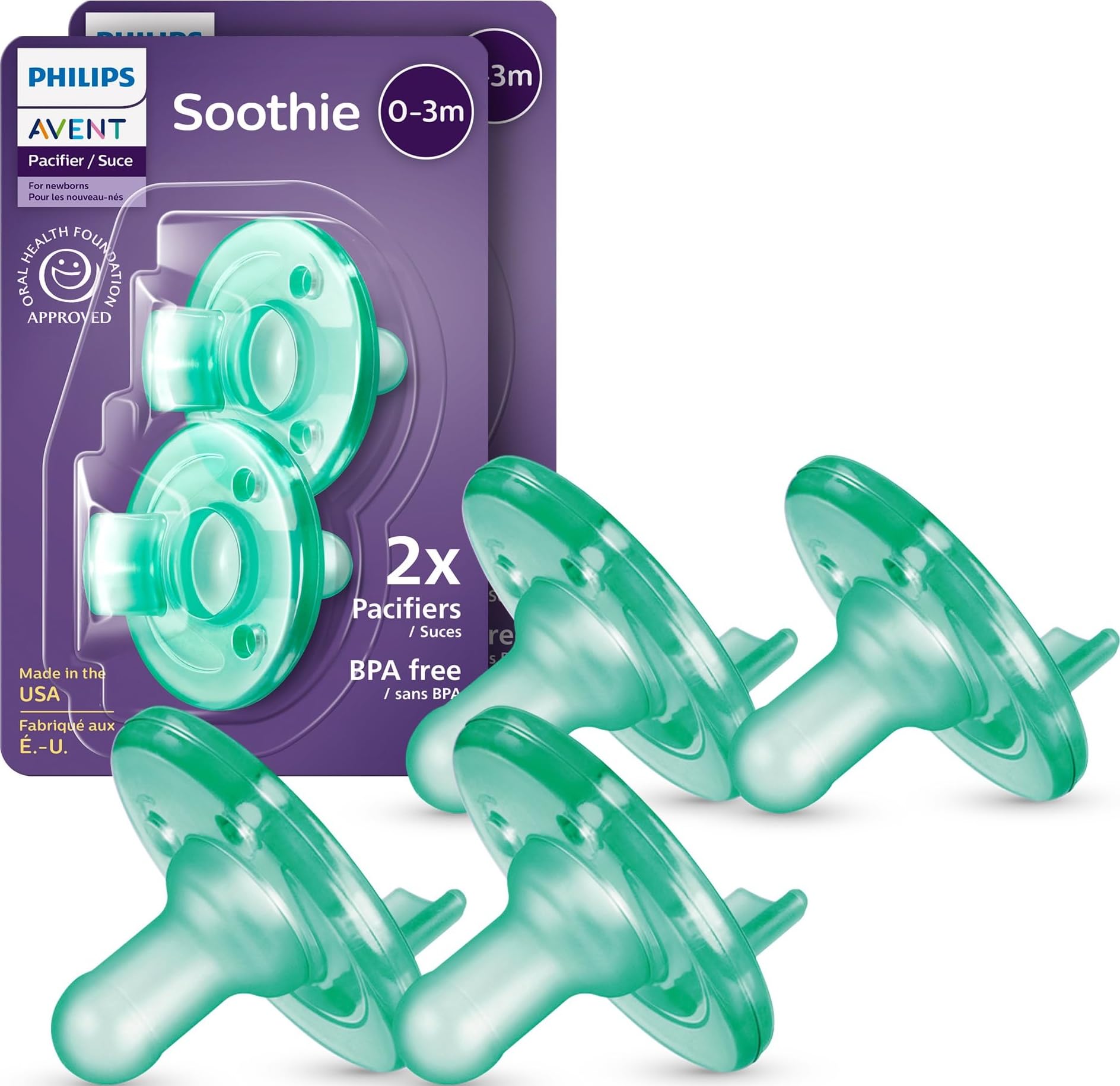
Philips Avent Soothie
Key Features
- Design: One-piece
- Material: Medical-grade silicone
- Age Range: 0-3 months
- Pack Size: 4 pacifiers
- Price: Budget
The Soothie is one molded piece of medical-grade silicone with nothing to take apart, and that single fact is why we hand it to anyone bringing home a breastfed newborn. There’s no seam between shield and nipple for residue to hide in, no separate ring to lose, and nothing to fill with water. You wash it, you can boil it, and you’re done.
The nipple is round and symmetrical, soft enough to compress, and sized for a 0-3 month mouth, and the whole thing is light in a way tiny mouths notice. Breastfed newborns tend to take to it. It also survives the life a pacifier actually has — dropped, stepped on, run through the sterilizer — and comes out the other side more or less unchanged.
The sizing is the honest catch: this is a newborn pacifier, and by three or four months you’re shopping again, which is why our top pick covers the full six. The smooth silicone can also slide out of a very small mouth in the early weeks, so expect some reinserting. Neither is a reason to skip it for a newborn. It’s the simplest thing on this list to keep clean, and simple is what the first three months reward.
Pros
- One-piece silicone with nothing to take apart
- Takes boiling and hospital-strength sterilization
- Round soft nipple sized for 0-3 months
- Survives drops and dishwasher cycles
Cons
- Sized for 0-3 months only
For a brand-new breastfed baby, we reach for the Soothie: one molded piece of medical-grade silicone, nothing to take apart, and nowhere for water or residue to hide.
Best for Staying Put
Tommee Tippee Ultra-Light
Key Features
- Design: One-piece silicone
- Shield: Curved with air holes
- Age Range: 0-6 months
- Pack Size: 4 pacifiers
- Price: Midrange
Tommee Tippee’s headline is weight: the StayPut is 20 percent lighter than the brand’s own Ultra-Light Original and, the brand says, about half the weight of the leading one-piece silicone pacifier. Discount the comparison and the underlying point survives — a lighter pacifier is easier for a small mouth to hold, because there’s less of it pulling itself out every time your baby turns their head.
The rest of the design backs that up. The nipple is symmetrical, so it’s always the right way up. The body is a single piece of silicone, so the shield and nipple can’t separate and nothing collects in a seam. The shield is curved to sit between nose and chin with air holes that keep skin from getting clammy underneath, and the sizing runs 0-6 months, the same span as our top pick.
This is the one we reach for when the pacifier keeps falling out. If you’ve been reinserting the same one every few minutes, the fix is usually less weight and less bulk rather than a new nipple shape, and lightness is the whole idea behind this one. Two things to know: the nipple runs large for some newborns in the first weeks, so a very small baby is better off starting with the 0-3 month Soothie, and the four-pack comes in one fixed pink-and-purple colorway. Neutral it is not.
Pros
- Very light, so it stays in small mouths
- Symmetrical nipple is always right way up
- One-piece silicone with a vented curved shield
Cons
- Nipple runs large for some newborns
- Fixed pink-and-purple colorway
When a pacifier keeps falling out, we point parents to the Tommee Tippee Ultra-Light, because less weight fixes more of those complaints than a different nipple shape does.
Best for 3-12 Months
MAM Comfort Pacifier
Key Features
- Design: One-piece silicone
- Weight: 32% lighter than other one-piece pacifiers
- Age Range: 3-12 months
- Pack Size: 4 pacifiers
- Price: Midrange
Most of this list stops at six months, which is exactly the gap the MAM Comfort fills: sized for 3 to 12 months, made as one piece of flexible medical-grade silicone, and the pick we give a parent whose baby has outgrown a newborn pacifier but isn’t giving one up yet. One purchase covers a stretch where a lot of babies are on their second or third size.
The design details are tuned to older babies. The nipple is symmetrical, and the whole thing is built so you can slip a finger into the nipple from behind to soothe a fussy baby — genuinely useful once they’re harder to settle than they were as newborns. MAM also calls it especially soft, and says it’s 32 percent lighter than other one-piece pacifiers, which matters when weight is the reason a pacifier keeps falling out.
Where it earns its keep is the run it covers: from the three-month mark to the first birthday without a size change in between, in a pacifier with no seam to clean and no hollow base to hold water. If your baby is already on the 0-6 month Original, this is the natural next step, and the softness carries straight over.
Pros
- One silicone piece with no water trap
- Finger-hold design for hands-on soothing
- Covers 3 to 12 months in one purchase
Cons
- Starts at 3 months, so not a newborn pick
- Colors may not match the listing photos
Our pick for the second half of the first year: the MAM Comfort runs 3 to 12 months in one silicone piece, so you’re not buying a third size at nine months.
Best for Silicone Refusals
BIBS Colour Pacifier
Key Features
- Nipple: Round
- Material: Natural rubber latex
- Age Range: 0+ months
- Pack Size: 2 pacifiers
- Price: Premium
BIBS pacifiers are natural rubber latex rather than silicone, and you can feel the difference the moment you pick one up: softer, warmer, more pliable, with a matte finish instead of the usual shine. The shield is round and sits proud of the face rather than hugging it, and the colors — this pair is a dusty blue and a steel blue — are why a lot of parents buy their first one. It looks like a design object rather than a piece of medical equipment, which is not nothing when it’s in your baby’s mouth for hours a day.
Rubber is also the reason we keep it on the list. Babies who refuse every silicone pacifier in the house will sometimes take this one, because the nipple gives more like skin and collapses differently in the mouth. If you’ve tried two or three silicone shapes and your baby is still spitting them out, this is the next thing to try, and it’s a better use of money than a fourth silicone brand.
Upkeep is where latex asks more of you. A UV sterilizer is out; BIBS asks for boiling water poured over the pacifier, a squeeze to clear it, and four to six hours of drying before it goes back in a mouth. That’s a longer ritual than dropping a silicone one in the dishwasher, and it’s the routine rather than the material that wears thin at 2 a.m.
The other trade-offs are size and lifespan. They’re sold as 0+ months, but a newborn can find them big at first and take to them closer to three months. And rubber ages faster than silicone: the nipple softens and can split at the seam, so check it often and retire it sooner than you would a one-piece silicone pacifier. Two to a pack means you’ll be buying a second pack before long, so start with one and see whether your baby agrees with you.
Pros
- Softer rubber for babies who refuse silicone
- Matte colors and a classic round shield
- Made in Denmark
Cons
- Priciest pacifiers per unit in this group
We keep the BIBS Colour on this list for babies who reject every silicone pacifier, because a softer rubber nipple is often what turns a refusal into a habit.
Best for Bottle-Fed Babies
Dr. Brown’s HappyPaci

Key Features
- Design: One-piece, open back
- Material: 100% silicone
- Age Range: 0-6 months
- Pack Size: 4 pacifiers
- Price: Budget
If your baby takes Dr. Brown’s bottles, the HappyPaci is the pacifier that matches them: the bulb is the same shape as the bottle nipple, so a baby who has already decided that shape is the good one doesn’t have to learn a second. That’s a narrower pitch than most pacifiers make, and it’s the most useful thing about this one.
Around that nipple sits a one-piece silicone body, plus a contoured, butterfly-shaped shield that curves away from a baby’s face instead of pressing flat against it, with air holes for airflow. Because it’s a single piece, it rinses clean in seconds and has no hollow base to hold water, and the gray, green, and ecru shades make it obvious at a glance which one came out of the wash.
Size is the catch, and it’s why we don’t push this one at newborns. The bulb is generous and the base is wide, and a newborn often can’t manage it in the first weeks — this is a pacifier to bring in once your baby has a little more mouth to work with, or straight away if they’re already comfortable on that bottle nipple. Past the newborn stage it’s a natural fit, and one of the better values here for a four-pack.
Pros
- Same nipple shape as Dr. Brown’s bottles
- One-piece silicone that rinses clean
- Contoured shield curves off the face
Cons
- Wide base is a lot for a newborn
HappyPaci earns its spot for bottle-fed babies already on Dr. Brown’s: the same nipple shape, one silicone piece, and a shield that stays off the face.
Best for Orthodontic Shape
NUK Timeless Comfy
Key Features
- Nipple: Orthodontic
- Material: Medical-grade silicone
- Age Range: 0-6 months
- Pack Size: 5 pacifiers
- Price: Budget
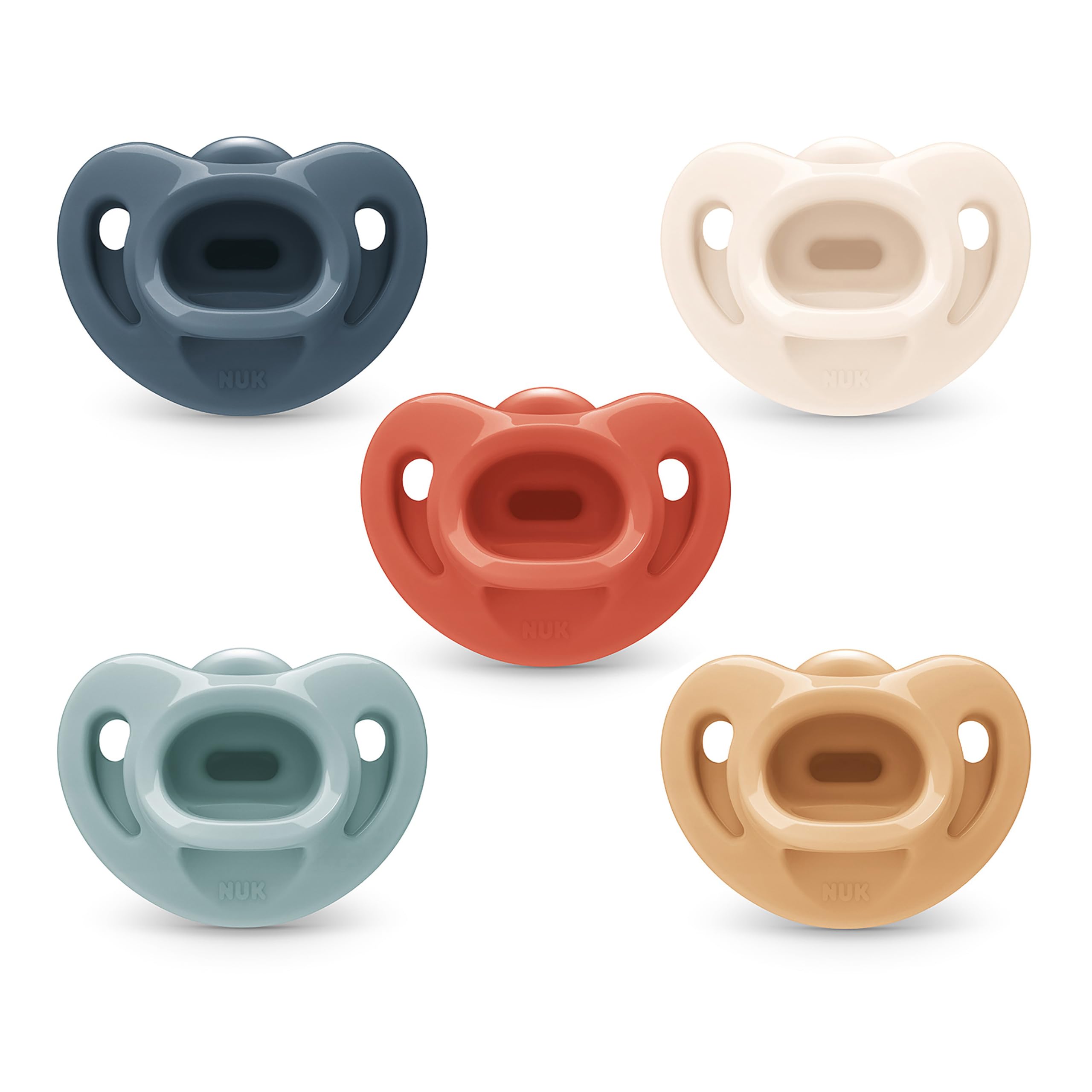
The word orthodontic on a pacifier package is doing a lot of work, and NUK’s version is the one to look at if that’s what you’re after. The nipple is breast-shaped rather than a plain bulb, designed to fit the palate and leave room for the tongue, and the shield is heart-shaped so it sits under the nose instead of across it.
It’s 100% medical-grade silicone in one piece, which means it survives the dishwasher and doesn’t fill up with water the way assembled pacifiers can. You get five to a pack, and that matters more than parents expect: binkies migrate, and five means one in the crib, one in the car, one in the diaper bag, one in the wash, and a spare.
One caveat belongs on the word orthodontic itself: whether a flatter nipple changes anything about your child’s teeth years from now isn’t something we can promise, so buy it for the feel in the mouth rather than the claim on the package. What we can say is that the shape divides babies — some take it on the first try, and some want nothing to do with it.
What makes it worth a place here is the combination: an orthodontic nipple, a one-piece body, and five of them for less than either two-pack costs. If you want to find out whether your baby likes a flatter nipple, this is the low-risk way to ask — and if the answer is yes, you already have a full rotation.
Pros
- Orthodontic breast-shaped nipple
- Heart-shaped shield sits under the nose
- Five medical-grade silicone pacifiers per pack
Cons
- Picks up lint, dust, and pet hair
If you want an orthodontic nipple without gambling on a single pacifier, the NUK Timeless gives you five silicone ones that survive the dishwasher.
Best for Small Mouths
Suavinex SX PRO

Key Features
- Nipple: Physiological, symmetrical
- Material: 100% silicone
- Age Range: 0-6 months
- Pack Size: 2 pacifiers
- Price: Premium
The first thing you notice about the SX PRO is the finish: a matte, velvety silicone that feels closer to skin than to the glossy material most pacifiers are made of. That texture is the pitch — Suavinex designed the nipple to mimic the feel and consistency of a breast, and it is noticeably softer to the touch than the one-piece designs from MAM and Tommee Tippee.
The nipple itself is physiological: thinner with a wider neck, so a baby’s mouth stays almost closed around it and pressure spreads across the gums rather than landing in one spot. It’s symmetrical, sized 0-6 months, and Suavinex points to an endorsement from the Spanish Society of Pediatric Dentistry. None of that guarantees your baby takes it, but it’s a considered design rather than a marketing shape.
The detail that sells it for a newborn is size. The nipple is small and doesn’t overwhelm a tiny face the way a wider bulb can, and it’s light enough that once it’s in, it tends to stay. One piece of silicone means it washes clean without a seam to get into, and it handles a bottle washer without complaint.
Where it earns its spot is the fit for a small mouth. If your newborn seems to lose every wider pacifier you offer, try this one before you conclude they don’t want a pacifier at all — a small, soft nipple is a different proposition from a big silicone bulb, and that difference is what turns a refusal into a habit.
Pros
- Velvety silicone that mimics a breast’s feel
- Small physiological nipple suits tiny mouths
- One-piece silicone, easy to clean
Cons
- Two per pack at the top of the price range
The Suavinex SX PRO is our pick when a newborn’s mouth seems overwhelmed by bigger pacifiers: a small, soft, velvety nipple that doesn’t dominate the face.
How We Tested Pacifiers With Real Babies
We started with the most-reviewed pacifier multipacks on the market and cut the list by material (silicone versus natural rubber), nipple and shield shape, one-piece versus assembled construction, age range, and price per pacifier. Anything that needed disassembly to get clean, or that was vague about what the nipple was made of, came off early. That left 15 pacifiers, which we handed to families with newborns and babies up to about a year old and followed for five months.
The testing happened where pacifiers actually live: 2 a.m. wakings, naps, stroller walks, the bottom of a diaper bag, and the top rack of the dishwasher. Parents logged whether a baby took the nipple on the first try or spat it out, how the shield sat against the cheeks, and how easy it was to scoop one up one-handed in the dark. Every week we checked nipples for thinning, cloudiness, and tears, and wiped each shield across a dark T-shirt and a fleece blanket to see how much hair and lint clung to it.
For cleaning, we noted whether water pooled inside the nipple or along a seam and whether a one-piece design rinsed clean without a brush. Glow-in-the-dark shields were charged under a lamp, then checked after an hour and again after six hours in a dark room. Because pacifiers vanish, we also counted how many disappeared from each pack in a month and worked out the real cost per surviving pacifier, and we watched whether colors dulled after repeated washing.
How to Choose a Pacifier
The binky that works is the one your baby will keep in their mouth, so fit and material come before any feature on the package.
Match the Pack to the Age Stage
Pacifiers are sized to a baby’s mouth, which is why the packs come in stages — 0-3 months, 0-6 months, 3-12 months — instead of one size for the whole first year. A nipple that’s too big for a brand-new baby is hard to keep in and tiring to hold; one that’s too small gets chewed rather than sucked.
Buy for the stage your baby is in now. Starting with a newborn and wanting one purchase to cover the first half-year, the 0-6 month size is the one to take. A 0-3 month pacifier like the Soothie is a newborn-only buy, and you’ll be shopping again at three months.
Silicone or Natural Rubber
Nearly every pacifier is silicone or natural rubber latex, and the choice is easy upkeep versus a softer feel. Silicone is clear, odorless, doesn’t pick up flavors, and takes boiling water, steam, and the dishwasher. Rubber is warmer and more pliable, which is why a baby who refuses silicone will sometimes take it — but it wears faster, can split at the seam, and can’t go in a UV sterilizer.
We start everyone on silicone and keep rubber as the second thing to try, once two or three silicone shapes have been rejected. At that point the extra care stops feeling like a chore and starts feeling like the price of a pacifier that actually gets used.
What Nipple Shape Actually Changes
A symmetrical nipple can go in either way up, which matters at 3 a.m. and matters again when someone else is doing the soothing. Orthodontic and cherry-shaped nipples have a specific orientation and a specific feel, and a baby who won’t take one often takes the other. What no shape can promise is a result years down the line; the oral-development claims on the package aren’t something you can check before you buy.
So treat shape as a fit question rather than a feature to compare. The pacifier your baby accepts is the better pacifier, whatever the packaging says about it.
One Piece, or Something That Comes Apart
A one-piece silicone pacifier has no seam between shield and nipple, so there’s nowhere for residue or rinse water to collect, and it can go through the dishwasher without a second thought. Pacifiers built from a nipple and a separate shield can hold a little water around the base after washing; shake it out and dry nipple-down.
The check takes seconds: squeeze the nipple after washing, and if water comes out, it was trapped in there. That’s the difference between a pacifier that dries clean and one that needs watching.
Frequently Asked Questions
How many pacifiers do I actually need?
Four, kept in rotation: one in the crib, one in the diaper bag, one in the wash, and a spare. That’s the number where losing one stops being an emergency and you stop buying single replacements at the worst possible moment.
Once you know a shape works, a four- or five-pack is the cheaper way to get there than buying pairs.
How often should I replace a pacifier?
There’s no calendar to follow — replace it at the first sign of wear. Run a thumbnail down the nipple: if it tears, feels thin, looks cloudy, or has gone sticky, it’s finished. Once your baby has teeth, check weekly.
Natural rubber breaks down faster than silicone, so a latex pacifier will need retiring sooner than a one-piece silicone one.
Are expensive pacifiers better?
Not in the way the price suggests. What the money buys is material and finish — softer silicone, natural rubber, a matte surface — not a better chance your baby takes it.
Acceptance is the one variable nobody can predict, so buy the smallest pack of a new shape first and save the multipack for the shape that survives a week.
Final Verdict
For most babies in the first six months, the MAM Original 0-6 month pack is the one to buy: it stays findable at 3 a.m., the symmetrical nipple can’t go in wrong, and the four-pack covers the crib, the bag, and the wash.
If you’re feeding a newborn and want the simplest thing in the house to clean, the Philips Avent Soothie is the better first pacifier for the 0-3 month window. If the pacifier keeps falling out, go lighter with the Tommee Tippee Ultra-Light, and once your baby passes three months, the MAM Comfort carries you to the first birthday.
