This post contains affiliate links. We may earn a small commission when you buy through our links — at no extra cost to you.
At 3 a.m., the last thing you want is to squint at a tiny screen while rocking a baby. A nursery thermometer should tell you two things at a glance: is the room comfortable, and is the air too dry or too humid? I’ve spent plenty of nights tiptoeing out of a nursery, and I know how quickly a "just checking" turns into a full wake-up. The right unit is small enough for a crowded dresser, reads clearly in dim light, and doesn’t ask for a fresh battery every few weeks.
We’ve tested 14 nursery thermometers over the past four months—from simple mini hygrometers to app-connected models—and the differences come down to accuracy, readability, and whether the smart features actually help at 2 a.m. We compared readings side by side, lived with each one through overnight feeds and nap-time checks, and paid attention to setup, battery life, Bluetooth range, and reliability. The picks below are the ones that earned a spot in the nursery.

Best for Nursery Default
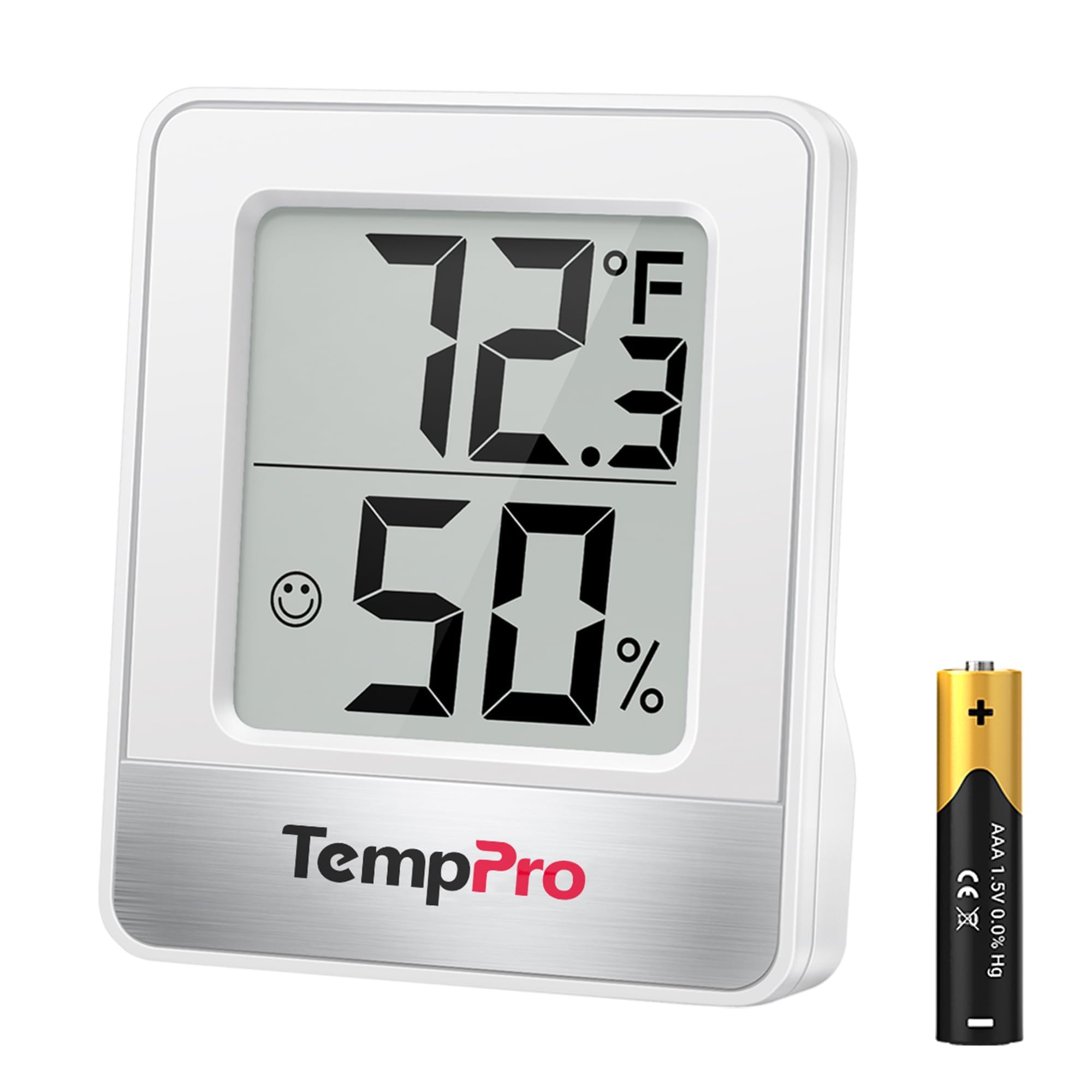
TempPro TP49 Thermometer
Key Features
- Mounting: Stand, magnet, or hang hole
- Refresh rate: 10 seconds
- Humidity accuracy: ±2% to 3%RH
- Temperature accuracy: ±1°F
- Price: Budget
At about two and a half inches tall and under an inch wide, the TP49 takes up less shelf space than a baby monitor and still throws numbers you can read from the doorway. That combination is why it’s our pick. In a nursery you’re usually reading the thing one-handed, half-awake, with a baby on your shoulder, and a display you have to walk over to and squint at doesn’t get checked. An unchecked thermometer is just decor.
The temperature sensor is rated to ±1°F and the hygrometer side to ±2 to 3%RH, refreshed every ten seconds — quick enough to watch the number climb while a space heater is running, which is exactly how you’ll use it on the first cold night. We came around on the face icon, too. Dry, comfort, and wet turn a humidity percentage into something a tired person can act on without looking up what the number is supposed to be.
Three mounting options cover almost any spot: a fold-out stand for a dresser, a magnet for a metal shelf or the fridge, and a hanging hole for a wall hook. We kept ours on the stand, angled toward the crib, and the size works in its favor there — it doesn’t crowd a narrow shelf already holding a sound machine and a stack of board books.
Pros
- Digits readable from across a dim room
- Stand, magnet, and hanging hole mounting
- Rated to ±1°F and ±2 to 3%RH
- Under an inch wide, fits tight shelves
Cons
- Ten-second refresh trails the app-connected pick
- Small body needs a spot above toddler reach
We recommend the TP49 for most nurseries: the smallest body here with digits you can read from the doorway, three mounting options, and accuracy rated as tightly as anything in this group.
Best for Two Rooms
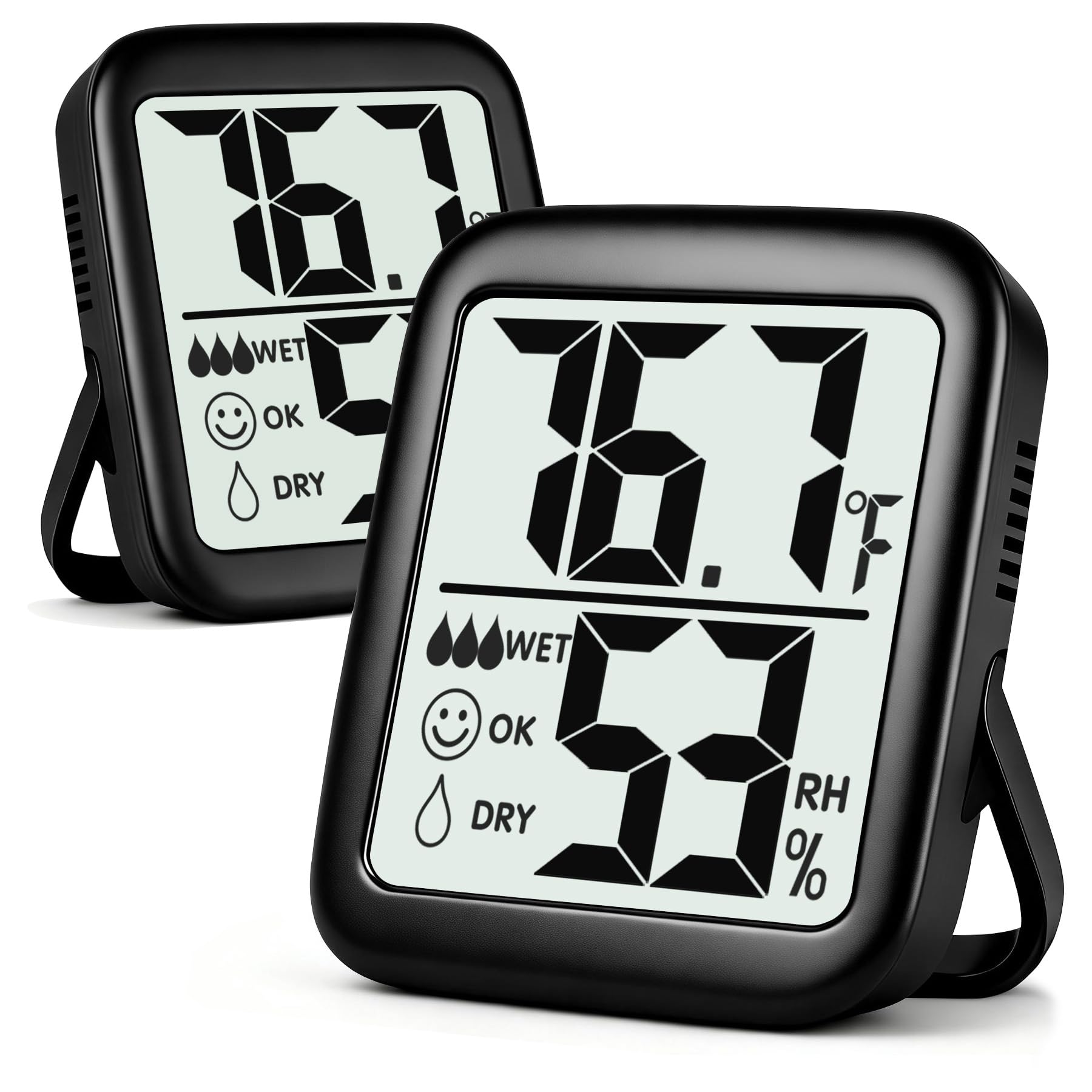
Antonki 2-Pack Thermometer
Key Features
- Battery: CR2032 included
- Mounting: Kickstand, magnet, or hanging hole
- Humidity range: 10% to 99%
- Units included: 2
- Price: Budget
Two units in one box is the entire pitch, and for a lot of families it’s enough. One goes on the nursery shelf; the other follows you to the living room, the guest room, or the grandparents’ house, so the number you’re watching doesn’t change depending on which room the baby is napping in. That’s a different job from what a single unit does, and it’s why this set earns a place.
Where we’re more careful is calibration. The two units in a set can sit side by side and disagree by a fraction of a degree, and humidity is looser still, so we treat a pair like this as a comparison tool rather than a precision instrument. Put both in the same room for a day before you trust either, note which one reads high, and carry that knowledge with you when they end up in different rooms. The digits are the other reason this set works: they’re legible from across a room, which is what you actually need at 2 a.m.
Each unit runs on a CR2032 coin cell that comes in the box, and the kickstand, magnet, and hanging hole give you the same three placement options as the rest of this group. We reach for the magnet first — stuck to a metal shelf or a filing cabinet, the unit stays off the surface where a curious toddler can sweep it onto the floor.
Pros
- Two units in one box
- Big digits you can read across a room
- Kickstand, magnet, and hanging hole
Cons
- The two units can read a degree or more apart
- Battery life varies widely between units
Two thermometers for about what one costs elsewhere — the set to buy if you want eyes on the nursery and the room you’re actually sitting in.
Best for Overnight Trends
Govee H5075 Thermometer
Key Features
- Screen: 3-inch LCD
- Bluetooth range: 164 ft
- Humidity accuracy: ±3%RH
- Temperature accuracy: ±0.54°F
- Price: Budget
A thermometer on a shelf tells you about right now. The H5075 also tells you about 3 a.m., 4 a.m., and the hour the heat came on — the app plots temperature and humidity as a curve, so a cold snap that happens while you’re asleep shows up in the morning instead of going unnoticed. If you’ve ever wondered whether the nursery is actually colder than the rest of the house at night, this is the unit that answers it.
The hardware is the strongest of this group: a 3-inch LCD, accuracy rated to ±0.54°F and ±3%RH, min/max records on the screen, and the same dry/comfort/wet indicator the cheaper units use. It also refreshes faster than anything else here — a nice thing to have, though a nursery doesn’t change temperature that quickly.
The app link is the part we trust least. It’s Bluetooth, not Wi-Fi, so the connection fades as you move through the house, and there’s no checking in from work; the alerts are useful from the next room, not from across town. Plan on the display doing the everyday work and the app being the bonus. The data export is what surprised us, though — a month of overnight lows says more about a drafty window than any single reading you happen to glance at on your way past.
Pros
- App graphs, alerts, and two years of export
- Tight ±0.54°F and ±3%RH accuracy rating
- 3-inch LCD with min/max on screen
- Fastest refresh in this group
Cons
- Bluetooth only, so alerts stop away from home
- A few units quit within months
Buy the H5075 if you want to know what the nursery did overnight: the app keeps a trend line and alerts you, and the display works perfectly well without your phone.
Best for Matching Pair
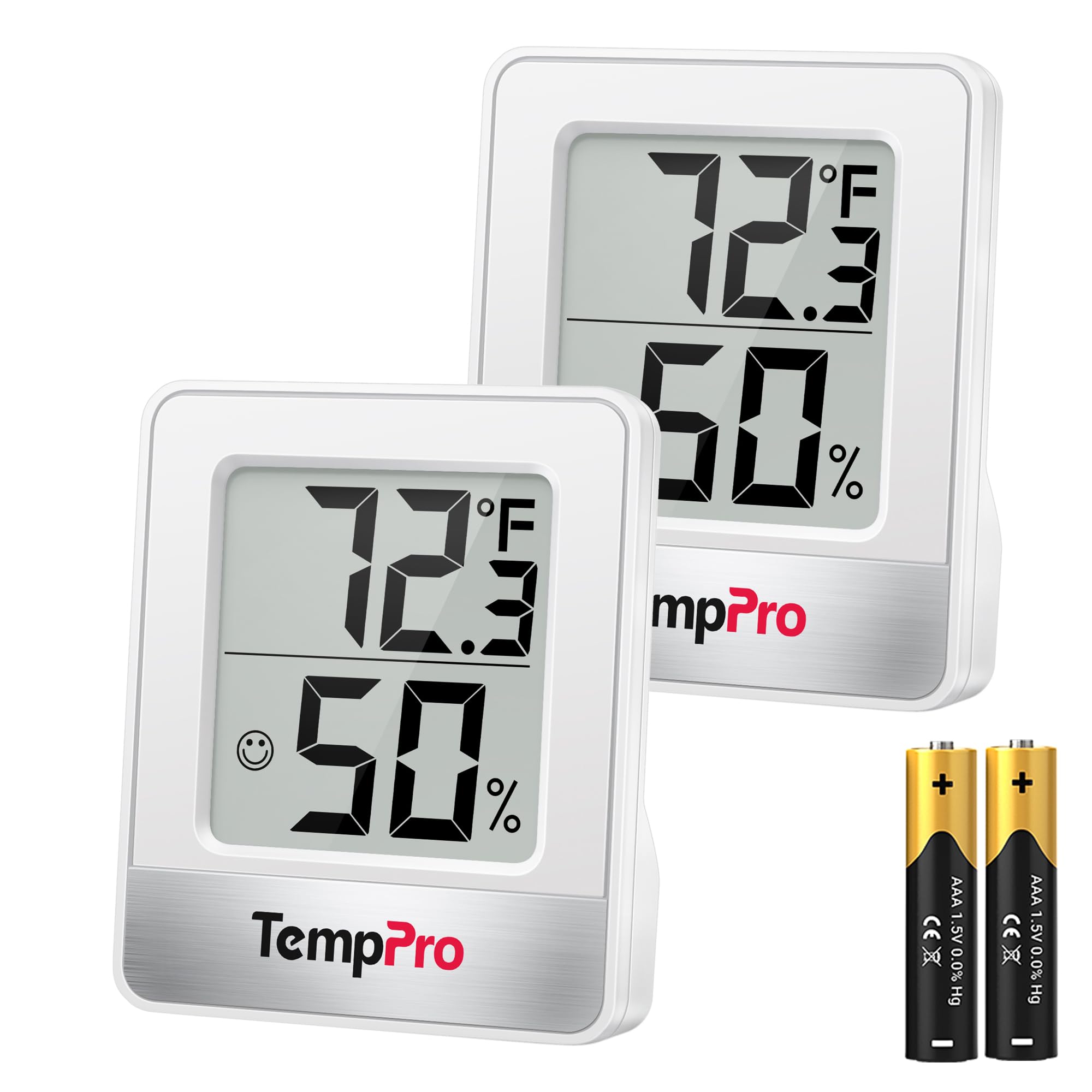
TempPro TP49 2-Pack
Key Features
- Refresh rate: 10 seconds
- Units included: 2
- Humidity accuracy: ±2% to 3%RH
- Temperature accuracy: ±1°F
- Price: Midrange
The unit in this box is the one we recommend at the top of this list, which takes most of the suspense out of it: same ±1°F sensor, same ten-second refresh, same stand, magnet, and hanging hole. What changes is the logistics of where you put them. One on the nursery shelf and one in the living room means you’re not walking down the hall to check a number, and the second unit travels — a guest room at your parents’ house can run much colder than home, and you’ll know before you put the baby down.
The trick we like with a matched pair: leave both in the nursery for a day and see whether they agree. If one runs a degree high, you have your reference for when they live in separate rooms, and you’re not guessing which reading to trust. What the pair can’t do is show you the night’s arc — the Govee’s trend line is the answer there — but for covering two rooms in one purchase, this is the simplest arithmetic on the page.
Pros
- Two of our top-pick unit in one box
- Cheaper per unit than buying two singles
- Lets you cross-check one unit against the other
Cons
- More units than a one-room setup needs
Buy the two-pack if you already know one room isn’t the whole story: it’s the same unit we recommend above, doubled for the room next door.
How We Tested the Best Nursery Thermometers
We started with a shortlist of 14 models, narrowing a longer list by reading specs and reviews, checking what each one offered for the money, and making sure we had a mix of basic mini hygrometers, wall-mount units, and Bluetooth-enabled thermometers. Then we put each one in a real nursery for four months—on a dresser, clipped to a shelf, and mounted on the wall—and checked it during overnight feeds, nap time, and the morning reset.
Accuracy came first: we placed every unit side by side in the same room for 48 hours and compared their temperature and humidity readings with a lab-calibrated reference, noting which ones drifted or disagreed. We also watched for reliability over the full four months, including whether readings froze, apps dropped their connection, or a unit needed a battery swap earlier than expected.
For ease of use, we set each one up from scratch—installing batteries, pairing Bluetooth where available, and testing alert range from the next room. We checked readability at a glance in dim light and from across the room, judged size and mounting options for small shelves and tight crib-side spots, and asked whether the extra functionality justified the cost compared with simpler models. A few disappointed: screens that looked fine in daylight washed out at night, and one app lost its connection repeatedly.
How to Choose a Nursery Thermometer
The number on the screen matters less than whether you can read it from the chair at 3 a.m., so start with the display and the placement, then worry about tenths of a degree.
Readability Comes Before Accuracy
Most units in this class are rated to within a degree Fahrenheit, so the difference that decides your purchase shows up on the display, not in the sensor. Look at the size of the digits and the distance you’ll read them from: a dresser six feet from the rocking chair is a different viewing job than a shelf at arm’s length.
Our test is simple. Set the unit where it will live, walk to the chair, and see whether you can read it without leaning in. If you can’t, it won’t get checked, and a thermometer nobody checks tells you nothing about the room your baby is sleeping in.
What Accuracy You Can Realistically Expect
You’re shopping in a ±1°F and ±3 to 5%RH world, which is plenty for a nursery: you’re deciding whether to crack a window or nudge the thermostat, not calibrating a lab. What matters more than the rating is agreement between units. Two thermometers from the same maker can differ by a degree, and the hygrometer side is looser still.
If you buy a pair, run them side by side for a day, learn which one reads high, and then trust the gap between them rather than any single absolute number.
Placement: Measure the Air the Baby Is In
A unit on a high shelf near the ceiling reads warmer than the mattress, and one beside a window or above a radiator reads the wall rather than the room. Put it at roughly mattress height on an interior wall, away from the door draft, direct sun, and the mist plume from a humidifier.
Mounting style is the other half of placement: a folding stand for a dresser, a magnet for a metal shelf, a hanging hole for a wall hook. All three are common, so pick the one that matches a spot you already have instead of clearing a new one.
Humidity and the Comfort Icons
The face icon — dry, comfort, wet — is the feature that ends up being used the most, because it turns a percentage into a decision: run the humidifier or leave it alone. Treat it as a prompt rather than a target.
Humidity swings several points between a nursery and the hallway, and a unit that reads dry an hour after a hot shower is telling you about the bathroom door. Make one adjustment and recheck an hour later instead of chasing the icon around the dial.
Do You Need the App?
A phone-connected unit adds trend lines and out-of-range alerts, which are genuinely useful for catching an overnight dip. The trap is the word smart: Bluetooth reaches across a house, not across town, and a Wi-Fi sensor usually wants a hub and an account you’ll be resetting at midnight.
If alerts only help while you’re home anyway, a plain display does the same job with no setup and no dead-app risk. That’s why the app should be a bonus rather than the reason you buy.
Frequently Asked Questions
Is a nursery thermometer the same thing as a baby thermometer?
No, and the two get mixed up constantly. A nursery thermometer measures the air in the room — it sits on a shelf and reads in the 60s and 70s. A baby thermometer measures body temperature and is a separate purchase; the flexible-tip oral, rectal, and underarm models sold in the baby aisle are for fevers, not for deciding whether to add a blanket.
You’ll want both eventually, but neither substitutes for the other.
How often do these need new batteries?
More often than the packaging suggests, and the type varies: coin cells (CR2032) in some units, AA or AAA alkalines in others. None of these is rechargeable, so keep a spare of whichever your unit takes in the diaper drawer.
Life varies a lot from one unit to the next, so if the display goes blank, change the battery before you assume the thermometer is dead.
Can I attach the thermometer to the crib?
No. Nothing needs to go in or on a crib, and a thermometer is no exception — beyond the hazard of a cord or clip, a unit that close reads the baby’s body heat instead of the room.
Put it on a shelf, a wall hook, or a dresser a few feet from the crib and high enough that a pulling-up toddler can’t reach it.
Final Verdict
Two things decide a nursery thermometer: whether you can read it without getting up, and whether it’s still working in six months. The TempPro TP49 wins both for most families — digits you can read from the chair, a footprint that disappears on a shelf, three mounting options, and a sensor rated to ±1°F.
If your baby’s night involves two rooms, the Antonki two-pack covers both. If you want to know what the room did at 4 a.m., the Govee’s app is the only thing here that tells you.
