This post contains affiliate links. We may earn a small commission when you buy through our links — at no extra cost to you.
The first spoonful is supposed to be a milestone, not a pop quiz on iron absorption. But that’s what the cereal aisle feels like: two nearly identical boxes, and no easy way to tell which one has enough iron, which texture a baby who has only ever had milk can actually swallow, or whether the premium price buys anything real. A good first cereal takes that weight off. It’s fortified, it thins to something swallowable, and it’s short on ingredients you’d have to explain.
My daughter’s first box came from the pediatrician’s sample closet, and I knew we were in trouble the moment I tasted it: chalky, faintly sweet, gluey within a minute. My team and I have since worked through 14 boxes over three months, and the ones I’d buy again stayed smooth and tasted like actual grain. One thing new parents rarely hear is that the classic rice starter has a reputation for binding a baby up, which is why oat and multigrain are worth a look even the first time around. The picks below cover both ends of that.

Best for First Spoonfuls
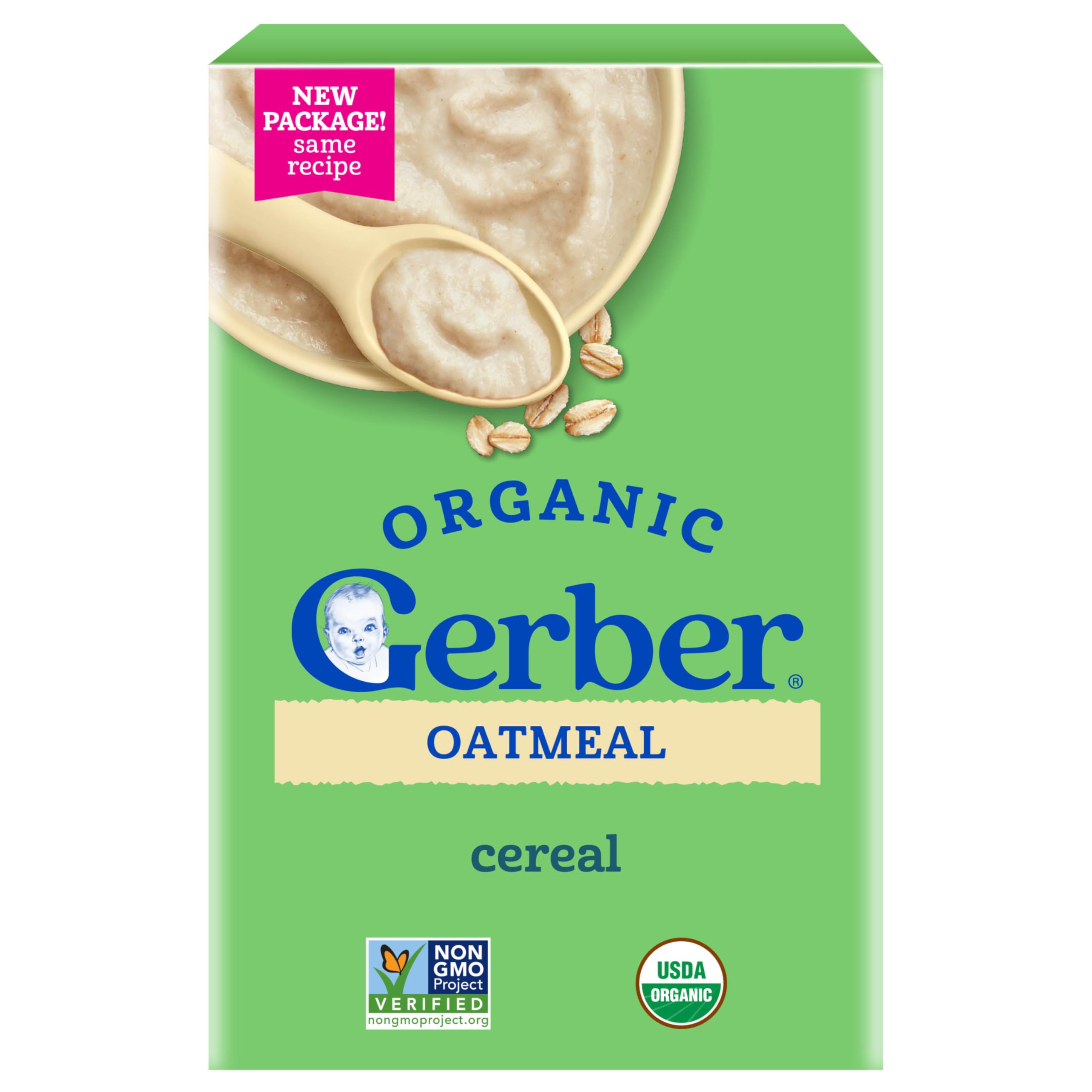
Gerber Stage 1 Organic Oatmeal
Key Features
- Stage: Stage 1, 6+ months
- Pack size: 5 x 8 oz (40 oz)
- Whole grains: 14 g per serving
- Vitamins and minerals: 14 essential vitamins and minerals
- Price: Midrange
Plenty of first cereals ask you to give something up: the organic boxes often skip the vitamin blend, and the heavily fortified ones read like a supplement with grain in it. Gerber’s Stage 1 organic oatmeal is the one here that doesn’t force the choice. It’s certified organic and Clean Label Project certified, and it still carries 14 grams of whole grains and 14 essential vitamins and minerals per serving, in a stage 1 formula built for six months and up. That combination is what settles it for us.
What we appreciate most is how little it asks of you. It’s a plain oat base designed to blend smoothly with breast milk or formula, so the first spoonfuls taste like something your baby already knows. You control the thickness — thin at the start, thicker once a spoon makes sense — and because there’s no fruit in it, it takes a spoonful of puree later without turning into dessert. Try that with a pear-cinnamon tub.
The plainness is also the limit. A baby who has moved on to texture will find this dull, and there’s no fruit or second grain inside the pack to switch to. It’s a first cereal rather than a whole cereal shelf, and that is precisely the job it does well.
Then there’s the pack: five 8-ounce boxes, 40 ounces in all. For a baby eating a few spoonfuls at a time, that’s months of breakfast, and you’ll want a cupboard shelf for it. If you prefer to start with a single box, Earth’s Best’s multi-grain is the smaller way in — though few babies object to a second box of plain oat.
Pros
- Certified organic and Clean Label Project certified
- 14 g whole grains and 14 vitamins and minerals
- Stage 1 formula for six months and up
- Blends smoothly into breast milk or formula
Cons
- Sold only as a five-box, 40-ounce pack
This is our default first cereal: certified organic, stage 1 for six months and up, and still fortified with 14 vitamins and minerals — a combination most boxes here make you choose between.
Best for Bulk Buyers
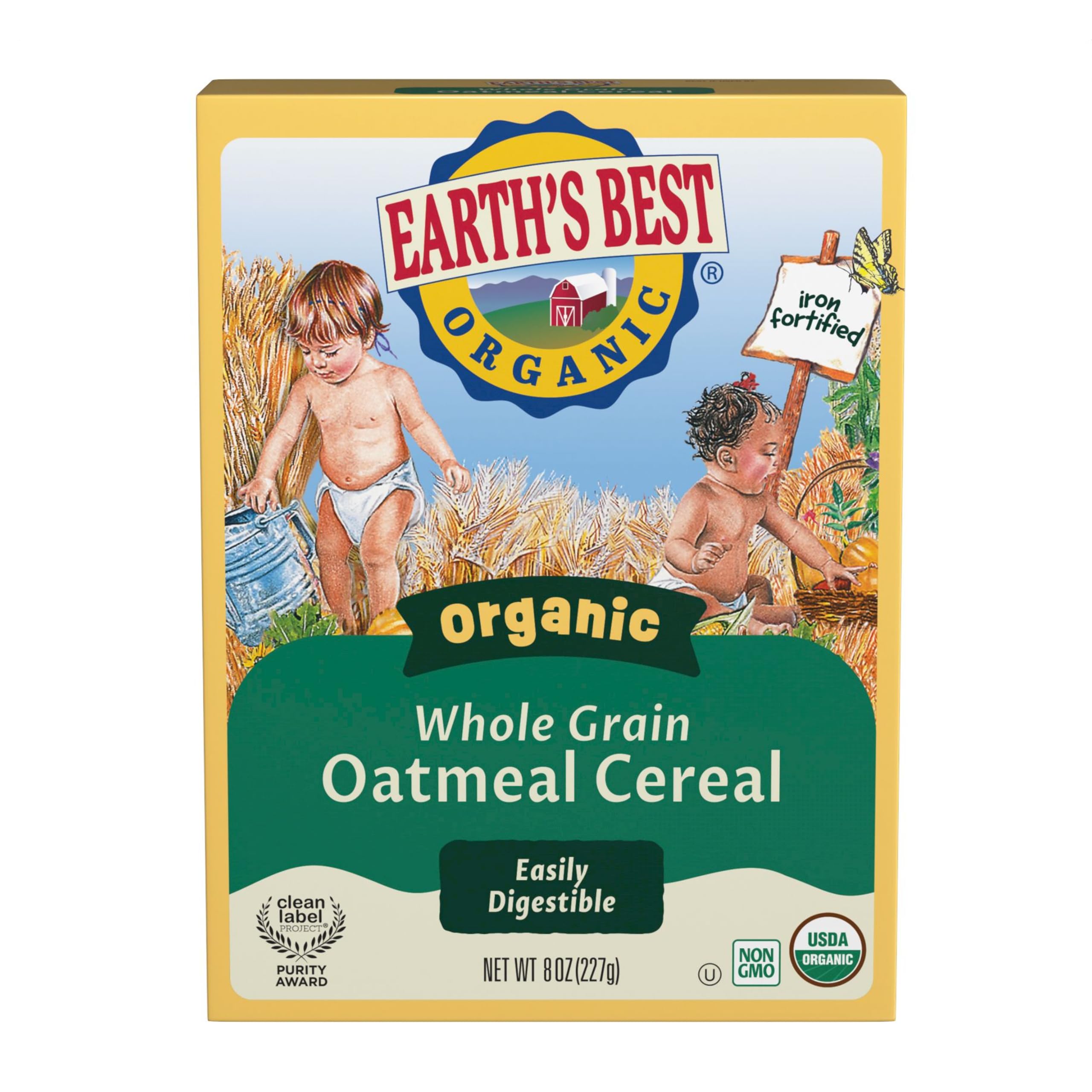
Earth’s Best Organic Oatmeal
Key Features
- Iron: Fortified
- Stage: 4+ months
- Pack size: 12 x 8 oz (96 oz)
- Certification: USDA Organic, Clean Label Project Purity Award
- Price: Premium
Ninety-six ounces of oatmeal arrives in one order: twelve 8-ounce boxes, stacked. That’s the whole proposition. This is the cereal for a household that would rather buy once than put cereal on the list every few weeks, and there’s no small box hidden inside for a first try.
The cereal itself is straightforwardly good — organic whole grain oats, iron-fortified, labeled from four months, and easy to stir into breast milk or formula. Per ounce it lands close to our top pick rather than far below it, so the case isn’t a bargain so much as a supply. What it buys is fewer decisions and a cupboard that stays stocked, which in a house with two children or a daycare bag to fill is worth real money.
The trade is the calendar. Babies move from thin cereal to lumps to table food within a few months, and twelve boxes bought at six months will still be on the shelf at eighteen. It also claims more cupboard space than a five-box pack. Buy the case once you know your baby likes the stuff, not before.
Pros
- Organic, iron-fortified whole grain oats
- 96 ounces in one order — months without reordering
- Labeled from four months as a first food
Cons
- Takes real cupboard space for a small eater
We rate this case for households that burn through oatmeal: organic, iron-fortified, and the fewest reorders of anything here — just check the calendar before you commit.
Best for Travel and Daycare
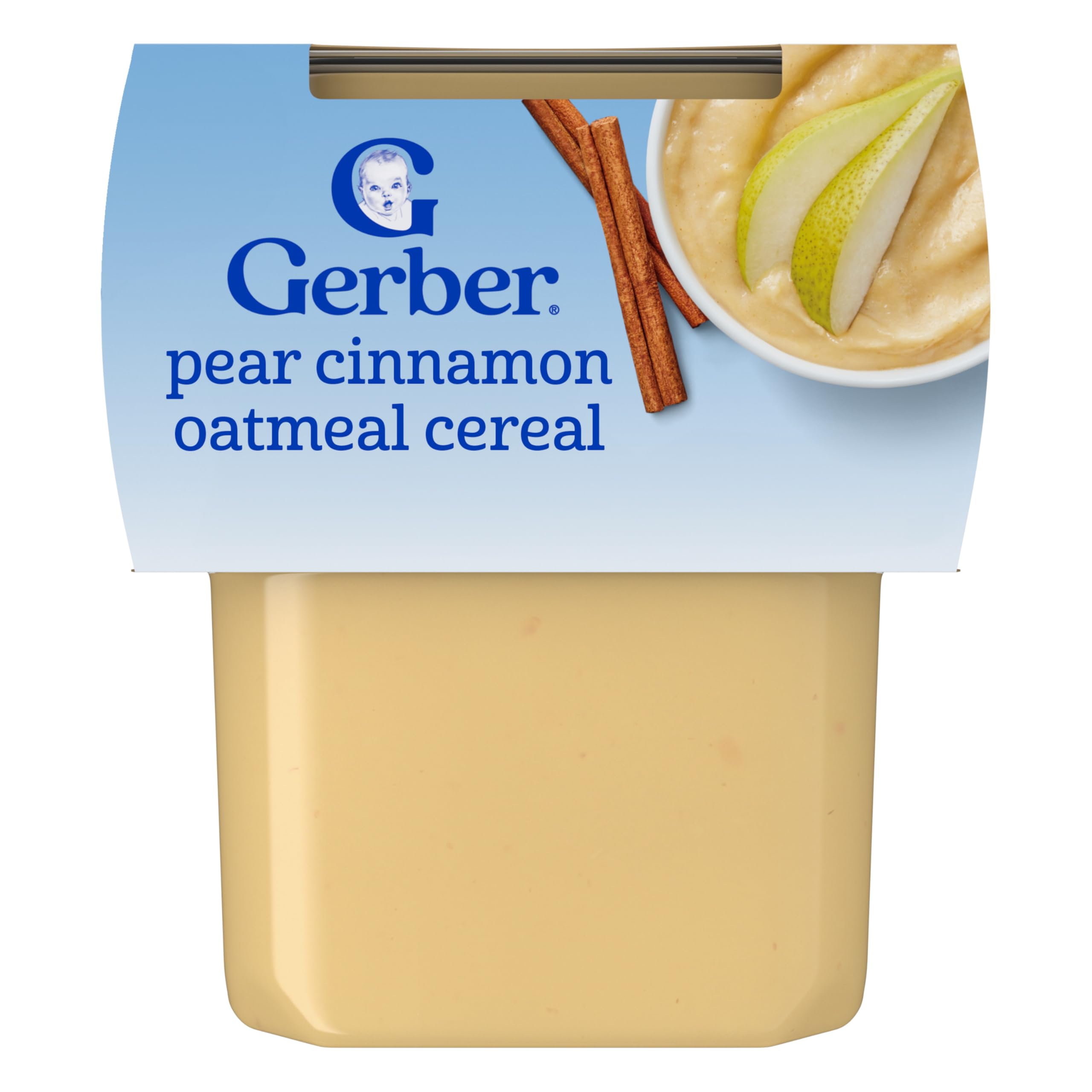
Gerber Stage 2 Oatmeal Tubs
Key Features
- Iron: 60% DV per serving
- Stage: Stage 2, 6+ months
- Format: Ready-to-eat tubs
- Pack size: 16 tubs (64 oz)
- Price: Budget
Some mornings there’s no time to measure anything into a bowl, and that’s the morning these tubs exist for. Gerber’s Stage 2 pear cinnamon oatmeal comes as 16 ready-to-eat tubs — 64 ounces in total — for babies six months and up who are ready to explore new textures and flavors.
The nutrition behind a convenience food is better than we expected. A serving carries 60% of the daily value of iron, 8 grams of whole grains, 45% of vitamin C, 30% of zinc, and 25% each of vitamins B6 and B12, with no added sweeteners and no artificial flavors. Iron is the number that matters most at this stage, and no other cereal here states a higher one.
Where a tub earns its keep is away from your kitchen: a diaper bag, a grandparent’s house, a daycare cubby where you don’t want to send a box and a scoop. Pear cinnamon is a fruit-forward flavor, so we think of it as the step after plain oat rather than a replacement for it. For a baby already eating mixed flavors, the convenience is worth the trade.
Pros
- Ready to eat — no bowl, no measuring
- 60% DV iron per serving, the most stated here
- 8 g whole grains plus vitamins C, B6, B12 and zinc
Cons
- Plastic tubs mean more packaging than a box
For mornings with no time to measure, we rate these tubs: 60% of the daily iron value, ready to eat, and easy to pack for daycare.
Best for Short Ingredient Lists
Holle Organic Oat Cereal
Key Features
- Age: 6+ months
- Allergens: May contain wheat and gluten
- Pack size: 8 oz box
- Ingredients: Whole grain oat flour, thiamin mononitrate
- Price: Premium
Two ingredients: whole grain oat flour and thiamin mononitrate. That’s the entire list, and it’s the reason to consider Holle’s organic oat cereal — no vitamin blend, no added iron, no flavoring, nothing to read twice.
That short list cuts both ways. If you’ve been told to get more iron into your baby, this is not the cereal that does it; the oats are the point, not the fortification. It suits the family that already covers iron elsewhere — with iron-rich foods, or with a fortified cereal at another meal — and wants a clean organic base for fruit, yogurt, or expressed milk. We treat it as one of two cereals in the cupboard rather than the only one.
Mixing is where it behaves well. It’s a whole grain oat flour that stirs into breast milk, formula, or water without much work, and it thickens as it stands, so the same box takes you from a first thin spoonful to something a one-year-old will accept. The 8-ounce box is small, which also means you’re not storing oat flour for months.
Our view: this is the cereal for the parent who reads labels and cooks a little. The two-ingredient list is what you’re paying for, and the missing iron is a gap you can plan around rather than a flaw in the product. If iron is the whole reason you’re buying cereal, start with our top pick instead and keep this one for the meals where it doesn’t matter.
Pros
- Two ingredients: oat flour and thiamin
- Organic whole grain oats
- Mixes smoothly with milk, formula, or water
Cons
- May contain wheat and gluten
We recommend Holle to parents who read labels and already cover iron elsewhere: two ingredients, organic oats, and nothing standing between the grain and the bowl.
Best for One-Box Trial
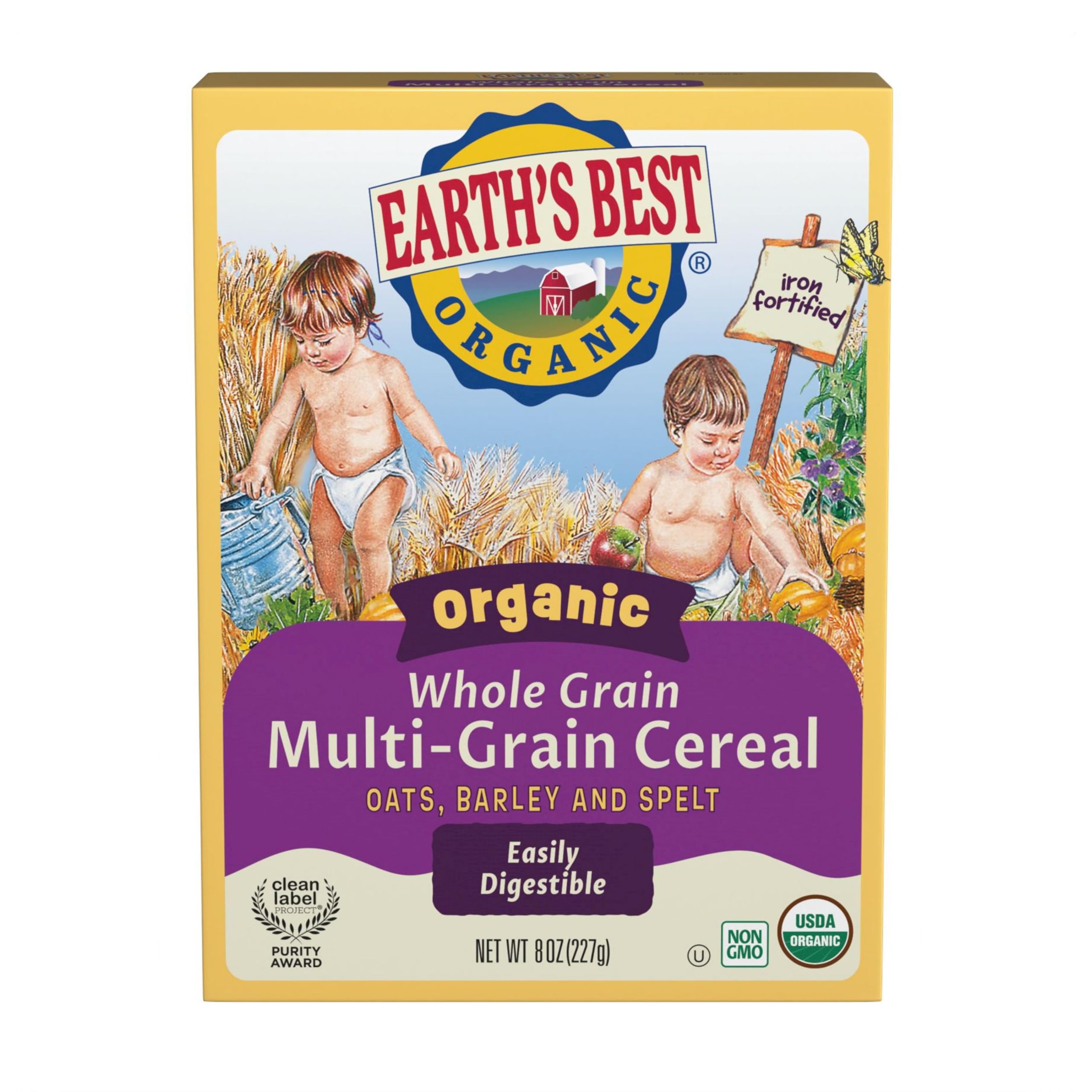
Earth’s Best Multi-Grain Cereal
Key Features
- Iron: Fortified
- Grain: Whole multi-grain
- Pack size: 8 oz box
- Certification: USDA Organic, Kosher
This is the box we point people to when they want to try a new grain without committing to a case. Earth’s Best’s organic whole multi-grain cereal comes as a single 8-ounce box, it’s USDA Organic and Kosher, and it’s iron-fortified like the rest of the brand’s infant line — a small, low-risk way to find out whether your baby takes to a mixed grain.
Multi-grain means several grains in one box, which is convenient once grains are established and slightly more to track when they aren’t. If you’re still introducing one new food at a time, an oat cereal is the easier starting point and this box becomes the next step a few weeks later. Either way, the size is the feature: it costs you a few breakfasts rather than a cupboard shelf.
Pros
- USDA Organic and Kosher certified
- Iron-fortified whole grain blend
Cons
We point people to this single box to find out whether their baby likes a mixed grain before they commit to a case of anything.
Best for Single-Serve Mornings
Amara Oats & Berries

Key Features
- Stage: Stage 2
- Format: Single-serve pouches, mix with liquid
- Pack size: 10 pouches
- Ingredients: Organic oats and berries
- Price: Premium
Amara’s oats and berries come as ten single-serve pouches you mix with breast milk, formula, or water — a stage 2 blend of organic oats and fruit that skips the bowl-and-box routine entirely. Tear, add liquid, stir, feed.
You pay for that. Per serving this is the most expensive cereal here by a wide margin, and whether it’s worth it comes down to where you feed your baby. At a restaurant, on a flight, at a sitter’s house, the pouch is the difference between a meal and a hungry afternoon. At your own kitchen table, it’s an expensive way to serve oats.
Texture is where it earns some of the money back: it stirs smooth and stays smooth, and the berries carry their own sweetness with no added sugar, which is a large part of the appeal. It’s also the easiest of these to hand to someone else — a sitter, a grandparent — with no instructions beyond add milk.
Pros
- Mixes with breast milk, formula, or water
- Short, clean organic ingredient list
- Single-serve pouches pack easily
Cons
- A pouch is a small serving for an older baby
We reach for Amara when breakfast happens away from home: a smooth, clean pouch that mixes in seconds, though you pay the most per serving here.
Best for Wheat-Based Meals
Nestle Cerelac Wheat with Milk

Key Features
- Form: Powder
- Contains: Wheat and milk
- Pack size: 2.2 lb can
- Price: Midrange
Nestle’s Cerelac is a different shape of purchase: one 2.2-pound can instead of a case of small boxes, and a wheat-with-milk powder rather than a plain grain you thin with formula. If cupboard space is tight and you don’t want to decant, that’s a real advantage.
Because the milk is already in the powder, a bowl comes together with water rather than measured formula or expressed milk, which makes it quick and portable when you’re out of the house. It also means you can’t adjust the milk to the brand your baby usually drinks — what’s in the can is what’s in the bowl.
Our take: this is a second-stage cereal — a wheat-and-dairy bowl for a baby who already eats both, and a pantry can for a household that would rather buy once than reorder. If you’re still introducing single grains one at a time, start with an oat cereal and come back to this when wheat is old news.
Pros
- Milk is already in the powder
- One 2.2 lb can, fewer reorders
Cons
- No small size — trying it means one 2.2 lb can
We keep Cerelac for households that want one big can and a wheat-and-dairy bowl, not for a baby still meeting single grains for the first time.
How We Tested the Best Baby Cereals
We built the shortlist by reading nutrition panels before anything else. A cereal stayed in contention if a whole grain led the ingredient list, if iron fortification was stated plainly on the front of the box, and if there was no added sugar or fruit powder quietly padding the numbers. From there we bought 14 boxes across single-grain, multigrain, and organic lines, ranging from store-brand value boxes to premium tins, and lived with them for three months.
Testing happened where cereal actually happens: a high chair at 6:45 in the morning, a diaper bag at a restaurant, a weekend at grandma’s. We mixed every box to package directions and then deliberately one step thicker and one step thinner, watching whether the powder clumped, sank, or dissolved cleanly, and whether it stayed spoonable after five and ten minutes in the bowl. We also opened each package one-handed with a baby on a hip, because that is how it goes at home.
I tasted all 14 plain and noted bitterness, chalkiness, and any lingering aftertaste, then logged how the babies responded to the first bowl and the third. For sensitivity, we watched diapers and spit-up for three days after each new cereal was introduced. Nutrition came down to iron, protein, sodium, and sugar per serving, and value to cost per prepared ounce rather than per box, since a fluffy cereal settles into far fewer servings than the package suggests.
How to Choose a Baby Cereal
The right baby cereal comes down to three things — the stage on the box, the iron in the bowl, and whether you’re willing to mix it — so start there and let flavor come last.
Match the Stage Before the Flavor
Boxes are labeled by stage and age, and that label does more work than the picture on the front. Stage 1 cereals are built for babies around six months, stage 2 for babies ready for mixed textures, and the 12-month-and-up cereals are coarser, fruitier, and meant for a toddler already eating table food. A toddler cereal is not a gentle first food, and a plain stage 1 cereal will bore a two-year-old who wants flavor.
Read the age statement first, then check the texture description. If your baby is just starting, buy the plainest cereal in the right stage and add flavor yourself.
Iron Is the Main Event
Infant cereal earns its place at the start of solids mostly by delivering iron, and how much it delivers varies more than the front of the box suggests. The cereals here that state a figure run from 20% to 60% of the daily value per serving; Holle’s oat cereal adds no iron at all. Neither approach is wrong, but they are different products. If cereal is your main iron source, buy one with the percentage printed on the panel. If you’re covering iron with other foods, a plain oat base is a perfectly good thing to own.
Read the nutrition panel before the marketing copy.
Powder, Tub, or Pouch
Three formats answer three different problems. A box of powder is the most flexible and the cheapest per serving — you control the liquid and the thickness — but it needs a bowl, a spoon, and a spare hand. A ready-to-eat tub removes the measuring, which is worth a great deal at six in the morning or in a diaper bag. A single-serve pouch sits between them: dry mix, one portion, add liquid.
Buy the format that matches your worst morning rather than your best one. Then check what a tub or pouch actually holds, because convenience formats are portioned for small appetites.
Buy a Box You Can Finish
Babies move through cereal fast — a few months of thin spoonfuls and you’re onto lumps and finger food — so package size matters more than it looks. One 8-ounce box is the sensible first purchase with any new cereal, and it’s the only way to learn whether your baby likes a grain before you commit to a case. Case buying makes sense once you know the answer, particularly with two children or a daycare bag to fill.
Mix It Thinner Than You Think
Start with less powder than the box suggests. Cereal thickens as it stands, and a bowl that looks right when you stop stirring can be paste by the time it reaches the high chair. Add breast milk, formula, or water a little at a time until it just holds on a spoon, and loosen it again if your baby fusses.
Warm liquid is fine, but test a drop on your wrist first, and don’t keep what’s been sitting out. A few spoonfuls of powder make more than you expect.
Frequently Asked Questions
Do I have to start with rice cereal?
No. Oatmeal and multigrain have largely replaced rice as the default first cereal, partly because rice tends to carry more arsenic than other grains. If you want a single grain to begin with, choose oat — both our top pick and the Earth’s Best oatmeal are oat-based and iron-fortified. Keep rice to occasional servings rather than the everyday bowl.
Can I put baby cereal in a bottle?
No. Cereal in a bottle thickens the flow, adds calories without teaching spoon skills, and is not a reflux treatment unless a pediatrician prescribes it. Feed cereal from a spoon, mixed to a soft spoonable consistency, and keep bottles for breast milk or formula. If you’re worried about intake, ask your pediatrician rather than adding cereal to a feed.
Is baby cereal necessary if we’re doing baby-led weaning?
Not necessary, but it is one of the easiest ways to cover iron. If you skip it, plan iron daily from soft meats, beans, lentils, and fortified cereals used in other forms. Many families do both — a bowl of fortified cereal some mornings, finger foods the rest of the time. What matters is that iron shows up every day, not which spoon it arrives on.
Final Verdict
Gerber’s Stage 1 organic oatmeal is the cereal we point to first: certified organic, stage 1 for six months and up, and genuinely fortified with 14 vitamins and minerals, in a pack small enough to live with. If your household goes through cereal quickly, Earth’s Best’s whole grain oatmeal case is the same job in a supply you buy once, and if your mornings happen anywhere but your own kitchen, the Gerber Stage 2 tubs skip the measuring entirely.
Buy the plain one first. Add flavor, and a case, once you know your baby’s appetite.
