This post contains affiliate links. We may earn a small commission when you buy through our links — at no extra cost to you.
A baby’s skin can turn on you fast: one wrong lotion and you’re dealing with redness, dryness, or a fussy baby who won’t settle. What I want from baby oil is simple — soft skin without a reaction, a scent that doesn’t overwhelm the nursery, and a bottle that earns its shelf space. The right one makes after-bath massage feel less like a chore and more like the calmest part of the bedtime routine, sealing in moisture and smoothing dry patches without leaving a greasy film.
I’ve been through plenty of greasy, perfumey misses that promised soft skin and delivered a rash instead. Over the past four months, our team of parents tested 15 baby oils on our own babies and toddlers, comparing textures from watery to thick, noting which fragrances faded versus lingered, and watching for any sign of irritation — redness, bumps, or extra fussiness. We also tracked how well each oil moisturized dry shins and cheeks, how far a bottle went, and whether a bedtime massage seemed to help sleep. The picks below are the ones that felt gentle, worked, and were worth keeping within arm’s reach of the changing table.


Best for Everyday Moisture
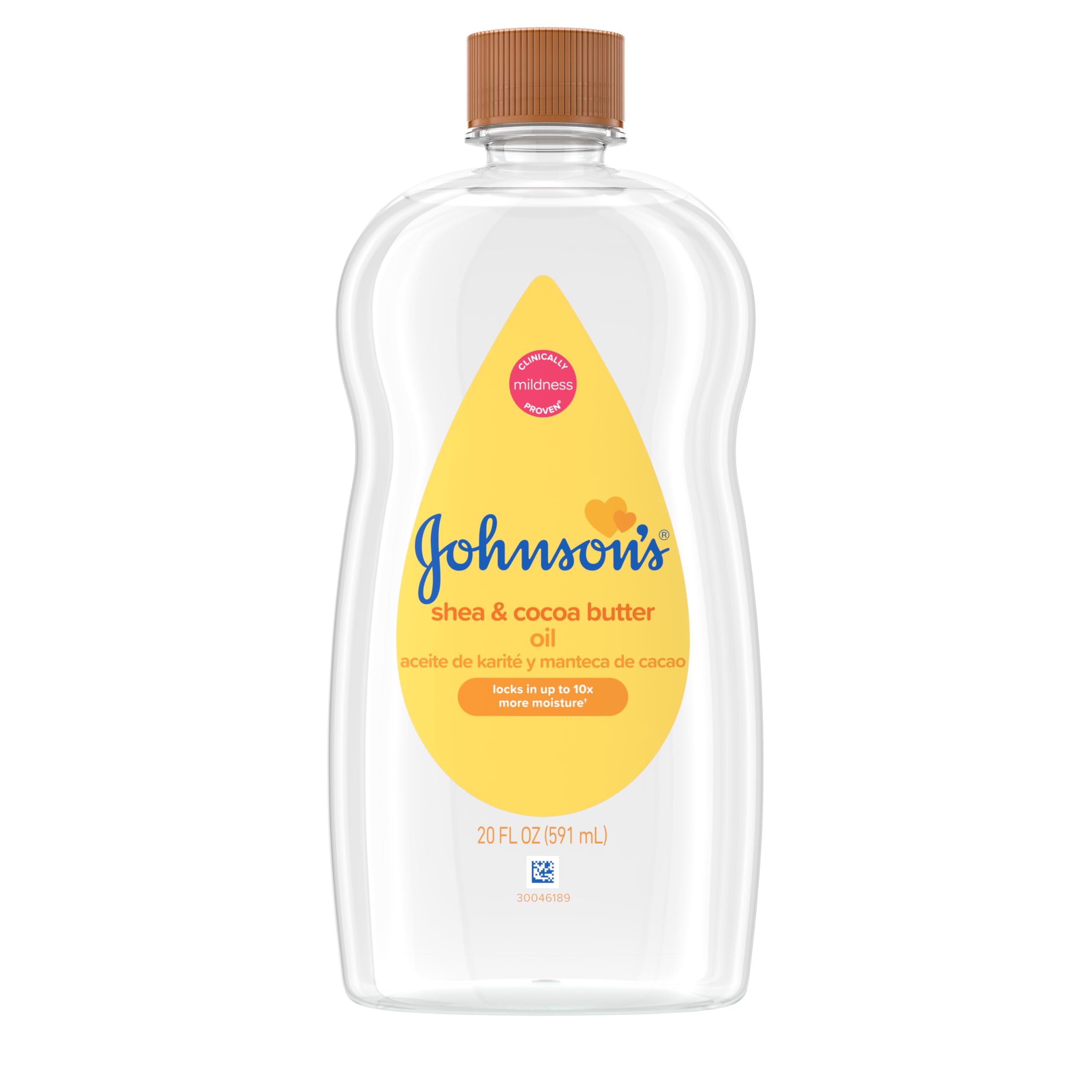
Johnson’s Baby Oil, Shea & Cocoa Butter
Key Features
- Size: 20 fl. oz, 6-pack
- Scent: Lightly scented
- Age guidance: 3 months and up
- Key ingredients: Mineral oil, shea & cocoa butter
- Price: Budget
Six 20-fluid-ounce bottles is the first thing to get past, because everything else about this oil is why it earns the top spot. The base is mineral oil, which sits on the skin rather than vanishing into it, and that is the point: spread on skin still damp from the bath, it forms a barrier that holds the water in while the shea and cocoa butter soften the feel. It is dermatologist- and allergy-tested, with no added parabens or dyes, and the label sets the minimum age at 3 months.
For the ordinary jobs, an after-bath slick-down, a leg massage, a dab on dry shins, this is the bottle that gets picked up. It spreads further than the plant-oil options here, so a small pour covers a whole baby, and skin still feels soft the next morning rather than only for ten minutes after the towel. On cost per ounce, nothing else in this group comes close.
The familiar lightly powdery scent is worth flagging first: a newborn or a rash-prone baby should start with an unscented formula instead. The other note has nothing to do with the ingredients. Mineral oil is genuinely slippery, and a wriggling baby next to a tile floor is a bad combination, so put a towel down before you open the bottle. The six bottles are a commitment too, so give them homes: one in the nursery, one in your own bathroom, one in the bag that goes to grandma’s.
Pros
- Lowest cost per ounce in this group
- Spreads far, so a pour covers a whole baby
- Dermatologist- and allergy-tested, no added dyes
- Skin still soft the next morning
Cons
- Lightly scented and labeled 3 months and up
- Six bottles is a lot to commit to
Our default for everyday baby oil: it seals in moisture after a bath, spreads further than the plant-oil picks, and costs the least per ounce here.
Best for Sensitive Skin
Earth Mama Calendula Baby Oil
Key Features
- Size: 4 fl. oz
- Scent: Unscented
- Age guidance: 1 month and up
- Key ingredients: Organic calendula, jojoba oil
- Price: Premium
Three ingredients, and that is the whole pitch. Earth Mama builds this on organic calendula and organic jojoba oil, with no mineral oil, no nut oils, no added fragrance and no dyes. If you have spent an evening reading labels because your baby’s cheeks flare after a bath, a list that short is the most reassuring thing on this page.
It is also the quietest bottle here. Nothing is added for scent, so what you smell is the faint plant smell of the calendula itself, and it fades quickly. On skin it goes silky rather than slick, closer to a dry oil than the classic mineral formulas, and it sinks in faster than a formula with no added fragrance has any right to.
Where it earns its price is on skin that reacts: dry patches, rough cheeks, a flaky scalp. This is the one to try first on a baby who has already come up red from something else, and it is gentle enough for a face, not just legs and tummy. Two or three drops do an arm, so the small bottle lasts longer than its size suggests.
What you pay for is the formula, not the packaging. There is no pump, no fragrance, no clever closure, just a plain 4-ounce bottle that lives on the shelf. Keep it for faces and scalps and use something cheaper on the legs if you want it to stretch through the winter.
Pros
- Three ingredients, no added fragrance
- Silky finish that sinks in quickly
- Works on scalp, cheeks and dry patches
Cons
- Premium price for a 4 fl. oz bottle
We keep this one for reactive skin: three ingredients, no added fragrance, and a silky finish gentle enough for a face.
Best for from Birth
Mustela Baby Oil
Key Features
- Size: 3.38 fl. oz
- Scent: Scented
- Age guidance: From birth
- Key ingredients: Avocado, pomegranate, sunflower oil
- Price: Premium
It is the only bottle here labeled from birth, and the pick for a parent who dislikes the feeling of oil sitting on skin. Mustela builds it on avocado, pomegranate and sunflower oil, with no parabens, phthalates or phenoxyethanol, and it disappears into skin fast enough that a sleepsuit can go straight on afterwards.
The bottle is 3.38 fluid ounces, small even by the standards of this group, and priced at the premium end. A little spreads well, but this is one to keep for the massage itself rather than for slathering legs after every bath.
Two things to know before you buy. The scent is the most noticeable of the plant-oil options, pleasant and lingering on a baby in a way that the unscented Earth Mama does not, which is either the appeal or the problem. And a plant blend is not automatically gentle: a rash is possible with this one, as with any botanical formula. Try it on a single thigh for a day before the first full-body massage.
Pros
- Labeled for use from birth
- Absorbs fast with no oily film
- Avocado, pomegranate and sunflower oils
Cons
- Premium price for a 3.38 fl. oz bottle
- Noticeable scent on a newborn
The only bottle here labeled from birth, which is why it is our first choice for a newborn, and it sinks in fast enough to dress straight after.
Best for Very Dry Skin
Palmer’s Cocoa Butter Baby Oil
Key Features
- Size: 5.1 oz
- Scent: Cocoa butter scent
- Key ingredients: Cocoa butter, vitamin E, rosehip oil
- Skin suitability: Eczema-prone skin
- Price: Budget
Cocoa butter, vitamin E and rosehip oil, at the cheaper end of this group. Palmer’s has been putting cocoa butter into skin care for a very long time, and this is the baby version: hypoallergenic, pediatrician and dermatologist approved, and labeled as suitable for skin prone to eczema and diaper rash, a claim none of the other oils here make.
The stubborn spots are where it proves itself: shins, elbows, the dry ring around a wrist, winter cheeks. It is not greasy, it absorbs quickly, and the softness lasts through a day rather than sitting on top of the skin. The scent is the giveaway, cocoa butter with a baby-powder edge, the kind you notice on a clean baby and then stop noticing entirely.
Two limits. At 5.1 ounces it is a spot-treatment size more than a head-to-toe-every-night size, so a family that oils daily will be reordering. And if you are after fragrance-free for a newborn, this is not it; the scent is half the appeal. For everyone else it is the best value among the plant-butter picks here.
Pros
- Cocoa butter and vitamin E for dry patches
- Labeled for eczema-prone skin
- Absorbs fast without a greasy residue
Cons
- Scented, so not the fragrance-free choice
- 5.1 oz is small for daily full-body use
Our pick for stubborn dry patches: cocoa butter and vitamin E for shins and cheeks, and the only label here that names eczema-prone skin.
Best for Bedtime Massage
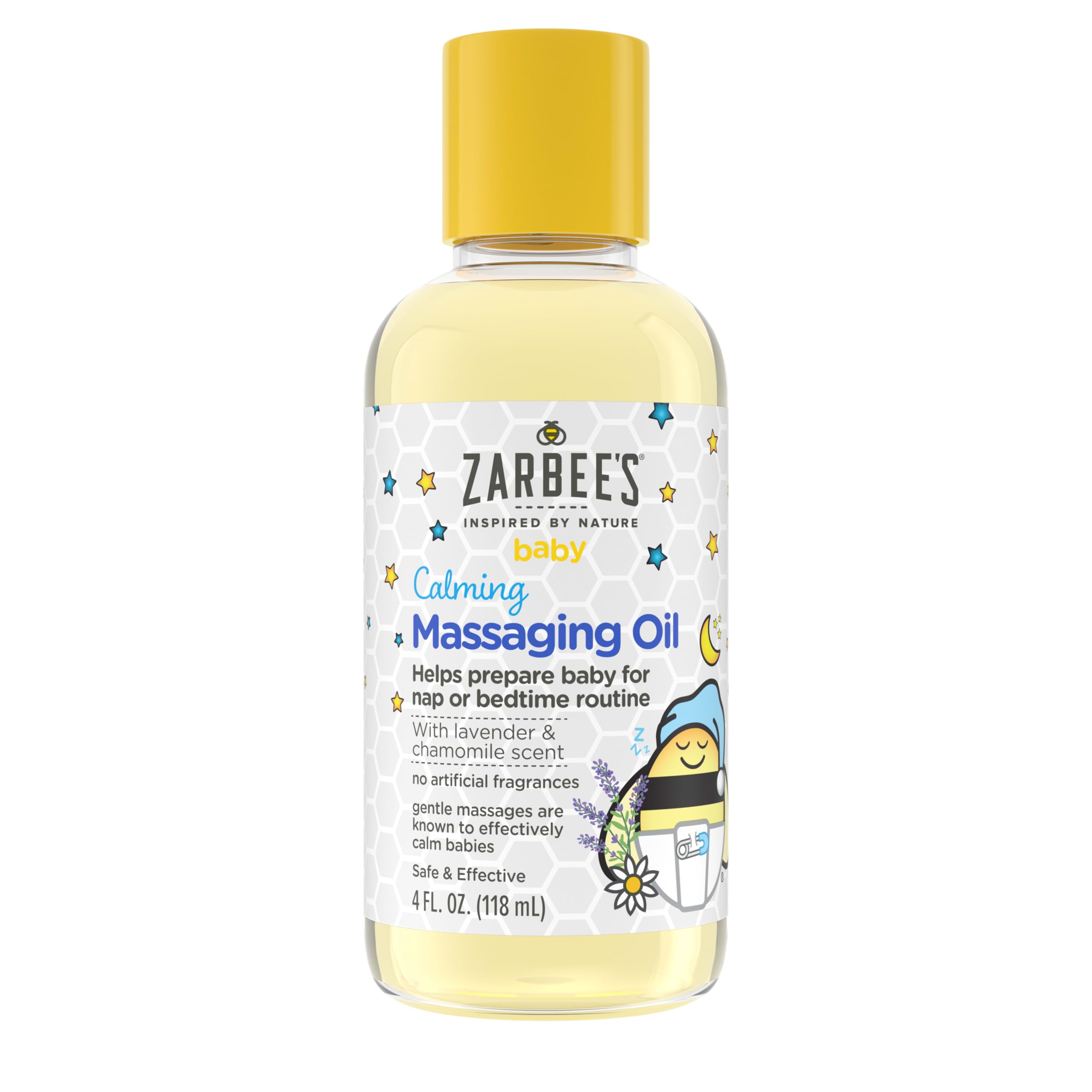
Zarbee’s Calming Massage Oil
Key Features
- Size: 4 fl. oz
- Scent: Lavender & chamomile
- Key ingredients: Lavender, chamomile
- Formulated without: Artificial fragrance, dyes, parabens
- Price: Midrange
Lavender and chamomile, and a bottle that is less about moisture than about the ten minutes before bed. We think that is a fair thing to sell: a massage oil that gives you a consistent, recognizable scent at the end of the bath, so the routine starts doing the work and you stop having to invent it.
The oil itself is light and non-greasy and absorbs enough that you are not leaving prints on the crib sheet. The scent comes from the botanicals rather than an added fragrance, and there are no dyes or parabens. On a small baby the lavender is noticeable, so smell it yourself first if you are sensitive to it.
The part to temper is the sleep promise. A massage can settle a baby and a routine helps, but the oil is not a sedative and the results are genuinely mixed, with some babies dropping off and plenty showing no difference at all. Buy it for the ritual and the soft skin, and treat a better night as a bonus rather than the reason.
Pros
- Lavender and chamomile set a bedtime cue
- Light, non-greasy finish
- No artificial fragrance, dyes or parabens
Cons
- Sleep benefits are inconsistent
- Lavender is noticeable on a newborn
We like this one for the bedtime ritual rather than the sleep claims: lavender and chamomile turn an after-bath massage into a cue.
Best for Daily Family Use
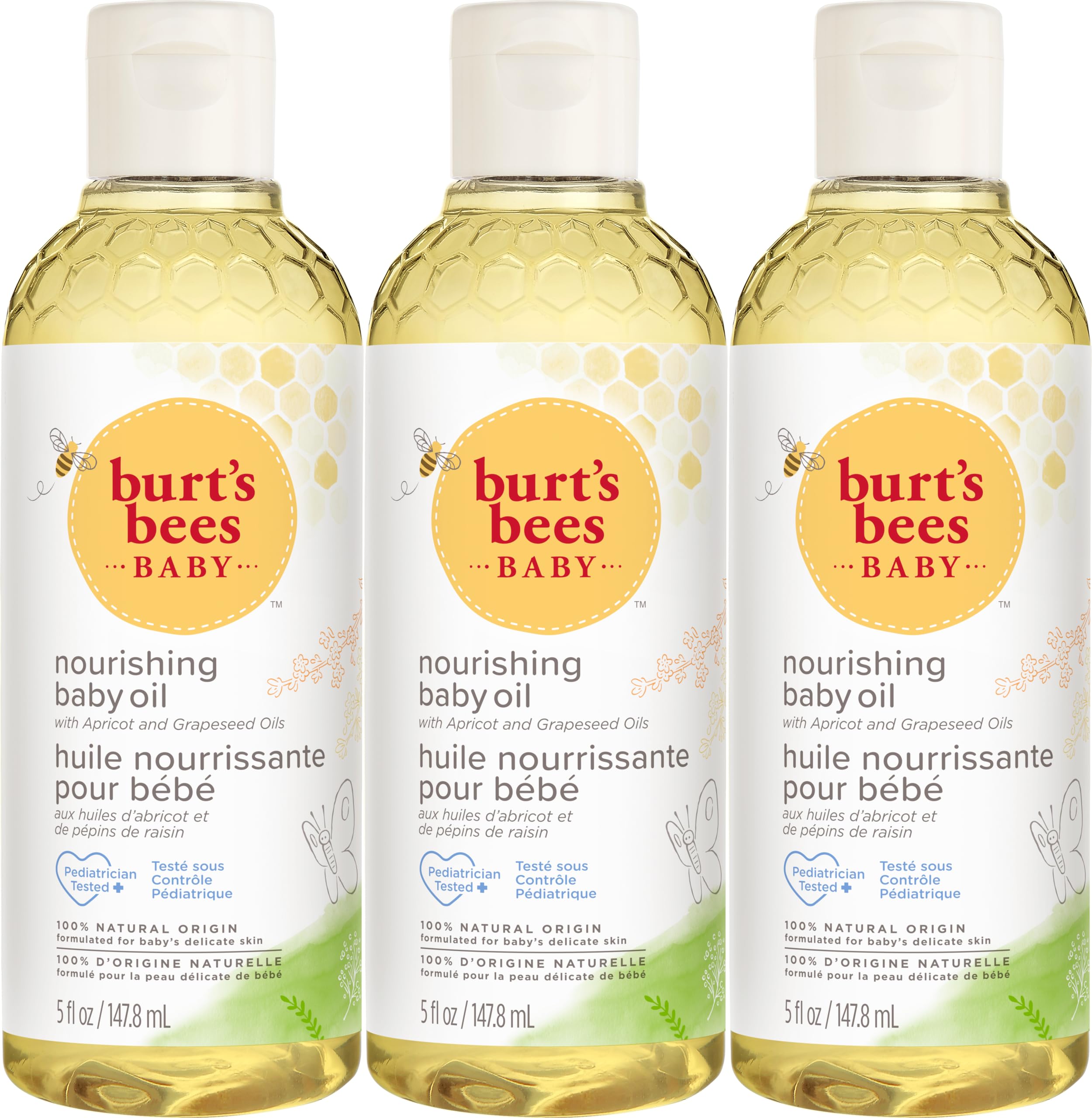
Burt’s Bees Nourishing Baby Oil
Key Features
- Size: 5 fl. oz, 3-pack
- Natural origin: 100% natural origin
- Key ingredients: Apricot oil, grape seed oil
- Formulated without: Parabens, phthalates, petrolatum, SLS
- Price: Midrange
Apricot and grape seed oil, no petrolatum, no parabens, no phthalates, no SLS, and a 100% natural origin claim on the label. Burt’s Bees packs it as three 5-ounce bottles, which tells you what it is for: a household that oils a baby every night and does not want to think about reordering.
The finish is the best part. It goes on thin, then dries down to almost nothing, with no film, no shine, and no waiting around before pajamas. For a baby who is already half-dressed and losing patience, that matters far more than the ingredient list.
A botanical blend does not make it automatically gentle, though. A rash is possible with this one, as with most of the plant-oil options here, so a patch test on the thigh before the first full massage is worth the day it costs. The scent is soft and noticeable; this is not the fragrance-free route.
Where it wins is format. Three bottles of a plant-oil blend is the right shape for nightly use, and a capful in the bath water is the second way to get through it, which is how a three-pack disappears quicker than you expect. If you want the same idea without scent, Earth Mama is the bottle; if you want a mineral base instead, the classic Johnson’s goes the other direction.
Pros
- Apricot and grape seed oil base
- Dries down without a film
- Three bottles for nightly use
- Free of parabens, phthalates and petrolatum
Cons
- Can provoke a rash on reactive skin
- Scent is noticeable on a newborn
The three-bottle pack is why we rate it: apricot and grape seed oil, a finish that dries to nothing, and enough to oil every night.
Best for Light, Creamy Feel
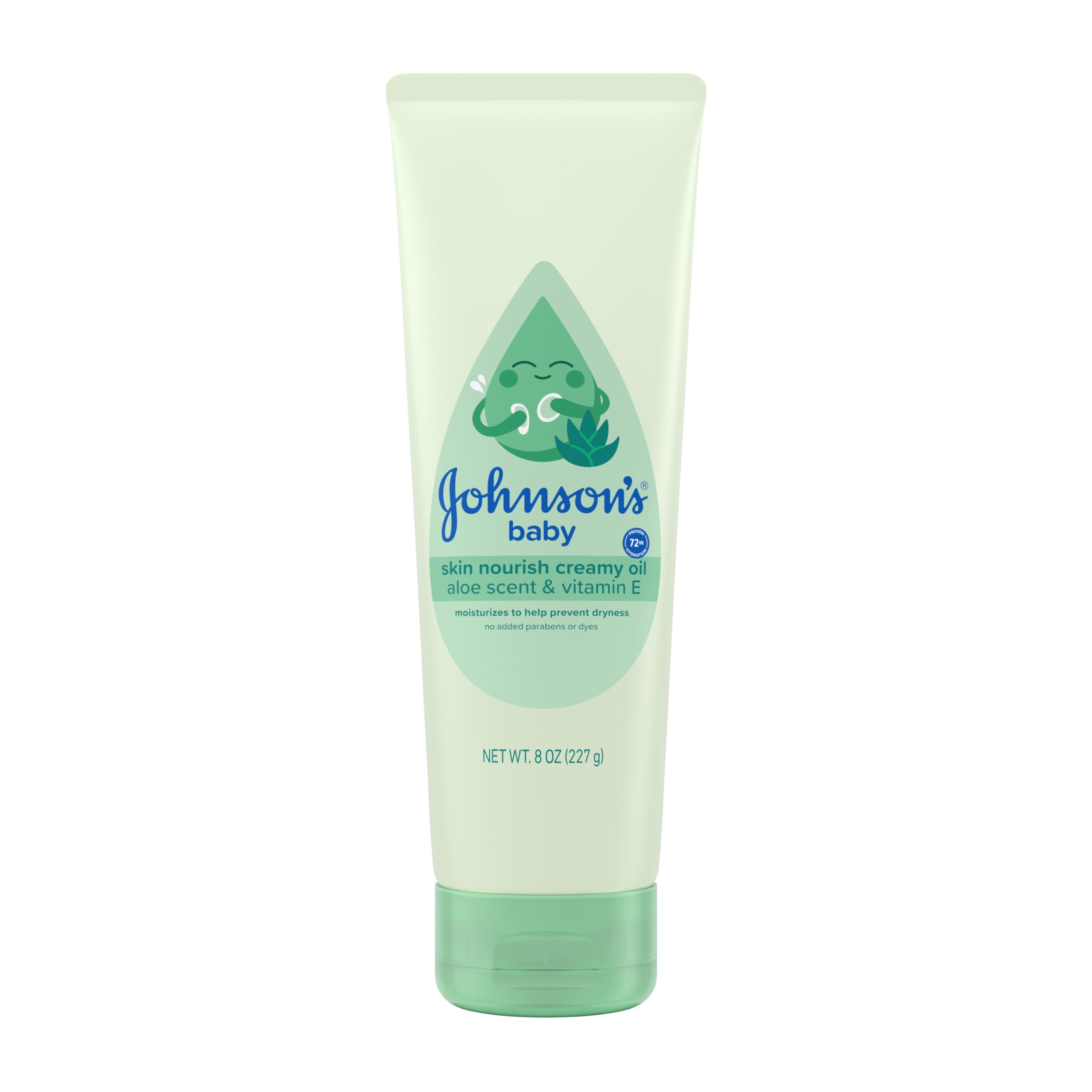
Johnson’s Creamy Baby Oil
Key Features
- Size: 8 fl. oz
- Scent: Lightly scented
- Moisture claim: 72 hours
- Key ingredients: Aloe vera, vitamin E
- Price: Budget
Creamy oil is the odd format here, thicker than the thin oils, thinner than a lotion, and it spreads like something in between. Johnson’s pairs aloe and vitamin E with that base, and the label claims 72 hours of moisture. We cannot confirm the number, but the immediate feel is right: soft rather than slick.
It sinks in fast, which is the whole reason to choose it. You can oil a baby’s legs and get a diaper on without a wrestling match, and there is no shine left on the changing mat afterwards. It is pH balanced and hypoallergenic, with no added parabens or dyes, and the label pitches it at the whole family.
What you give up is glide. For a long, slow massage the thin oils here are better, because they let your hands travel while this one starts to grab as it absorbs. If your massage is half a minute of tummy rubs before bed, you will not miss it.
Put it in the daytime slot: the bottle for a morning change when speed beats ritual. It is inexpensive, it goes on one-handed, and the aloe scent is light enough to disappear under a sleepsuit. That makes it the easiest of these to actually use every day, which is worth more than a richer formula you save for Sundays.
Pros
- Absorbs fast enough to dress straight after
- Light aloe scent, no greasy shine
- Easy to apply one-handed
Cons
- Too little slip for a long massage
This is the bottle we use in the morning: it absorbs fast enough to dress straight after and goes on one-handed.
Best for Single-Bottle Trial
Amazon Basics Baby Oil

Key Features
- Size: 14 fl. oz
- Scent: Lightly scented
- Skin testing: Dermatologist tested
One 14-fluid-ounce bottle, mild and gentle, lightly scented, dermatologist tested. That is the offer, and it is the right shape for plenty of households: a baby oil you can try without committing to a case of it, in a bottle big enough to keep in the bathroom.
The formula is the classic mineral-oil type, so it coats and seals rather than absorbing, which is all a baby oil really has to do. The caveat is sensitive skin. Stinging and rashes can happen with this one, and while plenty of babies wear it with no trouble at all, a newborn or a baby with eczema is not the place to start. A patch on the leg for a day tells you what you need to know.
Buy it as the trial bottle. Use it through a few weeks of baths, and if the scent and the feel suit your baby you have found a staple you can reorder without thinking; if they do not, you have not got six bottles of the wrong thing in the cupboard. One quirk worth knowing: packaging varies between orders, so the bottle that arrives may not match the photo, though the oil inside is the same.
Pros
- Single bottle, no multipack commitment
- Dermatologist tested and lightly scented
- Large 14 fl. oz bottle
Cons
- Can sting very sensitive skin
- Packaging may differ from the photo
We point first-time buyers here: one bottle, one patch test, and no commitment to a multipack before you know it suits your baby.
How We Tested the Best Baby Oils
We started by scanning ingredient lists and labels for both fragrance-free and lightly scented formulas, checking price per ounce, and ruling out anything that seemed likely to leave heavy residue or irritate sensitive skin. That left 15 bottles, which we used over four months.
Testing happened where baby oil actually gets used: on the bath mat, at the changing table, and during the last calm stretch before bed. Each tester patch-tested a drop on their inner forearm first, then on their baby’s legs, watching for redness, bumps, or fussiness over the next day. During regular after-bath massages, we noted how thin or thick each oil felt, how far a quarter-size pour spread over a squirming toddler, and whether pajamas or sheets felt greasy afterward. We checked dry patches on shins and cheeks before application, ten minutes after, and the next morning to see what actually moisturized.
Fragrance got its own test: we smelled each bottle fresh, then checked whether the scent lingered on skin or clothes an hour later, and whether it was soft or sharp in a small nursery. For sleep, parents kept a simple log of how quickly their baby settled after a massage and whether night wakings changed over the testing period. We also tracked price per ounce and how many uses we got from each bottle, and stopped using anything that caused redness or irritation — a dealbreaker no matter how nice the texture. The oils that made the final list were the ones that absorbed without a film, kept skin soft until morning, and never made us reach for a wipe in a hurry.
How to Choose a Baby Oil
Three things decide whether a baby oil suits you: what it is made from, whether it is scented, and how much slip you want on your hands at bath time.
Mineral oil or plant oils
Mineral oil is the classic base and still the cheapest way to seal moisture into skin. It works by sitting on the surface, which is why it holds water in so well and why it can feel slippery rather than absorbed. Plant oils such as calendula and jojoba, avocado and sunflower, apricot and grape seed, or cocoa butter sink in more readily and cost more, and each behaves differently: cocoa butter is the one for stubborn patches, apricot and grape seed for a light finish you can dress over.
The trap is assuming natural means safe for your baby. Botanical oils can provoke a reaction just as easily as anything else, and a plant blend is not a guarantee of tolerance. Whichever base you pick, test it on a small patch of skin before a full-body massage, and if your baby has already reacted to something, start with the shortest ingredient list you can find rather than the longest.
Settle the scent question first
Smell is the most noticed thing about a baby oil and the most likely reason one does not work out. Lightly scented classics suit most babies and are part of the ritual for plenty of parents. For a newborn, or a baby who has already had a rash, unscented is the safer starting point, and it is the reason a three-ingredient calendula oil earns a place on this list at a premium price.
Fragrance-free does not mean it smells of nothing. A simple plant oil carries its own faint smell, and naturally unscented means nothing was added, not that the bottle is odourless. If you dislike the smell of the oil itself, you will dislike it on your baby too, so smell before you commit to a case.
How much slip do you want
Thin oils give the most glide, which is what a real massage needs: your hands travel, the baby settles, and the oil takes a few minutes to sink in. Creamy oils sit between an oil and a lotion and absorb quickly enough that you can dress a baby straight away, at the cost of that long, smooth stroke. Neither is better; they suit different moments in the day.
Pick by when you will use it. For an evening massage and a slow routine, a thin oil. For morning changes and a baby who will not lie still, a creamy oil such as Johnson’s aloe version, which goes on one-handed. If you are oiling a scalp or a single dry patch rather than a whole body, a small unscented bottle covers both jobs.
Buy one bottle, then commit
Bottles here run from about 3 to 20 fluid ounces, and the small one is nearly always the right first purchase. A multipack only pays off once you know the formula suits your baby and you actually oil most days; three bottles of something that causes a rash is three bottles you cannot use up.
Think about who else will use it as well. The classic oils get borrowed for adult dry skin, shaving and cuticles, and a six-bottle pack makes sense in a household like that. If the oil only ever goes on the baby, one bottle at a time is plenty.
Frequently Asked Questions
Is baby oil safe for a newborn?
Check the label first, because the minimum age varies: Johnson’s lists 3 months and up, Earth Mama starts at 1 month, and Mustela is labeled from birth. If your baby is younger than the bottle allows, wait a few weeks. For any baby with eczema, a rash, or broken skin, ask your pediatrician before you start, and try a small patch on the thigh for a day before a full-body massage.
Can baby oil help with cradle cap?
Yes, and it is one of the better uses for it. Massage a few drops into the flaky patch on the scalp, let it sit and soften the flakes, then comb gently with a soft brush and wash it out at bath time. Do not pick at the scalp, and repeat over several baths rather than trying to clear it in one go.
Is baby oil better than baby lotion?
They do different jobs. Oil seals in moisture that is already in the skin, so it works best on skin that is still damp from the bath. Lotion adds water as well, which suits skin that needs hydrating rather than protecting. Many parents use both: oil at night after the bath, lotion in the morning before clothes go on.
Final Verdict
Our default is Johnson’s Baby Oil with Shea & Cocoa Butter. It seals in moisture after a bath, spreads further than any other pick here, and costs the least per ounce, which makes the six-bottle pack a hurdle worth clearing for a household that oils daily.
Change the requirement and the answer changes. If your baby’s skin reacts, or you simply do not want fragrance near a newborn, Earth Mama’s three-ingredient calendula oil is the better buy, and Palmer’s is the one for stubborn dry patches. If you want to test a formula before you commit to a case, start with a single bottle of Amazon Basics.
