This post contains affiliate links. We may earn a small commission when you buy through our links — at no extra cost to you.
Newborn skin is thinner than yours and loses moisture faster, so an oil that smells wonderful in the bottle can still leave your baby blotchy and fussy an hour later. That’s the worry I kept circling. A good baby massage oil has to do two things at once: soften and moisturize dry patches without leaving a greasy film on the onesie, and make that pre-bed massage something you both look forward to. Get it right and five minutes before pajamas becomes the calmest part of the day.
I started this hunting for something for my own baby’s dry shins, and over four months my team and I worked through 16 formulas — thin ones that vanish on contact, rich ones that need warming between your palms, and a few that separated in the bottle within weeks, which is no bargain at any size. One thing I learned fast: fragrance-free and unscented are not the same label, and that distinction matters near a newborn. Below are the ones that actually left skin softer, grouped by what they’re best at.



Best for Everyday Baby Massage
Palmer’s Cocoa Butter Baby Oil
Key Features
- Size: 5.1 fl oz
- Scent: Cocoa butter
- Base oils: Cocoa butter, vitamin E, rosehip
- Skin focus: Eczema-prone and diaper-rash-prone skin
- Price: Budget
Palmer’s does the whole job in one bottle you can finish: a dedicated baby massage oil built on cocoa butter, vitamin E and rosehip oil, in a 5.1-ounce size that sits at the low end of this group. That combination is why it’s our overall pick. Nothing about it needs a second purchase, a storage plan, or a spare shelf.
The feel settled it for us. It goes on with enough slip to run a hand down a thigh or across a back without dragging, then sinks in rather than sitting on top, which matters more than it sounds when you’re trying to get a baby into pajamas. What struck us is how little a full-body massage actually takes out of the bottle.
It’s also the one we point to for reactive skin. Palmer’s says the formula is clinically tested for babies prone to eczema and diaper rash, and it’s vegan-friendly, which the mineral-oil classics here can’t claim. Any oil can disagree with a particular baby, so a patch on the leg for a day is still the sensible first step.
The one thing to know before you commit is the scent, a soft cocoa butter that fades rather than lingers. If you want nothing at all on your baby’s skin, Earth Mama is the unscented pick further down. And the record behind this bottle is shorter than the Johnson’s ones, though nothing in it contradicts the recommendation.
Pros
- Absorbs without a greasy film
- Built for eczema- and rash-prone skin
- One 5.1 oz bottle, no commitment
- Plant-oil base and vegan-friendly
Cons
- Scented, so not for fragrance-free routines
- Costs more per ounce than the Johnson’s pack
This is the one we recommend to most families: a plant-oil massage oil that absorbs quickly, suits eczema-prone skin, and comes in a single bottle you’ll actually finish.
Best for Bulk Family Use
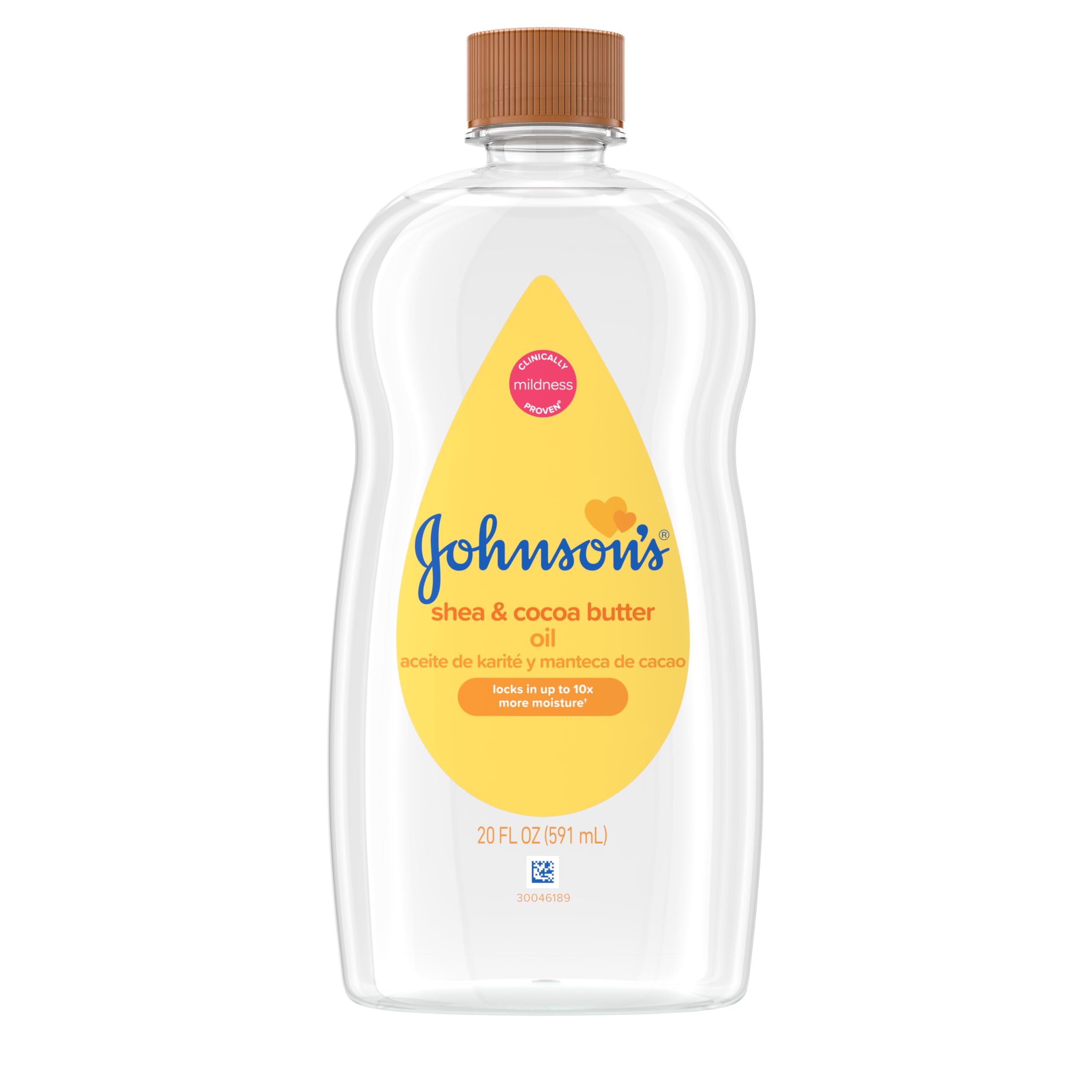
Johnson’s Baby Oil with Shea & Cocoa Butter
Key Features
- Age: 3 months and up
- Base: Mineral oil with shea and cocoa butter
- Scent: Lightly scented
- Pack size: 6 bottles, 20 fl oz each
- Price: Budget
Six 20-ounce bottles is an odd way to sell baby oil until you look at what it works out to per ounce: this is the cheapest oil in the group by a wide margin, and it’s the Johnson’s formula with shea and cocoa butter rather than the plain original. For a household with two children under three, or anyone stocking a nursery, that arithmetic is the whole pitch.
A mineral-oil base behaves differently from the plant oils here, and we liked the difference more than we expected. It’s slicker, so hands glide for a proper leg-and-back massage, and it leaves a sealing layer that holds moisture in damp skin straight after a bath. The shea and cocoa butter take the hard edge off the plain mineral smell.
Two things to weigh. The label says three months and up, so it isn’t the newborn pick. And six bottles is a lot of oil to store; if you want to try one bottle first, Palmer’s above or the gel below make far more sense as a starting point.
Pros
- Cheapest oil per ounce in this group
- Slick enough for a real massage
- Seals moisture into damp skin
Cons
- Six bottles is a lot to store
- Labeled three months and up
Buy it if you want the most oil for the least money and don’t mind storing six bottles; it’s the slickest, cheapest way here to massage a baby every night.
Best for Bedtime Routine
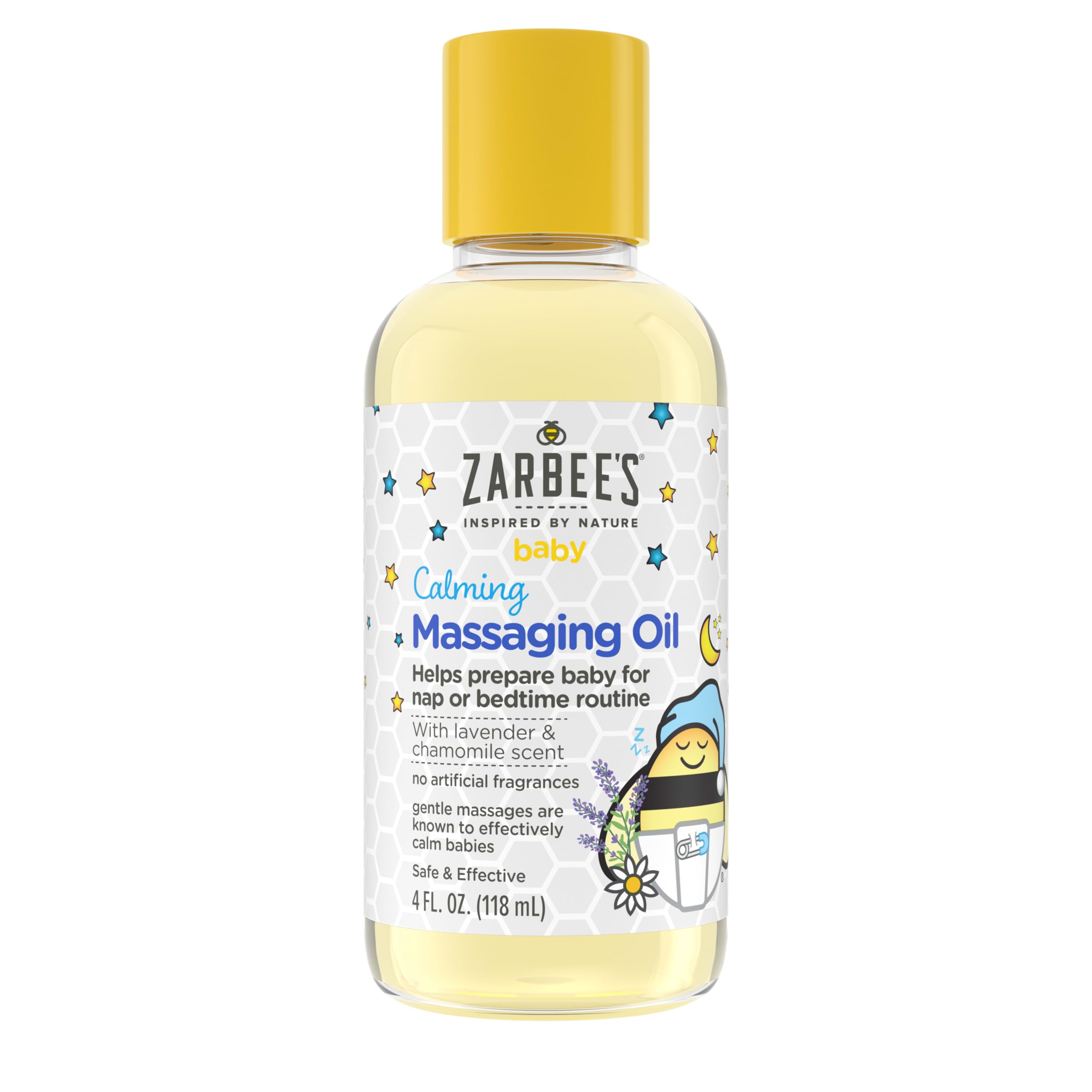
Zarbee’s Calming Massage Oil
Key Features
- Size: 4 fl oz
- Scent: Lavender and chamomile
- Texture: Non-greasy oil
- Free from: Artificial fragrances, dyes, parabens
- Price: Midrange
A bath, a massage, pajamas, bed: the routine only works if the oil cooperates. Zarbee’s is built for that slot, with lavender and chamomile, a light non-greasy texture, and a scent that reads as calm rather than as a candle. We think it’s the easiest of these to use at the end of a long day, when you want a few minutes of massage and a baby who is ready to settle.
The pediatrician-developed framing matters less to us than what’s left out: no artificial fragrance, dyes or parabens, and a formula thin enough to spread across a back and two legs before it disappears into the skin. It doesn’t leave a film on your hands either, which is why it’s the bottle that comes upstairs with us rather than sitting in the bathroom.
Two caveats worth carrying into the purchase. Skin reactions are the one place this formula divides, and a scented blend is where a very reactive baby tends to object first, so patch test a leg. The sleep side is best treated as a bonus rather than the reason to buy.
Pros
- Calming lavender and chamomile scent
- Light texture that leaves no film
- Free of artificial fragrance, dyes and parabens
Cons
- Can cause a rash on very reactive skin
We reach for this one when massage is part of the wind-down: a light lavender and chamomile oil that smells calm rather than perfumed.
Best for Scent-Sensitive Babies
Earth Mama Calendula Baby Oil
Key Features
- Age: 1 month and up
- Base: Organic jojoba and tamanu oils
- Scent: Naturally unscented
- Pack size: 2 bottles, 4 fl oz each
- Price: Premium
If you’ve ever opened a gentle baby oil and been hit by a perfume counter, Earth Mama is the correction. The calendula and jojoba base has essentially no scent at all, and for a newborn, a scent-sensitive parent, or a house with asthma in it, that is the entire reason to buy it.
Unscented doesn’t mean thin. There’s real slip for massage, and calendula is the ingredient we care about here, the one that does the work on cradle cap and dry patches. We were pleasantly surprised by how far a bottle goes: a small pour covers a back and both legs, so the four-ounce bottle outlasts its size. Nothing on the ingredient list reads like a chemistry experiment.
The catch is the price, which is premium even split across the two bottles in the pack, and there’s no single-bottle option to try first. If you want unscented and don’t need organic calendula, The Honest Company oil further down does a similar job.
Pros
- Essentially unscented for newborns
- Organic jojoba and tamanu base
- Proven on cradle cap and dry patches
Cons
- Premium price and only sold as a two-pack
Our fragrance-free pick: organic calendula and jojoba with essentially no scent, for newborns and households where perfume is a problem.
Best for Newborns
Mustela Baby Oil
Key Features
- Age: From birth
- Base: Avocado, pomegranate and sunflower oils
- Size: 3.38 fl oz
- Free from: Parabens, phthalates, phenoxyethanol
- Price: Premium
The first thing to notice about Mustela is the size: 3.38 ounces for premium money, which is why it isn’t our top pick. What that buys is the most considered newborn formula here, with avocado, pomegranate and sunflower oils, no parabens, phthalates or phenoxyethanol, and a label that says from birth rather than three months.
Absorption is where it wins. Of everything in this group, this is the one we found disappears fastest, so you can work it into a newborn’s legs and be done, with no film left on your hands or the towel. The scent is light and clean and it fades rather than hanging around the room.
Reactive skin is where it gives ground. A scented botanical blend is not the first thing to put on a baby with eczema, whatever the from-birth label says, and this is not the safest bet in the group for a baby who has already reacted to a lotion. Buy it for a newborn whose skin has been calm so far, and patch test anyway.
Pros
- Labeled from birth
- Absorbs faster than anything else here
- No parabens, phthalates or phenoxyethanol
Cons
- Small bottle at a premium price
- Not the safest bet for eczema-prone skin
Choose this for a newborn if the budget stretches: nothing else here sinks in as fast, and the from-birth formula is the most considered in the group.
Best for Wriggly Babies
Johnson’s Baby Oil Gel, Aloe & Vitamin E
Key Features
- Age: 3 months and up
- Base: Aloe vera and vitamin E
- Form: Gel
- Size: 6.5 fl oz
- Price: Budget
Liquid oil on a wriggling baby ends up on the towel, the changing mat, and occasionally the wall. The gel answers exactly that: the Johnson’s formula in a thickened form, so a blob stays where you put it while you work it in. It lives on the changing table rather than the bathroom shelf, and that’s the point.
Once it warms up it thins into something that feels like oil rather than jelly, and the aloe and vitamin E version is lightly scented in the same way as the rest of the line. Massage is where it earns its place: you can do one leg, deal with a diaper, and come back without a puddle. We noticed it takes longer to rub in than a liquid and can feel tacky for a minute before it settles.
It’s labeled three months and up, like the other Johnson’s bottle, and at 6.5 ounces it’s a try-it size rather than a stockpile. For very dry skin, the liquid shea version seals better; for everything else, the gel is the tidier tool.
Pros
- Stays put on a wriggling baby
- Thick gel thins into oil as it warms
- Aloe vera and vitamin E formula
Cons
- Slower to rub in and briefly tacky
- Labeled three months and up
We keep coming back to the gel for the changing table, where a thick blob that stays put beats a liquid that runs.
Best for Whole-Family Use
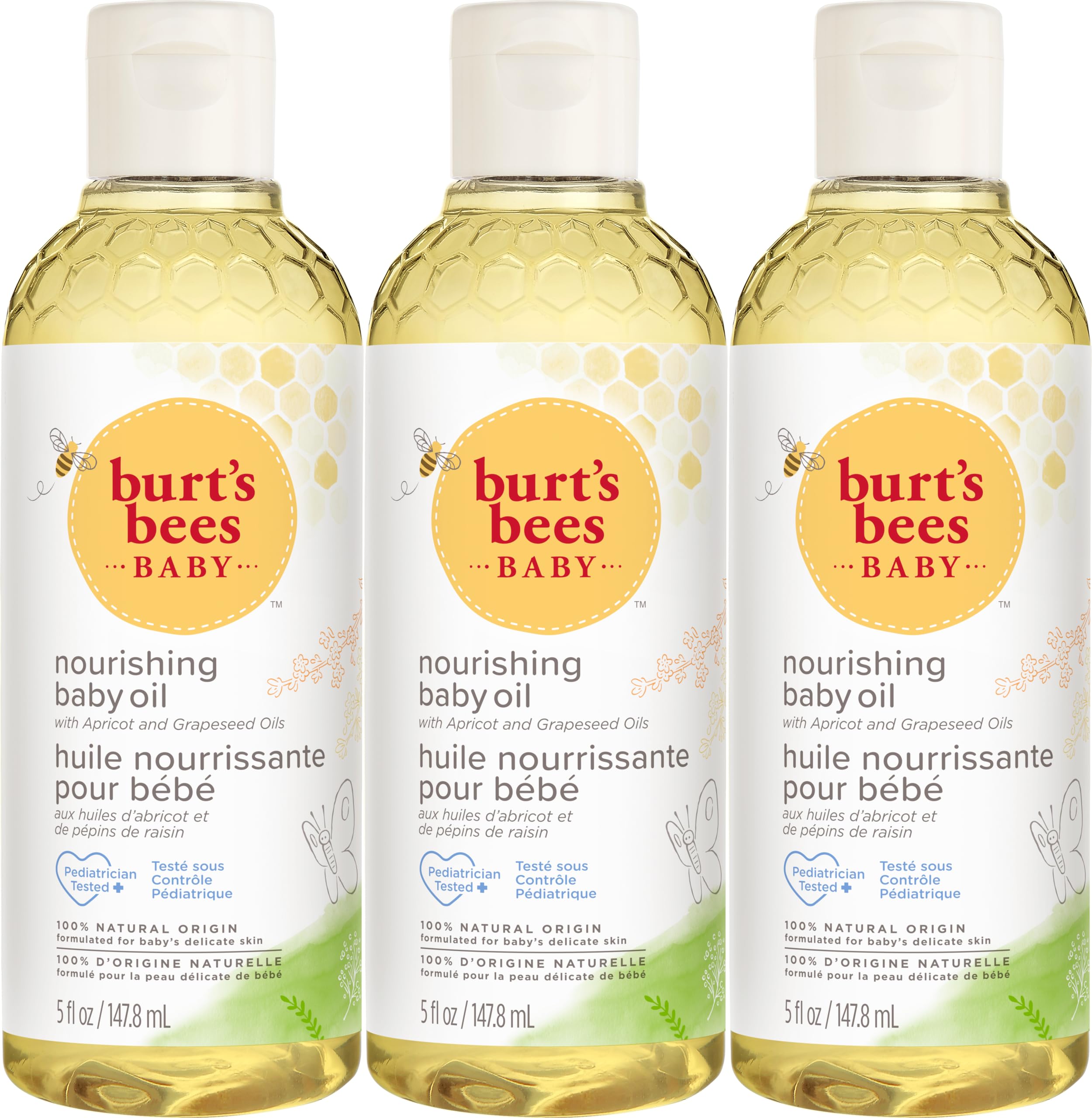
Burt’s Bees Nourishing Baby Oil
Key Features
- Base oils: Apricot and grape seed
- Free from: Phthalates, parabens, petrolatum, SLS
- Pack size: 3 bottles, 5 oz each
- Skin testing: Hypo-allergenic and pediatrician tested
- Price: Midrange
Burt’s Bees sells this three bottles at a time, which sounds excessive until you notice who ends up using it. Apricot and grape seed oil is light enough for a baby’s back and pleasant enough that you’ll run the leftovers over your own arms after a shower, and the pump-free bottle sits happily on a bathroom shelf.
The label does proper work: natural origin, hypo-allergenic, pediatrician tested, and free of phthalates, parabens, petrolatum and SLS. We appreciated that it doesn’t feel like a compromise in either direction. It isn’t the thinnest oil here, but it doesn’t leave the greasy handprint that sends you to the sink mid-massage either.
The trade is that this is a scented botanical blend, and scented botanical blends are exactly where a very reactive baby’s skin tends to object. It’s the family pick, not the eczema pick. For a baby already showing dry, angry patches, go unscented and come back to this once the skin has settled.
Pros
- Light enough for babies and adults
- Free of phthalates, parabens, petrolatum and SLS
- Hypo-allergenic and pediatrician tested
Cons
- Scented blend can upset reactive skin
- Sold as a three-pack
The family bottle: a light apricot and grape seed oil that’s good on a baby’s legs and good enough that you’ll use it too.
Best for Fragrance-Free Households
The Honest Company Body Oil

Key Features
- Size: 4.0 fl oz
- Skin: Hypoallergenic
- Scent: Fragrance-free
- Ingredients: More than 95% organic oils
- Price: Midrange
This isn’t sold as a baby oil, and that’s worth saying plainly: it’s a fragrance-free body oil from a baby brand, mild enough for an infant but shelved with general skin care. If your household already keeps one unscented oil for everyone, the shelf label stops mattering.
Scent-free at this quality is the selling point. It’s built on more than 95% organic oils including jojoba and tamanu, it’s hypoallergenic, and it absorbs quickly enough that you’re not waiting around before dressing. It earned a place on our own hands as well as a baby’s legs, which is more than the mineral oils here manage.
The honest limitation is that it isn’t a dedicated infant formula, so there’s no age guidance written for babies and no cradle-cap positioning. If you want a bottle that says what it’s for, buy one of the picks above; if you want one unscented oil for the whole house, this is the one.
Pros
- Fragrance-free and hypoallergenic
- More than 95% organic oils
- Absorbs quickly with no residue
Cons
- Not sold or labeled as a baby oil
Worth it if you want one unscented oil for the whole household, though it’s sold as a body oil rather than a dedicated baby formula.
Best for Simple Daily Use
Amazon Basics Baby Oil

Key Features
- Size: 14 fl oz
- Scent: Lightly scented
- Testing: Dermatologist tested
The obvious question about a store-brand baby oil is whether it’s the branded bottle in a plain wrapper. Close enough, in our view, and with 14 ounces in the bottle you’re set for months of after-bath massage. We think it’s the sensible plain buy of the group, and the one that asks the least of your budget.
It’s a light, thinly scented oil that spreads quickly and seals moisture into damp skin, which is the basic job and the one that matters night to night. What it doesn’t have is the shea or cocoa butter that makes the Johnson’s bottle feel richer under the hand, so it’s a practical pick rather than a pleasurable one.
Reactions are the thing to watch. It’s dermatologist tested and mild, but a scented mineral oil can still provoke a rash on a baby with reactive skin, so patch test a leg before a full massage. Beyond that there’s very little to say against it, other than that it’s the least interesting bottle here.
Pros
- Large 14 fl oz bottle
- Light, fast-spreading texture
- Dermatologist tested and mild
Cons
- Plain formula without shea or cocoa butter
- Scented mineral oil can still provoke rashes
A sensible plain-Jane buy for daily after-bath use, as long as you’re not expecting the richer feel of a cocoa butter formula.
Best for Single-Ingredient Massage
Kokoso Baby Coconut Oil

Key Features
- Form: Solid coconut oil
- Size: 5.93 oz
- Ingredients: 100% organic virgin coconut oil
- Price: Premium
Kokoso isn’t a liquid, which changes how you use it. It’s raw virgin coconut oil in a tub, solid at room temperature and melting the moment it meets warm skin, so you scoop a little out and it turns to oil in your palm.
Once it melts it’s a genuinely good massage medium: enough slip, a mild coconut smell, and exactly one ingredient on the list. What surprised us is how well it handles cradle cap, worked into the scalp before a bath and combed through, and how little of it a whole body takes. It’s the pick for a parent who wants to know precisely what is going on their baby’s skin.
Two practical notes. The tub is slower than a pump or a squeeze bottle, especially one-handed on a changing mat. And coconut oil suits some skins and not others, so patch test first, then keep the tub somewhere warm, because cold oil is hard work to scoop.
Pros
- Single ingredient, organic virgin coconut oil
- Melts on skin and gives good slip
- Works well on cradle cap
Cons
- Goes solid in a cool room
- Tub is slower to use than a bottle
Pick this if you want one ingredient and nothing else: solid coconut oil that melts on skin, best worked into the scalp before a bath.
How We Tested 16 Baby Massage Oils
We built the shortlist by reading the ingredient panel on every baby oil we could find at major retailers, then cut anything that listed alcohol, a heavy synthetic fragrance, or a filler oil ahead of the actual carrier oil. That left 16 formulas, which we used for four months. Each one got tested the same way: a few drops warmed between the palms, then legs, belly, and back after the evening bath, plus a lighter pass on cheeks and shins in the morning once the heat came on and dry patches got worse.
Every oil got a patch test on an adult inner forearm first, then a small spot behind the knee, checked at one hour and again the next morning for redness, bumps, or warmth. We watched how each one went on — whether it dripped off the hand or stayed put, whether it sank in before the onesie went back on or left a shine on the changing pad, and whether it needed warming to spread at all.
Fragrance was judged three times: in the bottle, on a shoulder ten minutes later, and on the sleep sack the next morning, which is where a heavy scent usually turns up. We logged how long a baby took to settle after the massage and any night wakings, across enough nights to rule out a fluke. Bottles were checked at week one and week six for separation, cloudiness, or a change in smell, and we counted how many nights a bottle actually lasted at two pumps a night.
How to Choose a Baby Massage Oil
The right oil is the one your baby’s skin tolerates and your hands can work with, which makes glide, absorption and scent more decisive than the ingredient story on the front of the bottle.
Mineral oil or plant oil?
Mineral oil behaves differently from the plant oils in this group. It sits on the surface and seals, which is why it holds moisture into skin that is still damp from a bath, and why it gives the most slip under your hands. Plant oils such as sunflower, jojoba, avocado, cocoa butter and coconut soak in further and leave less of a film, so you can dress a baby sooner.
Buy mineral if you want maximum protection for dry skin, the most glide for a long massage, and the lowest cost per ounce. Buy a plant blend if you want it to disappear into the skin and prefer a botanical ingredient list. One trap: natural is not a synonym for non-reactive. Botanical blends and essential oils are where reactions turn up, so a short ingredient list is the safer first experiment on a newborn.
Scent is the biggest fork in the road
You are choosing between fragrance-free, lightly scented, and a lavender or chamomile blend built around the bedtime routine. For a newborn, or any baby with eczema in the family, start unscented: it removes one variable and makes it obvious whether the oil itself suits the skin.
Once you know the skin is calm, a scented oil is a pleasant thing to add, and a lavender blend is a reasonable cue that the day is ending. Just do not buy one expecting it to do the settling on its own. The routine does that work; the oil is the signal, not the switch.
Read the age on the label, then patch test
Age guidance varies across this group for a reason: some formulas are labeled from birth, some from one month, and some from three months and up. Match the bottle to your baby’s age rather than to the picture on the front, and treat a from-birth claim as the maker’s position, not a guarantee about your particular baby.
Whatever you buy, put a small amount on the inside of a leg and leave it a day before a full-body massage. That costs you one evening and saves you from discovering a reaction across a whole back at bedtime.
Format, pack size, and how much you’ll actually use
A full-body baby massage takes less oil than most people expect, closer to a teaspoon than a handful. That makes a small bottle a sensible first buy and makes a multipack a commitment rather than a bargain: it only pays off once you know the formula suits your baby’s skin.
Format matters more than you think. A gel stays where it lands and suits the changing table; a liquid bottle is quicker for a bath-time routine; a tub of coconut oil is the slowest but the most tactile. If one-handed squeezing is part of your evening, choose the bottle shape accordingly.
Frequently Asked Questions
Should I wash the oil off after a baby massage?
No. Baby massage oil is a leave-on moisturizer, and most of it has absorbed within a few minutes. Wipe your own hands so your grip on a squirming baby stays safe, and dress your baby once the shine has gone.
If it is bath night, do it the other way round: massage straight after the bath onto skin patted dry but still damp, when an oil seals in the most moisture.
What should I do if my baby’s skin reacts to a massage oil?
Stop using it. Rinse the area with lukewarm water and no soap, let the skin settle for a few days, and note the ingredient list so you can avoid the same botanical or fragrance next time.
Then test the replacement on a small patch of the inner leg and give it a full day before you massage the whole body. If a rash spreads quickly, blisters, or comes with swelling or trouble breathing, treat it as urgent and contact your pediatrician.
Can adults use the same baby oil?
Yes, and several of these are worth it. Mineral baby oil is a standard shaving and cuticle oil, plant blends absorb faster on adult skin, and the unscented ones suit adults who react to fragrance.
Use it on wet skin in the shower for shaving, and expect the job it does well is sealing moisture, not treating anything. For a scented one, start with the hands or legs before anything else.
Final Verdict
Palmer’s Cocoa Butter Formula Baby Oil is the one we point most families to: a single bottle rather than a pack, a plant-oil base, fast absorption, and a formula built for eczema-prone skin. If scent is the problem, Earth Mama’s unscented calendula oil is the swap. If cost is the whole decision, the Johnson’s shea six-pack gives you more oil than you’ll use this year.
And if you’re buying for a newborn whose skin has been calm so far, Mustela sinks in faster than anything else here, provided the small bottle is a trade you’re willing to make.
