This post contains affiliate links. We may earn a small commission when you buy through our links — at no extra cost to you.
A kids wakesurf board has one job before anything else: help a lighter rider get up, settle into the wake, and actually want another turn. The wrong size or too much board can make a child feel like they’re steering a door, while a board that’s too small turns every wake into a balance test. That’s why I care less about graphics and more about how a board sits under a smaller rider, how the rail releases when they try a turn, and whether the deck still feels solid after a summer of rope drops and dock bumps.
Over the past eight months, my team and I have put six kids wakesurf boards through weekend lake sessions, from first rope pulls to short free rides. We watched which boards helped beginners get up without a fight, which ones stayed predictable when a kid shifted weight, and which showed rail wear or fin-box looseness by August. The best shortened the learning curve, felt worth the money, and had kids asking for another pull.


Best for Kids and Teens
Airhead PFISH
Key Features
- Length: 49 in
- Fin setup: 2 fins
- Board weight: 8.1 lb
- Rider weight limit: 175 lb
- Price: Midrange
Forty-nine inches long, twenty-one wide, 8.1 pounds, and rated to 175 pounds. Those four numbers are why this is the board we hand a kid who is ready to ride the wake on their own rather than on a rope. Everything else in this group is either adult-length or carries no published rider limit, and a child on a five-foot-plus deck spends the ride managing the board instead of the wave.
The shape backs the sizing up. A full outline with a fish tail is forgiving underfoot, and two fins keep it loose enough that a light rider can break the tail free and turn without muscling it. The deck is a thick grooved EVA pad with a kick tail, which matters more than it sounds on a kids’ board — children kneel, sit, and scramble back on after every fall, and a pad you can push off makes each restart less of a chore. We also like that 8.1 pounds is light enough for most kids in the eight-to-twelve range to walk down the dock themselves.
The catch is growth. At 175 pounds this board stops being the right choice: a teenager who takes to wakesurfing is shopping again in a couple of seasons, and an adult who wants a turn will find it sits low and turns slowly under their weight. That is the trade for a deck that fits a child properly on day one, and for the rider this is built for, it is the right trade to make.
Pros
- 49-inch deck with a youth-scale 175 lb limit
- 8.1 lb, light enough for a kid to carry
- Fish tail and two fins stay loose and forgiving
- Thick grooved EVA deck with a kick tail
Cons
- 175 lb limit caps it at kids and smaller teens
- Thin skim profile is less buoyant for timid beginners
If your rider is a kid or a young teen, this is the one we point you to: a 49-inch deck with a 175-pound limit that most children can carry, turn, and stand up on.
Best for Family Sharing
Hyperlite Broadcast
Key Features
- Length: 5 ft 4 in
- Board weight: 11 lb
- Construction: Layered fiberglass
- Rail profile: Rolled edge
- Price: Midrange
Hyperlite builds the Broadcast like a proper surf board: layered fiberglass top and bottom that overlaps around the rail, over a Biolite 3 foam core. That is why it feels stiff and quick underfoot rather than hollow and bouncy the way a molded deck can. The rolled edge profile is the part that matters for a family, since it suits a rider who is still figuring out how to set an edge as well as one who already knows.
At 5 feet 4 inches and around 11 pounds, it is an adult-sized board, and that is the point. A child who can already stand and steer will not outgrow it in two seasons, the mid-tail shape turns predictably, and both parents can surf it. In our group it is the board that comes off the rack most often, because nobody has to choose between the kid’s deck and the grown-ups’ deck.
What that versatility costs you is the walk to the water. A small rider wrestling five and a half feet of glass onto a rocking swim platform is a picture we know well; this is a board an adult carries for the child, not the other way around. If the rider is under about eight or nine, or still needs a hand getting up, start with the PFISH or the ZUP and come back to this one when they can handle themselves.
Pros
- Layered fiberglass over a Biolite 3 core
- Rolled edge and mid-tail shape forgive beginners
- Adults can ride it, so one board covers the boat
- Still the right board once the basics are learned
Cons
- 5 ft 4 in and 11 lb is a lot for a small child
The board we choose when kids and adults share the boat: real glass construction, a shape a confident child grows into, and a size that takes an adult to carry.
Best for Teens and Adults
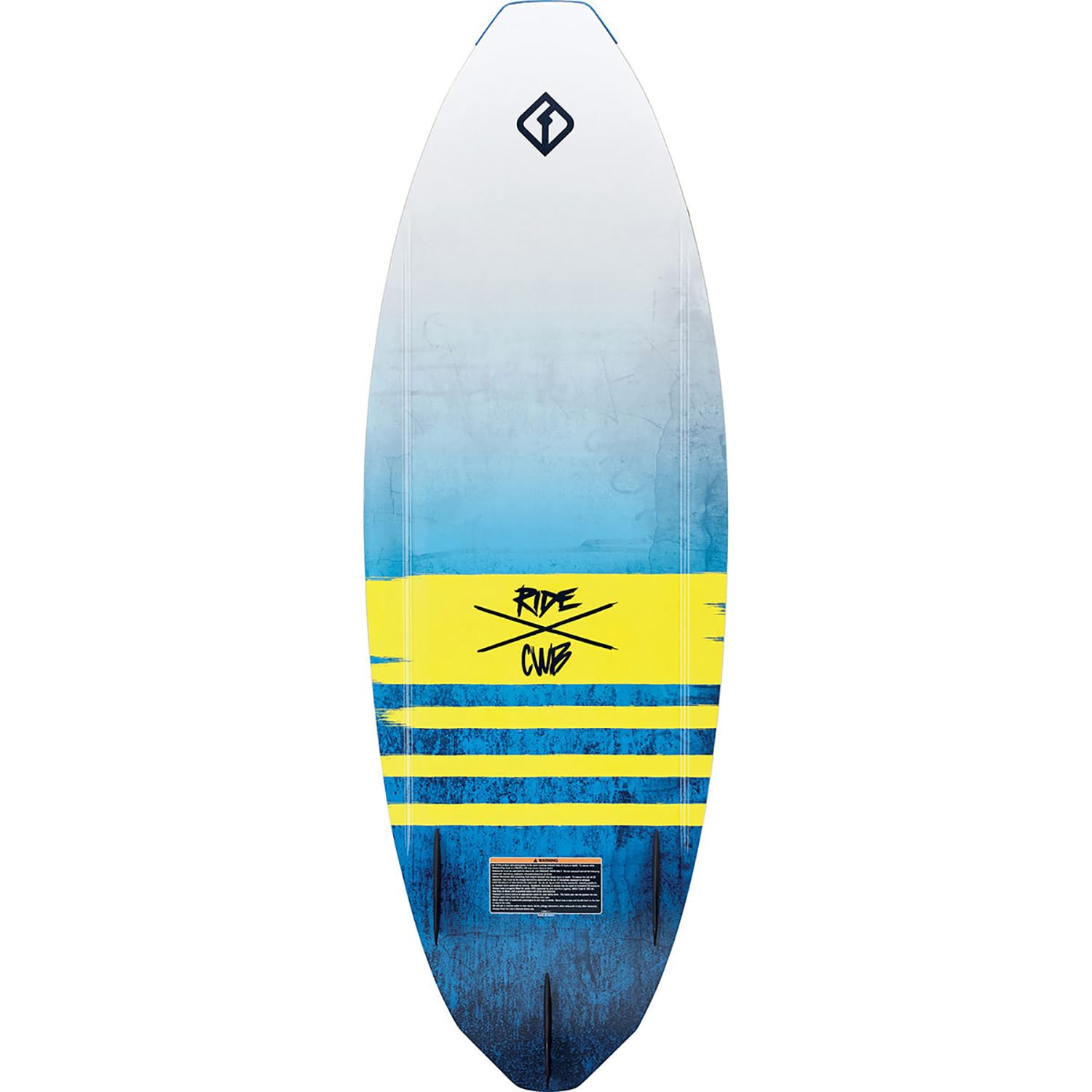
Connelly Ride
Key Features
- Deck: Diamond-cut EVA pad
- Length: 62 in
- Fin setup: Three 1.75 in tail fins
- Construction: Compression molded
- Price: Midrange
Sixty-two inches is the longest board here, and that is exactly what makes the Ride worth a look for a nervous teenager. Length and a double edge rail give it a big, predictable platform: it planes early, it tracks straight when the rider stands up stiff-legged, and the three 1.75-inch tail fins stop the back end sliding out on a slow wake. Stability is what we kept coming back to — a beginner on this board can concentrate on standing rather than on keeping the nose straight.
Compression molding keeps the Ride simple and tough, and the CNC diamond-cut EVA pad with a kick tail gives cold, wet feet something to lock into. The surf-style outline turns predictably rather than snapping around, which suits a rider still learning to look where they are going. Where it stops working is small riders: a nine-year-old on a 62-inch deck gives up the ability to swing it around, and the board ends up steering them. Read the length as a rider-size guide, keep the PFISH for the kids in between, and measure the boat locker before you assume this one lives there.
Pros
- 62-inch platform planes early and tracks straight
- Three tail fins keep the back end planted
- Diamond-cut EVA pad holds wet feet
- Molded construction shrugs off knocks
Cons
- 62 in is too much board for younger kids to turn
We recommend the Ride for teens and bigger beginners who want a stable platform under them, as long as the rider is big enough to turn 62 inches of board.
Best for First-Time Riders
ZUP YouGo

Key Features
- Length: 57 in
- Construction: Molded ABS with EVA pad
- Handle included: 60 ft
- Rider weight limit: 350 lb
- Price: Midrange
The YouGo is built around a tow hook at the nose and a pair of molded side handles, and that pairing is the whole idea: a kid holds on with both hands, gets pulled up to speed gently, and stands when they are ready instead of on a countdown. The 60-foot handle comes in the box. The deck itself is a 57-by-25-inch EVA-padded platform in molded ABS, rated to 350 pounds, so it will also carry an adult or a pair of kids.
We like it most for the child who is not ready to be let go of yet. That is a real stage on the water, and grips at the rails plus a hook that keeps the nose pointed at the boat get a kid through it faster than any amount of coaching from the back of the boat. It is also the toughest thing here: molded ABS and foam do not care about being dragged across a swim platform or dropped in the driveway, which is more than we can say for a glass board in a nine-year-old’s hands.
What it is not is a ropeless wakesurfer. Take the handle out of the equation and the YouGo is wide, thick, and slow to come around, so it does not build speed across the wake the way the PFISH or the Broadcast do, and kids who learn on it tend to stay on the rope longer. The children who rode ours spent more time standing and less time being fished out of the water, which is the entire point of a first board — just buy it for that job and not for the one the word wakesurf implies.
Pros
- Tow hook and side handles build confidence fast
- 60-ft handle comes in the box
- Molded ABS takes dragging and dropping
- 350 lb limit lets adults ride it too
Cons
- Not a ropeless wakesurfer
- Wide, thick deck is slow to come around
We hand a nervous kid the YouGo first, because the tow hook and side grips do most of the teaching — just know you are buying a towed board, not a ropeless wakesurfer.
How We Tested Six Kids Wakesurf Boards on the Water
We started by comparing published size and weight recommendations, construction details, fin setups, and replacement-part availability, then narrowed the field to six boards that covered true beginners through kids who were already linking turns. Over eight months, we took them on weekend lake sessions behind a family boat, rotating riders of different heights and weights so no single child’s size decided the results.
At the dock, we measured each board and matched it to riders before the first pull. On the water, we counted how many rope-assisted tries it took a beginner to stand and stay up, watched whether the board tracked straight at the end of the rope or wandered, and noted what happened when a kid let go and tried a short free ride. For handling, riders practiced gentle turns and small wake crossings; we looked for predictable edging rather than a board that felt twitchy or fought back.
After each session, we inspected rails, tail edges, deck traction, and fin boxes for pressure dings, soft spots, and loosening, and we kept using the boards after minor scuffs to see whether problems spread. We also compared what came in the box—fins, traction, any carry bag—against the price, because a kids board only feels like a good value if it survives the season and still leaves room for fun. The boards that scored best were the ones kids asked to ride again, not just the ones that looked good on paper.
How to Choose a Kids Wakesurf Board
Two numbers and one design question decide this purchase: how much the rider weighs, how much board they can physically handle, and whether it is meant to be towed or ridden ropeless.
Start with the rider weight limit
A stated maximum rider weight tells you who a board was designed for, and it matters more than the graphic on the deck. The PFISH is rated to 175 pounds, which is a youth-scale deck; the ZUP combo goes to 350, which is a whole-family board. A 90-pound child on a 175-pound board gets a deck that responds to their weight. The same child on a 350-pound board gets flotation they cannot push around.
Match the limit to the heaviest person who will ride it most weekends, not to the one adult who wants a single turn at the end of the day. And treat a board with no published rider limit as one to size by length and by trial rather than by assumption.
Board weight is your child’s problem, not yours
The PFISH is listed at 8.1 pounds. The 62-inch Ride and the molded ZUP are both bigger lifts, and the difference decides who carries the board from the truck to the dock. The board a child can handle alone is the one they ask for; the one they need help with is the one that stays in the rack.
Before you commit, have them pick it up with wet hands and walk it ten feet. Length works the same way — 62 inches of board on a rocking swim platform is a two-person job for most kids under about twelve.
Towed board or ropeless wakesurfer
These get sold under one label and they are not the same thing. A wakesurfer is built to ride the boat’s wake with no rope, which means the boat has to be weighted to make a wave with enough push for a light rider, and the board has to carry speed across the face. A towed board has a hook at the nose, often a handle, and the boat pulls the rider.
The word wakesurf in a title guarantees neither. Look for a tow hook and a handle in the box: if they are there, plan on the rope being part of the first several sessions and on learning to surf being a separate, later step.
Construction and deck grip
Fiberglass over a foam core gives a livelier board that rewards a rider who can already stand. Compression-molded and ABS boards are heavier and shrug off docks, driveways, and being dropped by a child.
For a first board, we put the deck pad ahead of the core. Kids kneel, sit, and scramble back on after every fall, so a thick, grooved EVA pad with a kick tail does more for a beginner than any weight saving. Save the livelier construction for the rider who is past the flailing stage and will keep the board for several seasons.
Frequently Asked Questions
What else do we need to buy with the board?
A properly fitted, Coast Guard–approved life jacket sized to the rider’s current weight is the non-negotiable; nothing else on this list substitutes for it. After that, a board bag earns its place if the board travels in a truck bed or rides on a rack, and a short rope is worth keeping aboard for the first teaching sessions.
Budget for the jacket and the bag together with the board, and treat everything else as optional until you know how often the family actually gets out.
Can you wakesurf behind any boat?
No. Wakesurfing needs a boat that makes a surfable wave — an inboard or a forward-drive — and the rider finishes up right where an outboard or sterndrive propeller hangs. If your boat has the prop off the back, treat the board as a tow-behind and keep the rider well away from the transom.
Settle that question before you buy the board, because the boat decides whether ropeless surfing is even on the table this season.
How do we get a kid up on the board the first time?
Start them on their stomach with the handle held in both hands and the nose pointed at the boat — a board sitting broadside to the pull rolls. Idle forward until the board is planing, let them come up to their knees, and only then to their feet.
Short pulls at low speed teach more than one long attempt, and ending the session on a good ride is worth more than squeezing in one more try.
Final Verdict
The PFISH is what we recommend to most families, because its 49-inch length and 175-pound limit match an actual child rather than an adult who is along for the ride.
If one board has to serve the whole boat, the Broadcast is the better buy, as long as an adult carries it to the platform. And if the child is still holding on with both hands, the ZUP combo earns its place — just don’t buy it expecting to teach ropeless surfing on it.
