This post contains affiliate links. We may earn a small commission when you buy through our links — at no extra cost to you.
Nearly every top-selling kids’ book series carries a 4.8- or 4.9-star rating and thousands of glowing reviews, but the real challenge isn’t finding a good set—it’s finding the one that matches your child’s actual reading ability. A timeless classic can quickly collect dust if the words are too hard, and a beginner chapter book can feel babyish to a child who has already leaped ahead.
The real gamble isn’t quality; it’s whether the series hits your child’s current sweet spot for vocabulary, attention span, and tone. Some books publish age ranges that are more aspirational than accurate, and content that one family finds hilarious another considers disrespectful.
This guide zeroes in on the nuances that matter: readability from other parents’ experience, how the humor lands, and whether a set actually grows with a child’s reading journey or stops short. The best series isn’t the one with the most awards—it’s the one your child asks to read again.


Best for Toddler & Preschooler
Dr. Seuss Beginner Boxed Set
Key Features
- Age & Grade Level: Ages 1–5 / PreK–2
- Number of Books: 5
- Content Tone: Classic rhyme, humor
- Format: Hardcover boxed set
- Series Continuity: More Seuss books available
- Price: Mid-Range
This boxed set bundles five of Dr. Seuss’s most celebrated titles—The Cat in the Hat, One Fish Two Fish Red Fish Blue Fish, Green Eggs and Ham, Hop on Pop, and Fox in Socks. Each book relies on strong rhythm and repetition, qualities that naturally engage infants and toddlers during read-alouds. The stories are short enough to hold a one-year-old’s attention yet lively enough to entertain a four-year-old. The hardcover binding and slipcase hold up well against the inevitable chewing, dropping, and dragging.
Reading aloud goes smoothly for the most part: the simple sentences invite children to chime in on repeated phrases, and the playful language encourages giggles. That said, Fox in Socks and some passages in other books contain tongue-twisters that can trip up even a practiced reader after the fifth pass. The books also spark interaction—kids point at the exaggerated illustrations and ask to hear their favorites again. The physical durability keeps them looking presentable after years of use.
This set is built for parents building a first home library for ages 1–5, gift givers who want a sure bet for baby showers or birthdays, and families who value screen-free bonding time. It does not function as a bridge to chapter books—once a child reads independently around kindergarten, the collection’s utility plateaus. Those seeking modern storylines, diverse characters, or longer narratives should look elsewhere. The tongue-twister frustration is real for some adults, but the overall joy usually outweighs the occasional stumble.
Priced below the cost of buying the five books separately, the set offers a cost-effective way to own the core Dr. Seuss library. The uniform slipcase keeps the books organized on a shelf and makes it a tidy gift. Generational ownership is a recurring pattern—many adults report reading these same copies to their own children.
Pros
- Well-loved gift for baby showers, birthdays, and early readers
- Better value than buying five individual hardcovers
- Engaging stories with rhythm and rhyme that make reading enjoyable
- Strong for beginner readers due to repetition and simple vocabulary
- Classic collection that families often pass down through generations
Cons
- Tongue-twisters can trip up parents during repetitive read-alouds, especially in Fox in Socks
- Does not bridge to chapter books; usefulness drops once the child reads independently around age 5
For families with children ages 1–5, this set delivers unmatched early reading bonding and gift appeal—plan to transition to longer stories around kindergarten.
Best for New Chapter Readers
Magic Tree House 1-4
Key Features
- Age & Grade Level: Ages 5–8 / Gr. 1–4
- Number of Books: 4
- Content Tone: Adventure, history
- Format: Paperback boxed set
- Series Continuity: Continuing series (books 5+)
- Price: Mid-Range
Magic Tree House gives emerging readers a bridge to independent reading that most early-reader sets miss: real chapters, a consistent sibling-hero duo, and a time-travel premise that rotates settings to keep each book fresh. The four books here — featuring dinosaurs, knights, mummies, and pirates — use short sentences, large print, and frequent illustrations to reduce intimidation, while cliffhanger chapter endings build the habit of wanting to read ‘just one more.’
The educational elements are woven in lightly. Jack’s notebook captures quick facts, Annie’s curiosity asks the questions a child would ask, and the historical backdrops — while simplified — give kids a first taste of ancient Egypt or medieval life. The 80-page length per book hits the sweet spot: long enough to feel like a ‘big kid’ book, short enough to finish over a few nights without stalling.
This set matches the child who has moved past picture books but isn’t yet ready for denser middle-grade series. It serves best in 1st through 3rd grade, either as a read-aloud partner read or a first solo chapter book. The stories are straightforward — advanced readers who need complex plots or layered characters will outgrow the formula within a few books — but for the child building reading stamina, that predictability is precisely the confidence boost needed.
Pros
- Engaging adventures that hook young readers and introduce chapter books
- Perfectly pitched for 2nd graders and emerging chapter book readers
- Easy-to-read text that builds confidence and nightly reading routines
- Sneaks in educational elements like history and study skills in a fun way
Cons
- Stories are straightforward and may not hold the interest of advanced readers for long
For a child ready to move past picture books, this boxed set delivers the right mix of adventure and accessible vocabulary — a confidence builder that turns reading into a habit.
Best for Reluctant Readers
The Bad Guys 1-5
Key Features
- Age & Grade Level: Ages 6–8 / Gr. 2–5
- Number of Books: 5
- Content Tone: Humor, graphic novel
- Format: Paperback boxed set
- Series Continuity: Ongoing series (more books)
- Price: Mid-Range
The Bad Guys makes reading feel like a Saturday morning cartoon, with deadpan humor and relentless visual gags that hook kids who think books are boring. While Dr. Seuss builds early literacy through rhyme and repetition, this boxed set wins over children who need to see reading as pure entertainment first — and does it with a brisk, graphic-heavy style that feels nothing like a typical chapter book.
Second- and third-graders who already devour Dog Man and Diary of a Wimpy Kid will find the same laugh-out-loud energy here, wrapped in an easy 2nd-grade reading level that lets them fly through pages without frustration. The trade-off is real: vocabulary stays light and the stories are designed for giggles, not literary depth. If you want a bridge to richer language or a traditional chapter book, this set isn’t built for that job.
Kids describe the series as impossible to put down, and that momentum is exactly what struggling readers need. The quirky gang of wannabe-heroes gives even older elementary students a guilt-free entry into independent reading, and the boxed set’s five books provide enough material to build a habit without overwhelming a child who’s fallen behind.
Pros
- Deadpan humor and frantic illustrations turn reading into a high-energy experience that reluctant readers actually request.
- Second-grade reading level builds confidence and speed, making the books feel achievable rather than frustrating.
- Quirky characters and graphic-novel style appeal even to older struggling readers up to fifth grade.
- Five paperback books in a single boxed set deliver hours of entertainment for a mid-range price, ideal for gifting or summer reading.
Cons
- The slapstick, mildly subversive humor may not sit well with parents who prefer gentler, more traditional storylines.
- A voracious reader can blow through all five books in a weekend, so the set may need a quick follow-up purchase.
For a child who scoffs at chapter books, this set is a low-risk way to turn reading into a treat rather than a chore — just don’t expect it to stretch their vocabulary or introduce complex storytelling.
Best for Humor-Loving Kids
Junie B. Jones 1-4
Key Features
- Age & Grade Level: Ages 5–7 / Gr. 1–4
- Number of Books: 4
- Content Tone: Humor, spunky personality
- Format: Paperback boxed set
- Series Continuity: Continuing series (more books)
- Price: Budget
Where the sweet-natured mystery series leans on gentle sleuthing, Junie B. Jones storms into the room with a megaphone. Barbara Park’s kindergartner narrates her own daily disasters—losing a tooth, catching the school bus, surviving picture day—with a voice so theatrical and unfiltered that children finishing short stories inhale these 80-page chapters in one sitting. This boxed set is the bridge for readers who’ve outgrown picture books but find traditional early readers lifeless.
The humor works because Junie B.’s logic, however misguided, mirrors how real five- and six-year-olds think. She misunderstands announcements, gets jealous of a classmate, and mispronounces words with full conviction. The easy-to-read print and short, cliffhanger chapters keep nightly reading from feeling like homework. For kids who see reading as a chore, laughing out loud at a character who blurts out what they only think can flip reading from obligation to reward.
This set fits families who value hooking kids on books over polished grammar drills. If your household can separate fictional sass from real-world expectations and you’re willing to pause occasionally to say, “We use different words,” you’ll get four affordable, slim paperback books that deliver pure reading momentum. Parents who prioritize correct language modeling from every page or who are dealing with a child prone to imitating rude behavior should set this box aside. The trade-off isn’t hidden: Junie B. says things like “stupid” and “dumb,” and her intentional grammar blunders are part of the comic design—not an oversight.
Pros
- Hilarious, relatable stories that make kids eager to pick up the next book
- Age-appropriate length and chapter structure for 1st–3rd graders building independence
- Encourages finishing books in one sitting and nightly reading routines
- Four full-length chapter books in a budget-friendly boxed set
Cons
- Intentionally incorrect grammar and spelling model language habits some families work hard to reinforce
- Name-calling and back-talk are central to the humor; children can mimic these behaviors at home or daycare
Embrace the sass for the sake of reading joy, and you’ll get a set that converts hesitation into genuine laughter-page after page. It’s a trade-off worth making when the goal is a child who asks for one more chapter.
Best for Action-Loving Tweens
Last Kids on Earth 1-3
Key Features
- Age & Grade Level: Ages 8–10 / Gr. 3–7
- Number of Books: 3
- Content Tone: Action, monster adventure
- Format: Hardcover boxed set
- Series Continuity: Continuing series
- Price: Mid-Range
Where Dr. Seuss’s gentle rhymes suit the toddler years, this hardcover boxed set dives straight into a post-apocalyptic world where kids battle zombies, monsters, and each other — all with deadpan humor and cartoon-style illustrations. The fast pace and visual storytelling make it feel more like a videogame than a traditional chapter book, which is exactly why children who claim they hate reading pick it up and finish all three volumes.
This set hits hardest for 3rd–7th graders (especially boys) who crave high-energy survival tales and have already worn out their Dog Man or Goosebumps collections. Parents should know the monster content is real — these creatures aren’t cuddly, and the “last kids on Earth” premise carries a persistent tension. Sensitive children or families looking for calm, gentle bedtime reading will find the stakes too high. But for kids who love creature battles and post-apocalyptic adventure, this box becomes a proudly displayed possession.
Pros
- Fast-paced monster battles and humor that hook even screen-obsessed readers
- Illustrations and comic-style panels make it accessible for reluctant readers
- Strong re-read appeal, with many children reading the set multiple times
- Hardcover format holds up well to repeated handling and backpack transport
Cons
- Monster battles and survival stakes can overwhelm children who frighten easily
- Post-apocalyptic setting carries a darker tone that may not suit every family’s reading preferences
A high-energy, illustrated series that does what many books can’t: make avid gamers and reluctant readers beg for the next volume. Best for kids ages 8–12 who thrive on monster action, not for those who need gentle, predictable stories.
Best for Classic Mystery Fans
Boxcar Children 1-4
Key Features
- Age & Grade Level: Ages 6–9 / Gr. 2–5
- Number of Books: 4
- Content Tone: Wholesome mystery
- Format: Paperback boxed set
- Series Continuity: Ongoing series (many books)
- Price: Mid-Range
Four orphaned siblings solve gentle mysteries in stories free of attitude or violence — the same formula that has captivated readers since 1924. For families moving beyond picture books, this set delivers 672 pages of independent reading where children join Henry, Jessie, Violet, and Benny on self-contained adventures that build confidence without fear. The accessible language and tight pacing often let a 2nd or 3rd grader finish an entire book in one sitting, creating momentum that early chapter book series rarely sustain.
This set fits parents who want old-fashioned, puzzle-driven mysteries that treat childhood with respect and avoid edgy content. The mild suspense comes from relatable problems — finding a home, uncovering a secret on an island — not from peril. The trade-off is a dated rural setting and simpler narrative style that may not hold the attention of kids who expect modern humor, fast action, or fantasy elements. For a child who enjoys connecting clues and imagining a bygone world, however, these books are exactly the kind of series that gets passed down through cousins and generations.
Pros
- Timeless mysteries that appeal across generations and still feel fresh nearly a century later.
- Wholesome, suspenseful plots that build reading stamina — many early readers finish a book in one proud sitting.
- Easy, accessible language designed for 2nd- to 3rd-grade independent reading success.
- A dependable gift for 8-year-olds and nostalgic parents wanting to share a childhood favorite.
Cons
- The reading level caps around age 9; older or accelerated readers may find the vocabulary and plots too simple.
- The classic, slower-paced mysteries can fail to hold the attention of kids accustomed to flashy, modern plots and humor.
When a child is ready for their first chapter books and you want stories rooted in kindness and problem-solving, this boxed set delivers a safe, engaging start that quietly builds the habit of reading.
Best for Fairy-Loving Girls
Never Girls 1-4
Key Features
- Age & Grade Level: Ages 6–8 / Gr. 1–4
- Number of Books: 4
- Content Tone: Disney fairy fantasy
- Format: Paperback boxed set
- Series Continuity: Continuing series
- Price: Budget
Four softcover chapter books drop young readers straight into Pixie Hollow with a quartet of ordinary girls who stumble into the fairy world. Each story moves at an unhurried pace that suits the stamina of a 6-to-8-year-old, with just enough sprinkle dust and discovery to hold attention. The set’s real strength is the series momentum — finishing one book naturally makes a child reach for the next, which keeps reading habit forming over days rather than weeks. At roughly the cost of a single hardcover, the boxed set removes any guilt about testing a new series on a hesitant reader.
This collection lands best with the 1st–3rd grade girl who lives in Tinker Bell costume and has seen every Never Land movie. For that kid, it’s a reading launchpad that turns screen-time enthusiasm into independent page-turning. The charm evaporates outside that window: older readers will crave meatier plots, and boys or non-fairy fans simply won’t find an entry point. That narrowness is the trade-off — it’s a specialized tool, not a universal library builder, but within its fairy-focused lane it delivers exactly what the fan expects.
Pros
- Gentle fairy tales that hook Disney and Peter Pan fans with magic and friendship.
- Text length and vocabulary match the emerging skills of 1st–3rd grade readers.
- Four-book pack creates addictive forward momentum; kids immediately ask for more.
- Budget-level pricing makes experimenting with a new series feel risk-free.
Cons
- The magical world assumes some familiarity with Disney Fairies; children new to Never Land may need extra context.
- The all-girl cast and fairy aesthetic leave boys and kids outside the princess phase on the sidelines.
For a Tinker Bell-obsessed girl ready for chapter books, this set is the most affordable and enchanting gateway into independent reading.
Best for Mth Fans
Magic Tree House 5-8

Key Features
- Age & Grade Level: Ages 6–8 / Gr. 1–4
- Number of Books: 4
- Content Tone: Adventure, history
- Format: Paperback boxed set
- Series Continuity: Continues from 1-4
- Price: Budget
This four-book boxed set picks up right where the first four left off, sending Jack and Annie to ancient Japan, the Amazon, the Ice Age, and the moon. Each story weaves real history into the same short chapters, large print, and gentle pace that gave new readers confidence in books 1-4. The set only works for children who have already completed those; giving it as a standalone gift leads to confusion. For kids ready for longer, more complex middle-grade novels, the simple structure will feel limiting. For the right child — one who raced through the introductory set — it’s a budget-friendly way to keep the adventure alive.
Pros
- Continues the historical adventures that hooked kids on the first four books, with all-new locations.
- Same accessible reading level and built-in educational facts keep learning frictionless.
- Four books at a single low price — a cost-effective alternative to buying titles individually.
Cons
- Prerequisite: child must have read books 1-4 first; otherwise the set feels disjointed.
- Stories stay at a 1st-3rd grade reading level and won’t challenge older or advanced readers.
If your young reader has already devoured books 1-4 and is clamoring for more, this boxed set feeds that hunger without breaking the budget. For first-time gifting, start with the introductory set instead.
Best for Gamer Kids
Trapped in a Video Game

Key Features
- Age & Grade Level: Ages 8–10 / Gr. 3–6
- Number of Books: Complete series
- Content Tone: Video game, action
- Format: Paperback boxed set
- Series Continuity: Complete series (standalone)
- Price: Mid-Range
This complete boxed set hooks kids who normally only care about screens, thanks to short chapters and game-like plots that feel like leveling up. The theme is laser-focused on video games — every plot revolves around characters trapped inside them — so it won’t land with non-gamers. For the right child, though, that’s exactly the point: it meets them where their interests already live, turning screen obsession into a reading habit.
Pros
- Grabs the attention of video-game-loving kids who usually reject books — gets them reading eagerly.
- Kids become genuinely excited to read, often waking up eager to continue — turning reading into a fun habit.
- Short, digestible chapters build stamina for reluctant readers, especially those with short attention spans.
Cons
For the video-game-obsessed 3rd–5th grader who’s never finished a book, this series is the entry point that can change that — just don’t expect it to work for a child who isn’t drawn to screens.
Best for Friendship Stories
Ivy + Bean Treasure Box

Key Features
- Age & Grade Level: Ages 6–8 / Gr. 1–5
- Number of Books: 3 + treasure box
- Content Tone: Friendship, mischief
- Format: Boxed set with treasure box
- Series Continuity: Continuing series
- Price: Budget
The Ivy + Bean Treasure Box delivers three early chapter books in a sturdy, gift-ready case with a secret compartment — a hit for young readers who see books as treasures. The stories follow two mischievous friends through everyday adventures that mirror real childhood dynamics, earning genuine laughs without relying on potty humor. The readability sits squarely at the 6–8-year-old sweet spot, building confidence for new solo readers. While the characters are endearing, the humor and personality depth don’t quite match the category’s very best chapter-book series. The pastel packaging and friendship-first focus naturally steer this set toward girls; families looking for a series with broader appeal may want to consider other options. Still, for its price, it’s a thoughtful, low-risk gift that makes reading feel special.
Pros
- Believable, mischievous friendship dynamics that reflect real kid behavior — no syrupy morals.
- Low reading level boosts confidence for first- and second-graders transitioning to chapter books.
- Gift-ready treasure box surprises kids and turns the set into an experience beyond just reading.
Cons
- Pastel packaging and strongly girl-centric characters limit the set’s appeal for boys or mixed-gender gifting.
- Humor and character depth, while enjoyable, may not hold the attention of kids who’ve already devoured wittier or more complex series.
A smart, budget-friendly gift for girls just starting chapter books — but if you need a series that spans genders or edges into sharper humor, look elsewhere.
Best for Wordplay Lovers
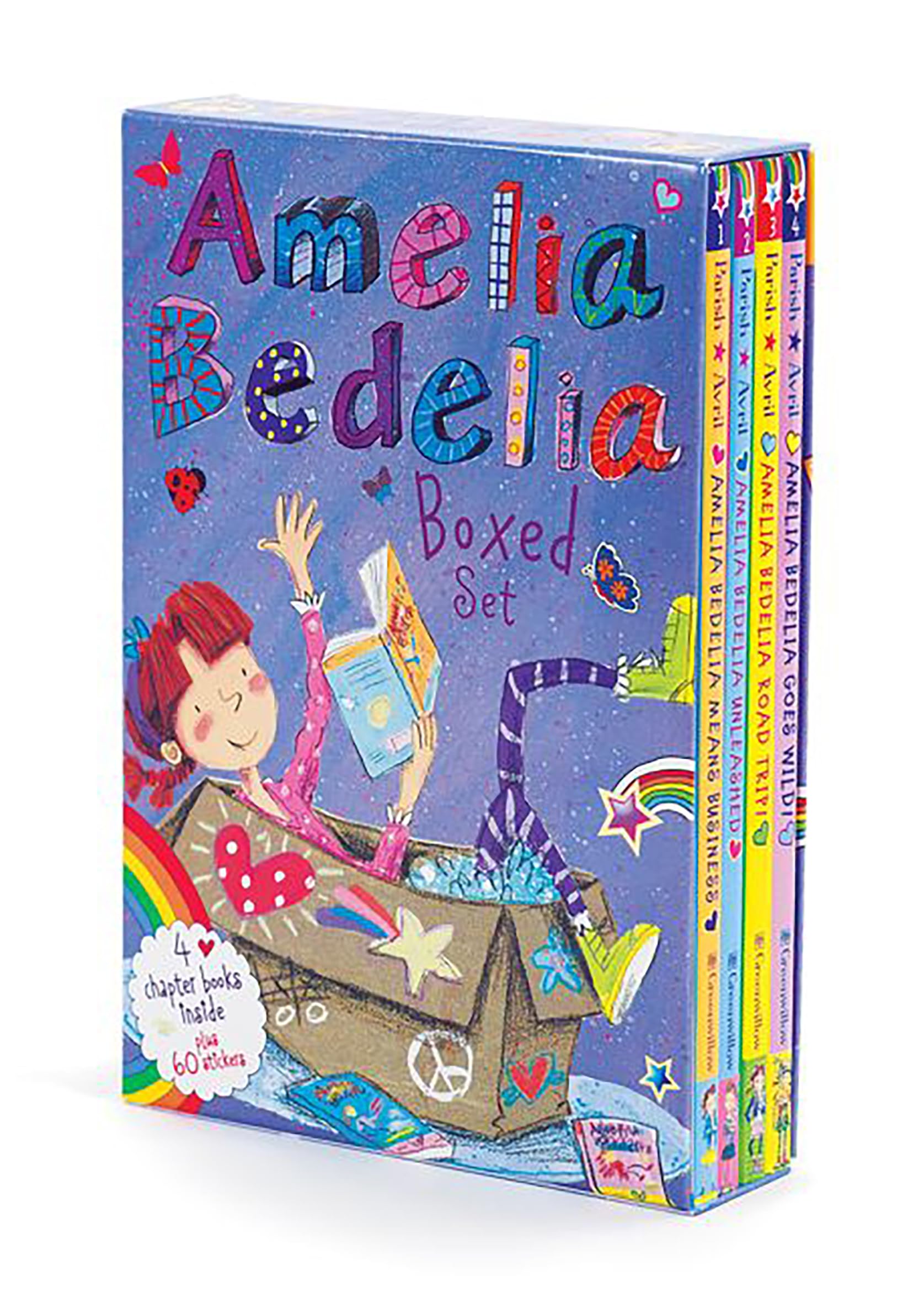
Amelia Bedelia 1-4
Key Features
- Age & Grade Level: Ages 6–8 / Gr. 1–5
- Number of Books: 4
- Content Tone: Wordplay humor
- Format: Boxed set
- Series Continuity: Continuing series
- Price: Mid-Range
Amelia Bedelia’s literal-minded misinterpretations of everyday phrases turn reading into a silly discovery of idioms and figurative language. The four-book box set hits a sweet spot for 1st through 3rd graders, with manageable chapters and gentle humor that rewards family read-alouds. The price per book makes it a popular birthday or holiday gift. The humor hinges on understanding wordplay, and children who take language at face value may find Amelia’s mistakes confusing rather than funny. The reading level can also feel uneven across the set. This set works best for kids who already enjoy language twists and have an adult nearby to explain the jokes.
Pros
- Clever wordplay and silly misunderstandings that get kids laughing while they read
- Approachable length and readability for 1st–3rd graders
- Great value, often bought as a Christmas or birthday gift
Cons
- The reading level varies across the four books, so a child may breeze through one and struggle with another.
- Wordplay humor can fall flat for literal-minded children who haven’t yet grasped idioms or figurative language.
This set shines for families who read together and can explain the jokes, but it may miss the mark for very literal readers or those needing a uniform reading level.
Best for Unicorn Enthusiasts
Unicorn Academy 1-4

Key Features
- Age & Grade Level: Ages 6–8 / Gr. 1–4
- Number of Books: 4
- Content Tone: Unicorn fantasy
- Format: Paperback boxed set
- Series Continuity: Continuing series
- Price: Budget
The four-book set delivers exactly what a unicorn-obsessed 6- to 8-year-old wants: light, predictable tales of magic and friendship at a reading level they can tackle without frustration. The same narrow focus that makes it a hit also limits its audience. Children who’ve moved beyond sparkles and simple storylines, or those who prefer facts over fantasy, won’t find enough depth to stay engaged. It doesn’t carry the cross-genre appeal or high-mention strengths of broader series, so its value hinges on finding a true unicorn fan.
Pros
- Light, enchanting stories make the leap from picture books to chapters feel effortless.
- Perfectly sized for small hands and short attention spans, ideal for newly independent readers.
- Budget-friendly boxed set offers four books for the price of a single hardcover, great gift value.
Cons
- The gentle, low-conflict plots may not hold the attention of action-oriented readers.
- The simple vocabulary and short sentences are quickly outgrown by strong readers ready for more complexity.
For a child who treats every sparkly object like treasure, this boxed set is a low-cost, high-engagement first step into independent reading.
Best for Avid Fantasy Readers
Land of Stories Complete

Key Features
- Age & Grade Level: Ages 8+ / Gr. 3–7
- Number of Books: 6
- Content Tone: Fairy-tale retellings, epic
- Format: Paperback gift set
- Series Continuity: Complete series
- Price: Premium
The six-book set delivers captivating fairy-tale retellings that keep kids glued to the page, with imaginative world-building that spans nearly 3,000 pages. The writing appeals evenly to boys and girls in the 8–12 range, and the reimagined classic tales feel fresh without losing their magic. At a premium price, the boxed set is a serious investment — and one that, unfortunately, can arrive with manufacturing defects like missing pages or chapters. Savvy gift-givers will unbox and flip through each volume before wrapping, because exchanges are possible. For families raising voracious readers who love extended adventures in a single universe, the series is a satisfying deep dive, provided the initial quality check is part of the plan.
Pros
- Captivating fairy-tale retellings that hook young readers for hours.
- Imaginative world-building praised across the 8–14 age range.
- Engaging for both boys and girls, with age-appropriate content.
Cons
- Some print runs contain manufacturing defects like missing pages or misprinted sections, requiring careful inspection upon delivery.
- Premium pricing makes this a significant upfront investment compared to other boxed sets.
For families whose kids devour fantasy series whole and can accept the small risk of a defective set (and check it immediately), this complete collection rewards with months of immersive reading.
Best for Silly Humor Fans
Zombie Goldfish Boxed Set

Key Features
- Age & Grade Level: Ages 7–9 / Gr. 2–4
- Number of Books: 3
- Content Tone: Silly, gross humor
- Format: Boxed set
- Series Continuity: Ongoing series
- Price: Budget
A pet goldfish turned zombie after a science experiment gone wrong sets up three books of wacky, slightly gross adventures that pull reluctant readers into chapter books. The offbeat premise and deadpan humor land best with 7–9 year-olds who appreciate weirdness over polish.
Without topic-level review data, we can’t confirm whether the humor universally lands or if the text difficulty matches the stated reading level. The 4.8-star average suggests broad appeal, but buyers wanting detailed content verification will find the data gap limiting. Sensitive kids afraid of zombie fish should avoid.
Pros
- Silly, gross-out zombie goldfish premise that captivates reluctant early readers.
- Affordable three-book boxed set, ideal for a low-risk gift or starter collection.
- Short, illustrated chapters build reading confidence in 7–9 year-olds.
Cons
- No topic-level review content is available to verify humor consistency or reading level alignment.
- Zombie fish and gross-out humor may unsettle sensitive or easily frightened children.
This set makes sense for parents willing to take a low-cost gamble on a silly, offbeat series to spark reading, provided their child isn’t easily spooked by undead fish and they’re comfortable buying based on a high star rating alone.
How to Choose
The most important factor when choosing a kids’ book series isn’t the rating or popularity—it’s whether the reading level actually matches your child’s current ability, not the age printed on the box.
Reading Age & Grade Level
Publishers often set broad age ranges that are more about marketing than actual readability. A 5-year-old might handle Magic Tree House or struggle mightily depending on their vocabulary and focus. Grade level—and feedback from other parents about how easily their child read it—offers a far more reliable guide.
If the text is too hard, a child will abandon the book within a few pages; too easy, and they’ll get bored and never pick it up again. Look for series where real readers report a sweet spot of engagement without frustration, and be ready to step down or up a level based on your child’s unique pace.
Number of Books
Boxed sets range from three to six or more books, and the count shapes both value perception and reading momentum. A smaller set is a low-risk way to test whether a series clicks, while a larger set costs less per book and can sustain a new reading habit for weeks.
The hidden trade-off: too many books at once can overwhelm a child who’s just starting to read independently. Gauge your child’s stamina—if they’re a brand-new reader, a three-book set may be a smarter launch pad than a five-book box that sits unfinished.
Content Tone
Humor, adventure, fantasy, and classic mystery each create a different reading experience, but the tone also carries deeper consequences. Series like Junie B. Jones use intentional grammatical errors and name-calling to fuel humor, which some families find hilarious and others see as counterproductive to language learning.
Think about the daily reading environment you’re building. If you’re actively teaching polite speech and proper grammar, a series that models the opposite can create confusion. But if your child needs pure, laugh-out-loud engagement to fall in love with books, that same spunky voice can be a breakthrough.
Physical Format
Hardcover books withstand chewing, dropping, and repeat reads far better than paperbacks, making them the safer bet for babies and toddlers. They also feel more substantial for gift-giving, but they cost more and take up more shelf space.
Paperback boxed sets are lighter and cheaper, ideal for older kids who are no longer tearing pages. For the youngest readers, though, a paperback can quickly become a tattered mess. Choose the format that aligns with your child’s age and your tolerance for wear and tear.
Series Continuity
Some sets are complete standalone collections, while others are the opening to a series that extends dozens of books. A complete set gives you a satisfying, self-contained arc, perfect for a one-time gift. A gateway series like Magic Tree House or Boxcar Children can lock a child into a reading habit that lasts years.
The trade-off is commitment. If your child falls hard for a series, you’ll be buying many more books, but that habit-building is exactly what many parents want. Decide upfront whether you’re gifting a single experience or deliberately starting a long-term reading journey.
FAQ
Is the Junie B. Jones series really inappropriate for young kids because of the bad grammar and name-calling?
The series intentionally uses grammatical errors and back-talk to mimic a child’s authentic voice and create humor. For families who prioritize correct language modeling, this can be a legitimate conflict. Many parents report that children who already understand proper speech are not negatively affected, but the name-calling and disrespect do cross a line for others. Previewing a few chapters before gifting is the most reliable way to decide if the tone fits your comfort level.
What’s the difference between Magic Tree House books 1-4 and 5-8 — should I start with the first set?
Books 1-4 introduce the core characters, the time-traveling tree house, and the rhythm of blending adventure with light history, making them the ideal on-ramp. Books 5-8 continue with new destinations and slightly more developed plots, but each book stands alone well enough that you could start there if a child is already confident. However, skipping the first set means missing the foundational experience that hooks young readers, so it’s better to begin with 1-4.
Are the Land of Stories books complete in this gift set, or are there missing pages and chapters?
The gift set is marketed as the complete six-book series, and the vast majority of sets arrive intact. A small number of customers have reported manufacturing defects such as missing pages or entire chapters in specific print runs. Inspect the set immediately upon arrival; Amazon will replace a defective set without cost, but the flaw can ruin a gift unveiling if not caught early.
At what age can a child read the Bad Guys box set independently?
Most 6-year-olds can read The Bad Guys with some help—the vocabulary is simple and the graphic-novel format breaks text into small, digestible chunks. Many independent readers in 2nd grade fly through the books on their own. If a child is still relying heavily on phonics, reading together the first time through bridges the gap until confidence kicks in.