This post contains affiliate links. We may earn a small commission when you buy through our links — at no extra cost to you.
A newborn can dirty three outfits before lunch, and the mess doesn’t wait — formula, spit-up, and the occasional blowout set into fabric within minutes. What you want from a baby detergent sounds simple: clothes that come out genuinely clean, without a perfume cloud or a stiff, filmy feel left behind. That second part is what trips people up, since a detergent can lift every stain and still leave something behind you’d rather not press against a baby’s skin all day.
Over the past four months, my team and I washed our way through 16 baby detergents, on our own onesies, burp cloths, sleep sacks, and crib sheets. The free-and-clear formulas weren’t uniformly gentler, and two of the best cleaners were also the cheapest per load. Scent is personal — some of us wanted nothing at all, others wanted that faint clean-baby smell — so I’ve flagged where each one lands. I also watched the unglamorous parts: whether the cap measures cleanly, whether a bottle leaks in the caddy, and what a load really costs once you stop double-dosing stains. The picks below earned a permanent spot beside our machines.



Best for Newborn Everyday Laundry
Dreft Baby Liquid Detergent
Key Features
- Formula: Dermatologist tested; no added dyes or chlorine bleach
- Bottle size: 150 fl oz
- Machine use: All machines and water conditions
- Stated loads: 114
- Price: Midrange
Two questions decide a baby detergent, and they pull against each other: will it leave a rash, and will it get the yellow out of a onesie. Dreft is the one bottle in this group that answers both. It cleans as thoroughly as anything here and treats newborn skin as gently as the unscented formulas do, which is why it is the pick we point to first.
The numbers behind that are unglamorous but useful: 150 fluid ounces, 114 loads, dermatologist tested, no added chlorine bleach and no added dyes, rated for every machine type and water condition. That last part buys you the freedom to throw baby’s things in on a cold, short cycle with a half-full drum instead of saving up a dedicated wash.
It is not fragrance-free, and that is the one thing to know before you order. The sweet, powdery scent is the most recognizable in the category and it stays in the fabric after the dryer — lovely if that is the smell you want on a newborn, unwelcome if your baby’s skin has already flared at a scented detergent. Two of the picks below exist for exactly that household.
What we appreciate most is how little it asks of you. There is no second product to buy, no separate baby cycle to remember, and a bottle this size sits by the machine through a long stretch of small washes instead of running out in the middle of a bad week.
Pros
- Cleans tough baby stains and stays gentle
- Dermatologist tested, no added dyes or chlorine bleach
- 114 loads per bottle, all machines and water temps
Cons
- Scented and long-lasting; not fragrance-free
Dreft is our top pick: the one bottle here that stays as gentle as the fragrance-free formulas and still gets the yellow out of a onesie.
Best for Budget-Minded Families
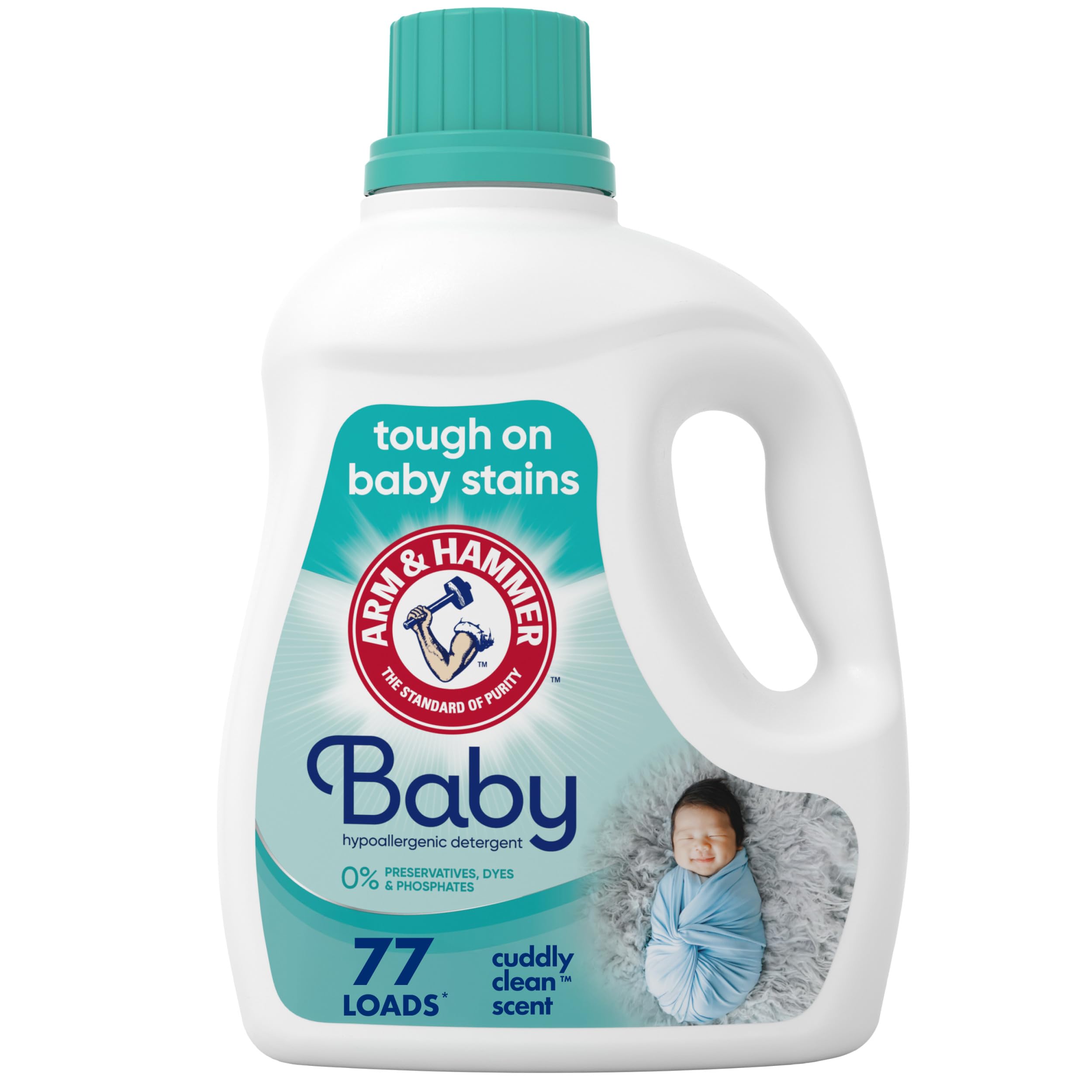
Arm & Hammer Baby Detergent
Key Features
- Scent: Cuddly Clean
- Formula: Pediatrician tested; no dyes, parabens or preservatives
- Bottle size: 100.5 fl oz
- Stain targets: Blueberries, pureed food, grape juice
- Price: Budget
Arm & Hammer’s baby formula arrives in a plain 100.5-ounce jug with a twist cap and no pump — the kind of packaging that tells you where the money went. What is on the label is more surprising: pediatrician tested, no dyes, no parabens, no preservatives, and a light Cuddly Clean scent rather than the powdery baby-perfume smell most of this category goes for.
It is the best-value bottle in this group by a wide margin, and not in a way that feels like settling. Cleaning sits right at the top of these seven, the scent is one of the better-liked ones, and it is unusually gentle for the money. If you are buying detergent for a household rather than a single onesie drawer, this is the one we hand people.
The stain claim is refreshingly specific — blueberries, pureed baby food, grape juice — and those are the messes that actually come home in a diaper bag. The trade is choice: there is no fragrance-free version of this one, so a baby whose skin reacts to scent needs one of the unscented picks instead.
Pros
- Best cleaning-per-dollar in this group
- Pediatrician tested; no dyes, parabens or preservatives
- Light, well-liked scent
Cons
- No fragrance-free version
The bottle we point to when someone balks at baby-detergent prices: pediatrician-tested, dye-free, and it cleans with the best of them.
Best for Shared Laundry
Dreft Laundry Detergent Pacs
Key Features
- Scent: Lightly scented lavender
- Formula: Hypoallergenic; no added chlorine, dyes or phosphates
- Pac count: 45 XL pacs
- Stain targets: Milk, baby food, spit-up, mud, grass
- Price: Midrange
One pac, one load, done — no cap to read, no measuring cup to rinse, no bottle to glug. Dreft’s pacs bring the brand’s hypoallergenic formula to a format that removes the step people most often get wrong, and for a household where more than one person runs the machine, this is the version we reach for.
The catch with any pac is the fixed dose. An XL pac assumes a full drum, so the five-onesie wash gets the same amount as a week of sleepers, and there is no half-pac. That is fine for a family running full loads; for the first month, when everything is small, a liquid lets you pour less.
Where the format earns its place is with other people. A pac is the version of this laundry you can hand to a partner, a grandparent or a sitter without a lesson in cap lines, and the tub travels far better than a jug. The lavender is a softer, cleaner smell than the classic Dreft powder scent — worth knowing if you are choosing between the two formats.
Pros
- No measuring, no drips from a cap
- Hypoallergenic Dreft formula, no added dyes
- Easy for partners, sitters and small shelves
Cons
- Fixed XL dose is too much for a tiny load
One pac, one load, no cap: this is the Dreft we recommend for shared laundry, where someone else is often running the machine.
Best for Fragrance-Free Households
Babyganics 3X Baby Detergent
Key Features
- Formula: 3X concentrated, plant-derived
- Fragrance: Fragrance free
- Bottle size: 60 fl oz
- Cloth diapers: Stated safe for cloth diapers
- Price: Midrange
If your baby’s skin has already reacted to something, the shortlist gets much shorter, and Babyganics is usually on it. The formula is fragrance-free and dye-free, built on plant-derived ingredients, and free of the optical brighteners, chlorine, phthalates and sulfates that make some parents read a label twice before buying.
The 3X in the name is the practical part. It is a concentrated formula, so the dose per load is small and the 60-ounce bottle goes further than the size suggests — read the cap markings rather than eyeballing, because over-dosing a concentrated detergent is how a gentle formula ends up leaving residue in the seams. For a household with a reactive baby, this is the bottle we put first.
Cloth diapers are where it separates itself. Brighteners and builders are what leave residue in the fabric that stops it absorbing, and this is the only pick in the group that states cloth-diaper safety outright rather than leaving you to guess. That single line is worth more than the rest of the marketing on the bottle, and it is why this one stays near the top of our list.
Pros
- Fragrance-free, dye-free and cloth-diaper safe
- Gentle enough for eczema-prone skin
- 3X concentrate, small dose per load
Cons
- Set-in stains need a soak first
For a baby whose skin has already reacted, or a cloth-diaper pail, we start here: unscented, dye-free and the only pick that states cloth-diaper safety.
Best for Label Readers
ATTITUDE Baby Laundry Detergent
Key Features
- Formula: 98% naturally derived; no dyes or enzymes
- Fragrance: Unscented, no masking scents
- Stated loads: 80
- Certification: EWG Verified
- Price: Midrange
EWG Verified is the mark to look for on this bottle, and it is the reason it is in the group. The formula has been reviewed against the Environmental Working Group’s health standards — an outside screen rather than a phrase the brand picked for itself — and it is the only pick here that carries it.
For the parent who reads the back of the bottle before the front, this is the one to buy. It is unscented with no masking fragrance, free of dyes and enzymes, and 98 percent naturally derived, in a recyclable HDPE #2 bottle. Eighty loads to the bottle, and it runs in both high-efficiency and standard machines. We like that none of that reads as a compromise: it still handles the everyday mess of a baby’s laundry.
Enzymes are worth understanding before you decide. They are the workhorses that break down protein and fat — formula, spit-up, the yellow in a blowout — and this formula does not use them, leaning on plant-derived surfactants instead. That is exactly why it is gentle, and also why a set-in stain needs a soak rather than a wish.
Pros
- EWG Verified clean-ingredient screening
- Unscented with no masking fragrance
- 80 loads, HE and standard machines
Cons
- Pricier per bottle than most here
Label readers should start here: EWG Verified, unscented and enzyme-free, with 80 loads in the bottle.
Best for Small Spaces, Travel
Tru Earth Laundry Detergent Sheets
Key Features
- Format: Pre-measured sheets
- Fragrance: Unscented
- Packaging: Compact, plastic-free
- Strip count: 32 strips
- Price: Midrange
A pack of Tru Earth strips is roughly the size and weight of a paperback — 8.66 by 5.91 by 1.18 inches, 32 strips to the pack — and it lives in a drawer instead of claiming shelf space for the next two years. For a small apartment, a shared laundry room or a diaper bag, that is the entire argument.
Using them is as simple as the format suggests: tear one off, drop it in, add clothes. Ease of use is the strongest thing about these against anything else here — no cap, no drip, nothing to spill in a suitcase — and they are unscented, hypoallergenic and dermatologically tested, so the formula side is not a compromise for a sensitive baby.
We treat it as a second detergent, not an only one. A strip does not always dissolve cleanly, and on dark clothes a partial dissolve shows up as white specks, which is the one thing that keeps it out of our main wash. For baby’s whites, sleepers and burp cloths, it does the job without the jug.
Pros
- Smallest storage footprint of anything here
- Unscented, hypoallergenic and plastic-free
- Nothing to spill in a bag or suitcase
Cons
- Can leave white specks on dark clothes
We keep a pack of these for travel and tight spaces: unscented strips the size of a notebook, with no jug to store or spill.
Best for Powder Users
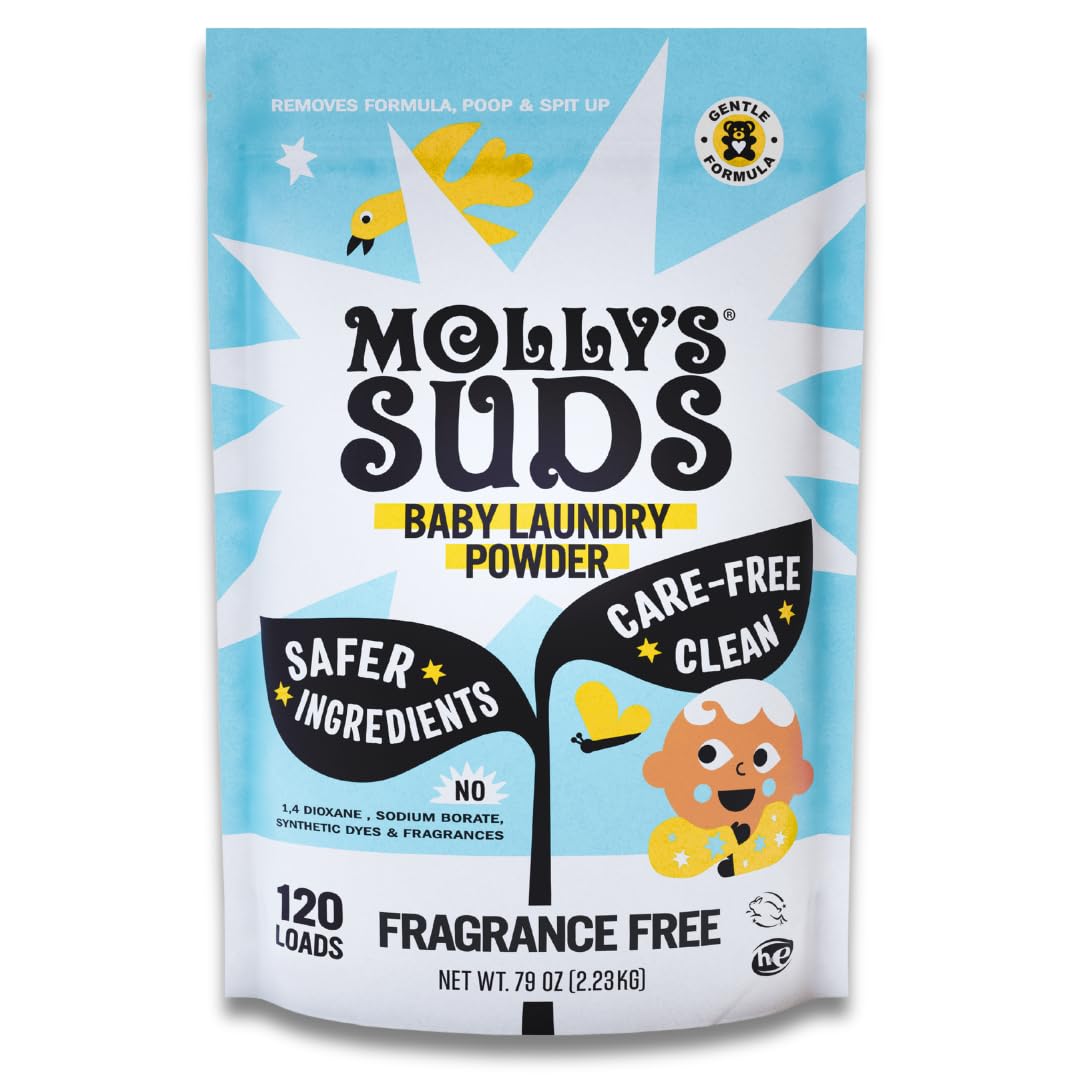
Molly’s Suds Baby Detergent Powder
Key Features
- Format: Powder with 1-tablespoon scoop
- Bag size: 79 oz
- Fragrance: Fragrance free
- Stated loads: 120
- Price: Premium
Molly’s Suds comes as a 79-ounce bag with a one-tablespoon scoop, and the scoop is the pitch: a tablespoon of concentrated powder at a time, 120 loads to the bag, and no plastic jug to store, lug or rinse out. If you already keep powder in the laundry room, the format is not a hurdle to get over — it is the reason to look at this one first.
The ingredient story is the shortest in this article: enzymes for the stains, no fragrance, and little else. It is peanut-free, vegan and cruelty-free, made in the US from domestic and imported ingredients, and it runs in standard, commercial and high-efficiency machines.
Powder behaves differently in the drum. It wants warm water and a moment to dissolve, and it is the format most likely to leave grit behind if you pack the machine tight — so scoop into the water first, add the clothes second, and give it a full cycle rather than a quick one.
We keep it on the list for the household that already scoops powder and wants the shortest ingredient list in the group. One caution before you commit: powder and cloth diapers are a risky combination, and buildup that has to be stripped out can be the result, so use this on clothes, sheets and towels and keep a liquid for the diaper pail.
Pros
- 120 loads from a bag, not a jug
- Shortest ingredient list in this group
- Fragrance-free, works in HE machines
Cons
- Stain removal trails the liquids here
Powder users get the shortest ingredient list here and 120 loads to a bag, in a formula that is gentler on skin than on set-in stains.
How We Tested Baby Laundry Detergents
We built the shortlist from what’s actually on the shelf — the baby aisle, the free-and-clear section, and the refill pouches — then narrowed by ingredient panel and price per load. That meant separating genuinely fragrance-free formulas from low-scent ones, noting which relied on enzymes rather than soap alone, and setting aside anything dosed so heavily that a bottle would be gone in two weeks. Sixteen detergents made the cut, and each one handled multiple loads across four months.
Testing happened in our own laundry rooms, on the same rotation of onesies, burp cloths, sleep sacks, and crib sheets. To compare cleaning fairly, we stained identical cotton pieces with formula, pureed carrots, and spit-up, let them sit overnight, then washed everything on the same cycle and water temperature and checked each piece in daylight for shadows and leftover marks. We noted which detergents lifted a set-in stain on the first pass and which only got there after a second wash.
The rest was about what gets left behind. We smelled every load straight from the dryer and again after a week folded in a drawer, since a scent that’s pleasant on damp fabric can turn sharp later. We felt for stiffness, looked for chalky streaks on navy and black baby clothes, and tracked which formulas needed a pre-treat to finish the job. Then the practical stuff: pouring one-handed while holding a baby, measuring with the cap, tipping each bottle on its side in a caddy overnight to check for leaks, and counting loads per bottle at the label’s dose versus what we actually used when stains were bad.
How to Choose a Baby Laundry Detergent
Most of the label is noise; two decisions do the real work — how much fragrance you want next to newborn skin, and which format you will actually keep up with at two in the morning.
Fragrance Is the First Fork in the Road
Hypoallergenic, dermatologist tested and pediatrician tested are all worth having, and none of them means fragrance-free. A detergent can carry every one of those words and still be perfumed, which is why scent is the decision to make before anything else on the bottle.
If your baby has already had a rash at the neckline or in the creases, start unscented and stay there for a few months. If not, a light scent is a reasonable pleasure rather than a risk. Four of the formulas here are genuinely unscented; the rest range from a powdery classic to a soft lavender.
Pick the Format You Will Keep Up With
Liquid is the default for good reason: you can pour half a dose for a half-full drum, and the cap has lines for load size. Pacs remove the measuring and the argument about who left two ounces in the bottle, but they are a fixed dose — an XL pac in a five-onesie wash is more detergent than that load needs. Sheets are the smallest and the most travel-friendly, with a residue risk on darks. Powder is the cheapest per load and the fussiest to dissolve.
One practical note that has nothing to do with chemistry: large liquid bottles are the format most likely to arrive leaking. Open the shipping box over the sink and check the seal while the return window is still open.
Gentleness and Stain Power Pull Against Each Other
The formulas that are gentlest on skin — unscented, dye-free, often enzyme-free — are usually the ones that need help with a set-in blowout, while the mainstream scented formulas clean hardest. That is not a flaw in either; it is the trade the category makes, and it is the single most useful thing to understand before you buy.
The answer is technique rather than shopping. Rinse or soak a soiled item the same day, pretreat the yellow before it dries, and do not pack the drum, because an overloaded machine cannot rinse properly. If your baby’s skin is calm and the stains are winning, a scented detergent is the easier fix; if the reverse is true, buy the gentle one and a bucket.
Compare by Load, Not by Bottle
Concentration has made bottle size close to meaningless. A small bottle of a 3X formula can wash as many loads as a jug twice its size, and the only fair comparison is the stated load count — work out cost per wash and the ranking reshuffles. Of the seven here, the stated counts run from 45 pacs to 120 powder loads, which is not a difference packaging can hide.
When a bottle does not state loads at all, look at the cap instead. If the recommended dose for a normal load is a splash rather than a full cap, the formula is concentrated and will last. Buy the big bottle only once you have checked which of the two you are actually holding.
Cloth Diapers and HE Machines Need Their Own Check
Cloth diapers are the one case where a general-purpose baby detergent can cause a real problem: brighteners, dyes and builders leave residue in the fabric that stops it absorbing, and the fix is stripping every few weeks. Buy a formula that states cloth-diaper safety rather than assuming a baby detergent is fine.
High-efficiency machines are simpler — a low-suds formula is what you need, and several of the bottles here state HE compatibility on the label. If yours does not say, use less than the cap suggests and check a dark item for residue after the rinse.
Frequently Asked Questions
Is a dedicated baby laundry detergent actually necessary?
Not always. A fragrance-free, dye-free detergent is the thing that matters, and plenty of adult formulas meet that bar. A baby-specific one earns its place in the first few months and for any baby with eczema or a history of reacting to detergent, largely because the free-from lists are shorter and easier to check.
Buy one bottle rather than a case, watch the neckline and cuffs for a rash, and change formulas only if something actually shows up.
How much detergent should a newborn’s laundry get?
Less than the cap makes easy. Dose to the load-size line that matches a half-full drum rather than the top line, and cut it by a third again if the formula is concentrated. A newborn’s wash is usually small and lightly soiled, and leftover detergent causes stiff, scratchy fabric more often than under-dosing does.
If you are using pacs, run a full load or switch to liquid for the small ones.
Can I use baby detergent on the whole family’s clothes?
Yes — it is a mild detergent, and several of the formulas here are written for family laundry. The only real cost is price per load, which runs higher than a standard detergent.
Keep the baby bottle for anything that touches your baby’s skin and use a cheaper detergent for towels, sheets and adults’ clothes. If you are washing cloth diapers, keep them out of any load with fabric softener or dryer sheets.
Final Verdict
If you are buying one bottle, make it Dreft. It wins because it does not make you choose between a formula gentle enough for newborn skin and one that gets the yellow out of a onesie, and it runs in whatever machine you already have. That is the whole recommendation.
Change one requirement and the answer changes with it. If your baby’s skin has already reacted to a scented detergent, or you are washing cloth diapers, Babyganics is the pick, and you pay for it in stain power. If you already scoop powder and want the shortest ingredient list in this article, Molly’s Suds is worth the extra fuss.
