This post contains affiliate links. We may earn a small commission when you buy through our links — at no extra cost to you.
A baby carrier is the difference between two free hands and a day spent negotiating with a stroller. The first time I tried to buckle a budget carrier alone in a grocery-store parking lot, I learned that a low price can hide a confusing fit, a sweaty panel, or a buckle that feels less secure than it should. What you’re really buying is confidence: baby held close, your shoulders not screaming, and a carrier that doesn’t quit halfway through the produce aisle. A good budget pick fixes all that without asking you to spend like you’re outfitting a nursery.
Over the past four months, my team and I tested a dozen budget baby carriers at home, on errands, and on walks, weighing ease of use, comfort, support, and safety. We also noted which fabrics ran hot, which straps sagged, which panels collected lint, and which prints were cute enough to wear past the diaper aisle. The best ones made us forget the budget part; the rest reminded us why fit and a secure buckle matter more than a pretty pattern.
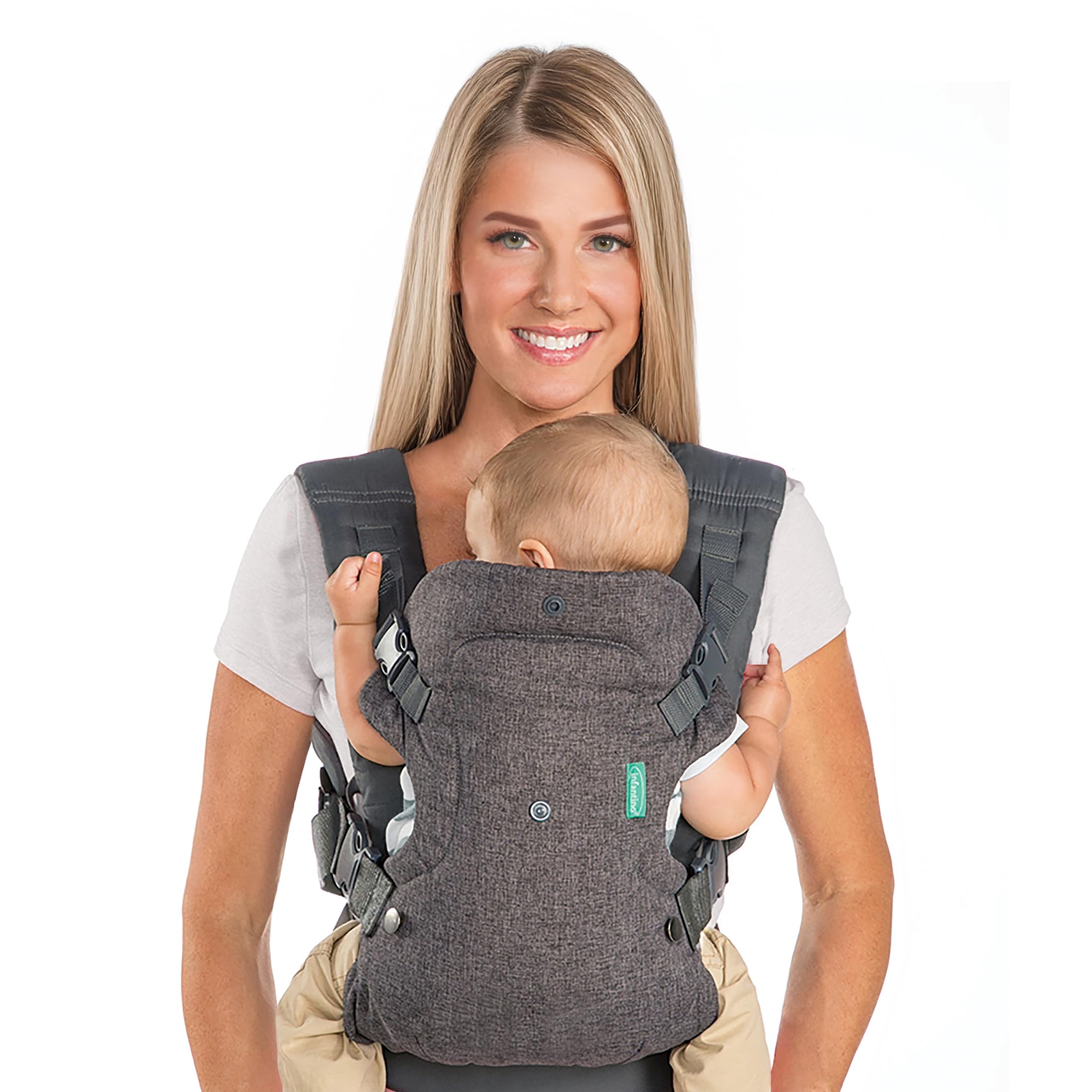


Best for Newborn to Toddler
Infantino Flip 4-in-1
Key Features
- Care: Machine wash
- Closure: Buckle
- Weight range: 8 to 32 lb
- Carry positions: Four, including back
- Price: Budget
Four carry positions and a machine-washable body at the lowest price of any convertible here — the Flip is the carrier we point most shoppers to, and the one we reached for on ordinary days. Buckles and a waist belt mean you can get it on in a hallway with a baby already in one arm, which is the test a lot of cheap carriers fail. Facing-in, facing-out and back carry mean it keeps working after the novelty of the first month wears off.
The seat is the part that earns its keep. It adjusts from a narrow setting that keeps a small baby’s legs tucked in to a wider one as their hips open up, and the leg openings move with it. We paid close attention to that, because a seat that won’t widen is what makes a baby fussy around the four-month mark. The head support is a simple flap rather than a structured panel, so it suits a baby with some neck control better than a floppy newborn.
Weight is the honest caveat here. It starts at eight pounds, so a seven-pound newborn needs a wrap for a few weeks. Past that, the strap adjustments take a big frame and a small one in the same afternoon, which is more than we can say for a tie wrap when two people of very different sizes are sharing one carrier. Shoulder and lower-back padding is fine for a supermarket trip and starts to feel thin two hours in with a heavier baby — that’s the moment to hand off to a hip seat.
The detail that surprised us most is the leg openings. They adjust independently of the seat, so a chubby-thighed baby doesn’t end up with red marks after twenty minutes. The fabric is 80 percent polyester and 20 percent cotton, and it comes out of the wash soft rather than stiff, which matters when a carrier gets worn three days running.
Pros
- Four positions, back carry included
- Machine washable
- Cheapest convertible in this group
- Seat and leg openings adjust separately
Cons
- Starts at 8 lb, so not for the first weeks
- Plenty of straps and buckles to learn
The budget carrier we point most shoppers to: four positions, a washable body and a price at the bottom of this group, in one carrier that lasts from eight pounds to a back-riding toddler.
Best for Newborn Contact Naps
KeaBabies Baby Wrap
Key Features
- Care: Machine wash cold
- Closure: Tie
- Weight range: 7 to 35 lb
- Fabric length: 202.5 in
- Price: Budget
The first month is mostly a holding job, and a long piece of stretchy fabric is still the cheapest way to do it hands-free. KeaBabies’ wrap is 202.5 inches of soft knit that ties around your torso, and once it’s on, a newborn is held against your chest in the curled position they spent nine months in. There’s nothing to buckle and nothing to adjust on the baby’s side, which is the whole appeal at two in the morning.
It’s the wrap we hand to someone who wants that snug, womb-like hold without paying a premium for a name. The fabric is soft enough that it doesn’t chafe your shoulders during a long carry, and the knot stays put through a morning of errands. We had the hang of tying it after three or four goes; the trick is tying it tighter than feels right, because the knit relaxes once it takes the baby’s weight. It’s also the cheapest wrap in this group, which matters for something you’ll use hard for a season.
The length is the price of a one-size fit. Tying it means the tails pool on the floor while you get the cross in place, which is worth knowing before you try it in a wet parking lot or on a bus. It’s a warm layer too — lovely in October, less so in July, when you’ll both be damp by the end of a walk. For the newborn stretch that’s a fair trade; by the time your baby wants to look around, the buckles of the Flip make more sense.
Pros
- Snug, womb-like hold for newborns
- Cheapest wrap in this group
- Ties to fit a wide range of wearers
Cons
- Tails drag on the floor while you tie
- Runs warm in hot, humid weather
A soft tie wrap that settles a newborn better than any buckle carrier here, and the one we reach for in the first three months.
Best for Toddlers on the Hip
MOMTORY 6-in-1
Key Features
- Care: Hand wash only
- Storage: Multiple pockets
- Weight range: 7 to 26 lb
- Carry positions: Six, with hip seat
- Price: Midrange
A hip seat is the carrier you buy when your baby becomes a toddler and your lower back starts filing complaints. The MOMTORY puts a padded shelf under their bottom and carries that weight on your waist instead of your shoulders, with a wide belt and H-shaped straps that sit flat rather than digging in. It’s the one here that made the difference on days when the stroller stayed in the car.
It’s genuinely six positions rather than a spec-sheet boast: facing in and out, front and back, plus the seat on its own once you unzip the upper panel, which is what you’ll do for a quick trip into a shop. The pockets are the sleeper feature — phone, keys and a bottle all sit within reach, and the storage is the strongest of anything in this group. The catch is care: it’s hand wash only, which is a real consideration for something that lives against a sweaty torso.
What decides whether it works is your waist, not your baby. The belt is generous, and on a smaller frame there’s a lot of tail left after it’s snug; the chest clip also sits high, and the trick we landed on is clipping it before you slide the whole thing over your head rather than fishing for it behind your neck. Get it fitted in the first week and it will carry a heavy toddler for an afternoon. The specification stops at 12 kg, so plan on the sitting-up stage rather than the preschool years.
Pros
- Takes toddler weight onto the hips
- Pockets that replace a diaper bag
- Six positions, including seat-only hip carry
Cons
- Hand wash only
- Waist belt fit varies a lot by frame
The hip seat that makes a heavy toddler manageable again — buy it when your shoulders have had enough, and fit the waist belt carefully.
Best for Quick Errands
Infantino Swift Classic
Key Features
- Care: Machine wash
- Extras: Front pocket and bib
- Weight range: 8 to 25 lb
- Carry positions: Two, front only
- Price: Budget
There is almost nothing to the Swift: two positions, a buckle at the waist, a pair of shoulder straps, a small pocket on the front and a bib that clips over the whole thing. That’s exactly why it’s the carrier we kept by the door for the eight-minute walk to the playground rather than the one we packed for a day out. It goes on over a coat, it folds into the bottom of a diaper bag, and it costs less than anything else here.
The trade-offs are the ones you’d expect at this size. It stops at 25 pounds, so it’s a first-year carrier rather than an investment; head support is minimal, which is fine for a baby who can sit up and less so for a floppy three-month-old; and there’s no back carry, so the day your toddler wants to ride behind you, this one is done. For errands with a small baby, none of that matters. The front pocket is sized for a phone and keys, and we used it on every single trip.
Pros
- Fast to put on and take off
- Lowest price in this group
- Front pocket plus included bib
Cons
- Caps out at 25 lb
- Minimal head and neck support
Our pick for quick trips: light, simple, cheap, and made for a baby under twenty-five pounds.
Best for Warm-Weather Walks
FRUITEAM 2-in-1
Key Features
- Care: Machine wash
- Materials: Linen with air-mesh panel
- Weight range: 7 to 42 lb
- Carry positions: Six, seat detaches
- Price: Midrange
Linen across the main body and a 3D air-mesh panel over the chest: this is the carrier in the group that thinks hardest about heat. The mesh sits exactly where a baby’s torso presses against yours, which is where a carrier turns clammy first, and the detachable cotton hood gives you something to shade a sleeping face or block a gust.
It’s the one we take out in July, and it’s also the most flexible design here. Unclip the upper section and the seat works on its own for a hip carry — the mode for ten minutes in a shop when a full carrier is overkill — and in full mode you get six positions, front and back, up to 42 pounds. The H-shaped straps and wide waist belt balance the load well; on a long walk with a heavier baby, the weight lands on the hips instead of pulling at the shoulders.
Where it asks something of you is the shoulders. The straps are wide and padded, and on narrower frames they can work their way outward over a long carry, so set the chest clip high and check it once an hour. The seat is also broad — comfortable for a toddler, a lot of fabric around a small baby — which makes this a carrier that starts making sense around the sitting-up stage rather than at newborn. It’s machine washable, which the hip seat above can’t claim.
Pros
- Linen body with mesh chest panel
- Upper section detaches for hip carry
- Back support without shoulder strain
- Machine washable
Cons
- Straps slide outward on narrow shoulders
- Seat is bulky around a small baby
The warm-weather carrier here: linen and mesh keep both of you cooler, and the detachable seat adds a hip carry for short stops.
Best for All-Day Carrying
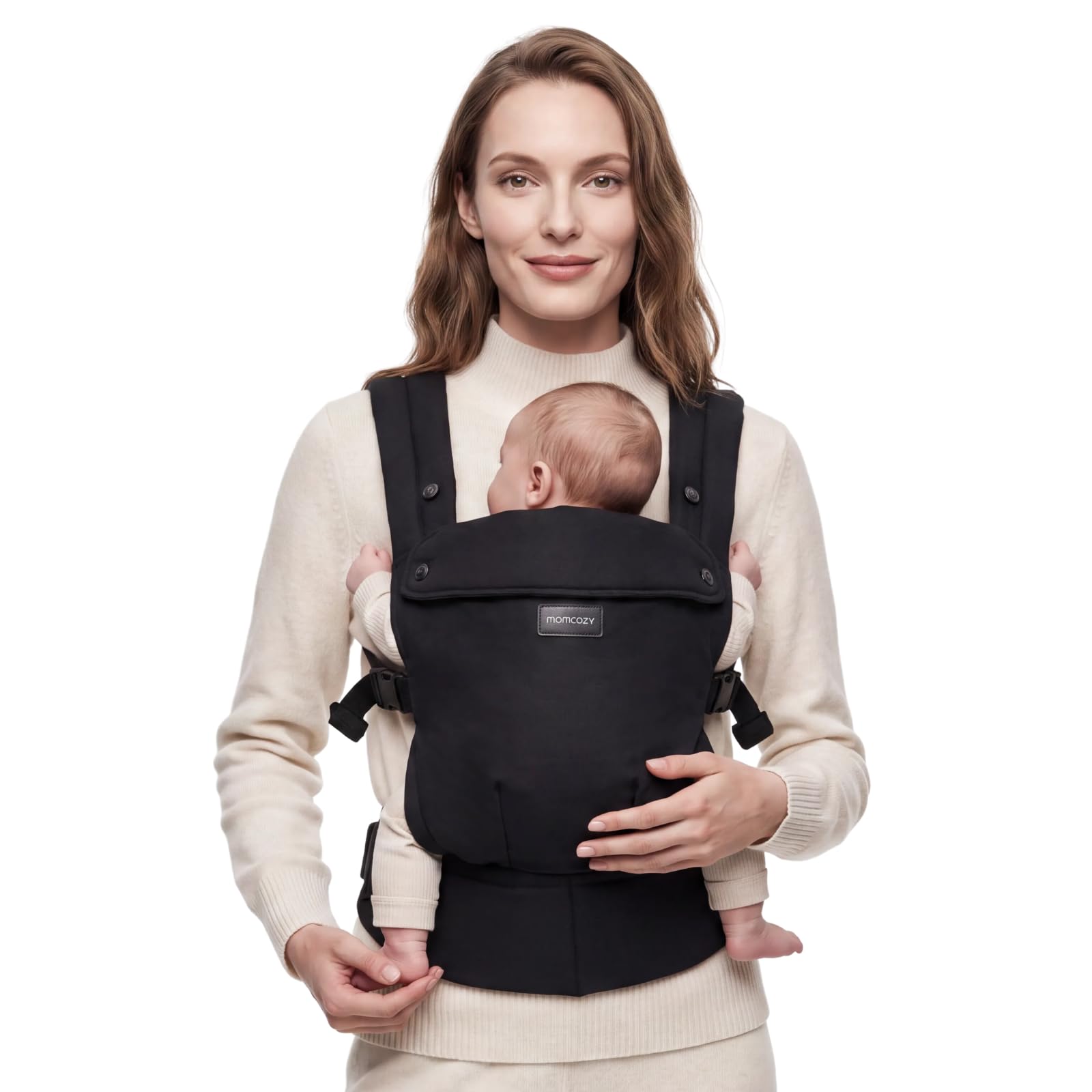
Momcozy PureHug
Key Features
- Fabric: OEKO-TEX certified cotton
- Age range: 3 to 24 months
- Back support: X-straps with EVA waist pad
- Weight range: 7 to 44 lb
- Price: Midrange
The X-shaped back is the reason to look at this one. Instead of two straps running parallel down your back, they cross between the shoulder blades, and Momcozy pairs that with a molded EVA pad at the waist. The effect is that the pull lands lower and more centrally than on an H-strap carrier, which is exactly what you want in the third consecutive hour of carrying.
It’s also the only carrier here made from 100 percent cotton with an OEKO-TEX certification, which is the sort of thing you notice if your baby’s face ends up against a synthetic strap for an hour. Three sizing positions cover 7 to 44 pounds and the buckles are quick enough to work one-handed. The head and neck area is padded without being rigid, so it supports a sleepy head without propping it into an unnatural angle.
What holds it back is upkeep and fit. The black cotton shows every bit of lint and dust, and the sizing runs tight for larger frames even though the belt itself has plenty of adjustment, so try the waist before you commit. What you get in exchange is a carrier you can wear all morning without your back complaining, in a cotton certified to OEKO-TEX.
Pros
- X-back straps spread the load
- OEKO-TEX certified cotton
- Quick to put on one-handed
Cons
- Black cotton collects lint and dust
- Fabric feels crisp rather than brushed
A cotton structured carrier with a back design that takes strain off your shoulders — worth the step up if you wear a baby all morning.
Best for Newborn Months
Boba Baby Wrap

Key Features
- Fabric: 4-way stretch cotton blend
- Closure: Tie
- Weight range: 7 to 22 lb
- Certification: IHDI hip-healthy
- Price: Midrange
Boba’s wrap and the KeaBabies wrap do the same job, and the difference is in the hand: this one is softer, with more give in both directions, and it drapes rather than holding a shape. If you want the fabric to feel like a favorite t-shirt, that’s worth something. It’s 198 inches long, so it’s a little easier to tie on a small frame than the longer wrap here.
The construction is straightforward: a four-way stretch cotton blend, a tie closure, no buckles or snaps anywhere. It’s certified hip-healthy by the International Hip Dysplasia Institute and built to the T.I.C.K.S. carrying standard, which is the sort of claim worth looking for on any wrap you buy. In practice that means a high, tight carry — baby up where you can plant a kiss on their head without leaning.
The trade-off is heat and tension. This is a thick, stretchy layer wrapped twice around your torso, and in warm weather you’ll both be damp within a couple of blocks; it’s a carrier for autumn and winter and for air-conditioned weeks of summer. The same stretch that makes it comfortable also means it can loosen over a long carry, so the knot needs re-checking and the fabric needs to go on tighter than feels natural at the start.
Where it beats the alternatives in this group is the newborn stage, full stop. For the first three months, a soft wrap is what settles a baby who will not be put down, and this one does it without asking you to wrestle a stiff length of fabric into place. Once they’re sitting up and wanting to face out, you’ll be reaching for a buckle carrier — that isn’t a flaw, it’s the job.
Pros
- Softer hand than the other wrap here
- Hip-healthy certified design
- Nothing to buckle or snap
Cons
- Runs hot in warm weather
- Can loosen over a long carry
The softer of the two wraps here, built for the newborn months and cool-weather walks — buy it if you want fabric that feels like a favorite t-shirt.
Best for Newborn Ease
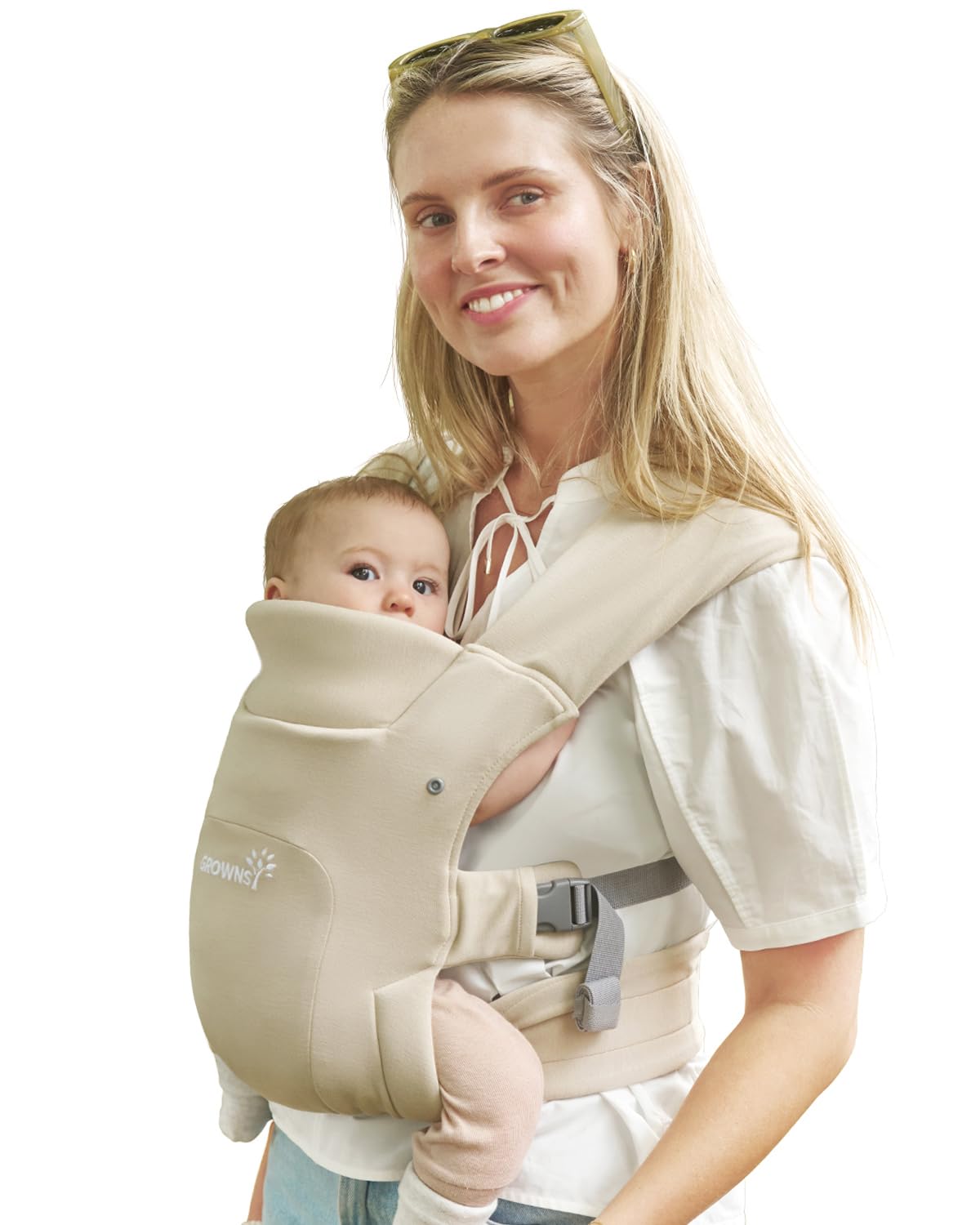
GROWNSY Newborn Carrier
Key Features
- Fabric: OEKO-TEX cotton blend
- Age range: 0 to 24 months
- Head support: Fold-down pad
- Weight range: 7 to 40 lb
- Price: Premium
The Grownsy is the most expensive carrier in this group, and what you’re paying for is a buckle carrier that behaves like a wrap for a newborn. The head and neck pad folds down rather than being a fixed panel, so it cradles a small baby and then gets out of the way once they can hold their head up. It’s a small design decision that makes the first two months much less fiddly.
The rest is standard structured-carrier thinking done well: an integrated EVA pad at the waist, a quick buckle system, a range from 7 to 40 pounds, and OEKO-TEX certified cotton-polyester fabric. It also looks different from everything else here — the cream color reads as a piece of clothing rather than a piece of equipment, which counts for something if you’re wearing it to a café.
The reservations are about how it holds up. The straps can work loose over a long carry, so a re-tighten halfway through a walk is worth building into the routine, and the fabric can pill after washing — the kind of thing you notice at month three rather than week one. Check the snaps and buckles each time you put it on; they’re the part that decides how long this one lasts.
None of that disqualifies it. The Grownsy makes most sense for a first baby whose parents want buckle convenience from day one and are willing to sit at the top of this group’s range to get it. If you’re happy starting with a tie wrap, the KeaBabies does the newborn job for less and the Flip takes over at eight pounds.
Pros
- Fold-down head and neck support
- Wrap-like comfort with buckles
- OEKO-TEX certified fabric
Cons
- Priciest carrier in this group
- Straps can work loose on a long carry
The friendliest structured carrier for a newborn, with a fold-down head pad and a buckle body, at the top of this group’s price range.
How We Tested the Best Budget Baby Carriers
We started by pulling together budget carriers sold at major retailers and narrowing the list by price, available sizes, and the kind of support each promised, then cut anything with vague safety information or a buckle design that looked hard to adjust one-handed. That left a dozen carriers, which we used for four months across the messy parts of the day: the morning diaper change, the grocery run, the fussy hour before dinner, and the longer weekend walk when the stroller stayed in the trunk.
Each carrier had to go on solo, without a mirror, while we timed how long it took to get a wriggling baby in and out and whether the straps stayed where we set them. We tugged on every buckle and seam, watched whether the baby could lean away from the panel, and checked that the fit held after a half-hour walk; testers of different heights and builds also swapped carriers to see where the shoulder and hip pressure landed. A carrier that needed constant readjusting, or that made us nervous on a flight of stairs, did not make the cut.
Because budget carriers often use simpler fabrics, we paid attention to heat and lint: we wore each one over a dark T-shirt and a sweater, then checked whether the panel left fuzz or made the baby’s neck clammy after a walk. We washed each carrier according to its care label and looked for frayed stitching, bent buckles, and fabric that pilled or lost shape. Value came down to whether those details held up after repeated use, and cuteness got a fair vote too—we asked whether we’d wear it to a coffee shop, not just around the living room. The ones that survived the four months were the ones we’d actually keep using.
How to Choose a Budget Baby Carrier
The cheapest carrier isn’t the one with the lowest price tag — it’s the one you can put on alone, in a hallway, with a baby in one arm, and still reach for six months later.
Start with the family, not the price
Budget carriers come in three shapes and they do genuinely different jobs. A tie wrap is a long piece of stretchy fabric: nothing to buckle, wonderfully snug for a newborn, and it stops making sense once your baby wants to look around. A buckle carrier clips on in seconds and usually covers front, facing-out and sometimes back carries. A hip seat moves the load to your waist and shines with a heavier toddler, but it won’t hold a newborn.
Decide which stage you’re buying for before you compare anything else. A wrap plus a cheap buckle carrier is often the most sensible budget answer, and it costs less than one do-everything carrier that does neither job well.
Read the weight range in both directions
Most of us check the top number. The bottom one matters more in the first weeks: an eight-pound minimum means a seven-pound newborn waits, while the wraps here work from seven. At the other end, treat the ceiling as the point where a carrier stops being pleasant rather than the point where it stops being possible.
If you want one purchase to cover newborn to toddler, be realistic. The first month may need a wrap, and the third year may need a hip seat — at this price, the carrier that does both comfortably is rare.
Fit is the whole purchase
The waist belt is where budget carriers succeed or fail. It has to sit on your hips rather than your ribs, and it has to close snugly on the smallest wearer in the house as well as the largest. Wraps sidestep the belt entirely by tying, but a long wrap pools on the floor if you’re petite and runs short of tail if you’re not.
Before you commit, put the carrier on with the baby in it and check that you can reach the chest clip without help. That single test separates the carriers you’ll use daily from the ones that end up in a drawer.
Carry positions you’ll actually use
Facing-in is the position you’ll live in: it works from the first week and it’s the one a baby naps in. Facing-out is a short-stage favorite, best saved for a baby with steady head control, and it’s the position that puts the most strain on your back. Back carry is what rescues you once your toddler wants to ride behind you.
A cheap carrier that does facing-in really well beats a slightly dearer one that claims six positions and only two of them comfortably. Count the positions you’ll use this year, not the ones on the box.
Frequently Asked Questions
How do I tie a baby wrap tight enough?
Tie it before you pick the baby up, and aim for tighter than feels natural — the fabric relaxes once it takes their weight. A simple check is to lean forward: if the baby’s chin drops toward their chest or the wrap sags away from your body, retie it.
Practising over a doll or a teddy once or twice makes the first real attempt much calmer, and it’s the fastest way to learn how much give your particular wrap has.
Do I still need a carrier if I have a stroller?
They solve different problems. A stroller handles long, flat trips with a full diaper bag; a carrier handles the school run, stairs, buses and the narrow aisles of a shop where wheels won’t fit, and it’s the only one of the two that settles a fussy newborn.
Start with one inexpensive carrier rather than a full travel system, and let a month of real errands tell you which one you reach for first.
How do I wash a baby carrier?
Check the label before the first wear — wash the carrier before it goes on the baby. Most wraps here take a cold machine wash, the buckle carriers vary, and the MOMTORY hip seat is hand wash only, which is worth knowing before you buy it.
Close every buckle before washing and air-dry rather than tumbling; heat is hard on stretch fabric and on plastic hardware.
Can my baby sleep in a carrier?
Dozing while you’re upright and watching them is normal, and for many newborns it’s how contact naps happen. Put them down for proper sleep rather than letting a long nap run in the carrier.
While they’re in it, keep the basics visible: face uncovered, chin off the chest, back supported, and nothing tucked around them that didn’t come with the carrier. Take them out for feeds and changes.
Final Verdict
For most families, the Infantino Flip 4-in-1 is the carrier to buy: four positions, a washable body and the lowest convertible price in this group, in one carrier that goes from eight pounds to a back-riding toddler. If your baby is still under eight pounds, start with the KeaBabies wrap and move to the Flip once they fill out.
Once you’re carrying a toddler on one hip for an afternoon at a time, the MOMTORY hip seat is the upgrade that saves your back — just fit the waist belt carefully before you rely on it.
