This post contains affiliate links. We may earn a small commission when you buy through our links — at no extra cost to you.
A bath toy has one job, and it isn’t really entertainment: it’s the thing that turns a slippery, end-of-day wrestling match into twenty minutes your baby actually looks forward to. The catch is what happens after the water drains. Anything that holds water inside, whether it’s the classic yellow squeaker or the squirty fish, eventually shoots something back out that you’d rather not see in a clean tub, and that’s usually the night the whole basket goes in the trash.
I’ve cleared out that basket more than once, so this time around I cared less about cute and more about what a toy looks like after its hundredth bath. Fourteen sets have been in and out of our tubs over the past four months, some adored and some ignored by the third night. The pattern was hard to miss: the ones that last drain completely or never hold water at all, and the ones babies come back to are simpler than the packaging suggests. Size quietly decides a lot, too, both for small hands and for wherever you’re drying them between baths. The picks below are the ones that earned their spot on the ledge.


Best for Almost Every Bath
The First Years Stack & Count Cups
Key Features
- Pieces: 8 cups
- Material: BPA-free plastic
- Drain holes: Yes, in every base
- Recommended age: 6 months to 2 years
- Price: Budget
Every bath toy in this guide has to answer one question: where does the water go when the bath is over? The First Years cups answer it with a shaped hole punched through the base of each one. Scoop a cup, lift it, and the water falls out in a shower; leave the set in the tub and it drains instead of sitting full until morning. That single design decision is why these eight cups are the toy we recommend to almost every family.
From around six months they’re something to grab and bang together, and the stacking and nesting comes over the following year: a tower to build, a tower to knock down, a small cup hidden under a big one. The numbers molded into each base give the set a second life once the stacking gets boring. Ours moved between the tub, the water table and a bucket in the yard without ever feeling like the wrong toy for the setting.
The trade-off lives in that same hole. A cup drains as you lift it, so there’s no deep jug for pouring from a height, and a determined toddler will notice. Eight loose pieces also means eight things to gather at the end of a bath, though they nest into one stack you can carry in a single hand. Neither bothers us much; if you want a big dramatic pourer, this isn’t it.
Pros
- Holes in the base pour and drain
- Works from grabbing to counting
- BPA-free and easy to rinse
- Nests into one tidy stack
Cons
- Drains as it lifts, so no deep pour
- Eight separate pieces to gather
Our pick for nearly every bathroom: eight BPA-free cups that pour, drain and stack, and keep earning their place from a baby’s first grab to toddler counting games.
Best for Babies under One
Munchkin Float & Play Bubbles
Key Features
- Floats: Yes
- Pieces: 4
- Watertight: Sealed, no holes
- Recommended age: 4 months and up
- Price: Budget
These four bubbles are completely sealed. No holes, no valves, nothing to squeeze water out of afterwards. Two are characters, a duck and a whale, and two are whirly toys that spin and rattle, with textured rings that slide around the outside of each one. It’s a bath toy designed around the thing that ruins bath toys.
We kept the youngest bather in mind with these, and the sealed build is what sells them: no rinse-and-shake ritual after the bath, and no hollow inside going musty in the corner of the tub. The rattle and the spinning parts give a baby something to track with their eyes and grab at with both hands, and the shape is easy to hold with wet fingers. Four months and up is the right bracket; this is a first bath toy rather than a long-term one.
Past about eighteen months the appeal narrows. These float, rattle and spin and that is the whole repertoire, while a toddler with a scoop wants to move water from one place to another. As a small set that lives in the tub and never needs drying out, though, we think it’s the right first purchase for a baby who is just getting steady in the water.
Pros
- Fully sealed, so nothing to drain
- Floats and rattles for babies
- Textured rings to grab and track
Cons
- Solid plastic makes for loud throws
The one we hand to a baby new to the tub: sealed, floatable and rattle-ready, with nothing to drain, dry or dig mold out of.
Best for Letters and Counting
Munchkin Foam Bath Letters & Numbers
Key Features
- Colors: 6
- Pieces: 36 (A-Z and 0-9)
- Material: Soft foam
- Sticks when wet: Yes, to tile and tub
Wet a foam letter, press it against the tile, and it stays there, which turns the wall beside a seated toddler into a board at exactly their eye level. Thirty-six pieces, letters A to Z and numbers 0 to 9, in six colors. Of everything here, this is the set we keep coming back to for the shampoo-and-rinse stretch, when a child needs both hands busy and you need both hands free.
The learning arrives as a side effect of the play: names spelled out, numbers put in order, colors grouped, letters fished out of the water and slapped back up on the wall. They float too, so they work as loose pieces in the tub as well as on it, and the foam is soft enough that a letter thrown across the bathroom doesn’t hurt anyone.
The sticking has a condition: dry letters slide down the wall, so a set that’s been out of the tub for a day needs a dunk before it goes back up. Thirty-six pieces also means thirty-six things to fish out, which is where a mesh scoop hanging off the tap earns its keep. Neither is enough to put us off, because the wall keeps a toddler occupied long enough to get through a hair wash, which is the point of a bath toy.
Pros
- Sticks to tile and tub when wet
- Letters and numbers for early learning
- Soft foam, safe for small hands
- Six colors that float loose too
Cons
- Sits damp unless squeezed and dried
The best learning toy here: a wet letter sticks to the tile at toddler eye level, so spelling and counting happen during the bath rather than instead of it.
Best for Ring-Toss Play
Nuby Floating Purple Octopus
Key Features
- Floats: Yes, octopus and rings
- Pieces: 4 (octopus and 3 rings)
- Material: BPA-free rubber
- Recommended age: 18 months and up
- Price: Budget
A purple octopus floats in the middle of the tub with three rings to toss onto its arms. There are no holes anywhere in it, and the rings float too, which matters more than it sounds: a ring that sinks is a ring you have to dive for, and the game dies halfway through the bath.
The game is the point. A toddler kneels at the water, aims, misses, retrieves, tries again, and that is hand-eye work dressed up as throwing things. It holds attention for a whole bath rather than a couple of minutes, and once the rings are on the arms the octopus becomes a character to dunk and rescue, which stretches it past its one trick.
Where it earns its spot is the eighteen-month-to-three-year window, when a baby toy is too simple and a big-kid set is too much. The octopus sits upright in the water, the rings go on and come off, and the whole thing dries without a mold worry because there’s nowhere for water to hide. It’s the set we hand to a toddler before anything with a squeaker in it.
Pros
- Floats upright, rings float too
- No holes, so no mold worry
- Tossing game builds coordination
Cons
- Smaller than the photos suggest, especially the rings
Our pick for the ring-tossing stage: one floating octopus, three rings and no holes for water to sit in, for roughly eighteen months to three years.
Best for Bath and Beach
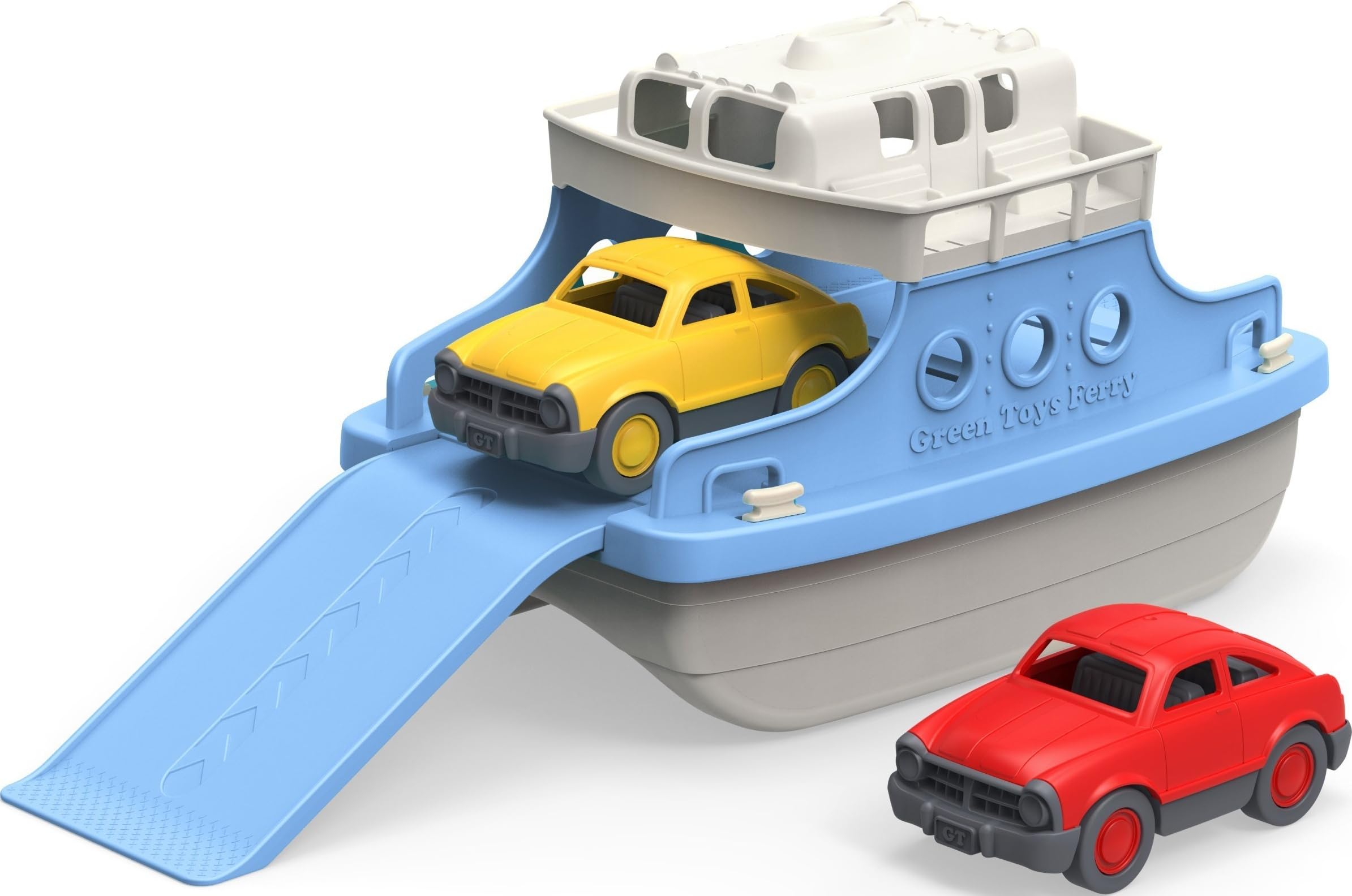
Green Toys Ferry Boat with Mini Cars
Key Features
- Pieces: 3 (ferry and 2 cars)
- Material: 100% recycled plastic
- Dishwasher safe: Yes
- Recommended age: 36 months and up
- Price: Midrange
The ferry is the only thing here you can put in the dishwasher. Recycled plastic, three pieces, the boat plus two mini cars that ride on the deck, and a build that shrugs off being dropped, kicked around the yard and shoved wet into a beach bag. It’s made in the USA from recycled milk jugs and it feels like it.
Now the caveat that decides whether it suits your bathroom: the deck is open. Water comes over the sides, the boat sits lower and lower, and with enough sloshing it turns turtle and goes down. On a calm bath with a careful two-year-old it floats and the cars roll off the ramp; with a splasher it’s a submarine. Green Toys grades it from three years old, and that’s about right.
We still rate it, because a toy that works in the pool, the sandpit and the bottom of the toy box is worth more than one that only works in water. If you want something that reliably bobs alongside a baby, the sealed shapes on this list do that job better. If you want the thing that survives the whole summer, this is it.
Pros
- Dishwasher safe, so it gets truly clean
- Recycled plastic, made in the USA
- Survives bath, pool, sand and drops
Cons
- Graded three and up, so not a baby toy
Buy it for the bath-and-beach bag rather than the tub alone: a tough recycled-plastic ferry that floats on a calm bath and doubles as an outdoor toy.
Best for Older Toddlers
BUNMO Textured Suction Bath Toys

Key Features
- Pieces: 10
- Material: Silicone
- Sticks to: Wet tile, glass and tub
- Recommended age: 3 years and up
- Price: Budget
Ten textured silicone suckers, each a different shape, that press onto wet tile and peel off again. They stick to the tub, the shower screen, the fridge and an airplane window, and they connect to each other as well as to the wall. Three years and up, and explicitly not for mouthing, which tells you most of what you need to know about who they’re for.
The appeal is the pop. Press one on, peel it off, run a thumb over the texture; it’s a fidget toy that happens to be bath-safe, and the building side means a four-year-old gets far more out of it than a two-year-old does. We found they work best as a bath-time distraction for a child who has decided baths are a negotiation, because sticking and peeling is absorbing in a way that floating ducks stop being around year two.
Two limits worth knowing. They need smooth, wet, clean tile to hold, and grout lines, textured tubs and a soapy film all defeat them, which is genuinely annoying mid-build. And because they’re not mouthable, they’re a poor fit for a baby who still tests everything with their teeth. Give them to a preschooler with a glass shower screen and they’re the most open-ended thing on this list.
Pros
- Sticks to tub, glass and tile
- Silicone with a satisfying pop
- Builds and connects, not just sticks
- No holes, so nothing to drain
Cons
- Not mouthable, so not for babies
One for the preschooler, not the baby: ten silicone suckers that pop onto wet tile and build into something, with no holes to trap water.
How We Tested the Best Baby Bath Toys
We started by pulling together the sets that show up again and again in parent forums and bestseller lists, then narrowed by the things that actually matter at 7 p.m.: whether a piece is fully sealed or has real drain holes, phthalate- and BPA-free materials, seams and painted details that look like they’ll survive teething, and how many pieces you get for the price. Sets with dozens of tiny parts got flagged early, since a tub full of confetti-sized toys is its own kind of chore. That filtering left us with fourteen sets to live with.
Those sets went into a real bath routine roughly three nights a week for four months, shared by a 9-month-old and a 2-year-old, plus a few sessions at the kitchen sink. We paid attention to which pieces got grabbed first, which ones got handed back and forth, and which were floating untouched by the third or fourth bath. Every piece also got squeezed under water, shaken out, and left on the tub ledge to see how much water stayed trapped inside.
After six weeks we cut open anything with a squeaker or a hole to check the inside, and we dropped each toy from counter height onto tile to watch for cracks, split seams, or paint flaking off. We measured whether a piece actually fits in a toddler’s fist and whether the full set fits in a standard bath caddy or drain basket. At the end we counted how many pieces per set genuinely got played with against what the set cost, because a cheap bucket of twenty that yields three good toys isn’t the bargain it looks like.
How to Choose Baby Bath Toys
The most useful question you can ask about a bath toy is where the water goes when the bath is over, because everything else about owning it follows from that.
Sealed or drainable: the mold question
There are two designs that work and one that doesn’t. A fully sealed toy has no opening at all, so there is nowhere for water to sit; a fully open toy has a hole wide enough that water runs straight back out and air gets in. The one that fails is the toy with a narrow hole you can’t see into, which takes water in and never lets it dry.
Turn any toy over before you buy it. If you can see the inside, or there’s no opening at all, it’s a reasonable bet; if there’s a pinhole and a hollow body, you’re committing to squeezing and shaking it after every bath. Our cups sit at one end of that spectrum and the sealed bubbles at the other.
Buy for the stage six months from now
Bath toys outlive the stage you bought them for, which is why a set that only does one thing ends up in the bottom of the toy basket. A baby who is just sitting up wants sealed pieces to grab and mouth; a crawler wants things to scoop and pour; a toddler wants a target, whether that’s a ring to toss, a fish to catch or a letter that sticks to the wall.
We lean toward anything with a second act. Cups that stack and later count, or letters that float loose before they spell a name, keep earning their place long after the first trick is mastered.
What "floats" actually means
Almost every bath toy claims to float, and most of them do, in still water, when they’re empty. The difference appears once a toddler starts splashing. An open deck, a cup turned the wrong way up or a hull with a drain hole will take on water and sit lower, and a boat with enough water inside it goes over.
That isn’t a fault so much as a design fact, and it changes where a toy belongs. Sealed shapes and simple cups behave predictably in the tub; an open-deck boat is better bought for the pool, the beach and the garden, where it can fill up and be emptied without anyone minding.
Cleaning, drying and piece count
Every bath toy you own needs somewhere to dry, and every piece you buy is one more thing to gather. Rinse, shake, and leave the set in a mesh basket or scoop so air reaches all of it; foam needs squeezing out and laying flat, and anything the maker says is dishwasher safe gets the easiest ride of all.
Piece count is a real decision. Eight pieces is a bath. Thirty-six is a project, and worth it only if the pieces do something a child actually wants to do. If you’re buying for a baby rather than a toddler, buy fewer, bigger pieces and add the small stuff when the mouthing stops.
Frequently Asked Questions
How often should I replace bath toys?
Judge each toy rather than the calendar. Once a month, squeeze anything hollow and look and smell inside it: a musty odor, dark specks or water that won’t come out means it goes, because you can’t clean a surface you can’t reach.
Sealed toys and open-drain sets like the cups don’t have the same expiry date, but retire any of them that has split, cracked or gone brittle in the sun.
Can I put bath toys in the dishwasher?
Only when the manufacturer says so. The Green Toys ferry is designed for it, which is unusual, and it’s one of the reasons that boat holds up so well outdoors.
Foam pieces, silicone suckers that you want to keep their grip, and anything with a seal or moving parts do better in warm water with a little soap, then air-dried. Read the care line on the packaging before the first wash, not after.
My baby hates the bath. Will a toy actually help?
Often, yes, but not by adding more to the tub. Give a reluctant bather one job with their hands: scoop and pour with two cups, or stick silicone suckers onto the tile at their eye level and peel them off again. A couple of toys that do something beats a tub full of floaters that just sit there.
Keep the toy count low and hand over the same one at the start of every bath for a week, so it becomes part of the routine rather than a surprise.
Final Verdict
Start with the cups. Eight pieces that pour, drain, stack and count will still be in use when the novelty of everything else has worn off, and having a second set for the garden is no hardship.
If your baby is still under a year and puts everything in their mouth, the sealed Float & Play Bubbles are the simpler, cleaner buy. Once they’re sitting up and spelling, the foam letters take over the wall. The ferry earns its place in the beach bag rather than the tub, and the suckers are for the preschooler who has stopped mouthing everything in reach.
