This post contains affiliate links. We may earn a small commission when you buy through our links — at no extra cost to you.
The first time you fold a stroller at the gate with a toddler on one hip and a boarding pass in your teeth, every extra pound and stiff hinge announces itself. A good airplane stroller is not just a compact set of wheels; it is the difference between moving through security with a little dignity and wrestling a small piece of furniture across the terminal. The right one gives you a free hand and one less thing to worry about.
Over eight months, my team and I traveled with 12 airplane strollers, from one-hand folders to sturdier models that double as daily drivers. We weighed them, folded them while holding a bag, gate-checked them, and used them on sidewalks and in rental car trunks. One thing I learned: the smallest fold is not always the best value—a slightly larger package can buy you a sturdier frame, a comfortable handle, and a fold lock that stays shut, even if it looks less sleek in the hall. The picks below are the ones that made travel feel lighter.


Best for All-Around Travel
Mamazing Ultra Air
Key Features
- Weight: 11.6 lb
- Harness: 5-point
- Folded size: H22x W19.3 x D11 inch
- Weight limit: 50 lb
- Price: Premium
A carbon-fiber frame that weighs 11.6 pounds is the reason the Mamazing Ultra Air earns our default recommendation. Plenty of travel strollers are light; fewer combine that carry weight with a one-hand fold, a reclining seat, and a 50-pound limit. For a parent juggling a boarding pass and a toddler, that combination is the difference between a stroller that helps and one that becomes another thing to manage.
The folded package is 22 by 19.3 by 11 inches, compact enough for many overhead bins but not the smallest here. We noted the 22-pound basket capacity, which is unusually generous for this class and makes the Mamazing more useful for a day out than a bare-bones umbrella stroller. The UV-protective canopy and included travel bag round out a genuinely travel-ready kit.
We like the seat for toddlers: the recline is useful for naps, the five-point harness is the right setup, and the 39.4-inch maximum height gives growing kids some room. It is not the stroller to buy if you want the tiniest possible folded cube; that is the gb Pockit’s job. It is the better all-rounder for families who want one stroller to cover the airport, the rental car, and the hotel lobby.
Pros
- 11.6-pound carbon frame is easy to lift
- One-hand fold and unfold simplify boarding
- Recline and 50-pound limit suit toddlers
- 22-pound basket and travel bag add real utility
Cons
- Durability record is mixed
We recommend the Mamazing as our best all-around pick for airplane travel: a light cabin-friendly stroller with recline and a toddler-sized seat.
Best for Smallest Fold
gb Pockit Air
Key Features
- Weight: 10.4 lb
- Harness: 3-point
- Folded size: 11.8 x 7 x 13.8 inches
- Weight limit: 55 lb
- Price: Premium
The folded package is the headline: 11.8 by 7 by 13.8 inches, small enough to slot into a carry-on or drop into an overhead bin. At 10.4 pounds, the gb Pockit Air is one of the few strollers here that genuinely earns the phrase cabin-first. That is why it stays on our shortlist for minimalist travelers even though it gives up comfort.
Our verdict is that it is the right pick for a specific trip, not every trip. The fold is clever once you learn it, but it can take a few attempts and a firm shove when you are hurried. The seat is firm and the canopy is modest, so a long airport day with a napping toddler is not its strength. If you want the smallest possible thing to carry, it is.
The 55-pound limit is generous for a stroller this small, so it can last into the preschool years. We see it as a second stroller for travel rather than your only stroller. It is the one we pack when the trip is short and the overhead bin is the real constraint.
Pros
- Folds smaller than a carry-on
- 10.4 pounds is easy to carry
- 55-pound limit lasts into preschool
Cons
- 3-point harness only
For the traveler who prizes the smallest possible folded package, the Pockit Air is the one we recommend, as long as you accept a firm seat and a fold that needs practice.
Best for Ultralight Carry
Mompush Jeto
Key Features
- Weight: 10.1 lb
- Carry strap: Integrated
- Folded size: 20.5 x 17.3 x 7.1 inches
- Weight limit: 40 lb
- Price: Budget
At 10.1 pounds, the Mompush Jeto is the stroller we pick when the carry matters more than the cushioning. It folds to a flat 20.5 by 17.3 by 7.1-inch square, self-stands, and has an integrated carry strap. That is a useful combination on a jet bridge: you can fold it, grab the strap, and keep moving.
The one-second fold is the other draw. It is not the silkiest mechanism in this group, but it is simple enough to learn and small enough to stow in a trunk or a tight entryway. The seat is more upright than the plush picks, so it suits short hops and alert toddlers better than long nap-heavy days.
We think the Jeto makes the most sense as a budget travel stroller or a second stroller for a family that already owns a full-size pushchair. It does not have the reclined, padded feel of the Mamazing or the Nexis, but it is the one we grab for a quick weekend flight where every pound counts.
Pros
- 10.1-pound carry is easy on stairs
- Folds flat, self-stands, and has a carry strap
- Budget price for the travel features
Cons
- 40-pound weight limit
- Small under-seat basket
We recommend the Jeto as a budget travel stroller for short trips, quick folds, and parents who care more about carry weight than a plush seat.
Best for Premium Auto-Fold
Mompush Nexis
Key Features
- Weight: 13.9 lb
- Recline: Multi-angle
- Folded size: 19.88 x 18.11 x 7.87 inches
- Weight limit: 50 lb
- Price: Premium
The auto-fold is what sets the Mompush Nexis apart. Press the mechanism and the stroller collapses and stands on its own, ready to wheel or lift. At 13.9 pounds for the complete stroller and 11.5 pounds for the carbon frame, it is not the featherweight here, but it is still a manageable carry for most parents.
The Nexis is a premium travel stroller, and the details mostly earn it. The seat reclines through multiple positions, the canopy is large with a mesh window, and the package includes a rain cover, cup holder, and storage bag. For a child who needs a real nap on the go, that is a more useful set than a bare umbrella fold.
The 50-pound limit gives it a longer runway than the Jeto, and the folded package at 19.88 by 18.11 by 7.87 inches is compact enough for many overhead bins. We did find that it can need the right angle to settle into a tight bin, so it rewards a little practice.
We rank the Nexis as the premium auto-fold pick rather than the default. The Mamazing is the better all-rounder, and the Jeto is the easier carry, but neither folds and stands itself quite like this. It is the one for a parent who wants the stroller to do more of the work.
Pros
- Auto-folds and self-stands
- Near-flat recline and large canopy
- 50-pound limit gives growing room
- Rain cover, cup holder, and bag included
Cons
- Mixed sturdiness record
We recommend the Nexis for travelers who want an auto-fold, a near-flat recline, and a large canopy in a premium package.
Best for Theme Parks
Dream On Me Coast Rider
Key Features
- Weight: 12.8 lb
- Ride modes: Stroller, rider, scooter
- Folded size: 24.41 x 16.14 x 10.63 inches
- Weight limit: 45 lb
- Price: Budget
The Coast Rider is less a conventional airplane stroller and more a theme-park tool. It converts from a stroller into a ride-on board and then a scooter, which is why it appeals to families with an older toddler who wants to move. At 12.8 pounds, it is still light enough to lift into a trunk or gate-check.
For a park day, the 45-pound limit and upright seat make more sense than a padded newborn stroller. The stroller is compact when folded, at 24.41 by 16.14 by 10.63 inches, but it is not the one we choose for a tight overhead bin. Think of it as a gate-check stroller that doubles as entertainment once you are through security.
The convertible design is the real reason to choose it: it gives a tired four-year-old a place to ride without a second piece of gear. We still treat it as a gate-check stroller rather than a cabin stroller, which is the right role for a park-heavy trip. It is not the stroller we reach for when the overhead bin is the only place it can go.
Pros
- Converts to rider and scooter
- 45-pound limit for older kids
- 12.8 pounds is easy to lift
Cons
- Folding mechanism can stick
We recommend the Coast Rider for theme-park and older-toddler trips where the ride-on modes matter more than overhead-bin size.
Best for Budget Backup
Dream On Me Aero

Key Features
- Weight: 7.2 lb
- Harness: 3-point
- Folded size: 40.6 x 7.7 in
- Weight limit: 33 lb
- Price: Budget
At 7.2 pounds, the Dream On Me Aero is the stroller we choose when the trip is short, the budget is tight, and the carry is the whole point. It has a one-hand fold, a removable canopy, and a simple steel frame. It is not luxurious, but it is honest about what it is.
The Aero is best for quick errands, taxi rides, and gate-checked weekends. The simple seat and removable canopy keep the weight down, and the one-hand fold is quick when you are unloading a car. It is a short-trip stroller rather than an all-day comfort machine. The 33-pound limit is fine for a younger toddler, and the fabric is easy to wipe down.
We see it as a backup stroller or a second stroller for grandparents, not the one to choose for a long Disney day. The low price is part of the appeal, but the real advantage is that you can carry it up stairs or onto a bus without thinking twice.
Pros
- 7.2-pound carry is exceptionally light
- One-hand fold for quick trips
- Budget-friendly backup stroller
Cons
- Short handles for taller parents
- Small canopy and 3-point harness
We recommend the Aero as a budget backup for short trips and quick errands, not as the one stroller for a long airport day.
Best for One-Touch Folding
Gromast Gravity

Key Features
- Fold: Gravity auto-fold
- Weight: 16.3 lb
- Folded size: 20 x 14 x 22.8 inches
- Weight limit: 48.5 lb
- Price: Midrange
The gravity auto-fold is the trick that makes the Gromast worth a look. Press the release and the stroller collapses itself into a self-standing package in seconds. That is a genuinely useful convenience when you are holding a child and a carry-on, and it is the reason this stroller stands out in a crowded field.
The seat is wider and more padded than the ultralight picks, and the four-position UPF50+ canopy gives good coverage for sunny walks. The package includes a cup holder and carry bag, so it feels more complete than a bare travel stroller. At 16.3 pounds, it is a midweight rather than a featherweight.
The folded shape is 20 by 14 by 22.8 inches, which is tall enough that we do not treat it as an overhead-bin stroller. It is better suited to gate-checking, car trips, and hotel use. The 22 kg limit is fine for most toddlers, but it is not the stroller for a big preschooler.
We rank the Gromast as a comfort-first auto-fold alternative, not the default. If you want the folding to be almost effortless and you do not need the smallest possible package, it earns a place. If you are trying to travel with one small bag and no checked luggage, the gb Pockit or Mompush Jeto makes more sense.
Pros
- Gravity auto-fold is genuinely quick
- Wide padded seat for longer outings
- Large four-position canopy
- Cup holder and carry bag included
Cons
- Mixed sturdiness record
We recommend the Gromast for parents who want a comfort-first stroller with a near-effortless auto-fold, even if it means gate-checking rather than carrying it into the cabin.
Best for Rolling Luggage
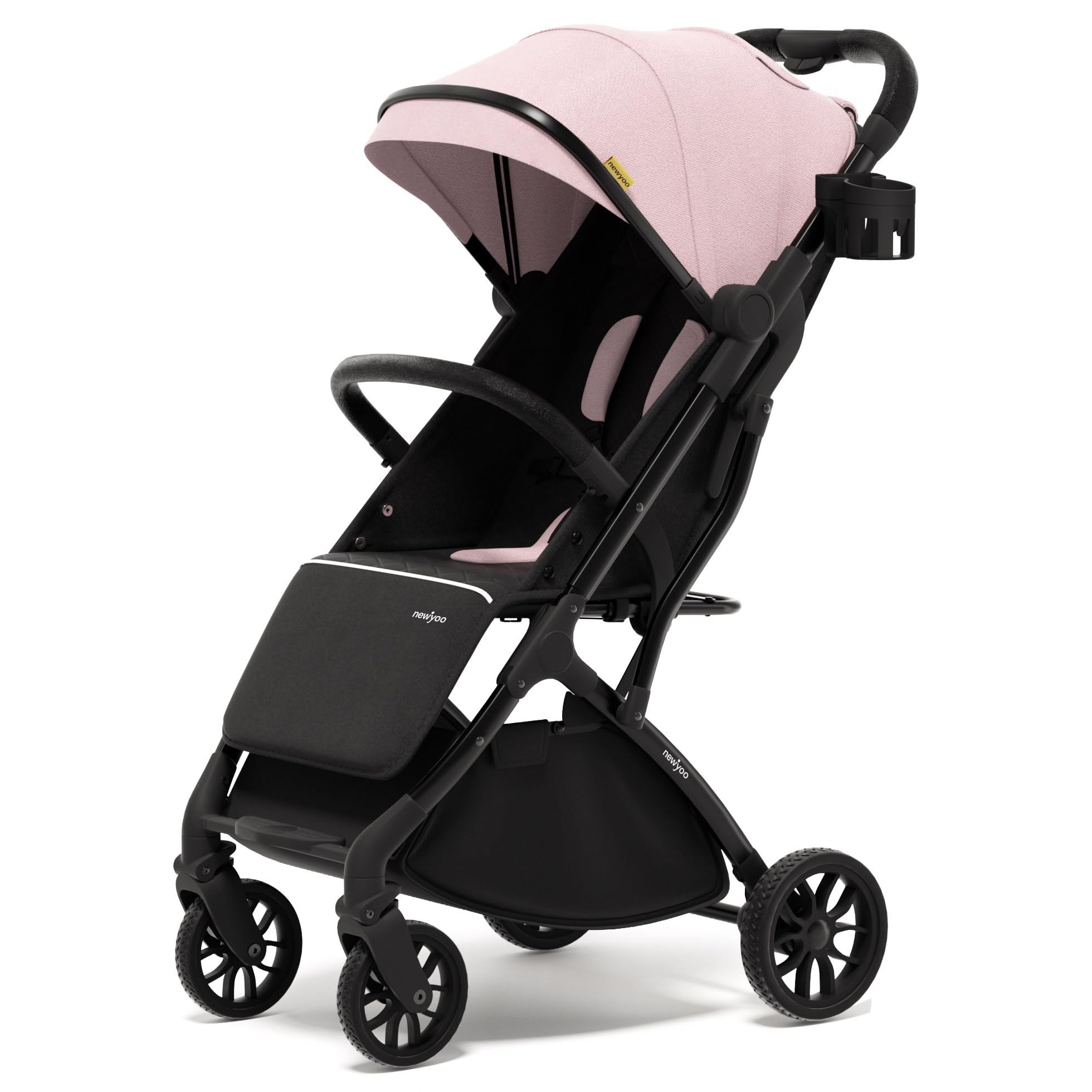
newyoo GlideTow TR18
Key Features
- Weight: 17.6 lb
- Recline: 175 degrees
- Folded size: 21.06 x 12.2 x 26.4 inches
- Weight limit: 33 lb
- Price: Midrange
The GlideTow’s party trick is the telescoping pull handle: fold the stroller, tilt it, and roll it behind you like a suitcase. That is a smart answer to the awkward carry that makes compact strollers feel heavier than their listed weight. The trolley mode changes how you move it through a terminal, and that matters more than the raw weight.
The seat reclines to 175 degrees, which is unusually flat for a travel stroller, and the zip-open rear mesh panel adds airflow for a napping baby. The UPF50+ canopy is large, and the package includes a cup holder and stroller bag. For a newborn-to-toddler travel stroller, that is a compelling feature set.
We rank it as a niche pick rather than a default because the folded package is tall, at 21.06 by 12.2 by 26.4 inches, and the 33-pound limit caps how long it lasts. If you want a stroller that rolls like luggage and reclines for naps, it is the one here that does both. If you need the smallest cabin package, look at the gb Pockit or Mompush Jeto.
Pros
- Rolls like luggage in trolley mode
- 175-degree recline for naps
- Large UPF50+ canopy
Cons
- Heavy at 17.6 pounds
- Harness and closure quality is inconsistent
We recommend the GlideTow for families who want a stroller that rolls like luggage and reclines for naps, and who value those conveniences over a conventional cabin fold.
How We Tested Airplane Strollers
We started by pulling together the travel strollers that show up again and again in airport-parent conversations, then narrowed the list by folded size, listed weight, handle-height range, price, and whether the fold could reasonably be done with one hand. That left us with 12 strollers, which we used for eight months in the places these products actually live: security queues, gate-check desks, jet bridges, narrow airplane aisles, rental car trunks, neighborhood sidewalks, and the occasional cobblestone stretch. We rotated them among testers of different heights and carried each one up and down stairs, onto buses, and through a crowded terminal.
At the airport, we timed how long each stroller took to fold and unfold while holding a diaper bag, then repeated the process with a child in our arms. We checked whether the fold lock or closure stayed shut when we lifted the stroller by its handle, and whether the folded package fit into the overhead bin, under a seat, or only at the gate-check counter. We also noted how each one rolled on tile, carpet, and jet-bridge seams, and whether the handle left taller testers hunched or shorter testers reaching.
Back home, we used the same strollers for daily errands, school runs, and weekend walks, watching for wobbly frames, frayed seams, scuffed fabrics, and brakes that drifted. We weighed each one on a luggage scale and compared that number with how it felt to lift one-handed, because a stroller can be light on paper and still awkward by the handle. Value came down to how much stroller we got for the money after eight months of real use, not how it looked in a product photo. The best ones looked presentable after a trip, stayed sturdy over curbs, and still folded without a fight.
How to Choose an Airplane Stroller
The best airplane stroller is the one you can fold, lift, and stow without needing a second pair of hands.
Start with the folded package
Cabin rules are not universal: an overhead bin on a regional jet is not the same as the bin on a wide-body, and a stroller that fits one may not fit another. We treat the folded dimensions as the first filter, before weight. The gb Pockit Air is the smallest package here and the clearest cabin-first choice, while the Mamazing and Mompush Nexis are compact enough for many bins but benefit from a practice fold. If you are flying a carrier with tight regional bins, plan to gate-check rather than assume.
Practice the fold before the trip
A one-hand fold is only useful if it works while you are holding a child, a bag, and a boarding pass. We prioritise a fold that locks open, self-stands, and leaves you a strap or trolley handle. The Mompush Jeto’s strap and flat square are easy to manage; the Nexis and Gromast do more of the folding for you. Test the sequence at home with one hand behind your back. If it needs two hands and a knee, it will be awkward at the gate.
Decide how much nap comfort you need
Ultralight strollers save your shoulders, but they often save weight by thinning the seat, shrinking the canopy, and limiting recline. We think the nap question is the one that separates a true travel stroller from an emergency umbrella stroller. If your child still naps in the stroller, a near-flat seat and a larger canopy are worth the extra pounds. The Mamazing and Mompush Nexis are the better all-day choices; the gb Pockit and Mompush Jeto are short-hop tools. For an older toddler who wants to ride, the Coast Rider’s convertible seat is more useful than a deep recline.
Check the parts that wear
Small wheels and folding joints take a beating in travel use. We check the wheels, brake, and harness buckle before we trust a stroller with a child. Give the wheels a spin, make sure the brake engages on both sides, and confirm the harness buckle is easy to fasten but hard for a child to release. A five-point harness gives more security for a small baby; a three-point harness is simpler but less enveloping. The cheapest stroller is not a bargain if a wheel or strap fails early, so weigh the warranty and the replacement-part situation.
Frequently Asked Questions
Do airlines charge to gate-check a stroller?
Usually not for one stroller per traveling child, but the rule depends on the airline and fare. Check the carrier’s family-travel page before you fly, and ask at the check-in desk for a gate-check tag. Keep the stroller with you through security and hand it over at the jet bridge; do not send it to the regular baggage belt unless you are prepared to collect it at the carousel.
Can I use an airplane stroller from birth?
Only if the seat reclines far enough and the maker lists a newborn age range. The newyoo GlideTow and Mompush Nexis are the clearest newborn-friendly options here; the ultralight picks are better once your child can sit up. Check the harness fit with a blanket or insert only if the maker allows it, and never add padding that did not come with the stroller.
How do I clean a travel stroller after a trip?
Wipe the frame and wheels with a damp cloth, spot-clean the fabric with mild soap, and let everything dry fully before folding. Do not soak the harness or put the frame in water. If the stroller was gate-checked, rinse off airport grit and check the wheels and fold locks before the next use.
Can a travel stroller replace my everyday stroller?
For car errands, public transit, and smooth sidewalks, often yes, especially if you pick one with a real canopy and some recline. For long neighborhood walks or rough pavement, a full-size stroller with bigger wheels is still more comfortable. Keep the travel stroller as a second stroller if you regularly cover uneven ground.
Final Verdict
After testing the set, the Mamazing Ultra Air is the airplane stroller we recommend first. It has the best balance of a manageable 11.6-pound carry, a compact fold, a reclining toddler seat, and a 50-pound limit, so it can handle the airport and the days around it. If your only goal is the smallest possible folded package, choose the gb Pockit Air; if you want the lightest carry, the Mompush Jeto is the better fit. For a theme-park trip with an older child, the Coast Rider’s convertible ride-on mode earns the nod.
