This post contains affiliate links. We may earn a small commission when you buy through our links — at no extra cost to you.
A stroller is the rare piece of baby gear you touch every single day, usually several times, and the wrong one announces itself fast. It’s the fold that needs two hands and a hip, the front wheels that lock up in a narrow grocery aisle, the basket too shallow to swallow a diaper bag. What you’re really shopping for is something that fades into the background of your day: easy to push one-handed while the other hand holds a coffee or a toddler, easy to fold while you’re balancing a bag, and padded enough that a nap can happen mid-errand. Get those right and the stroller stops being a chore you manage and becomes the thing that lets you keep moving.
I’ve pushed a lot of strollers over cracked sidewalks and through doorways that were narrower than advertised, and my team has now spent eight months living with 12 of them, from $150 umbrellas to full-size cruisers. Here’s the piece of wisdom that surprised me most: the stroller that folds flattest is almost never the one that pushes best, and most shoppers end up trading a little of one for the other. The picks below are grouped by which trade-off they make, so you can match one to your actual week rather than the showroom floor.



Best for Baby and Toddler
Graco Ready2Grow 2.0
Key Features
- Max weight: 50 lb
- Folded size: 33.5*17*8 Inches
- Stroller weight: 32 lb
- Seating capacity: 2
- Price: Midrange
A rear seat close enough to touch, a bench, and a standing platform make the Ready2Grow 2.0 our default for a baby and toddler. The rear seat keeps the baby near you, while the older child can sit, perch, or stand as the trip changes. The two full seats are useful now; the extra positions are what keep the stroller useful when the older child starts walking more.
Car-seat flexibility is the other reason it earns the top spot. It accepts two Graco infant car seats at once, which is unusual for a stroller that also has a bench and platform, and makes the frame useful for twins as well as a baby and toddler. If you already own a Graco seat, the click-in route is simpler than juggling a bassinet and a toddler seat.
The 32-pound frame and 33.5 x 17 x 8-inch fold are manageable for a double, and the slim package stands against a garage wall without swallowing the whole bay. We like that more than the weight; it is still a two-hand lift into a trunk. Most families will use it as a weekend and errand stroller, not a daily carry up stairs.
Pros
- Flexible two-seat, bench, and platform layout
- Accepts two Graco infant car seats
- Slim fold for a double
- Good value for the flexibility
Cons
- Upper seat has limited adjustment
- Fold can be fussy with upper seat
The Ready2Grow 2.0 is our default for a baby and toddler: two full seats, a bench, a platform, and two-car-seat flexibility in a relatively slim fold.
Best for Newborn to Toddler
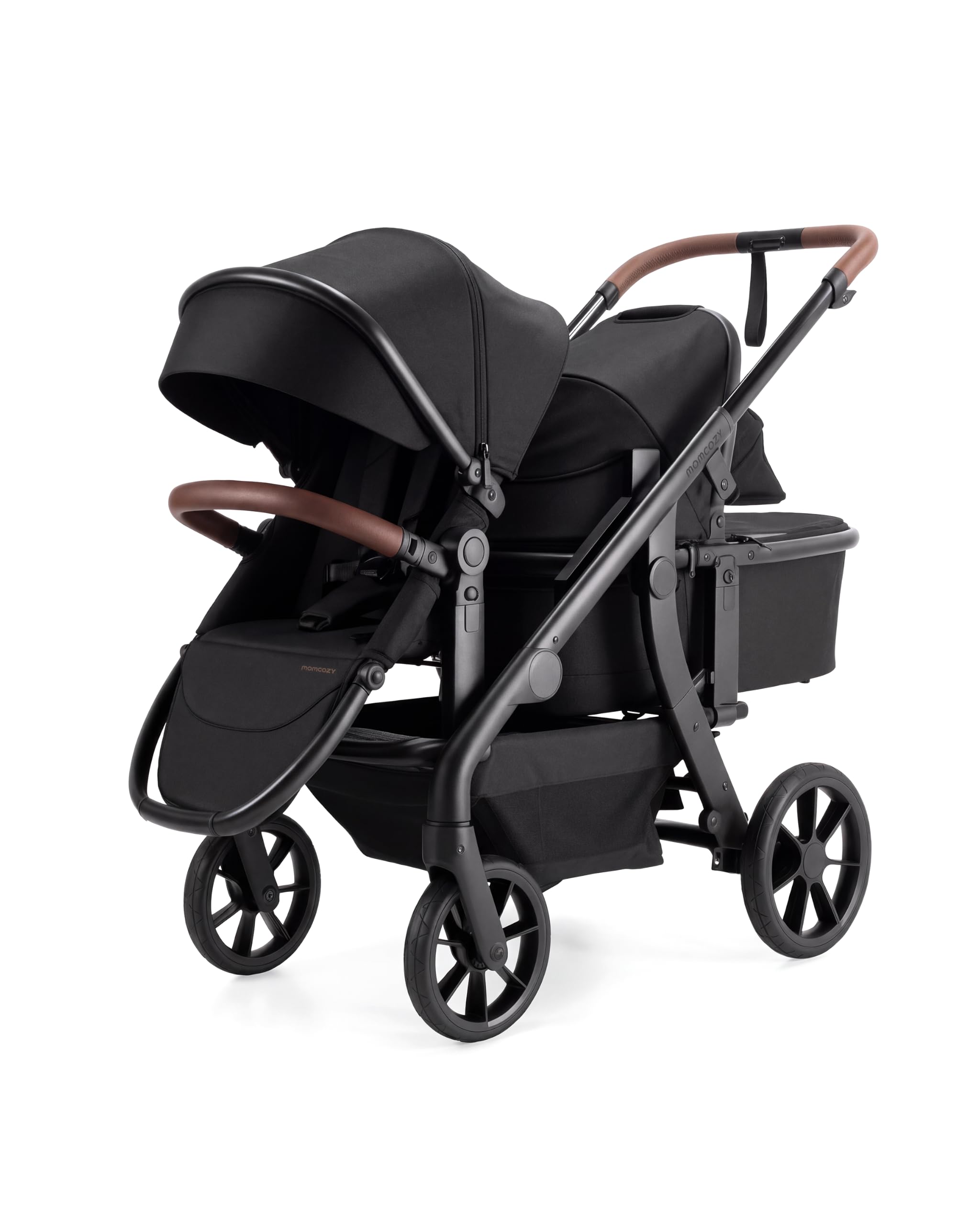
Momcozy ChangeGo
Key Features
- Max weight: 50 lb
- Folded size: 37.4*23.23*18.5 Inches
- Basket capacity: 19.8 lb
- Seating capacity: 2
- Price: Premium
Twenty-three configurations sounds like a marketing number until you see what comes in the box: a carrycot, a toddler seat, a rain cover, and a travel bag on one aluminum frame. That is the real pitch of the ChangeGo. It can be a single stroller for a newborn, a double for a newborn and toddler, or a wagon-shaped hauler as the family changes.
We think it earns its premium if you want one stroller to cover long walks and travel rather than a garage full of frames. The 10-inch front and 12-inch rear wheels and the suspension are the reason it feels more planted over curbs and broken pavement than the lighter tandems here. The carrycot is the part we appreciate most for a newborn: a flat place to lie on longer walks, with a zip-out mesh panel for airflow.
The toddler seat reclines and the canopy extends, so both children can settle. This is a stroller for long walks and travel, not a quick-errand frame; if it lives in the garage and comes out for the day, the size is easier to live with. The travel bag is a thoughtful extra for the times it does go in the car.
Pros
- One frame covers newborn, toddler, and wagon
- Large wheels and suspension for rougher paths
- Carrycot included for lie-flat newborn
- Sturdy build and premium finish
Cons
- Folded package is bulky for small trunks
For families who want one premium stroller to cover a newborn carrycot, a toddler seat, and wagon duty, the ChangeGo is the pick we keep coming back to.
Best for Chicco Car Seats
Chicco Cortina Together
Key Features
- Max weight: 40 lb
- Car seat fit: Chicco KeyFit 30, Chicco KeyFit 35
- Stroller weight: 34 lb
- Seating capacity: 2
- Price: Premium
Two Chicco infant seats click in without an adapter, and that is the reason the Cortina Together exists. For a family already using Chicco seats, it removes a whole category of compatibility homework and makes the stroller a true travel system rather than a frame with an adapter.
Two standard seats with reclining backrests mean a napping baby and an awake toddler do not have to share the same setup. The self-standing fold can be activated with one hand, and the height-adjustable handle helps taller parents. At 23.5 inches wide, it threads through doorways more easily than the jogger here, while still giving each child a proper seat.
We recommend it for Chicco families who want a conventional double rather than a convertible or a wagon. The seats are simple to live with, and the no-adapter fit is the feature you are paying for. The independent canopies are the small luxury on top: one child can nap in shade while the other watches the world.
Pros
- Two Chicco car seats click in without adapters
- Two reclining seats with independent canopies
- Self-standing one-hand fold
- Narrower than the jogger for doorways
Cons
- 34-pound frame is heavy to lift
We put the Cortina Together first for Chicco families: two proper seats and two click-in car seats without adapters, in a narrower package than the jogger.
Best for Jogging and Trails
Baby Trend Expedition Double
Key Features
- Open width: 31.5 inches
- Rear wheel: 16 inches
- Stroller weight: 32.2 lb
- Seating capacity: 2
- Price: Budget
At 31.5 inches wide, the Expedition is a different animal from the 22- to 25-inch tandems here, and that is the whole decision. We recommend it for trails, parks, and school-run sidewalks, not crowded shops. The three-wheel layout and big rear tires are what make it feel at home on grass and gravel.
The 16-inch rear wheels and 12-inch front wheel roll over roots and curb cuts with less drama than the small-wheel tandems. The front wheel locks for straight tracking, and the brake is easy to reach. Storage is genuinely useful too: a large basket and pockets on the back of each seat give you a place for snacks, wipes, and a water bottle.
Both seats fold flat for naps, and the canopy has a peek-a-boo window, so it works for a baby and a toddler on a long walk. The front wheel lock is the detail that makes it feel like a jogger rather than a big stroller. The storage and big wheels are why it earns a place for families who spend weekends outdoors rather than in shops.
Pros
- Big wheels handle grass and gravel
- Useful basket and seat-back pockets
- Easy one-hand push on rough ground
- Both seats fold flat for naps
Cons
- Plastic fittings are the durability weak point
Our pick for grass, gravel, and park paths is the Expedition; its big wheels and smooth push are worth putting up with the extra width.
Best for Budget Hop-On
Baby Trend Sit N’ Stand 2.0
Key Features
- Max weight: 50 lb
- Folded size: 22.63" x 34.00" x 16.00"
- Stroller weight: 29 lb
- Seating capacity: 3
- Price: Budget
The least expensive way here to move two children, the Sit N’ Stand 2.0 does it without pretending the toddler needs a full seat all the time. The rear platform and bench are the whole idea: your older child can hop on at the preschool door and step off when they want to walk, while the baby stays in the front seat or a compatible Baby Trend infant seat.
We like it for errands, school pickup, and short neighborhood trips, especially with a toddler who is in and out constantly. The 22.63-inch width and 13.15 kg frame, or about 29 pounds, are easier to handle than the full doubles, and the fold is compact for a stroller with a platform. The covered parent tray with cup holders is a small thing that makes a difference on a hot walk.
The front seat is the compromise. It suits a smaller toddler better than a tall 4-year-old, and the narrow wheelbase is happiest on pavement; roots and gravel are not its friend. The platform is for a child who can stand and hold on, not a place for a sleeping toddler.
Pros
- Toddler can sit or stand on rear platform
- Light and compact for a double
- Lowest price in this group
- Storage basket and covered parent tray
Cons
- Car-seat fit is limited to Baby Trend seats
We keep the Sit N’ Stand 2.0 for budget-minded families with a toddler who walks half the time and wants a perch for the other half.
Best for Two Full Seats
Baby Joy Double Stroller

Key Features
- Max weight: 33 lb
- Folded size: 22.5 x 12 x 43 inches
- Stroller weight: 31 lb
- Seating capacity: 2
- Price: Budget
Two full seats, two canopies, and a basket on a straightforward tandem frame: the Baby Joy is the plainest stroller here. The 22.5-inch width is the number that matters in shops and doorways; it is one of the easier doubles to thread through a checkout aisle, and the tandem layout keeps the footprint predictable.
The seats recline, the backrests and footrests adjust, and each child gets a canopy. That is the right feature set for a baby and a toddler who still nap on opposite schedules. The basket underneath is useful for a diaper bag and a few groceries, and the five-point harnesses are the same simple type you find across this group.
We recommend it as the value pick for two children who need full seats and a compact footprint. It is the least expensive full double in this group, and the narrow width is what keeps it useful after the novelty of a double wears off. The separate canopies are the detail we appreciate most; they let a napping baby stay shaded while the toddler looks around.
Pros
- Two full reclining seats with separate canopies
- Narrow 22.5-inch tandem footprint
- Lowest-priced full double here
- Adjustable backrests, footrests, and handle
Cons
- 33-pound per-seat limit
The Baby Joy is the value pick we point to when you need two full reclining seats and a narrow footprint, not a travel-system conversion.
How We Tested 12 Strollers Over Eight Months
We built the shortlist from spec sheets first, filtering by folded dimensions, weight, seat weight limits, and whether the seat could go from a full newborn recline to an upright toddler position. Then we read owner reviews looking for the complaints that repeat across brands, things like wheels that shimmy after a few months, fabric that pills at the harness slots, and storage baskets too shallow to hold a diaper bag. Anything we couldn’t picture lifting into a trunk with one hand, or that topped a price we’d struggle to justify, got cut. That left 12 strollers, each of which went home with a tester for eight months.
Each stroller did the same rounds: the daycare drop-off, the grocery run, the doctor’s office waiting room, and a daily walk over sidewalk cracks and up curbs. We timed every fold with a stopwatch, once with two hands and once while holding a toddler on a hip, then loaded each one into the trunk of a sedan to see how much cargo space was left. We pushed them one-handed through store aisles with a bag of groceries in the basket to judge handling under real weight, and we buckled a wiggling, protesting child into every harness at least a dozen times. Handlebar height, recline angle, and footrest position got adjusted mid-walk to see how easily each changed with a kid already seated.
Because eight months is long enough for gear to show its age, we finished by checking wheels for flat spots, seams at the fold hinge, and how much the frame flexed when lifted by the bumper bar. Fabric went through the wash whenever a snack cup spilled. When we compared what still felt solid against what each stroller cost, the pattern was clear: the ones that held their shape were rarely the cheapest, but they also weren’t always the priciest.
How to Choose a Stroller for a Baby and Toddler
Start with how you will actually use the stroller, then choose the seating layout and car-seat fit around that.
Choose the seating layout around your toddler
A full second seat is the right answer when both children still nap or need to stay contained on longer outings. A bench or standing platform is better for a toddler who wants to hop on and off at school pickup and walk the rest of the way, but it is not a substitute for a seat on a long day. Side-by-side joggers buy room and stability with width; tandems buy a narrower path through shops. We would rather match the layout to your daily routine than to the number of seats on the box.
Check the car-seat fit before the stroller color
Car-seat compatibility is brand-specific, not universal. Graco strollers here take Graco infant seats, Chicco takes Chicco, and the Baby Trend Sit N’ Stand takes its own EZ-Lift and Secure-Lift seats. If you already own an infant seat, look for that exact model on the compatibility list before you fall for a frame. None of our picks include a car seat, so budget for one separately unless the listing says otherwise.
Measure the folded package and the open width
A stroller can be narrow when open and still long when folded. The Graco’s slim fold is easy to stand against a wall; the Expedition’s 31.5-inch frame is an outdoor tool, not a boutique-aisle stroller. A typical interior door is around 30 to 32 inches wide, so a 31.5-inch jogger is at the edge. Check the folded size against your trunk and the open width against the narrowest doorway or checkout aisle you use.
Plan for the lift, the fold, and the storage
For a stroller that lives in the car, weight and fold effort matter more than a cavernous basket. For one that lives by the front door, storage and push matter more. The doubles here run from about 29 to 34 pounds, which is a two-hand lift for most of us; the carrycot convertible is the one that asks for the most garage space. Decide which trade-off you will meet every day, not which one looks best in the showroom.
Frequently Asked Questions
How long can a toddler use a double stroller?
Until they reach the per-seat weight limit or no longer fit comfortably, not until they outgrow the total capacity. In this group the per-seat limits run from 33 to 50 pounds. Check the limit for the seat your toddler will actually use, and leave room for a coat, snacks, and a diaper bag.
Can I take a double stroller on an airplane?
Ask your airline before the trip, because stroller rules depend on the carrier and aircraft. Most families gate-check a folded stroller; a compact fold helps, but none of these is guaranteed a cabin spot. Remove loose cups and bags, and label the frame before you hand it over.
How do I clean a double stroller?
Start with the manual, because fabric rules differ: Chicco lists machine wash cold for its fabric, while the Baby Trend models are spot or wipe clean. Vacuum crumbs from the fold and harness buckles, and wipe the frame with a damp cloth. Avoid soaking the frame or forcing grit through the folding joints.
Final Verdict
For most families, the Graco Ready2Grow 2.0 is the stroller we recommend first. It takes a newborn in a Graco car seat and a toddler in the second seat, then adds a bench and platform as the older child wants more independence.
The Momcozy ChangeGo is the upgrade for a lie-flat carrycot and a more planted push on long walks. If your toddler mostly walks and you want the least expensive way to keep a perch available, the Baby Trend Sit N’ Stand 2.0 is the practical alternative.
