This post contains affiliate links. We may earn a small commission when you buy through our links — at no extra cost to you.
A stroller built for running is a joy on an open trail and a nuisance in the back of a hatchback — that’s the bargain at the heart of this category. The good ones buy back your morning miles without giving up the reclined seat your kid actually naps in; the bad ones rattle your wrists numb by mile two and take two hands and a hip check to fold. What separates them has almost nothing to do with the feature list on the box and everything to do with frame stiffness, wheel alignment, and where the brake sits under your foot while you’re moving.
I logged most of my own miles behind a hand-me-down jogger with a front wheel that pulled left, so I’m fussy about tracking. Over the past ten months, my team and I have assembled, folded, run behind, and car-stuffed eight running strollers, and the differences surfaced fast — in the first ten minutes of assembly, in the fold, in how much a model drifts on a crowned road. The ones worth your trunk space are below.



Best for Running on Hills
BOB Gear Wayfinder
Key Features
- Tires: Air-filled, 16-inch rear and 12-inch front
- Brakes: Hand brake and wrist strap
- Stroller weight: 31.1 lb
- Child weight limit: 65 lb
- Price: Premium
A hand brake and a wrist strap are the two things we check first in a running stroller, and no other pick here pairs them. On a descent with a toddler aboard, that combination changes the job from hanging on to actually steering.
It is how the package holds together that made this our top pick. Independent dual suspension and air-filled tires, 16 inches at the rear and 12 at the front, smoothed out cracked sidewalk and packed gravel, and the front wheel locks straight for a run and swivels for the walk home. The handlebar adjusts through a wide range so two parents of different heights can share it, the one-hand recline let us lay the seat back for a nap without breaking stride, and it is travel-system ready if you add an infant seat.
The compromises are about carrying it rather than pushing it. At 31.1 pounds it is one of the heavier strollers in this group, and the difference shows up at the trunk instead of on the pavement, so lift one before you commit if it is going into a hatchback twice a day. If your routes have hills on them, that effort buys you something real.
Pros
- Hand brake and wrist strap for hills
- Independent dual suspension and air-filled tires
- Front wheel locks to run, swivels to walk
- One-hand recline and adjustable handlebar
Cons
- Doesn’t fold flat, so it slides in the trunk
- Cargo basket rated for only 10 pounds
For anyone who runs rather than walks, this is the one: a hand brake on descents, a wrist strap on your wrist, and a front wheel that locks solid before you pick up speed.
Best for Serious Daily Runners
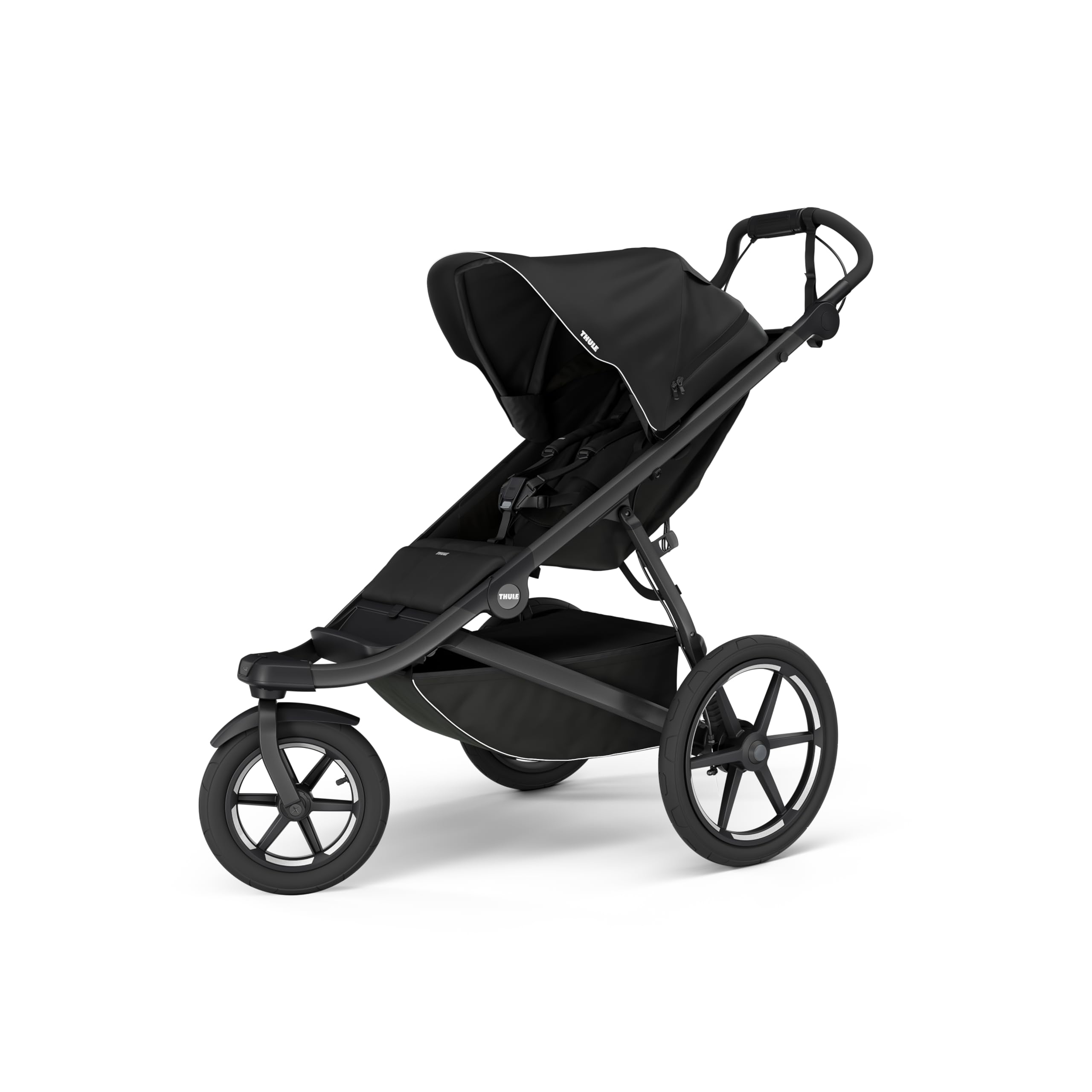
Thule Urban Glide 3
Key Features
- Brakes: Integrated twist hand brake
- Folded size: 13 x 22 x 37 inches
- Front wheel: 13.5 inches
- Stroller weight: 32.5 lb
- Price: Premium
The seatback runs short, and a tall 2-year-old is already close to the top of it. Even so, this is the most refined stroller we pushed in this group. With a smaller toddler aboard that is a trade worth making; with a tall one, try before you buy.
What the money buys is the push. The front wheel is 13.5 inches, the largest here, and with air-filled tires and suspension it rolled over gravel and tree roots without the jolt reaching the handlebar. The integrated twist hand brake is easier to modulate on a slope than a lever, the magnetic buckle clicks shut one-handed, and the seat and canopy fabric lift off for washing. It arrives assembled, and the one-hand fold is the tidiest in this group, easy enough to collapse while holding a wriggling toddler in the other arm.
Two small things: there is no cup holder in the box, and the car-seat adapter is a separate purchase, so a family that needs a travel system from day one is better served by a stroller that includes one. At 32.5 pounds it is also a two-hands-into-the-trunk stroller, and it is the priciest of the picks here.
Pros
- Smoothest push in this set
- Twist hand brake and magnetic buckle
- One-hand fold, arrives assembled
Cons
- Seatback is short for taller toddlers
- No cup holder included
We point runners with a smaller toddler and room in the budget here: the smoothest push in this set, a twist hand brake, and a magnetic buckle that is easy in a hurry.
Best for Value All-Rounder
Delta Children Apollo
Key Features
- Tires: Puncture-proof, 16-inch rear and 12-inch front
- Folded size: 18.5 x 15.5 x 31.5 inches
- Stroller weight: 33 lb
- Child weight limit: 50 lb
- Price: Midrange
The Apollo arrived with a safety tether, a parent organizer with two cup holders, a swing-out child tray, and a car-seat adapter for Graco SnugRide Click Connect and Evenflo seats, which is the kind of list you often pay extra for.
On the move it is a proper jogger rather than a pram with big wheels: a shock-absorbing frame, puncture-proof tires at 12 inches front and 16 rear, reflective piping on the harness, and JPMA certification. The canopy extends with UPF 50+ and a peek-a-boo window, and the flat fold with quick-release rear wheels got it into a trunk without a wrestling match.
For a midrange price this is the most complete package in the group, and it is the pick we hand to families who want one stroller for the supermarket run and the Saturday jog. What sells it is the combination: nothing else here puts a tether, suspension, and a car-seat adapter in the same box.
Pros
- Safety tether and JPMA certification
- Shock-absorbing frame with puncture-proof tires
- Car-seat adapter included for Graco and Evenflo
Cons
- Heavy at 33 pounds to lift
- Adapter fits only the listed Graco and Evenflo seats
Our value pick: a tether, a shock-absorbing frame, and a car-seat adapter in the box make this the most complete midrange jogger here.
Best for First-Time Runners
Baby Trend Expedition
Key Features
- Cup holders: 4
- Front wheel: 16-inch lockable swivel
- Stroller weight: 23.6 lb
- Child weight limit: 50 lb
- Price: Budget
Weight is where the Expedition wins. At 23.6 pounds it is the lightest stroller in this group, and the difference is obvious every time you lift it one-handed into a hatchback.
There is a real jogger underneath the low price. The front wheel swivels for steering and locks straight for a run, the tires are all-terrain bicycle rubber with a 16-inch front wheel, and the steel frame is rated to 50 pounds. Four cup holders spread across the parent and child trays, a covered compartment on the parent tray for keys and a phone, and a padded five-point harness that adjusts without a fight. Assembly took us minutes rather than an evening.
If your running is on flat paths rather than long descents, you will not miss what the premium strollers add, and the lockable front wheel means it tracks straight when you do pick up the pace. It is the stroller we reach for when it is going in and out of the car several times a day.
Pros
- Lightest stroller here at 23.6 pounds
- Lockable front swivel wheel
- Four cup holders and a covered parent compartment
Cons
- Front end feels jerky as pace picks up
- Takes up space in a full trunk
Buy this one if the lift into the trunk is what stops you using a jogger: 23.6 pounds, a lockable front wheel, and a price that leaves room in the budget.
Best for Travel System Use
Jeep Classic Jogger

Key Features
- Wheels: 12-inch front and rear
- Folded size: 32 x 18 x 14 inches
- Stroller weight: 29 lb
- Child weight limit: 50 lb
- Price: Midrange
The Classic does two jobs: a jogger with a safety tether and reflective piping, and a travel system that takes a Graco SnugRide Click Connect or an Evenflo Nurture or Embrace seat.
It is the second look we suggest when the Delta Apollo feels like too much stroller. The Classic is four pounds lighter and folds into a tidier 32 by 18 by 14 inches, and the swing-away child tray and JPMA certification cover the same ground a different way. Its wheels are 12 inches front and rear, which makes it nimbler in a shop aisle and busier over rough ground than the bigger rear wheels on the Apollo.
For a family whose car seat is a Graco or an Evenflo and whose running is mostly neighborhood pavement, this is a complete infant-to-toddler setup, and the canopy with UPF 50+ handles a summer morning without a separate shade.
Pros
- Works as a jogger and a travel system
- Compact 32 x 18 x 14-inch fold
- Safety tether and reflective piping
Cons
- A wheel can lock up mid-push
- Fold needs two hands
A compact-folding jogger that doubles as a travel system for Graco and Evenflo seats, and the one we suggest when the Apollo feels like too much stroller.
Best for Graco Seat Owners
Graco FastAction LX

Key Features
- Fold: One-hand, one-second
- Folded size: 23.5 x 35.5 x 17.5 inches
- Stroller weight: 28.2 lb
- Child weight limit: 50 lb
- Price: Midrange
Graco’s one-second, one-hand fold is the neatest piece of engineering in this group, and it is why the FastAction LX earns a place: pull the strap set into the seat and the stroller collapses with one hand while you hold a toddler with the other.
The rest is sensible rather than special. A 12-inch front wheel, a three-position handle, a multi-position recline, a child tray with a cup holder, a large basket, and Click Connect compatibility with Graco infant seats. The seat pad lifts out for washing, and the 50-pound limit covers several years of growing.
Where it gives ground is bulk and ride. It is 28.2 pounds and feels bigger than that in a shop aisle, and over gravel it is firmer than the air-tired picks. For a Graco household doing a mile at a time on pavement, neither matters much.
Pros
- One-hand, one-second fold
- Takes Graco Click Connect infant seats
- Large basket, child tray, washable seat pad
Cons
- Feels heavy and bulky for its size
We rate it for Graco households who mostly walk: the best fold here, Click Connect compatibility, and a fair ride on pavement, as long as you don’t mind the bulk.
How We Tested: Miles, Folds, and Trunk Space
We built a shortlist of 34 running strollers from manufacturer specs, conversations with running-store staff, and the models that kept surfacing in parent forums, then cut it down on three practical questions: does the front wheel lock, is the brake a hand lever or a foot bar, and what’s the folded footprint. Eight made the final cut, and we bought each one at retail like any other customer, so nothing arrived pre-tuned or pre-assembled.
Assembly came first. I timed each stroller from box-open to first roll and noted whether the instructions quietly assumed a second adult. Every model was then weighed on a bathroom scale, folded one-handed while I held a coffee in the other, and lifted into both a hatchback and a sedan trunk. Ride quality got the most miles — pavement, crushed gravel, and a deliberately canted sidewalk — where I watched for front-wheel drift, wrist strain through the handlebar, and whether the brake was reachable mid-stride without breaking form.
Stability and durability ran across the full ten months, roughly 200 logged miles plus daily walks and errands. I loaded each under-seat basket to its stated limit and leaned on the handlebar to see what tipped, then checked tire tread, fabric seams, and brake cables at the three- and nine-month marks. Versatility was judged at the grocery store and the mall as much as on the trail, because a stroller that only runs is a stroller you eventually stop using.
How to Choose a Running Stroller
The front wheel, the brake setup, and the weight you lift separate a stroller you will run with from one that stays in the garage.
Start with the front wheel
A stroller built for running needs a front wheel that locks dead straight, because a swivel that wanders will shimmy the moment you pick up speed, and that shimmy is usually the lock not being fully seated rather than a fault in the stroller. Before you run, lock the wheel and push hard on the handlebar to feel for play. A three-wheeler with no lock at all is a walking stroller with big tires. If you plan to run more than you walk, make this the first thing you check.
Brakes and wrist straps are not optional
Keep the wrist strap on whenever the stroller is moving; it is the only thing that keeps the stroller with you if you trip. A hand brake is the other half of control: on a descent it lets you hold speed without dragging back on the handlebar, and it is the feature we rank first when there are hills on the route. If your running is flat and paved, a strap and a rear brake are enough.
Air-filled tires or puncture-proof ones
Air-filled tires ride better over roots, gravel, and broken pavement. Puncture-proof and foam tires never leave you stranded but pass more chatter up to the handlebar. The trade is upkeep: air tires want a pump in the basket and a pressure check before a run, and they can flat. On pavement and packed path either type works, so choose on convenience. On rocky or rooty ground, the air-filled ride is worth the maintenance.
Weight and folded size decide whether you take it
Every jogger here pushes easily once it is rolling; the difference is the lift. Our picks run from 23.6 to 33 pounds, with folded lengths from 13 to 37 inches. Measure your trunk with the parcel shelf in place, then picture the worst day: a sleeping baby, a full load, rain. If the stroller goes into a car daily, make weight your first comparison. If it lives in a garage and you run from the door, buy the ride instead.
Seat fit for a growing toddler
Seatback height is the number few listings give and every parent of a tall toddler notices. Check the child weight limit, which runs from 50 to 65 pounds across these picks, and whether the seatback reaches the back of your child’s head. A deep recline buys you nap-time on a long walk, and a canopy with ventilation matters more than a cup holder in July. If your toddler is already near the top of a seat, size up before you buy.
Frequently Asked Questions
What age can a baby ride in a running stroller?
Plan on around six months, once your baby has head and neck control, before using the stroller seat for anything faster than a walk. Before that you need a bassinet or a car-seat adapter, and both are for walking and errands.
Check the stated minimum age and weight for the specific stroller, and start with short, smooth, flat routes before you build up to real runs.
Can I run with the infant car seat clicked in?
No. Adapters and travel-system brackets are made for walking. An infant seat sits higher and further forward than the stroller seat does, and that is not a setup to run behind.
Use the stroller seat with the harness once your child is old enough, or a bassinet for walks, and keep the car seat for the car and the supermarket.
How do I stop a running stroller rolling away?
Set the rear brake every time you stop, even for a second, and keep the wrist strap on until you have. A three-wheeler on a camber will roll on its own if you rely on friction.
If yours creeps with the brake set, check that the brake is engaging both rear wheels and that the tires are properly inflated.
Final Verdict
Pick the BOB Gear Wayfinder if you want one stroller that handles a hill as well as a sidewalk. The hand brake and wrist strap are the difference between controlling a descent and simply surviving it, and the dual suspension earns its keep on gravel.
On flat, paved routes the Delta Children Apollo gives you a tether, a shock-absorbing frame, and a car-seat adapter for a midrange price. And if the lift into the trunk is what stops you using a jogger at all, the Baby Trend Expedition is the one to carry.
