This post contains affiliate links. We may earn a small commission when you buy through our links — at no extra cost to you.
Most hiking strollers promise all-terrain capability, but the reality is a trade-off between cushioned air tires that can go flat and foam-filled options that sacrifice trail comfort. Weight and folded size also vary widely, turning everyday lifts and trunk space into daily frustrations. This guide focuses on the two factors that actually determine trail performance — suspension quality and tire type — while being honest about the portability compromises each choice brings. Whether you prioritize bump absorption on rocky paths or the convenience of never pumping a tire, the right option depends on how often and how far you stray from pavement. Understanding that trade-off is the first step to a stroller that matches your actual hiking routine, not just the marketing photos.


Best for Trail Runners
BOB Revolution 3.0 Single
The suspension system uses adjustable shocks that let you tune the damping for your running weight and terrain. On gravel paths, packed dirt, and even uneven grass, the stroller tracks straight and the wheels absorb bumps before they reach the child. That means you can maintain pace without worrying about jostling your passenger – a difference you feel immediately compared to foam-tire joggers that transmit every root and rock.
The 9-position adjustable handlebar and tank-like frame make daily use straightforward for households with multiple caregivers of different heights. Tall parents (6’2" and over) report no hunching, and the pneumatic tires hold air well with occasional top-offs. Real-world complaints center on weight: at 28.5 lbs, lifting the stroller into a sedan trunk is a two-hand, awkward move. Owners who leave it assembled in the garage or have an SUV find this a non-issue.
This stroller is built for the parent who logs miles on trails, runs curbside, or pushes through park grass weekly. The premium price and heavy frame are acceptable trade-offs for that use. Skip it if you need a lightweight stroller for frequent car loading, or if your budget doesn’t stretch past entry-level models – the ride quality and adjustability aren’t worth the cost if you only jog on smooth pavement occasionally.
Pros
- Suspension absorbs impacts on roots, gravel, and pavement – ride is smooth across varied terrain.
- Build quality uses dense materials and tight assembly – no wobble or creaks after months of use.
- 9-position handlebar fits parents from 5’2" to 6’4" comfortably – easy switch between caregivers.
Cons
- Heavy at 28.5 lbs – lifting into a car trunk requires effort and can be awkward.
- Occasional fabric tearing and wheel bearing noise reported after several months of heavy use.
Buy this if you run daily on mixed terrain and want a stroller that handles like a mountain bike. Skip it if you need a lightweight stroller for frequent car loading or are on a tight budget.
Best for Chicco System
Chicco Activ3 Jogger
Key Features
- Tire & Wheel Size: Foam-filled
- Weight: 27.5 lbs
- Price: Mid-Range
The Activ3’s foam tires eliminate flat repair and air-pressure checks entirely, while the clip-in car seat adapter (no extra parts needed) turns it into a travel system in seconds. Compared to the top pick’s air-filled tires and adjustable suspension, the ride here is firmer on rocky paths—you trade some shock absorption for maintenance-free convenience.
Best for parents who own a Chicco infant seat and want one stroller that handles paved paths, packed gravel, and the occasional grass strip without worrying about tire pressure. The trade-off is clear: if your routine includes rough, root-filled trails, the smoother air-tire models with suspension will feel more comfortable—and the Activ3’s folded size (27.5 lbs, bulky shape) demands a roomy trunk.
Pros
- Never-flat foam tires – no maintenance, always ready to roll.
- Solid construction and easy setup out of the box.
- Hand-operated brake and wheel lock suit jogging needs.
Cons
- Bulky folded shape requires ample trunk space and a strong lift.
- Foam tires transmit more vibration on rugged trails than air-filled alternatives.
Buy this if you want foam tires that never go flat and a seamless Chicco car seat link. Skip it if you prioritize maximum trail comfort or have limited trunk space.
Best for Budget All-Terrain
Delta Apollo Jogger
Key Features
- Tire & Wheel Size: Rubber, 16/12
- Weight: 30.6 lbs
- Price: Budget
The Delta Apollo Jogger undercuts most competitors by several hundred dollars while still offering a padded, shock-absorbing frame and smooth rolling on gravel, grass, and pavement. Its puncture-proof rubber tires eliminate flat-tire hassles, and the included adapters snap in Graco and Evenflo car seats. The ride is noticeably firmer than premium air-tire models like the BOB, but the trade-off is entirely reasonable for parents who stick to neighborhood walks, park paths, or light hiking trails.
This stroller is built for budget-conscious families who want a capable all-terrain option without spending premium money. It handles daily walks and casual off-road outings well, and the easy fold and quick assembly save time. However, durability is not on par with the top pick: a minority of units have reported front wheel defects (bent or broken within the first week). If you need a stroller that can withstand hundreds of miles of rigorous running, the Apollo’s wheel reliability is a gamble you may not want to take. For everyone else, it delivers remarkable value.
Pros
- Smooth ride on varied terrain – gravel, grass, and pavement
- Easy assembly and one-handed fold
- Car seat adapters included for Graco and Evenflo
- Puncture-proof rubber tires – no flats
Cons
- Occasional front wheel defects reported within the first week
- Heavy at 30.6 lbs; lifting into a car requires effort
Buy this if you want a capable all-terrain jogger with car seat compatibility at a budget price. Skip it if you need guaranteed durability for frequent rugged trail use or can’t accept any risk of wheel defects.
Best for Twin Off-Road
BOB Revolution Duallie 3.0
The Duallie borrows the same adjustable shock suspension found on the single-seat BOB Revolution, giving two kids the same smooth, controlled ride over rocks and roots. What you gain is the ability to jog or hike with both children at once without downgrading trail performance. What you trade is the significantly lighter weight and smaller footprint of the single — the Duallie weighs 33.1 lbs and is notably bulkier, making it harder to lift into a car or navigate tight doorways.
This stroller is best for active parents of twins or two close-age children who run regularly on unpaved paths or hike on technical terrain. The air-filled pneumatic tires and independent suspension absorb chatter that would rattle lesser double strollers. The trade-off: the heavy frame and large dimensions limit portability, and a minority of owners report canopy seams splitting or wheel bearing wear after a year of heavy use. If your daily routine involves paved sidewalks and occasional grass, the added weight and expense won’t make sense.
Pros
- Absorbs bumps and rough trails as smoothly as the single version.
- Solid frame with precise steering for jogging and tight turns.
- Handles off-road hiking and jogging with two kids comfortably.
Cons
- Heavy and bulky – tough to lift into a car or store in small trunks.
- Some canopy fabric and wheel bearing issues reported after a year.
Buy this if you’re an active parent of two who needs a stroller that can handle trails and jogging without compromise. Skip it if you have limited storage or rarely go off-road.
Best for Twin Budget
Baby Trend Double Jogger
Its foam tires eliminate flat repairs and the price undercuts most premium doubles, but the ride quality trades off – on rough trails the suspension feels stiff compared to air-filled models. The fold is simple and the stroller pushes well on flat pavement with one hand, but the width is a dealbreaker for standard doorways (you’ll need to measure before buying).
Best for parents of twins on a tight budget who walk mostly on smooth sidewalks, wide park paths, or paved trails. Avoid if you frequently pass through narrow home or store doors – it won’t fit. Durability is a gamble: some owners report wheel wobble or brake issues after months of use, so this is best for occasional, not daily, duty on forgiving surfaces.
Pros
- Unbeatable value for a side-by-side double jogger
- One-hand push on flat terrain with good maneuverability
- Easy fold and quick-release wheels simplify storage
Cons
- Too wide for most standard home and store doorways
- Occasional quality issues: wheel wobble, brake unreliability, and frame breaks after a year
Buy this if you need an affordable double jogger for paved paths and occasional park use. Skip it if you have narrow doorways or need a stroller for daily rough terrain.
Best for Adjustable Handle
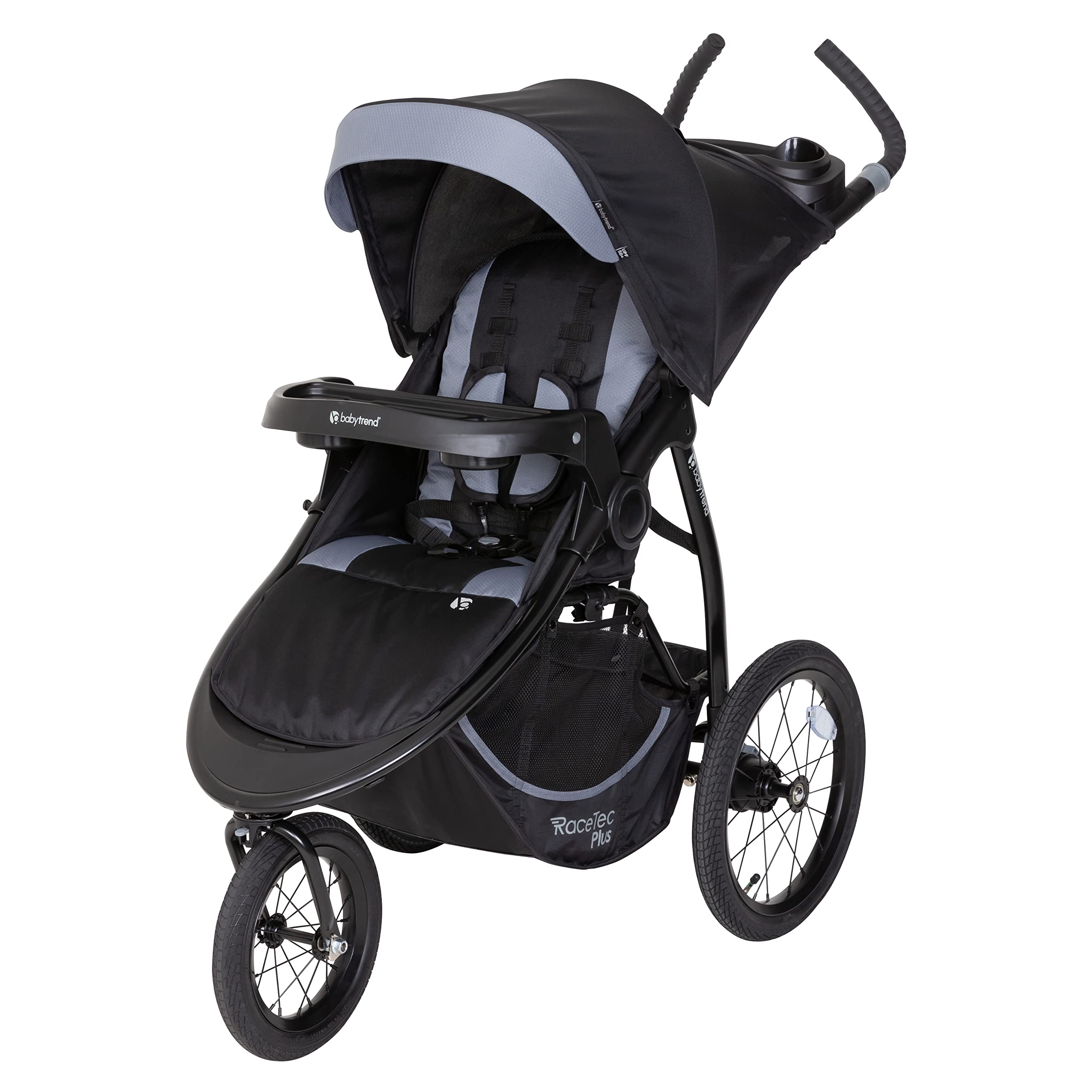
Baby Trend Race Tec Plus
Key Features
- Tire & Wheel Size: Air all-terrain
- Weight: 25.1 lbs
- Price: Budget
The Baby Trend Race Tec Plus features a 4-position rotational handlebar that rotates to fit different pushing heights and styles – a feature usually reserved for premium joggers like the BOB Revolution. While the BOB offers superior suspension and tire durability, this model trades some rough-terrain refinement for handle adjustability at less than half the price.
Best suited for families with multiple caregivers of varying heights who want a budget-friendly jogger with an adjustable handle. However, the air tires are prone to flats – owners report inner tube failures – and the handle mechanism can feel stiff on some units. If flat-free convenience matters more, foam-tire alternatives may be a better fit.
Pros
- Rotational handle adjusts to multiple heights and pushing styles for families with different caregivers.
- Smooth ride over varied terrain at a budget-friendly price point.
- Lightest frame in its class at 25.1 lbs, easier to lift and maneuver.
Cons
- Air tires commonly develop flats and inner tube failures during regular use.
- Handle adjustability can be stiff or too short for some taller caregivers.
Buy this if you have multiple caregivers of different heights and want an affordable jogger with an adjustable handle, and you’re comfortable with occasional tire maintenance.
Best for Budget Casual
Baby Trend Expedition Jogger

The Baby Trend Expedition Jogger offers a smooth ride on varied terrain, simple assembly, and a trigger fold that compacts easily – all at a price that undercuts most competitors. Its air tires and 16-inch rear wheels handle pavement, gravel, and grass well, making it a capable choice for casual walks and light jogs. However, the fixed handle won’t fit taller parents comfortably, and durability is uneven: some units develop tire pops or wheel wobble after moderate use. For a small step up in cost, the Delta Apollo provides more consistent build quality and an adjustable handle, but if budget is tight and use is occasional, this stroller still delivers the basics without major compromises.
Pros
- Strong price-to-performance ratio for budget buyers
- Smooth ride on pavement, gravel, and grass
- Easy assembly and compact trigger fold
Cons
- Tire and wheel durability issues reported after moderate use
- At 23.6 lbs, the frame feels heavy when lifting into a car
Worth considering if you need the lightest budget jogger for paved paths and occasional park use. Not ideal for daily off-road miles or if you are taller than average.
Best for Jeep Styling
Jeep Classic Jogger

The Jeep Classic Jogger delivers a smooth ride on pavement, grass, and gravel, and the low price with Jeep styling is appealing. However, a notable number of owners report front tire failure within weeks—either flats or structural failure—making it a gamble for daily use unless you budget for immediate tire replacement.
Pros
- Budget-friendly price for a jogger with car seat compatibility and Jeep branding.
- Smooth rolling on pavement, gravel, and grass for neighborhood walks.
- Out-of-box assembly takes minimal time with clear instructions.
Cons
- Front air tires have early failure reports—some users experience flats or damage within weeks.
- Occasional quality control issues like broken clips or stitching in a minority of units.
Worth considering if you want a Jeep-themed stroller for light neighborhood walks and are willing to replace the front tire upfront.
Best for Stylish Mid-Range
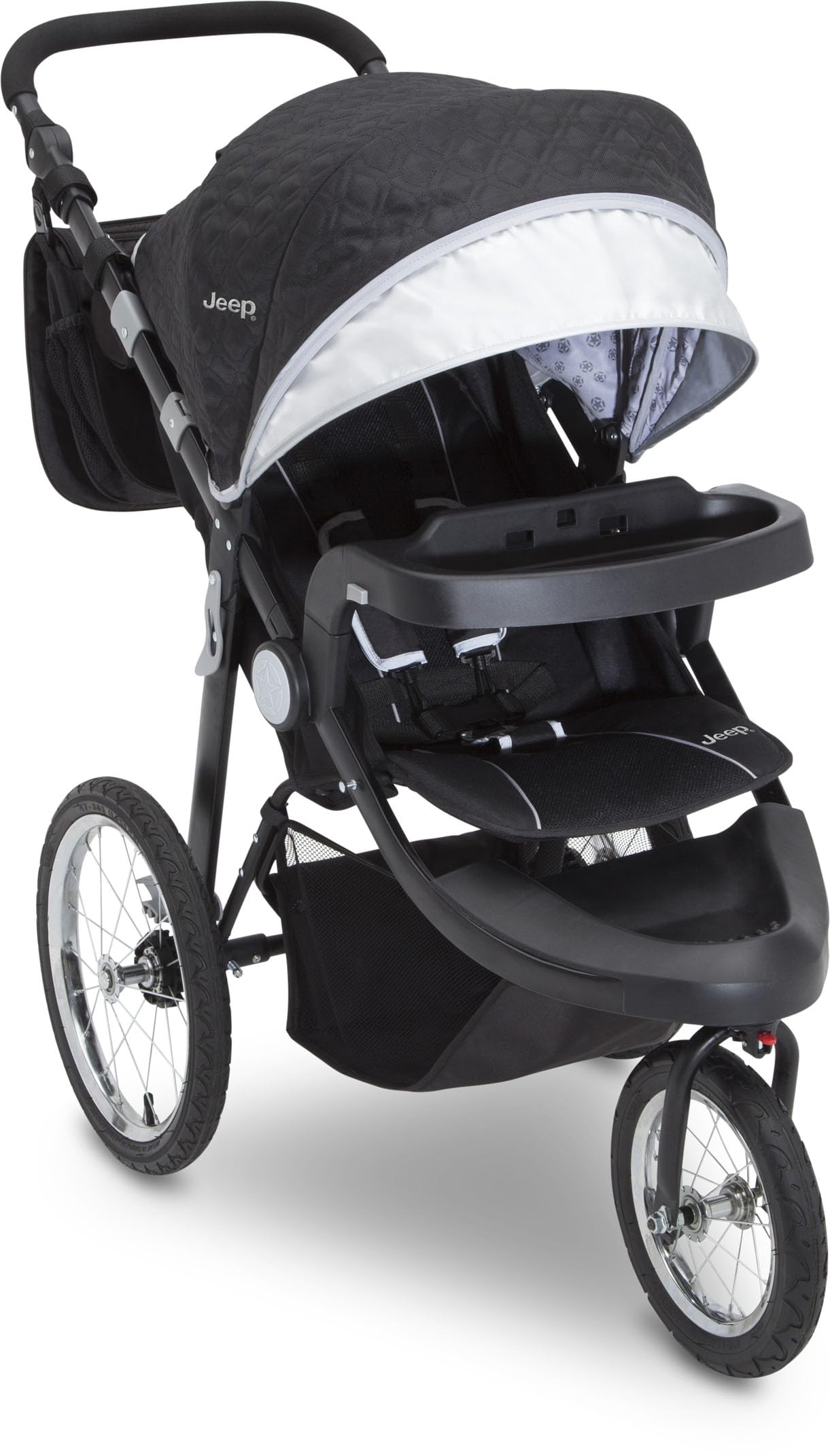
Jeep Cross-Country Sport
Key Features
- Tire & Wheel Size: Air metal spoke
- Weight: 26 lbs
- Price: Mid-Range
The metal spoke wheels and adjustable foam handle create a rugged, Jeep-inspired look that stands out on neighborhood paths. Parents report a smooth ride and convenient parent organizer, making it pleasant for moderate jogs. However, long-term durability is a question mark: some owners experience plastic cup holder breaks and tire wobbles, and the stroller is hefty when folded. Compared to the similarly priced Chicco Activ3, the Jeep sacrifices some peace of mind for style.
Pros
- Smooth, stable ride that handles bumpy surfaces well.
- Parent organizer provides easy access to essentials.
Cons
- Plastic components like cup holders and handle can be delicate under heavy use.
- Large folded size makes storage and trunk fit challenging.
Worth considering if you’re a Jeep fan who values style and a smooth ride for moderate use, and you’re willing to accept occasional durability quirks.
How to Choose
The biggest decision in a hiking stroller is whether you prioritize flat-free convenience or maximum trail cushioning — because no tire type does both well.
Wheel Size & Tire Type
Air tires (pneumatic) provide superior shock absorption on roots and rocks but require occasional inflation and are prone to flats. Foam-filled tires never go flat but transmit more vibration, making the ride harsher on rough terrain. Larger rear wheels (16-inch) roll over obstacles more easily than smaller ones.
Suspension Quality
A stroller’s suspension directly affects how much bump energy reaches your child. Mountain-bike-style shocks with adjustable tension excel on uneven trails, while simpler spring or frame flex systems work fine for packed gravel and grass. Without suspension, even smooth pavement can feel jarring on long walks.
Weight & Folded Size
Every pound matters when lifting a stroller into a trunk or up stairs. Models under 28 lbs are noticeably easier to handle, while heavier options (30+ lbs) become a daily workout. Folded dimensions vary widely; check your car’s trunk opening before buying a wide double or a long single.
Car Seat Compatibility
If you plan to use the stroller from birth, confirm that it accepts your infant car seat without extra adapters. Some brands (like Chicco) click in directly, while others require separate adapters that may not be included. Travel system compatibility saves time but often adds weight.
Handlebar Adjustability
A fixed handlebar forces shorter or taller parents to push from an awkward angle, reducing control on hills. Adjustable handles (rotating or telescoping) let each caregiver find a comfortable push height. This is less critical if only one person will push regularly.
FAQ
How do I prevent my jogging stroller tires from going flat on hikes?
Switch to foam-filled or solid rubber tires that never deflate. Strollers like the Chicco Activ3 use foam-filled tires that eliminate flats entirely, though the ride is slightly firmer on rough trails. If you prefer air tires, carry a small pump and patch kit, and check tire pressure before every hike.
Can I use a jogging stroller for everyday walks?
Yes, but the heavy weight and large folded size can be inconvenient for errands or tight spaces. Jogging strollers are designed for stability at speed, not for compact storage. If you need one stroller for both trails and shopping, consider a model under 28 lbs and test the folded fit in your car.
What is the best way to fit a large jogging stroller in a small car?
Measure your trunk opening height and depth before buying. Many jogging strollers have removable rear wheels that cut the folded length by several inches. Also look for a trigger or compact fold mechanism — the Baby Trend Expedition folds smaller than most in its class.
Are heavy jogging strollers harder to push on trails?
Weight matters more for lifting than pushing. Once moving, a well-suspended heavy stroller can actually roll more smoothly than a lightweight one with poor suspension. The extra mass helps maintain momentum over bumps, but you’ll feel it when stopping or going uphill.