This post contains affiliate links. We may earn a small commission when you buy through our links — at no extra cost to you.
Spilling breast milk is its own genre of heartbreak. Twenty minutes on the pump can end with a torn seam in the freezer or a zip seal that quietly gives up in the bottom of a diaper bag, and there is no getting that ounce back. A good storage bag protects the work: it holds the volume it claims, freezes flat enough to stack, and pours into a bottle one-handed at 2 a.m. without a funnel and a prayer.
I’ve been on both sides of this — the bag that split on the freezer shelf, and the ones I kept buying. Over the past four months, my team and I filled, froze, thawed, and poured our way through 16 different bags, and the differences come down to things you can’t see in a product photo. Thicker isn’t automatically tougher, for one, and the printed ounce lines on some bags are off by half an ounce, which matters when you’re counting feeds. The picks below are the ones that earned their shelf space.




Best for Everyday One-Hand Pouring
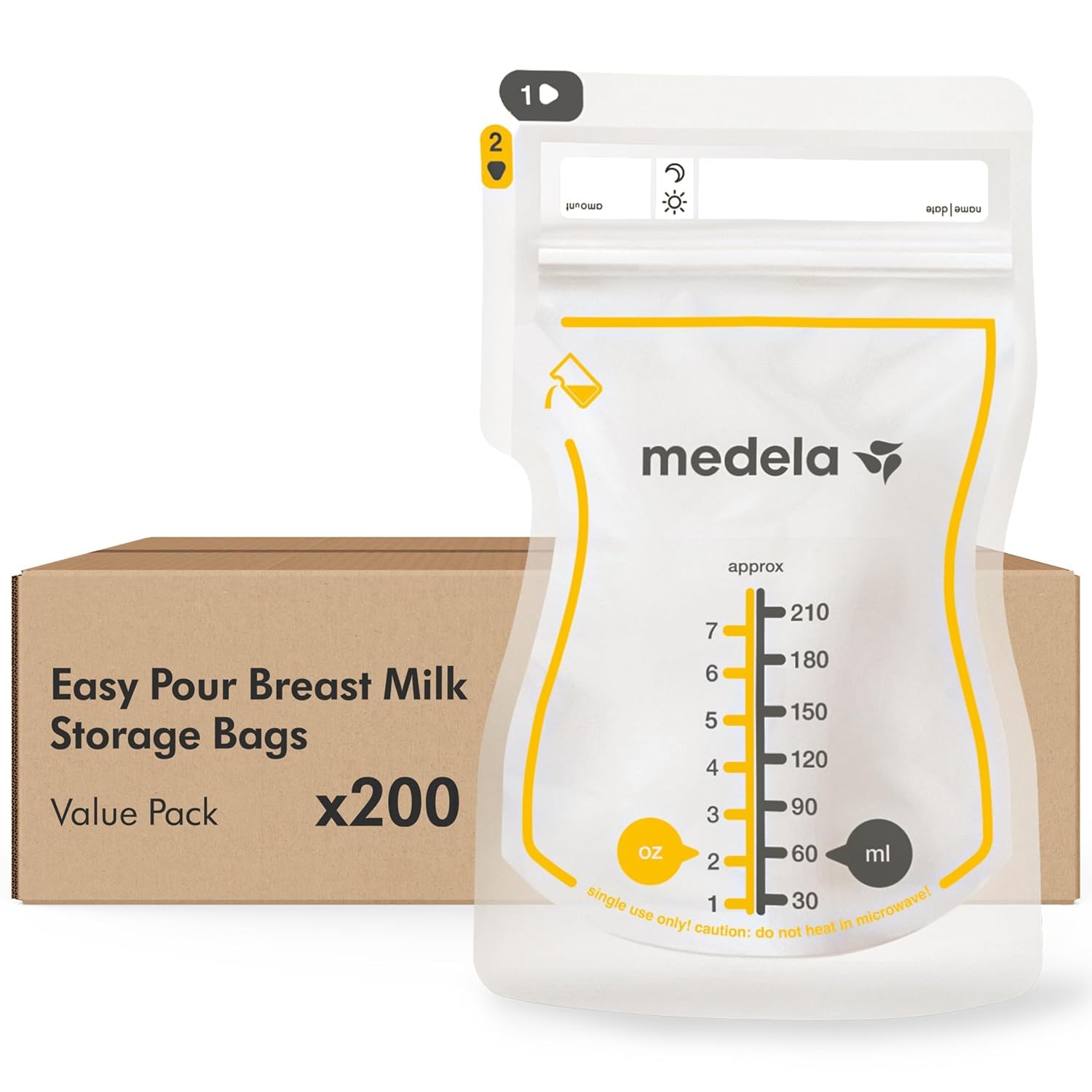
Medela Easy Pour
Key Features
- Capacity: 7 oz / 210 ml
- Pack Count: 200 bags
- Pour Style: Side spout, one-hand
- Freeze Format: Flat or self-standing
- Price: Midrange
The side tab is the whole idea. You tear it back along its perforation and the corner becomes a spout you can aim at a bottle neck, while the wide top takes a pour straight from a pump flange. When one arm is holding a baby and the other is holding milk you cannot replace, that aim matters more than almost anything else printed on the box.
We came away thinking this is the best all-round bag in this group, and it wins on the details that decide whether a stash survives rather than on features. The double-layer film has real body, the bag stands on its own half full, and it freezes into a flat rectangle that stacks. Nothing about the construction made us nervous.
Seven ounces per bag gives a big morning session somewhere to go, and the write-on panel is wide enough for a date, a time and an ounce count in marker that doesn’t smear. The bags also arrive sanitized inside a resealable pouch, so the unused ones stay clean in the cupboard instead of loose in a drawer.
Stacked flat, they peel apart cleanly when you take one off the pile, which is more than we can say for thinner film that welds itself to its neighbor. It’s a small thing until you’ve stood at an open freezer at midnight trying not to crack a bag.
Pros
- Side spout pours one-handed into a bottle
- Thick double-layer film with a firm seal
- Stands upright for filling, freezes flat
- Holds 7 oz, more than most bags here
Cons
- 200-count box is a long commitment
We recommend the Easy Pour to anyone who wants one bag for the whole job — fill, freeze flat, pour one-handed — without paying boutique money for it.
Best for Cheap Flat Freezing
Lansinoh Breastmilk Bags
Key Features
- Closure: Double zipper
- Capacity: 6 fl oz
- Pack Count: 200 bags
- Freeze Format: Freeze flat
- Price: Midrange
A freezer full of milk is really a filing system, and Lansinoh’s bags file best: filled to a sensible level and frozen flat, they turn into rectangles you can stack and flip through instead of a drawer of frozen lumps. That’s why they’re still the bag we suggest first to anyone starting out — the shape does more for your freezer than any claim on the packaging, the cost per bag is among the lowest here, and the tear-away top is tamper-evident, so you can see at a glance that a bag hasn’t been opened.
The film is thinner than the sturdiest bags in this group, and six ounces is the ceiling. Both are fine if you treat the bag like a bag: fill to a finger’s width below the line, freeze it flat on a tray, and press the double zipper from the middle outward with your thumb so both tracks catch. Do that and the seal behaves.
Worth knowing: a pump-into-bag adapter, sold separately, lets you express straight into the bag with a Lansinoh pump or most major brands, which spares you a bottle on the nights you can’t face washing one. It’s the quiet feature of the box — nothing about it changes the bag, but it changes how often you’re at the sink.
Pros
- Freezes into flat, stackable rectangles
- Low cost per bag for a big brand
- Double zipper and reinforced seams
- Pump-into-bag adapter available separately
Cons
- Film feels thinner than the sturdiest bags here
Lansinoh is the bag we tell anyone starting a stash to buy first: cheap, flat-freezing, and reliable once you press both zipper tracks properly.
Best for Pumping at Work
Kiinde Twist Pouches
Key Features
- System: Pump, store and feed
- Closure: Threaded twist cap
- Capacity: 6 oz
- Pack Count: 80 pouches
- Price: Premium
Kiinde’s pouch isn’t really a bag — it’s the middle of a system. A threaded cap replaces the zip, an adapter screws onto your pump flange, and the same pouch clicks into a nipple ring so the baby feeds straight from it. The stretch we spent using one, the sink stayed empty: no bottles to wash, no milk to decant and lose.
Pumping straight into the pouch is the part that changes a working day. The pouches stand up on a stiff base, so you can set one down mid-session without it flopping, and the markings run up the side so you can see how much you’ve expressed without transferring anything into another vessel and back.
For anyone pumping away from home — daycare drop-off, an office, a car — this is the system that collapses three steps into one, and we think it earns its premium there. It is a commitment rather than a bag you try: the pouches only make sense with the caps, adapters and nipples that go with them.
Freezer space is the other trade-off. The pouches hold their shape instead of collapsing flat, so a dozen take up noticeably more room than a dozen flat bags. If your freezer is a drawer rather than a chest, that difference shows up by the end of the first month.
Pros
- Pump, store and feed from one pouch
- Threaded cap seals without a zipper
- Stands up on its stiff base for filling
- Removes bottles from the wash cycle
Cons
- Highest cost per feed here
For pumping away from home and skipping bottle washing, Kiinde’s system is worth the higher cost per feed; for pure freezer storage, a flat bag does it cheaper.
Best for Trying Thick Bags
Dr. Brown’s Storage Bags
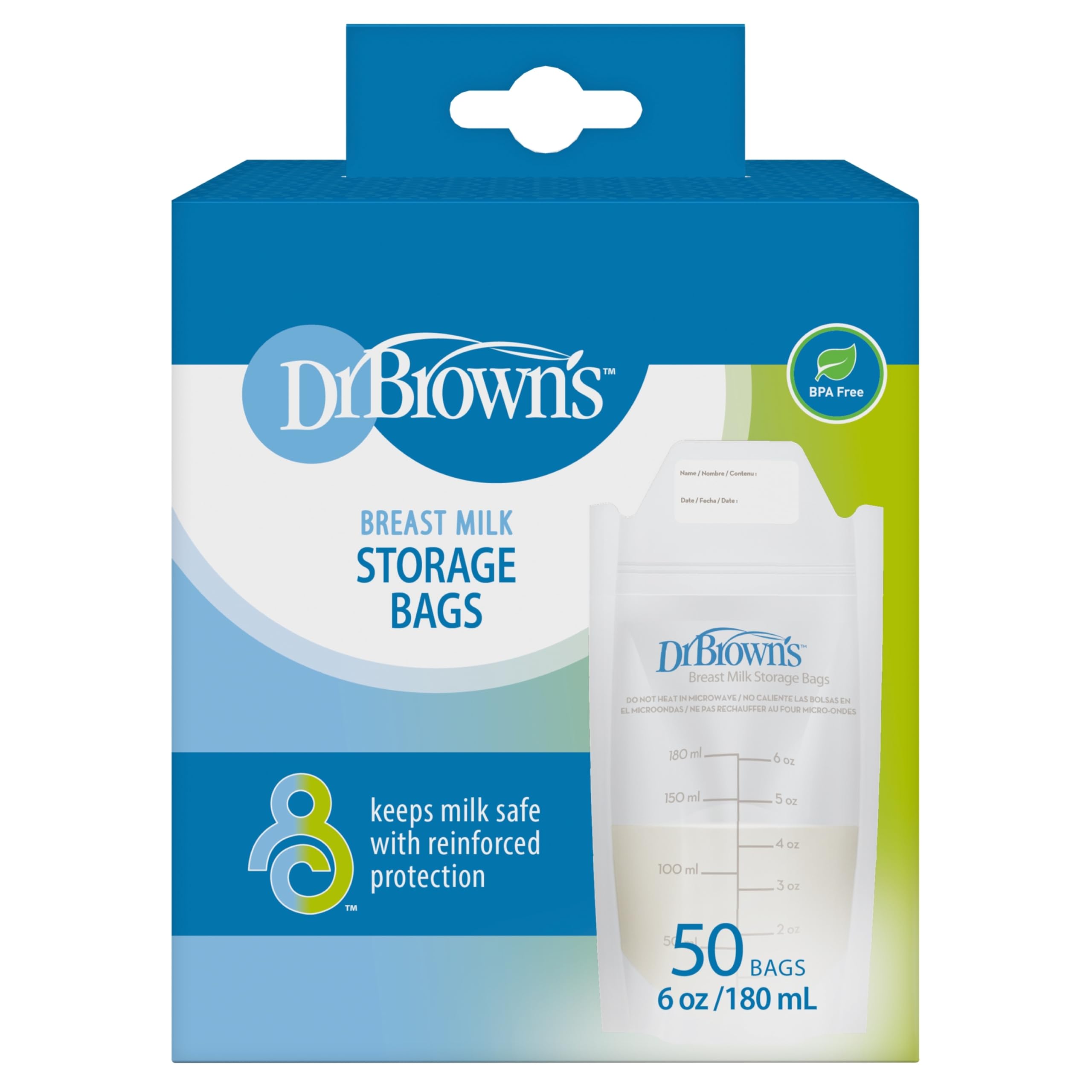
Key Features
- Base: Gusseted, self-standing
- Closure: Double zipper
- Capacity: 6 oz
- Pack Count: 50 bags
- Price: Midrange
Stiffness is the quality that stands out first. The double-layer film on these bags has enough body to hold the bag open on its gusseted base while you pour one-handed, and it doesn’t fold shut on the milk the way thinner bags do. That stiffness is also what makes the bag feel protective rather than merely present.
Fifty to a box is why they stay on our list. It’s the smallest commitment of the disposable bags here, which makes it the sensible way to find out whether a thick bag suits you before you buy two hundred of anything, and it’s the box we suggest to anyone who pumps only a few times a week.
In a crowded freezer the extra material earns its keep: the wide side seams give you margin if a bag takes a tumble, and the gusset means one can stand in the fridge door for the day’s bottles instead of lying flat and out of reach. Treat the printed ounce scale as a rough guide rather than a measurement — if you’re tracking intake, pour into a bottle first.
Pros
- Thick double-layer film
- Gusseted base stands while filling
- Small 50-count box to try
- Wide side seams resist splitting
Cons
- Stiff zip is fiddly with wet fingers
Dr. Brown’s bags are the sturdy small-box pick for anyone who wants thick film and a standing base without committing to a two-hundred-count purchase.
Best for Larger Pump Sessions
Nuliie 8 oz Bags
Key Features
- Closure: Double zipper
- Capacity: 8 oz
- Pack Count: 120 bags
- Pour Style: Side pour spout
- Price: Budget
Eight ounces is the number that decides this one. If your first pump of the morning clears six ounces, a bag that tops out at six splits one session into two bags and doubles the space it takes in the freezer — and these take the whole session with room left, at a cost per bag near the bottom of this group. That combination is why they made the list.
The side spout is the second reason we kept reaching for them. Instead of cutting a corner off and hoping, you tear back a tab on the side and pour from a controlled opening, which is far less nerve-wracking over a bottle at two in the morning. The pour is the part of the job every bag gets wrong, and this one gets it right.
Sealing takes a deliberate pass: press the full track rather than swiping at it, and freeze below the printed line rather than at it, and the bags come through a freeze-and-thaw cycle intact. Ours held, and the ones that fail are the ones where somebody stopped halfway.
The 120-count box splits the difference between a sampler and a year’s supply, which suits a pumper who wants to try a bigger bag without betting a whole stash on it. It’s also the box that fits a diaper bag shelf without taking over.
Pros
- Holds 8 oz, so a big session fits one bag
- Side spout pours without cutting a corner
- Stands for filling or freezes flat
- Low cost per bag
Cons
- Narrow top opening makes filling fussier
- Zip needs two dry hands
The Nuliie 8-ounce bags are what we hand to a heavy producer: more room per bag, a spout that pours cleanly, and one of the lowest costs per bag here.
Best for Checking Milk Warmth
Momcozy Temp-Sensing Bags
Key Features
- Closure: Double zipper
- Capacity: 6 oz
- Indicator: Temp-sensing color change
- Pack Count: 120 bags
- Price: Midrange
The temperature dot is the reason to look twice at these: a patch on the bag shifts from purple toward blue as the milk warms, so you can see roughly where a portion stands without opening it or testing a drop on your wrist. With a baby fussing in one arm, that glance is worth something.
Roughly is the operative word. The patch reads the surface it’s printed on, not the middle of the bag, and a bag straight out of the fridge will look colder than milk that has been sitting in a warmed bottle. Use it to tell cold from warmed, and keep a proper check for whether a feed is ready.
Set the patch aside and these are a solid mid-pack bag: thick film that stands up while you fill, a double zipper with side seams to back it up, and two tear points so you can pour from a corner or snip the top. What we appreciated most is how little the bag flops — the sides stay upright while you pour, which is the difference between a clean fill and a wipe-down.
The detail that sold us is smaller than the temperature patch: milk goes in and comes out through separate openings, so you never pour from the hole you filled through. It’s the kind of thing you only notice after using a bag that doesn’t do it.
Pros
- Color patch cues cold versus warmed milk
- Thick film stands up for filling
- Separate in and out openings
- Freezes flat or upright
Cons
- Zip needs a deliberate pass to close
- Pouring means cutting a corner open
Momcozy’s temperature patch is a genuine convenience rather than a gimmick, and the bag underneath it is sturdy enough to earn a place in a daily rotation.
Best for Stash Building
Motif Medical Bags
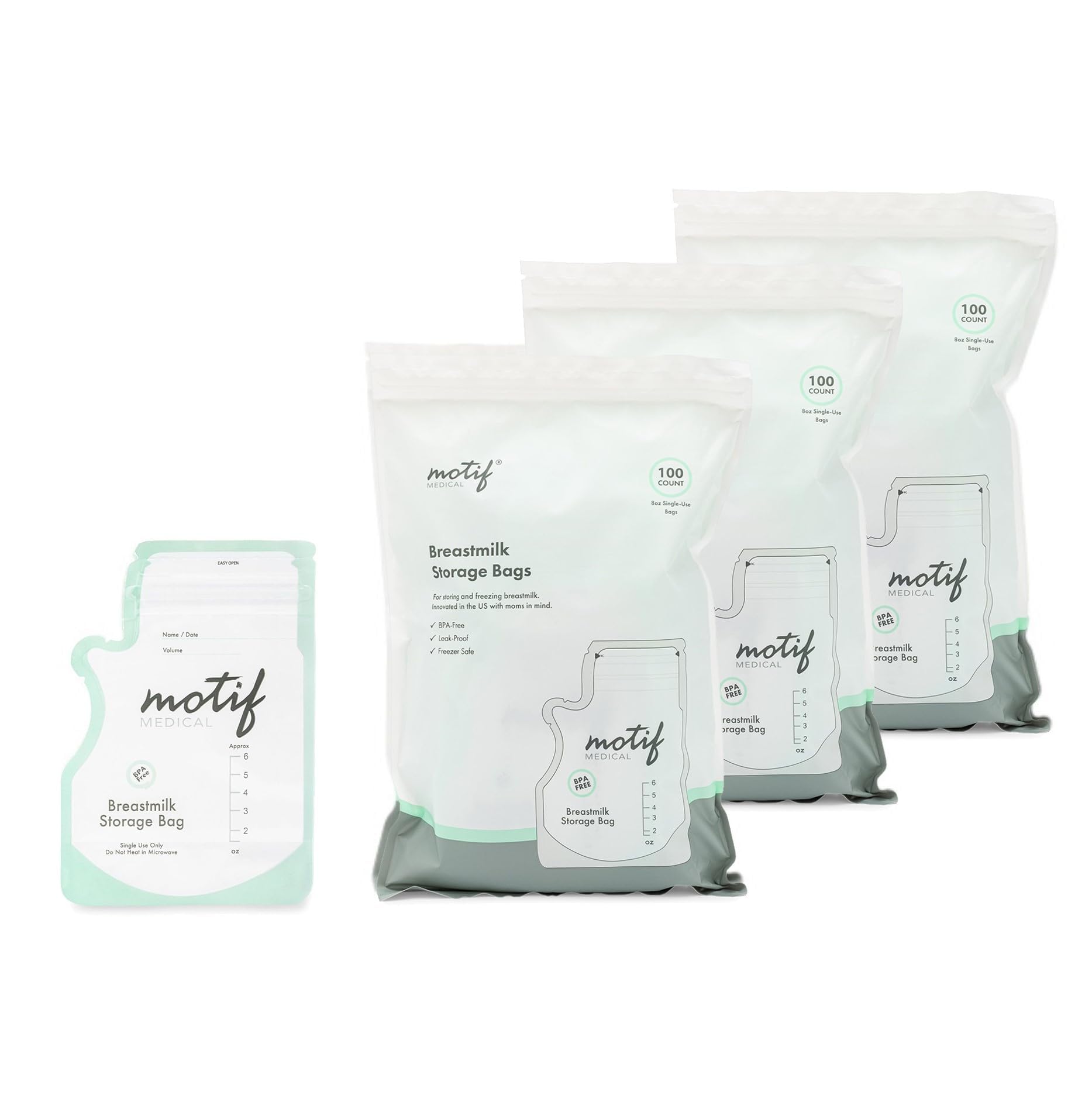
Key Features
- Capacity: 6 oz
- Pack Count: 300 bags
- Pour Style: Easy-pour spout
- Freeze Format: Flat or self-standing
- Price: Midrange
Three hundred bags in one box is a different kind of purchase: not a trial and not a top-up, but a stash built in an afternoon and then worked through for months. It’s the biggest box here by a wide margin, and for someone pumping every day it’s the order that stops the repeat buying.
What makes it worth the shelf space is the film. These are thick — noticeably more body than a standard bag — and they hold their shape standing on the counter, which matters when you’re filling four in a row at the end of a session. Freezer burn is not the thing you end up worrying about with these.
The pour spout tears cleanly along its perforation and makes decanting a single pour rather than a squeeze and a shake. It’s a small design decision that shows up every single time you use one, which is exactly how we judge a bag.
If you already know you like a spouted bag and you’re pumping daily, this is the bulk buy that makes the most sense in this group. Buy it once your routine is established, though, not in the first week — nothing about the box rewards being early.
Pros
- 300 bags, the largest box here
- Thick film stands and freezes flat
- Clean-tearing pour spout
- Holds up without splitting
Cons
- Stiff top seal takes a thumbnail to open
Motif’s 300-count box is the buy-once answer for a daily pumper building a full stash, provided a stiff seal doesn’t put you off.
Best for Reusable Daily Pumping
Nuliie Silicone Bags

Key Features
- Closure: Double seal with clip
- Capacity: 8.1 oz
- Material: Food-grade silicone
- Pack Count: 7 pouches
- Price: Premium
A pumping year goes through box after box of disposable bags, and that arithmetic is what sent us looking at silicone. Seven pouches, washed and refilled, break the cycle — no reorder, and nothing in the bin on a Sunday night. For anyone who has watched a freezer bag go straight into the trash, the appeal is obvious.
The design is closer to a food pouch than a milk bag: a wide mouth you can fill from a pump, a double-sealed top with a slider clip, and enough structure to stand on the counter. The wide mouth is what makes them work — you can get a bottle brush inside, and they go through the dishwasher rather than needing a special soak.
Silicone wears, though, so these are worth inspecting rather than trusting: check the seams before each fill, and retire a pouch at the first sign of a split rather than waiting for it to fail over a bottle. Where they earn their keep is a mixed stash — keep a box of flat disposables for freezer volume and use four or five of these for the milk that moves fastest, and both the waste and the reordering shrink.
Pros
- Seven pouches replace box after box
- Double seal with a slider clip
- Wide mouth is easy to fill and wash
- Goes through the dishwasher
Cons
- Takes far more freezer space than flat bags
- Top folds over unless the pouch is full
Reusable silicone suits a daily pumper who minds the waste, though it works best alongside flat disposable bags rather than replacing them outright.
How We Tested 16 Breast Milk Storage Bags
We started with a list of more than 60 bags and narrowed it by format: pre-sterilized single-use pouches, gusseted stand-up bags, and a few reusable options. Reading spec sheets for stated capacity, seal type, and material claims got us to 16, chosen to cover the range of sizes sold — small 4-ounce bags for light pumps up to 8-ounce bags built for a full session — and the spread of prices you’d find in a drugstore aisle or a late-night order.
Testing ran four months alongside real pumping schedules. Each bag was filled to its printed ounce line with water and weighed on a kitchen scale, which is how we caught the brands that overstate their capacity and one that undersells it. Then we did it for real: filled with milk, frozen flat on a sheet pan, stacked in the freezer, thawed in a bowl of warm water, and poured into a narrow-neck bottle one-handed in a dim kitchen at 3 a.m.
Seal and durability got their own rounds. We sealed each bag the way its instructions said, squeezed it hard, and shook it upside down over the sink; wide double-track press strips held, while several single-track bags opened at the corner. Filled bags rode in a diaper bag under a stroller for a full day, and frozen bags were stacked on each other for a week to see which ones welded into a block. Ease of use came down to whether a bag stood up on the counter mid-pour, whether the corner or spout dribbled down the outside, and how legible the volume lines were. We tracked cost per bag and count per box throughout, since a bag you can’t justify using twice a day isn’t much of a bag.
How to Choose Breast Milk Storage Bags
A storage bag has one job — get your milk from the pump to the bottle without losing any — and the differences that decide it are the seal, the pour, and how the bag sits in your freezer.
The seal is the decision
Nearly every leak starts at a corner or at a zipper track that didn’t quite catch. A double zipper, pressed from the middle outward with a thumb, holds better than a single track, and reinforced side seams give you more margin when milk expands as it sets. Threaded caps, like the ones on the Kiinde pouches, take the zipper question out of it entirely at a higher cost per feed.
Whatever the closure, the failure mode is the same: a bag filled to the line and frozen hard, with nowhere for the expansion to go. Fill below the line, freeze flat on a tray, and you have removed most of the risk before it starts.
How the milk gets out
Pouring is where a bag that looked fine becomes infuriating. A tear-off corner works, but you’re aiming a floppy bag at a narrow neck; a side spout gives you a controlled stream and often a second opening; a wide top is easy to fill and hard to aim. If you’re pouring one-handed with a baby on your arm, pay for the spout — the Medela Easy Pour and the Nuliie bags both build one in.
Six ounces or eight
Most bags here are marked to six ounces; a few go to eight. What matters is your typical session. If a morning pump fills six ounces, an eight-ounce bag saves you a second bag and the freezer space that comes with it. If you usually pump three or four, the bigger bag just holds more air and takes up more room.
Flat, standing, or both
Flat-freezing is the habit that makes a stash manageable: a bag frozen flat stacks like a file, thaws quickly, and uses a fraction of the space. A gusseted base, as on Dr. Brown’s bags, also lets the bag stand while you fill it, which is worth having. The trap is a self-standing bag that never gets flattened — a week of those fills a drawer.
Freeze them flat on a tray first, then stand the frozen stack on end once it’s solid. You get the filling convenience and the storage shape.
Disposable or reusable
Disposables win on freezer space and on not thinking about them; silicone pouches win on waste and on the cost of a pumping year. Plenty of pumpers keep both: a box of flat bags for volume and four or five silicone pouches for the milk that moves fastest. If you go reusable, check the seams before each fill and retire a pouch at the first sign of a split.
Frequently Asked Questions
Do you have to sterilize breast milk storage bags before you use them?
No. Disposable bags arrive pre-sterilized behind a tamper-evident seal, and rinsing one before use adds water and bacteria rather than removing them. Check that the perforated top is intact when you tear it back, keep the unused bags in their resealable pouch or box, and write the date on the panel before you fill it, while your hands are still clean.
Can you wash and reuse disposable breast milk storage bags?
No. The film and zipper aren’t built for a second fill, and a washed bag is a bag with a weakened seam — not a saving worth the risk. Use each bag once and recycle it where your program accepts soft plastics. If reuse is the point, buy silicone pouches, which are designed to be washed and refilled.
Why do bags leak when the milk thaws?
Expansion. Milk takes up more room frozen than liquid, so a bag filled to the printed line has nowhere to put the extra, and a seam or corner takes the strain as it warms. Leave headroom before freezing, freeze flat on a tray, and thaw in a mug or jug so a split bag costs you a cup rather than the whole drawer.
Final Verdict
Medela’s Easy Pour is the bag we come back to: a side spout you can aim one-handed, thick film that stands while you fill and freezes flat, and a seven-ounce capacity that swallows a whole morning pump. For most people building a stash, it’s the safest default on the page.
Two requirements push you elsewhere. If cost per bag decides it, Lansinoh’s flat-freezing bags are the cheapest route to a full freezer. If you pump away from home and want to stop washing bottles, Kiinde’s pouch system replaces the bag and the bottle in a single step.
