This post contains affiliate links. We may earn a small commission when you buy through our links — at no extra cost to you.
A sensory toy has one job: to help someone settle, focus, or simply feel good in their hands. The trouble is that plenty of them fail at the second part. They smell like a tire fire, leave a sticky film on the coffee table, or split a seam and leak gel before the week is out. I’ve watched a child reject a perfectly cute squishy because it was too slick to grip, and I’ve scraped putty out of a rug. A good one earns its place by being pleasant to touch, easy to clean, and sturdy enough to survive real handling.
Over six months, we tried 14 sensory toys with kids and adults, noticing what a catalog photo won’t show: whether colors stay bright after a wipe-down, whether the cute shape survives daily squeezing, whether it’s small enough to stash but big enough to grip, and whether the price feels fair once you’ve lived with it. Some were a hit for a day and then forgotten. The keepers are the ones that got picked up again without prompting.


Best for Tummy Time
Melissa & Doug Flip Fish
Key Features
- Care: Surface washable
- Dimensions: 9.76 x 3.74 x 13.5 inches
- Recommended age: 0-9 months
- Sensory features: Mirror, crinkle, squeaker, textures
- Price: Midrange
The Flip Fish earns its place by packing four kinds of sensory play into one soft object: a crinkling body, a squeaker tail, a shatterproof mirror, and textured scales with hidden pictures underneath. That combination is what makes it useful for tummy time, when a baby needs something to track, swat, mouth, and eventually grab.
The fish shape helps. It is wide enough to give a baby several places to grab, and the different fabrics give small hands more than one texture to explore. The peekaboo scales add a small cause-and-effect game for an older baby who is starting to reach and lift.
We keep coming back to the mirror. It gives a baby a face to focus on during floor time, and because it is set into the body rather than clipped on, there is no loose piece to chase. The squeaker tail adds a sound cue for cause and effect.
The fabric is surface washable, which matters for a toy that will meet spit-up and sticky hands. The 12.96-ounce weight is light enough to move from the play mat to the crib rail, but the 9.76-by-3.74-by-13.5-inch body is not something you tuck into a diaper bag.
For most families, this is the sensory toy to buy first: it covers visual, tactile, and auditory play without batteries or a screen, and it grows with a baby from early tracking to grabbing. The caveat is that it belongs at home or in a room where it can stay put, not in the go-bag.
Pros
- Mirror, crinkle, squeak, and textures in one toy
- Soft shape suits tummy time and grabbing
- Surface-washable fabric handles spit-up
Cons
- Surface wash only; not machine washable
The Flip Fish is our default for the first nine months because it puts mirror, crinkle, squeak, and varied fabric in one surface-washable toy.
Best for Teething Babies
TOHIBEE Sensory Teether
Key Features
- Care: Hand wash only
- Material: BPA-free silicone and ABS
- Recommended age: 0-12 months
- Sensory features: Textured balls, rattle, clicker
- Price: Budget
A teether has to do two jobs at once: soothe gums and stay interesting after the chewing stops. The TOHIBEE ball handles both with a dozen textured silicone sections, a rattle ring, and a twisting clicker, all arranged around a shape a baby can grab with both hands.
The mix of textures is the practical part. The sections vary in shape and texture, and the rattle ring moves separately, so a baby can find a different mouthfeel without switching toys. The clicker adds a second sound for older babies who are learning that their hands can make something happen.
We think the compact size is mostly a strength: it fits small hands and slips into a diaper bag without taking over. It does read larger in photos than in hand, and the small parts mean this is supervised play rather than a crib toy. For a baby in the thick of teething, though, that smaller shape is easier to hold than a full ring.
Pros
- Textured silicone sections soothe gums
- Rattle and clicker add sound
- Compact shape is easy for small hands to grip
Cons
- Hand wash only
For a baby in the thick of teething, this ball gives sore gums several textures plus a rattle and clicker in one easy-to-grip shape.
Best for Newborn Tracking
Infinno Wrist Rattles
Key Features
- Care: Hand wash only
- Materials: Cotton, polyester, spandex
- Set includes: 2 wrist rattles, 2 foot finders
- Recommended age: 0-12 months
- Price: Budget
Keeping anything on a newborn’s feet is its own challenge, which is why the Infinno set earns points for putting sound-makers on the wrists, too. The set includes two soft wrist rattles and two foot-finder socks in contrasting patterns.
The foot socks are the fussier half. They slip off when a baby kicks or pulls, so they work best for supervised floor time rather than a car seat or stroller. The wrist rattles stay on more reliably, and the soft jingle is gentle enough for a new baby.
The part that stands out to us is how the set turns ordinary movement into cause and effect. A wave of the arm or a kick brings a sound, and the high-contrast bug faces give a newborn something to lock onto. That makes it a strong first sensory toy: the baby is the one making the action.
Pros
- Wrist rattles stay on during movement
- Soft jingle and high-contrast patterns
- Turns kicks and waves into sound
Cons
- Hand wash only
These wrist rattles and foot socks are a smart first sensory set for newborns, turning natural arm and leg movement into soft sound.
Best for Travel Play
Nutty Toys Pop Tubes
Key Features
- Material: BPA-free plastic
- Dimensions: 8.3 x 1.1 x 1.1 inches
- Piece count: 8 large tubes
- Recommended age: 3 years and up
- Price: Budget
A restaurant table is where these pop tubes earn their keep. Eight large tubes connect end to end, stretch out, and collapse with a satisfying pop, which gives a toddler a lot to do without a screen.
The uneven texture and bright colors do the sensory work, and the tubes are light enough that a child can build a long chain without fighting the weight. They also connect and disconnect easily, so the toy changes shape as fast as a toddler’s attention does.
The weak point is the sound. The pop carries, which is fine at home and less welcome in a quiet waiting room. For a toddler who needs busy hands, though, that is a small price to pay for a toy that packs into a bag and comes out ready to play.
For us, the set still earns a place in the diaper bag for ages three and up, because it is light, connectable, and easy to replace. It is not the toy we hand to a baby who mouths everything, but for a toddler who needs busy hands, the trade-offs are easy to accept.
Pros
- Eight connectable tubes encourage building
- Textured surface and satisfying pop
- Light enough for travel play
Cons
- Tubes can dent and lose pop action
The Pop Tubes are our pick for older toddlers who need a busy-hands toy on a restaurant table or airplane tray.
Best for Calm-Down Corners
hand2mind Sensory Tubes
Key Features
- Material: Plastic
- Tube count: 4
- Item weight: 1.4 lb
- Recommended age: 3-17 years
- Price: Midrange
The hand2mind tubes are the calm-down tool in this group: four sealed cylinders, each with a different mix of floating shapes and liquid, so the same shake produces a different pace of movement. We reach for this set when a child needs to slow down and watch, not when they need to wrestle a toy into a new shape.
The tubes are a good size for small hands, and the included guide gives caregivers a few ways to use them beyond shaking. The four designs are different enough to rotate, which helps a child stay with the activity instead of treating all four as the same object. This is a tabletop or calm-corner toy, not a rough-and-tumble travel set.
Pros
- Four tubes with different visual flow
- Good size for small hands
- Includes a calm-down activity guide
Cons
- Can leak after a hard drop
This is the set we reach for when a child needs to slow down and watch, not wrestle a toy into a new shape.
Best for Quiet Fidgeting
Cevioce Fidget Slug
Key Features
- Material: Plastic
- Item weight: 9.17 oz
- Piece count: 3 slugs
- Recommended age: 3 years and up
- Price: Budget
The slug does one thing well: it moves. Each of the three toys is a chain of rounded plastic segments that swivels through your fingers and clacks as it goes, so it rewards a restless hand without requiring a screen or a battery.
We were surprised by how much the sound adds. It is not a silent fidget, but the clack is softer than a clicker and rhythmic enough to be soothing rather than distracting. The movement is smooth, and the head and body stay together when you bend it.
The three-pack is the practical part: one can live in a backpack, one by the desk, and one in the car without a fight over sharing. For a pocket fidget that keeps hands busy during homework or travel, it is one of the easiest picks here to recommend.
Pros
- Smooth, articulated movement
- Satisfying clackety sound
- Three-pack is easy to stash
Cons
- Not for mouthing; 3+ only
The Fidget Slug is the pocketable fidget we hand to older kids who concentrate better with something moving in their hands.
Best for Older-Kid Fidgets
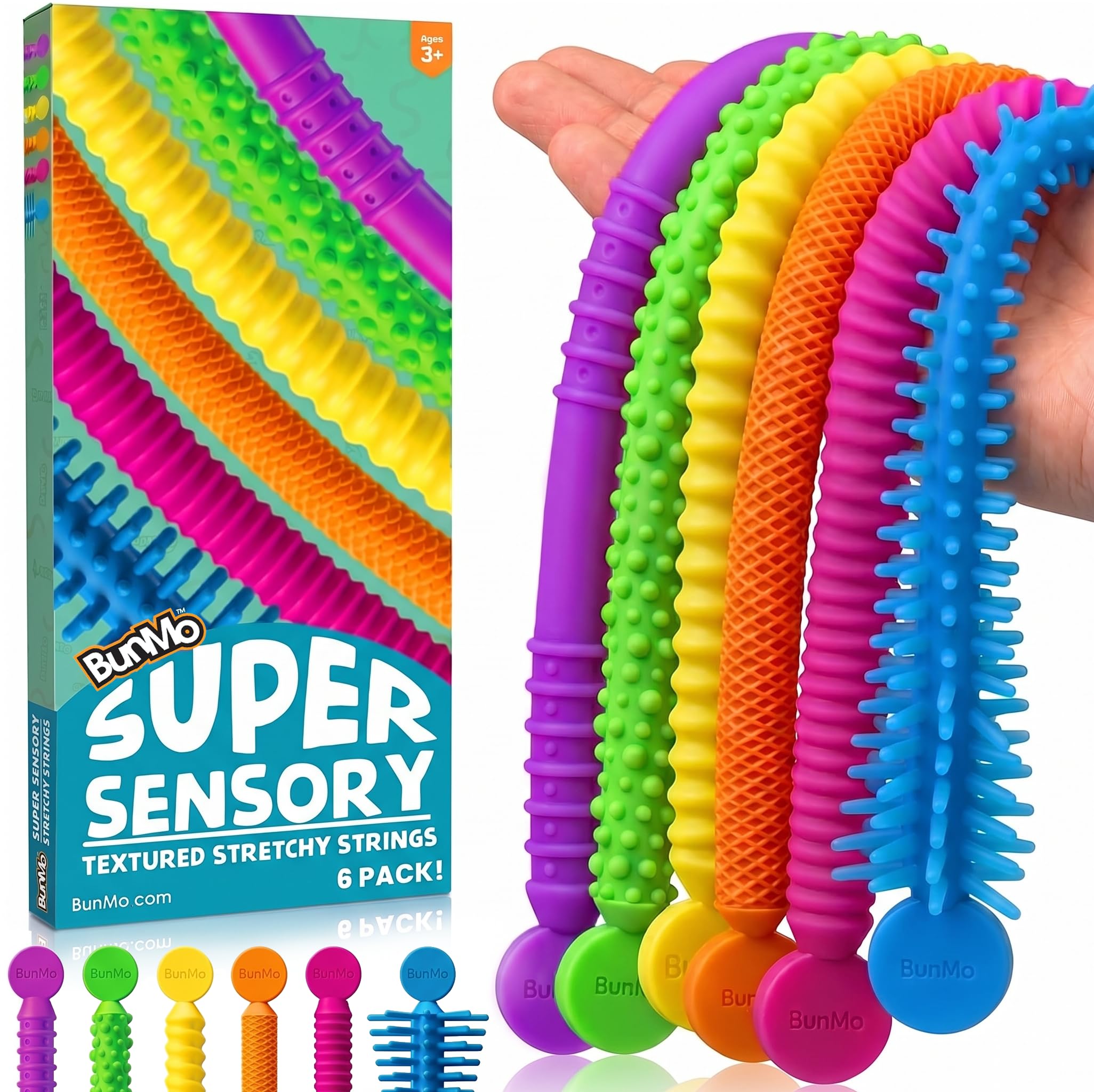
BUNMO Stretchy Strings
Key Features
- Care: Hand wash
- Material: Latex-free TPR
- Piece count: 6 stretchy strings
- Recommended age: 3 years and up
- Price: Budget
The first thing to know about BUNMO’s stretchy strings is that they are not a mouthable toy. The 3+ label is serious, and the six strings are meant for pulling, twisting, and wrapping through fingers, not for teething babies.
That boundary is easier to accept once you handle them. The latex-free TPR has a soft, grippy feel, and the strings stretch far without turning into a sticky mess. They are also easy to wipe down, which matters for a toy that ends up on desks, restaurant tables, and car seats.
We appreciate the six-pack because it gives siblings or a classroom several strings without a fight, and the bright colors make them easy to spot in a bag. For older kids and adults who need something to do with their hands, these are the most versatile stretchy fidgets here, provided everyone keeps them away from mouths.
Pros
- Tough, latex-free stretchy material
- Six strings for sharing
- Easy to wipe clean
Cons
BUNMO’s strings are the stretchy fidget we trust for older kids and adults, as long as everyone respects the no-mouthing rule.
Best for Sticky Squish Play
Crayola Globbles

Key Features
- Care: Wash with soap and water
- Material: BPA- and phthalate-free plastic
- Piece count: 16 squish balls
- Recommended age: 4-10 years
- Price: Midrange
Globbles are less a calm-down fidget than a game: you squish them, throw them at a wall or ceiling, and watch them stick before they peel off. The 16-pack comes in bright colors, and the sticky surface is the whole point.
The washable stickiness won us over. Rinse one under soap and water and it comes back tacky rather than leaving a residue on hands or walls. That makes them easier to live with than a lot of sticky toys.
The trade-off is durability: rough play can burst one, and the sticky surface is not for a child who still mouths everything. A clean container helps, but these are not heirloom toys.
For kids four and up who like throwing and sticking, the set is still a lot of active sensory fun, and the 16 pieces make it easy to share. We just keep them off carpeted floors and accept that they need replacing sooner than a solid plastic toy.
Pros
- Washable sticky surface
- 16 pieces for sharing
- Active throwing and sticking play
Cons
- Collects lint and hair quickly
Globbles are the sticky squish set we choose for kids who want to throw, stick, and peel, with washing and durability as the trade-offs.
Best for Party Favors
JOYIN Mochi Squishies

Key Features
- Size: 1-2 inches
- Packaging: Individually wrapped
- Piece count: 25 mini squishies
- Recommended age: 3 years and up
- Price: Budget
The JOYIN set is a party-favor pack first: 25 miniature mochi squishies, each individually wrapped, with a random mix of animals and fruit. At one to two inches, they are small enough to tuck into eggs, goodie bags, or a classroom prize bin.
We like them for that job because the squish is soft and stretchy, and the variety keeps kids trading and choosing. The catch is the random assortment: a piece can arrive with a noticeable odor or a tacky finish. For supervised kids, they are an easy, cheerful bulk pick. Keep a few in a zipper pouch for restaurant waits; the rest can go straight into party bags.
Pros
- 25 individually wrapped squishies
- Soft, stretchy tactile feel
- Good variety for party bags
Cons
- Tiny 1-2 inch pieces suit 3+ only
The JOYIN mochi pack is our bulk pick for party bags and prize boxes, with 25 wrapped squishies that are cute, soft, and small.
How We Tested the Best Sensory Toys
We started by reading customer reviews and filtering a long list by size, price, and materials—anything with a pattern of complaints about chemical odor or leaky seams came off the table. That left us with 14 toys to test for six months, a mix of squishy, stretchy, putty-like, and fidget styles. We chose them to cover a range of prices and textures, not just the cutest packaging.
For six months, those toys lived where sensory toys actually end up: on the living room rug, in the car during long rides, in a quiet corner before bed, and on desks during work calls. We handed them to kids and adults and kept a simple tally of which ones got picked up without a prompt. We squeezed, stretched, dropped, and wiped each one with baby wipes and mild dish soap, then checked crevices for crumbs and lint.
We sniffed every toy straight out of the package and again after a week in a sealed bin. Gel-filled ones got a hard squeeze and a windowsill stint to see if seams wept. We checked whether seams stayed closed after repeated pulling, whether surfaces stayed tacky enough to stick to a wall but not so tacky they collected hair, and whether colors bled or dulled after washing. We also noted whether the cute face still read after a week of squishing, and how each toy felt in the hand—too small to grip or too big for a backpack pocket. At the end, we compared how often each toy came back out against what it cost; a cheap toy that gets ignored is worse value than a pricier one that stays in rotation.
How to Choose Sensory Toys for Babies and Toddlers
The right sensory toy is the one that matches your child’s stage and the sense they actually seek, not the one with the longest feature list.
Match the toy to the mouthing stage
Under about six months, a baby explores mostly with eyes and mouth, so soft fabric, high-contrast patterns, gentle rattles, and a secure mirror do more than a pile of small pieces. From six to twelve months, a silicone teether with several textures earns its keep. Once a child is past mouthing everything, usually around three, stretchy strings and pop tubes become practical. If your baby still chews toys, keep the 3+ fidgets out of reach and choose a surface-washable fabric toy or a teether instead.
Choose one sense to lead
Most good sensory toys emphasize one sense and let the others support it. A visual toy such as the hand2mind tubes is about watching flow and color; a tactile toy such as the Flip Fish is about crinkle, fabric, and grab; an auditory toy such as the wrist rattles is about cause and effect. Decide whether you want a toy for exploration, comfort, or distraction. A toy that tries to do all three at once can be overstimulating, especially for a baby who is tired or already worked up.
Separate active fidgets from calming tools
Pop tubes, stretchy strings, and slugs give hands something to pull, twist, and move; they suit waiting rooms, car rides, and kids who concentrate better while fidgeting. Visual tubes and liquid timers are slower, and they work better for winding down. The setting changes the choice: a quiet restaurant calls for a low-sound fidget, while a calm-down corner benefits from a toy that rewards watching rather than doing. If a toy makes noise, make sure that noise fits where you plan to use it.
Check the smallest part, the care label, and the age range
Sensory toys live on the floor and in mouths, so the practical details matter. Look at the smallest detachable piece before buying for a baby under three; if it fits inside a toilet-paper tube, it is a choking risk. Check whether the toy is surface washable, hand wash only, or wipe clean, because a toy that is hard to clean stops being used. The age range is a starting point, not a guarantee: a three-year-old who still mouths everything is not ready for a non-mouthable fidget.
Buy for the setting, not the collection
A single well-chosen toy usually beats a basket of near-duplicates. If you need party favors or classroom prizes, a bulk pack of individually wrapped squishies makes sense; for daily use, choose one teether, one visual toy, and one fidget that suit your child’s stage. Rotate a few at a time so they feel new. Durability matters more with stretchy and pop toys, which can dent, tear, or burst with rough play; buy the pack you can afford to replace, not the one that promises indestructibility.
Frequently Asked Questions
Do sensory toys help with autism or ADHD?
They can be useful tools for some children and adults, especially when a person seeks tactile or visual input to self-regulate. They are not a treatment for autism or ADHD, and a toy that calms one child can overwhelm another. Offer one option at a time, watch whether your child seeks it out or pulls away, and ask an occupational therapist for guidance if you are choosing toys for regulation needs.
How do I introduce a new sensory toy to a cautious child?
Leave it within reach and let the child come to it. Model one simple action, such as squeezing or turning it, then stop and wait. If the child recoils from the texture or sound, put it away and try a different material later rather than pushing. A cautious child often needs several short exposures before a toy feels safe.
How should I store small sensory toys?
Keep a single open bin for the toys in rotation and a lidded container for the rest. Small squishies and detachable parts go in labeled zipper pouches, out of reach of children under three. Rotate four to six toys at a time; too many at once makes the pieces harder to track and the play less focused.
Final Verdict
For most families, the Melissa & Doug Flip Fish is the first sensory toy to buy: it combines mirror, crinkle, squeak, and texture in one washable floor toy that suits the first nine months. If teething is the immediate need, choose the TOHIBEE ball for its silicone textures and rattle. If you are building a calm-down corner, the hand2mind tubes are the better fit; they ask a child to watch and breathe rather than pull and twist.
