This post contains affiliate links. We may earn a small commission when you buy through our links — at no extra cost to you.
The first weeks home with a newborn shrink your world to the size of a couch cushion. Babies want to be held constantly, and by 2 p.m. your arms are done. A carrier buys back your hands: you can stir a pot, fold laundry, or walk the dog while your baby naps against your chest. But a carrier built for a six-month-old will swallow a newborn, so the seat, the head and neck support, and the buckles have to be right from day one.
Over the past six months, my team and I have put 12 newborn carriers on our own chests and on a rotating cast of very opinionated babies, from the second week home through the six-month mark. What surprised me is how much ease of use beats clever features — you’ll be buckling one of these one-handed in a parking lot with a fussing baby — though we still argued about which ones looked best in the photos. The picks below are the ones we kept reaching for, and the ones we’d hand to a friend without a second thought.



Best for Everyday Newborn Use
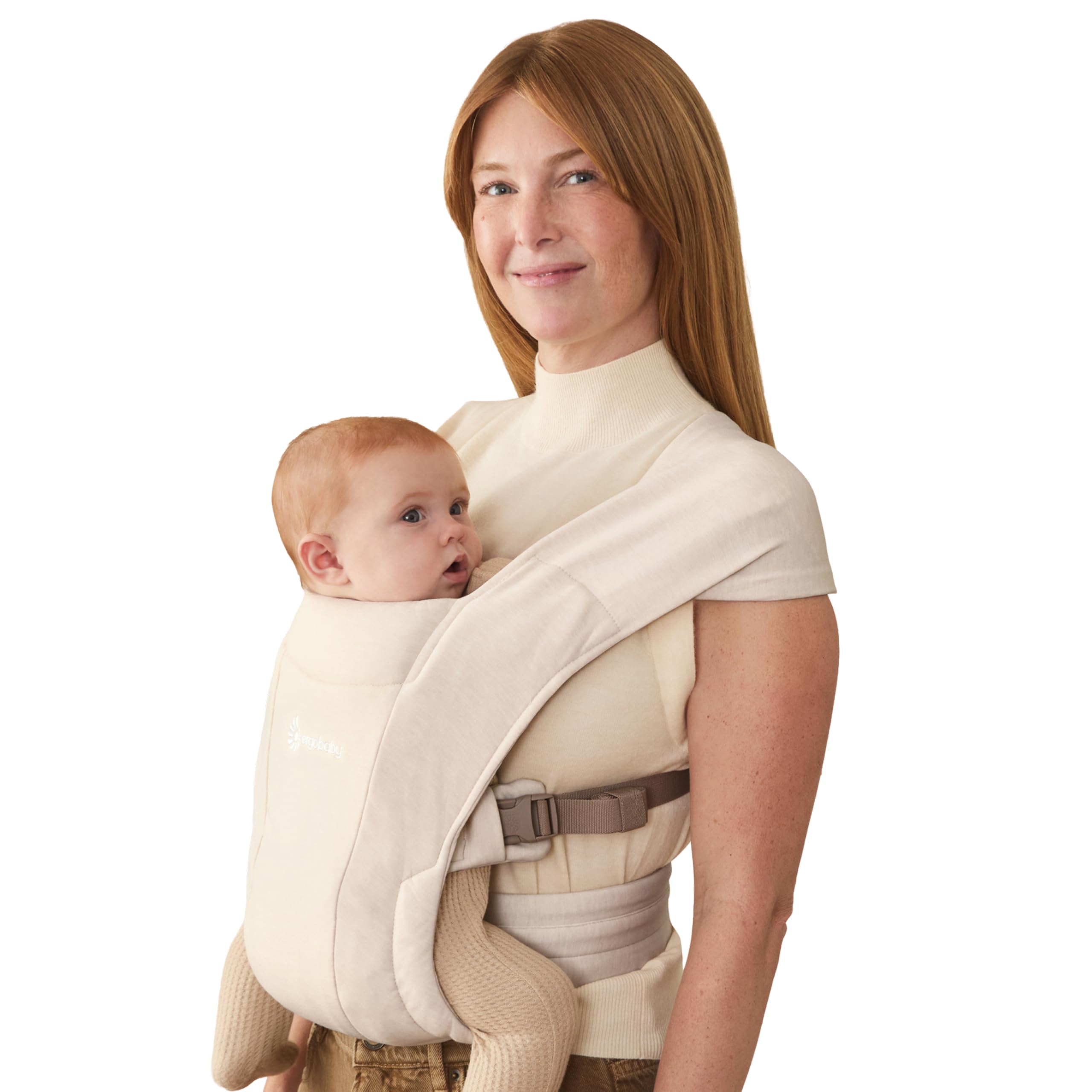
Ergobaby Embrace
Key Features
- Hip healthy: IHDI recognized
- Head support: Padded head and neck
- Weight range: 7-25 lb
- Carry positions: 2 front positions
- Price: Premium
The Ergobaby Embrace is what we hand a new parent who wants the closeness of a wrap without learning a long tying routine. It buckles on like a structured carrier, but the soft knit body molds around a newborn instead of standing away from them. The padded head and neck panel gives us a defined place to settle a sleepy baby, and the adjustable bucket seat keeps the hips in a supported position. For the first year, that combination is what earns it the top spot here.
What sold us on it for daily use is the solo factor. The cross-back straps and front adjustment points let one person tighten the carrier after the baby is in, which matters when you are home alone and the baby has just fallen asleep. The fabric is soft enough for a onesie-only newborn and washes in the machine, so it does not become precious.
We also appreciate that it does not look like a piece of hiking gear. The cream knit is tidy enough for a doctor’s appointment or a walk, and the narrow body makes it easy to sit down in. It is a newborn carrier first, not a piece of equipment you have to armor up in.
Support is the one place to stay attentive: the padding helps, but a newborn still needs a hand behind the head until head control arrives. That is normal for this stage, not a flaw, but it means the Embrace rewards a careful fit. If you want one carrier to last through toddlerhood, the Omni Classic is the better long-term buy; for the newborn year, the Embrace is the one we recommend first.
Pros
- Soft knit molds to a newborn
- Easy to put on solo
- Padded head and neck support
- Machine washable for daily use
Cons
- Only two front carry positions
- 25 lb ceiling limits toddler use
We recommend the Embrace as our newborn default because it combines wrap-like softness with buckle-in simplicity and proper head support.
Best for Snug Wrap Carry
Boba Baby Wrap
Key Features
- Fabric: 95% cotton, 5% spandex
- Carry style: Front wrap
- Hip healthy: IHDI certified
- Weight range: 7-22 lb
- Price: Midrange
A long piece of stretch cotton sounds like the least technical way to carry a baby, and that is exactly why the Boba Wrap works for us in the first weeks. The fabric is soft, wide, and springy enough to cup a newborn’s back and legs, and the tie-on fit lets you put the baby high and close instead of hanging at your waist. It is the carrier we reach for when a baby is fussy and wants the womb-like pressure of a wrap.
The wrap is listed from 7 to about 22 lb, which covers the newborn and early infant stage rather than the whole toddler years, and the four-way stretch blend is designed to hold its shape after washing. We like that it is certified hip-healthy and built around the T.I.C.K.S. fit rules; those are useful guardrails when you are learning. It also packs down to almost nothing, so it lives in the diaper bag without a second thought.
The learning curve is real. First tries can look like a linen closet explosion, and the fabric has to be tied snug before the baby goes in; if you leave slack, the baby sinks and you have to start over. Once the tie is right, the hold is secure and the weight sits across both shoulders. This is a wrap for parents who want maximum snuggle and do not mind a two-minute routine, not for someone who needs to buckle up one-handed at a parking lot.
Pros
- Snug, womb-like newborn hold
- Hip-healthy certification
- Packs down small
Cons
- Runs hot in warm weather
We choose the Boba when a newborn needs a snug, womb-like hold and the parent is willing to learn a proper tie.
Best for Budget Structured
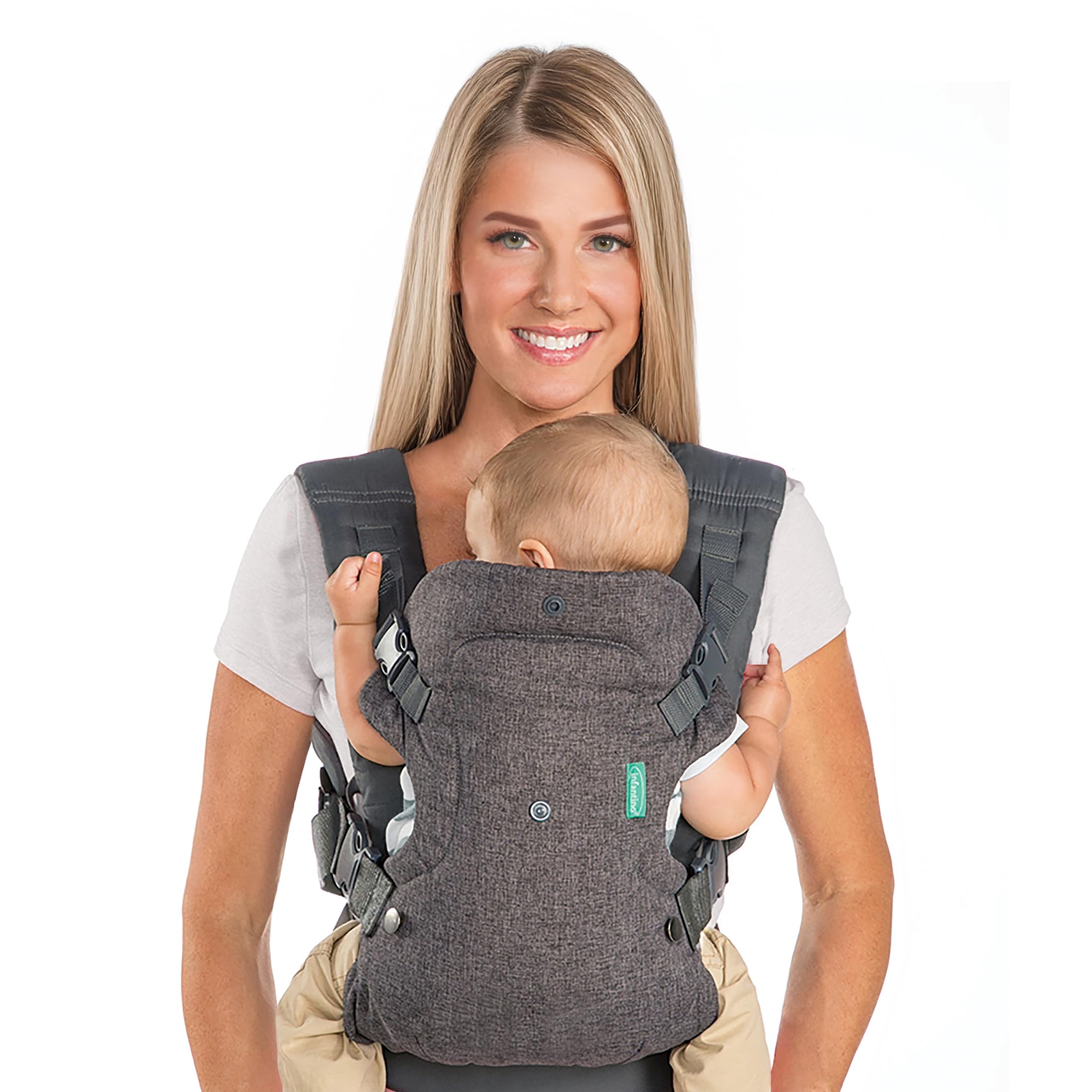
Infantino Flip 4-in-1
Key Features
- Closure: Buckle
- Head support: Adjustable
- Weight range: 8-32 lb
- Carry positions: 4
- Price: Budget
The Infantino Flip is the carrier we point to when a family wants a structured seat but does not want to spend premium money before they know what they like. It has four carry positions, a buckle closure, and a padded waist belt, which is a lot of carrier for the money. It is not the plushest newborn option here, but it is a straightforward way to learn structured babywearing.
For a newborn, the important part is the adjustable head support and the narrow-seat facing-in setting. The seat changes width as the baby grows, and the straps adjust enough for two different-sized caregivers. In use, the Flip feels more like a small backpack than a wrap: there is structure around the baby, and the waist belt takes some of the load off your shoulders.
We noticed the padding and the wide waistband most on longer walks. The Flip is not as moldable as a soft wrap, and the shoulder straps can feel bulky under a jacket, but it stays put once adjusted. The head support is a panel you position rather than a rigid brace, so a very small newborn still needs a hand behind the head; that is the main reason we see it as a budget structured option rather than the gentlest newborn choice.
Where the Flip wins is the hand-off between home and errands. It is machine washable, the buckles are easy to find by feel, and the front pocket is enough for a phone and a pacifier. We still reach for a wrap when a newborn is very fussy, but for a parent who wants one affordable carrier to learn on, the Flip is the practical starting point.
Pros
- Four carry positions for growth
- Adjustable head support
- Budget structured option
Cons
- Minimum 8 lb leaves smaller newborns out
- Facing-out and back positions come later
We keep the Flip in the roundup as the structured carrier to learn on without paying premium money.
Best for Newborn to Toddler
Ergobaby Omni Classic
Key Features
- Fabric: Mesh
- Hip healthy: IHDI recognized
- Weight range: 7-45 lb
- Carry positions: 4
- Price: Premium
The Omni Classic is the one we choose when a family wants to buy once. It starts at 7 lb for a newborn and runs to 45 lb, with four positions and a seat that widens as the baby grows. That range is the reason it costs more than the newborn-only options, and it is also the reason it stays in the car after the first year.
We like the mesh version for warm weather and long walks. The fabric breathes, the lumbar support is substantial, and the three-way head and neck support gives you a place to tuck a sleeping newborn’s head without adding a separate insert. The cross-back or H-back strap options are genuinely useful for different shoulders, and the whole carrier feels planted when the waist belt is snug.
The trade-off is bulk. This is a lot of carrier around a tiny baby, and the shoulder padding can feel like wearing a small backpack. Some petite wearers find the fit less friendly, so check the waist and shoulder adjustment range before you commit. If you mostly carry a newborn around the house, a wrap is softer; if you want one carrier for the stroller years, the Omni is the more versatile buy here.
Pros
- Grows from 7 to 45 lb
- Four carry positions
- Breathable mesh
- Strong lumbar and head support
Cons
- Hand wash only
The Omni Classic is our long-haul pick when one carrier has to go from newborn to toddler without a second purchase.
Best for Quick Wrap Carry
Koala Babycare Wrap
Key Features
- Fabric: Cotton
- Closure: Tie
- Carry style: T-shirt-style wrap
- Weight range: 2-9 kg
- Price: Midrange
The Koala Babycare wrap is the closest thing here to putting on a T-shirt and tucking a baby into the front. Two adjustable bands cross your back and tie at the waist, so there is no long sheet of fabric to wrestle with and no tail dragging on the floor. That makes it the easiest wrap in this group to get on by yourself, especially in a small hallway or a parking lot.
The cotton is soft and breathable, and the back panel gives more structure than a traditional stretch wrap without becoming a full buckle carrier. We found the two-band system keeps the baby high and close, and the tie-off at the waist is simple to tighten. It is a good fit for parents who want a wrap’s snugness but know they will not practice a long tying routine enough to get fast at it.
The limits are real: it is hand wash only, which makes it a less convenient daily carrier than the machine-washable options here, and the cotton takes a little longer to dry. Those are easy to accept if you want a quick, cozy carrier for the first months. If you need one carrier to last through the first year, the Embrace or Omni Classic makes more sense.
Pros
- T-shirt-style wrap goes on fast
- Two bands stay put
- Soft cotton with back support
Cons
- Weight ceiling around 9 kg
The Koala is the wrap we reach for when a fast, T-shirt-style carry matters more than a long custom tie.
Best for Errands and Storage
MOMTORY 6-in-1
Key Features
- Closure: Buckle
- Storage: Multiple pockets
- Hip seat: Built-in
- Carry positions: 6
- Price: Midrange
The MOMTORY is the carrier that thinks like a day bag. There is a built-in hip seat under the baby, six carry options, and enough pockets to hold a phone, keys, and a bottle without dragging along the diaper bag. For errands where you are in and out of the car, that combination is more useful than it sounds.
The hip seat is the part we appreciate most. It gives a seated shelf for the baby and takes weight off your shoulders, and the wide waistband spreads pressure across the lower back. The storage is not a token zip pocket; it is laid out for the things you actually need on a short trip. The carrier is also easier to put on alone than a wrap once the straps are set.
Newborn use is where it asks for care. The listed range starts at 7 lb and tops out at 12 kg, so it is not a one-and-done toddler carrier despite the six-position marketing. The head and neck area needs a careful fit for a small baby, and the waistband is the make-or-break dimension: some wearers find plenty of room and others find it too big or awkward. Check the waist range before you buy, especially if you are petite or plus-size.
What keeps it in the roundup is the practical package. The pockets, hip seat, and supportive waistband make it a strong choice for parents who want to carry a baby through a store or a park without a stroller. It is not our first pick for a tiny newborn who needs maximum head support, but it earns a place for errands and heavier babies.
Pros
- Built-in hip seat eases weight
- Useful pockets and storage
- Supportive waistband
Cons
- Hand wash only
We like the MOMTORY for errands because the hip seat and pockets make a stroller feel optional.
Best for Budget Wrap
KeaBabies Baby Wrap

Key Features
- Fabric: Stretch proprietary fabric
- Carry style: Front wrap
- Hip healthy: IHDI certified
- Weight range: 7-35 lb
- Price: Budget
The KeaBabies wrap is the budget pick we keep recommending because it gets the softness right. The fabric is stretchy without feeling thin, and it cups a newborn’s body instead of leaving gaps at the shoulders. For the first few months, when the baby wants to be held constantly, that softness does more work than a pile of buckles.
It is a one-size tie wrap, so the fit comes from how you tie it rather than from a sizing chart. The fabric has enough length and stretch to fit a range of wearers, and the 7-35 lb range means it can stay in rotation as the baby grows. We like that it is machine washable and comes with a storage bag, because a wrap that can be washed and stuffed into the diaper bag is one you actually use.
Against the Boba, the KeaBabies is the more affordable choice and nearly as soft; against the Koala, it trades the T-shirt-style convenience for a more traditional, customizable tie. If you want a low-cost wrap to learn on, this is the one we point to first. It is a simple, honest wrap, and that is exactly why it earns a place.
Pros
- Soft stretch fabric
- Wide 7-35 lb range
- Machine washable
- Budget-friendly wrap
Cons
- No structured head support
- Long fabric takes practice to tie
We point to the KeaBabies when a family wants a soft wrap at a budget price and can practice the tie.
Best for Easy-On Crossover
Momcozy Baby Wrap

Key Features
- Fabric: 95% polyester, 5% spandex
- Closure: Tie
- Size range: XXS-XXL
- Carry style: Two-piece wrap
- Price: Midrange
The Momcozy wrap is built around a smart idea: two pieces that go on more like a T-shirt than a long tie, so you are not dragging six feet of fabric across a parking lot. The fabric is soft and stretchy, and the crossover back gives a snug, womb-like hold when you get the tension right.
We like the idea for quick ups and downs. The two-piece layout is easier to put on over a sleeping baby than a traditional wrap, and the stretch fabric follows the baby’s shape without a lot of bulk. It is machine washable and packs small, so it works as a diaper-bag backup.
The fit is the sticking point. The carrier is sold as XXS-XXL, but the fit is not equally generous across body types, especially for plus-size parents, and a loose pass is a safety problem rather than a comfort preference. The two-piece design also has a learning curve; it is simpler than a long wrap, but it is not buckle-and-go. Check the size range against your body before you commit, and practice the tie before you are standing in a parking lot.
For a parent who wants a soft wrap but finds a traditional tie intimidating, the Momcozy is worth a look. It is not the most secure-feeling newborn carrier in this group, and the size range is a real caution, but the two-piece design solves a genuine problem. We see it as a niche pick: good for quick contact naps at home, less so as your only carrier for a growing baby.
Pros
- Two-piece design is quicker than a long wrap
- Soft stretch fabric
- Packs small for a diaper bag
Cons
- Front carry only
We see the Momcozy as a niche easy-on wrap for parents who want softness without a traditional long tie.
How We Tested 12 Newborn Carriers With Real Babies
We started with the newborn carriers sold by major retailers and specialty baby brands — close to 30 models — then cut anything that only worked with a separate infant insert sold as an add-on, anything without an adjustable seat, and anything priced far outside what most families budget. That left 12 carriers, which we tested over six months, starting with testers’ babies at two to three weeks old and following the same infants through the six-month mark.
Each carrier went into real rotation: contact naps while cooking dinner, grocery runs, pediatrician waiting rooms, and one long airport day. We timed how long it took to put each one on alone, standing in a parking lot, and counted the adjustments it took to get a snug fit — then repeated it with a tester five inches shorter and one six inches taller. We kept a hand at the back of each baby’s neck to check head support, watched whether the hips settled into that seated M shape, and confirmed the chin never dropped toward the chest.
Comfort got measured in hours rather than minutes: we wore each carrier for at least one 45-minute stretch and noted where it pulled — shoulders, lower back, base of the neck. On warm-weather walks we checked the baby’s back for sweat and felt whether the fabric trapped heat. Every carrier was folded into a diaper bag beside a water bottle and a changing pad to see what it crowded out, and washed per its label to see how the seams, buckles, and shape held up. The winners were the ones we reached for without thinking, and the ones our babies settled into fastest.
How to Choose a Newborn Baby Carrier
The right newborn carrier is the one you can put on alone, tighten into a secure facing-in hold, and live with when your baby gets heavier.
Start With the First Three Months
For a newborn, a soft wrap gives the most moldable hold and the easiest way to keep a baby high and close. A structured carrier with a padded head panel is quicker to put on and easier to hand to a second caregiver. We treat a wrap as the most forgiving first carrier if you expect to wear the baby mostly at home for contact naps. If you need to get in and out of the car or hand the baby to a partner, start with a buckle carrier and add a wrap later.
Check the Newborn Fit, Not Just the Weight Range
A carrier’s minimum weight is a starting point, not a guarantee. A 7 lb rating still leaves you with a baby who needs a high, visible-face position and support behind the head and neck. Look for a facing-in setting with a head panel you can adjust, and keep the baby’s hips in the supported M-shape the maker describes. Facing-out and back carries come later, once the baby has head and neck control. The carrier should let you see the baby’s face easily and keep the chin off the chest.
Fit the Wearer, Too
The best newborn carrier is the one that fits the adult who will use it most. A wide waist belt and padded shoulders help with heavier babies, but extra padding can feel like a backpack on a small frame. Petite and plus-size wearers should check the waist and strap range before ordering; the MOMTORY and Momcozy both show how much the same size label can vary in real use. If two caregivers will share the carrier, look for front adjustment points so you can tighten it after the baby is in.
Plan for Heat, Washing, and Growth
Stretch wraps are cozy but add a layer of fabric, so they can feel hot in summer; a mesh structured carrier or a lighter wrap is easier in warm weather. Check the care label before you buy, because a hand-wash-only carrier is a bigger commitment than a machine-washable one. Finally, decide whether you want a first-year carrier or one that grows to toddler size. A 25 lb ceiling is fine for a newborn-focused purchase; a 45 lb carrier costs more but can replace a second purchase later.
Frequently Asked Questions
Why use a baby carrier instead of a stroller?
A carrier keeps a newborn close for contact naps, leaves both hands free, and works on stairs, buses, and narrow store aisles where a stroller is awkward. It is not a replacement for a stroller on long outings or in heat. Start with a carrier for the first three months if your baby wants to be held constantly; keep the stroller for longer trips and for carrying gear.
How do I keep a newborn from sliding down in a wrap?
Tie the wrap snug before you put the baby in, then settle the baby high on your chest with the knees higher than the bottom and the pelvis tucked forward. The fabric should support the baby from knee to knee, and you should be able to kiss the top of the head without straining. If the baby sinks, untie and start again rather than tugging at the fabric while the baby is in it.
Can I use a baby carrier after a C-section?
Many parents do, but the waistband is the part to think about. A soft wrap or a carrier with a high, adjustable waist can sit away from the incision; a firm hip seat or low buckle may press on it. Try the carrier empty first, keep sessions short, and follow your clinician’s guidance about lifting and core recovery.
Final Verdict
The Ergobaby Embrace is the newborn carrier we recommend first because it gives you a soft, close hold without asking you to learn a long wrap. It is easy to put on alone, the head and neck padding helps you settle a newborn, and the machine-washable knit stands up to daily use. If you want the snugness of a wrap, choose the Boba; if you need one carrier to last into toddlerhood, the Omni Classic is the better long-term buy.
