This post contains affiliate links. We may earn a small commission when you buy through our links — at no extra cost to you.
A kids piano is the best gift in the room on the morning it’s unwrapped and the worst one by the following weekend, once the demo song is lodged in everyone’s head and three keys have stopped responding. What separates a real first instrument from a plastic noisemaker rarely shows on the box. It comes down to whether the keys respond to a small hand, whether the notes land in tune, and whether the whole thing stays put when a toddler leans on it. Get those right and you have something a child returns to on their own, which is the only review that really counts.
I’ve had a lot of these come through my house, and the ones kids keep playing are the ones that feel like instruments. My team and I spent six months testing 12 kids pianos with children aged 2 to 7, and the price tag told us almost nothing — key spacing mattered far more than key count, since a small hand can’t reach across a wide board. The picks below are the ones still getting played.


Best for First Wooden Piano
B. toys Mini Maestro
Key Features
- Keys: 25
- Power: 3 AA batteries (included)
- Age range: 3 years and up
- Learning aid: Color-coded songbook
Out of the box, the Mini Maestro is already assembled, with the three AA batteries in place. That matters more than it sounds when a birthday present is standing in front of an impatient 3-year-old: there is no stand to attach, no app to pair, and no screwdriver hunt before the first note. We handed it over and it was making music a minute later. That ready-to-play quality is a big part of why it is our top pick.
The songbook is the part we kept coming back to. Six classical tunes use colors instead of note names, and the keys carry the same color marks, so a child can match a dot to a key and hear a recognizable melody before they can read music. We like that the learning aid is printed and not another screen. The 25 keys cover those tunes and plenty of free play, and the color coding gives an adult an easy way to join in without turning the session into a lesson.
Sound is the other reason it earns its place. The tone is warm and restrained, not the brittle beep we expected from a wooden toy, and it does not turn into a headache when a child bangs the same key over and over. The mostly wood body feels more substantial than the plastic alternatives here, and the keys are sized for small hands. For the preschool years, it gets the important part right: it makes a child want to press the next key.
Pros
- Color-coded songbook makes tunes approachable
- Arrives assembled with batteries included
- Warm, restrained tone
- Mostly wood construction feels substantial
Cons
- Only 25 keys, so it won’t carry a child into lessons
- Battery-only power means ongoing AA replacements
Our top pick is the Mini Maestro: it sounds pleasant, comes ready to play, and uses a color-coded songbook a preschooler can follow.
Best for Babies and Toddlers
Baby Einstein Magic Touch Piano
Key Features
- Keys: 25
- Power: 3 AA batteries
- Age range: 6-36 months
- Learning aid: 3 color-coded sheets
- Price: Budget
For a baby who is still learning to press a key deliberately, the Magic Touch Piano is the most forgiving instrument here. The keys respond to a touch rather than a firm push, so a sitting baby can make a note without having the strength or aim of a preschooler. We tried it with a baby who was more interested in swiping than playing, and the reward was immediate enough to keep the attention.
What we appreciate most is how optional the learning is. In free-play mode, the piano is just a piano; in the color-matching mode, the sheets turn a familiar tune into a matching game. The included sheets give an older toddler something to grow into, and the wooden body gives it a more polished look than the plastic baby toys around it.
The volume switch has low and high settings, which is a small thing until you have heard the same demo song twenty times in a row. We also like that the two modes keep the toy from feeling like a one-trick gadget: a baby can bang, and a toddler can follow colors. It is a first instrument, and it knows it.
This is a first instrument for the sitting-up crowd, not a keyboard for a 5-year-old. Its 25 keys and nursery-song sheets are built around the 6-to-36-month stage, and a child who is ready for two-hand pieces will want more range. For the stage it is designed for, the focus is the point: it gives a baby a cause and effect they can control, with a sound that does not punish the adults in the room.
Pros
- Touch response suits a baby’s light press
- Learning modes stay optional
- Low and high volume settings
Cons
- Front-heavy legs can tip on soft surfaces
- Color-coded sheets can be tricky to match to keys
For babies and young toddlers, the Magic Touch Piano is the one we hand over first because it rewards a light touch and keeps the songs optional.
Best for Older Beginners
Best Choice Products 37-Key Keyboard
Key Features
- Keys: 37
- Setup: Stand and stool included
- Sounds: 8 instrument sounds
- Age range: 3 years and up
- Price: Premium
A 37-key keyboard on a stand changes the way a child sits at the instrument, and that is the first thing this Best Choice Products model gets right. There is a stool, a microphone, and enough keys to play with both hands instead of hunching over a tabletop. We set it up in a playroom and the footprint was immediately obvious: this is furniture as much as it is a toy.
The 37 keys are the reason to choose it over the smaller pianos here. A 5- or 6-year-old can play simple two-hand pieces and learn where middle C sits without running out of keyboard. The stickers above the keys are a helpful bridge for the first few weeks, and the eight instrument sounds and rhythms give a child more to explore than a single piano tone. The lights and microphone are fun, but they are not the reason we recommend it.
The trade-off is that it asks for more room and more patience than a tabletop toy. The stand and stool take up floor space, and the mode buttons can overwhelm a 3-year-old who just wants to hit keys. For an older beginner, that extra surface is useful: it puts the keyboard at a comfortable height and makes the whole thing feel like a real instrument. We think it is the right step up for a child who has already shown interest, not a first purchase for a baby.
Pros
- 37 keys support two-handed play
- Stand and stool put it at a comfortable height
- Stickers help early note-finding
Cons
- Not a full-size keyboard for later lessons
- Runs on four AA batteries
This is the one we point to for older beginners who want a stand, stool, and microphone in one floor-standing setup.
Best for Sing-Along Play
Love&Mini 24-Key Piano
Key Features
- Keys: 24
- Power: 4 AA batteries
- Features: Microphone and playback
- Age range: 3 years and up
- Price: Budget
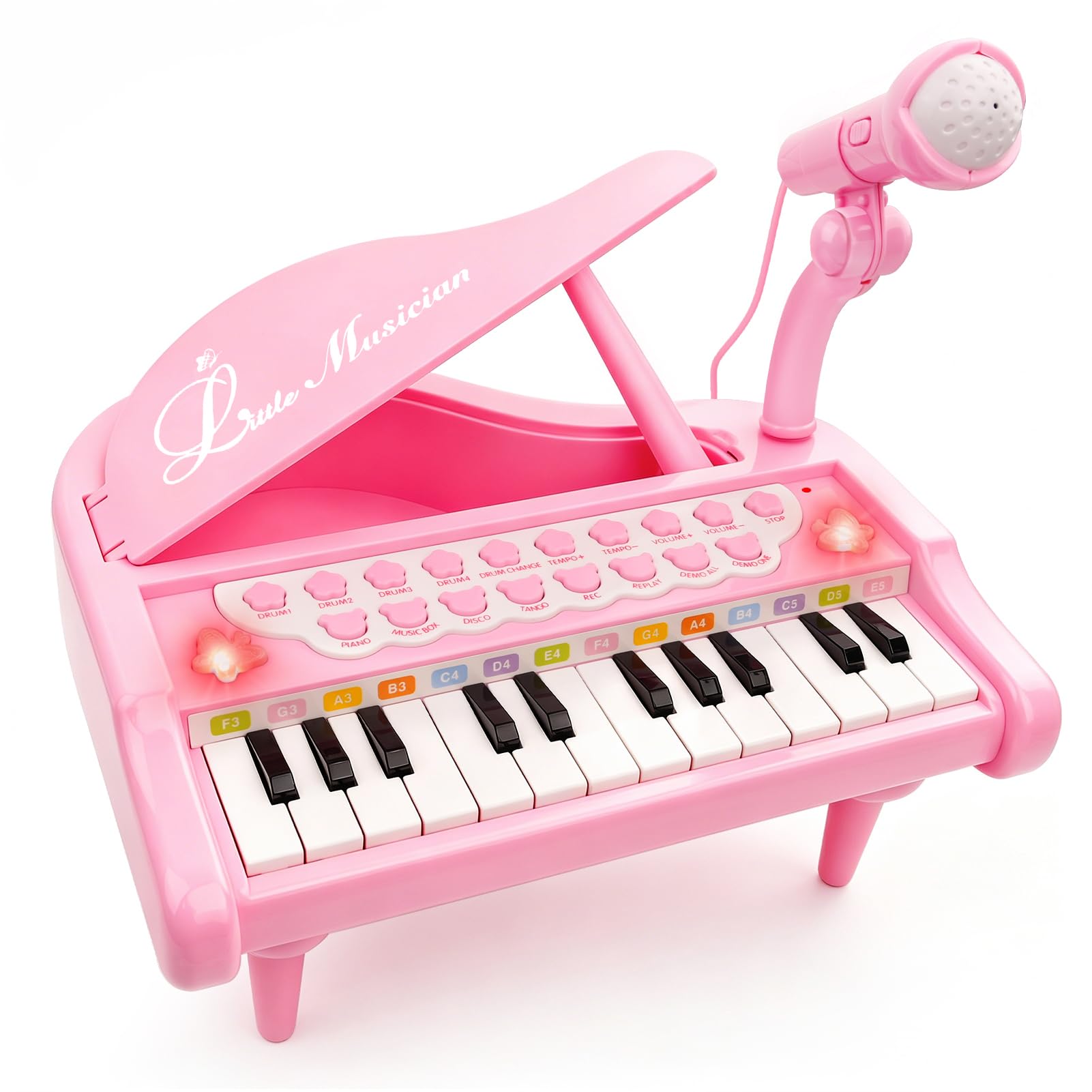
The microphone is the reason a child will ask for this one by name. It turns the keyboard into a performance toy: sing a phrase, press record, play it back, and do it again louder. We found the record and playback loop more engaging than the built-in demo songs, because it puts the child’s own voice in the music. For a 3- or 4-year-old who wants to sing along, that is a stronger hook than another nursery-rhyme button.
The rest of the package is built for tabletop play. There are 22 songs, four instrument modes, eight percussion sounds, and LED lights, so a child can switch from piano to music box to disco without any help. The microphone is still the feature that earns the space, and the small footprint makes it easy to move from the living room to a bedroom. The electronics are the part to check: sound can glitch and the microphone can stop working, so test every function during the return window. A dead microphone turns the main feature into a plastic prop, so buy from a seller with easy returns.
Pros
- Microphone and record/playback drive the play
- 22 songs and four instrument modes
- Compact enough for tabletop play
Cons
- Compact 24-key layout is not for lessons
- Runs on four AA batteries
The Love&Mini 24-key is our pick for a compact sing-along toy: the microphone and playback are the draw, and the small keys suit little hands.
Best for 6-12 Months
WITALENT Elephant Piano

Key Features
- Keys: 30
- Age range: 6 months and up
- Activities: 6 hand-training parts
- Dimensions: 8.07 x 5.59 x 2.56 inches
- Price: Budget
A baby activity center with a keyboard attached is a better description than piano for this one, and that is not a criticism. For a 6-month-old, there is a nose to turn, a ball to rotate, a flower to pull, a page to flip, and a ring to grasp, all before a child has the coordination to pick out a tune. The 30 keys and animal sounds give the piano part a real role, but the other activities are what keep a baby coming back.
We like that the piano is not the only thing to do. A baby can press a key and get a light or a sound, then turn the elephant’s trunk for a different reward, which is exactly the cause-and-effect play this age needs. The learning mode adds numbers, instrument voices, and animal sounds; the music mode lets a baby make a tune without a wrong note. For a car seat or a diaper bag, the small size is an advantage.
The catch is that it is a lap toy, not a floor piano. At roughly 8 by 5.6 by 2.6 inches, it will feel small to a 2-year-old and useless to a 4-year-old who wants to play real songs. If you want a piano for a toddler to grow into, this is not it; if you want to keep a baby busy in the high chair, it earns its place.
Pros
- Six hand-training activities beyond the keys
- 30 keys with lights and animal sounds
- Small enough for a car seat or diaper bag
Cons
- Some units arrive with dead functions
We keep the WITALENT elephant for the 6- to 12-month stage, when a lap-size activity toy matters more than a keyboard a child can learn songs on.
How We Chose and Tested the Best Kids Pianos
We started with roughly 40 kids pianos — acoustic uprights, baby grands, and electronic keyboards — and narrowed the field by reading the fine print: key count and key width, whether a bench or stand came in the box, published dimensions and weight, and how easy batteries and replacement parts were to find. Anything without real measurements got cut. That left 12 units, from budget toy-store models to spendier heirloom-style uprights, which we tested for six months in our own homes with kids aged 2 to 7.
Testing happened where the piano actually lives: playroom floors, living room rugs, and one grandparents’ hallway. We watched how much pressure a 2-year-old needed to get a note, whether a palm slap triggered a jingle instead of a chord, and whether the volume dropped low enough for a 7 p.m. performance. Parents logged how often each piano got played unprompted — our most honest measure of fun — and whether siblings fought over it or drifted away after a week.
We leaned on the lids, sat down on the benches, and pushed each one sideways across hardwood and carpet to see what tipped or slid. Every few weeks we checked whether keys still sprang back cleanly, whether the tuning had drifted, and whether the finish survived a wipe with a damp cloth. We also measured footprints against real floor space, timed assembly solo out of the box, and noted which batteries or adapters came included.
How to Choose a Kids Piano
The right kids piano is the one your child can play without help, so match the key count and layout to their age before you fall for a long list of modes.
Start with your child’s stage and key count
A 6-month-old needs a cause-and-effect toy with a few keys and activities; a 3-year-old can use a 25-key tabletop piano; a 5- or 6-year-old is ready for 37 keys and a stand. Key count is not a quality score. A 25-key toy covers nursery tunes, while 37 keys let a child play with two hands without running out of notes. We prefer a smaller keyboard a child can reach over a full-size instrument that sits unused.
The trap is the word compact. In a listing it often means the piano fits a shelf, not that it fits a child’s lap or hand span. Check the listed dimensions and key width before ordering.
Listen for tone and a volume you can live with
Kids pianos live in the same room as you, so tone matters more than the number of demo songs. A pleasant, restrained sound is easier to hear twenty times a day than a loud, brittle speaker. Volume control is worth having on an electronic keyboard; on a toy piano, a naturally quiet tone can be a virtue. We listen for notes that sound in tune and a low setting that can fade into the background.
If you can compare only one thing, compare the sound at low volume. That is where cheap speakers buzz and keys sound uneven, and where a toy that seemed charming in the store becomes tiresome at home.
Check the keys, the base, and the battery door
Keys are the part that fails first. A sticky or loose key turns a piano into a frustration, so press every key before the return window closes. A wide, stable base matters too: a tabletop piano with little legs can tip when a baby leans on the front edge. Wooden toys feel more substantial and often sound warmer, but plastic can be perfectly durable if the case and keybed are solid.
Use the stated AA batteries, keep the compartment closed, and remove the batteries for long storage. Put a tabletop piano on a firm, flat surface rather than a soft rug, and stay close when a baby is pulling up on it.
Decide how much setup and how many modes you want
At one end, the B. toys Mini Maestro comes assembled and ready to play; at the other, a 37-key keyboard with a stand and stool takes up floor space and needs a permanent spot in the playroom. More modes are not automatically better. A 3-year-old can be overwhelmed by eight rhythms and five drum sounds; an older beginner may enjoy them. We like a keyboard that can be a piano first and a sound-effects toy second.
If space is tight, a tabletop model with a songbook will get more use than a floor-standing setup that has to be moved for vacuuming. If your child has already asked for lessons, the stand and full-size playing position are worth the room.
Frequently Asked Questions
Can a kids piano be tuned?
Toy pianos are not tunable. Acoustic toy pianos use fixed metal rods, and electronic models use a fixed sound chip, so there is no tuning pin to adjust. If one note sounds sour, check the batteries first; if it still sounds wrong, treat it as a defect and use the return window. Do not try to bend or file the rods.
How should I clean a kids piano?
Wipe the keys and body with a damp cloth and a little mild soap, then dry immediately; do not run water over the toy or soak the keys. Keep liquids away from the battery compartment, and remove the batteries if the piano will sit unused for weeks. For wooden models, avoid leaving it in a humid bathroom or next to a radiator.
Can my child use headphones with a kids piano?
Some electronic keyboards have a headphone jack; most toy pianos do not. If quiet practice matters, check the listing for a headphone jack before buying rather than assuming the volume control is enough. If the listing does not name one, assume there is not one, and choose a keyboard that lists the jack if silent play is the priority.
Final Verdict
Start with the B. toys Mini Maestro if you want one first piano that sounds pleasant, comes ready to play, and gives a preschooler a songbook to follow. It is the easiest of these to live with, and the 25-key range is enough for the years when a child is learning that music is something they can control. For a baby who is still swiping at keys, the Baby Einstein Magic Touch Piano is the better shape; for a 5- or 6-year-old asking for a real keyboard setup, the Best Choice Products 37-key is the step up.
