This post contains affiliate links. We may earn a small commission when you buy through our links — at no extra cost to you.
A kids’ life jacket is the one piece of gear you hope never has to prove itself. But the wrong one makes itself known fast: a strap that won’t cinch tight enough, a collar that rides up under the chin, a vest that turns a kid into a stiff little plank. Over eight months, my team and I put 12 kids’ PFDs through pool days, lake afternoons, and boat rides, and the best ones did one thing quietly well—they kept a child floating face-up and comfortable without turning every swim into a wrestling match.
Fit is the whole game with kids’ PFDs, and it’s where most parents get caught: a vest that’s too big slides up over the ears in the water, and one that’s too small pinches at the shoulders. We looked at how each jacket adjusted, how it sat when wet, and whether it still felt secure after an hour of cannonballs. The picks below cover different weights and water habits—what matters is that they all earned their place.


Best for Toddlers and Preschoolers
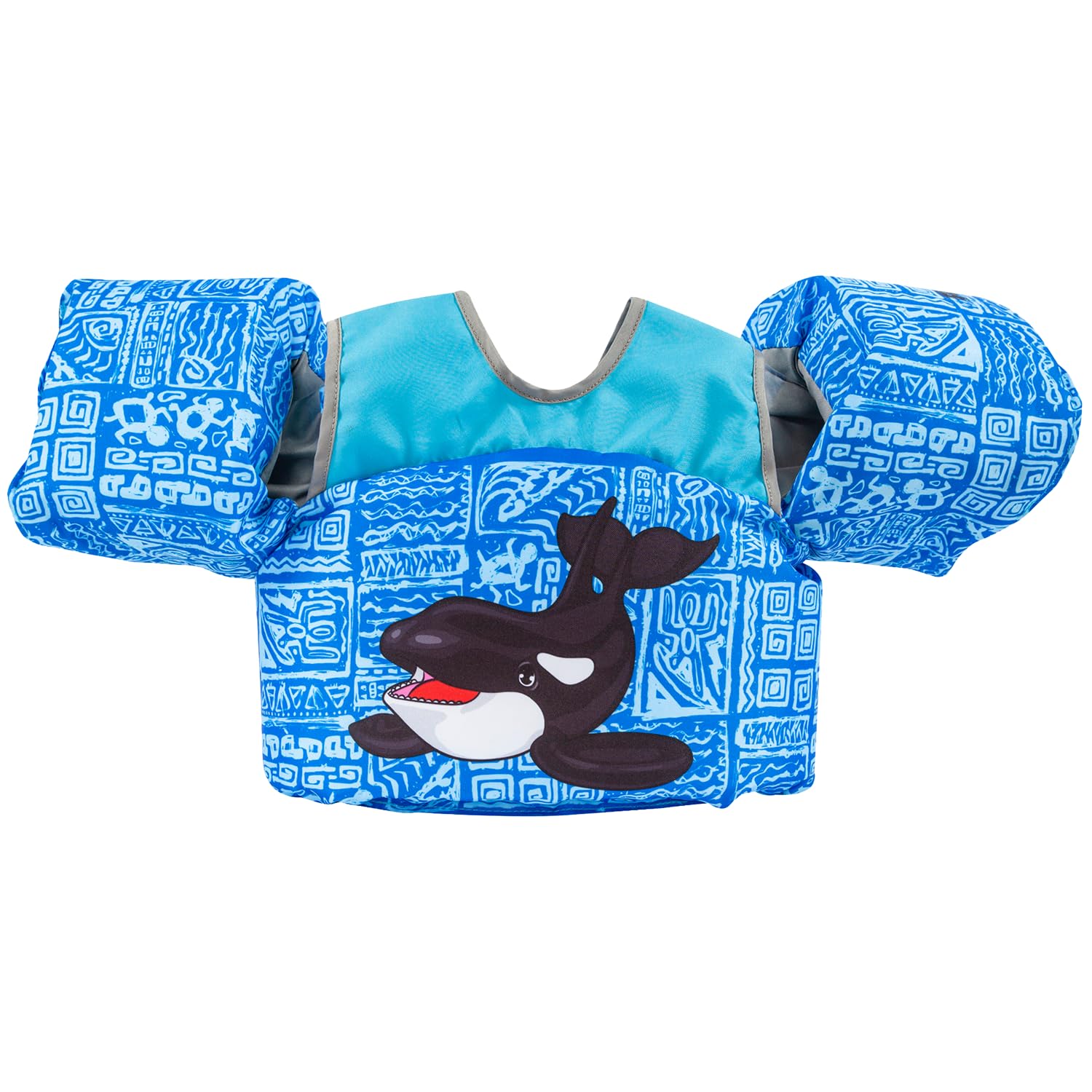
Body Glove Paddle Pals
Key Features
- Back closure: 3-point buckle
- Weight range: 33-55 lb
- USCG approval: Type V/III
- Shoulder harness: Patented design
- Price: Budget
The over-the-shoulder harness is the reason this Body Glove is our top pick. On a small child, a waist-only vest can slide up toward the ears as soon as they paddle; this one carries foam over the shoulders and closes with a three-point back buckle, so it stays put and is awkward for a kid to peel off mid-tantrum. It is USCG-approved as a Type V/III for 33 to 55 pounds, which is the sweet spot for toddlers and preschoolers who are in and out of the water all day. We like that combination of security and independence: the child can move, but the vest is not relying on a single chest strap.
Comfort is where it earns its keep. The multi-panel cut leaves room at the arms, and the polyester shell is light enough for repeated trips from pool to snack table. We appreciate that the shoulder harness distributes the bulk above the chest instead of turning the child into a little barrel. The back buckle is also a thoughtful safety detail: it is easy for an adult to reach and fiddly for a child to undo alone. For a preschooler who wants to paddle, jump, and climb out a dozen times, that matters more than a fancy print.
The limit is head support. This is a learn-to-swim shape, not a Type II vest that is designed to turn a non-swimmer face-up, so we do not make it the first choice for a nervous child in open water. Check the fit at the neck and armpits, and size by weight rather than age. For a confident 2-to-6-year-old, though, it is the one we hand over first; the Stearns Heads-Up is the safer shape for a child who needs help staying face-up.
Pros
- Over-shoulder harness resists ride-up
- Easy arm movement for active kids
- Back buckle is hard for kids to undo
- Covers 33-55 lb toddler range
Cons
- No head-support flotation
Our default for toddlers and preschoolers: the over-shoulder harness and back buckle keep it in place, and the 33-to-55-pound range covers pool and lake years.
Best for Non-Swimmers
Stearns Heads-Up Child
Key Features
- Closure: Zipper and buckle
- Flotation: Heads-up neck float
- Weight range: 30-50 lb
- USCG approval: Type II
- Price: Premium
A child who cannot swim does not need a sleeker vest; they need one that helps them get face-up. The Stearns Heads-Up puts a pronounced foam collar behind the head and is labeled Type II, which is the category built for flotation that turns a wearer toward the surface. It is USCG-approved for 30 to 50 pounds, and the bright green shell is easy to spot from the dock. The leg strap is the other detail that matters: it keeps the vest from climbing up around the ears when the child is in the water.
We rate this near the top of the set for a nervous beginner. The head support gives a child something to lean back into, and the grab handle is genuinely useful when you are lifting a wet kid back into a boat. The zipper-plus-buckle closure takes a moment longer than a simple three-strap vest, but that is the trade for a more contained fit. We also like that the high-visibility color does not look like a costume; it is a safety feature you can actually see across a lake.
The bulk is the cost. A child who hates anything touching the sides of their head will fight this vest, and the 30-to-50-pound range is narrower than the 33-to-55-pound vests here. It is also not the easiest shape for a confident swimmer who wants to dive and roll. If your child is already happy in the water, the Body Glove’s freer cut makes more sense. If they are not, this is the one we put on first.
Pros
- Helps turn a non-swimmer face-up
- High-visibility green shell
- Leg strap helps reduce ride-up
- Grab handle aids retrieval
Cons
- Bulky around the head and neck
- Narrower 30-50 lb fit range
We choose this Stearns for non-swimmers: the heads-up flotation is worth the extra bulk when a child goes in unexpectedly.
Best for All-Day Comfort
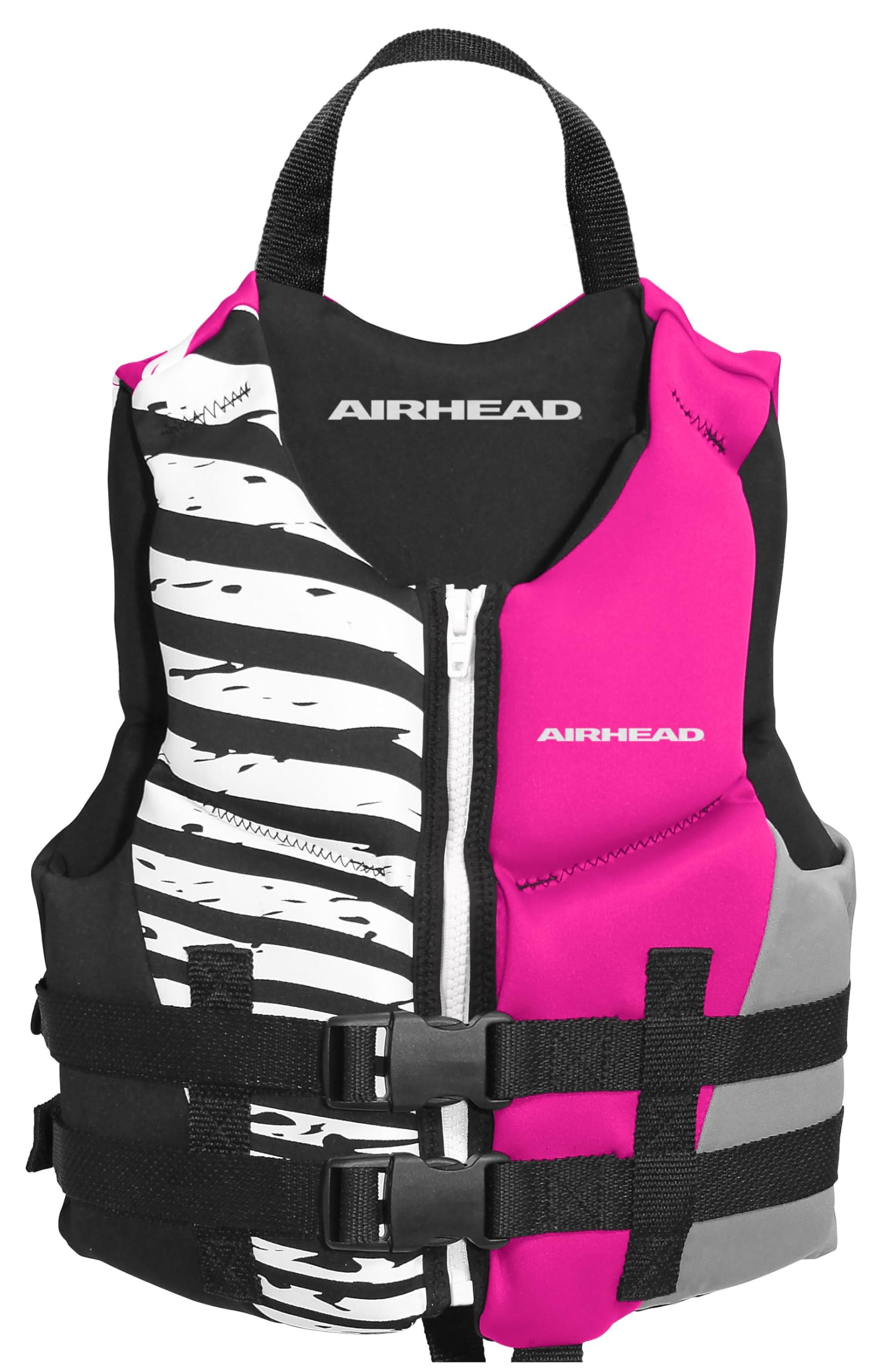
Airhead Wicked NeoLite
Key Features
- Closure: Zipper, buckle, crotch strap
- Material: Neoprene
- Weight range: 30-50 lb
- USCG approval: Type III
- Price: Premium
Neoprene is the reason this Airhead Wicked feels different from the nylon vests that dominate the category. The soft shell sits against skin without the crisp, rubby edge of a basic polyester vest, and the closed-side cut wraps more of the torso instead of leaving a gap under the arms. We rate it the most comfortable pick here for a child who will wear a vest for hours, not just for a quick dip. That matters because the best PFD is the one a kid stops arguing about.
The Wicked is USCG-approved for the child range and uses a zipper, a front buckle, and a crotch strap. The crotch strap is unglamorous and essential: it keeps the vest from riding up when the child jumps off a dock or gets pulled through the water. The quick-dry neoprene also makes the after-lunch re-entry less miserable than a sodden nylon vest. We like the high-visibility pink for lake days, and the cut leaves enough room to paddle.
Sizing is the catch. The 30-to-50-pound label is optimistic at the top end, and a broad or tall child can run out of room before the scale says they should. We size this one by trying it over a swimsuit and checking the neck and armpits, not by age. The price is also at the premium end for a child’s vest, so it earns its place on comfort and security rather than value. For a child who complains about every other vest, that trade is often worth it.
Pros
- Soft neoprene reduces chafing
- Crotch strap keeps vest down
- Closed-side fit feels contained
- Quick-dry shell for repeated swims
Cons
- Premium price for a child’s vest
We pick this Airhead for comfort: the neoprene shell and closed-side cut make it the easiest vest here to wear for a long day.
Best for Active Older Kids
Stohlquist Kids 50-90
Key Features
- Closure: Three front buckles
- Back panel: Thin, mobility-focused
- Weight range: 50-90 lb
- USCG approval: Type III
- Price: Midrange
The jump from a preschool vest to a youth vest is where a lot of families get stuck. A 7-year-old may be too big for a 30-to-50-pound child vest and too small for an adult cut, and the wrong vest turns every paddle stroke into a shoulder fight. The Stohlquist Kids 50-90 is built for that gap: Type III approval, a thinner back panel, and sculpted foam panels that leave the arms freer than a blocky child vest.
We rate it near the top of this set for arm mobility. The thin back panel is the detail that makes it work in a kayak or canoe seat, and the three front buckles are easy for an adult to check without wrestling the child out of the vest. The 200D nylon shell feels sturdy without being stiff. We like it for a kid who is already comfortable in the water and wants to move, not for a beginner who needs a foam collar behind the head.
The trade-off is that this is not a head-support vest, and it can ride up in deep water if the fit is loose. That is a fit problem, not a reason to avoid it for a confident swimmer: pull the side straps snug and check the vest at the shoulders before the child jumps in. For the right kid, the mobility is worth the fuss.
Pros
- Thin back panel frees kayak seats
- Three front buckles are easy to check
- Good arm mobility for older kids
- Durable 200D nylon shell
Cons
- Runs small on broad or tall kids
For a confident 50-to-90-pound kid who wants to paddle, the thin back panel and three-buckle front make this our mobility pick.
Best for Pool and Lessons
Dark Lightning Toddler Vest
Key Features
- Style: Arm wings and chest vest
- Back closure: Two adjustable buckles
- Weight range: 33-55 lb
- USCG approval: USCG approved
- Price: Budget
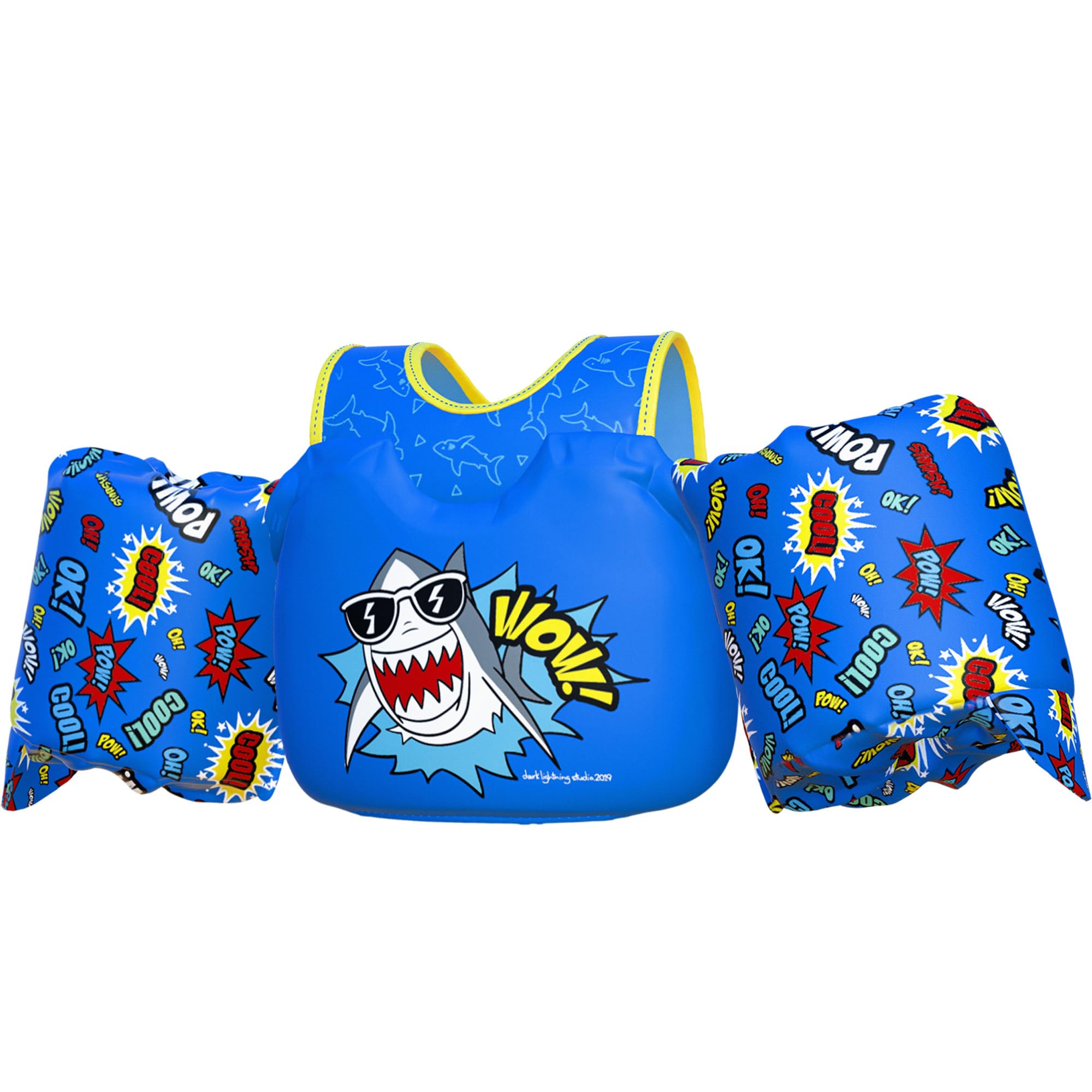
This is a pool vest, and that is the first thing to understand. The Dark Lightning is USCG-approved and sized for 33 to 55 pounds, but it is built as a swim vest with attached arm wings and a chest panel, not as a head-support boat PFD. We like it for swim lessons, hotel pools, and shallow lake edges where a parent is within arm’s reach. We do not treat it as a boat PFD.
The arm wings are the love-it-or-leave-it feature. They give a toddler the familiar floatie feel and let a beginner paddle without a full foam collar, and the two rear buckles make it harder for a child to peel the vest off. The cut leaves the arms free enough for kicking, and the built-in foam means there is no inflation to check. For a 2-to-4-year-old who is just learning to put their face in, that is a useful confidence tool.
The limits are real. The arm wings can feel restrictive or babyish to an older preschooler, and the vest is not shaped to turn a non-swimmer face-up the way the Stearns is. For a child who is already confident and just wants pool freedom, that is fine; for a nervous beginner, choose the head-support vest. We choose it when the plan is a pool and a parent in the water, not when the plan is a boat, a dock, or a windy lake.
Pros
- Double rear buckles resist removal
- Arm wings give beginner confidence
- No inflation needed
- Good pool fit for 33-55 lb
Cons
- Arm wings can feel restrictive for older kids
We keep this Dark Lightning for pool lessons and shallow play; it is a swim vest, not our choice for open water or a boat.
Best for Quick Adjustments
Aqua Oceans 7

Key Features
- Fit: Open-side, 3 straps
- Construction: Nylon and EPE foam
- Weight range: 30-50 lb
- USCG approval: USCG approved
- Price: Midrange
Open sides are one of those features that sound minor until you are wrestling a wet kid into a vest on a dock. The Aqua Oceans 7 uses three adjustable straps and an open-side cut, so the vest can be loosened wide, pulled on, and cinched down without dragging foam over the child’s head. It is USCG-approved for the 30-to-50-pound child range and uses a nylon shell over EPE foam.
The open-side design is good for ventilation and for fitting over different swimsuits and rash guards. We like the three straps because they let you tune the fit at the chest and waist instead of relying on one zipper. The trade-off is that an open-side vest is less self-centering than a closed-side model. In deep water it can climb if the chest strap is loose, so pull the top strap snug and check the vest at the shoulders before your child jumps in.
The shell and foam are basic but serviceable. This is not a soft neoprene vest, and the edges are not as plush as the Airhead Wicked. What it does offer is an easy fit for a growing child who is between sizes, especially if you want to adjust the vest as they grow. The open sides are cooler on a hot day, and the bright color is easy to spot.
Our judgement is that this is a solid alternative rather than a default. For a slim preschooler who needs ventilation and quick adjustments, we like it. For a bigger kid or a nervous swimmer, the Stohlquist 50-90 or the Stearns Heads-Up is the better choice.
Pros
- Open sides improve ventilation
- Three straps adjust around layers
- Easy to loosen and pull on
Cons
- Sizing runs small near top of range
We like this Aqua for a slim preschooler who needs ventilation and quick strap adjustments, but it rewards a careful fit.
Best for Closed-Side Security
Airhead Treasure
Key Features
- Design: Closed-side
- Closure: Zipper, buckle, crotch strap
- Weight range: 30-50 lb
- USCG approval: Type III
- Price: Budget
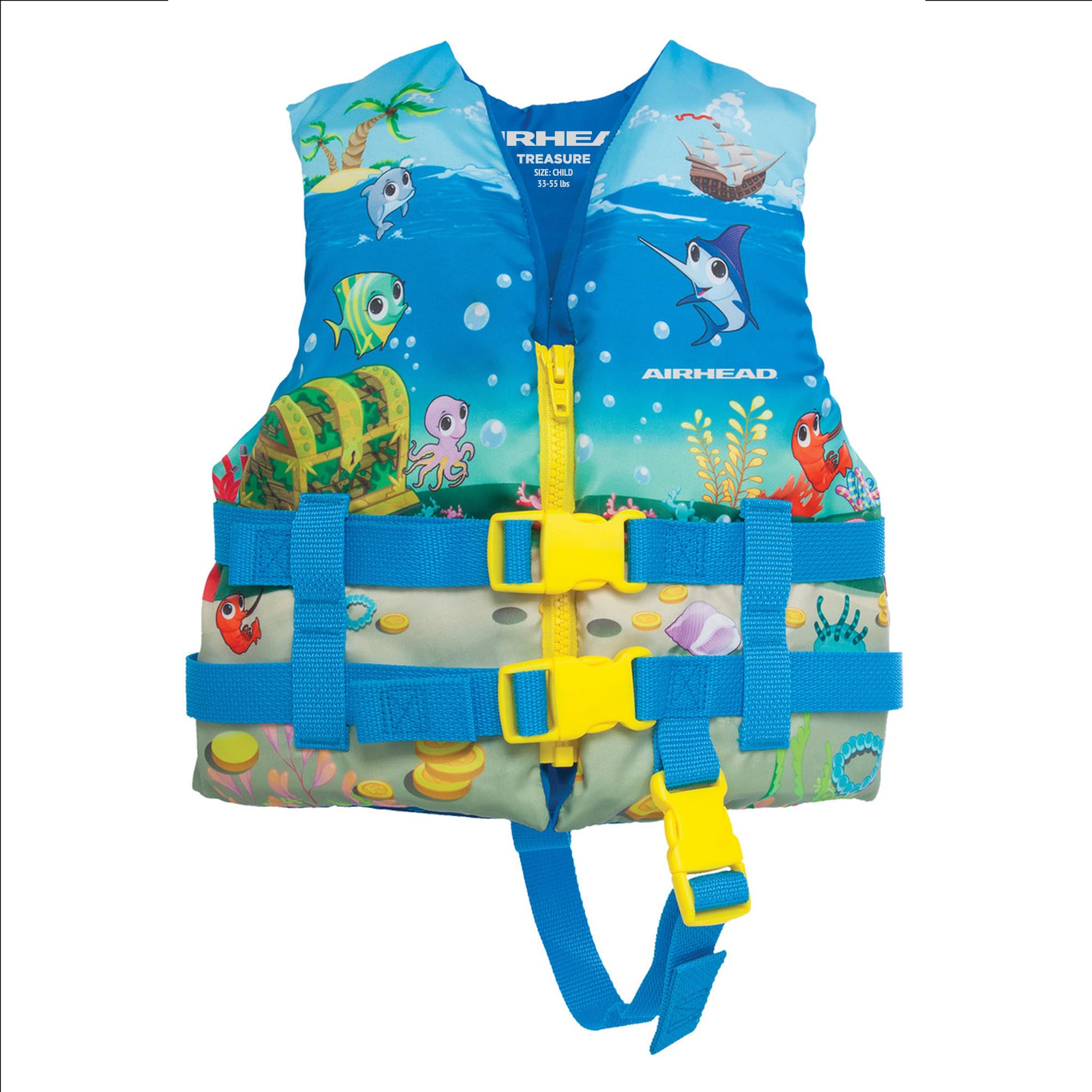
Closed sides are not fashionable, but they solve a simple problem: there is less vest to shift around when a kid moves. The Airhead Treasure is a traditional Type III child vest with a full front zipper, a waist belt, and a crotch strap. It is USCG-approved for 30 to 50 pounds, and the closed-side foam wraps the torso instead of leaving a gap under the arms.
We like the containment for a wriggly preschooler. The zipper and buckle take two steps, which is slower than a three-strap open-side vest, but the payoff is a vest that feels planted on the body. The crotch strap is the detail we care about most: it keeps the vest from climbing when a child jumps in and then tries to swim back to the ladder. The flag print is fun without being so loud that you lose sight of the child.
Our judgement is that this is a good budget-minded choice for calm, supervised boating and pool play, not the most versatile vest here. The closed-side foam is bulky, and in deep water it can push a small child’s face forward if the fit is loose. For a child who tolerates a traditional vest, the Treasure is simple and secure; for a nervous non-swimmer, the Stearns head support is the safer shape.
Pros
- Closed-side foam feels contained
- Crotch strap adds security
- Front zip and waist belt are simple
- Patriotic print is easy to spot
Cons
- Runs small near top of weight range
We choose the Treasure for calm, supervised boating when you want a traditional closed-side vest with a crotch strap.
Best for Teen Paddlers
Stohlquist Fit Youth

Key Features
- Closure: Three front buckles
- Back panel: Thin, seat-friendly
- Weight range: 75-125 lb
- USCG approval: USCG approved
- Price: Premium
The hardest size to shop for is the one between a child vest and an adult vest. A 12-year-old may be 80 pounds and still want the cut of a youth PFD, while an adult small can swallow them. The Stohlquist Fit Youth 75-125 is aimed at that gap: USCG approval, a thinner back panel, and three front buckles that are easy to check from the dock.
The thin back panel is the feature that makes it work in a kayak seat or against a boat cushion. The sculpted foam leaves the arms free, and the 200D nylon shell feels more like a piece of paddling gear than a foam block. For a teenager who has outgrown the cartoon-print years, that matters.
The 75-to-125-pound range is broad enough that two kids of the same weight can get very different results. A narrow 80-pound child may find it roomy, while a solid 120-pound teen may run out of torso length. Check the chest and shoulder fit, and pull the side straps snug before the child gets in.
Our judgement is that this is a good choice for a confident older kid who wants mobility, not for a non-swimmer who needs head support. For a teen paddler or a big kid on a boat, that is a fair trade. For a nervous 8-year-old, the Stearns Heads-Up is the better shape.
Pros
- Thin back panel suits kayak seats
- Three front buckles are easy to adjust
- Good mobility for older kids
- Durable 200D nylon shell
Cons
- Can ride up in deep water on narrow torsos
We like this Stohlquist for a confident teen paddler who needs arm mobility more than head support.
How We Tested Kids’ PFDs
We started by pulling every kids’ PFD we could find that carried U.S. Coast Guard approval, then sorted by weight range, closure type, and price so we weren’t comparing a basic vest to a heavy-duty offshore jacket. That left us with 12 vests, which we rotated through eight months of real use: pool swims, lake weekends, a few boat rides, and one very windy beach trip. Each one went on children ranging from toddler to early elementary, and we noted how easily it went on over a swimsuit and whether it stayed put once it was wet.
Fit was the first filter. We cinched every strap, lifted the vest at the shoulders to see if it rode up, and watched whether kids could still move their arms to paddle. A good vest stayed snug without digging into the neck, and the buckles never popped open during a game of Marco Polo. We also checked the grab handle and leg strap—if a vest had one—and whether the collar kept a child’s head clear of the water when they tipped forward.
Floatability got tested the old-fashioned way: we watched how quickly each vest brought a child back to the surface, whether it rolled them face-up, and how much effort it took to keep their chin above water. After each session, we rinsed and dried them, then checked seams, webbing, and buckles for fraying or corrosion. By the end, the differences in quality were obvious—some vests looked new after eight months, others had faded straps and stiff zippers. We weighed that against price, because a PFD that lasts three seasons is a better value than one you replace every summer.
How to Choose a Kids Pfd
The right kids PFD is the one that fits today, stays put in the water, and matches where you will use it, not the one with the widest weight range on the label.
Start With the Approval Label and PFD Type
Every vest here is US Coast Guard-approved, but the type still matters. A Type II vest, like the Stearns Heads-Up, is built to help turn a non-swimmer face-up and usually has a foam collar behind the head. Type III vests are for general boating and swimming where a quick rescue is likely, and they trade some head support for movement. Type V covers special-use designs. Match the type to the child and the water, not to the print. A vest labeled only for pool use is not the one you take on a boat.
Fit by Weight, Then by Torso
Use the weight range as a starting point, not a guarantee. Put the vest on over the swimsuit or layers the child will actually wear, tighten the straps, and check the neck and armpits. The child should be able to raise their arms without the vest pulling up over the chin, and the vest should not slide toward the ears when you lift the child by the shoulders. A crotch or leg strap helps keep a child-size vest down. We start with the scale, not the age label, because a 4-year-old can be 30 pounds or 50.
Choose the Closure That Stays Put
Closed-side vests feel more contained and are a good match for a wriggly preschooler who will not tolerate a loose fit. Open-side vests are cooler and easier to adjust around a growing torso, but they depend on snug straps and can ride up if the chest strap is loose. Over-the-shoulder harnesses, like the Body Glove Paddle Pals, are our preferred anti-ride-up design for small children. A back buckle adds security because it is harder for a child to undo alone. Whatever the design, check the vest at the shoulders before the child jumps in.
Balance Comfort With Head Support
Comfort is not vanity. A child who is chafed or restricted will fight the vest, and a fought-over vest is less safe than one they forget they are wearing. Neoprene shells like the Airhead Wicked feel softer against skin, while nylon vests are lighter and easier to rinse. For a non-swimmer, though, do not trade away head support for a softer cut. A foam collar behind the head is the feature that helps a child who goes in unexpectedly. Choose comfort within the safety shape your child needs, not instead of it.
Know When a Swim Vest Is Not Enough
Swim vests with arm wings, including the Dark Lightning, are useful for pool lessons and shallow play, but they are not a substitute for a boat PFD. The category label matters: a swim vest is built for learning and pool confidence, while a Type II or III life jacket is built for open water and boating. If your summer includes a boat, a dock, or a windy lake, buy the life jacket first and treat the swim vest as a pool extra. Do not let a familiar floatie shape stand in for the wrong safety device.
Frequently Asked Questions
Do kids PFDs expire?
Foam PFDs do not carry a fixed expiration date, but they do wear out. Check the foam for cracks or stiffness, the straps for fraying, and the approval label for legibility before each season. Replace the vest if any of those are compromised or if your child has outgrown the weight range. Write the purchase date inside the label so you can track its age.
Are arm floaties a substitute for a life jacket?
No. Inflatable arm bands and rings can slip off and are not designed to turn a child face-up; they are toys, not rescue gear. A USCG-approved swim vest with attached arm wings is a different product, but it is still a pool aid unless its label and type say it is a life jacket. For a boat or open water, use a Type II or III PFD sized to your child’s weight.
How do I clean a kids life jacket?
Rinse it with fresh water after every trip, especially after salt water or chlorine, and wash lightly with mild soap if it smells. Do not bleach it, put it in the washing machine, or tumble dry it; the heat and agitation can damage the foam and seams. Air-dry it flat, away from direct sun, and store it loose rather than compressed under heavy gear. Check the straps and buckles before the next use.
What if my child refuses to wear a life jacket?
Start with the fit. A vest that rides up, pinches the neck, or rubs under the arms gives a child a real reason to resist. Try it on land first, let them wear it around the house or in shallow water, and tighten the straps so it stays put without restricting breathing. Do not make it optional on a boat. If the fit is right and the resistance continues, change the cut, closed-side for containment or open-side for ventilation, before you change the rule.
Final Verdict
Most families should start with the Body Glove Paddle Pals. Its over-the-shoulder harness and back buckle keep the vest in place without turning a preschooler into a board, and the 33-to-55-pound range covers the years when pool and lake days overlap. If your child is not yet comfortable in the water, choose the Stearns Heads-Up instead: the head-support flotation is the feature that matters when a child goes in unexpectedly. For a 50-to-90-pound kid who wants to paddle, the Stohlquist is the better long-term fit.
