This post contains affiliate links. We may earn a small commission when you buy through our links — at no extra cost to you.
Two-year-olds are the most honest audience you will ever shop for. They can’t fake delight, and they can’t fake boredom either — hand a 2-year-old the wrong thing and it hits the floor in under a minute. The sweet spot is narrow: toys that are too babyish get ignored, and anything with too many steps ends with a parent quietly shelving it. What actually works is something that sits just at the edge of what a toddler can almost do, then lets them nail it on their own.
I’ve spent the past four months watching my team hand 16 different gifts to real 2-year-olds — on playroom floors, at a birthday party, in the back seat, and once in a bathtub. The ones that kept coming back out of the toy bin were sturdy enough to survive being dropped, thrown, and wiped down, and simple enough that a toddler could get them going without a grown-up hovering. They also didn’t punish the adults: a toy with one song stuck on repeat is a toy you’ll be hiding on a high shelf by week two. The gifts that earned repeat play are below.


Best for First Building
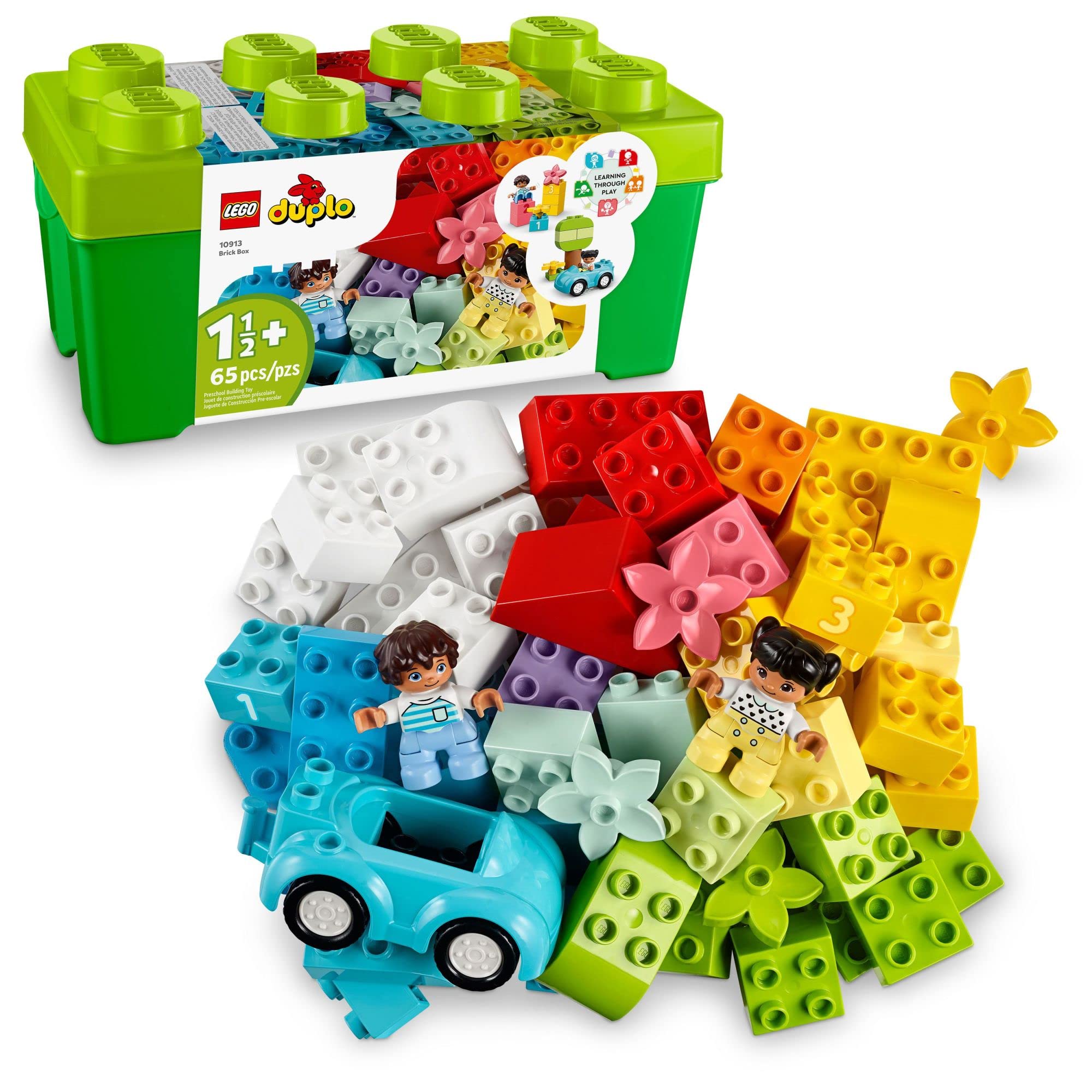
LEGO DUPLO Brick Box 10913
Key Features
- Pieces: 65
- Storage: Brick-shaped storage box
- Also included: Toy car, windows, flowers, tree
- Stated age range: 18 months and up
- Price: Midrange
Eighteen months is the number that matters on this box. A two-year-old is already past it, which means the set asks nothing of them they cannot do: the bricks are big enough to grab with a whole hand, they click together with a push, and they come apart without an adult. That is why this is the gift we hand over most often, and the one we reach for when we know nothing about the child except their age.
The 65 pieces do more than the count suggests. There is a car with moving wheels, windows, flowers and a tree to build around, plus a booklet of build ideas for the adult who opens the box and wonders what happens now. Everything goes back into a brick-shaped storage box that stacks on a shelf, and that matters more than it sounds — a building set with no home becomes a drawer of loose plastic within a month.
What we noticed at the two-year-old end is that the play looks nothing like building. It is stacking four bricks, adding a window, pulling the wheels off the car and starting again. That is the stage, and the set meets it without supervision. Store the box on a low shelf and it doubles as the thing a child can reach for themselves, which is most of the battle at this age.
Pros
- Bricks a two-year-old can click together alone
- Brick-shaped storage box included
- Car, windows, flowers and a tree to build around
- Still worth playing with at four
Cons
- Only 65 pieces — a starter quantity, not a fleet
Our default gift for a two-year-old: big bricks, a storage box, and a set that still fits a four-year-old — one present that covers more than the birthday.
Best for Word Learning
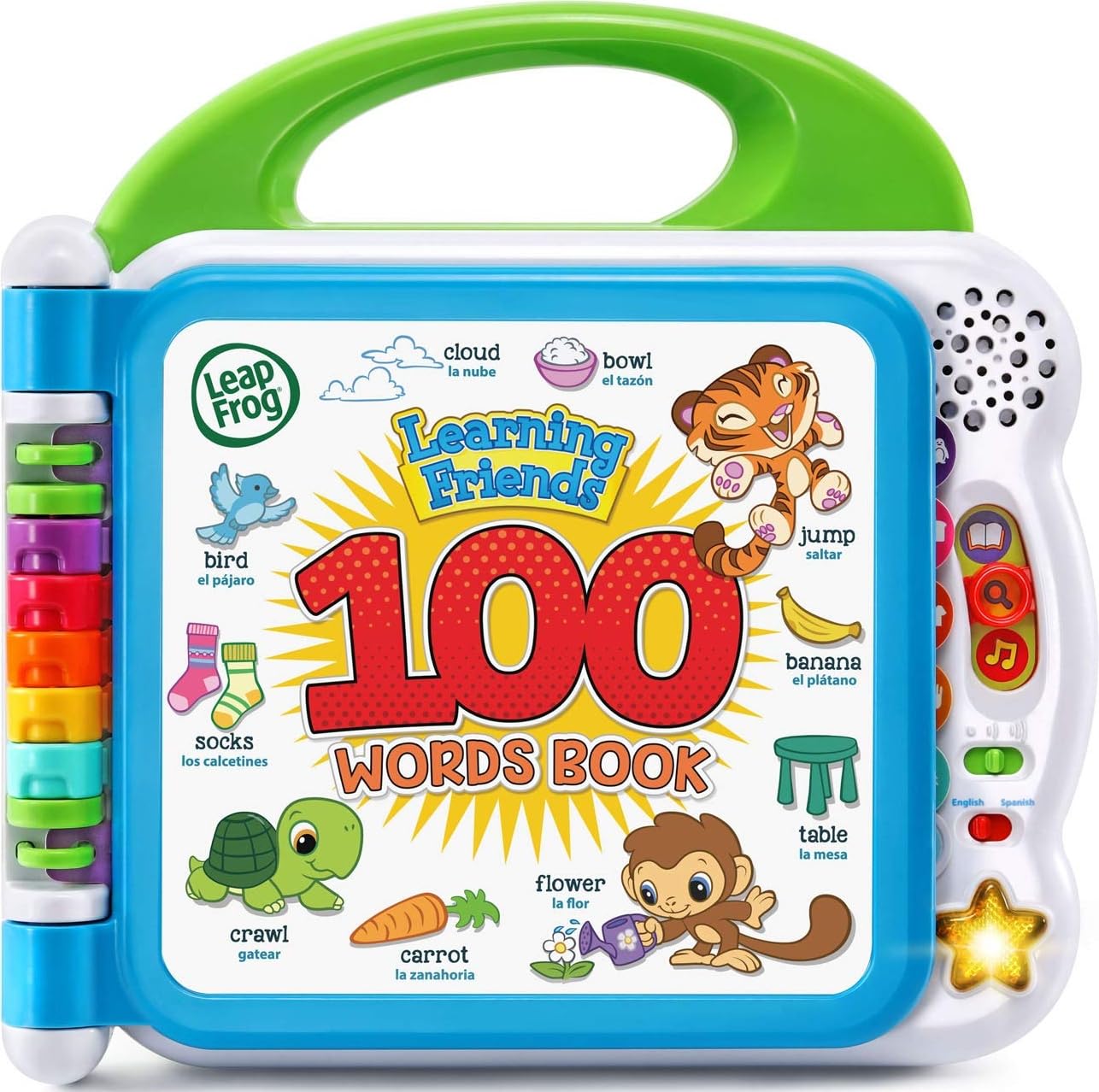
LeapFrog 100 Words Book
Key Features
- Words: 100+
- Batteries: 2 AA, demo set included
- Languages: English and Spanish
- Stated age range: 18 months to 4 years
- Price: Budget
A small switch flips the whole book into Spanish. Every word, every sound effect and both songs come in either language, which makes this the rare toy a bilingual household can hand to either set of grandparents without a briefing first.
We think it is the best learning buy here. More than 100 words sit in categories a two-year-old actually lives in — pets, food, mealtime, colors, opposites, outside — and touching a picture plays the word, a sound effect, and sometimes a fact. A child who has just started talking can run the whole thing themselves, and that independence is the part that matters at two.
One adjustment worth making for a younger toddler: a 9.4-inch page carrying a dozen words means each picture is small, so a child nearer 18 months will stab at the wrong one and not care. By two the aim is good enough. The pages are stiff board and survive being sat on, and the star button plays the theme song, which is either the best or the worst feature depending on your tolerance.
Pros
- 100+ words in both English and Spanish
- Touching a picture plays the word aloud
- A toddler can operate it unaided
Cons
- Recorded voice is clear but relentless
We think this is the best learning value on the list: a bilingual talking book a two-year-old drives alone, once the sing-song voice has worn you down.
Best for Pretend Play
LeapFrog Shapes and Sharing Picnic Basket
Key Features
- Batteries: 3 AA
- Play modes: 3
- Play pieces: 15
- Stated age range: 6 months to 4 years
- Price: Midrange
Fifteen pieces is a wonderful number for play and a difficult number for a living room. Plates, forks, cups, pretend food and a tablecloth all come out at once, and all of them go back inside the basket when the picnic ends. That is the design decision that makes the set workable in a real house: the toy is its own container, and it lights up and talks, so it gets played with rather than stored.
The clever part is the shape sorter in the lid. Drop a food piece into the right slot and the basket names its shape and color; press the butterfly and it politely requests a snack, which a two-year-old will rush to fetch. There are three modes — music, shapes and colors, and picnic time — so the toy changes character depending on which button a small hand lands on first.
Shape matching sits right at the edge of what a two-year-old can do, which is why this holds attention longer than the average pretend-food set. The pieces are chunky enough for a toddler grip, the songs are short, and the plastic has taken drops without complaint. What we cannot tell you is that a missing piece will be replaceable, because it will not.
Pros
- Shape sorter names each food’s shape and color
- Everything fits back inside the basket
- Three modes keep it from going stale
Cons
- No replacement pieces are sold
Fifteen pieces of shape-sorting, singing pretend play that fit a two-year-old’s hands exactly — decide now that the basket is where the pieces live.
Best for Cause and Effect
VTech Chomp and Count Dino
Key Features
- Batteries: 2 AA
- Food pieces: 8
- Stated age range: 12 months to 3 years
- Songs and phrases: 130+
- Price: Midrange
The whole toy is one action. Drop one of the eight food pieces into the dinosaur’s mouth and it tells you the color, the food, and sometimes the shape, then asks for another. In counting mode it counts what it has eaten. For a two-year-old in the middle of a putting-things-into-things phase, that loop is close to perfect.
The mouth is deep and the pieces need a firm push before they register. A determined two-year-old gets there; a child who gives up easily will hand the piece back to you instead. Show them once, pressing the piece down with a finger, and the problem largely goes away — it is a demonstration problem, not a design flaw.
Away from the mouth there is more than expected: five shape buttons, a spinning disc, wheels so it can be pushed along the floor, and more than 130 songs, melodies, sounds and phrases. The volume control and the auto shut-off are the two features parents notice most, because a toy that sings and then stops by itself is a toy you can leave in a room.
Eight food pieces is a lot to keep track of, and they are exactly the sort of thing that slides under a sofa cushion. If you can live with that, the reward is a toy that responds every single time a piece goes in, which is what keeps a two-year-old coming back. It is rated from 12 months to three years, so there is a full year of runway left on a second birthday.
Pros
- Names colors, foods and shapes as it eats
- Over 130 songs, sounds and phrases
- Volume control and auto shut-off
Cons
- Eight loose food pieces are easy to lose
The most satisfying cause-and-effect toy here: feed it a piece and it answers immediately, which is the exact feedback loop a two-year-old is hunting for.
Best for Active Play
Bouncy Pals Dinosaur Hopper
Key Features
- Cover: Removable, washable plush
- Weight: 3.9 lb
- Inflation: Hand pump included
- Stated age range: 18 months to 12 years
- Price: Premium
A hand pump comes in the box and inflation takes about a minute: no valve adapter, no hunting for a bicycle pump at nine in the morning. That alone puts it ahead of most inflatables, and it is why this is what we suggest when a two-year-old has energy to spend and not much yard to spend it in. The plush cover pulls off and goes in the wash, which matters for a toy that gets dragged across floors.
It is rated from 18 months, but the useful age is closer to two — the bounce needs enough leg behind it to get going. For a second birthday the timing is right, and the cover makes it a dinosaur rather than a piece of gym equipment, which is most of why a child picks it out of a pile. Check the seam when it first arrives and you will know quickly whether you got a good one.
Pros
- Hand pump included; inflates in about a minute
- Removable, washable plush cover
- Works indoors and out
Cons
- An inflatable, so it needs topping up
The one to buy when the gift needs to burn energy rather than occupy a lap — it inflates in a minute and suits a child who is already two.
Best for Younger Toddlers
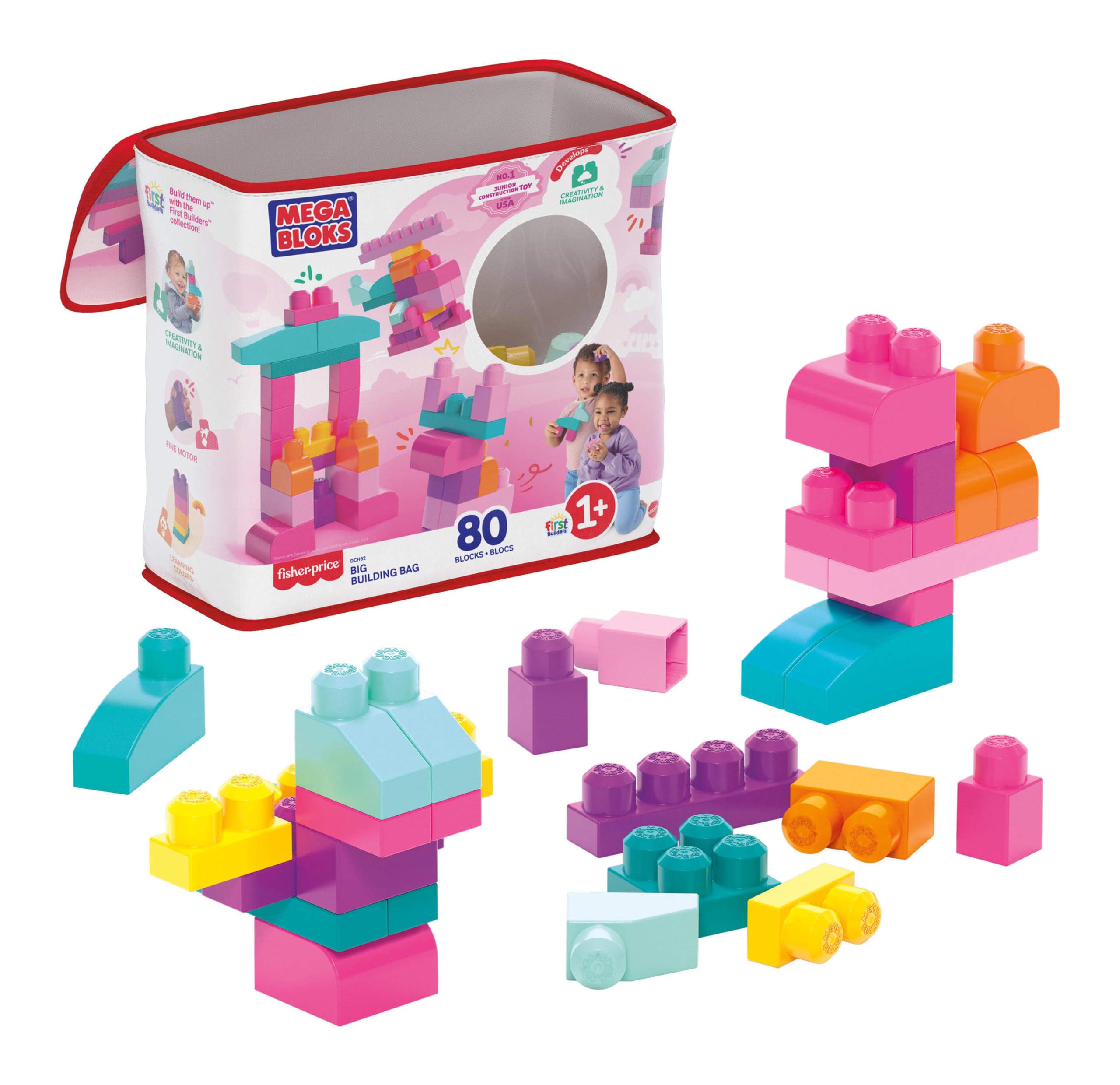
MEGA BLOKS First Builders Big Bag
Key Features
- Pieces: 80
- Storage: Carry bag
- Block style: Large interlocking blocks
- Stated age range: 12 months to 5 years
- Price: Budget
If the DUPLO box is the tidy option, this is the forgiving one. The blocks are bigger again, the corners are rounder, and they pull apart with far less force — which is the difference between a one-year-old joining in and a one-year-old watching from the edge of the rug. The bag holds 80 pieces, enough for a wall, a tower and a road at the same time.
We reach for this when the two-year-old is on the young side or still puts everything in their mouth. Each block is big enough for a whole hand to grip, which is the entire point at this age, and the 12-month age floor reflects it. It is also the set that shrugs off being sat on, tipped out and trodden on.
Big blocks build big structures, so a tower gets tall fast and then needs floor space; a two-year-old’s build will colonise the rug. They also click together firmly enough that a finished wall stays standing when it gets nudged, which is the difference between a game that continues and one that ends in tears.
Pros
- 80 large blocks that pull apart easily
- Carry bag doubles as storage
- Rated from 12 months up
Cons
- A soft bag rather than a stacking box
Bigger, softer blocks for smaller hands: we reach for this bag when the two-year-old is on the young side or still mouths everything they pick up.
Best for Quiet Play
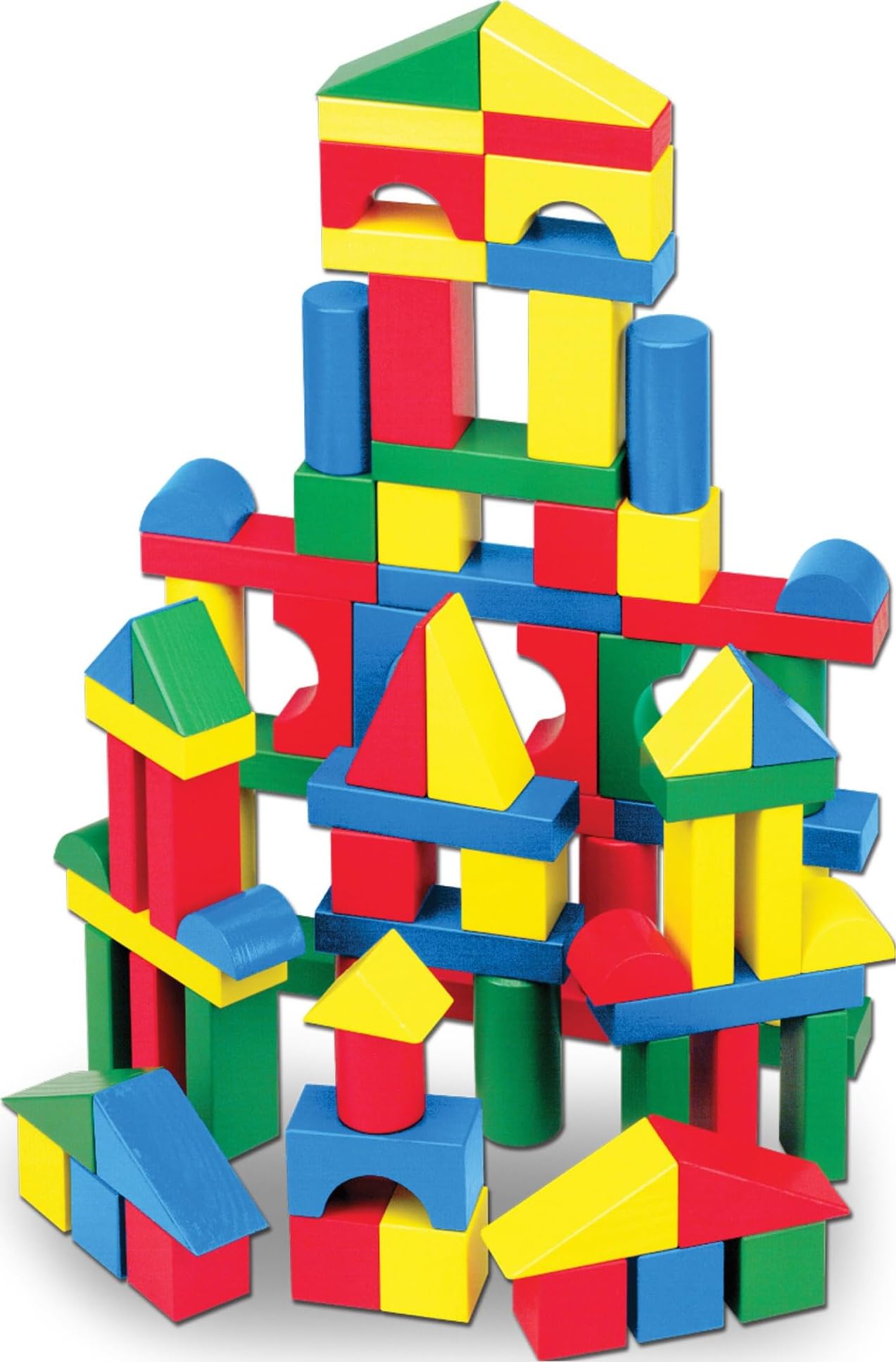
Melissa & Doug 100 Wooden Blocks
Key Features
- Pieces: 100
- Storage: Cardboard storage box
- Stated age range: 2 years and up
- Shapes and colors: 9 shapes, 4 colors
- Price: Budget
One hundred solid wood blocks, four colors, nine shapes, and a cardboard box. No batteries, no songs, no lights that flash when you clap. On a list where almost everything else talks back, this is the set that lets a room stay quiet — and the one that gets pulled out again at six, when the towers have turned into bridges and garages.
The shapes are the classic unit-block set, sanded smooth with rounded edges and paint that holds up to being chewed and thrown. A two-year-old uses them the way two-year-olds use blocks: stacking four, lining them up end to end, then flattening the lot. The cardboard box is sturdy enough to be the permanent home, which is a small mercy at tidy-up time.
What we like most is that there is no wrong way to play with them, and nothing to break. A two-year-old stacks, a four-year-old builds a garage, a six-year-old gets the whole box out again. For a family that has had enough of chirping plastic, this is the pick, and the price of entry is a cardboard box and a loud crash on a hard floor.
Pros
- 100 solid wood pieces, no batteries
- Rounded edges and paint that holds up
- The box works as permanent storage
Cons
- No clutch — towers topple instead of clicking
A quiet, battery-free classic that a two-year-old stacks and a six-year-old still uses — buy it for the family that has enough singing plastic.
Best for Just-Turned-Two
SEREED Baby Balance Bike

Key Features
- Weight: 3.5 lb
- Wheels: 4
- Maximum weight: 55 lb
- Stated age range: 12 to 24 months
- Price: Premium
Four wheels, no pedals, and steering that stops at 135 degrees. That last number is the one we care about: the front end cannot jackknife far enough to tip a small rider over, and it is why we are comfortable pointing a two-year-old at this rather than at a tricycle with a pedal they cannot reach.
At 3.5 pounds it is light enough that a child can walk it around and an adult can carry it under one arm, and the aluminum frame is rated to 55 pounds, so weight will not be what retires it. The seat sits low, the grip is soft and non-slip, and putting it together takes minutes.
The stated range is 12 to 24 months, which makes this the tightest window on the page. A child right around their second birthday fits it well; one who will turn three before the weather turns will be looking for something bigger. Measure that boundary against the actual child before you order, because it decides everything else.
For the child who has just turned two and watches an older sibling tear around on a scooter, this is the right first set of wheels, and the four-wheel stability means it gets used instead of parked. For a taller or older two-year-old, the hopper is the better buy — it has a much longer run and does not expire on a birthday.
Pros
- Four wheels with a 135-degree steering limit
- 3.5 pounds, easy for a child to move
- Rated to 55 pounds
Cons
- Narrow seat and short wheelbase
A light, stable first set of wheels for a child right around their second birthday — the stated range stops at 24 months, so check it first.
How We Tested the Best Gifts for 2-Year-Olds
We built the shortlist from scratch, pulling roughly 60 toys and gear pieces from retailer best-seller lists, specialty toy shops, and the gifts parents in our own lives keep buying for second birthdays. We crossed off anything that jumped more than one developmental stage — 2-year-olds are mostly into filling, dumping, stacking, and the first glimmers of pretend play — along with anything that needed a tablet, a subscription, or a small fortune in batteries to be fun. Then we handed 16 finalists to families with toddlers and checked back over four months.
The real testing happened on playroom floors, at snack time, in the back seat on the way to daycare, and at one birthday party where a pile of gifts met six 2-year-olds at once. We noted which ones got grabbed first, which came back out on day three and again in week three, and how much adult help each required — if a grown-up had to step in every 30 seconds to make it work, it lost ground. We also watched for the exact moment a toy tipped from challenging into frustrating, because that’s when a toddler walks away and doesn’t return.
Durability got its own round of abuse: we dropped each gift from toddler-table height onto hardwood, tossed it into a toy bin, wiped it down the way you’d clean up after a snack, then checked seams, paint, and small parts for anything loose or cracking. Anything that made noise we listened to up close and from across a room, tested whether the volume could be turned down or switched off entirely, and noted whether the speaker turned songs into a buzz. We finished by counting the hidden costs, from batteries to refill packs, and whether the thing fits on a shelf.
How to Choose a Gift for a 2-Year-Old
A second birthday is where a toy stops being something to look at and becomes something to do, and that single shift decides most of what is worth buying.
Read the top of the age range, not the bottom
A toy stamped 12 to 24 months is already halfway out the door on a second birthday, while one that starts at 18 months and runs to four or five has years left in it. We weight the upper end of the range more heavily than the lower, because the child grows into the top of it and out of the bottom.
The clearest example on this list is the balance bike: a genuinely good little ride-on that its own 24-month ceiling rules out for a child who will turn three before spring. If the party is months away, buy for the age the child will be, not the age they are.
Piece size and the mouthing question
Two-year-olds vary wildly here. Some have stopped putting things in their mouths; plenty have not, especially with a new sibling in the house. The reliable check is the piece itself: anything that fits inside a toilet-paper tube is a risk for a child who still mouths objects, whatever the box says.
That is why the large-format sets suit this age so well, and why a hundred small wooden blocks are a considered purchase rather than a reflex one. If you cannot picture the child’s habits, ask the parents — they will know instantly.
Batteries, volume, and the adults in the room
An electronic toy is a gift to the child and a houseguest for the parents. We look for a volume control and an auto shut-off before anything else, then at how many batteries it eats — most of the talking picks here run on two or three AAs, and the cells in the box are demo batteries that will not last the week.
In a small apartment or on a long drive, a quiet toy is a kindness. The dino has both a volume switch and auto shut-off; the wooden blocks have neither and need no batteries at all.
Loose pieces need a home
A set with fifteen pieces and a basket is a joy. The same set without the basket is fifteen objects under the sofa. We weight built-in storage heavily for this age, because a two-year-old cannot be relied on to tidy and the adults should not have to.
The picnic basket holds everything it comes with, the DUPLO box is shaped like a brick, and the MEGA BLOKS bag has a handle a child can carry. A set that arrives with nowhere to put itself tends to end up in a drawer.
How long it stays interesting
Novelty toys peak on day one. The ones worth buying get played with differently at three than at two — blocks that start as towers and become houses, a shape sorter that becomes a picnic. That is why the open-ended sets lead this list.
If you want one gift that covers the whole year, buy the open-ended thing. If you want the unwrapping to be the highlight, buy the one with the lights and the songs. Both are legitimate; just know which you are buying.
Frequently Asked Questions
Do 2-year-olds actually build with blocks, or is that for older kids?
At two it is stacking, sorting and knocking down rather than building — a tower four blocks high is a good day. That is still exactly the skill the toy is for: grip, balance, and cause and effect.
Large interlocking bricks make the payoff easier than plain wooden blocks, which is why we point most second birthdays at a big-format set. The houses and garages arrive around three.
What do I buy a 2-year-old who already has everything?
Buy into a set they already own instead of opening a new category. Another DUPLO set combines with the bricks in the toy box, and extra MEGA BLOKS simply make the existing bag better.
Ask the parents which brand is already in the house. A duplicate of something the child loves beats a novelty they ignore, and it is the one question that reliably saves a wasted gift.
Should I open the box before I wrap it?
For anything battery-powered, yes. Fit fresh AAs, find the volume switch and confirm the thing actually turns on, because the cells shipped in the box are demo batteries that may be flat by party time.
Keep the receipt and the packaging until the child has had a go. A toy that dies mid-unwrapping is a worse gift than one that arrives already working.
Final Verdict
Start with the LEGO DUPLO Brick Box. It is the gift a two-year-old can use on the day, that a four-year-old still plays with, and that has somewhere to live between sessions. If the child is on the young side or still mouths everything, the MEGA BLOKS bag is the more forgiving shape. If you want a learning toy rather than a building one, the 100 Words Book delivers the most for the money here.
The balance bike is the only pick with an expiry date, and it is short — check that 24-month ceiling against the actual child before you commit.
