This post contains affiliate links. We may earn a small commission when you buy through our links — at no extra cost to you.
Every December I watch the same scene play out: a kid shreds the wrapping paper, lights up, and by 10 a.m. the thing is in a pile by the couch while someone asks for a snack. The gifts that survive that pile are almost never the biggest or the loudest. They’re the ones with some give to them — something a kid can play a second and third way once the novelty burns off. That’s what I went hunting for this year: presents that are still getting dragged out in February, not just on the morning of.
Since late summer, my team and I have been handing 18 different gifts to a rotating crew of kids between 3 and 11 — board games, building sets, craft kits, dolls, a few glow-in-the-dark things — and quietly noting which ones came back out of the closet without an adult suggesting it. One thing I’ve learned the hard way: the age printed on the box is a suggestion, but the player count usually isn’t, so read that panel before you buy for a specific kid. The ones that earned their keep are below.


Best for Preschool Pretend Play
Melissa & Doug Ice Cream Counter
Key Features
- Pieces: 28
- Material: Wood
- Recommended age: 3 to 6 years
- Counter dimensions: 13.43 x 7.72 x 8.7 inches
- Price: Midrange
Twenty-eight pieces sounds like a lot until you see where they go. Eight wooden scoops, six toppings, two cones, a cup, a scooper, tongs, a spoon, a menu card, and six play bills all sit in the recesses of the counter itself. What sold us is the loop it sets up: a child scoops, stacks, hands the cone over, takes the next order. It is built around serving someone rather than around looking good on a shelf.
That loop is why it is our top pick. The menu and the bills turn scooping into a game with rules — order, remember the order, count out the payment — instead of a heap of toy food. In our testing a four-year-old ran the shop while a two-year-old stacked scoops beside her, which is roughly the span the box claims: three to six.
The build backs it up. The counter is wood with smooth edges, the scoops carry enough weight to stack without toppling, and the whole thing wipes clean. Between sessions everything goes back into the counter, so there is no bin of loose play food to step on. The play money is the flimsiest thing in the box, which is worth knowing before a two-year-old gets hold of it.
Past six, the shopkeeper routine loses its pull — an older sibling will take an order but won’t start the game, and that is the honest ceiling. Below it, this is the present that gets played with on the twenty-sixth as well as the twenty-fifth.
Pros
- Scooper lifts and stacks the wooden scoops
- Menu and play bills turn it into a game
- The counter stores all 28 pieces
- Wood construction takes daily play
Cons
- Play money is the flimsiest piece in the box
We made it our best overall because a preschooler can run an entire shop with it, and every one of the 28 pieces has somewhere to go afterwards.
Best for First Family Game
Candy Land Board Game
Key Features
- Players: 2 to 4
- Reading: Not required
- Playing time: About 15 minutes
- Recommended age: 3 years and up
- Price: Budget
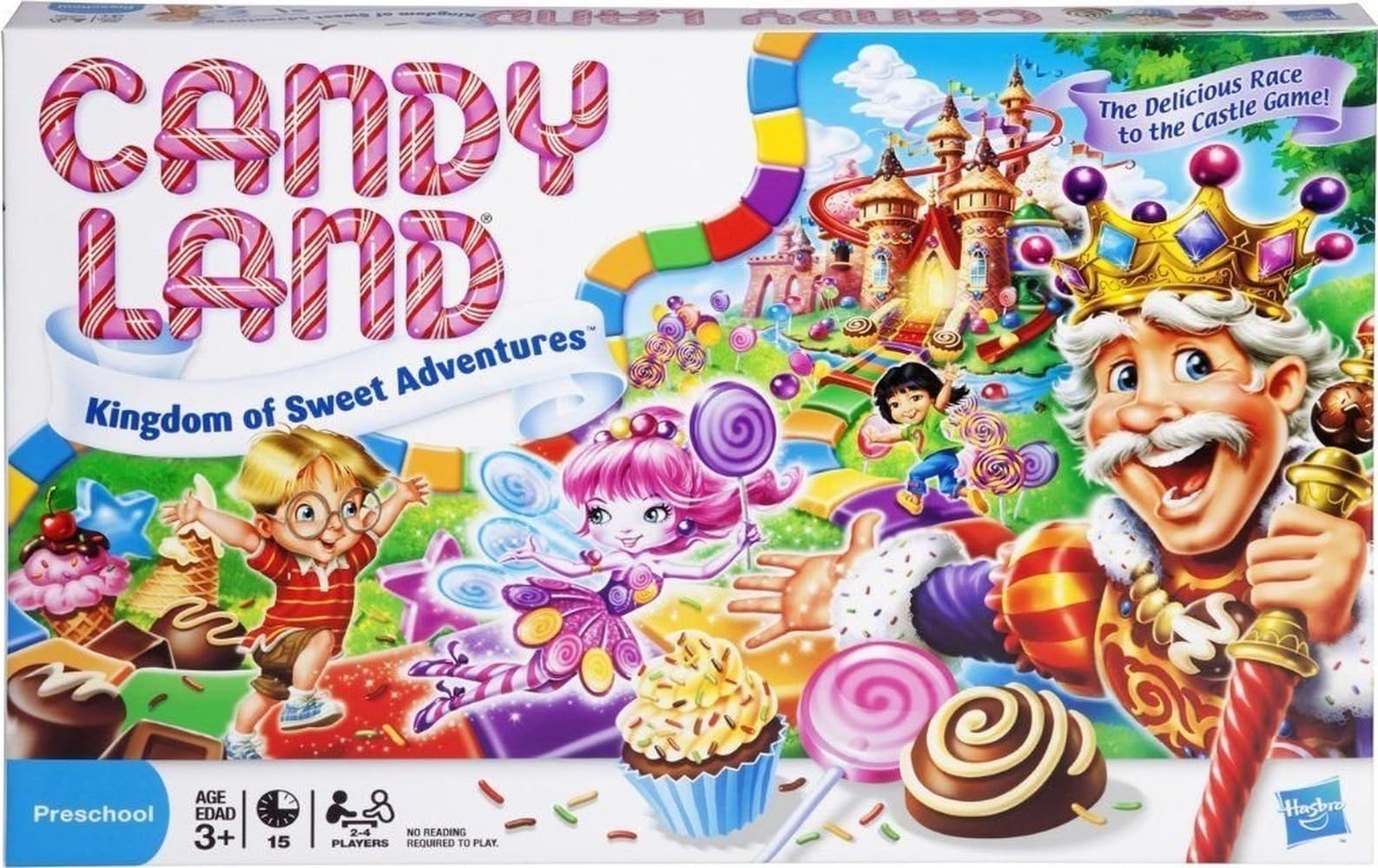
No reading, no counting past the colored squares, and a game that is over in about fifteen minutes: Candy Land is the one in this group a three-year-old can play with a six-year-old at the same board without an adult running it. That, more than nostalgia, is why we keep recommending it.
The pieces suit small hands — four chunky gingerbread pawns and a deck of cards instead of dice, so nothing rolls under the couch. It plays two to four, which covers a parent and two children without an argument about the rulebook. The cards come stiff and are awkward to shuffle at first; bend the deck a few times before the first game and let a child deal, which most can manage from about three.
Set expectations on two things. It is pure chance: draw well and you leap ahead, draw badly and you slide back, and a six-year-old will notice there are no decisions to make. And a round ends the moment someone reaches the castle, so losing is quick and public — which is exactly what a first game is for. As a present it is one of the cheaper picks here and pairs easily with something bigger.
Pros
- Playable by a three-year-old with no reading
- Fifteen-minute rounds suit short attention spans
- Chunky pawns and a sturdy board
- Low price for a first game
Cons
- Almost no decisions — it is a race of chance
We keep it on the list because it is the one game in this group a three-year-old can genuinely play, with no reading and no help.
Best for Travel and Waiting
Kanoodle Brain Puzzle
Key Features
- Pieces: 12
- Case size: 5.75 x 3.25 x 0.75 inches
- Challenges: 228
- Recommended age: 7 years and up
- Price: Budget
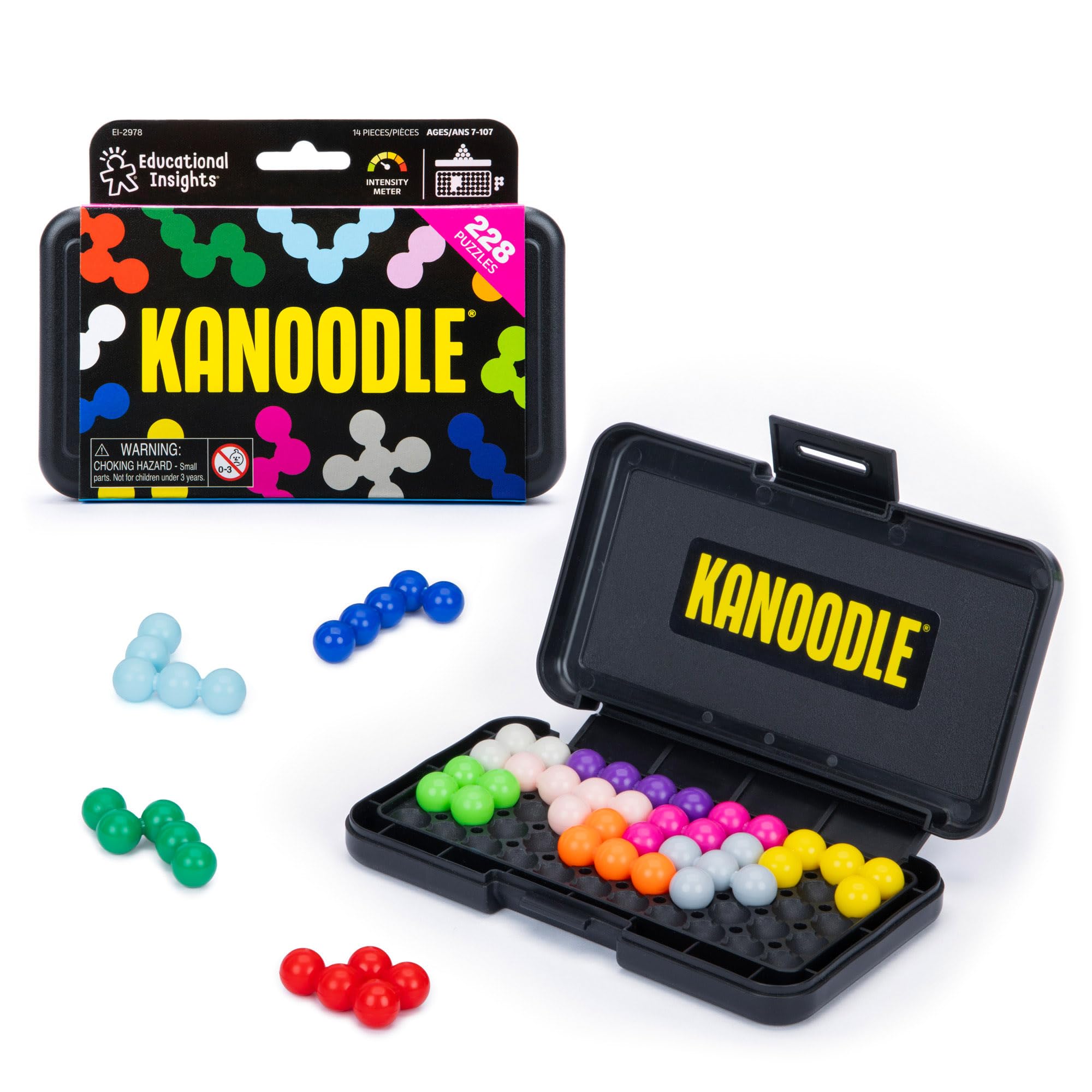
Kanoodle is smaller than a paperback: twelve plastic pieces, a case that doubles as the board, and a booklet of 228 challenges. It fits in a coat pocket, which is most of the point.
We like it for the kid who fidgets — on a plane, in a restaurant, in the back of the car on the way to a relative’s house. The challenges start gently in 2D, where a bright six-year-old can work the first pages alone, then move into 3D builds that kept the adults occupied. The box says seven and up, which is about right for the harder half.
The catch is that it is a solo toy. There is no version of this that two children play together, so a household with two of them needs two Kanoodles or a rota. Everything lives in the case, though, and the booklet fits inside, so it does not shed pieces in a bag the way most travel games do. It is one of the cheapest things here, and it earns its place in a stocking.
Pros
- Fits in a coat pocket or purse
- 228 challenges from easy to expert
- The case holds every piece
- Adults get pulled in too
Cons
- Single-player only
- The opening challenges are over in seconds
We hand it to the kid who needs something to do with their hands — small, self-contained, and hard to put down.
Best for On-The-Go Drawing
Crayola Pip-Squeaks Marker Set
Key Features
- Closure: Snap
- Contents: 25 markers, 40 sheets
- Marker type: Washable mini
- Case dimensions: 9.35 x 11.28 x 1.25 inches
- Price: Budget
Washability is the claim we cared about most here, and it is the reason to pick this set over a plain box of markers. Twenty-five mini markers sized for small hands, forty sheets of paper, and a hard case with a snap closure. Crayola labels the ink washable from skin and most washable clothing, and that covers the usual forearm and tabletop incidents.
The case is what makes this a gift rather than supplies. Every marker has its own slot, so you can see at a glance which one is under the sofa, and the paper travels in the same box. Snap it shut and it goes in a bag for a restaurant or a flight — the markers stay put instead of rolling around a seat pocket.
Two small irritations. The markers need a firm push to seat back in their slots, which a three-year-old will want help with for a while. And the paper is the first thing to run out; the sheets are plain, so a stack of cheap paper keeps the set going long after the fortieth drawing. Neither changes the recommendation. This is the least expensive way here to hand a small child a real art kit that survives being carried around.
Pros
- Mini barrels fit toddler hands
- Washable from skin and most clothing
- Every marker has its own slot
- Snap case travels well
Cons
- Markers need a firm push to seat
Our pick for the youngest artists: washable markers, paper, and a case that keeps both together in the car.
Best for Living-Room Concerts
YLL Kids Karaoke Machine
Key Features
- Dimensions: 4.72 x 3.93 x 5.9 inches
- Microphones: 2 wireless
- Battery life: 4 to 8 hours
- Connectivity: Bluetooth, TF card, headphone
- Price: Midrange
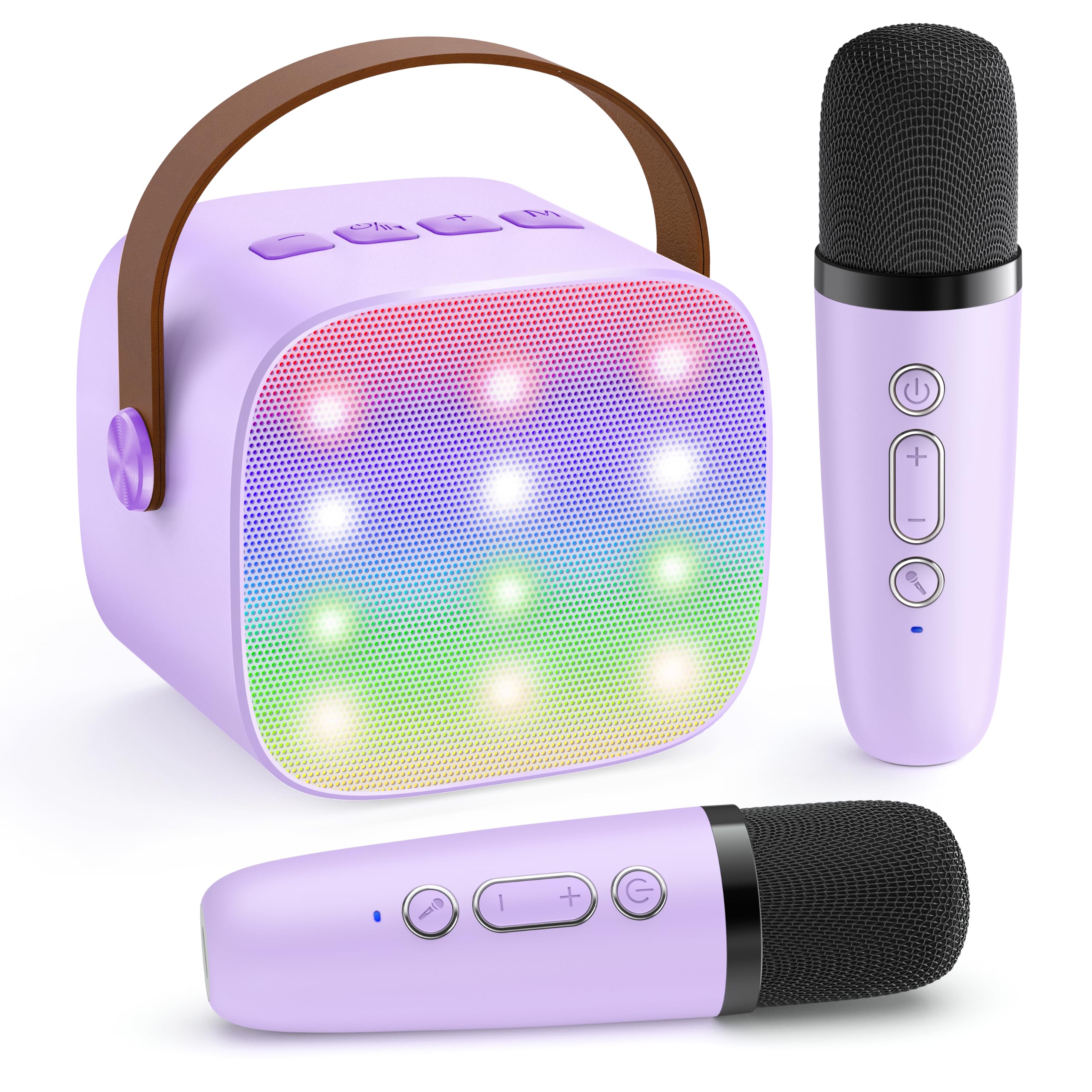
Two wireless microphones change what this is. With one, a child performs; with two, the family does — and that second microphone is why it earns a place in a gift guide rather than a toy box.
The speaker is smaller than a lunchbox and the mics pair themselves once it is switched on. It runs on rechargeables, four to eight hours on the box, and takes Bluetooth from a phone or tablet for backing tracks. There is also a headphone jack, which we rate as the most useful feature in the whole thing: a child can practice without the rest of the house hearing the same chorus forty times.
The four voice-change modes are what actually get used; the robot voice has legs. Sound is loud and clear enough for a living room and no better than that, which is fine for what this is. The appeal peaks somewhere around four to nine — older children want a real microphone, and younger ones mostly shout into it. It arrives in a gift box with two charging cables, so it is presentable if you are shipping straight to a niece.
Pros
- Two wireless mics pair automatically
- Four silly voice effects
- Headphone jack for quiet practice
- Four to eight hours per charge
Cons
- Best for roughly ages four to nine
- Two charging cables to keep track of
We recommend it for the kid who already performs for the room — two mics make it a family thing rather than a solo toy.
Best for Active Family Nights
Nex Playground
Key Features
- Players: Up to 4
- Extra games: Play Pass sold separately
- Included games: 5
- Recommended age: 5 years and up
- Price: Premium
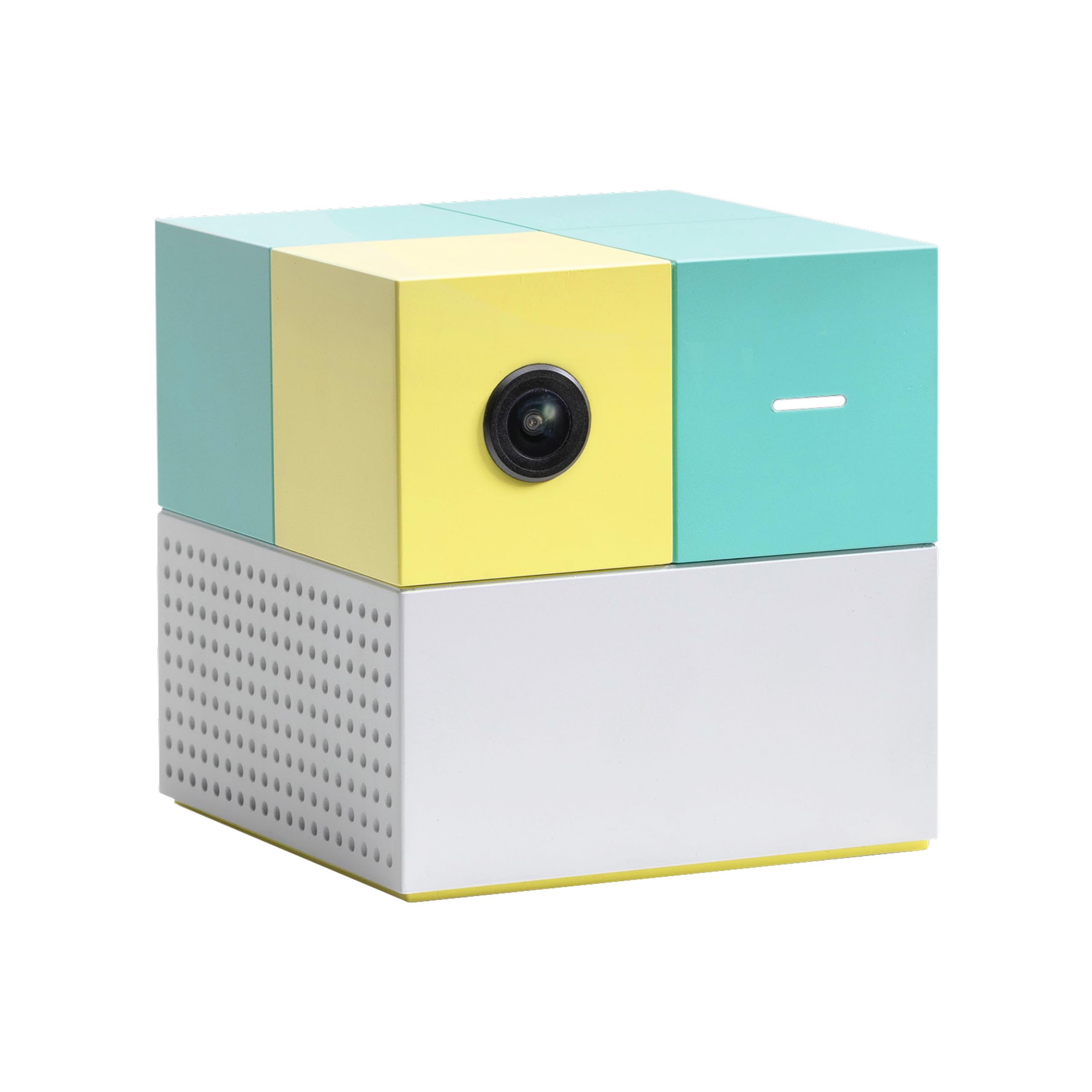
There is no controller. A wide-angle camera on a box the size of a couple of stacked paperbacks watches how you move and the game responds, which is why a five-year-old can start playing without being taught anything.
Setup is an HDMI cable, power, and a short calibration. Five games come in the box — Fruit Ninja, Whac-a-Mole, Go Keeper, Starri, and Party Fowl — and they are the sort that has everyone in the room taking a turn. Up to four players, no controllers to lose or charge, and a full-body game that leaves adults breathing harder than they expected.
Two things to price before you commit. It needs a television with clear floor space in front of it; a set squeezed into the corner of a small room gets a fraction of the play. And the library beyond those five games sits behind a Play Pass subscription sold separately. It is also screen time, plainly — the argument for it is that the screen is spent standing up and swinging.
Under those conditions we think it earns its place, because it is the one gift here that pulls in a five-year-old, a nine-year-old, and both parents on the same evening. The console itself is small enough to unplug and take to a cousin’s house, which is more than most big-ticket presents manage.
Pros
- No controllers to lose or charge
- Up to four players at once
- Five games included in the box
- Small enough to take to a relative’s house
Cons
- Extra games need a paid Play Pass
- Needs a TV and open floor space
We think it is worth the biggest spend here if your television has floor space in front of it and you have priced the subscription.
Best for Parties and Stockings
Play-Doh 42-Pack

Key Features
- Cans: 42 one-ounce
- Compound: Non-toxic, wheat-free
- Packaging: Flip-top box
- Recommended age: 2 years and up
- Price: Midrange
Forty-two one-ounce cans is not a play-desk supply; it is a distribution system. One box covers four stockings, a classroom party, and an advent calendar, which makes it a different kind of gift from everything else here.
The cans are the small size, in a spread of colors, and the box has a flip-top for handing them out. The compound is labeled non-toxic and wheat-free, and the cans hold their softness — a spare box that sits in a cupboard until February still opens to usable dough. Ages two and up.
We recommend it as the useful addition rather than the main event. A one-ounce can is a single session for a toddler and about ten minutes for a seven-year-old, so it suits a house that already owns the roller and the cutters, or a parent who wants a drawer of small distractions. Bought as the big present it will disappoint; bought to cover stockings and party favors, it is one of the cheapest ways here to make a lot of children happy at once.
Pros
- 42 one-ounce cans in assorted colors
- Cans stay soft in storage
- Ages two and up, non-toxic
- Flip-top box for handing out
Cons
- Small cans are a single session for older kids
We buy this for the handout drawer, not the tree — it covers stockings, party favors, and classroom prizes in one box.
Best for Crafty 6-To-12S
JOYIN Rock Painting Kit

Key Features
- Paints: Glow and metallic
- Pieces: 44
- Includes: Rocks and brush
- Recommended age: 6 to 12 years
- Price: Budget
The glow-in-the-dark paint is the pitch, and it is the part to set expectations on. These pigments need a charge under a bright light before they show anything, so a rock painted at the kitchen table at night looks like a rock. Leave it under a lamp or in the sun first and it holds a soft glow once the lights go out.
The rest of the kit is straightforward: forty-four pieces, including rocks to paint, glow and metallic paints, and a fine brush. There is no prep beyond covering the table, and a six-year-old can work independently from the first rock. The kit is aimed at six to twelve, and that feels right.
One technique makes the difference. A white or pale base coat, dried, then color on top gives the paint something to grip and makes the shades read properly; skip it and the paint soaks in and the rock looks muddier than the child intended. It is seconds of extra work per rock and the difference between a keeper and a mess.
As a gift it is an afternoon rather than a season, which suits a supplementary present better than a main one. The paints go further than the rocks in the box, so a walk to find more is part of the fun — and the finished rocks end up on a windowsill instead of in a toy bin, which is the best thing a craft kit can manage.
Pros
- 44 pieces including rocks and paints
- Glow and metallic paints included
- Almost no prep — paint and go
- Paint outlasts the rocks in the box
Cons
- Glow paint needs a strong charge to show
We like it for the six-to-twelve painter who wants something to keep — just charge the glow paint before judging it.
How We Tested These Gifts Over Four Months
We started with a few hundred listings and cut them down by age grading, small-parts and battery requirements, price, and whether the manufacturer actually sells replacement pieces — a game missing its one die is a game that dies in March. Anything with instructions nobody could follow after two read-throughs got eliminated, as did kits that needed a supplement purchase to be playable. That left 18 gifts, which we tested from late August through mid-December.
Testing happened where these things actually live: the after-school window between 4:30 and 6, a rainy Saturday when nobody could go outside, one sleepover, and a cold open where we handed over a box still in its packaging and timed how long it took a group of kids to get playing without an adult stepping in. For the glow-in-the-dark items, we charged them under a lamp for 20 minutes, then checked them in a dark closet and again at bedtime an hour later to see whether the glow actually held.
Along the way we watched for the things that decide whether a gift gets used twice or twenty times: whether rules clicked after one explanation or needed a grown-up hovering all evening, how many times a kid asked to play again in the same sitting, and whether the second round went differently than the first. We also dropped pieces on hardwood, stepped on a few boards by accident, and shoved everything back in the box the way a kid would, then checked a month later whether the corners were still square and every piece was still accounted for. Value got judged per evening of real use, not per box.
How to Choose Christmas Gifts for Kids
Start with the age on the box and the youngest person who will actually use it, and most of the other decisions get easier.
Match the gift to the youngest player
The age on the box is a floor, not a suggestion. A game a three-year-old can join needs no reading and no arithmetic, which is why Candy Land still works for mixed ages: a six-year-old and a three-year-old can share a board without an adult running it. Buy up and the present sits in a cupboard until the child catches up.
If two siblings will use it, pick something with graded difficulty — Kanoodle’s puzzles start gently and get genuinely hard — so the older child has something to chew on while the younger one works the easy pages.
Decide whether the screen is part of the gift
Most of this list is screen-free, and for a lot of parents that is the whole point. The exception is the Nex Playground, which connects to a television and uses a camera to track movement. It is still screen time, but it is screen time spent standing up and swinging.
The practical question is the room. It needs a TV with clear floor space in front of it; a set wedged into the corner of a small living room gets a fraction of the play of one with an open carpet in front of it.
Open-ended play or a single afternoon
Some gifts get played with for months and some are finished by dinner on the twenty-fifth. A craft kit like the rock painting set is an afternoon — a good one, but an afternoon. Dough, markers, and the wooden ice cream counter are open-ended: the same pieces become a different game next week.
For the main present under the tree we favor open-ended. A kit works better as the second gift, and better still for a child whose house already holds plenty of toys that do one thing.
Where it lives in January
Piece count matters less than where the pieces end up. Sets that store themselves — the ice cream counter’s recesses, the marker case’s slotted insert, Kanoodle’s own case — get used more, because nobody has to hunt for a lid or a bin.
Watch for the word compact in a listing. It usually means the box fits a shelf, not that it fits a backpack. Check the actual dimensions against the bag it needs to travel in before you picture a child carrying it onto a plane.
What it costs after Christmas
The price on the box is only the first payment. Consumables run out: dough dries, paper goes before markers do, and glow paint gets used up quickly. Screen-based gifts can carry a subscription — the Playground includes five games and sells the rest of its library as a Play Pass.
Rechargeable toys save on batteries but still want a cable and a socket on Christmas morning. Price the refill or the subscription before you commit; it is the difference between a gift and a hobby with dues.
Frequently Asked Questions
What’s a good Christmas gift for a kid who already has everything?
The ones that get used up. A 42-pack of dough disappears into a house that already owns the cutters and the mat, and a marker-and-paper set replaces the dried-out pens in the art drawer. Avoid another large playset if the toy room is full.
A consumable plus one small thing — a puzzle, a card game — lands better than a big box and takes up no shelf space afterwards.
How many gifts should you buy a child for Christmas?
Enough that each one gets looked at. A workable rule is four: something they want, something they need, something to wear, and something to read, plus one bigger present if that is your family’s tradition.
In practice, one gift a child still uses in February beats five that are forgotten by lunchtime on the twenty-fifth.
Is October too early to buy Christmas gifts for kids?
No, and for the popular toys it is smart. Buying now locks in the model you researched rather than whatever is left in mid-December, and it spreads the cost over two months.
Keep the receipt and the original packaging in case the child already has one, check the return window, and store the box out of sight — a wrapped gift hidden in a closet for ten weeks is a gift someone finds.
Final Verdict
The Melissa & Doug ice cream counter is where we point most families. It is the gift here that turns into a game rather than a display: order, scoop, count out the bills, then pack it all back into the counter. Three- to six-year-olds get the most from it, and the wood holds up for the years they will use it.
If the child is three and the house owns no games yet, Candy Land is the better first buy for a lot less. If you want the whole family moving instead, the Nex Playground is the splurge worth making — provided the television has floor space in front of it and you have priced the Play Pass.
