This post contains affiliate links. We may earn a small commission when you buy through our links — at no extra cost to you.
The hardest part of sunscreen with kids isn’t remembering it—it’s getting it on. My kids have opinions about anything that feels thick, smells like a tropical candle, or leaves their faces chalky, and I’ve learned that a formula they resist is a formula that doesn’t get reapplied. The best kids sunscreens block sun reliably and disappear into the morning routine without a fight: they spread easily, sink in without a greasy film, and feel gentle enough for daily use.
Over the past spring and summer, we tested 14 kids sunscreens through school drop-offs, camp days, sprinkler afternoons, and beach weekends. We tracked whether protection held through sweaty play, how easily each rubbed in, and whether it left a white cast on different skin tones. We noted consistency from first squeeze to last, how the fragrance sat on sensitive skin, and whether the finish felt greasy or comfortable. We compared tube sizes and price per ounce, since a sunscreen you can’t afford to reapply isn’t much help. The picks below are the ones my family and testers reached for without complaint.



Best for Daily Baby Protection
Blue Lizard Baby SPF 50+
Key Features
- SPF: 50+
- Size: 5 oz tube
- Water resistance: 80 minutes
- Active ingredient: Zinc oxide
- Price: Midrange
Blue Lizard builds a UV-sensing cap into this tube, and what looks like a gimmick turns out to be the most useful thing in our beach bag. The plastic deepens in color as the sun strengthens, so a bottle sitting on the towel tells you at a glance that it is time for another coat. When you are juggling two children and a cooler, that beats any alarm you could set.
The formula underneath is what earns the top spot. It is zinc oxide, fragrance-free, SPF 50+, broad spectrum, and rated for 80 minutes in the water, in a 5-ounce tube that spreads like a lotion rather than a paste. Of the mineral options here, this is the one we get an even, thin layer out of fastest, which matters when the person being coated is already halfway to the surf.
We also appreciate that it is built for skin that reacts: no fragrance, no parabens, and calendula and aloe in the base. On a face it rubs down to a faint sheen rather than a mask, and it stays comfortable through a morning outside without leaving a greasy film.
Set against the Thinkbaby bottle, you trade an ounce of product and some coconut-scented charm for a thinner formula that goes on faster. That is the trade we make on most mornings, and it is why this is the tube we refill first.
Pros
- Fragrance-free zinc for reactive skin
- Spreads like lotion, not paste
- 80 minutes of water resistance
- Color-changing cap prompts reapplication
Cons
- Five ounces goes fast on full-body use
- Feels tacky over a rich moisturizer
Our default for most families: a fragrance-free zinc tube that spreads easily, holds through a swim, and reminds you when to reapply.
Best for Beach Days
Thinkbaby SPF 50+ Sunscreen
Key Features
- SPF: 50+
- Size: 6 oz
- Labeled age: 6 months to 5 years
- Active ingredient: Zinc oxide
- Price: Premium
Thinkbaby smells like coconut, properly like coconut rather than like a laboratory’s idea of it, and that single detail buys more cooperation than any explanation of why sunscreen matters. A child who associates the bottle with the beach rather than with stinging eyes stops fighting the second coat, and by August that difference is the whole game.
It is a straight zinc oxide mineral formula at SPF 50+, and the six-ounce bottle is the largest mineral lotion in this lineup. This is the one we take when the plan is four hours at a pool rather than twenty minutes at the playground, because it stays put through repeated dips and a towel-dry or two.
Where it earns its place for us is full-body coverage on a fair-skinned child. The formula is thick, so you can see where you have been and where you have missed, and that visibility is worth something when the person you are coating is spinning. It has also been gentle on cheeks that react to everything else we have tried.
The catch is the cast. On pale skin it fades to a soft sheen within a few minutes. On deeper skin tones it reads as a visible layer and needs real working in, and it is not the thing to swipe on a face in a parking lot. We use it on bodies and reach for a clear stick when the face is the target.
Pros
- Coconut scent reduces application fights
- Six ounces, the largest mineral lotion here
- SPF 50+ zinc with strong water resistance
- Gentle on sensitive skin
Cons
- Takes extra scrubbing off at bath time
Our pick for long, wet days: a big bottle of thick coconut-scented zinc we trust for hours in the sun, with a bath-time job at the end.
Best for Budget Family Coverage
Coppertone WaterBabies SPF 50
Key Features
- SPF: 50
- Size: 8 fl oz
- Labeled age: 3 months and up
- Water resistance: 80 minutes
- Price: Budget
Eight ounces, a squeezable bottle, and the cheapest way here to cover a whole family. If you are buying sunscreen for three children rather than one baby, that arithmetic decides more than any ingredient list, because the sunscreen that runs out in July is not protecting anyone in August.
It earns its place by being the easiest product in this group to actually use up. It goes on like hand lotion, soaks in fast, leaves no white residue on skin or car seats, and needs no fight. SPF 50, broad spectrum, 80 minutes of water resistance, and free of oxybenzone, octinoxate, PABA, and dyes. For legs, arms, and shoulders on a child past the baby stage, we reach for this before anything else.
The compromises show up around the nose. It stings if it migrates into eyes, so we keep it below the brow and hand a stick to whoever is doing faces. Beyond that it does everything we ask of a body sunscreen, and it does it without a second thought about how much we are using.
Pros
- Cheapest way here to cover a family
- Rubs in clear with no white residue
- 80 minutes of water resistance at SPF 50
- Free of oxybenzone, octinoxate, PABA, and dyes
Cons
- Strong baby-powder fragrance
The family bottle we recommend: cheap enough to use generously, quick to rub in, and clear on skin, as long as you keep it away from eyes.
Best for Fast Body Coverage
Banana Boat Kids Sport Spray
Key Features
- SPF: 50
- Size: Two 6 oz cans
- Fragrance: No added fragrance
- Water resistance: 80 minutes
- Price: Budget
Here is the scenario this can is built for. You are at the pool gate, the toddler is already running, and you have about eight seconds to get protection onto a pair of shoulders and a back. A spray wins those eight seconds, and that is not trivial, because an uncooperative application is how sunburn happens.
It is SPF 50 with 80 minutes of sweat and water resistance, no added fragrance or oils, and a light, quick-drying finish that does not leave children shiny. The mist goes on evenly and covers a squirming back without a wrestling match.
We treat it as a body product. Everything below the chin gets a fast pass, and faces get a stick, which is the division of labor that keeps application under a minute. That is why the two-pack lives split between the car and the beach bag: there is always a can within reach, and nobody is hunting for lotion at the last minute.
The caveat is that a spray rewards thoroughness. A hurried pass leaves gaps, and the quick dry tempts you to stop early, so we go over each child twice in good light before anyone is allowed in the water. It is the fastest option here, not the most foolproof one.
Pros
- Sprays on in seconds at any angle
- No added fragrance or oils
- 80-minute sweat and water resistance
Cons
- Can leave marks on light-colored swimwear
The can we keep in the car: fast, even coverage for bodies on days when nobody will stand still, with faces handled by a stick.
Best for Faces and Reapplication
Sun Bum Kids Clear Stick
Key Features
- SPF: 50
- Size: 0.53 oz stick
- Finish: Clear
- Application: Wet or dry skin
- Price: Premium
The clear finish is the whole reason this stick earns its price: no white nose, no ghost eyebrows, no argument, and more usefully, a child who can swipe it on without turning their face into a project. This is the sunscreen we hand over and get back empty.
It is built for wet or dry application, which sounds like a marketing line until you are at a pool with a soaked kid. The stick glides over wet skin instead of skipping across it, so a mid-swim top-up does not require a towel and a negotiation. SPF 50, broad spectrum, water resistant, and made without oxybenzone, octinoxate, parabens, or synthetic fragrance.
We like the feel of it too: no grease, no stickiness, nothing transferring onto car seats or collars. There is a light scent that drew no complaints from the kids we tested it on, which is more than we can say for the coconut bottle.
Used on faces and ears, it lasts a reasonable while. Used on arms and legs it is gone in a week, and that is not a flaw so much as a reminder that this is a face purchase and the body should get a lotion.
Pros
- Goes on completely clear
- Works on wet or dry skin
- Kids can apply it themselves
Cons
- Costs more than the other sticks here
Worth the extra money if faces are the daily battleground: clear, fast, and easy enough that kids apply it themselves.
Best for Budget Face Coverage
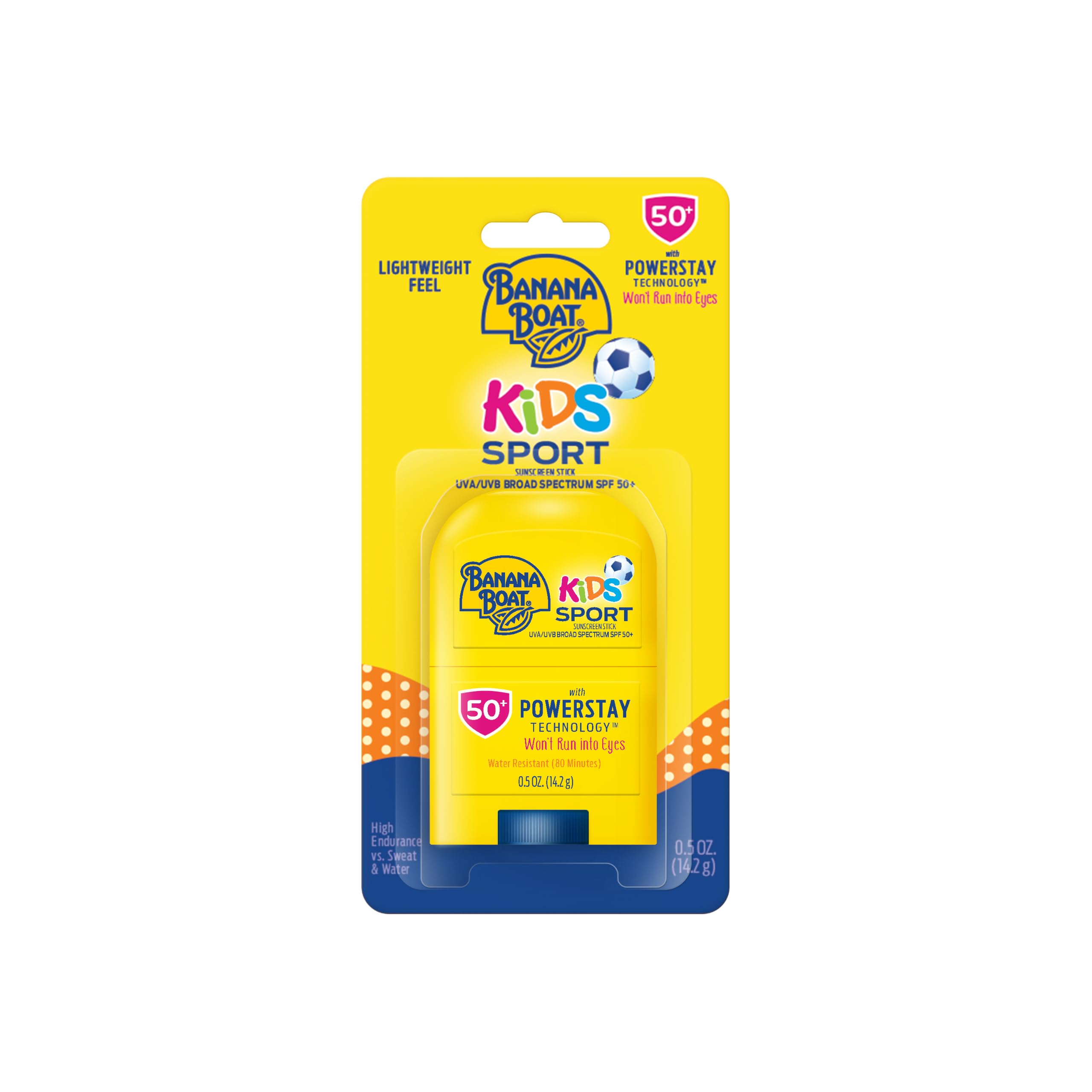
Banana Boat Kids Sport Stick
Key Features
- SPF: 50
- Size: 0.5 oz stick
- Fragrance: Fragrance-free
- Water resistance: 80 minutes
- Price: Budget
If the clear stick’s price feels steep for something that lives in a pocket, this Banana Boat stick does most of the same job for a fraction of the cost. It is fragrance-free, glides on without dragging, and is the budget stick we recommend first.
It is SPF 50 with 80 minutes of water, sweat, and heat resistance, and the formula is mild enough not to clog pores. The stick is a good width for a face: cheeks, nose, ears, and the back of the neck take about fifteen seconds, which is roughly the attention span you are working with.
It goes on smooth and does not need rubbing in, and what is left behind is a light sheen rather than a white mask, fine on arms and fine on most faces in a hurry. The convenience is the point: this is the stick that stays in the diaper bag and gets used because it is there.
The honest limit is coverage. This is a face-and-neck product, and half an ounce used on legs will vanish before lunch. Keep a lotion for bodies and this in the bag that goes everywhere, and the pair will carry you through a summer.
Pros
- Fragrance-free and non-greasy
- Far cheaper than the clear stick
- Pocket-sized for bags and backpacks
Cons
- Slippery until it dries down
Our budget stick: fragrance-free, smooth, and cheap enough to keep one in every bag, as long as you only ask it to do faces.
Best for Reactive, Sensitive Skin
Baby Bum SPF 50 Lotion
Key Features
- SPF: 50
- Size: 3 oz tube
- Fragrance: Fragrance-free
- Active ingredient: Zinc oxide
- Price: Premium
Baby Bum is for the child whose skin reacts to everything: fragrance-free, mineral zinc oxide, and a base of coconut oil, shea butter, and cocoa butter instead of the usual unnamed fillers. If you have a drawer of half-used sunscreens that ended in a rash, this is the one worth trying next.
It is SPF 50, water resistant for 80 minutes of swimming, made without oxybenzone or octinoxate, and pediatrician and dermatologist tested. The three-ounce travel tube fits in a diaper-bag pocket, which is where ours lived for most of the summer.
A word of caution that matters more than any specification: reactions are still possible on a fragrance-free mineral formula, and a rash on a baby is a miserable way to find out. Patch test on the inner arm a day before you commit to a beach trip, and introduce it on its own rather than layered over a new lotion.
For a baby or toddler with sensitive skin, this is the tube we recommend keeping in the bag: small enough to carry, gentle enough for daily use, and a formula we are comfortable putting on faces as well as bodies. For coating three children before camp, buy something bigger. This one is for the child who needs the careful option.
Pros
- Fragrance-free mineral formula for reactive skin
- Coconut oil, shea, and cocoa butter base
- Travel size fits a diaper bag
Cons
- Stiff to spread straight from a cool tube
The one we suggest for reactive skin: a fragrance-free mineral lotion in a travel tube, with a patch test first and a bigger bottle for bodies.
Best for Bulk Family Supply
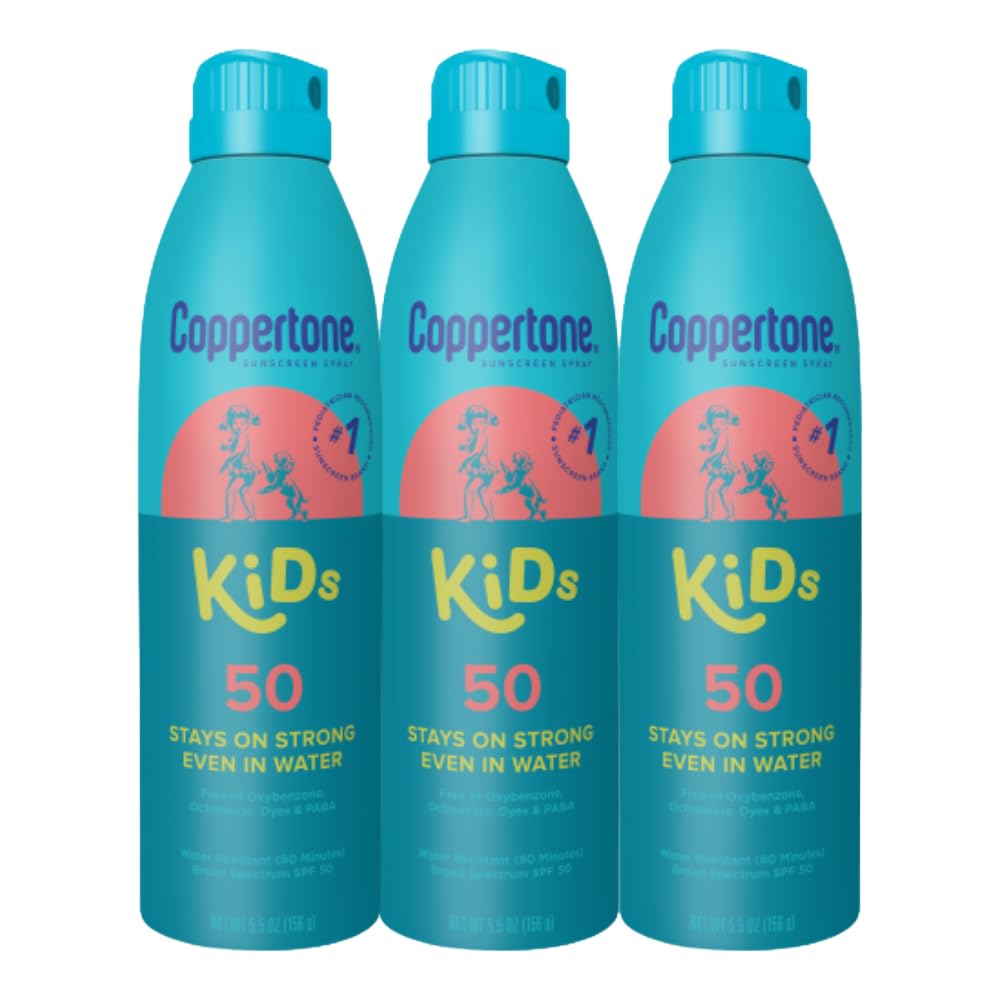
Coppertone Kids Spray 3-Pack
Key Features
- SPF: 50
- Size: Three 5.5 oz cans
- Spray angle: Any angle
- Water resistance: 80 minutes
- Price: Budget
Three cans is a commitment. It is also the most sensible way to buy a spray if you are supplying a family: one for the house, one for the car, and one for whichever grandparent ends up with the kids for the weekend. If you want to try a spray for the first time, buy a single can instead.
What it does well: SPF 50 broad spectrum, 80 minutes of water resistance, no dyes, PABA, octinoxate, or oxybenzone, and a nozzle that sprays at any angle. That last part matters more than it sounds when you are aiming at the back of a child who is upside down on a swing.
It goes on light and dries fast, and it is the can we grab for arms and legs on the way out the door. Faces get a stick. That is the same division of labor we use with the Banana Boat spray, and it is the one that keeps application under a minute.
It is an also-consider rather than a runner-up for two reasons: we trust it less than the lotions above for a long day in the sun, and a fast spray can go on thinner than you think it has. Buy it as the bulk can that lives in the car, not as the only sunscreen you own.
Pros
- Three cans to distribute between house, car, and sitter
- Sprays at any angle
- 80 minutes of water resistance
Cons
- Only sold as a three-can pack
A bulk buy for families who already know they like spray sunscreen: three cans, an any-angle nozzle, and a permanent place in the car.
How We Tested the Best Kids Sunscreens
I started by pulling together the kids sunscreens that kept surfacing in parent reviews and retailer best-seller lists, then narrowed the field by SPF, active ingredients, water resistance, fragrance, and price per ounce. I filtered out anything that was hard to find in a practical size or came only in tiny, expensive tubes. That left 14 formulas, which we used from early spring through the end of summer—about five months—during school drop-offs, camp days, backyard sprinkler sessions, bike rides, and beach weekends.
At each application, I squeezed a stripe onto my forearm first to judge consistency—whether it was runny, stiff, or separated—and then let my kids apply it themselves. I watched how far a nickel-sized amount spread, whether it dragged or pilled on damp skin, and whether it left a visible white cast on fair, medium, and deep skin tones. After it dried, we checked for a greasy shine on faces and hands and noted whether the fragrance faded quickly or lingered. For effectiveness, we tracked whether anyone burned during long outdoor stretches and whether protection stayed put through sweat, water play, and towel wipes.
At the end of each day, I asked my kids whether their skin felt dry, itchy, or sticky, and I checked faces and shoulders for redness or irritation. We also tracked how each tube held up—whether the cap clogged, whether the formula thickened near the end, and how many applications we got per ounce. A sunscreen stayed in the rotation only if it protected consistently, rubbed in without a fight, and felt comfortable enough that nobody complained.
How to Choose a Kids Sunscreen
The sunscreen that works is the one you will actually reapply, so settle the format your child will tolerate before you start comparing SPF numbers.
Mineral or chemical: pick for the skin, not the label
Zinc oxide sits on top of the skin, which is why it irritates less, and why it leaves a cast and takes more rubbing in. Chemical filters sink in clear and dry fast, but they need about fifteen minutes to start working and are more likely to sting if they reach eyes. For a baby, an eczema-prone toddler, or a child who has reacted to something before, we start with mineral. For an older kid who will not tolerate a white face, a clear stick or a chemical lotion is the pragmatic choice.
Whichever you land on, patch test on the inner arm a day ahead rather than discovering a reaction at the beach.
Match the format to the body part
Lotion covers a body fastest per squeeze, a stick handles a face without a fight, and a spray buys speed when nobody will stand still. Most families end up owning two: a lotion for arms and legs, and a stick for faces, ears, and necks. The trap is expecting one product to do both. A half-ounce stick used on legs disappears in a single application, and a face product pressed into full-body service is how you run out by Wednesday.
Aim for SPF 50, then stop
Protection gains flatten above SPF 50, and water resistance tops out at 80 minutes on every product here, so the number on the front matters less than how often you reapply: every two hours, and again after a swim, a towel-dry, or a heavy sweat. A bigger SPF does not extend that clock. Put the money into a second bottle so there is always one in the bag rather than into a larger number.
Work out what a bottle actually covers
An 8-ounce lotion gets a family of four through several weekends; a half-ounce stick is a face-only purchase that might last a month. Mineral formulas cost more per ounce than drugstore chemical lotions, so we split the budget: an inexpensive body lotion for legs and arms, a nicer stick for faces, and one fragrance-free mineral tube for the child whose skin reacts. Going cheap on the format you use most is a false economy.
Frequently Asked Questions
Can my kid just use my sunscreen?
Adult formulas protect just as well, but they are usually built around fragrance, alcohol, and a lighter texture that can sting on a child’s face. Kids’ formulas skew fragrance-free and mineral for exactly that reason. Use your own bottle on your arms, and keep a fragrance-free kids’ formula for faces and for any child with eczema.
Does kids sunscreen stain swimsuits and car seats?
Sprays are the usual culprits: an aerosol mist settles on collars, straps, and seat fabric, and some formulas leave pale or orange marks that survive a normal wash. Rinse swimwear in cool water as soon as you are home and wash it separately. Using a stick on faces and necks keeps most of the spray where it belongs, on skin.
What is the youngest age for sunscreen?
The bottles set their own floors: Coppertone WaterBabies is labeled for 3 months and up, Thinkbaby for 6 months to 5 years. Below the age on the label, ask your pediatrician before applying, and let shade, a brimmed hat, and long sleeves carry the rest of the day.
How do I keep it out of my kid’s eyes?
Keep lotion below the eye socket and use a stick on the brow, the outer corners, and the tops of the ears. With sprays, never aim at a face: spray into your hands and wipe. If it does get in, rinse with clean water instead of rubbing, and switch to a stick for the next coat, because one stinging application ends a child’s cooperation for the week.
Final Verdict
Our default is the Blue Lizard baby tube: fragrance-free zinc that spreads easily enough to use twice a day, holds through 80 minutes in the water, and comes with a cap that reminds you when to go again. If you want a bigger bottle and do not mind working a thicker lotion in, take the Thinkbaby to the pool.
And if the daily fight is specifically about faces, start with the clear Sun Bum stick. It ends that particular argument.
