This post contains affiliate links. We may earn a small commission when you buy through our links — at no extra cost to you.
The first time you buckle a newborn into an infant car seat, the driveway can feel like a test you didn’t study for. The seat has to install tightly in different cars, hold a floppy newborn’s head steady, and still be light enough to carry into a doctor’s appointment, while staying comfortable enough for car naps and simple enough to tighten in a dark parking lot. Over eight months, we tested 10 infant car seats across sedans and SUVs, clicking them in and out of bases through errands and daycare drop-offs. The best ones balanced a secure fit with the convenience of daily use.
One buyer’s truth: infant seats are short-lived purchases, so value isn’t just the sticker—it’s how well the seat fits your car and routine. The picks below earned their spot by installing correctly without a fight, supporting a newborn’s head and neck, staying stable in the base, and keeping babies comfortable on longer rides. Some are lighter for caregivers who carry them often; others trade a few pounds for a more planted feel.


Best for Everyday First Seat
Graco SnugRide Lite LX
Key Features
- Base: 4-position adjustable with level indicator
- Height limit: 32 inches
- Weight range: 4 to 30 pounds
- Carrier weight: 7.2 lb
- Price: Budget
Seven point two pounds. That’s the SnugRide Lite LX with nothing in it, and it’s the number that decided this pick for us. An infant seat gets lifted out of a car and set down again several times a day — at the curb, at the doctor’s office, on the kitchen floor while you find your keys — and the difference between a light carrier and a heavy one lands in your forearm long before your baby outgrows the seat.
The rest of the seat is sensible rather than fancy, which is what the price reflects. The base has four recline positions and a level indicator you can read from the door, so setting the angle on a sloped back seat isn’t a guessing game. It’s rated from 4 to 30 pounds and up to 32 inches, the same ceiling as the SnugFit, and the five-point harness has four height positions to grow through. It also clicks into Graco’s strollers, which matters more than it sounds when you already own one.
Where the money didn’t go is the extra safety hardware. There’s no anti-rebound bar on the Lite LX — both of our other picks carry one — and that’s the honest difference between this seat and the SnugFit. For a first seat that gets handed down and replaced when your baby outgrows it, we think that’s the right place to save.
Pros
- 7.2-pound carrier is the lightest of our picks
- Level indicator and four recline positions
- Lowest price of our three picks
Cons
- Base can shift in cars with contoured seats
Lightest carrier we tested, a base that levels without guesswork, and the lowest price of our picks — this is the infant seat most families should start with.
Best for Extra Rear-Facing Safety
Graco SnugRide SnugFit
Key Features
- Harness: Moves with the headrest, no rethreading
- Height limit: 32 inches
- Weight range: 4 to 30 pounds
- Anti-rebound bar: Included
- Price: Midrange
Same brand, same 4-to-30-pound range, same 32-inch ceiling — the SnugRide SnugFit is the Lite LX with the safety hardware turned up. It adds an anti-rebound bar, and its headrest and harness adjust together in a single motion. That combination is what makes it the sensible step up from our top pick rather than a sideways move.
The anti-rebound bar is the piece we think earns the difference. It sits against the vehicle seat back and limits how far the seat rocks toward it in a crash, and it’s the sort of addition you can’t retrofit later. Both this seat and the Doona have one; the Lite LX doesn’t. Whether that’s worth paying for is a judgement call, but it’s the clearest hardware gap between first and second place here.
The harness is the part you’ll appreciate on a Tuesday morning. Height and headrest move together with the baby already strapped in, so growing out of a position costs a few seconds instead of a rethreading session in a parking lot. With four positions between newborn and 30 pounds, that adds up faster than the spec sheet suggests. The base gets four recline positions of its own, and the infant inserts come out as your baby grows.
Which brings us to the one thing to check closely. The seat ships with infant head and body supports, and for most newborns they do the job. If your baby is on the small side — and this seat is rated from 4 pounds, so it may be — fit the insert and look at how that little head sits before the first drive home. A small caution on an otherwise straightforward seat.
Pros
- Anti-rebound bar adds rear-facing protection
- Harness and headrest adjust together
- Small price step over the top pick
Cons
The pick we recommend for extra rear-facing protection without premium money: an anti-rebound bar and a headrest that adjusts with the harness.
Best for Errands and Travel
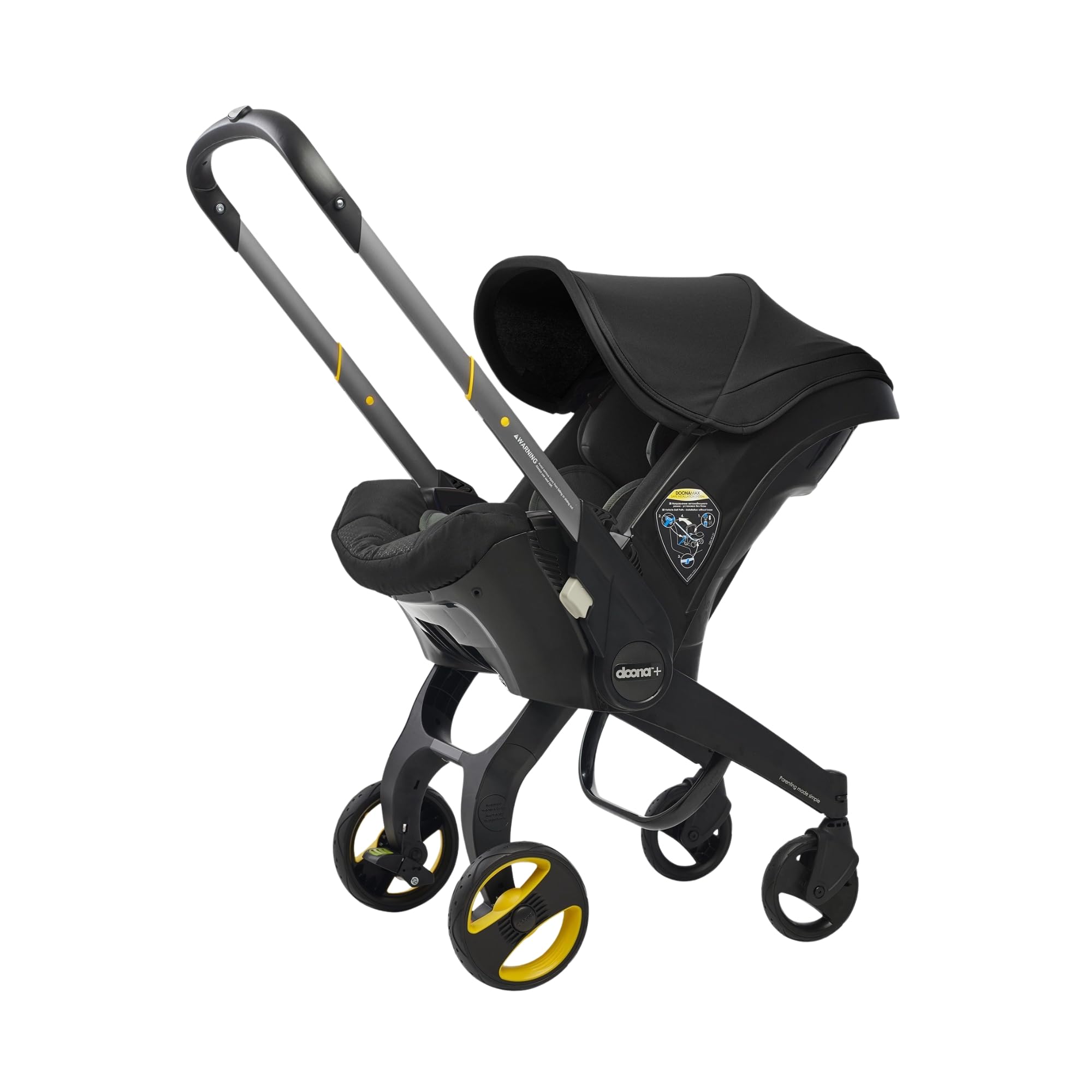
Doona Car Seat & Stroller
Key Features
- Base: LATCH, included
- Folded size: 26L x 17.4W x 22.4H inches
- Height limit: 32 inches
- Minimum weight: 4 lb
- Price: Premium
The Doona answers one specific moment: the baby has fallen asleep in the car and you need to be inside a building in the next two minutes. Instead of lifting a carrier onto a stroller frame, you convert the seat itself and push. No frame in the trunk, no second transfer. That’s the whole idea, and it’s a genuinely different way to run errands.
What it asks of you is small. The LATCH base comes with the seat, the canopy is UPF 50+ and water-repellent, and the whole thing is approved for aircraft — which matters if you fly with a baby rather than gate-checking a stroller. The seat is rear-facing only, rated from 4 pounds, and works to the same 32-inch height as the others here.
The part we minded most is the lift. Getting a sleeping baby out of a deep back seat takes both hands and a bit of shoulder, and that is the price of never unfolding a frame. The money buys the conversion and the cabin approval, and that is the entire argument for it.
One habit worth building: the seat drops onto its base with a click, and we got into the habit of tugging up on the handle afterward to confirm it caught. Do that every time, in every car, whatever seat you own. Folded, the Doona measures 26 inches long by 17.4 wide — small enough for a hall closet, which is more than the stroller it replaces can say.
Pros
- Converts to a stroller without a frame
- Approved for aircraft use
- Folds small enough for a closet
- LATCH base and seat protector included
Cons
- Roughly double the weight of the lightest pick
- Costs the most of our picks by a wide margin
The seat we recommend when loading a stroller is the part of the day you resent: it converts in place, it’s approved for the cabin, and you pay in weight and price.
How We Chose and Tested Infant Car Seats
We started by comparing the infant car seats that show up again and again in registry guides and owner reviews, then narrowed the field by seat weight, base design, harness adjustability, included newborn inserts, and price. We bought 10 seats at different price points and spent eight months using them the way families do: installing them in sedans and SUVs with both the seat belt and lower anchors, moving them between cars for daycare drop-off, and carrying them from the house to the driveway with a weighted doll inside.
Installation was the first filter. We read each manual, installed every seat in the same two vehicles, and checked the angle indicator, belt path, and base movement at the belt path—if a seat took three tries or left us guessing, we noted it. We also tested the carrier’s release from the base one-handed, buckled the harness with and without the newborn insert, and checked whether the chest clip and straps were easy to tighten without pinching. For head support and comfort, we looked at how the inserts cradled the weighted doll, whether the headrest stayed put, and how padding felt over longer rides and naps.
We weighed each seat empty and with the doll, then carried it at hip height from the front door to the car and into a store—this is where a few pounds became obvious. We also checked stability by setting each carrier on a flat floor and nudging it, and by confirming it clicked into its base with an audible latch and no rock. For value, we tracked what came included—base, inserts, canopy—and whether the seat stayed comfortable and easy to use through spit-up, blown-out diapers, and repeated in-and-out trips. The seats that advanced did the boring things right every day.
How to Choose an Infant Car Seat
Almost every infant seat here stops at the same place — 30 pounds and 32 inches — so the real choice is what you carry, how the base sits in your car, and whether you want wheels built in.
Start with the ceiling, then set it aside
The seats in this group share a ceiling: 30 pounds and 32 inches on both Gracos, with the Doona working to the same 32-inch height. That means capacity tells you almost nothing about which one to buy. A long baby usually reaches the height limit first, and either limit ends the seat’s life. Spend your attention on what actually differs — how heavy the carrier is, how the base installs in your particular car, and whether you want a stroller built into the seat.
Carrier weight is the spec you feel daily
The Lite LX is 7.2 pounds without a baby in it; the Doona is roughly double that. Add a six-month-old and a diaper bag over your shoulder and a two-pound gap stops being a footnote. If one adult does most of the driving and the seat mostly lives in the car, a heavier carrier is easier to live with. If you’re lifting it in and out six times a day, weight outranks every feature on the box, and we put more store in it than in any side-impact claim we can’t measure at home.
The base is where installs go wrong
Every seat here includes a base, and the base is the part that has to be right. Look for a recline adjustment — four positions on both Gracos — and a level indicator, which turns the angle into something you can see rather than guess. The trap is that a base which locks rock-solid in one car can shift in another, because back seats are shaped differently and leather hides movement. Install it, then push at the belt path: an inch of give is the pass mark. Try the other outboard position before you decide the base is at fault.
Rethread harness or one that moves with the headrest
Harness height has to move as your baby grows, and there are two ways to do it. Most seats route the straps through slots in the shell, so you pull the harness out and rethread it with the seat empty. The SnugFit’s harness and headrest adjust together, with the baby already strapped in. Four height positions sounds like a small number until you’re rethreading in a parking lot. If you plan to use one seat for two children, that convenience is worth a modest premium.
Do you want the stroller built in?
The Doona’s case is simple: if your days are short hops — nursery, car, shop, car — a seat that becomes a stroller removes a whole piece of equipment from your life. The cost is a carrier roughly twice the weight of the Lite LX and a price several times higher. If your trips are longer, or you prefer a proper stroller with a basket underneath, put the money into a light carrier that clicks into the stroller you already own, and you’ll have a lighter lift every single day.
Frequently Asked Questions
Can you use an infant car seat without the base?
Often, yes. The vehicle’s own seat belt routes through guides on the carrier shell instead of through the base, and the seat still has to sit at the correct angle with the belt locked tight. Check your manual for the baseless belt path before you rely on it — not every seat allows one, and the routing differs from the base install.
The trade is repetition. A baseless install comes out with the seat and has to be redone every trip, so most families use it for taxis and borrowed cars rather than the daily run.
Do I need a second car seat base?
If two adults share drop-off and pickup, a second base is the difference between a five-second click and a ten-minute reinstall. Moving a base between cars means redoing the install and rechecking the recline angle, and that’s the step people skip when they’re running late.
Bases are sold separately, so price one alongside the seat rather than after. The cheaper seats here leave more room in the budget for a spare.
Can I use an infant car seat on a plane?
Only if the seat is approved for aircraft use, and the approval is marked on the seat or in the manual. The Doona carries that approval, which is part of what the price buys. A carrier without it can’t be used in a seat on board, so it gets checked with the luggage or stays home.
If you fly more than once a year with a baby, confirm the approval before you buy rather than at the gate.
Do infant car seats expire?
Yes, and the date is stamped on the shell as well as printed in the manual. Plastic and harness webbing degrade with heat and sun, and the date is the maker’s statement that protection is no longer guaranteed.
Check the stamp before you accept a hand-me-down. A seat with a visible date, a known history and no crash behind it is reasonable; one with neither isn’t worth the risk.
Final Verdict
The Graco SnugRide Lite LX is the infant seat we recommend to most people, and the reason is the part you notice every day: at 7.2 pounds it’s the lightest carrier here, its base has a level indicator that takes the guesswork out of the angle, and it costs the least of our picks.
Move up to the SnugFit if you want the anti-rebound bar and a harness that adjusts without rethreading. If the stroller in your trunk is the thing you dread unloading, the Doona earns its weight and its price.
