This post contains affiliate links. We may earn a small commission when you buy through our links — at no extra cost to you.
Every parent knows the 7 p.m. sweep: on your knees, raking blocks and puzzle pieces into a pile with your forearm, because the bin you bought is either too small or too heavy for a toddler to open. A good toy chest fixes both — it holds enough that cleanup is a two-minute job, and it opens easily enough that a 3-year-old can manage alone. What it shouldn’t do is pinch fingers, slam shut, or fall apart the first time a kid climbs in to reach the toy at the bottom.
I’ve shuffled a wooden chest, a molded plastic one, and two soft-sided bins between rooms in my own house, and the lid turns out to be the whole ballgame. Over the past six months, we’ve loaded, unloaded, assembled, and wiped down 12 toy chests in playrooms and bedrooms, from hard-sided wooden boxes to collapsible fabric bins. The number on the box rarely matches what actually fits, either.
Some of these are built to be sat on and handed down; others fold flat in a closet between uses. The picks below held up to both.



Best for Playrooms and Bedrooms
Step2 2-in-1 Toy Box & Art Lid
Key Features
- Lid: Lift-off art board
- Assembly: None required
- Interior space: 4.5 cubic feet
- Assembled dimensions: 30.5"L x 19"W x 19"H
- Price: Midrange
The lid is the reason this one stays in the room instead of getting tucked into a closet. Lift it off, turn it over, and the top becomes a portable art board with a clip for holding paper, which turns the chest into a drawing station between cleanups. It also arrives fully assembled — no screws, no Allen wrench, no cardboard explosion on the living room floor.
Everything else about it is sized for real life: 30.5 inches long, 19 inches deep, 19 inches high, with 4.5 cubic feet inside. That’s a bin of blocks, a basket of stuffed animals, and the pile of cars that never makes it back to a shelf, without the chest swallowing half the floor. The double-wall plastic is the other part we appreciate. It takes a toddler leaning over the edge, it wipes clean with a damp cloth, and the molded color won’t chip or peel.
The lid is also the catch. It sits on the rim and lifts off entirely rather than hinging, so a 2-year-old who wants a toy out will need help putting the top back, and the chest never truly seals. We don’t hold that against it much: a lid with nothing to slam is a lid that can’t catch fingers, and it comes off in one motion. If you want a chest a toddler can open and shut alone, the Delta Deluxe is the one to look at.
Pros
- Arrives fully assembled — no tools needed
- Lid converts to a portable art board
- 4.5 cubic feet in a 30-inch footprint
- Double-wall plastic wipes clean
Cons
- Lid lifts off instead of hinging
Our pick for most playrooms: 4.5 cubic feet of wipe-clean plastic, no assembly, and a lid that flips into an art board.
Best for Toddler Bedrooms
Delta Children Deluxe Toy Box
Key Features
- Lid: Slow-closing safety hinge
- Material: Engineered wood
- Age range: 3 years and up
- Assembled dimensions: 23.5"L x 14.25"W x 20.5"H
- Price: Midrange
The hinge is the whole argument for this chest, and it’s why we point toddler parents here. The lid closes slowly and holds itself open, so a 2-year-old can dig for a toy without it dropping on their hands, and letting go doesn’t produce a slam. Rounded corners and smooth edges finish the job — this is a chest built for the years when everything in the room gets climbed on.
What it isn’t is big. At 23.5 inches wide, 14.25 deep and 20.5 high, it swallows a lot of small toys and very little of anything large; the ride-on and the dollhouse stay on the floor. We kept wanting another few inches. The word "deluxe" is doing some work in the name, so measure the toys currently living on the rug before you order.
Assembly is a one-person, one-screwdriver job, and the pieces line up without much swearing. The colorful graphics sit under a scratch-resistant finish and wipe down with a damp cloth, which matters in a chest that will double as a snack table and a Play-Doh counter. Set it beside the bed and it holds what a 3-year-old actually owns; expect to shop for something bigger around age six.
Pros
- Slow-closing hinge won’t slam or pinch
- Rounded corners and smooth edges
- Scratch-resistant character finish
- Compact enough for a small bedroom
Cons
- Interior is small — big toys won’t fit
- Lid can rest slightly ajar
For a toddler’s bedroom, this is the pick: a slow-closing hinge, rounded corners, and a footprint that fits beside the bed.
Best for Shared Living Spaces
Melissa & Doug Wooden Toy Chest
Key Features
- Lid: Safety hinge
- Storage volume: 8.25 cubic feet
- Weight tested to: 81 lb
- Assembled dimensions: 32.75"L x 19"W x 24"H
- Price: Premium
At 8.25 cubic feet, this is the biggest chest in this group by a comfortable margin — about 33 inches long and 24 inches high, with more depth than anything else here. It’s also the only one that looks like it came from a furniture store: solid white panels, straight lines, no cartoon anywhere on it.
The box is weight tested to 81 pounds, which is how it ends up being used in practice — a bench at the end of a bed, a spot for pulling on socks, somewhere to pile the laundry that needs folding. The safety hinge holds the lid open while a kid rummages and closes it without a bang. It arrives flat, and assembly with a Phillips screwdriver is the part to slow down for: the wood can split around the pre-drilled holes if you drive the screws hard, so stop when they’re snug rather than when they won’t turn.
What the premium buys is capacity you can hide a whole playroom’s worth of clutter in, a hinge that won’t catch fingers, and a finish that doesn’t announce itself as a kid’s product. This is the one to buy when the chest goes in a shared living space, a guest room, or a big-kid room that’s outgrown primary colors. Set aside an evening for assembly and go gently with the driver.
Pros
- 8.25 cubic feet — the largest here
- Weight tested to 81 pounds
- Safety hinge won’t drop the lid
- White finish reads as furniture
Cons
- Pre-drilled holes can split the wood
For a room where the chest has to pass as furniture: 8.25 cubic feet, a safety hinge, and a white finish that disappears against the wall.
Best for Large Toy Hauls
Gowee Extra Large Toy Storage Box
Key Features
- Lid: Flip-top
- Capacity: 167 liters
- Compartments: 3
- Assembled dimensions: 35.5"L x 17"W x 17"H
- Price: Budget
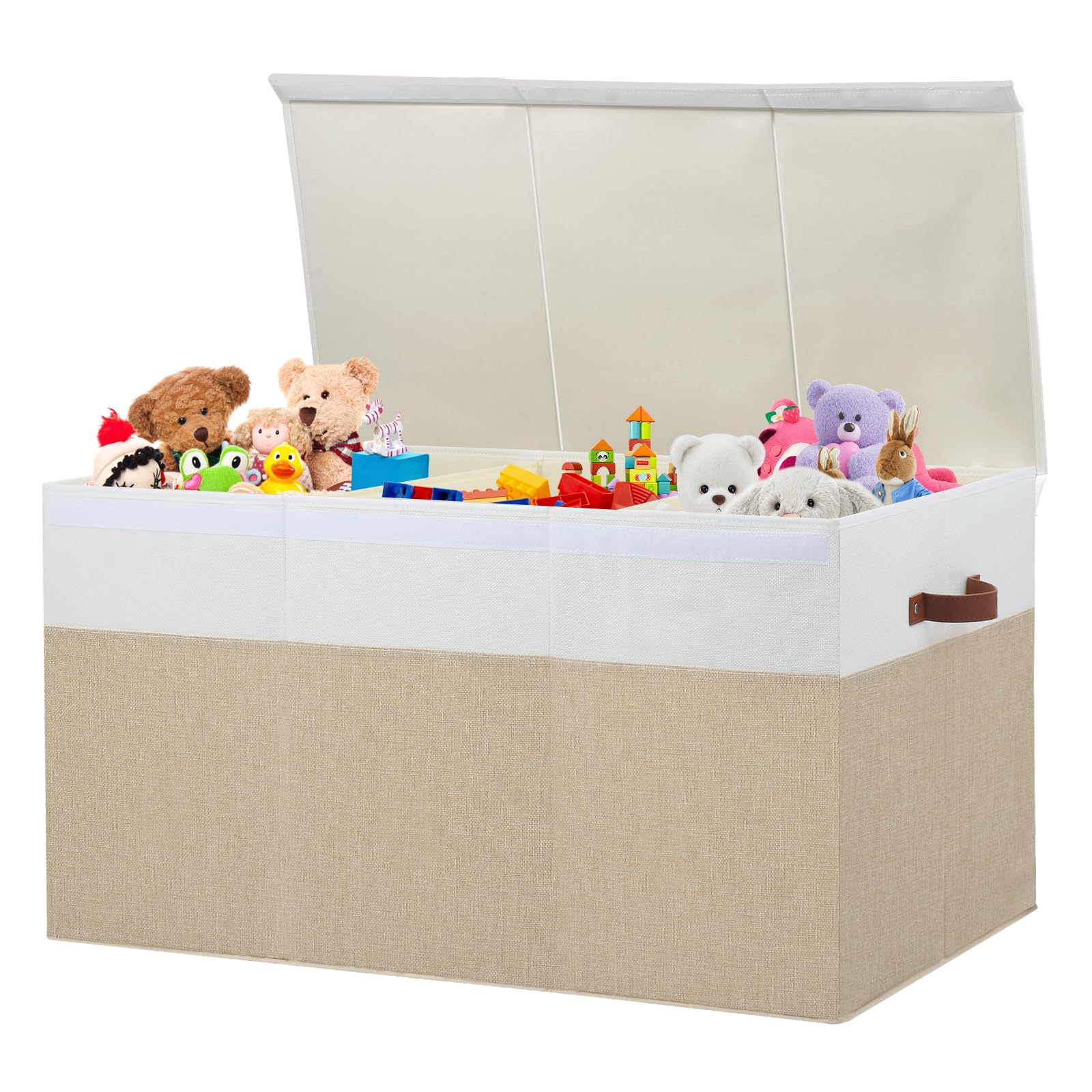
A hundred and sixty-seven liters is a strange thing to picture, so put it this way: at 35.5 inches long and 17 inches deep, this bin swallows what makes plastic chests overflow — the giant teddy, the folded play mat, the dress-up collection that never had a home.
The dividers are what make it more than a hamper with a lid. Two panels attach with hook-and-loop strips and split the interior into three, so blocks stay on one side and stuffed animals on the other, or both come out for one open box. Ours stayed put with the panels in. With them out, the linen sides bow once you pack past the rim, and the lid stops sitting flush.
It’s a fabric box over 3 mm board, and it behaves like one. The flip-top keeps dust off, the riveted side handles let you drag it across a room, and it folds flat when the toys rotate. Don’t sit on it and don’t expect it to survive a jump off the couch. Two of these along a playroom wall would hold more than most families own.
Pros
- 167 liters — the most capacity here
- Two removable dividers
- Riveted handles for dragging
- Folds flat when empty
Cons
- Sides bow when overpacked
- Not built to be sat on
For sheer volume there’s nothing close here: 167 liters, two removable dividers, and a lid that hides the lot — as long as nobody sits on it.
Best for Nursery Corners
CLCROBD Large Toy Box
Key Features
- Weight: 3.8 lb
- Material: Polyester
- Storage volume: 2.42 cubic feet
- Assembled dimensions: 21"L x 14.2"W x 14.2"H
- Price: Budget
Three point eight pounds is the number that matters here. This is the chest you pick up one-handed with the other arm full of laundry, carry from the living room to the nursery, and drop in a corner without worrying about the corners — because there aren’t any hard ones.
Inside there’s 2.42 cubic feet, which handles a small toy problem: the stuffed animals, the board books, the bin of blocks. The polyester body is reinforced at the sides, bottom and lid, so it stays open and upright when it’s full, and the soft rim means a toddler pulling up on it doesn’t meet an edge. It’s the chest we hand a 1-year-old without a second thought.
The animal on the front is felt applique rather than a print, and it’s the sort of detail a 2-year-old points at. What it won’t do is scale. This is a nursery-corner chest, not the answer to a playroom floor covered in toys — buy it first, then buy the big one when the collection outgrows it.
Pros
- 3.8 pounds and soft-sided
- Reinforced sides, bottom and lid
- Fits a nursery corner
- Felt animal applique
Cons
- Only 2.42 cubic feet
The one to carry from room to room: 3.8 pounds, soft sides, and an animal applique a toddler will actually notice.
Best for Budget Playrooms
Little Tikes Play ‘N Store Toy Chest

Key Features
- Lid: Lift-off
- Assembly: None required
- Storage volume: 10,980 cubic inches
- Assembled dimensions: 30.5"L x 20"W x 18"H
- Price: Midrange
Compared with our top pick, this chest gives you more room for less money. It measures 30.5 by 20 by 18 inches and holds 10,980 cubic inches — close to 6.4 cubic feet — which is a serious amount of toy for the outlay. What it doesn’t give you is anything clever.
The plastic has taken leaning, climbing and the general mistreatment a chest in a family room gets, and the oval body has no sharp corners at shin height. There is nothing to assemble: the chest comes in one piece and the lid drops on.
That lid is a flat panel resting on the rim. Tip it up and it comes free; set it back and it covers the toys without latching. The trade is deliberate — a lid that lifts off can’t guillotine small fingers — but it also means the chest is really a bin with a cover, and a toddler will leave the top on the floor.
For a basement playroom, a garage, or a first collection that hasn’t outgrown anything yet, that trade is fine. The chest does its one job — swallowing toys and keeping them out of sight — for less than the Step2, and there’s no hinge to work loose.
Pros
- More interior space than our top pick
- Nothing to assemble
- One-piece plastic wipes clean
- Oval shape, no sharp corners
Cons
- Lid lifts off and doesn’t latch
A big, tough, no-assembly plastic bin for less than our top pick — with a lid that rests on top instead of hinging.
Best for Stuffed Animals
YOLOXO Toy Box Chest

Key Features
- Material: Fabric
- Storage volume: 82 liters
- Panel thickness: 3 mm
- Assembled dimensions: 26.8"L x 13.8"W x 16"H
- Price: Budget
The walls are board under fabric, so this isn’t the chest for a room where kids climb, throw, or shove. What it is: 82 liters of closed storage — 26.8 inches long, 13.8 deep, 16 high — for less than any other pick here, in a fabric finish that looks better in a living room than a plastic bin does.
Three-millimeter inserts stiffen the walls and a solid board sits in the bottom, enough for stuffed animals, books, dress-up clothes and the soft stuff that makes up most of a small child’s collection. The handles on each end are the detail we use most: this is a box you carry to another room rather than drag.
One caveat before you buy: pack it past the rim and the sides bow, and the lid stops sitting flat. Where it earns its place is the guest room that became a nursery and the apartment where a rigid chest would dominate the room.
Pros
- 82 liters at the lowest price here
- 3 mm panels hold the walls
- Side handles for carrying
- Folds flat between uses
Cons
- Lid lifts off entirely
- Fabric isn’t water resistant
The pick for soft toys and dress-up clothes: 82 liters of closed, fabric-covered storage at the lowest price here.
How We Tested Toy Storage Chests
We started with every toy chest we could find from the major kids’ furniture and storage brands, then cut the list to 12 based on price, available sizes, and lid type — a spread of wooden chests, molded plastic bins, and foldable fabric boxes, since that’s the real fork in the road for shoppers. Anything with no lid attachment at all didn’t make it in.
Each chest was assembled solo with only what came in the box and timed; we counted the steps, noted whether hinge hardware arrived pre-attached or demanded a screwdriver, and flagged any step that needed two adults. Then each one went into a working playroom, where we filled it with blocks, dress-up clothes, and stuffed animals and counted what actually fit versus what the box claimed, watching how much dead space odd-shaped toys left behind.
The lid got the most attention. We let it fall from fully open and watched whether it slammed or eased down, checked whether it stayed up on its own while a kid dug around two-handed, and ran a finger-width check along the closing edge for pinch points. We also noted how the lid attaches — hinges, straps, hook-and-loop, or nothing — and whether it came off in a toddler’s hands during a normal dump.
Durability was the least gentle part: kids climbed in, we dragged loaded chests across hardwood, wiped juice and marker with a damp cloth, and rechecked seams, corners, and finish afterward. We lived with them long enough to judge whether they still looked presentable in a room adults sit in, and whether the kids reached for them without being asked.
How to Choose a Toy Storage Chest
The lid decides whether you love a toy chest or quietly resent it, so start there and work back to size, material, and assembly.
Start With the Lid
Two lid designs cover almost every chest here, and they behave differently enough to settle the purchase. A hinged lid with a slow-close or support mechanism stays attached, holds itself open while a child rummages, and won’t drop on fingers; the Delta Deluxe and the Melissa & Doug chest both work this way. A lift-off lid comes free in your hands. It can’t slam — on the Step2 and the Little Tikes chest that’s the whole point — but a toddler can’t put it back, and it usually ends up on the floor. If the chest lives where a 2-year-old plays unsupervised, pay for the hinge.
Match the Interior to the Toys You Own
Volume tells you how much fits; the footprint tells you whether it fits in the room. A 4.5-cubic-foot chest like the Step2 runs about 30 inches long, while the Melissa & Doug chest reaches 8.25 cubic feet by going taller and deeper in roughly the same wall space. Measure the wall first, then measure the biggest thing that has to go inside — a ride-on, a dollhouse, a folded play mat. Tall rigid toys, not small ones, are what force an upgrade, and listed dimensions are outside measurements, so usable space is always a little smaller.
Plastic, Wood, or Fabric
Plastic is the toughest per dollar and the easiest to wipe: climbing, juice, and a trip out to the yard don’t hurt it. Wood buys furniture — the Melissa & Doug chest is the one here that doesn’t look like a kid’s product — at the cost of money, weight, and assembly. Fabric boxes like the Gowee and the CLCROBD give you the most liters for the least cash and fold flat between uses, but the walls are board inside cloth: they bow when overpacked and won’t take a jump. Match the material to the room the chest lives in, not to the toy count.
Assembly, Weight, and Doorways
Some chests arrive ready to use; the wooden ones need a screwdriver and an evening. That matters most when the chest is a birthday gift landing the night before, so check before you order. The wooden picks are also the ones to slow down on, since driving screws hard into pre-drilled holes can split a panel. Weight is the other practical question: a 29-pound wooden chest is a two-person carry up stairs, while the fabric boxes at 4 to 6 pounds move one-handed. Measure the stairwell and the doorway before the box shows up, not after.
Frequently Asked Questions
How do I clean a fabric toy box?
The outside takes a damp cloth and a little mild soap; blot rather than soak, then leave the lid open until it dries completely. The board panels inside warp if water gets between the fabric and the board, so don’t hose it down or put it in a washing machine.
Plastic chests are easier. A damp cloth handles most of it, and crayon marks come off with a little rubbing alcohol on a rag.
How do I keep a toy chest from turning into a junk pile?
Rotate instead of cramming. Keep one chest’s worth of toys in circulation and the rest in a closet bin; when the lid stops closing, swap about a third of the contents rather than shopping for a bigger chest.
A box with dividers, like the Gowee, makes the swap quick because you can lift one section at a time and see what’s actually in there.
Can a toy chest do a second job once the kids outgrow it?
Usually. Wooden chests move into blanket, entryway, or linen storage, and thick plastic ones end up in the garage or the trunk of a car. Fabric boxes fold flat, so they’re easy to stash but rarely survive a second life under heavy gear.
If you want something to hand down, buy wood or heavy plastic rather than board-and-cloth.
Final Verdict
Most families should buy the Step2 2-in-1: 4.5 cubic feet, no assembly, wipe-clean plastic, and a lid that turns into an art board. If the chest goes in a toddler’s bedroom, choose the Delta Children Deluxe instead — the slow-closing hinge is what matters when a 2-year-old is the one lifting the lid.
And if the toys have already outgrown every bin in the house, the Gowee holds about a third more for less money. Buy it before you buy another plastic box that fills up by December.
