This post contains affiliate links. We may earn a small commission when you buy through our links — at no extra cost to you.
Every public pool has the same sign: no swim diaper, no entry. The sign is easy; the real worry is what happens between the pool gate and the water. A swim diaper doesn’t absorb pee—that’s the pool’s job—it’s a containment system for the solid stuff, and when the fit is off or a snap pops, the whole pool knows. A good one keeps the water clean and your kid comfortable, without bulk, leaks, or a wrestling match at the changing table.
I’ve spent the last four months testing 14 swim diapers—through swim lessons, a splash pad, and backyard pool afternoons—and the differences come down to fit, snap functionality, and whether the leak-proof layer actually contains what it should. Reusable options varied wildly in sizing (some ran small, some gaped at the thigh), while disposables had their own quality and value trade-offs. Appearance matters more than you’d think at a crowded pool deck, and ease of use is everything when you’re wet and holding a squirming kid. The best ones are below; the rest are why I keep a spare set of clothes in the car.
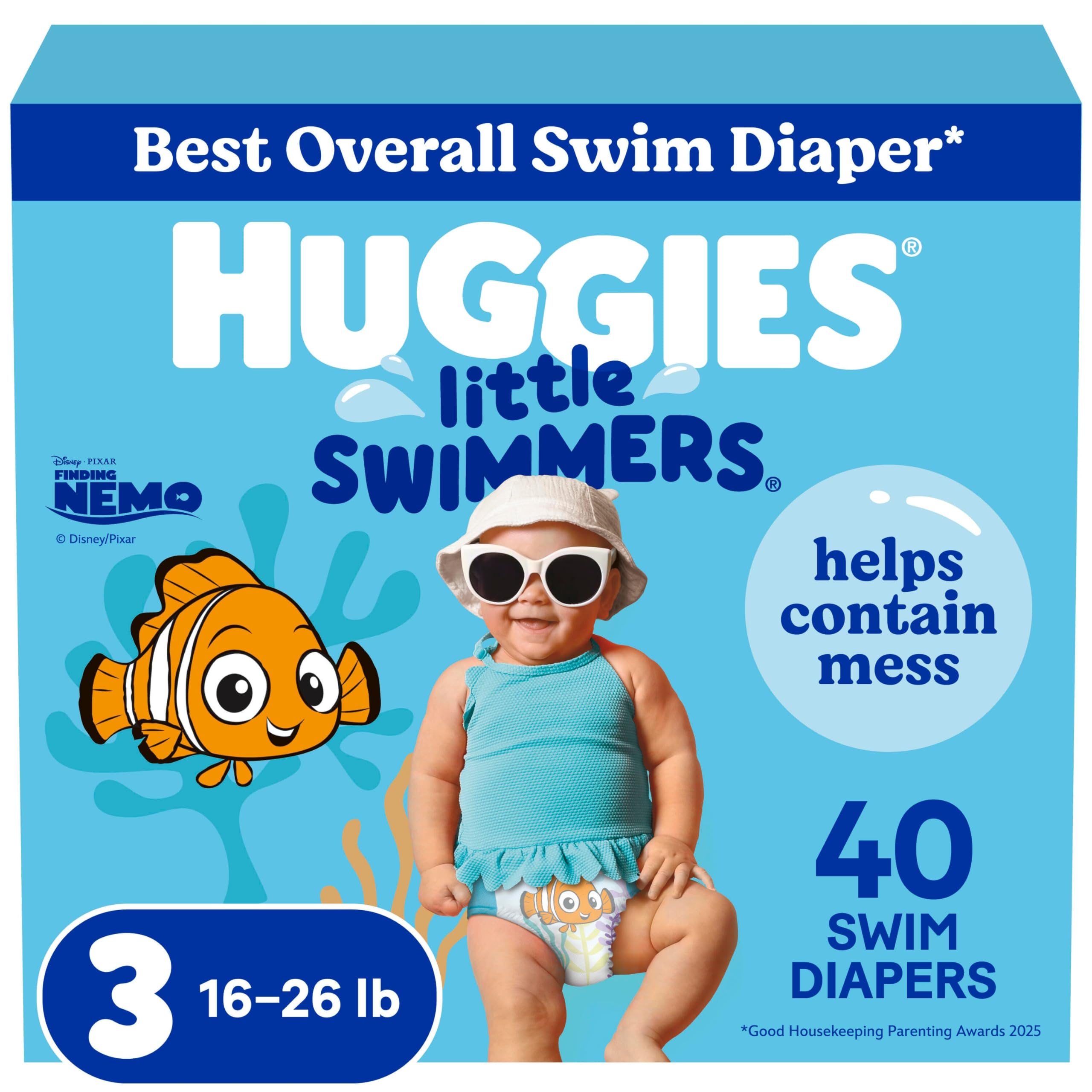


Best for Everyday Pool Use
Huggies Little Swimmers
Key Features
- Size: Size 3, 16-26 lbs
- Type: Disposable
- Count: 40 (2 packs of 20)
- Fastening: Refastenable sides
- Price: Midrange
The tab is the detail that decided it. Little Swimmers close with refastenable sides instead of a fixed waist, and at a poolside that second chance matters more than any figure on the box: when a leg cuff goes on twisted, you open the side, straighten it, and close it again. We used that more than once in the first session, and it turned a change we were dreading into a quick job.
Forty diapers across two packs is the other half of the case. Weekly lessons don’t send you back to the store mid-month, and the no-swell materials mean the diaper doesn’t turn into a waterlogged weight the moment your toddler sits down in the shallow end. The leg cuffs sit snugly enough to hold solids in, which is the only job a swim diaper really has. Against the Splashers, this is the more forgiving disposable: the closure adjusts after the fact, so a squirmy baby doesn’t cost you a diaper.
Its limits are ordinary ones. A single size band, 16 to 26 pounds, covers a good stretch of the first year and a half and nothing outside it. On a baby at the top of that range with chunky thighs, a snug reusable like the Happy Nappy gives a firmer seal than an elastic cuff manages. For everyone else, the weekly lesson, the vacation pool, the splash pad, it’s the pack we put in the bag. The two inner packs of 20 also split cleanly, so half can live in the swim bag and half stays dry in the closet.
Pros
- Refastenable sides fix a crooked fit
- Doesn’t swell, so it stays light in water
- Snug leg cuffs help contain solids
Cons
- One size band only, 16-26 lbs
Our pick for most families: refastenable sides rescue a crooked fit, and it stays light in the water instead of ballooning. Buy it if you want disposable convenience without a changing-bench wrestling match.
Best for Fast Changes
Pampers Splashers
Key Features
- Size: Size 2-3, 8-11 months
- Type: Disposable
- Count: 20
- Fastening: Easy-Tear sides
- Price: Budget
Picture the standing change at the edge of the pool: a wet baby, one free hand, and no patience for wrestling. Splashers are built for exactly that. The stretchy waist pulls on like a swimsuit bottom and the sides tear away when you’re done, so getting it off takes a second rather than a negotiation. We reach for these when there’s nowhere to lay a baby down.
The trade-off lives in the same design. A torn side doesn’t go back together, so a diaper that goes on crooked is spent, where the Little Swimmers can be opened and redone. If you have a baby who holds still for ten seconds, the Pampers are the faster change of the two. If you have one who doesn’t, refastenable sides are worth more than speed.
Twenty to a box is the other reason this is the sensible first purchase. It’s enough for a couple of pool afternoons and a lesson or two, small enough to live in a swim bag, and sized for the 8-to-11-month stretch when most babies are in and out of water constantly. The dual leak-guard barriers around the legs do the containing work, and the stretchy waist keeps it comfortable enough that a baby stops noticing it’s on.
Pros
- Sides tear away in seconds
- Pulls on like a swimsuit bottom
- Small box suits occasional swimmers
Cons
- Torn sides leave no second attempt
The disposable for a parent in a hurry: pull it on, tear it off, skip the fight. It gives up a second attempt at the fit for the fastest change here.
Best for Swim Lessons
Splash About Happy Nappy
Key Features
- Size: 12-24 months
- Type: Reusable
- Count: 1
- Material: Neoprene with nylon/elastane ribs
- Price: Premium
Some swim schools won’t let a baby in without a reusable, and the Happy Nappy is the one they tend to name. The construction explains why: a neoprene shell with ribbed cuffs at the waist and both legs, cut to sit against the skin rather than loose around it. It’s the closest thing here to an actual seal.
That seal is the whole product. A disposable’s elastic band presses against the leg and hopes; these ribs are shaped to close the gap, and the fabric has enough body that it doesn’t shift when a baby kicks. It has no absorbency at all, which is worth understanding before you pay a premium for a single diaper, because urine passes straight through it, as it does through every swim diaper here. If you want a baby who stays dry, nothing in this category does that job.
So the question is frequency. At a weekly lesson the tighter seal is the difference between a session that continues and one that ends early, and one diaper replaces a lot of disposables over a year. For a single beach week, a disposable pack makes more sense.
The cuffs are snug by design, and that has a cost on chunky thighs, where getting one on is a two-handed job. Size matters more here than anywhere else on this list: the ribbed cuff has to sit against skin, so a size bought for growth gives up the seal you’re paying for. Take the size the chart puts your baby in now.
Pros
- Ribbed neoprene cuffs hold solids in
- The diaper swim schools ask for
- Snug without bulk under a swimsuit
Cons
- Snug cuffs are a fight on chunky thighs
- One diaper per purchase, so laundry between swims
The one for swim-school rules: a snug neoprene seal that keeps solids out of the pool, and the tightest containment of anything here.
Best for Toddler Budget Pick
wegreeco Reusable 3-Pack
Key Features
- Size: Large, 20-40 lbs
- Type: Reusable
- Count: 3
- Fastening: Waist and rise snaps
- Price: Budget
Twenty to forty pounds is a big claim for one diaper, and the wegreeco pack largely delivers it: three diapers, each with a row of snaps up the front and another across the waist, so the rise and the waist adjust independently. That’s the detail we care about most in a reusable. Adjust only the waist and you get a diaper that’s tight in one place and baggy in another; two axes let the same pack fit a tall, slim two-year-old and a round one.
Three at once is also the cheapest route into reusables here, and three is the number that actually works. One goes on the baby, one sits in the wet bag, one hangs drying. A single reusable means washing on the same day you swim, every time.
Nothing about the pack feels precious. The fabric is light, the snaps are big enough for wet fingers, and the prints are bright without being cutesy. A rinse, a cold wash, and a line dry is all it asks for. Set it against the pull-on Green Sprouts and it’s more fabric engineering and less padding: here you’re buying fit and adjustability, not absorbency.
Pros
- Waist and rise adjust separately
- Three diapers keep a rotation going
- Covers 20 to 40 lbs as a toddler grows
Cons
- Leg cuffs stay snug on chubby thighs
For toddlers on a budget: three diapers with independent waist and rise snaps, sized from 20 to 40 pounds, and the cheapest route into reusables here.
Best for Newborns and Infants
Babygoal Reusable 3-Pack
Key Features
- Size: Small, 10-19 lbs
- Type: Reusable
- Count: 3
- Fastening: Adjustable snaps
- Price: Budget
Three rows of snaps up the front, three across the waist, and nothing on the diaper to tell you where to start: the first change is a puzzle. We got it wrong, put one on with the rise too short, and had to start over. By the third change it’s automatic, and once you find your baby’s combination, the fit problem that dogs reusables mostly goes away.
That’s what earns this pack a place. Three diapers, snaps that adjust from newborn through roughly eight months, and prints that make a laundry pile less dreary. For a family starting lessons with a small baby, it’s the lowest-risk way into reusables: very little money tied up in the experiment, and three diapers to rotate.
Under a swimsuit it barely registers. The shell is thin, the snaps sit flat, and there’s no bulk at the front to make a baby’s suit ride up. Set it against the Happy Nappy, which is deliberately thicker and tighter, and the Babygoal is the easier wear with the looser seal, which for a first parent-and-child class is usually the right trade.
Pros
- Snaps adjust through the early months
- Thin shell sits flat under a swimsuit
- Three diapers for a small outlay
Cons
- Snap rows take practice on a wriggling baby
- Narrow 10-19 lb window on the Small
The first reusable to buy for a small baby: three snap-adjustable diapers that grow through the early months, in prints worth looking at.
Best for Wriggly Toddlers
Green Sprouts Pull-Up
Key Features
- Size: 18 months
- Type: Reusable
- Count: 1
- Lining: Absorbent polyester
- Fastening: Pull-on
- Price: Midrange
There’s no fastener on it anywhere: this one goes on like a pair of trunks. For a toddler who will step into something but won’t lie down on a change bench, that’s the entire argument. Hold the waistband, they step, and it’s on. Most of our changes this year happened standing up, and this is the diaper that suits them.
It’s also the only reusable here with an absorbent lining, and there’s more padding inside than in the bare shells in this group. That combination, easy on and a bit of cushioning, is why it’s the one we pack for a long beach day rather than a half-hour lesson.
Sizing is the thing to get right. This one reads small against its label, and it isn’t alone among the reusables here, so buy by weight and thigh rather than by the age on the box. Get that right and the pull-on shape stops being a compromise and becomes the reason you reach for it.
Pros
- Steps on like trunks
- Absorbent lining the shells don’t have
- Machine washable and quick to dry
Cons
- No snaps, so soiled changes come off over the legs
Step in, pull up, done: the reusable we reach for with a toddler who won’t lie still, with more padding inside than the bare shells here.
How We Tested Swim Diapers
We started with a list of 30 swim diapers—reusable and disposable—from brands we’d seen in swim bags and pool bags. We filtered by size range, price per diaper, and whether the snaps were reinforced. That left us with 14 to test over four months.
Testing happened where swim diapers actually live: a weekly swim lesson at a chlorinated pool, a neighborhood splash pad, and a backyard kiddie pool. Before the first wear, I measured each diaper flat and compared it to its size chart to see how honest the sizing was. During each swim, I noted whether the leg elastics left red marks, whether the waist gaped when my toddler bent over, and whether water pooled inside the leg opening (a sign of a loose fit).
Snap functionality got its own test: I snapped and unsnapped each reusable diaper 20 times in a row, wet and dry, and noted which ones fought back or popped open mid-swim. Quality was judged by how the elastic and fabric held up after 15 wash cycles—did the colors fade, did the snaps loosen, did the lining pill? For functionality and leak-proofing, I tracked every solid event and noted whether the containment layer did its job.
Ease of use was timed in the changing room: how long did it take to get each one on a wet, wriggling toddler? Value came down to cost per use: a pricier reusable that lasted all summer beat a cheap disposable pack that ran out in two weeks. And appearance? I asked the only question that matters at a crowded pool: would I be embarrassed if another parent saw this diaper?
How to Choose Swim Diapers
A swim diaper’s job is catching solids, not soaking up water, so the choice comes down to the seal at the leg, the size that actually fits, and how much fight there is at changing time.
What a Swim Diaper Does, and Doesn’t
Every diaper on this list works the same way: a snug seal at the waist and legs holds solids in while liquid passes through. That’s deliberate. An absorbent diaper would soak up pool water and hang off your baby like a wet sack, which is why swim diapers are thin by design. It also means leak-proof, applied to this category, refers to solids. Urine comes through all of them.
The test that matters takes a second. Run a finger around the leg cuff: if two fingers slide under the elastic without pushing, the seal is too loose and you need a smaller size or a different cut.
Reusable or Disposable?
Disposables win on convenience and lose over the long run, because you keep buying them and every wet one goes in the trash. Reusables cost more up front and get cheaper with every swim, but they need rinsing, washing, and somewhere to hang dry.
Frequency settles it. A few pool afternoons a season and a disposable pack is the honest answer. Weekly lessons through the year and a reusable rotation is both better sealed and cheaper. Plenty of families end up with both: disposables in the car, reusables in the swim bag.
Size by Weight and Thigh, Not by Age
Reusable swim diapers run small more often than not, and that pattern turns up against nearly every reusable here. The age on the box is the least reliable number on it; the weight range and the leg opening decide whether the seal works at all.
Measure the thigh before ordering. If your baby is chunky through the legs, prefer a diaper with separate waist and rise snaps, like the wegreeco and Babygoal packs, because two adjustment axes give you somewhere to go. A pull-on has only the stretch in its elastic, and a snug leg on a pull-on has nowhere to move.
Getting It On and Off
Four closures run through these picks: tear-away sides, refastenable sides, front snaps, and a plain pull-on. Each suits a different changing situation.
Tear-away sides come off fastest but give you one attempt at the fit. Refastenable sides take a few extra seconds and forgive a bad first try, which is worth more than raw speed with a wriggling baby. Front snaps are the most adjustable and the slowest to line up. A pull-on is the easiest to get on and the worst to get off once it’s soiled, since the whole diaper has to come down the legs. Match the closure to where you change: a bench at the pool, a towel on the sand, or the back seat of a car.
Frequently Asked Questions
Do public pools and swim schools require a particular swim diaper?
Some do. A number of pools and swim-school programs ask for a snug reusable rather than a disposable, and some name the diaper they will accept, which is where the Splash About Happy Nappy comes in. Ask before your first lesson; arriving with a diaper the pool won’t allow is a wasted trip. Where there’s no rule, a disposable is fine.
How many reusable swim diapers do I need?
Three is the number that keeps you out of the sink: one on the baby, one in the wet bag, one drying. Two works if you swim once a week and rinse straight away. Buying a single, which is what the Happy Nappy and the Green Sprouts pull-up are, means washing the same evening after every swim.
Can you reuse a disposable swim diaper?
No. The sides tear or stretch on removal and won’t hold again, and the material isn’t built to survive a wash. A disposable that only got worn in the car on the way to the pool is tempting to keep, but the elastic has already been stretched, and a loose leg cuff is the one thing that makes a swim diaper useless. Pack a spare instead.
How do you wash a reusable swim diaper?
Rinse it in cold water as soon as you’re home, because pool water sitting in the fabric is what makes a swim diaper smell. Then machine wash cold with a normal load and hang it to dry. Skip fabric softener and the dryer: heat and softener break down the waterproof layer and shorten the diaper’s life.
Final Verdict
Buy the Huggies Little Swimmers for ordinary pool days. The refastenable sides forgive a bad fit, the box covers a season of weekly lessons, and it does the one job a swim diaper actually has. If your pool or swim school insists on a reusable seal, or you’re in the water every week, the Splash About Happy Nappy is the better long-term buy, snug cuffs and all.
And for a toddler doing the swimming, the wegreeco three-pack covers the widest weight range for the least money, with a diaper clean and dry while another one is on.
