This post contains affiliate links. We may earn a small commission when you buy through our links — at no extra cost to you.
A personalized gift only works if the name is spelled right and the thing itself survives more than one excited afternoon. That’s the quiet worry behind every custom book, name puzzle, and embroidered blanket: will it feel special to the kid, and will the grown-up still like it after a few washes? The right one turns a name into something a child reaches for on their own—at bedtime, in the car, on a rainy Saturday—not a keepsake that lives on a shelf.
Over the past six months, my team and I tested 14 personalized gifts for kids, from storybooks and puzzles to blankets and jewelry. We checked whether the personalization came through correctly, how easy each gift was for a child to use without an adult hovering, and whether materials and edges held up after play and laundry. Size and length mattered too: a blanket that’s too small or a chain that sits wrong won’t get worn. The strongest picks balanced content, appearance, and value, and felt like gifts rather than catalog items—the ones below are the ones we’d happily hand over at a birthday party.


Best for Toddlers Learning Letters
Fat Brain Toys Name Puzzle
Key Features
- Board length: 26 inches
- Letter colors: Assigned by the maker
- Personalization: First name up to 9 letters
- Recommended age: 12 months and up
- Price: Midrange
Twenty-six inches is a lot of board for a child’s name, and that length is why we reach for the Fat Brain Toys puzzle whenever the name is unusual. One price covers up to nine letters, so Ada and Annabelle get the same piece of wood, and the letters arrive capitalized in a mix of bright colors that reads as a toy rather than a nameplate.
It’s rated from twelve months, younger than anything else personalized in this guide, and the difficulty grows with the child: stacking at one, shape-matching at two, spelling at four. The letters sit fairly flush in the board, so the smallest hands may need a fingertip under the edge or the whole puzzle tipped over to get started, which stops mattering once they’ve done it a few times.
The wood is smooth, the paint is bright and non-toxic, and the puzzle does a second job most personalized gifts don’t: propped on a shelf it works as nursery decor, and it stays legible long after the birthday cards are gone. One practical note — if the name runs past nine characters, order the short version, because there is no longer board.
Pros
- Takes names up to nine letters at one price
- Rated from twelve months, the youngest start here
- Doubles as nursery decor after the toy stage
- Smooth, well-finished wood and bright paint
Cons
- Letter colors are assigned, not chosen
- Some letters only fit in one orientation
Our default pick: a made-to-order name puzzle that takes nine letters at one price, suits a one-year-old as well as a four-year-old, and looks good enough to leave out.
Best for New-Baby Keepsake
I See Me! Bedtime Book
Key Features
- Size: 9 x 11 inches
- Format: 20-page hardcover
- Age range: 0 to 6 years
- Personalization: First name on every page
- Price: Premium
The most expensive gift here is also the one that arrives looking like it cost something: a 20-page hardcover with the child’s name worked into the illustrations as well as the text. We expected a template with a name dropped into the gaps, and what is on the page is a name stitched into the artwork, which is a different thing to flip through.
Whether the premium is worth it depends entirely on the recipient. For a newborn or a first birthday, this is the gift that sits on a shelf for a decade and gets read at bedtime, and the 0-to-6 span means it doesn’t expire the way a name puzzle eventually does. For a five-year-old who already has a stack of books, we think the money goes further elsewhere in this guide.
Two details to settle before ordering. The first name is the only name used, on the cover and through the story, so a child who goes by a nickname needs that decision made at checkout rather than afterward. And the book is printed for the order, which makes it a gift to plan rather than one to grab on the way to a party.
Pros
- Name woven into the story and the artwork
- Suits a newborn through about age six
- Hardcover keepsake that reads as a real gift
Cons
- The most expensive pick in this set
- Only the first name is printed
Buy it for a baby or a first birthday: a hardcover the child’s name runs through from cover to cover, and the gift here most likely to be kept for twenty years.
Best for Matching Nursery Colors
BloomOwl Name Puzzle
Key Features
- Made in: United States
- Personalization: Name plus your color choice
- Recommended age: 3 years and up
- Price: Midrange
Most personalized puzzles pick the palette for you. BloomOwl hands it over: choose the colors before the puzzle is made, which is the difference between a gift that matches the nursery and one that merely lands in it.
Underneath the paint it’s a proper wooden name puzzle — smooth letters, a curved base, enough weight that it stays where it’s put instead of skating across a table. We were pleasantly surprised by the box: the inside is printed so the child can color it, which turns packaging into a second activity instead of landfill.
The limitation is age. BloomOwl lists three years and up where our top pick starts at twelve months, so for a one-year-old this is decoration first and a toy later. Past three, that gap closes and the color choice becomes the whole reason to pick this one over the alternative.
Where it earns its place in this set is longevity. A puzzle matched to the room tends to stay on the shelf instead of going into the toy bin, and that’s how a personalized gift gets used past the first month. The child also grows into the letter-matching rather than out of it, which is more than you can say for most things that arrive with a name on them.
Pros
- You choose the color scheme
- Made in the United States
- Box interior doubles as a coloring page
Cons
- Starts at three years, not twelve months
The name puzzle to buy when the nursery has a color scheme: you choose the palette, the wood is smooth and sturdy, and it suits a three- or four-year-old learning to spell.
Best for First Savings Habit
Summidate Letter Piggy Bank
Key Features
- Height: 9 inches
- Opening: Screwed acrylic panel
- Personalization: Initial plus alphabet stickers
- Price: Midrange
A piggy bank you can’t see into is just a wooden box. The Summidate bank runs a clear acrylic panel across the front so a four-year-old can watch the coins stack up, and watching is most of what keeps a child feeding it.
The personalization is a letter — pick an initial from A to Z, or one of the animal shapes — and a sheet of alphabet stickers comes in the box so a child can finish the rest of the name. We like that the last step belongs to the kid: a bank a child labels personally gets more use than one that arrives finished. It stands nine inches tall, which takes folded bills and still fits on a shelf.
Getting money out is the part to think about before you wrap it. The acrylic front is held on with a run of small screws, and that is a deliberate design — it makes saving the default — but it also means this is a long-term bank rather than a Saturday coin-counting one. The wood is finished with mineral oil and beeswax rather than paint, and it doesn’t look out of place on a shelf in a bigger kid’s room.
Pros
- Clear front so a child can watch savings grow
- Initial plus stickers to finish the name
- Nine inches tall, takes coins and folded bills
- Oil and beeswax finish, no paint
Cons
- Smaller in person than the listing suggests
A wooden bank a child personalizes with an initial and stickers, with a clear front that makes saving visible — our pick for four- to eight-year-olds.
Best for Preschool Everyday Purse
mibasies Toddler Purse
Key Features
- Strap: Adjustable
- Dimensions: 5 x 5.2 x 2 inches
- Target age: 3 to 8 years
- Personalization: Patched initial
- Price: Budget
Five inches square sounds too small until you watch a two-year-old try to carry anything bigger. Small is the point here: a snap she can work herself, an adjustable strap, and a patched initial on the front that makes the bag hers rather than a hand-me-down. Of the bags in this guide it’s the least expensive, and the one sized for the smallest hands.
What it holds is snacks, a couple of little toys, sunglasses, and whatever treasure is being transported that day. What it doesn’t hold is a school-age kid’s water bottle and lunch. We found the faux leather wipes clean and the oiled edges shrug off being dragged around, and the strap adjusts far enough that the same bag works from about two up to five.
Check the patch when it arrives. A letter that sits crooked on the front is small in the hand and enormous on a gift, and it’s the one thing worth inspecting before the wrapping paper comes out.
Pros
- Small and light enough for a toddler to carry
- Adjustable strap and an easy snap closure
- Initial patch makes it feel personal
Cons
- Outgrown once a child reaches school age
For the two- to five-year-old who wants a bag like a grown-up’s: small, adjustable, wipeable, and finished with a patched initial.
Best for Hands-Free Days Out
Gitus Initial Belt Bag
Key Features
- Pockets: Two zip, three mesh
- Dimensions: 7.8 x 2.4 x 5 inches
- Strap length: 28 to 44 inches
- Personalization: Letter patch
- Price: Budget
The strap runs from 28 to 44 inches, which covers a four-year-old wearing it across the body and a nine-year-old wearing it at the waist. That spread is wider than most kids’ bags manage, and it’s the reason this one doesn’t get outgrown in a single school year.
Inside it’s a proper little organizer: two zipped pockets, three mesh dividers, and enough room for snacks and the collection of rocks that comes home from every walk. The initial is a patch on the front, the nylon is water resistant, and the buckle adjusts anywhere along that range.
We came back to this one for days out rather than school days. It wears hands-free on a zoo trip, sits flat in a backpack when it isn’t wanted, and takes a scuff without showing it — and the initial means two siblings can tell whose is whose.
Pros
- Strap spans preschool through pre-teen
- Two zip pockets and three mesh dividers
- Water-resistant nylon wipes clean
Cons
- Hand wash only
- Little spare room if a child overpacks
The one to hand a kid on a day out: an adjustable strap that spans preschool to pre-teen, an initial patch on the front, and pockets that keep small things findable.
Best for First-Birthday Guest Book
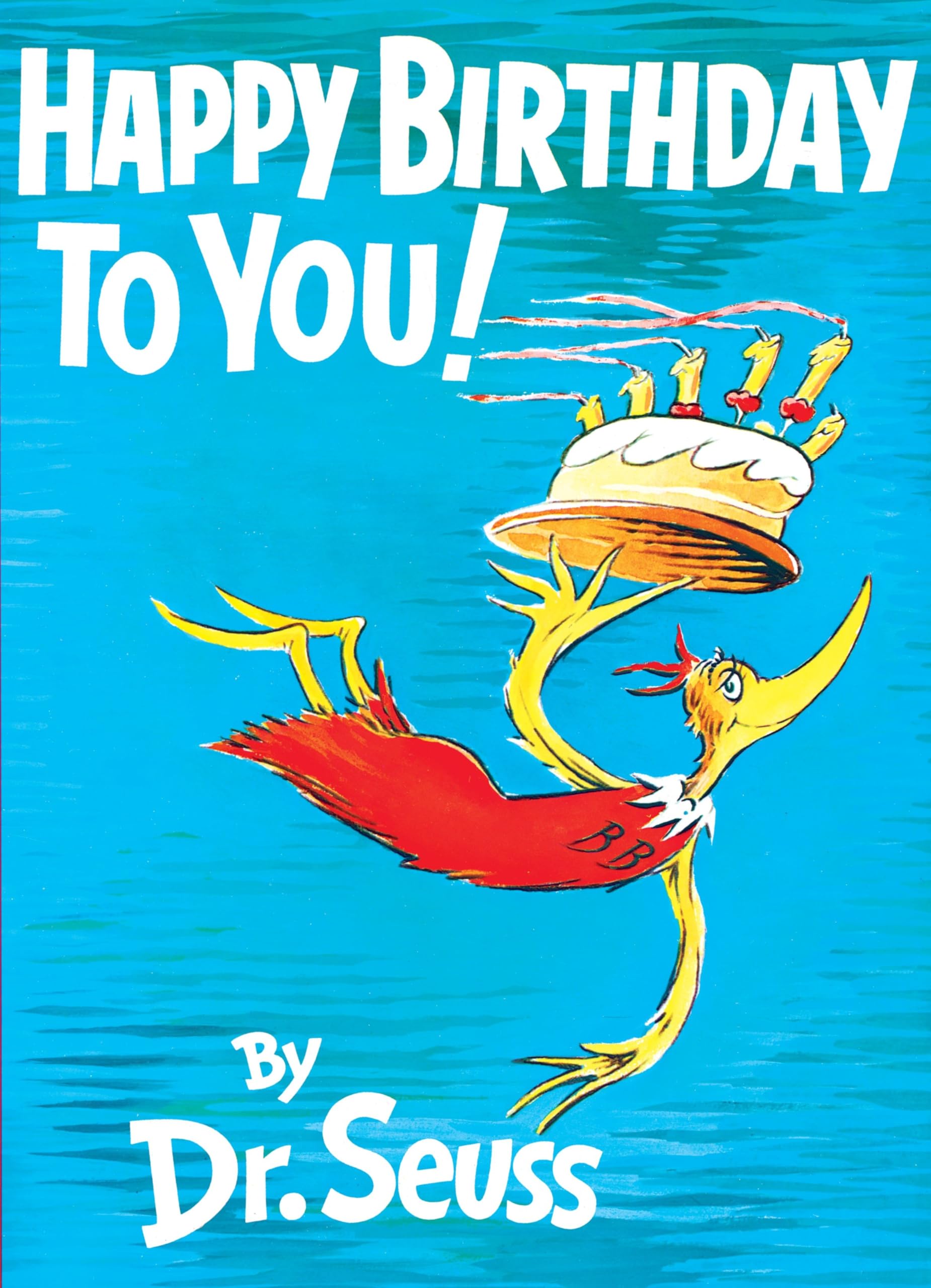
Happy Birthday to You!
Key Features
- Format: 64-page hardcover
- Grade level: Kindergarten to 4
- Personalization: Handwritten inside, not printed
- Price: Budget
The personalization here comes from you, not from a printer. The inside covers and the margins are where a family writes the names of everyone at the party, and that turns a 64-page classic into a record of who was in the room for a first birthday.
As a book it does exactly what a Seuss birthday book should: a hardcover, a rhyme that survives the ninth read-aloud of the week, and a story about a birthday rather than a generic message. We think the guest-book trick is the reason to buy this edition rather than another Seuss title — it’s the least expensive gift in this guide, and the only one where the personalization can be added the morning of the party.
Sixty-four pages is longer than the board-book Seuss titles, and that is a plus at four and a slog at two; the story lands once the child can follow a plot. As a first-birthday present it is really a gift to the parents, who get something to hand around while everyone is standing in the kitchen.
Pros
- Costs less than anything else in this guide
- Room inside for guests to sign
- Hardcover birthday story that gets reread
Cons
- Nothing is personalized by the seller
- Paper pages will not survive a one-year-old
The cheapest way to give a personalized keepsake: a hardcover Seuss birthday book, passed around the party, with the messages doing the personalizing.
Best for Family Photo Gift
IMAGE3D RetroViewer

Key Features
- Viewer size: 2.13 x 2.13 x 1.65 inches
- Personalization: Your photos on a custom reel
- Reel processing: 5 business days
- Price: Premium
The viewer arrives with a voucher, not a reel. You upload the photos afterward, and Image3D turns them into a plastic reel you click through by hand — which is the whole appeal and the whole catch, because the gift isn’t finished until you’ve done the second part.
When the reel does arrive, it is unlike anything else in this guide. Your own photographs — the family dog, the grandparents, last summer — clicked through one at a time in a red plastic body that feels like 1985 in the best way. We noted that children who have never handled a screen-free photo toy take to the clicking almost immediately, and the viewer is tough enough to be carried around.
The pictures are tiny, so the photos you choose matter: a close-up with one face filling the frame reads beautifully, and a wide shot of a beach reads as mush. The reel itself is durable plastic, old classic reels work in the viewer, and more reels can be ordered later, which is how this becomes a recurring gift rather than a one-off.
It’s the pick for a child whose grandparents live three states away, or for the parent who wants a photo gift that isn’t another screen. The personalization is the point and the toy is the mechanism, and the clicking is what makes it a toy instead of a photograph.
Pros
- Your own photos in a kid-proof viewer
- Works with classic reels too
- More reels can be added later
Cons
- Five business days to process each reel
- One reel included; extra reels cost more
The photo gift: a red plastic viewfinder loaded with a reel of your own pictures, and the only pick here a child can look through.
How We Chose and Tested Personalized Gifts for Kids
We started by pulling together a shortlist from small personalization shops, museum stores, and larger retailers, then narrowed it by whether names could be previewed before ordering, age recommendations, turnaround, materials, and price. We cut anything with vague sizing, no personalization preview, or care instructions that made the gift feel fragile. That left 14 gifts, which we tested over six months with families and kids ranging from toddlers to tweens.
Testing happened where gifts actually live: birthday parties, bedtime, car rides, the playroom floor, and the laundry room. We watched kids open each gift, then noted whether they went back to it without prompting a day later. For ease of use, we paid attention to whether a 3-year-old could turn puzzle pieces or pages without help and whether a 10-year-old could fasten a clasp or adjust a strap alone. We checked personalization spelling and placement against the order form, measured blankets and books against stated dimensions, and laid necklaces and bag straps flat to see where the length actually landed on a child.
After a month of regular use, we washed blankets and plush items according to care labels and checked seams, corners, and edges for fraying or lifting. We flipped through books and puzzles to see whether content stayed engaging after repeated readings, and we compared the finished look against the price to judge value. Gifts that survived the six months and still got chosen on ordinary days made the final list.
How to Choose a Personalized Gift for a Kid
The name is the easy part; the decision is whether the thing carrying it is something the child will use at two and still keep at ten.
Decide what the personalization actually is
A printed name is the most personal thing you can put on an object. A single initial is the least — it’s a decoration that happens to be a letter, and it can’t be corrected if it turns up crooked or the child starts going by a nickname. Photos and handwritten messages sit in between: real personalization, but supplied by you rather than the maker.
Two gifts at the same price aren’t equal here. A name a child can read is worth more than a letter they can’t yet connect to themselves, and that is why the puzzles and the printed book sit above the initial bags in this guide for a child under four.
Match the gift to the age, not the birthday
The stated age on the listing is the number worth checking twice, because personalization doesn’t make an object suitable. A name puzzle rated from twelve months is a chew-and-stack toy; the same idea rated from three years is nursery decor until preschool arrives. The difference isn’t quality — it’s whether the gift gets played with on day one.
Bags run the other way. A five-inch purse suits a two-year-old and frustrates a seven-year-old, while an adjustable belt bag covers the school years. Buy for the child in front of you, not the one on the invitation.
Leave room for the making
Anything with a name on it is usually made after you order, and the clock starts then, not at checkout. Custom photo reels are the slowest of these: the voucher in the box becomes a reel only after you upload the pictures and the maker processes them.
Order at least two weeks before you need it, confirm the spelling and capitalization on the order form, and keep the confirmation. A misspelled name on a made-to-order item isn’t a return, it’s a reorder.
Choose between a keepsake and a workhorse
Some personalized gifts are meant to be kept and some to be used, and mixing the two up is how a lovely present ends up in a drawer. A hardcover book and a photo reel are keepsakes: they get read and looked at for years, and they do not survive juice.
A puzzle, a bank and a belt bag are workhorses. They take knocks, they get outgrown, and their value shows up in daily use rather than in a memory box. If you can’t decide, buy the workhorse and save the keepsake for a bigger milestone.
Frequently Asked Questions
Are personalized gifts returnable?
Rarely, and almost never once a name has been printed or a reel has been made. That puts the whole burden on the order form: check the spelling, the capitalization and the initial before you pay, and keep the confirmation email.
If a different name arrives than the one you ordered, that’s a fulfillment error rather than a change of heart, and the seller should put it right — so photograph the item before you unwrap or discard anything.
What if the child’s name is too long for the gift?
Trim it. The Fat Brain Toys puzzle takes nine characters and no more, and personalized books print just the first name, so a hyphenated four-syllable name needs a decision before you order: the short form the family actually uses, a single initial, or a different gift entirely.
Ask the parents which version of the name goes on party invitations, and use that.
Can I put a child’s full name on a bag they take to school?
Use the first name or a single initial instead. A bag carrying a full name tells a stranger at a playground exactly what to call the child, and the same goes for a birth date or a school name printed on anything a kid carries alone.
The initial patch is the version worth choosing for anything that leaves the house without an adult attached to it.
Final Verdict
If we were buying one personalized gift this month, it would be the Fat Brain Toys name puzzle: nine letters of a child’s own name, starting at twelve months, at a flat price that doesn’t punish an unusual spelling. It’s the pick that works whether the child is one or four, and the one most likely to still be on a shelf in five years.
Choose the I See Me! book instead when the gift is for a baby and the parents are half the audience. Choose the BloomOwl puzzle if the nursery has a color scheme worth matching — just remember it starts at three, not one.
