This post contains affiliate links. We may earn a small commission when you buy through our links — at no extra cost to you.
A kids lunch box has one job: get lunch from your kitchen to the cafeteria table without leaking, sweating, or coming home half-eaten. That sounds simple until you’re packing at 7 a.m., trying to fit a sandwich, fruit, and a drink into a box your child can open without help. The wrong one lets yogurt escape into the backpack, keeps soup lukewarm, or has a latch that a 5-year-old can’t manage. The right one makes the morning faster and the lunch more likely to actually get eaten.
I’ve packed a lot of lunches, and over the past four months our team put 14 kids lunch boxes through real school days—backpacks, cubbies, cafeteria tables, and the kitchen sink. We filled them with cold yogurt and warm soup, laid them sideways in backpacks, and handed them to kids to open and close. The best ones didn’t just hold food; they survived being carried by the handle, dropped on the sidewalk, and washed night after night. The picks below are the ones that made the morning routine easier, not more complicated.



Best for Preschool and Kindergarten
Bentgo Kids Prints Lunch Box
Key Features
- Tray care: Removable, microwave and top-rack dishwasher safe
- Compartments: 5
- Total capacity: 2.4 cups
- Recommended age: 3 to 7 years
- Price: Midrange
Five compartments, each sealed by its own stretch of lid, is the reason this is our top pick. A preschooler’s lunch is a run of small foods that must not touch — grapes here, crackers there, a spoonful of yogurt that would ruin everything — and the Bentgo keeps them apart through a backpack that gets swung onto a hook and dropped on a playground.
The 2.4 cups reads small on paper and it is right for a 3- or 4-year-old: half a sandwich, fruit, a cheese stick, and a few crackers fill the sections with nothing wasted. Past second grade the appetites outgrow it, and that is the honest limit. The latches are what we kept noticing, two clips a small hand can pop on its own, which is the difference between a box a kid owns and a box an adult has to open at the table.
The tray lifts out, so the messy part goes in the microwave and on the top rack of the dishwasher while the printed shell stays on the counter. Two practical details: there is no room inside for an ice pack, so this one travels in an insulated bag with a cold pack beside it, and the shell itself has to be hand washed.
For kindergarten, daycare, and anyone tired of scraping yogurt out of a backpack, this is the box to start with. Warm pasta at noon is the one thing it cannot do, which is where the OmieBox comes in, and if you need sheer volume for very little money, the QQKO gives you more food with latches we trust less.
Pros
- Five compartments that seal separately
- Latches a preschooler can work alone
- Tray lifts out for microwave and dishwasher
- Fits standard kids lunch bags
Cons
- Outer shell must be hand washed
Our pick for most families: five compartments that seal, latches a preschooler can work alone, and a tray that lifts out for the dishwasher.
Best for Hot Lunches
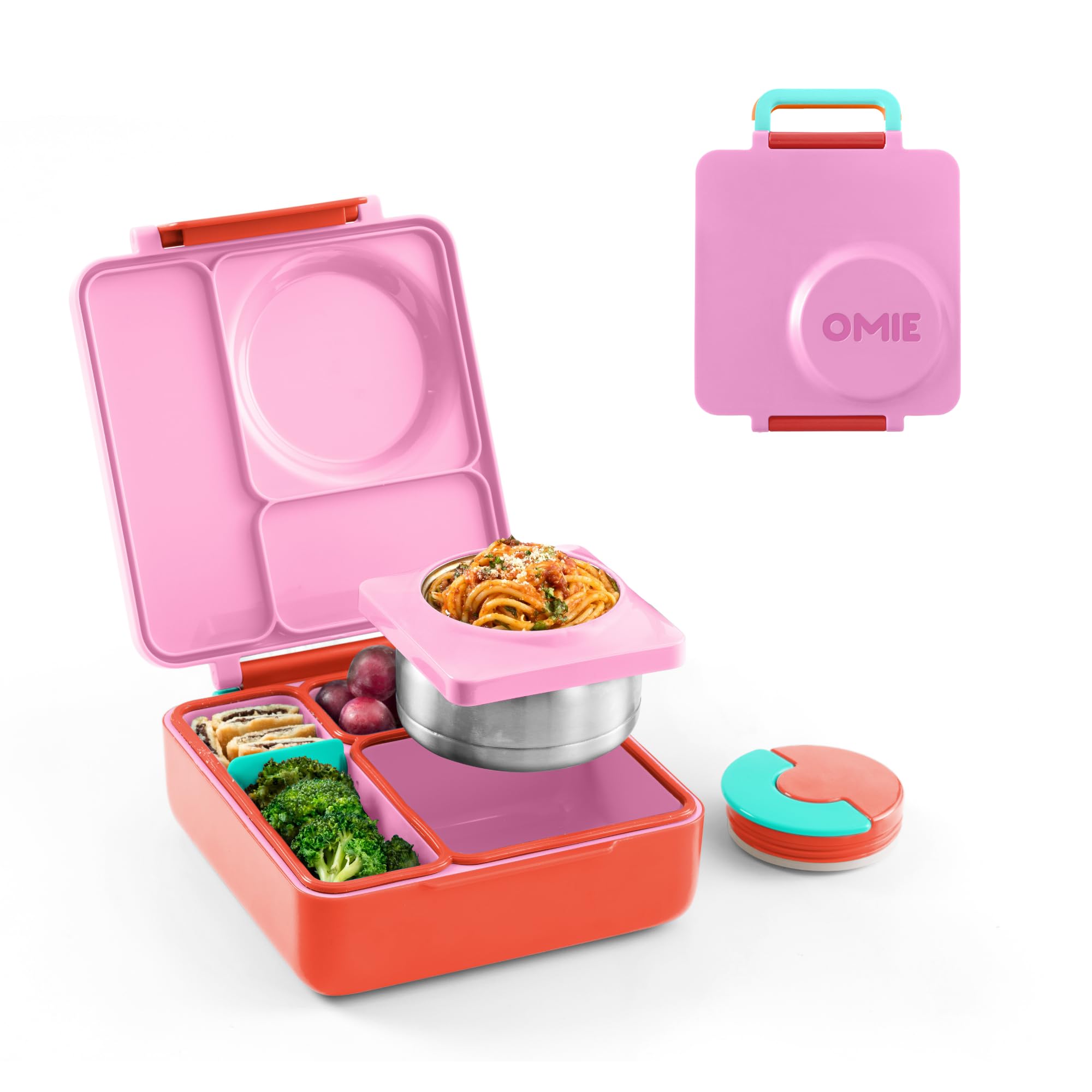
Omie OmieBox
Key Features
- Weight: 1.8 lb
- Materials: Stainless steel and rubber
- Compartments: 3 plus insulated food jar
- Price: Premium
Packing a hot lunch usually means a thermos and a separate box, which is two things to keep track of before eight in the morning. The OmieBox folds them into one: three compartments, an insulated food jar that sits down among them, and a lid that closes over the lot.
Where it earns its keep is the child who will not touch a cold sandwich but will eat leftover pasta, rice, or soup. We think that child justifies the premium and a sandwich-only eater does not. Two things to know before you commit: the latch takes a firmer push than a Bentgo’s, so a 3-year-old may still need help closing it, and the hinge is the part that wears first.
What we appreciated most is the cleaning. The rubber seals lift out completely, so the smell of last Tuesday’s chili comes out of the lid instead of living in it. It weighs 1.8 pounds before any food goes in, which is what a stainless jar and a real hinge cost you.
Pros
- Hot and cold food in one box
- Seals lift out for a thorough clean
- Fits inside a standard kids lunch bag
Cons
- Hinge and latch are the wear points
- 1.8 pounds before food goes in
We recommend it for the child who will eat warm leftovers at school; the insulated jar and the sealed cold side do the work of two boxes.
Best for Bento Box Pairing
Bentgo Kids Prints Lunch Bag
Key Features
- Care: Wipe clean
- Capacity: 4.5 liters
- Carry options: Handle, shoulder strap, buckle clip
- Price: Midrange
Our top pick’s tray measures 8.5 by 6.5 by 2 inches, and this bag swallows it with room left over for a drink, a snack, and a slim ice pack. At 4.5 liters it holds more than most preschool bags, and the wipe-clean lining turns a leaked applesauce into a thirty-second job instead of a laundry cycle.
There are three ways to carry it: a top handle, an adjustable shoulder strap, and a buckle handle that clips onto a backpack so it rides hands-free. The cross-body strap is the one a small child can manage alone, and the clip is what saves a kid juggling a bag and a water bottle at the gate.
It costs roughly what the box does, and what you are paying for is the fit and the matching print rather than extra insulation. Plenty of bags will carry a lunch for less, and the mibasies is sturdier than its price suggests, but this is the one designed alongside the tray, with the pockets landing where the gaps are.
Pros
- Swallows the Bentgo tray with room for snacks
- Three carry options including a backpack clip
- Wipe-clean lining handles spills
Cons
- Fabric can rip at the seams
We pair it with our top pick: the tray drops in with room for a drink and snacks, and the lining wipes clean in seconds.
Best for All-Day Cooling
PackIt Freezable Classic
Key Features
- Weight: 1.6 lb
- Cooling: Gel built into the walls
- Capacity: 3 liters
- Freeze time: 12 hours
- Price: Midrange
Coming out of the freezer it is stiff and heavy, like a cold brick with a zip on it. That is the entire idea: the gel is built into the walls, so there is no ice pack to remember, lose, or leave in the fridge at home.
It lies flat in the freezer overnight, about 12 hours by the maker’s count, and comes out ready to hold a lunch cold until noon. The 3 liters take a Bentgo box plus a drink, the top-loading zip makes packing quick, and the buckle handle clips onto a backpack.
Weight is the catch. Frozen and empty it is already substantial, and a 4-year-old carrying it plus a backpack will feel every ounce, so this is one for an older child or an adult’s hands. It also wants a flat slot in the freezer every night, which not every kitchen has going spare.
For summer camp, a school with no fridge, or a long day out, we have not found anything here that holds food colder without extra gear. If your child carries their own bag to the car every morning, the lighter Bentgo bag or the mibasies is the kinder choice.
Pros
- No ice packs to remember or lose
- Keeps food cold through a school day
- Clips to a backpack by the handle
- Collapses flat in the freezer
Cons
- Stitching can fail along the seams
For camp, hot classrooms, and long days out, freezing the bag overnight beats any ice pack we have used.
Best for Roomier Printed Bag
Simple Modern Disney Lunch Bag
Key Features
- Care: Hand wash only
- Capacity: 4 liters
- Warranty: Limited lifetime
- Price: Midrange
A kids’ lunch bag with a limited lifetime warranty is unusual enough that it is the first thing we mention, and the bag behind it holds up: 4 liters take a bento box, an ice pack, and a drink bottle with the zip closing without a fight. The water-resistant lining wipes out, and the prints are the licensed ones children ask for by name.
At about 10 by 8 by 4 inches it drops into most backpacks, and the range lets you match a backpack or a water bottle from the same brand. It sits in the same price range as the Bentgo bag, so the choice is simple: this one for the prints, the warranty, and a little more room, the Bentgo for an exact fit with the Bentgo tray.
Pros
- 4 liters fit a box, ice pack, and bottle
- Holds up through a school year
- Backed by a limited lifetime warranty
Cons
- Hand wash only
- Zipper can stick or unravel
We choose this over the Bentgo bag when prints and a lifetime warranty matter more than an exact fit with a bento tray.
Best for Toddler and Daycare
mibasies Kids Lunch Bag
Key Features
- Pockets: Front zip, inner mesh
- Capacity: 2.5 liters
- Dimensions: 10 x 3 x 8 in
- Price: Budget
At 2.5 liters and 10 by 3 by 8 inches, this is the smallest bag we recommend, and that is the point: it slides into a toddler’s backpack without a bulge, holds a bento box and a slim ice pack, and wipes clean with a damp cloth. There is a zip pocket on the front, a mesh pocket inside, and a spot underneath for a name sticker, a small thing that matters a lot when thirty similar bags go into the same cubby.
This is the one we reach for when a child is starting daycare and does not need to carry a thermos and three snacks. The 900D polyester and dense stitching are sturdier than the price suggests, and the zip opens smoothly for small hands. If you do need room for a drink bottle and a thermos beside the box, step up to the Bentgo bag or the Simple Modern.
Pros
- Slides into a toddler’s backpack
- Fabric and stitching hold up
- Wipes clean inside
Cons
- Small 2.5-liter capacity
- Hand wash only
We point daycare and preschool families here: a small, sturdy bag that fits a bento box and survives being dragged by a toddler.
Best for First Bento Kit
QQKO Kids Bento Lunch Box

Key Features
- Care: Dishwasher safe, microwave-safe base
- Capacity: 1200ml/40oz
- Included: Sauce cup, utensils, food picks, muffin cups
- Compartments: 4
- Price: Budget
The box arrives with a sauce cup, a fork and spoon, ten animal food picks, and four silicone muffin cups, which sounds like filler until you watch a 4-year-old eat a lunch they helped assemble. The picks make cucumber slices worth picking up, and the muffin cups stop blueberries rolling into the sandwich.
Underneath the extras is a 1200ml/40oz box with four compartments, a lid lined with silicone seals, and a buckle closure that opens from the bottom up so small hands can get a grip on it. The base is microwave safe and the whole thing is dishwasher safe, which makes it an easy weekday box for a family that does not want to hand wash anything.
We think of it as a first bento: cheap enough that losing it at daycare is not a crisis, and big enough for a hungry 7-year-old. It is not the box you keep for years, and the Bentgo is the better long game if you want one that outlasts a school year, but nothing else here gets a child that excited about a packed lunch for the money.
Pros
- Four compartments plus a sauce cup
- Comes with picks, muffin cups, and utensils
- Microwave-safe base, dishwasher safe
Cons
- Clasps can snap within months
- Food can move between compartments
We think of it as the first bento: the picks and muffin cups get a young kid interested, and the price makes losing it survivable.
How We Tested Kids Lunch Boxes
We started with a list of more than 40 lunch boxes from brands we’ve used and ones that kept showing up in parent reviews, then narrowed it by size, insulation type, latch design, and price. The final 14 ranged from simple soft-sided bags to compartmented hard boxes. Over four months, they went to school in backpacks, sat in cubbies and on cafeteria tables, got carried by kids ages 4 to 9, and came home to the kitchen sink.
On school mornings, we packed the same lunch into each one: a sandwich, a cut-up apple, a yogurt, a snack, and a drink. We noted whether the box closed without crushing the food, whether it fit in a standard backpack, and how much it weighed empty and packed. To check leaks, we filled compartments with water and applesauce, sealed them, shook them, and laid them sideways in a backpack with books for 30 minutes. For temperature, we packed cold yogurt with an ice pack and warm soup in a small thermos, then checked both at noon with a probe.
Cleaning was its own test: we smeared tomato sauce and yogurt into corners, let them sit, then washed by hand and on the dishwasher’s top rack, looking for trapped food and cloudy plastic. Kids opened and closed every latch, carried each box by its handle, and dropped them from backpack height onto pavement to see what cracked or popped open. We also compared what came with each box—ice packs, dividers, spare latches—against what it cost, because a clever feature isn’t worth much if the hinge fails in a month. And we asked kids which designs they reached for first—a box they like carrying is more likely to come home empty.
How to Choose a Kids Lunch Box
A lunch box and a lunch bag do different jobs, and the fit between them decides more of your mornings than either one’s feature list.
Bento Box or Lunch Bag, or Both
Most families end up buying twice: a compartment box that keeps food separate and a bag that insulates it. Buy the box first, then check the bag’s interior against the box’s footprint. Our top pick measures 8.5 by 6.5 by 2 inches, and the bags here run from 2.5 to 4.5 liters, which means the smallest one holds that tray and very little else.
The trap is choosing a bag for its print and discovering there is no room for an ice pack beside the box. Look for a stated capacity plus at least one pocket that is not competing with the box for space.
What Leak-Proof Really Covers
On a compartment box, leak-proof usually means the lid seals each section so yogurt stays out of the crackers. It does not mean the box can be shaken upside down in a backpack without anything reaching the lid channel or the next compartment.
Before the first school day, put water in the wettest compartment, close it, and tip it over the sink. What survives that tells you what you can pack. Soups and stews belong in a jar, not a compartment, whatever the listing promises.
Can Your Child Open It Alone
A latch an adult finds easy can be a wall for a 3-year-old, and a box that is hard to close comes home open with the food in the bag. Softer, fewer closures are easier than stiff snaps, and a zipper is its own skill that takes practice.
Hand the empty box over before the first week of school and have your child open and close it ten times while talking about something else. If they cannot manage it while distracted, it is not the right box yet.
Portions, Weight, and What They Eat
Capacity figures get generous in the marketing and modest in real life. A 2.4-cup bento suits ages 3 to 7; a 1200ml box looks like more food than a kindergartner eats and gets emptied by second grade. Judge by the lunch your child finishes at home, not the number on the listing.
Weight matters too. A freezable bag can weigh over a pound and a half before anything goes in it, and a small child feels that on the walk to school.
Cleaning and the Parts That Break First
Buy the box you can take apart. A removable tray that is dishwasher safe on the top rack saves a nightly scrub, and seals that lift out are the difference between a box that dries and one that smells.
The failure points run through the whole category: hinges, clasps, bag zippers, and the stitching at bag seams. Check whether the outer shell is dishwasher safe before you load it — most are not, and a warped shell will not latch.
Frequently Asked Questions
Can you freeze a kids lunch box?
Only if it was built for it. A freezable bag like the PackIt has gel sealed into its walls and needs about 12 hours in the freezer; that is what keeps food cold with no ice pack. A regular plastic bento gains nothing from the freezer.
For an ordinary lunch bag, freeze the ice packs on their own and pack them beside the box rather than under it, so the cold reaches the food instead of the bag’s base.
How long can a packed lunch sit before it is not safe?
Perishables should stay out of the danger zone, which generally means no more than two hours above about 40 degrees. A morning-packed lunch of meat, cheese, or dairy needs a frozen ice pack or a freezable bag unless there is a fridge at school.
If your child leaves the bag in a warm cubby until noon, treat the cold source as non-negotiable rather than optional.
How do you label a lunch box so it comes home?
Put the name on the box itself, not just the bag, and add it to the removable tray as well since trays get left on cafeteria tables on their own. The mibasies bag has a spot for a name sticker underneath.
A strip of masking tape with a name and a classroom number peels off without residue at the end of the year.
Final Verdict
Buy the Bentgo Kids Prints first. Five sealed compartments that a 3- to 7-year-old can open without help is the most useful thing a lunch box can do, and the lift-out tray means nobody is scrubbing peanut butter at ten at night.
Two alternatives change the answer honestly. The OmieBox is the right buy if your child will eat warm leftovers at school, and the freezable PackIt is the one for camp or a classroom with no fridge, as long as an adult or an older child is carrying it.
