This post contains affiliate links. We may earn a small commission when you buy through our links — at no extra cost to you.
The first cold morning of soccer season, my son made it about 12 minutes before the stiff-legged shiver set in — the one that means whatever’s under the uniform isn’t working. Good base layers disappear under a jersey and hold a thin layer of warmth against the skin; bad ones itch, bunch at the ankle, or bag out at the knee by halftime. It’s not about bulk — it’s about a kid staying comfortable in 35 degrees long enough to keep playing.
Two things trip up first-time buyers. Sizing up "so it lasts" backfires, because a loose base layer can’t trap warmth — you want a close, stretchy fit. And fleece-lined doesn’t automatically mean warmer: the plush ones feel great in the hand, but a few run so hot that a kid sweats on the field and then chills on the bench. We spent one full winter with 16 sets and separates, on kids from 4 to 11, through school mornings, ski days, and muddy Saturday games. The picks below are the ones that held their shape and stayed put.


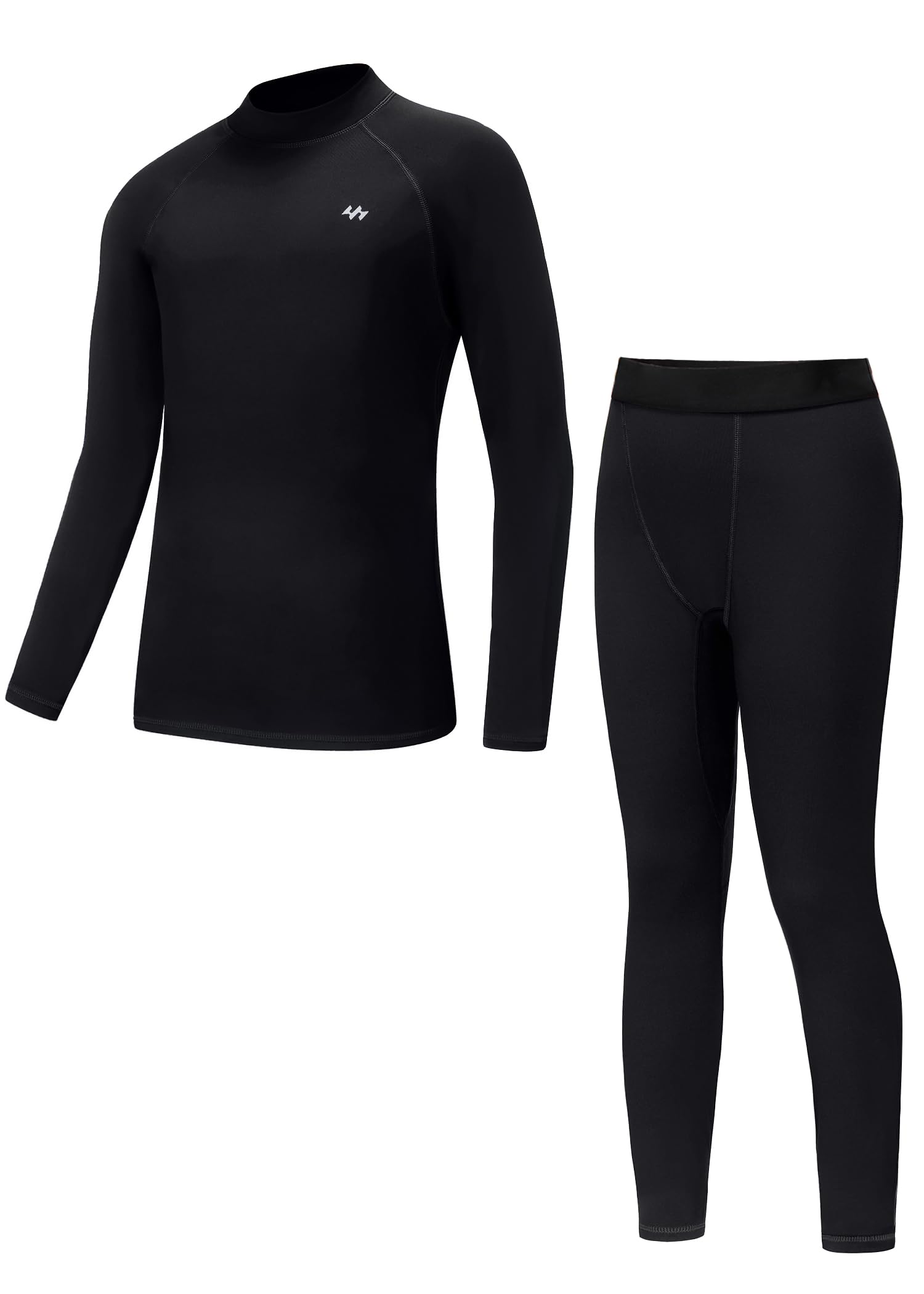

Best for Cold-Weather Sports
TELALEO Boys Thermal Set
Key Features
- Fit: Compression
- Lining: Fleece
- Pieces: Top and pants
- Price: Midrange
Fleece on the inside, slick on the outside: that combination is why this set won us over. The brushed lining is what a kid feels against the skin, and it’s genuinely soft rather than scratchy, which is the difference between a base layer that gets worn and one that gets negotiated over every morning. The smooth outer face is the part you’ll appreciate at 7 a.m. on a field, because it slides under a jersey or a snow bib instead of grabbing at the shoulders.
Warmth is where it earns the top spot. The fabric is substantial without becoming a second jacket, so a kid can wear it under football pads or ski bibs and still move the way they need to. Because it’s two pieces, you can also send just the top under a hoodie on a day that starts cold and warms up by recess, which is most of the fall in a lot of the country.
Size is the one thing to get right. The cut runs small against the chart, and the compression fit is meant to sit close, so a child between sizes should go up rather than squeeze into the smaller set. Sizing up also buys a second winter, and the snug cut means one size larger still sits against the skin the way a base layer has to.
The two pieces split well, too: leggings under shorts for a cold practice, the top alone under a hoodie on a milder day. That flexibility, more than any single feature, is why this is the set we reach for first.
Pros
- Fleece lining warms without heavy bulk
- Smooth outer face slides under uniforms
- Soft against skin, not itchy
- Top and leggings work separately
Cons
- Runs small against the size chart
We recommend this set to nearly every family shopping for winter base layers: it warms without bulk, slides under a uniform, and covers top and legs together.
Best for Girls Snow Days
ViCherub Girls Thermal Set
Key Features
- Lining: Fleece
- Pieces: Top and leggings
- Department: Girls
- Price: Midrange
A thermal top that stays tucked is rarer than it should be. This one is cut long in the body, so it stays down through a morning of skiing instead of riding up the moment a kid lifts their arms, and that small detail decides whether a base layer does its job under a snowsuit.
The warmth comes from a light fleece lining rather than a heavy one, and that’s the right call for layering: it holds heat close while leaving room in the suit for the insulation to work. It’s soft enough that it stops being a negotiation, and the long johns stay snug through the seat without digging in at the waist, which is the part kids complain about first.
Sizing is where to slow down. The legs and hips run narrow on some sizes while the body comes up roomy on others, so check the chart against height rather than age and go up a size for a child who is solidly built through the thighs. Get that right and the rest is quiet, which is the highest compliment a piece of children’s clothing can earn.
Pros
- Light fleece warms without bulk
- Top cut long to stay tucked
- Soft lining that doesn’t itch
- Layers under snow gear without bunching
Cons
- Sizing varies; legs run narrow on some sizes
For girls who spend the winter in snow gear, we pick this set: light fleece, a top that stays tucked, and enough room to layer without bulk.
Best for under Shorts
TELALEO Compression Leggings
Key Features
- Fit: Compression tight
- Fabric: Moisture wicking
- Pack Size: 2-4 pack
- Price: Midrange
Shorts in November is a real strategy, and a pair of tights is all it takes to make it work. These are the leggings we hand over most often: thick enough to take the edge off a cold sideline, thin enough that shin guards and uniform shorts still fit the way they’re supposed to.
What we like best is the balance. The fabric is smooth and substantial with a bit of stretch, so it slides under shorts without bunching and doesn’t go see-through when a kid squats or slides, the two things that make cheap tights obvious from across the field. They hold their shape through the wash as well, which is not something we can say for every pair in this roundup.
Sizing is where these get fiddly. Some packs run large enough that a small fits like a medium, so order by height and check the listing for the pack you’re actually buying rather than assuming last year’s size will repeat. Get it right and one pack covers practices, games, and the school run for a season.
Pros
- Thick enough for cold sidelines
- Smooth under shin guards and pads
- Several pairs in one pack
- Holds shape through repeated washing
Cons
- Sizing runs large in some packs
If your kid won’t give up shorts, these are the tights we hand over: thick, smooth, and warm enough that the shorts stay on well into fall.
Best for under Jerseys
G Gradual Thermal Shirt
Key Features
- Use: Football, baseball, soccer, basketball
- Lining: Fleece
- Pieces: Long-sleeve top
- Price: Budget
Sometimes you only need half a base layer. A long-sleeve top under a jersey is the whole job, and this is the one we hand over for it: fleece-lined, cut close, and quiet under a uniform. The fuzzy inside does the warming without leaving a visible lump at the shoulders, and the torso is cut long enough that it stays put rather than riding up mid-inning.
The lining is light, which is the honest limit here: this is a cool-morning layer, not the piece for a kid who runs cold in January. Under a baseball jersey on a chilly spring night or a football uniform in October, that thinness is exactly right, warm without tipping a kid into overheating once they start running. It’s a top only, so plan on leggings or a full set if the legs need covering too.
Pros
- Fleece lining without visible bulk
- Slides under a jersey cleanly
- Long torso stays tucked
- Holds its color through washing
Cons
- Light lining is not a deep-cold layer
- Top only, not a full set
For a kid who needs warmth under a jersey and nothing else, we buy this top: light fleece, a clean line under the uniform, and no bunching at the shoulders.
Best for Budget Full Set
Ewedoos Kids Thermal Set
Key Features
- Lining: Fleece
- Pieces: Top and bottom
- Stretch: 4-way
- Wicking: Moisture wicking
- Price: Budget
This is the least expensive full set on our list, and nothing about the fabric announces it. The fleece lining is soft and even, the outside is smooth, and the whole thing has a four-way stretch that makes it feel more athletic than the waffle knits in this group.
In practice that stretch is the story. It moves with a kid who is climbing over snowbanks, kneeling in the snow, or rolling around in a football uniform, and it doesn’t fight them the way a stiff thermal does. The lining is warm enough for snow play without being so heavy that it stands in for a jacket.
Where this set earns its place is as the second and third copy: the spare that lives in the school bag, the one that goes to a grandparent’s house, the one you buy when two kids need thermals in the same week. Warmth and softness are both genuinely good here, and the price tier is the lowest in this group.
It’s also the set we’re most comfortable sending out with a kid who is rough on clothes, because a torn knee is an annoyance rather than a loss. For a family buying for two or three children at once, that math matters more than any single specification.
Pros
- Lowest price tier in this group
- Four-way stretch moves with kids
- Soft fleece lining against skin
- Warm enough for snow play
Cons
- Bottoms run small and short
We point budget-minded families here: a soft, stretchy top-and-bottom set that handles snow play and a football uniform without a premium price.
Best for Mild-Winter Practices
Under Armour HeatGear Long Sleeve
Key Features
- Pieces: Long-sleeve top
- Department: Boys
- Size Range: Big kid
- Price: Premium
This is not a thermal, and reading it as one is the fastest way to be disappointed. Under Armour builds it as a lightweight compression layer, thin, smooth, and cut close, and it does that job extremely well.
What it does is put a barrier between skin and a jersey without adding weight. The fabric is smooth enough to disappear under a uniform, it holds its shape and color through repeated washing, and it doesn’t leave a kid clammy when they come off the field. The fit runs true to size with a little room to grow, which is rare in a compression top a kid will wear for two seasons.
The catch is what a single top costs: this sits in the premium tier of this group, and it buys the lightest layer here rather than the warmest. That’s the right trade for a kid who runs hot, plays fall and spring sports, or spends games indoors, where it’s the layer they forget about. For a January sledding hill, it’s a first layer, not the only one.
Pros
- Thin enough to disappear under a jersey
- Warm without overheating a hot-running kid
- Holds shape and color in the wash
- True to size with room to grow
Cons
- Premium tier for a single top
- Not warm enough alone in deep cold
For a kid who overheats in a heavy thermal, we reach for this one: thin, smooth, and warm enough under a jersey without a bulky feel.
Best for Practice-Day Volume
Rolimaka Compression Leggings

Key Features
- Fit: Tight
- Fabric: Quick dry
- Pack Size: 3-4 pack
- Price: Midrange
The reason to buy these is arithmetic: several pairs arrive together, which means one in the wash, one in the drawer, and one already in the gym bag. Tights get lost, stretched, and outgrown, and having a stack of them solves that faster than any single pair at the top of the market.
They handle the basics well. The fabric is quick-drying and stretchy, easy for a kid to pull on without help, and warm enough under shorts on a cool evening. They’ve worked under soccer shorts, football pants, and a jiu jitsu gi, which is a wider range of use than most pieces here see.
The knees are the weak point, and it’s worth knowing before you order. Thin tights and turf are a bad combination, and these are no exception, so a kid who slides will wear through the knees well before the rest of the fabric gives out. Rotating several pairs spreads that wear and keeps one clean pair for game day.
Treat them as consumables and the value makes sense. Sizing runs big for some kids, so check the chart before committing, and expect the smaller of two sizes to be the better fit on a lean child. They’re the pair we pack for practice, not the pair we save for a weekend on the slopes.
Pros
- Three or four pairs per pack
- Quick-dry fabric for back-to-back practices
- Easy for kids to pull on alone
- Warm under shorts on cool evenings
Cons
- Knees wear through on turf and gym floors
We keep these in the practice rotation: several quick-dry pairs that cover the week, with knees we’ve learned to treat as expendable.
Best for Everyday School Layering
Amazon Essentials Thermal Set

Key Features
- Fabric: Cotton blend
- Pieces: Top and bottom
- Department: Boys and toddlers
A cotton-blend waffle knit is a different animal from a fleece-lined synthetic, and for some kids it’s the only one they’ll wear. It feels like ordinary clothing rather than gear, with no slick face and no brushed pile, which makes it the easier sell on a school morning when everything else is a fight.
It breathes better than fleece under a sweater or a uniform, and it stretches enough to keep up with a toddler who is in and out of a car seat all day. The trade is warmth in the wet: cotton holds damp, so this is a set for dry cold, school days, and the walk to the bus rather than a slushy afternoon on a sled.
It’s soft enough that it doubles as pajamas on a cold night, which is a fair second life for it, and the fabric has held its shape through our washing. It won’t replace a fleece set for skiing, and it isn’t the layer for a genuinely cold night under a uniform, but it’s the one that gets worn on ordinary days.
Sizing is what to watch. The set runs large, so a child who measures into a size will likely need the one below it to get the close fit a base layer needs, and a toddler in particular can swim in their usual size. Buy it as everyday winter clothing for a kid who won’t tolerate synthetics, not as mountain gear.
Pros
- Cotton blend breathes under clothes
- Soft, ordinary feel kids accept
- Stretchy enough for toddler wear
- Doubles as warm sleepwear
Cons
- Runs large; size down
- Cotton holds damp in wet snow
For school-day layering and kids who won’t wear slick synthetics, we like this cotton-blend set, just size down, because it’s cut generously.
How We Tested Kids’ Base Layers Through a Full Winter
We started with more than 60 options — the best sellers in the category, plus the brands that kept turning up in our kids’ teammates’ gear bags — and narrowed to 16 using three practical filters: fabric content spelled out clearly in the listing, a size chart built on height and weight rather than age alone, and whether the price bought a top and a bottom or just leggings. Then we handed them to families with kids ages 4 through 11 and let a real winter happen to them.
Most of the testing looked like an ordinary week. Kids wore the layers to school under uniforms, to Saturday soccer and football games in the 30s, on two ski days, and to a sledding hill that ate an entire afternoon. After 45 minutes outside we felt necks and lower backs, and we noted whether a kid came back damp and chilled under a fleece — the clearest sign a fabric wasn’t moving sweat away.
Fit got the closest scrutiny, because that’s where base layers fail. We watched whether a kid could pull one on without help, whether cuffs stayed at the ankle through a half of soccer, whether knees bagged out, and whether the size-up we instinctively reach for turned into a loose, drafty mess. Softness was the kids’ verdict: we logged every unprompted complaint about tags, seams, or itch, and took note of which pieces they asked for again.
Everything was washed weekly with the rest of the laundry, no special handling. We tracked pilling at the underarms, seams separating at the crotch and shoulder, and whether legs came up an inch short by February. Because a base layer only covers half a kid, value came down to price per piece — a cheap set that shrank or pilled out of rotation by midwinter wasn’t a bargain, and the multipacks of leggings only earned their keep if the fabric survived contact with knee pads and a dryer.
How to Choose Kids Base Layers
The right base layer is decided less by warmth ratings than by what goes over it: the layer has to sit snug, stay smooth, and not need babysitting all winter.
Decide Which Pieces You Actually Need
A full set, top and long johns, is the default for skiing, sledding, and any practice where a kid stands around in the cold. When the outer layer is already a jersey or a uniform top, a single long-sleeve layer is enough, and it’s the piece that gets the most use from October through April. Leggings on their own cover the shorts-in-November crowd, disappearing under shin guards where a full set would be too much fabric.
Buy for the outer layer your child wears most, not for the coldest day of the year. A family that skis needs full sets; a family that mostly drives to school and stands on a sideline needs one good set plus a couple of tops.
Fleece-Lined Synthetics Versus Cotton Blends
Fleece-lined synthetics trap warm air in a brushed pile while a smooth outer face slides under whatever comes next. They are the warmer choice for snow and for standing still outdoors. A cotton-blend waffle knit breathes better and feels like ordinary clothing, which makes it easier to get a picky kid dressed, but cotton holds damp, so it’s a poor pick for a sweaty practice or a slushy afternoon.
The trap is a cotton set labeled thermal: the word describes the waffle knit and the cut, not fleece-grade warmth. Match the fabric to the weather your kid actually goes out in, and treat a fleece-lined set as too much for a heated classroom.
Fit: Snug Is the Point
A base layer keeps a child warm by sitting close and staying there. A roomy one bunches at the shoulders and leaves gaps at the wrists and ankles, which is where the cold gets in. That makes sizing the hardest part of this purchase, and it’s where these products disagree most: some run small, some run large, and the same listing can vary by size.
Treat the size chart as a starting point. Go up one size in a fleece set if your child is between sizes or you want a second winter out of it, since a snug cut still sits against the skin one size larger. For compression pieces, order the size they wear in athletic gear.
Durability and How Many Sets to Buy
The two failure points are knees and seams. Thin leggings wear through on turf and gym floors long before the fabric fades, so if your kid slides, buy several pairs and rotate rather than expecting one to last a season. Seams that pull at the shoulder or the crotch after a wash usually mean the cut is too small, not that the fabric is bad.
For a child in gear daily, two sets plus a couple of spare leggings keeps one clean, one on, and one in the wash. Three sets is a comfort rather than a necessity unless the laundry pile says otherwise.
Frequently Asked Questions
How many base layer sets does a kid need for winter?
Two full sets get most kids through a school week: one on, one in the wash or drying. Add a third if your child is in gear every day for a sport, and add stand-alone leggings if shorts are non-negotiable once the temperature drops.
Multi-packs are the practical way to build that rotation, since several pairs arrive together and one blown-out knee doesn’t end the season.
Should base layers go under or over underwear?
Underwear first, then the base layer over it. Long johns are a first layer outdoors, not a replacement for underwear, and leggings work the same way under shorts or snow pants. The exception is a child who reacts to seams, where a smooth, flat-seamed top worn directly against the skin is often more comfortable than a cotton undershirt bunched underneath.
Can kids base layers go in the dryer?
Yes, on low. High heat is what shortens their life: it flattens the fleece pile that does the warming and relaxes the stretch that keeps the fit close. Turn fleece-lined pieces inside out, dry them on low or hang them, and skip fabric softener, which coats the fibers.
If a set comes out pilled or stiff, the dryer setting is the usual culprit rather than the fabric.
Final Verdict
We tested these under snow gear, on cold sidelines, and on ordinary school mornings, and the TELALEO set is the one we recommend first: two pieces, a soft fleece lining, and a smooth outer face that disappears under a uniform, for less than the premium single tops here. If you’re shopping for a girl and want a top that stays tucked under a snowsuit, the ViCherub set is the better call, and the Ewedoos set covers the same ground for a family buying several at once. For a kid who lives in shorts, start with the TELALEO leggings and add a top only when the jersey stops being enough.
