This post contains affiliate links. We may earn a small commission when you buy through our links — at no extra cost to you.
A baby life jacket has exactly one job, and it isn’t comfort — it’s keeping a small, top-heavy person face-up in the water. The trouble is that vests stiff enough to do that are often stiff enough to make a baby miserable before you’ve even reached the dock. I’ve wrestled a squirmy 20-pounder into one that swallowed him whole, and I’ve watched a cheaper vest ride up until the collar pressed into his chin. Over the past four months, we’ve put 10 infant life jackets on real babies in backyard pools, off a lake dock, and on slow afternoon boat rides.
The weight range printed on the label matters more than the age beside it, and the two approval styles behave differently — the one with a support collar is built to roll a face-up baby onto their back, while the flatter cut assumes your hand is on them the entire time. We leaned toward vests a baby will tolerate for a full hour, because the safest jacket on the market is useless once it’s off and screaming on the dock. The ones that earned a permanent spot in the beach bag are below.


Best for Overall Infant Safety
Stohlquist Infant Life Jacket
Key Features
- Closure: Zipper and crotch straps
- Buoyancy: 7.6 lb
- USCG status: Type II
- Weight range: 20–30 lb
- Price: Premium
The first thing to know about the Stohlquist is its 20- to 30-pound window. That is narrower than most infant vests here, and it is the reason this one feels purpose-built: the collar, chest panels, and crotch straps are sized for a baby who has outgrown the newborn sack but is not ready for a child vest. If your baby is 18 pounds, this is not the pick, however good it looks.
What we like most is the Type II layout. The sculpted foam collar sits behind the head, and the 7.6 pounds of buoyancy is meant to help a baby settle face-up; the reinforced grab handle gives you a place to lift without hauling on an arm. In a group where several vests are Type III or simply labeled USCG approved, that combination is the strongest safety story here.
The zipper and adjustable crotch straps take a minute to dial in, but once set they keep the vest from sliding up. We also appreciate the soft 200-denier nylon and PVC-free foam; it feels less like a stiff block than the price tag might suggest. The trade-off is the collar itself: it is substantial, and a baby who dislikes anything around the neck will let you know. Test it on land first and check that the collar sits below the chin, not against the throat.
For a 20- to 30-pound baby who will be on a boat or dock, this is the vest we trust first. What it buys is a clear Type II layout, a proper grab handle, and a fit that stays close to the body when the straps are snug. The crotch straps are the detail that matters when you lift a wet baby; they keep the vest from bunching under the arms.
Pros
- Type II collar supports face-up flotation
- Reinforced grab handle for lifting
- Soft nylon and PVC-free foam
- Crotch straps hold the vest down
Cons
- Collar can feel restrictive
- Premium price
For a baby who has outgrown the smallest vest, the Stohlquist is our first choice: the Type II collar and grab handle give us the most confidence at the dock.
Best for Budget-Minded Families
Stearns Infant Life Vest
Key Features
- Closure: Zipper and leg strap
- Item weight: 10.2 oz
- USCG status: Type III
- Weight range: Under 30 lb
- Price: Budget
If the Stohlquist is the vest we reach for when a baby is close to 30 pounds, the Stearns is the one that makes more sense for the first year. It covers infants under 30 pounds, uses a simple zipper and leg strap, and leans on a foam neck roll to encourage face-up flotation. We think it is the best value in this group, and the bright red shell is easy to spot from the dock.
The neck roll is the feature that sells it, but it has to sit behind the head, not under the chin. Fasten the leg strap and check the fit with the baby seated; the vest should not slide up when you lift at the shoulders. Treat the first fitting as part of the purchase, not a step you rush on the boat ramp.
The Stearns is not as soft as the Airhead or as structured as the Stohlquist, and the nylon shell feels basic. What it does have is a straightforward layout, a visible color, and a price that leaves room for a second vest for the grandparents’ boat. For a calm lake or a supervised pool, it is an easy vest to live with.
Pros
- Neck roll encourages face-up flotation
- Bright color is easy to spot
- Simple zipper and leg strap
Cons
- Can ride up if the fit is loose
The Stearns is our value pick for under-30-pound infants: a simple neck-roll life vest that floats, wipes down, and leaves room in the budget for a spare.
Best for Comfort-First Babies
Airhead Wicked NeoLite
Key Features
- Closure: Zipper, buckle, crotch strap
- Item weight: 15.5 oz
- USCG status: Type II infant
- Weight range: 15–30 lb
- Price: Midrange
Closed sides and a quick-dry NeoLite shell make the Wicked the comfort play in this group. The torso is wrapped rather than open at the sides, a zipper sits under the buckle, and the shell is meant to dry quickly, so the vest feels less like a life jacket and more like a soft vest you happen to buckle on. That is a real advantage on a day that moves between boat, beach, and lunch.
The infant size is listed for 15 to 30 pounds, and the crotch strap and waist belt do the work of keeping the vest from pulling up when you pick up a baby. We like the closed cut for wiggly babies because there are fewer open edges to catch an arm, though it also means you are pulling the vest over the head rather than laying it on.
What sold us is how little fuss the Wicked creates once it is on. The soft shell and bright pink option are easy to live with, and the vest has a more tailored feel than the budget picks. It does run small for the stated range, so check the chest and weight before you commit; a baby at the top of the range may need the next size.
Pros
- Closed sides feel soft against skin
- Quick-dry shell suits boat-and-shore days
- Crotch strap helps stop ride-up
Cons
- Runs small for the stated range
We reach for the Airhead Wicked when comfort and quick drying matter most; the closed-side cut and soft shell suit babies from 15 to 30 pounds.
Best for Small Babies
Connelly Babysafe Vest
Key Features
- Closure: Two quick-release buckles
- Item weight: 8 oz
- USCG status: USCG approved
- Weight range: Under 30 lb
- Price: Midrange
The Connelly Babysafe looks less like a vest and more like a padded hammock with a head pillow. For a small baby, that is the point: the soft nylon cradle supports the head and keeps the foam off the legs, so a baby who is not yet sitting well can be carried in it without the vest pushing into the chin.
We like it best for babies in the 10- to 20-pound range. It is only 8 ounces, the two quick-release buckles are easy to work with one hand, and the grab strap at the back gives you a handle when you lift a wet baby onto the dock. It feels gentler than the full-collar vests, which matters for a newborn or a small infant.
The trade-off is adjustability. Two straps do not give you the tuning of a three-strap open-side vest, and there is less room to fine-tune the neck opening as a baby grows. Check the fit often and move up when the head pillow starts to sit low. The upside is that there is less hardware to fight with during a diaper change.
For a newborn or a baby just into the 20-pound range, the Connelly is the vest we hand to a nervous first-time boater. It is not the pick for a 28-pound toddler, but it does the small-baby job without turning the baby into a foam block.
Pros
- Soft hammock cradles small babies
- Head pillow supports the neck
- Lightweight at 8 ounces
Cons
- Limited strap adjustment
- Can ride up as baby grows
For a small baby, the Connelly’s soft hammock and head pillow are the draw; it is the one here that feels least like a stiff foam block.
Best for Travel and Packing
O’Neill Infant Superlite
Key Features
- Closure: Two buckles and through-leg strap
- Item weight: 10.4 oz
- USCG status: Type II
- Weight range: Under 30 lb
- Price: Midrange
At 10.4 ounces, the O’Neill Superlite is the vest that disappears into a diaper bag. It is a Type II infant vest with a polyester shell and PE foam, and it packs smaller than the full-collar picks here. If you are flying to a rental house or keeping a vest in the car for spontaneous lake days, that matters.
The closure is straightforward: two buckles plus a lower through-leg strap, with drain holes in the foam so water does not sit in the vest. We like the through-leg strap because it gives the vest a second anchor when a baby is picked up, and the quick-release buckles are easy to manage with wet hands.
The front panel is the part we noticed most. It comes up high and feels bulkier than the 10.4-ounce figure suggests, so a baby who is already resistant to collars may arch away from it. Check that the baby can sit and reach without the foam pressing into the chin, and size up if the vest is tight across the chest.
For travel, this is our pick in the set: light enough to pack, Type II where it counts, and quick to rinse and hang. It is not the softest vest here, and the bulk is real, but the trade is a vest you will actually bring along instead of leaving at home.
Pros
- Light 10.4-ounce build
- Type II flotation
- Drain holes speed drying
- Through-leg strap adds security
Cons
- Bulkier than its weight suggests
- Can ride up into the neck
The O’Neill is our lightweight choice for travel: Type II flotation in a vest that packs small, though the front panel is bulkier than its weight suggests.
Best for Quick Changes
Full Throttle Infant Vest
Key Features
- Closure: Collar buckle and leg strap
- USCG status: USCG approved
- Head support: Oversized collar
- Weight range: Under 30 lb
- Price: Budget
Getting a life jacket over a baby’s head is half the battle. The Full Throttle solves that with a buckle opening at the collar, so the vest opens wide and closes around the neck instead of being dragged over the face. We think that is the reason to choose it, especially in a small boat where you are dressing a baby on a bench.
The oversized collar is the other useful part. It supports the head and gives you a place to hold when you lift the baby, and the elastic leg strap keeps the vest from riding up without a lot of extra hardware. It is USCG approved and sized for infants under 30 pounds, with a simple nylon shell that wipes down.
The vest is bulky, though, and the thick front panel makes it awkward to hold a baby against your chest. For a quick dock change or a baby who fights overhead vests, that trade is worth it. For a long boat day with a lot of carrying, the softer Connelly or the lighter O’Neill is easier to live with.
Pros
- Collar buckle makes it easy to put on
- Oversized collar supports the head
- Elastic leg strap adds comfort
Cons
- Bulky front panel
We like the Full Throttle for quick changes because the collar opens wide; the oversized head support is a real help, even if the vest is bulky to carry.
Best for Toddlers 1–3
Dark Lightning Infant Vest
Key Features
- Item weight: 5.64 oz
- USCG status: USCG approved
- Head support: Headrest
- Weight range: 0–30 lb
- Price: Budget
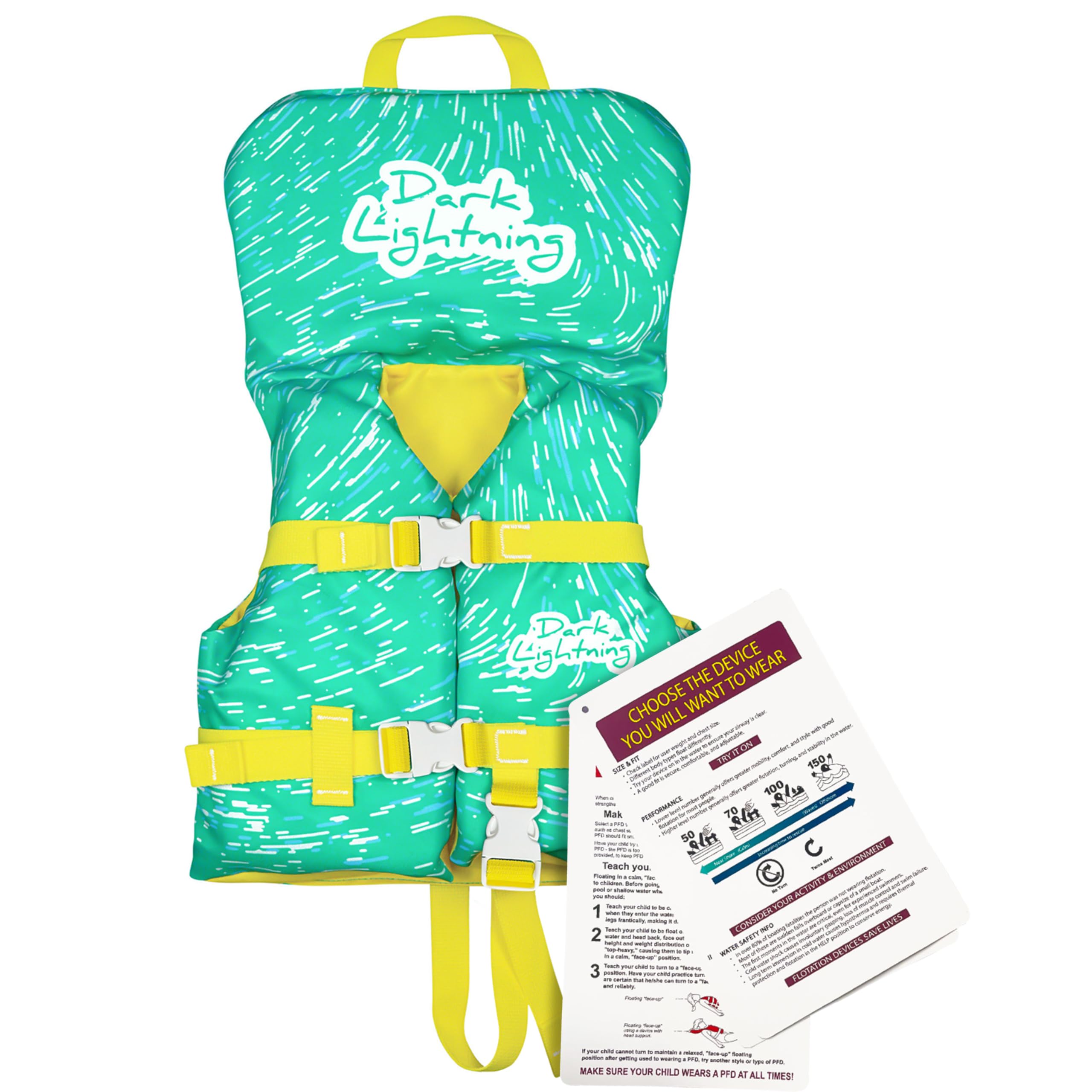
The Dark Lightning label says 0–30 pounds, but the vest tells a different story. It is built like a toddler vest: a tall foam front, a headrest, a leg strap, and a grab handle, with enough structure that a very small baby can get lost in it. For a 1- to 3-year-old, that structure is useful.
The headrest and grab handle are the details we appreciate. They give you a way to steady a toddler on a dock and a place to hold the vest when you lift, and the 160-gram build is light enough to keep in a bag. The leg strap is adjustable, but the foam is stiff enough that a seated baby can feel pushed forward.
For a toddler, it is a solid budget option with more head support than the price suggests. For a baby under one, or a baby under 20 pounds, skip it; the vest runs large and the stiff front can ride up. This is a vest for the walking, squirming stage, not the newborn stage. The bright green shell is also easy to spot when a toddler makes a break for the water.
Pros
- Headrest supports a toddler’s neck
- Grab handle helps at the dock
- Light 160-gram build
Cons
- Runs large for small babies
The Dark Lightning is a solid toddler vest for 1- to 3-year-olds, but it runs large and is not the right pick for a baby under one.
How We Tested These Infant Life Jackets
We started by pulling every US Coast Guard–approved infant vest we could find, around two dozen, and narrowed by weight range, shell material, and whether the vest had a support collar, a grab handle, and a leg strap. Ten made it into the rotation, from neoprene sport vests to basic nylon styles, and we tested them from late May through September — roughly four months.
Fitting happened in the living room first, on a wriggly 1-year-old in a diaper, because that’s where most parents try one on for the first time. I counted how many straps had to be tightened to get a snug fit on a 19-pound baby, then checked the fit the way you’re supposed to: lift the vest by the shoulders and see how far it slides up toward the chin and ears. I also buckled each one on a baby sitting on the dock, strapped that baby into a car seat to judge bulk, and noted how much of a fight it was to get a vest on and off with wet, sunscreen-slick hands.
In the water, we tested from a backyard pool and off a lake dock with a hand hovering under the baby at all times. I watched whether each vest floated a baby face-up or let them tip forward, how high the collar held the head, and whether the neckline dug into the chin once the flotation got waterlogged. We ran 20-minute floats per vest to see where chafing started at the neck and armpits, and timed how long each one took to dry on the line afterward.
After every session we rinsed off the sunscreen, checked seams and buckles, and looked for stretched webbing or faded shell by the end of the summer. The vests that kept getting pulled back out for the next trip were the ones that went on without a fight, floated a baby level, and left no red marks behind.
How to Choose an Infant Life Jacket
The right infant life jacket is the one that fits your baby’s weight and stays put at the neck and shoulders, not the one with the longest feature list.
Start With USCG Approval and Type
A USCG-approved PFD is the baseline; without that label, a vest is a pool toy, not safety equipment. For infants, Type II is the more protective starting point because it is designed to help a baby turn face-up, while Type III assumes a calm-water setting and a wearer who can keep themselves upright. We prioritize Type II for babies. A Type III vest is not the first choice for a baby just because it is cheaper. If the label does not name a type, treat the weight range and fit as the next things to verify.
Fit by Weight, Then Fit the Neck
Start with the weight range on the label, but do not stop there. A 22-pound baby can be long in the torso or broad in the chest, and an infant vest that gaps at the neck will ride up when the baby is in the water. Fasten every buckle and strap, then lift gently at the shoulders; if the vest can slide up over the chin, it is too loose or the wrong size. Check the neck opening with the baby seated and standing. The crotch strap should sit flat, not cut into the diaper area.
Head Support and Face-Up Flotation
A support collar or headrest is not a guarantee, but it gives a baby’s head a place to rest and can help the vest settle face-up. Look for a collar that sits behind the head rather than pressing on the throat, and a grab handle you can reach without fumbling. Then try the vest in shallow, calm water with both hands on the baby; every design behaves differently once it is wet. The Stohlquist’s Type II collar is the most substantial in this set, while the Connelly uses a softer hammock and pillow for smaller babies.
Straps, Buckles, and the Crotch Strap
The crotch strap is the part that keeps an infant vest from sliding up around the ears, so we consider it essential, not optional. Closed-side vests feel snugger but can be harder to get on a wiggly baby; open-side vests with three straps are easier to adjust, though there is more to check. A buckle at the collar, like the Full Throttle’s, is a small design choice that makes a big difference during a diaper change or a quick dock transfer. Whichever you choose, recheck every strap after the vest gets wet.
Comfort, Bulk, and Travel
Babies tolerate a vest that lets them sit, reach, and nap without the foam pushing into their chin. Bulk is the trade-off: more foam can mean more flotation and support, but it also makes the vest hotter and harder to carry. A lighter shell and drain holes help for travel and repeated dips; the O’Neill Superlite is the easiest of these to pack, while the Airhead Wicked’s soft closed sides are kinder for a baby who fights rough fabric. Buy for the water you actually use, not the one in the brochure.
Frequently Asked Questions
Can I use a pool float or swim vest instead of an infant life jacket?
No. Armbands, ring floats, and most swim vests are toys, not USCG-approved flotation devices. For a boat, dock, or open water, use a PFD labeled for your baby’s weight and check that the USCG approval is printed on the label. A pool float can be a supplement for supervised play, never the safety plan.
Can a baby sleep in a life jacket?
No. A life jacket is for wearing in and around water, not for sleep, stroller rides, or a car seat. Once you are out of the water, take it off and let the baby cool down; leaving a sleeping baby in a bulky vest can restrict movement and trap heat. Keep the vest within reach for the next trip.
What if my baby hates wearing a life jacket?
Try it on at home, over a swim diaper and with the straps loose enough to fasten but snug enough that the vest cannot lift over the chin. Let the baby sit and play for a few minutes, then take it off before fussing escalates. If the collar presses on the throat or the vest rides up as soon as you lift the baby, change the size or try a different collar shape rather than forcing it.
Final Verdict
After fitting these vests on babies across the weight ranges, the Stohlquist is the one we recommend for most families with a 20- to 30-pound infant. The Type II collar, 7.6 pounds of buoyancy, and reinforced grab handle make it the most confidence-inspiring package here, and the crotch straps keep it close when you lift a wet baby.
For a smaller baby, choose the Connelly Babysafe; its soft hammock and head pillow suit a 10- to 20-pound infant better, and it is easier to settle. If budget is the deciding factor, the Stearns is the value alternative, provided you check the fit in shallow water before relying on it.
