This post contains affiliate links. We may earn a small commission when you buy through our links — at no extra cost to you.
The first time my daughter smacked both palms down on a restaurant highchair tray, I got a good look at exactly how much of last night’s dinner was still sitting there. Wipes just push the mess around. A placemat gives a baby a clean, defined surface to eat off, and it gives you one less thing to apologize for.
We’ve spent the past four months living with 16 of them — reusable silicone mats with suction bases and the stick-on disposable sheets that turn up in every restaurant diaper bag — and the pattern is clear. The print on the front doesn’t matter much. Whether it stays put, and whether you can wipe last night’s sweet potato off without scrubbing, matters a lot. A mat that peels up at one corner is a toy, not a placemat.
Size matters more than you’d think, too: a mat too big for a restaurant tray is dead weight in the diaper bag, and one too small catches about half the fallout. Below are the ones that earned a permanent spot in ours.



Best for Everyday Meals
Moonkie Silicone Placemats
Key Features
- Care: Dishwasher safe
- Pack: 2 mats with pouch
- Mat size: 15.7 x 11.7 in
- Material: Food-grade silicone
- Price: Budget
We put the Moonkie mats through the mess a 1-year-old actually makes: a tipped cup, a smear of yogurt, a bowl shoved toward the edge. The raised lip that runs around the 15.7 x 11.7-inch mat caught the spill before it reached the table, and that shallow wall is the whole difference between a placemat and a plain sheet of silicone.
Two mats come in the pack, which is the practical part — one goes on the table, the other goes in the dishwasher, and you’re never waiting on a wash. They roll into the included pouch small enough for a diaper bag, a smear of tomato sauce came out in the dishwasher rather than setting in, and the muted two-tone silicone doesn’t shout baby gear across the kitchen.
What it doesn’t have is a suction cup. The mat holds by grip alone, so a textured or damp tabletop weakens the hold, and a baby who works a finger under the corner can peel it up. We still start here because it does the daily job better than anything else on this list: it covers a full place setting at home, wipes clean in seconds, and never needs replacing.
Pros
- Raised lip keeps spills on the mat
- Two mats mean one is always clean
- Rolls into an included pouch
- Dishwasher safe and stain resistant
Cons
- No suction base; a corner can be peeled up
For everyday meals at home and most outings, this is the mat we reach for: two reusable silicone mats that wipe clean, roll into their own pouch, and catch spills at the edge.
Best for Eating Out
Babebay Disposable Stick-On Placemats
Key Features
- Count: 40 mats
- Adhesive: Strips on 5 sides
- Mat size: 12 x 18 in
- Material: Food-grade polypropylene
- Price: Budget
The moment a restaurant table comes into view, this is the pack we pull out: 40 mats at 12 x 18 inches, wide enough that a toddler’s whole eating zone — plate, cup, the peas that miss — sits on plastic instead of a tabletop you wiped with a baby wipe and hope. For eating out, nothing else here covers as much for so little.
The back carries adhesive strips on five sides, so you press along each edge instead of the middle, and on a dry, sealed table it holds through a whole meal. Adhesion is where these live or die: a damp wipe-down or a textured tabletop defeats the strips, and a baby who tugs at a corner will find the loose one. Wipe the table, let it dry, then press from the edge inward.
The alphabet animals do more than decorate — a toddler naming letters stays in the chair a few minutes longer while you order. Food-grade polypropylene free of BPA, PVC, phthalates, and lead is what goes under the food. The trade-off is that it’s a consumable: 40 mats covers months of weekend outings, and then you buy another pack.
Pros
- Covers a full 12 x 18 eating area
- Five adhesive sides grip a dry, sealed table
- Alphabet designs hold a toddler’s attention
- Forty mats last months of outings
Cons
- Strips let go on damp or textured tables
- Single use, so the pack runs out
If the diaper bag has room for one thing, make it this: stick-on mats that turn any restaurant table into a clean 12 x 18 eating surface.
Best for Starting Solids
ezpz Mini Mat
Key Features
- Care: Dishwasher, microwave, oven safe
- Weight: 7.4 oz
- Material: Food-grade silicone
- Compartments: 3
- Price: Midrange
Three shallow compartments set into an oval of silicone: the Mini Mat is a plate and a placemat in one piece, and the shape does what a flat mat can’t. A baby learning to scoop gets a wall to push against, and you can put a protein, a vegetable, and a fruit in front of them without three separate bowls skating around the tray.
The suction base is what we watched most closely, and it’s conditional. Pressed onto a clean, slightly damp highchair tray, it holds against a baby’s sideways shove and a spoon banged on the rim; on a dusty tray or a matte wood table it lifts at the edge, and a determined toddler can get a fingernail under and peel the whole thing up. It’s the only mat here that holds by suction rather than grip, which makes it the right first plate for a baby who hasn’t learned to lift things yet — wet the base and press from the center out.
At 7.4 ounces it packs flat in a diaper bag, and it’s dishwasher, microwave, and oven safe, so leftovers can go straight from the fridge to the mat to the table with one dish to wash. The silicone is food-grade and free of BPA, BPS, PVC, latex, and phthalates, which matters more here than on a mat, because half the meal ends up on the mat rather than in the baby.
Pros
- Three compartments portion out first meals
- The only suction base in this group
- Dishwasher, microwave, and oven safe
- Packs flat at 7.4 ounces
Cons
- Oval footprint overhangs some highchair trays
The one to buy when your baby is just starting solids: a silicone plate and mat in one, with three compartments and suction that holds on a clean, wet tray.
Best for Table Chewers
Table Tyke Placemat
Key Features
- Weight: 1.76 oz
- Mat size: 12 x 10 in
- Material: FDA food-grade silicone
- Edge bumper: Folds over the table edge
- Price: Premium
A silicone bumper folds over the front edge of the table, which sounds like a small thing until you’ve watched a baby try to chew the corner of a restaurant four-top. That bumper is why the Table Tyke stays in our rotation: teeth and foreheads meet soft silicone, and the 12 x 10 mat gives the baby a clean surface to eat from at the same time.
There are no suction cups, and the mat slides on a polished table when a toddler pushes it — the bumper is what stops it walking off the edge, because it hooks over the lip. On a thick or rounded edge it doesn’t fold as cleanly, and on a highchair tray or a counter with no edge at all you lose the feature you paid for, so this is a restaurant and dining-table mat rather than an all-purpose one.
Integrated loops hook together once it’s rolled, so it packs into a diaper bag without a separate pouch, and at 50 grams it adds nothing to the load. It’s dishwasher safe, FDA food-grade silicone, and plain enough that nobody argues about the pattern. The 12 x 10 original is sized for one plate and a snack, not a full spread.
Pros
- Bumper covers the edge a baby chews
- Rolls up with built-in loops
- Light at 50 grams and dishwasher safe
Cons
- No suction, so it can slide on polished tables
- 12 x 10 surface suits one plate, not a spread
The bumper is the whole reason to buy it: a silicone lip folds over the table edge, so a baby who chews and head-bumps the table meets soft silicone instead.
Best for Stocking Up
Cutebe Silicone Placemats 3-Pack
Key Features
- Care: Machine or hand wash
- Pack: 3 mats
- Mat size: 14.7 x 11 in
- Material: Food-grade silicone
- Price: Budget
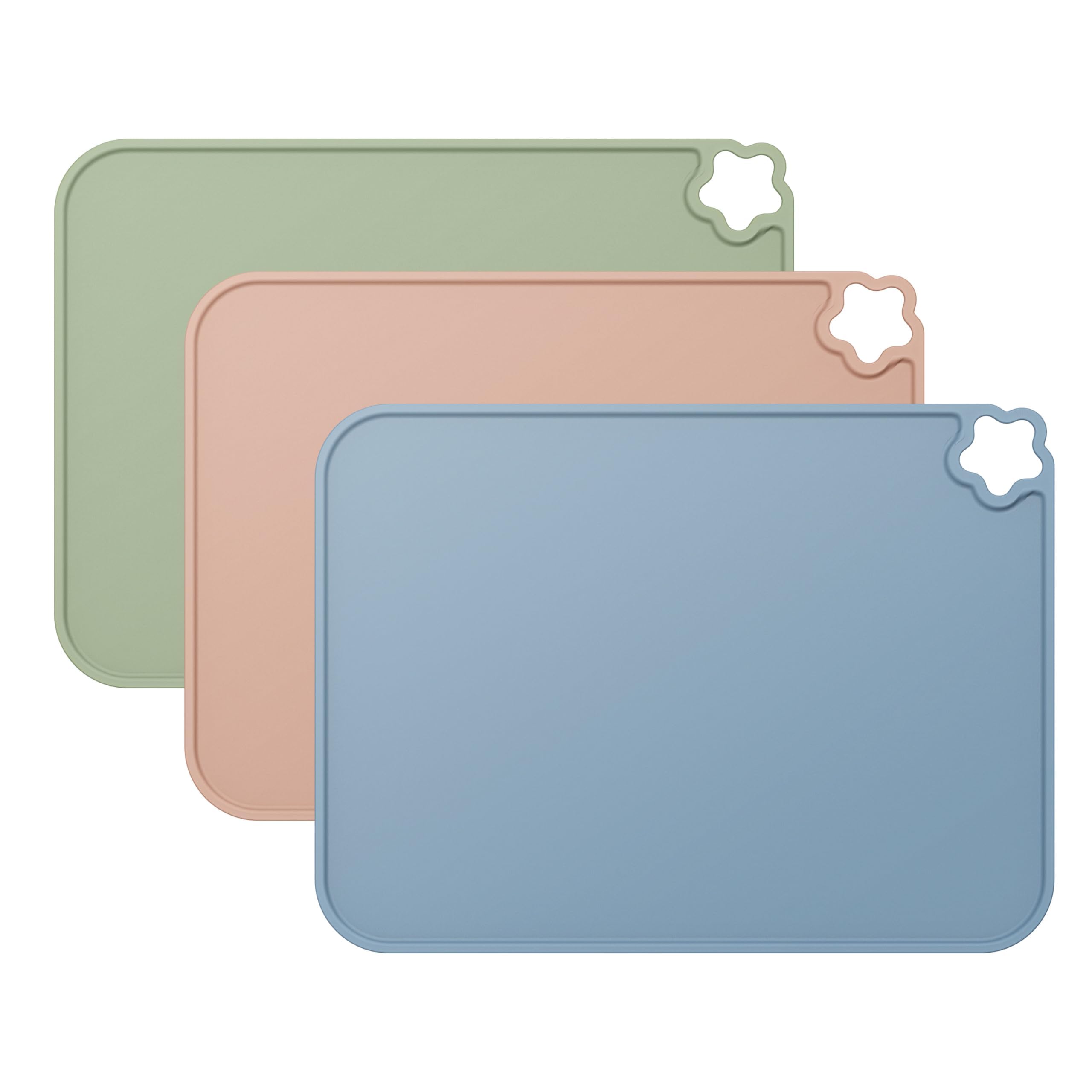
Three silicone mats for roughly what one costs elsewhere is the reason the Cutebe pack is here, and the value isn’t only about money: three mats means one on the table, one in the wash, and one in the diaper bag, so a clean surface is always somewhere in the house. The three colors — blue, green, and pink — also settle the which-one-is-mine argument with a toddler.
The finish is the pleasant surprise. The silicone resists stains, so sauces wipe off rather than soaking in, and each mat has a flower-shaped cutout in one corner so it can hang on a hook instead of living in a drawer. At 14.7 x 11 inches there’s room for a plate and a cup, and the raised edge stops crumbs and slow spills. The material is thin — it drapes and folds easily, and it sits on the table rather than gripping it.
That low edge is the limit: a cup knocked over at speed sends liquid straight over the side, and with no suction the mat can be dragged across the table by a toddler pushing a bowl. For a kid who has stopped throwing, that’s a fair trade for three mats you can rotate through the wash without ever running out.
Pros
- Three mats for about the price of one
- Stain-resistant silicone wipes clean
- Raised edge catches crumbs and slow spills
- Corner cutout hangs on a hook
Cons
- Low lip won’t hold a fast spill
- No suction, so it can be dragged
Three stain-resistant silicone mats for about what one costs elsewhere, so there’s always a clean one within reach when the last one is in the sink.
Best for Dining-Out Entertainment
J.L. Childress ColorMe Placemats
Key Features
- Count: 24 mats
- Design: Colorable Mickey scenes
- Mat size: 18 x 14 in
- Material: 75% recycled paper
- Price: Midrange
Most disposable placemats are a clean surface and nothing more. The J.L. Childress ColorMe mats are the ones we hand over the moment we sit down, because the Mickey and friends line drawings turn the wait into something to do — crayons or colored pencils, a big sheet, and a toddler who stops asking how long until the pancakes.
The size matters as much as the drawing. At 18 x 14 inches it covers more table than the 12 x 18 plastic mats here, which leaves room for a plate and a coloring session at the same time, and the design is sturdy enough that food doesn’t soak through it mid-meal.
It’s paper made from 75% recycled material, and the multiple adhesive strips keep it flat through a whole meal, then lift without leaving residue behind. That stick is the part we care about most: a mat that curls up at the corner is worse than no mat, because it ends up on the floor with the crayons.
The catch is what paper means. A soaked drink ends the mat, and 24 to a pack works out to more per mat than the plastic disposables, so this is a pack we ration rather than use every day. It earns its place on long restaurant waits and airplane tray tables, where a stuck-down activity buys more quiet than another snack ever does.
Pros
- Coloring designs keep kids busy before food
- Large 18 x 14 surface
- Adhesive strips hold flat and peel clean
- Made from 75% recycled material
Cons
- Paper, so a soaked spill ends it
- Costs more per mat than plastic packs
Worth the extra per-mat cost when the wait is the hard part: coloring placemats that stick flat, cover a big area, and keep a toddler busy until the food lands.
Best for Small Tables
mushie Silicone Placemat

Key Features
- Care: Dishwasher safe
- Shape: Semicircular
- Mat size: 18 x 8.87 in
- Material: Food-grade silicone
- Price: Midrange
The mushie mat is the one we leave out on the counter, because it looks like something designed rather than something that fell out of a diaper bag. The dinosaur print is clean and cheerful, the semicircle suits a small table, and the silicone is the same food-grade material as the rest of this list.
It’s a table liner more than a full eating surface, and that’s how we treat it. At 18 x 8.87 inches it’s a strip: a bowl, a cup, and a small plate fit; a divided plate and a sippy cup don’t. For a toddler eating blueberries at the kitchen counter that’s exactly right. For a full dinner setup it’s tight.
There’s no suction, and the grip is average among the mats here — it stays put on a smooth table, slides on a polished one, and a hard pull can tear it. Dishwasher safe, stain resistant, and light at 5.92 ounces, it survives the wash better than it survives a determined toddler.
So why include it? Because plenty of mealtimes are not a full production, and this is the mat that stays on the table between them instead of going back in the drawer. Buy it for a child past the throwing stage and a table that isn’t huge; skip it if you need one mat to do everything.
Pros
- Dinosaur print looks good left on the table
- Dishwasher safe and stain resistant
- Light 5.92-ounce mat rolls up for a bag
Cons
- Narrow 18 x 8.87 strip fits a snack, not a setting
- No grip or suction; can tear under a hard pull
The prettiest mat here and the most limited: buy it for snacks and small tables, once your child is past the stage of throwing everything.
Best for Restock the Bag
Hippypotamus Disposable Placemats

Key Features
- Count: 45 mats
- Adhesive: Strips on 4 sides
- Mat size: 12 x 18 in
- Packaging: Resealable zipper bag
- Price: Budget
The Hippypotamus pack arrives as 45 individually folded mats in three muted colors — cream, sage, and blush — inside a resealable zipper bag. That bag is the detail that sold us: it survives the bottom of a diaper bag, holds the unused mats flat, and keeps them from creasing into a wad before you ever get to the restaurant.
Each mat is 12 x 18 inches with adhesive on all four sides, made from food-grade material free of BPA, BPS, PVC, lead, and phthalates. Fifteen of each design means the bag doesn’t turn into a pile of the one print nobody wants, and the soft palette is a relief if alphabet animals aren’t your thing.
Adhesion is the weak point, as it is with every sticky mat here: the strips want a dry, sealed table, and a mat can turn up with a strip missing or already lifting at a corner, so check before you press one down. Buy this pack for the calmer colors and the bag that survives; buy the Babebay pack if five adhesive sides and alphabet animals suit you better.
Pros
- Forty-five mats, fifteen of each design
- Resealable zipper bag keeps them flat
- Muted cream, sage, and blush palette
Cons
- Some mats arrive with a missing adhesive strip
- Adhesion depends on a dry, sealed table
The disposable to choose if muted colors and a bag that lasts matter to you: 45 individually folded mats that live tidily in a diaper bag.
How We Picked and Tested Baby Placemats
To build the shortlist, I started with roughly 40 placemats and filtered by price, material, and size — anything that wouldn’t sit flat on a standard restaurant highchair tray or a 12-inch stretch of table was out. I also split the field by what actually holds a mat down: a suction base, a stick-on adhesive edge, or nothing at all. That left 16 placemats, which we used for four months.
Grip came first, since everything else is moot if the mat moves. I pressed each suction mat onto a clean highchair tray and onto a scuffed wooden table, tugged a corner, then let a 9-month-old go at it with both hands. I noted which ones held through a full meal, which curled up at the edge, and which a baby could peel off in one pull. The stick-on sheets got pressed onto a laminate restaurant table and checked again after 30 minutes of applesauce.
Cleaning came next. I smeared each mat with tomato sauce and a swipe of turmeric, let it sit for 20 minutes, then washed it the way the maker instructs. I watched for staining, lingering smell, warping after the dishwasher, and whether the disposable ones tore on removal or left a sticky patch behind.
Last, I rolled or folded each one into a diaper bag, timed how long it took to lay out one-handed while holding a baby, and used them through a run of restaurant dinners, highchair breakfasts, and a weekend at my mother’s house, where the table is textured and almost nothing suctions properly.
How to Choose Baby Placemats
The placemat that works is the one that stays put on the surface you actually eat on, and a restaurant table and a highchair tray ask for different designs.
Reusable or Disposable?
Start with where the mat will spend most of its life. A reusable silicone mat covers everyday meals at home, wipes clean, and goes in the dishwasher; you buy it once and stop thinking about it. A disposable stick-on mat solves a different problem — a public table you can’t scrub — and gets tossed with the crumbs folded inside. We keep both: the silicone mat does the daily work, and a stack of sticky placemats lives in the diaper bag.
What Makes a Placemat Stay Put
Three mechanisms, three ways to fail. Suction needs a smooth, non-porous surface and a clean, slightly damp base; press it down and it resists a sideways shove, but it lifts at the rim once a fingernail gets under. Plain silicone grip holds on the same smooth tables without a seal to break, and slides on a textured or damp one. Adhesive strips need a dry, sealed tabletop. Whatever you buy, the prep is the same: wipe the table, let it dry, and press from the edges inward.
Match the Size to the Surface
The mats here run from an 18 x 8.87-inch strip to a full 12 x 18 sheet, and that range decides where each one works. A 12 x 18 disposable covers a toddler’s whole eating zone on a restaurant four-top; a 15.7 x 11.7 reusable mat handles a plate, a cup, and the spill between them. A 12 x 10 mat is sized for one plate and a snack. If the mat has to sit inside a highchair tray with a raised rim, check the flat center against the mat’s footprint before you buy — the oval Mini Mat overhangs some trays.
Cleaning and Stains
Silicone is the easiest material to live with: it resists stains, doesn’t absorb water, and most of the reusable mats here are dishwasher safe. Wipe or rinse a mat before the food dries and nearly everything comes off; leave a tomato sauce sitting overnight and you may still be scrubbing the next morning. Paper and plastic disposables are one soaked spill away from the trash, which is the trade you’re making for the convenience.
Edges, Compartments, and Bumpers
A raised lip catches crumbs and slow spills, not a cup knocked over at speed — and a low lip, like the one on the Cutebe mats, lets liquid run straight off the side. Compartments do a different job: they separate foods and give a baby a wall to scoop against, which matters most in the first months of self-feeding. A bumper that folds over the table edge is the specialist option, and worth it if your baby’s favorite hobby is chewing the table.
Frequently Asked Questions
How many baby placemats do I need?
Two reusable mats cover a household: one on the table, one in the wash or the diaper bag. For disposables, a 40-pack used at two restaurant meals a week lasts roughly five months, so a single silicone mat plus one pack of stick-on mats is a sensible starting kit.
Can a baby chew on a silicone placemat?
Yes, if the mat is labeled food-grade silicone and free of BPA, PVC, lead, and phthalates — the standard every reusable mat here is sold under. A baby who gnaws the edge will eventually test it, so check the rim for tears or pitting after each dishwasher cycle and replace a mat that starts to break down.
Do stick-on placemats peel off cleanly?
The adhesive is low-tack and lifts off sealed, finished tables without residue. On veneer, unsealed wood, or a table with a lifting finish, work a corner up slowly and pull back along the surface rather than up, and don’t leave a mat stuck on overnight.
Final Verdict
Buy the Moonkie two-pack first. It’s the mat that stays on the table at home, catches the spill instead of the tablecloth, and rolls into the diaper bag for a weekend away. Then put a pack of Babebay stick-on mats in the bag for tables you can’t trust.
If your baby is just starting solids, the ezpz Mini Mat’s three compartments and suction base are worth the step up. If the table edge is the enemy, the Table Tyke’s bumper is the only design here that covers it.
