This post contains affiliate links. We may earn a small commission when you buy through our links — at no extra cost to you.
The hardest part of keeping a child rear-facing longer isn’t deciding it’s worth doing—it’s finding a seat that leaves room for the front passenger and doesn’t make you dread the pickup line. A good extended rear-facing car seat buys time in the safer position without turning every trip into a harness wrestling match. I’ve buckled kids into enough seats to know the box specs rarely match a compact back seat.
Over nine months, our team tested 12 extended rear-facing car seats through school runs, road trips, and sticky-snack messes. What separated them wasn’t flashy. It was a tight install on the first try, a harness that adjusted without waking a sleeping toddler, and a rotating seat that saved my back in a narrow spot. A sun shade that stays put matters more than you’d think, too. The picks below are the ones we’d install in our own cars without a caveat, and the right one depends on your car, your kid, and how much bending you’re willing to do.




Best for Most Families
Graco Extend2Fit 2-in-1
Key Features
- Seat weight: 19 lb
- Extra legroom: Up to 5 in.
- Rear-facing height: Up to 49 in.
- Rear-facing weight: 4 to 50 lb
- Price: Midrange
The feature that earns this Graco the top spot is easy to miss in the product photos: a four-position panel that slides out from the front of the seat for up to 5 inches of extra legroom. That’s the number to care about, because rear-facing children generally run out of legroom and shell height before they run out of weight capacity. Add the 50-pound rear-facing limit and a 49-inch rear-facing height limit, and there’s more room to grow than in almost anything else here.
Forward-facing, the harness carries a child from 26.5 to 65 pounds, and the headrest and harness move together through 10 positions, so nothing has to be rethreaded when a younger sibling inherits the seat. At 19 pounds and 19.5 inches wide, it’s light enough to move between cars a few times a year and narrow enough to sit beside another seat in a mid-size back row. The Simply Safe Adjust harness moves with one hand on the headrest, which is the kind of thing you stop noticing precisely because it works.
Two things to know before you order. There’s no booster stage, so when the forward-facing harness is outgrown you’re shopping again. And the extension panel buys legroom by pushing the seat’s footprint forward, so in a compact car slide it out and then check that the front passenger still fits before you finish the install.
Pros
- 50 lb rear-facing weight limit
- Sliding panel adds up to 5 in. of legroom
- No-rethread harness with 10 height positions
- 19 lb shell is manageable to move
Cons
- No booster mode once the harness is outgrown
We recommend it to almost every family shopping for extended rear-facing: 50 pounds of rear-facing plus the legroom that makes staying backward comfortable.
Best for Tall Vehicles
Evenflo Revolve360 Extend
Key Features
- Modes: 3
- Rotation: 360 degrees, one hand
- Seat weight: 29.6 lb
- Rear-facing weight: 4 to 50 lb
- Price: Premium
In a crowded lot, the first thing you notice is that the whole seat swings around to face the open door, so you buckle a child standing at the curb instead of leaning across the back seat. Evenflo’s Revolve360 Extend does that with one hand in both rear-facing and forward-facing mode, and it keeps a child rear-facing to 50 pounds.
That pairing is what earns it a place here. Plenty of seats reach 50 pounds backward and a few rotate, but this is the one with both, and the rotation is the version you feel at 7 a.m. on a school morning. The install is also designed to serve both modes, with the Sure360 system, LockStrong belt tensioner, and Tether360, so flipping the seat forward doesn’t mean a second wrestling match in the driveway. Fourteen headrest positions and a Quick Clean cover that lifts out for washing round out the practical side.
You pay for it in weight: 29.6 pounds makes this the heaviest seat in the group, and hauling it between cars is a two-hand job rather than a quick swap. The harness can also catch near the bottom and stop pulling out all the way; if that happens in the first week, use the return window rather than fighting it all year.
Pros
- 360-degree rotation in both modes
- Rear-facing all the way to 50 lb
- One install serves rear- and forward-facing
- Quick Clean cover comes off to wash
Cons
- Heaviest seat here at 29.6 lb
- Among the priciest seats in this guide
We think it’s worth the premium if you load a toddler into a tall vehicle daily: the same 50-pound rear-facing limit, minus the reach.
Best for Three Across
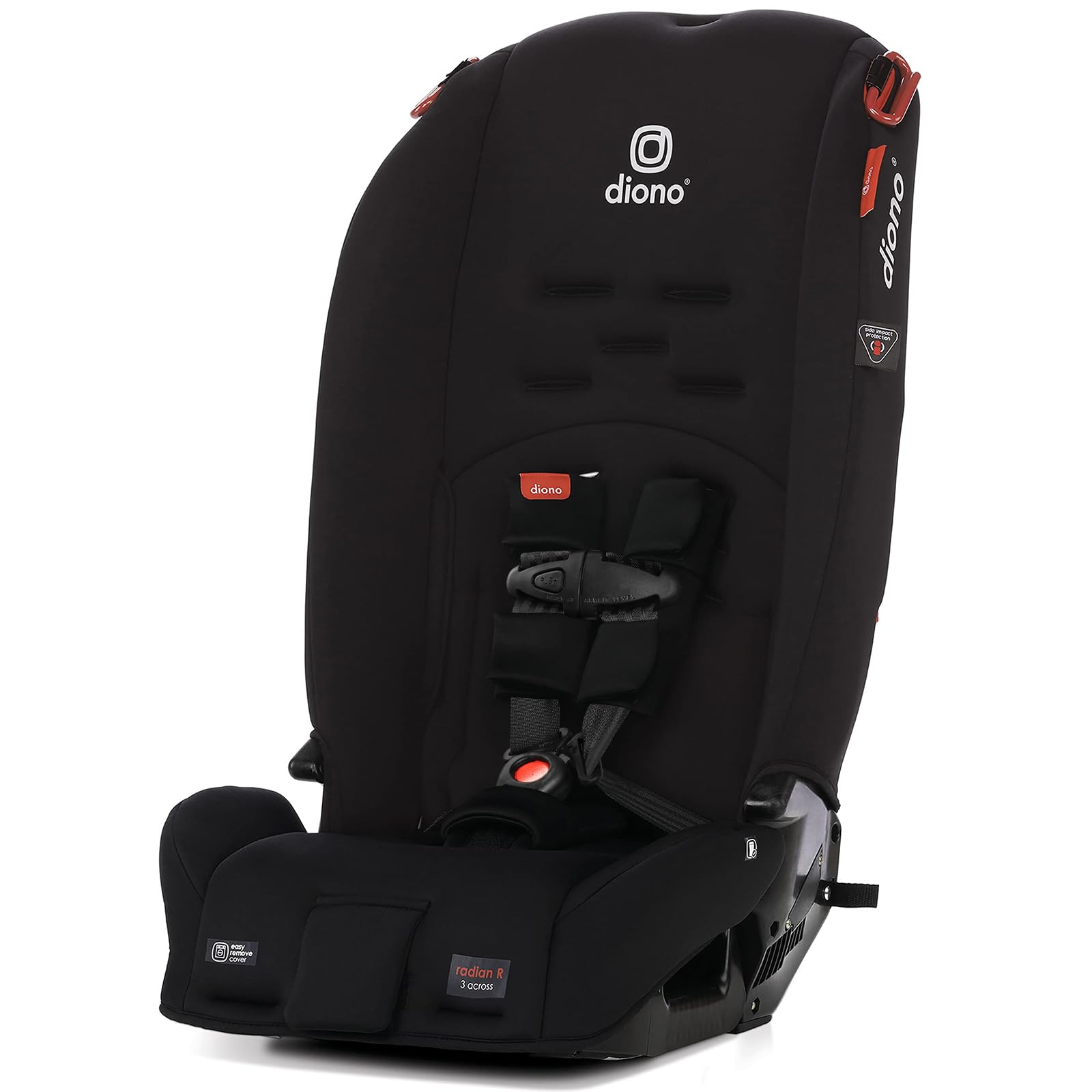
Diono Radian 3R
Key Features
- Width: 16.9 in.
- Seat weight: 23 lb
- Rear-facing height: Up to 44.1 in.
- Rear-facing weight: 5 to 50 lb
- Price: Midrange
At 16.9 inches wide, this is as narrow as anything in this guide, and that single number is why the Radian 3R exists: three of them fit across a mid-size SUV or a third row where two ordinary seats won’t. The shell is built around a reinforced steel core, which is also why it weighs 23 pounds and feels more like equipment than furniture.
Rear-facing runs to 50 pounds, matching our top pick, but the rear-facing height limit is 44.1 inches, a few inches short of the tallest shells here. That’s the figure that ends extended rear-facing for a tall child, so weigh it against your own kid before you buy. The payoff is longevity: one seat covers birth through a 120-pound booster, and Diono rates it for ten years.
Installation is the part to set expectations for. This seat has a reputation for being fussy: the detachable rear-facing base and the anchor belt path reward patience, and a tight fit takes a knee in the seat and a slow, steady pull rather than a quick yank. Once it’s locked in, it stays put. There are no cup holders in the box either, so add a set to the order if your toddler travels with a drink.
Pros
- 16.9 in. wide for three across
- 50 lb rear-facing limit
- Steel core feels substantial
- Runs from birth to a 120 lb booster
Cons
- Rear-facing height caps at 44.1 in.
- No cup holders included
We recommend it when three seats have to share one row: the 16.9-inch shell is the whole argument, and it still rear-faces to 50 pounds.
Best for Small Back Seats
Evenflo Revolve360 Slim
Key Features
- Modes: 2
- Width: 16.9 in.
- Rear-facing height: 17 to 48 in.
- Rear-facing weight: 4 to 50 lb
- Price: Premium
Same one-hand rotation as the Revolve360 Extend, in a shell that measures 16.9 inches across instead of 19.8. If your constraint is the width of the back seat rather than the height of the vehicle, this is the version to look at, because it leaves room beside it for a second seat or a passenger.
It keeps the 50-pound rear-facing limit, adds a 48-inch rear-facing height limit and 15 headrest positions, and the Quick Clean cover comes off in one piece for washing. For a compact SUV that will eventually hold three across, that combination is the one we keep coming back to, since the seat you can actually spin is the seat you load without straining.
Two limits. It’s a 2-in-1, so the harness stops at 65 pounds and there’s no booster stage; the Extend keeps going to a highback. And the rotation mechanism can lock up and refuse to spin, so run it through a full swing in the parking lot before the return window closes, because a swivel seat that won’t swivel has lost the reason it’s in the car.
Pros
- 16.9 in. footprint for tight rows
- 360-degree one-hand rotation
- Rear-facing to 50 lb and 48 in.
- Quick Clean cover washes easily
Cons
- No booster mode after 65 lb harness
- Rotation mechanism can stick
For a compact back seat, this is the rotating seat to get: a 16.9-inch footprint and the same 50-pound rear-facing limit as our top pick.
Best for Long-Term Use
Graco 4Ever DLX 4-in-1
Key Features
- Modes: 4
- Seat weight: 23 lb
- Height positions: 10
- Rear-facing weight: 4 to 40 lb
- Price: Premium
This is the seat you buy when you don’t want to buy another one: rear-facing harness, forward-facing harness, highback booster, then backless booster. Graco rates it for ten years of use, and the last two stages mean it stays bolted into the car long after the harness is gone.
The hardware is aimed at that long haul. A 6-position recline helps on a sloped back seat, the headrest and harness move together through 10 positions, and the padding is thick enough that a sleeping preschooler doesn’t fold forward at the neck. At 23 pounds it isn’t a seat you move weekly, and 21.5 inches of width makes it the widest of our picks, which matters if it has to share a row with anything else.
The compromise sits at the front end. Rear-facing stops at 40 pounds, the lowest ceiling among our picks, so a heavy three-year-old may need to turn before you’re ready to give up the backward position. In exchange you get a decade of forward-facing usefulness, and that’s the trade this seat is asking you to make.
Pros
- Four modes through a backless booster
- Rated for ten years of use
- 6-position recline helps installation
- No-rethread 10-position headrest
Cons
- Rear-facing stops at 40 lb
- Widest of our picks at 21.5 in.
We recommend it to families who want one seat for a decade and can accept a 40-pound rear-facing ceiling to get there.
Best for Sunny Climates
Baby Trend Cover Me 4-in-1

Key Features
- Modes: 4
- Canopy: UPF 50+
- Seat weight: 18 lb
- Rear-facing weight: 4 to 40 lb
- Price: Budget
Rear-facing babies face the back window, which is exactly where the afternoon sun lives. Baby Trend’s answer is a canopy built into the seat shell: UPF 50+, adjustable for height and angle, and mounted so a child old enough can push it back without asking anyone for help.
It’s the least expensive seat in this guide and it still covers four stages: rear-facing infant from 4 to 18 pounds, rear-facing toddler to 40, forward-facing harness, then a booster to 100. At 18 pounds it’s also the lightest seat here, which matters when it lives in a grandparents’ car and comes out on weekends rather than staying put.
The rear-facing ceiling is 40 pounds, so it isn’t the long-haul choice for a big toddler, and the harness takes some fussing: the straps twist easily, and a twisted strap won’t tighten evenly no matter how hard you pull the tail. Straighten both sides flat before you pull, and it behaves.
Where it earns its place is the second vehicle: the car that sits in the driveway, a grandparent’s sedan, anywhere the sun hits the back window and the seat isn’t doing daily duty in a tall SUV. And the canopy is the rare seat feature a toddler can operate alone, which buys you a quieter drive more often than you’d expect.
Pros
- Integrated UPF 50+ canopy
- Four modes to a 100 lb booster
- Lightest of our picks at 18 lb
- Least expensive seat here
Cons
- Rear-facing ends at 40 lb
- Harness straps twist easily
We recommend it for a second car or a grandparent’s vehicle, where the built-in canopy earns its keep on every sunny drive.
Best for Easy Cleaning
Disney Grow and Go

Key Features
- Modes: 3
- Height positions: 3
- Rear-facing height: 19 to 40 in.
- Rear-facing weight: 5 to 40 lb
- Price: Midrange
The seat pad comes off for washing without unthreading the harness. That sounds minor until a child is sick forty minutes from home, and then it’s the difference between a wipe-down at a rest stop and a full harness rethread in the rain.
The rest is a friendly, well-padded three-stage seat: rear-facing harness, forward-facing harness, then a highback booster to 100 pounds. Harness holders keep the straps sitting open while you load a wiggly toddler, the headrest and harness adjust together in one step, and the Mickey Sprinkle print is the one in this guide a child will actually point at in the driveway.
The rear-facing window is the weak spot: 5 to 40 pounds and 19 to 40 inches, with just three headrest positions, so a tall two-year-old hits the height limit earlier than in the Extend2Fit or the Radian 3R. We think the washable pad is genuinely the most useful thing here, which makes it a better buy for the years after rear-facing than for extended rear-facing itself. If it starts leaning to one side, the install has loosened, so check the belt path and re-tighten rather than living with the tilt.
Pros
- Pad washes without unthreading the harness
- Harness holders keep straps open
- Three modes to a 100 lb booster
- Prints toddlers actually like
Cons
- Rear-facing height stops at 40 in.
- Only three headrest positions
We recommend it for the washable pad and the prints, as long as your child is short enough to make 40 inches of rear-facing height last.
How We Tested Extended Rear-Facing Car Seats
We started by narrowing the field to seats that officially support extended rear-facing use and that shoppers can actually find at a range of prices, then filtered by size, mode range, and whether the seat could fit three across in a mid-size SUV. We ended up with 12 seats and used each for nine months, rotating them between a compact sedan, a mid-size SUV, and a borrowed minivan so every install got tested in more than one back seat.
We installed each seat from scratch, first with the lower anchors and then with the seat belt, timing how long it took and checking for movement at the belt path. We noted whether the seat fit behind a front passenger at a realistic legroom setting, how much the harness and headrest adjusted without uninstalling, and how heavy the seat felt when carried from the garage to the car. For the rotating models, we used them in tight parking lots and crowded drop-off lines to see whether the rotation actually helped with loading a toddler.
In daily use, we watched how kids settled in for longer rides, whether the padding stayed comfortable after an hour, and whether the cover handled crumbs, milk, and a juice-box leak. We checked that the sun shade stayed where we put it and that the buckle and harness were easy to operate in a hurry. We also factored in what each seat included for the price, because a seat that needs extra purchases to work well is not a good value. Safety came down to a tight, repeatable install, a secure harness fit every single time, and whether the shell felt solid or flexed when we pushed on the headrest.
How to Choose an Extended Rear-Facing Car Seat
The rear-facing height limit, not the weight limit, is usually what ends extended rear-facing, so shop the shell and the legroom first and treat the pounds as a tiebreaker.
Height Ends Rear-Facing Before Weight Does
Every seat here lists a rear-facing weight limit, and very few children reach it first. Children gain height faster than pounds after the second birthday, and the practical limit is the shell: most manuals want at least an inch of hard shell above the head, and the seat’s stated rear-facing height cap tells you when that runs out.
Our picks range from a 40-inch rear-facing height limit to 49 inches, which is a big spread in a category where a single growth spurt matters. If your toddler is tall, read the height figure as the real specification and compare seats on that line before you look at anything else.
Legroom, Depth, and the Front Seat You Give Up
A rear-facing seat is deep by design, and the child’s legs need somewhere to go. Graco’s four-position panel on the Extend2Fit slides out for up to 5 inches of extra legroom; the Radian 3R gets much of the same effect from a compact, upright shell with less depth.
The trade shows up in the front seat. Before you order, set the driver’s seat where it actually sits and measure from its back to the rear cushion, then compare that gap with the seat’s depth figure. In a small sedan, the panel is the first thing to slide back in once your child is out of the toddler years.
Installation, and How Often the Seat Moves
A correct install is what makes any seat safe: at the belt path it shouldn’t move more than an inch in any direction. A seat belt often gets tighter than lower anchors in a narrow spot, and rotating models need clearance to swing, so open the door and watch the arc before you commit.
Weight is the other half of this. Seats in this guide run from 18 to 29.6 pounds, and if the seat shuttles between two cars every week that spread is the difference between a one-hand carry and a two-hand haul. A seat you avoid moving is a seat that stays properly installed.
Two Across, Three Across, and the Width You Have
Widths here run from 16.9 to 21.5 inches, and that spread decides whether three seats can share a row. Measure the back seat between the bolsters and subtract the seats you already own; the answer comes fast, and it usually rules out the roomiest shells.
Cup holders are the hidden variable. The Radian 3R ships without them, so add a set to the order if your child travels with a drink, and check whether the holders on any seat you’re considering fold away when you need the last half inch.
Modes, and the Booster You’ll Actually Use
Convertible car seats come as 2-, 3-, and 4-in-1s, and the extra stages are the part you pay for. A booster is inexpensive to buy later, so a 2-in-1 with a 50-pound rear-facing limit often serves a tall child better than a 4-in-1 that stops at 40.
If one seat will pass through three children, the math flips and a model rated for ten years earns its keep, as long as you can live with its rear-facing ceiling. Buy for the stage you’ll use longest, not the stage printed largest on the box.
Frequently Asked Questions
Can I use the lower LATCH anchors for a bigger rear-facing child?
Often not for the whole time. Many vehicles cap lower-anchor use by the combined weight of the child and the seat, frequently near 65 pounds, and the seat belt takes over after that.
Check the anchor limit in your vehicle manual and the seat’s own instructions, then switch methods if your child plus the shell goes over it. A tight seat belt install is just as safe.
Can I put an extended rear-facing seat in the middle seat?
Usually yes, and the middle is a good spot for a rear-facing child because it sits furthest from both doors. The catch is anchors: most vehicles don’t allow lower-anchor use in the center unless the manual says so.
In that case you install with the seat belt, which is just as secure when it’s tight. Confirm the center position in your vehicle manual before you plan the rest of the row around it.
Can my child wear a winter coat in the car seat?
Not a puffy one under the harness. Thick coats compress in a crash and leave the straps loose. Buckle your child in the coat once, tighten, then take them out without loosening the straps and buckle them again without the coat.
If you can pinch slack at the shoulder the second time, the coat is too bulky for the seat. A fleece layer plus a blanket over the buckled harness keeps them warm instead.
When does a car seat expire?
Every seat carries a manufacture date and an expiration on a label under or behind the shell, usually six to ten years out; the Radian 3R is rated for ten years of use.
Write the date somewhere you’ll see it, and don’t take a used seat with an unknown history. Plastic and webbing degrade, and the expiration date exists because of that.
Final Verdict
The Graco Extend2Fit is the seat we point most families to: 50 pounds of rear-facing and a sliding panel that gives a growing child the legroom to stay there. If you lift a toddler into a tall SUV every morning, the Evenflo Revolve360 Extend pairs that same ceiling with a seat that turns to face you.
And if three seats have to share one row, the Diono Radian 3R’s 16.9-inch shell is the whole reason it’s here.
