This post contains affiliate links. We may earn a small commission when you buy through our links — at no extra cost to you.
A climbing dome is the rare backyard toy that needs no coaching from you: kids see the struts and they’re off — over the top, through the gaps, hanging upside down from the third rung. The less obvious part happens in the driveway, where the domes that last are the ones that go together square, sit flat on uneven grass, and don’t turn into a rusted sculpture by the second summer.
We’ve spent the past eight months assembling, disassembling, and living with 12 of these, with a rotating cast of neighborhood kids putting each one through far more than I could. Height mattered less than I expected. The weight rating on the box is a static number that says nothing about six kids hanging off one side, and several now come with a hammock or saucer swing slung inside the frame — which is what turns a five-minute climb into an entire afternoon.
The picks below run from compact domes for the 3-to-6 crowd to 10-foot frames that swallow a playdate, and I’ve flagged where each one needs an adult eye.




Best for Most Backyards
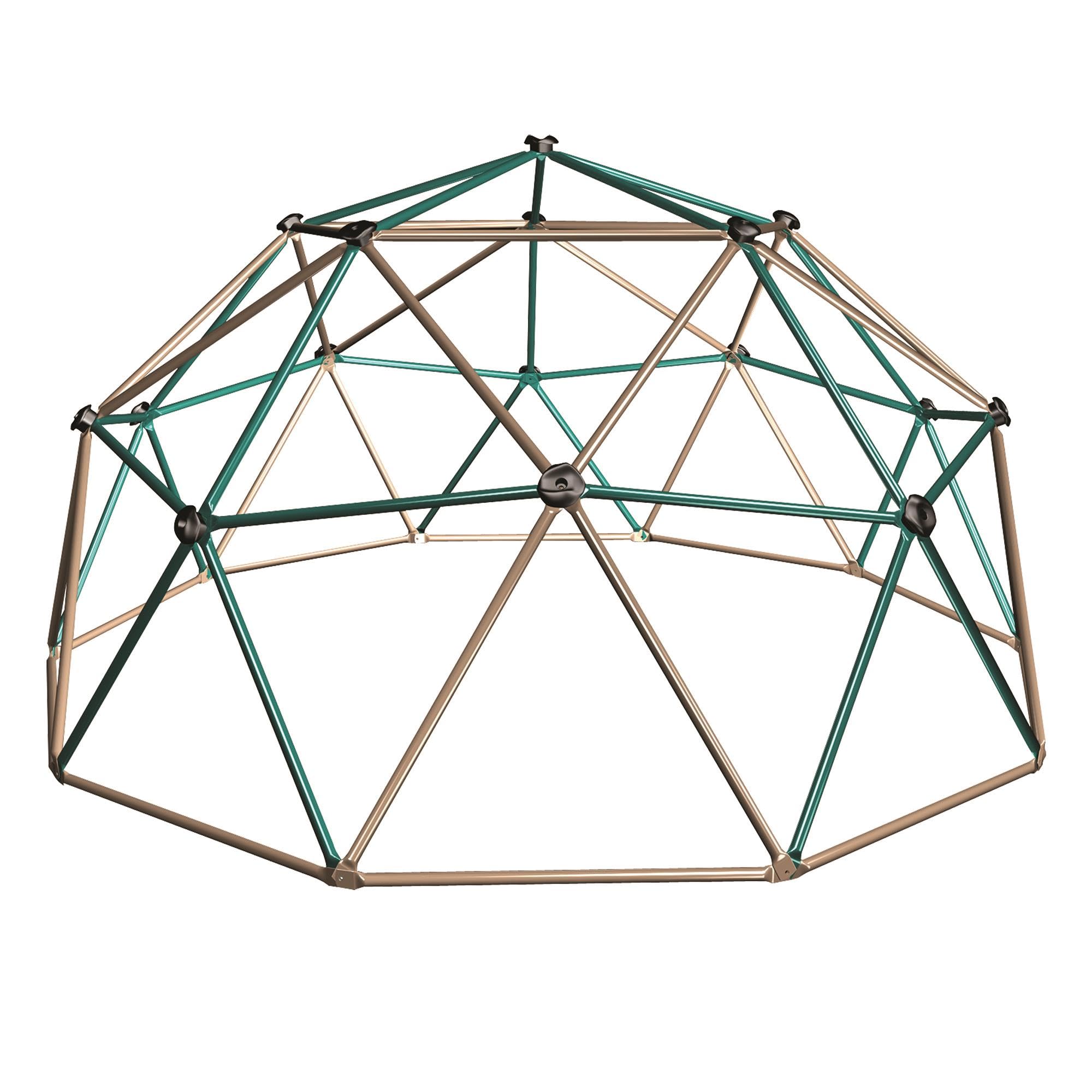
Lifetime Geometric Dome Climber
Key Features
- Frame: Powder-coated steel
- Assembled size: 5 ft H x 10 ft W
- Weight capacity: 600 lb
- Recommended ages: 3 to 10 years
- Price: Premium
The real test of a climbing dome is what happens ten minutes after the novelty wears off. On the Lifetime, it’s one kid working a route across the top ring, two smaller ones crawling through the middle, and a third hanging off a side joint waiting for a turn. Ten feet across and five feet tall is the combination that makes that possible: wide enough that a group can spread out, tall enough that bigger kids climb instead of crouch.
The frame underneath is what you’re paying for — powder-coated steel, a 600-pound total capacity, and high-density polyethylene grips bolted on at the joints. We like those grips more than the spec sheet suggests we should. Bare steel tube is slick in the rain and hot in July, and a molded hold gives a sneaker and a small hand something to catch on, which matters most on the way down. The powder coat is also the reason you won’t be repainting it every other spring.
Set-up is the part to plan for. The box is heavy and the parts count is high, so sort the hardware into cups by size, lay the tubes out by length, close the bottom ring first, leave every bolt finger-tight until the frame is whole, and tighten from the bottom up. Two adults and a free afternoon turn it into a job rather than a fight, and the assembly video is worth the ten minutes it takes.
What you get for the effort is the most complete jungle gym in this group: group-sized, weather-finished, and light enough that one adult can walk it across the lawn. The moving trick is to lift one side and step it rather than drag it, which keeps the legs from plowing ruts into wet grass.
Pros
- Ten-foot span keeps a crowd busy
- 600-pound frame covers several kids
- Molded grips suit small hands
- Light enough to walk across the lawn
Cons
- Wants a ten-foot circle of level ground
Our pick for most backyards: ten feet of span, a 600-pound steel frame, and a finish that lives outside without a cover.
Best for Smaller Yards
Easy Outdoor Space Dome Climber
Key Features
- Frame: Rust-resistant alloy steel
- Assembled size: 91 x 91 x 46 inches
- Weight capacity: 1,000 lb
- Recommended ages: 3 to 9 years
- Price: Midrange
Ninety-one inches across instead of a hundred and twenty. That three-foot difference is the whole case for the Space Dome: it drops into the corner of a yard that a ten-footer would swallow, and it doesn’t give up strength to do it. The frame is rated to 1,000 pounds, enough that two adults can hang off the top rails without a creak.
We like it for the yard that already has a swing set, a garden bed, and a fence line to work around. The detail we appreciate most is small and easy to miss: the hardware is capped. Aircraft-style nuts with covers mean the threaded end of a bolt isn’t sitting at knee height waiting for a barefoot kid, and on a structure this low to the ground that isn’t a fussy point.
Set-up takes two people even though the frame is smaller than the ten-footers, and it’s the kind of build where laying the bolts out in order and tightening from the bottom up saves an hour and an argument. Count the hardware before you start so a short bag doesn’t strand you on the last ring.
Pros
- Fits a yard that can’t spare ten feet
- 1,000-pound rating handles adults
- Capped hardware at knee height
- Rigid frame that doesn’t shift
Cons
- 46 inches tall, so big kids top out
The pick for a yard that can’t spare ten feet: 91 inches across, rated to 1,000 pounds, and finished to stay outside.
Best for Basketball Fans
Zupapa 10FT Climbing Dome
Key Features
- Frame: Hot-dip galvanized steel
- Extras: Backboard, rim, two basketballs
- Assembled size: 120 x 120 x 61 inches
- Weight capacity: 1,000 lb
- Price: Midrange
The backboard is why you look twice. Zupapa bolts a small rim and backboard to the top of the dome and ships two basketballs with it, so the top of the structure becomes a game: climb, stand on the beams, shoot, climb down. It reads like a gimmick until a kid who was finished with climbing twenty minutes ago starts keeping score against himself.
The frame under the hoop is the serious part. Each pole is hot-dip galvanized rather than simply powder-coated, with a zinc layer the maker puts at 60 micrometers or more, and the steel is 1.2 mm thick with five reinforced beams closing the top. That’s the treatment for a structure that stays out through winter. Capacity is 1,000 pounds, and the grips are the same molded HDPE the rest of this group uses.
Where it loses ground is the paperwork. The directions are printed in black and white while the tubes are color-coded, the kind of mismatch that costs an hour. Open the assembly video first and lay the tubes out by length before anyone picks up a wrench. Do that, and this is a ten-foot, hoop-equipped, galvanized dome at mid-range money — and the hoop is the reason a dome still gets used in year three.
Pros
- Backboard, rim, and two balls included
- Galvanized poles for year-round weather
- 1,000-pound capacity
Cons
- Assembly wants two adults
Buy it for the hoop: a galvanized ten-footer that gives kids a game at the top and holds 1,000 pounds.
Best for Hammock Lounging
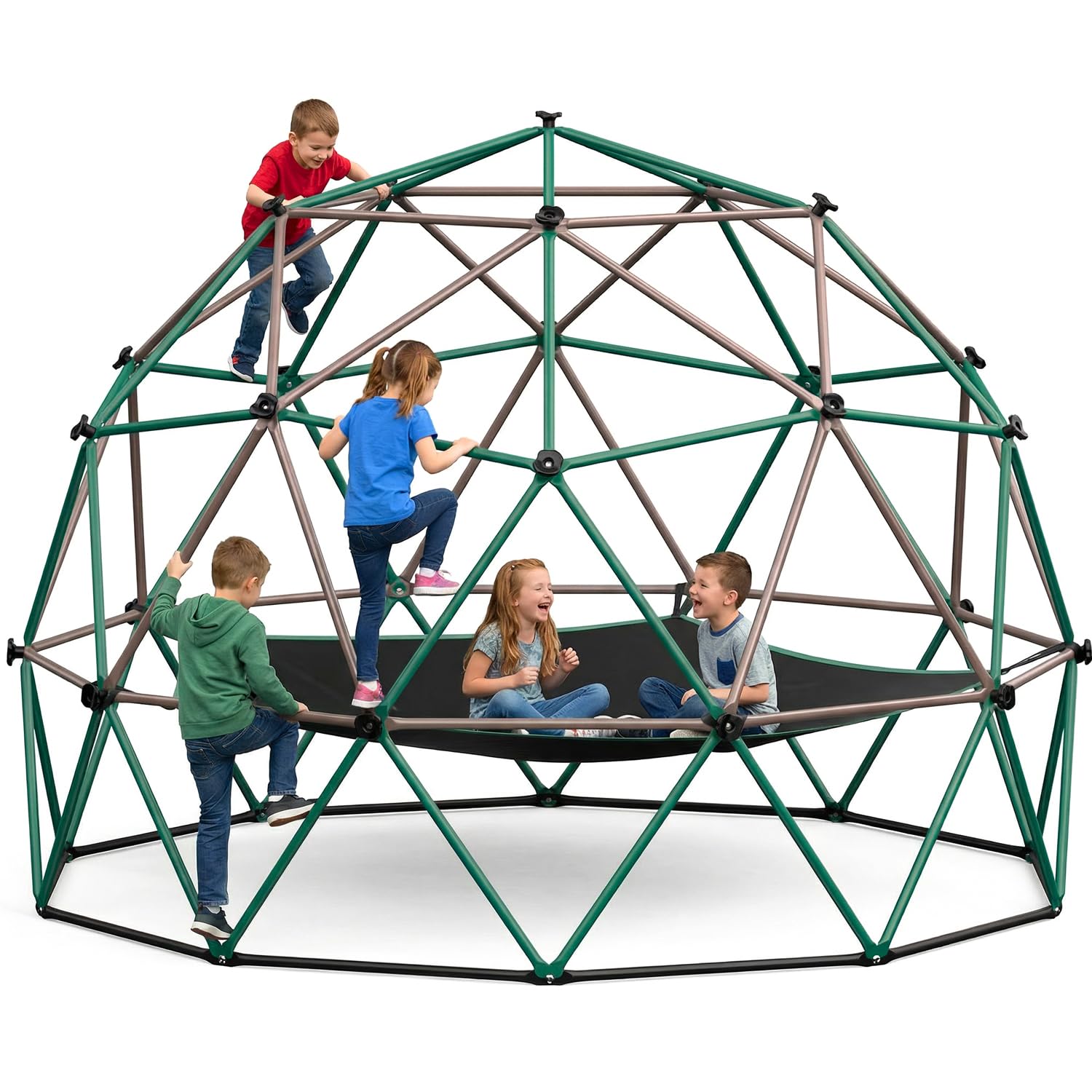
GIKPAL 10FT Dome with Hammock
Key Features
- Frame: Hot-dip galvanized steel
- Players: Up to 5
- Included: Hammock and swing
- Assembled size: 10 ft diameter, 5 ft tall
- Price: Midrange
The mat is the clever bit. GIKPAL’s hammock unhooks and lies flat as a ground mat, then goes back up under the apex when somebody wants to lie down and look at the sky. In practice it does something more useful than either job: it gives a nervous four-year-old a base to sit on inside the dome while the bigger kids climb over the top. We’re pleasantly surprised by how much difference a piece of fabric makes to the way the whole structure gets used.
Underneath is 65 hot-dip galvanized pipes in a ten-foot circle, five feet tall, with a swing that shares the center point with the mat. The frame is rated for five kids at once, the galvanizing is the more durable of the two steel finishes in this group, and the package comes with a lifetime warranty and a 90-day no-questions window.
Unbox it on the lawn and check every tube before assembly. Paint can arrive thin in places and the occasional pole is bent, and both are far easier to sort out before the frame is standing than after. Once it’s up, the structure is sturdier than the price suggests, and one adult can shift it for mowing.
Pros
- Hammock mat doubles as a ground mat
- 65 hot-dip galvanized pipes
- Swing included with the hammock
- Lifetime warranty
Cons
- Assembly wants two or three adults
The best value in the hammock group: a two-in-one mat, a swing, and galvanized pipes without premium money.
Best for Older Kids
Hapfan 6.5 FT Tall Climbing Dome
Key Features
- Included: Hammock
- Certification: ASTM certified
- Assembled size: 9 ft x 9 ft x 6.5 ft
- Weight capacity: 950 lb
- Price: Premium
Nine feet wide and six and a half feet tall, which makes this a different building from the five-foot domes. It’s aimed at the family whose ten- and eleven-year-olds quit the little dome two summers ago: the top ring sits well above the reach of most eight-year-olds, so there is still something to climb toward instead of a frame they can straddle from the ground.
We think it’s the right buy for that family and the wrong one for a yard full of toddlers, since the upper rings are higher than a four-year-old should be without a spotter. The frame is ASTM certified and rated to 950 pounds, the tubes are powder-coated against rust and UV, and the hammock slung underneath gives a younger sibling somewhere to be while the older kid climbs — the practical answer to a four-year age gap.
Set-up is advertised as tool-free and three-person, and that’s about right: the tubes are long and want hands on both sides. Give it more clear ground than a five-footer needs, too, because a taller dome puts a kid higher off the ground, and a grass or thick mulch landing matters more here than anywhere else on this list.
Pros
- 6.5 feet tall for older kids
- 950-pound total capacity
- ASTM certified frame
- Hammock included
Cons
- Costs more than the five-foot domes
For kids who have outgrown a five-foot dome, the extra height is worth the premium: 6.5 feet tall, ASTM certified, hammock included.
Best for Climbing and Swinging
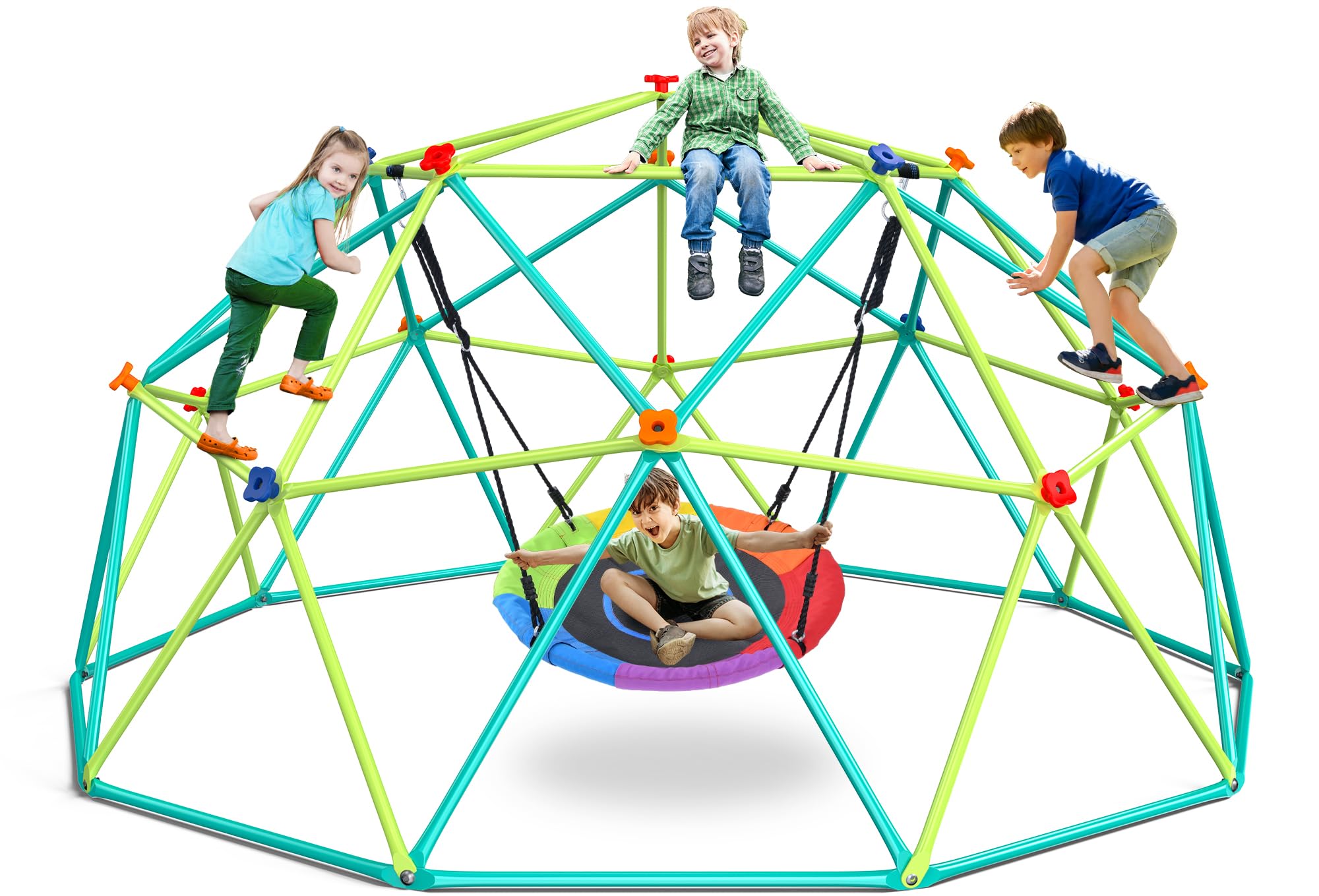
Hapfan 10 FT Dome Swing Set
Key Features
- Included: Saucer swing
- Assembled size: 10 ft x 10 ft x 5 ft
- Swing capacity: 400 lb
- Weight capacity: 800 lb
- Price: Premium
Line up a third person before the box comes inside. Hapfan asks for two, and the frame goes together without extra tools, but the tubes are long and the first two rings want someone holding each side while a third threads bolts. Start it alone on a hot afternoon and you’ll be tired of the idea well before you’re tired of the frame.
The payoff is the swing. A saucer swing hangs from the underside of the apex on a PP mat with an Oxford fabric cover, rated to 400 pounds, and it changes what the structure is for: a kid who won’t climb will swing, and a kid who climbs will swing after. Sixty-five rust-resistant tubes carry an 800-pound dome rating, with a 133-pound cap on any single tube.
The middle of the dome is the trade-off. The swing hangs exactly where kids climb through, so the busiest ten minutes of a playdate get crowded. The fix is simple: hang the swing for the kid who wants it and pull it down when the climbing starts, since it comes off in a couple of minutes.
For a family with one climber and one swinger, that’s a fair swap — two toys in the footprint of one, and a second kid who has something to do at the same time as the first.
Pros
- Saucer swing rated to 400 pounds
- 65 rust-resistant steel tubes
- Two ways to play in one footprint
Cons
- Five-foot apex caps older climbers
The pick for a mixed-age yard: climb on the dome, swing in the middle, 800 pounds of frame underneath.
Best for Tight Budgets
VEVOR 6FT Climbing Dome
Key Features
- Certification: ASTM and CPC certified
- Assembled size: 72 x 72 x 35.4 inches
- Weight capacity: 600 lb
- Recommended ages: 3 to 9 years
- Price: Budget
This is the least expensive way into a certified steel dome, and for a yard with a three- and a five-year-old in it, that’s enough. Six feet across, 35 inches tall, 600 pounds, ASTM and CPC certified, with the climbing handles smoothed so small hands don’t find an edge. We think of it as a starter dome: the right shape for the years before a kid starts wanting height.
The trade-off lands where you’d expect. A 35-inch apex sits below an adult’s waist, so a seven-year-old is folding himself into the thing rather than climbing it, and the cross bars are sparse enough that a cautious kid may want a hand the first few times up. Walk beside them for a week and it stops mattering.
Assembly is a two-person job with the usual mix of diagrams and guesswork. Set it on grass or mulch, and know that at under 40 pounds one adult can pick it up and carry it — which is not true of anything else on this list.
Pros
- Certified steel frame at the lowest price here
- Six-foot footprint fits a patio
- Smooth climbing handles
- Under 40 pounds to move
Cons
- 35-inch apex suits the preschool years
The budget pick: a certified six-foot steel dome that fits a small patio and a preschooler, and costs the least here.
Best for Indoor Play
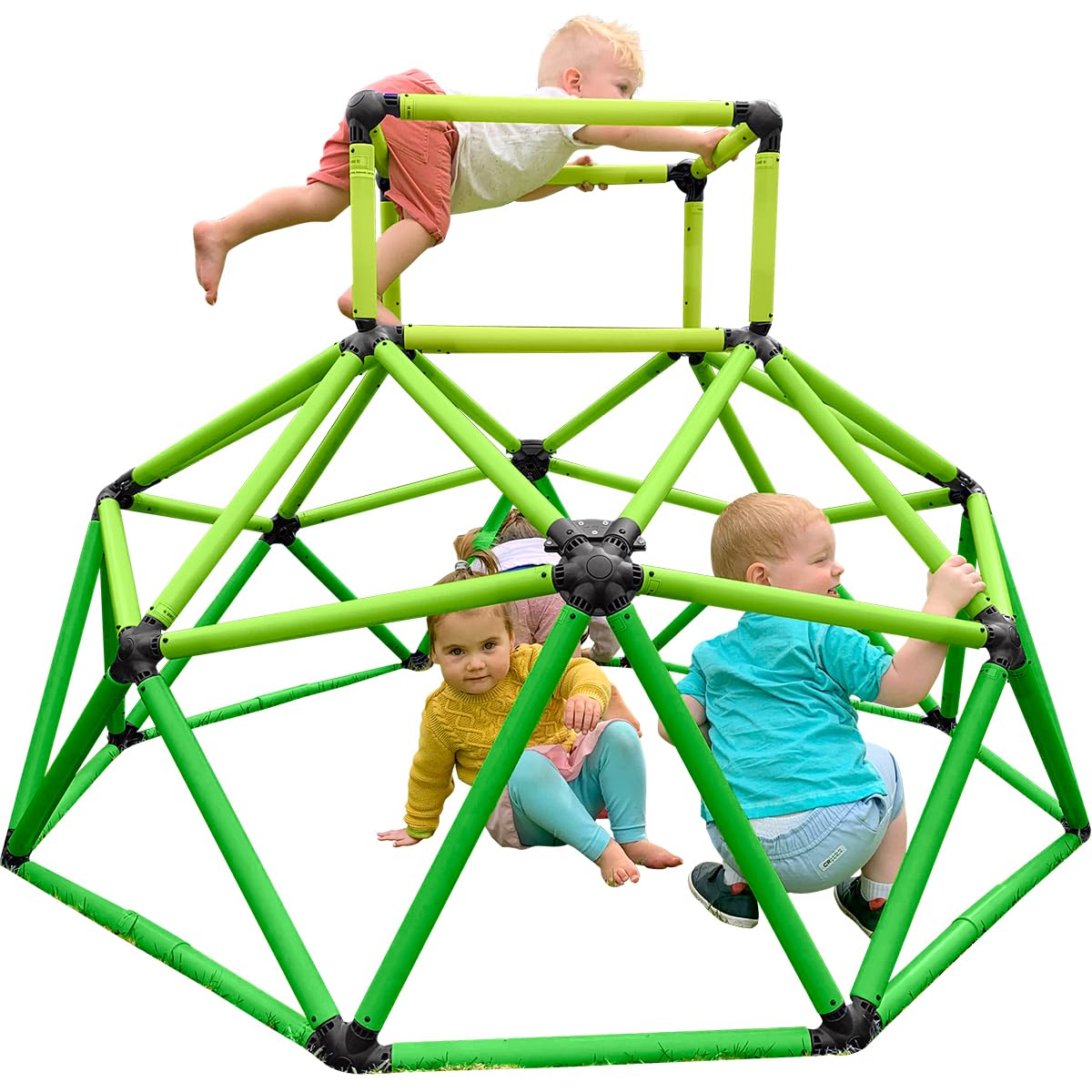
Eezy Peezy Climber with Top
Key Features
- Frame: UV-protected plastic
- Weight: 25 lb
- Players: 1 to 4
- Assembled size: 70.07 x 65.53 x 46.65 inches
- Price: Budget
Some families don’t have a yard. This is the dome for a basement playroom or a small patio: interlocking plastic tubes with double self-locking springs, 25 pounds, 70 inches across, and a platform on top instead of a single apex.
It’s built for the three-to-six set. The tubes are UV-protected, it holds up to four kids at once, and the top deck makes it read as a tower to climb into rather than a dome to scramble over — which is exactly what a four-year-old wants and exactly what a nine-year-old doesn’t.
The connectors are made to stay put, and they do. Separating one is a genuinely miserable job, so pick the spot before you build it and expect it to live there. Buy it for a toddler who needs something to climb in February, in a room, with an adult nearby; what it does better than any steel dome here is fit through a doorway and make sense indoors.
Pros
- 25 pounds, easy to move indoors
- Platform top suits young climbers
- UV-protected plastic
Cons
- Tops out at preschool size
- Plastic joints are the wear point
The indoor pick: a 25-pound plastic climber for toddlers and basements, not for a backyard full of big kids.
How We Chose and Tested These Climbing Domes
The shortlist started with every climbing dome we could find from the outdoor-play brands sold in the U.S. We cut by footprint, height, and whether the frame was powder-coated steel rather than painted tube; anything that shipped without anchoring hardware or grip texture on the bars was out. Twelve made the final cut, and we spent eight months with them in backyards with kids ages 3 to 9.
I assembled each one solo with only the tools in the box, timing the build and noting whether the instructions were labeled diagrams or a wall of text; anything that needed a rubber mallet to line up bolts got marked down. I timed disassembly too, at the end of the season — a dome you can’t take apart is a dome that lives in your yard forever. Then I checked the frame after a week of use: pushing the top hub, watching whether the legs sank into turf after rain, and having kids hang off one side to see how much it flexed.
Climbing was observed rather than measured — whether a 4-year-old could find a foothold on the way up and, more importantly, on the way down. I counted how many kids climbed at once before it felt crowded and compared that to the capacity on the box. Where there was a hammock or saucer seat, I hung it and watched how much the frame moved when someone pumped it.
Everything stayed outside through rain and wind for the full eight months, and I checked welds, bolt heads, and coating scuffs monthly. For mobility, I dragged each dome off the grass to mow and timed it; some scooted, some took a second adult. Value came down to what shipped in the box — stakes, anchors, a swing seat — and whether it still felt solid in month seven.
How to Choose a Climbing Dome
A dome earns its place on two numbers — the circle it needs and the height it reaches — and almost everything else is a detail you argue about afterward.
Measure the Circle and the Height
The number in the product name is the diameter, so a 10-foot dome needs a 10-foot circle of level ground plus a few feet of clear space on every side for kids coming off it. Keep it away from fence posts, tree wells, and windows. Height decides how long the thing stays interesting: five feet at the apex is the standard and carries most kids to about eight or nine, a 35-inch dome is a toddler structure, and a 6.5-foot frame is the only shape here that still challenges a twelve-year-old.
Before you order, lay a hose on the grass in the circle you have in mind and walk around it for a day. It’s a cheaper way to find out that the only flat spot is where the shed goes.
Steel, Plastic, and What Weather Does
Three finishes show up in this group: powder-coated steel, hot-dip galvanized steel, and molded plastic. Powder coat is a painted shell over steel and it holds up fine until it chips; galvanizing dips the finished tube in zinc so the protection runs all the way through, which is what you want on a frame that stays out through winters. Plastic is for indoor or covered use and for the toddler years — light, rust-free, and the joints are what give out first.
If the jungle gym is going on grass and staying there, pay for steel. If it lives in a basement, plastic is the better answer and always was.
Budget for the Assembly, Not Just the Dome
Every structure here arrives as a box of tubes, bolts, and a diagram, and the gap between a tolerable job and a lost Saturday is preparation. Sort the hardware into cups by size, lay the tubes out in length order, close the bottom ring first, leave every bolt finger-tight until the frame is whole, then tighten from the bottom up.
Two adults is the realistic minimum and the tallest frames want three. Easy assembly, when a maker claims it, describes the connectors, not the clock.
Read the Capacity Numbers Properly
A total weight rating is not a per-child rating and it is not a headcount. A 600-pound dome and a 1,200-pound dome both hold a pack of six-year-olds; the difference shows up when an adult climbs on to rescue somebody or four big kids pile onto one side. A published per-tube limit, like the 133 pounds Hapfan allows on a single tube, tells you where the frame is strongest.
Match the age range to your oldest child, not your youngest. A dome bought for a three-year-old that tops out at eight is a five-year purchase; one bought for a nine-year-old gets most of a childhood.
Hammocks, Swings, Nets, and Hoops
Attachments are how a dome stays interesting once the climbing gets easy. A hammock or net under the apex gives a hesitant kid a place to start and a tired one a place to flop. A swing turns the middle into a second toy and takes up the space where kids climb through. A hoop makes the top into a game.
Pick the attachment your kids will actually use and skip the one that only adds parts to assemble. The GIKPAL’s mat, which unhooks and lies flat as a ground mat, is the most useful version of the idea here.
Frequently Asked Questions
Is a climbing dome worth it compared with a swing set?
They do different jobs. A swing set is a queue — one kid per swing — while a dome lets four or five climb at once and needs no concrete footings or build crew. If your kids head for the climbing frame at the playground before the swings, a dome gets more use per square foot of yard.
If they mostly want to swing, buy the swing set, or pick a dome with a saucer swing hung underneath, like the Hapfan 10 FT Dome Swing Set.
How do you move a climbing dome to mow under it?
Walk it rather than drag it. With the frame empty, lift one side a few inches and step it across the grass, which keeps the legs from plowing ruts. Two adults make it simple; on a lighter frame like the VEVOR, one adult manages alone.
If it’s going to move often, set it on a tarp or mark the spot so it goes back in the same place, and check the bolts again after the first few moves.
Can a climbing dome stay outside all winter?
A steel frame with a galvanized or powder-coated finish is built to stay out, so plan on leaving it. The hardware and the tube ends suffer first: check the bolts each spring and touch up chips before they spread.
Sweep snow off the apex rather than letting it sit and refreeze, and give a light plastic climber some shelter — wind is more of a problem for it than cold.
What should a climbing dome sit on?
Grass is the usual answer, with a thick mulch bed or a rubber play surface under the frame if the dome is going on bare ground. Avoid concrete and pavers. Level matters as much as surface: a dome on a slope will lean, and the legs will walk downhill every time a kid climbs.
Check level before the last bolts go in, and keep a clear margin around the base so nobody lands on a fence post.
Final Verdict
Buy the Lifetime if the yard can take it. Ten feet of span, a 600-pound frame, and a finish that doesn’t need repainting is the combination most families are after, and nothing else here balances all three as well.
If ten feet is more grass than you have, the Easy Outdoor Space Dome keeps the strength at 91 inches across and 1,000 pounds. And if the kids are already past the five-foot stage, the tall Hapfan is the only frame here built for them.
