This post contains affiliate links. We may earn a small commission when you buy through our links — at no extra cost to you.
Toddlers are going to hit something. A pounding toy is the rare thing in the house that lets them do it without dents in the coffee table, and the good ones turn that urge into a lesson in cause and effect: the peg sinks, the ball vanishes through the hole, and the show resets for another round.
The trouble is that plenty of these benches look charming on a shelf and quit by the second week — pegs that stick halfway, mallets that split, a base that skids every time a 2-year-old leans into a swing, a crack loud enough to hear through a closed door. We spent four months with 14 of them, from palm-size to two-handed, in playrooms, living rooms, and one patient grandmother’s kitchen.
Pegs and balls ask different things of a kid. A peg bench is repetitive and calming, the same payoff every time; a ball tower adds surprise, but only if the ball sits still on top and clears the hole instead of wedging in it. Those are the differences that decide which one your kid actually returns to, and they are what the picks below were sorted on.
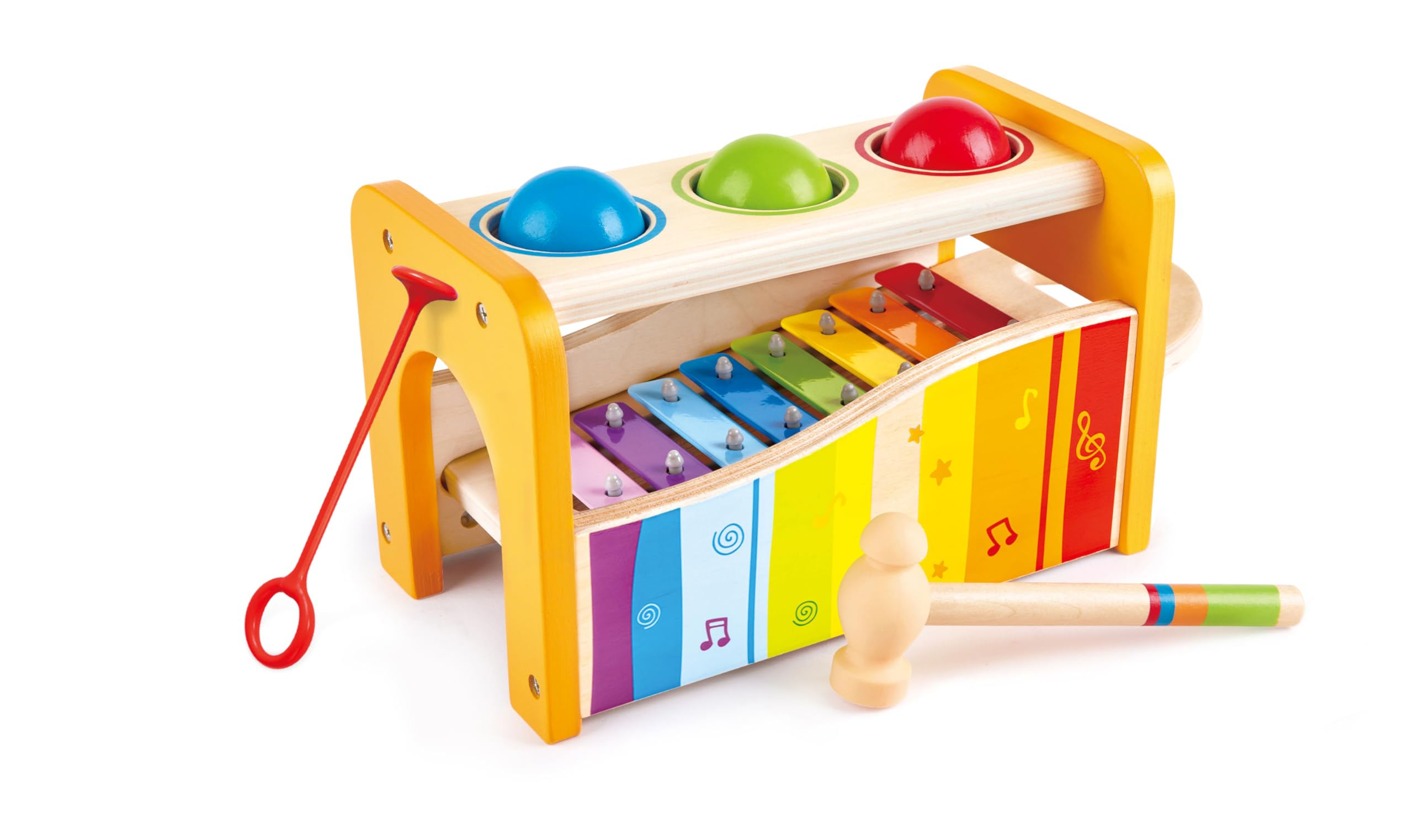


Best for First Pounding Toy
Hape Pound & Tap Bench
Key Features
- Material: Wood
- Dimensions: 9.45 x 5.91 x 5.31 inches
- Musical feature: Slide-out xylophone
- Recommended age: 12 months – 3 years
- Price: Midrange
The first thing we noticed about the Hape Pound & Tap Bench is that every hammer strike produces a note. A ball drops through the bench, lands on the xylophone, and rolls out a short phrase as it travels. That immediate cause-and-effect is why it earns the top spot for a first pounding toy: a 12-month-old can swing, hear a result, and try again without help. The xylophone also slides out, so the bench becomes a separate instrument once the hammering slows down.
The wooden build feels solid in the hand, and the 9.45-inch-wide bench is small enough to sit on a shelf but wide enough that the balls have somewhere to go. We like that the mallet is scaled for a toddler grip, though the solid wood balls pick up speed and roll across the floor. A shallow tray or a blanket underneath keeps them from disappearing under the couch.
The xylophone notes are short and bright, and they repeat every time a ball drops. That repetition is the point: a child hears the same scale and starts to predict it. The slide-out xylophone adds a second act, and it is the part older toddlers return to after the mallet loses its novelty.
For a 1-year-old who is just learning to aim, the wide target and the immediate reward make this the easiest of the group to stick with. For a 3-year-old, the pounding itself may lose novelty before the xylophone does. That is fine: the toy is doing its job if it gets a toddler to swing, listen, and repeat.
Pros
- Immediate musical reward for every strike
- Two toys in one: pounding bench and xylophone
- Starts at 12 months
Cons
- Xylophone notes can sound sharp and repetitive
For a first pounding toy that gives something back, we reach for the Hape.
Best for Classic Peg Bench
Melissa & Doug Pounding Bench
Key Features
- Pegs: 8 peekaboo pegs
- Material: Wood
- Dimensions: 10.25 x 5.3 x 5.3 inches
- Recommended age: 24 months – 4 years
- Price: Budget
The eight pegs on the Melissa & Doug Deluxe Pounding Bench do not come out. Pound one down and another pops up on the other side, so the bench stays complete and the child can keep going without an adult reloading. The wooden bench is 10.25 inches wide, with a chunky mallet and a classic look that fits a nursery shelf.
That captive design is why it stays in our rotation for 2-year-olds who want to hammer without interruption. There is nothing to lose under the sofa and nothing to reset, which makes it the calmest toy in this group to leave out. The trade-off is that the pegs move easily, so some toddlers push them with a finger and skip the mallet altogether.
The wood is solid, and the mallet is easy to grip. We still prefer it for a first peg bench because the play is simple and the pieces stay attached. If you want sound and a musical reward, the Hape bench is the better fit.
Pros
- Captive pegs stay attached
- No reloading or lost pieces
- Simple wooden build
Cons
- Wood can dent and scuff under heavy hammering
Captive pegs and no reloading make this our no-fuss pick for 2-year-olds.
Best for 1-Year-Olds
Battat Pound & Count Bench
Key Features
- Pegs: 10 colorful pegs
- Material: Wood
- Dimensions: 10.56 x 4.75 x 5.56 inches
- Recommended age: 12 months and up
- Price: Budget
The Battat Pound & Count Bench is the toddler-first version of the classic peg bench: it starts at 12 months, carries 10 colorful pegs, and adds numbers, colors, and simple emotion faces to the side of the wood. The mallet has its own slot on the side, which sounds like a small detail until you have stepped on a mallet in the dark.
It earns its place as the first bench for 1-year-olds because the pegs are captive and pop back up, so a child who is still learning to aim can keep swinging without help. The 10.56-inch bench is wide enough to feel stable but small enough to sit on a low shelf, and the side storage keeps the set together.
The numbers and faces give it more to talk about than a plain peg bench, and the mallet slot means the whole toy can be put away in one piece. It is a first bench, and the 10 pegs give a 1-year-old plenty to do.
Pros
- Starts at 12 months
- 10 pegs with numbers, colors, and emotions
- Side mallet storage keeps the set together
Cons
- Pegs are easy to push, so older toddlers may lose interest
The best first bench for a 1-year-old, in our view, keeps the pegs attached and stores the mallet.
Best for Ball Maze Play
Battat Pound & Roll Ball Maze
Key Features
- Pieces: 7-piece set
- Material: Plastic
- Dimensions: 11 x 5 x 11.75 inches
- Recommended age: 12 months and up
The Battat Pound & Roll Ball Maze is a vertical drop toy: place a ball on top, hit it with the mallet, and it travels through color-coded openings and ramps before landing in the base. The set comes fully assembled, with a mini hammer and a removable base that opens to store the balls inside.
The plastic body is light and the footprint is compact at 11 by 5 by 11.75 inches, so it fits on a shelf or in a closet. The balls stay inside the maze once they drop, which is the feature we appreciate most: there is no tray of loose balls to chase after every turn.
This is our pick for 12-month-olds who like to watch a ball travel as much as they like to hit it. The maze adds a second layer of cause-and-effect, and the inside storage makes cleanup part of the play. It is not a wooden heirloom, but it is the tidiest ball maze here.
Pros
- Balls store inside the base
- Color-coded openings add matching play
- Fully assembled and compact
Cons
This tidy ball maze is our pick for 1-year-olds who want to watch the ball travel.
Best for Budget Pick
Fisher-Price Tap & Turn Bench
Key Features
- Pegs: 5 shape pegs
- Material: Plastic
- Dimensions: 5.19 x 9.88 x 8 inches
- Recommended age: 12 months and up
- Price: Budget
The Fisher-Price Tap & Turn Bench is the smallest and least expensive toy in this group, and it still gives a toddler two sides of play. Five colorful shape pegs sit in a plastic bench; flip it over and there is another round of pegs to tap, twist, and pull. It earns its spot for tight spaces and for families who want a pounding toy without a wooden bench’s weight.
The pegs are easy to tap, and the compact size makes it easy to move from room to room. It is not the quietest toy when a toddler gets going, but it is the one we tuck into a bag for a weekend away.
Pros
- Two-sided bench doubles the play
- Compact and lightweight
- Budget-friendly
Cons
- Hammer handle is wide for small hands
Our budget pick puts two sides of peg-pounding in a footprint small enough for a shelf.
Best for Color Matching
Playkidz Pound A Ball

Key Features
- Material: Plastic
- Dimensions: 13.74 x 10.43 x 2.72 inches
- Color match: Balls match rings
- Recommended age: 12 months and up
- Price: Midrange
The Playkidz Pound A Ball sets up a color-matching game before the hammering starts: the balls match the colored rings around the openings on top. A toddler can sort by color, then pound the ball through and watch it roll down the ramp into the bottom tray. It is a 12-month-and-up plastic toy with a smooth-sanded mallet and a set of balls.
The plastic body is light and the openings are sized for the included balls, with a bottom tray that catches them after the drop. The mallet has a smooth handle, and the whole toy is easy to wipe down. It is a simple mechanism, with no batteries and no assembly.
This is the one for color-minded toddlers who like to sort before they swing. It is the most sorting-focused toy here, and the color match gives a 1-year-old a second way to succeed.
Pros
- Balls match colored rings for sorting play
- No batteries or assembly
- Smooth mallet and wipe-clean plastic
Cons
- Bottom tray detaches easily
- Light base tips under a hard lean
When color matching matters as much as hammering, this is the one we choose.
Best for Wooden Ball Run
Melissa & Doug Pound & Roll Tower

Key Features
- Balls: 4 wooden balls
- Material: Wood
- Dimensions: 5.5 x 5.5 x 10 inches
- Recommended age: 24 months – 4 years
- Price: Midrange
The Melissa & Doug Deluxe Pound and Roll Wooden Tower is a vertical ball run: four wooden balls sit in the holes at the top, and a hit sends them down through the tower and out the bottom. The white tower is 10 inches tall, with a small wooden mallet and brightly colored balls.
The wooden construction is the appeal. It looks like a classic toy, the balls make a satisfying clatter on the ramps, and the tower is open enough that a child can watch the ball travel. The mallet is light and easy to swing, and the whole thing is simple enough to leave out on a shelf.
A shallow tray under the tower keeps the balls from wandering across the floor, and the four balls are the only loose pieces in the set. That makes cleanup manageable, even after a long session.
It suits 2-year-olds who are drawn to the visual run and for families who want a wooden toy that looks good in a playroom. The wooden tower has a charm the plastic version cannot match.
Pros
- Wooden tower with a visible ball run
- Four wooden balls and a light mallet
- Classic look for a playroom
Cons
- Balls can slip through without a solid hit
- Wood can dent under heavy hammering
The wooden tower we pick for 2-year-olds is this one, because the ball run is the show.
How We Tested 14 Pounding Toys (With Real Toddlers, Not Lab Equipment)
We started with the benches and towers that keep turning up in nursery-school classrooms and on therapist recommendation lists, then cut anything with loose small parts, a mallet too small for a toddler’s fist, or a pattern of complaints about pegs snapping. That left 14 toys, which we rotated through four months of ordinary days: pre-breakfast play on the living room rug, after-nap pounding on hardwood, playdates where a 1-year-old and a 3-year-old fought over the same mallet, and one grandmother’s kitchen where nothing is allowed to leave a mark.
Stability came first, because a bench that moves is a bench a toddler abandons. We set each one on carpet and on bare floor and watched whether it skated or tipped when a child leaned their full weight into a swing, and whether an adult could hold it steady with one hand. For sound, we pounded out 20 strikes, then did it again from the next room with a toddler napping upstairs; the gap between a muffled thock and a hollow plastic crack mattered more than we expected.
On the ball toys, we dropped each ball 20 times and counted how many cleared the hole instead of wedging halfway, then set a ball on the top opening and walked away to see if it stayed put or rolled under the couch. We measured footprints against a highchair tray and a single shelf, and checked whether the pegs were fat enough for a 1-year-old to grab without the hammer.
Durability meant four months of daily use plus deliberate abuse — drops off the coffee table, a mallet used as a teether, a weekly wipe-down — then checking for chipped paint at the peg edges, separating mallet heads, and screws that had worked loose. Throughout, we logged which toys the kids returned to on day three and day thirty, and which ones were sturdy enough that we would save them for a younger sibling.
How to Choose a Pounding Toy for a Toddler
The best pounding toy is the one your child can swing at and succeed with on the first try; everything else is secondary.
Start With the Right Action for Your Child’s Age
A 1-year-old is still learning to aim, so the toy should give them a wide target and a quick result. A bench with captive pegs that pop back up, or a ball maze with color-coded openings, lets a child swing and succeed without an adult reloading. For a 2- or 3-year-old, a classic peg bench with 8 to 10 pegs adds more challenge and more chances to count and match. If your child still mouths toys, choose a design with no loose pegs or balls.
Prioritize Pegs That Stay Put
Captive pegs are the difference between independent play and a parent crawling under the sofa. On a bench where one peg goes down and another pops up, the set stays complete and the child can reset it without help. The Melissa & Doug and Battat benches both use that design. Check the resistance, too: if a peg moves with a feather touch, the hammer becomes optional and an older toddler may lose interest. Press a peg with your thumb before buying; it should need a deliberate push.
Check Stability, Storage, and Sound
A pounding toy takes force, so a wide base and a tray that stays attached matter. A ball maze with a removable base can spill its balls, and a light bench can slide on a hard floor. Sound is the other daily cost: xylophones produce short, bright notes, and battery-powered games add volume and a failure point. Decide whether you want quiet wood or a musical reward. If you choose a musical toy, listen to a demo and imagine the same phrase 50 times before you commit.
Choose Wood or Plastic for Your Home
Wood feels solid and looks at home in a nursery, but it can dent, scuff, or chip under heavy hammering. Plastic wipes clean and is lighter, though it can slide and may feel less durable. We like wood for a dedicated play space and plastic for a toy that travels or gets wiped down often. For a shared living room, a compact plastic bench is the calmer choice; for a nursery, a wooden bench with captive pegs is the one that stays out.
Frequently Asked Questions
Do pounding toys actually help toddlers learn?
They give toddlers repeated practice at gripping a tool, aiming, and watching a result, which is the real value. The learning comes from the repetition, not from lights or music. Choose a toy your child can hit successfully within a few tries; if the mallet is too heavy or the target too small, they will move on before the coordination benefits show up.
How do I clean a wooden pounding toy?
Wipe the wood with a damp cloth and a little mild soap, then dry it immediately. Do not soak it or put it in the dishwasher. Check the pegs, mallet, and paint for cracks, splinters, or chipping before each use, and stop using any piece that is damaged.
Can I buy a used pounding toy?
Yes, if you inspect it first. The pegs should move freely but stay captive, the mallet head should be tight, and the wood should have no cracks, splinters, or peeling paint. Check the manufacturer’s recall page for the model number, and skip the toy if the mechanism is stiff or pieces are missing.
Are pounding toys good for a toddler who hits?
They can be a safe place to practice force, but they are not a fix for hitting. Set a simple rule: the mallet hits the bench, not people or pets. Choose a toy with a stable base so your child can swing without chasing it, and put the toy away if the rule is broken. Model gentle taps before handing over the mallet.
Final Verdict
Our default is the Hape Pound & Tap Bench: it starts at 12 months, gives every strike a musical payoff, and pulls apart into a xylophone. For a 2-year-old who wants a pure peg bench, the Melissa & Doug Deluxe Pounding Bench is the calmer, no-lost-pieces choice. If you need the smallest footprint and the lowest cost, the Fisher-Price Tap & Turn Bench is the one to grab.
