This post contains affiliate links. We may earn a small commission when you buy through our links — at no extra cost to you.
Around five in the afternoon, babies seem to get the same memo: being set down is a crisis. A swing earns its keep in exactly that hour, not as a gadget but as a second pair of hands — a moving seat where a fussy baby settles while you chop onions, fold a load of laundry, or sit down for the first time all day. What it really fixes is the crying-to-doing ratio of your evening.
The catch is that babies are ruthless critics. I’ve watched a swing get rejected in four minutes flat because the motor whined or the seat looked plusher than it felt, and then it becomes a costly laundry hamper. We spent six months with 12 swings, prioritizing the things parents end up depending on: multiple speeds and glide directions, a recline that suits a floppy newborn, a fold that fits in a closet, and app or remote control so you aren’t leaning over a sleeping baby to change the setting.
Noise and steady footing on carpet versus hardwood separated the field as much as motion did. These are the ones that stayed in rotation well after the novelty wore off.



Best for First-Year Soothing
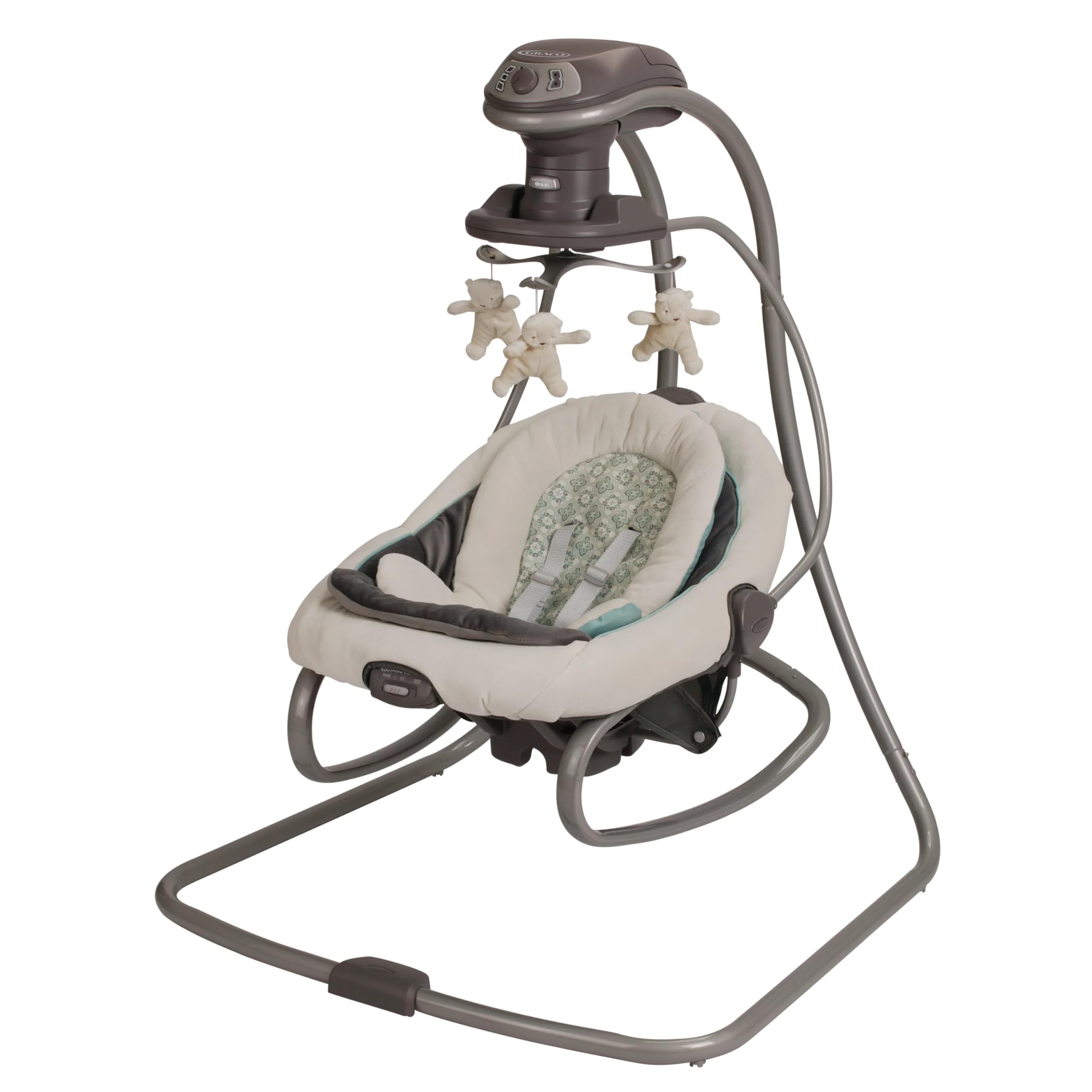
Graco DuetSoothe Swing & Rocker
Key Features
- Swing speeds: 6
- Weight limit: 30 lb
- Product weight: 21 lb
- Swing directions: 3
- Price: Premium
The seat on the DuetSoothe lifts off its frame and becomes a rocker with its own carry handle, and that is the detail that made it our top pick. On the frame, the seat swings in three directions — side to side and front to back among them — at six speeds, with two levels of vibration. It’s also rated to 30 pounds, ten more than most of the swings here, so it’s still doing something useful months after a 20-pound swing would have been folded away.
The seat itself is deep at 14.13 inches, with body support and a recline, and the two-speed vibration gives a fussy baby a second thing to settle on when swinging alone isn’t landing. It reads as furniture rather than a temporary gadget, which is the right look for a living room and the wrong one for a hall closet.
The single thing we minded is the mechanism: it clicks as it swings, quietly at the low speeds and noticeably at the top of the range. If the swing goes in a room where a baby actually sleeps, run it slow for a day and listen before you decide.
Pros
- Three swing directions plus two vibration levels
- Seat converts to a rocker with a carry handle
- 30-pound limit, the highest in this group
- Deep seat with body support and recline
Cons
- Heavy at 21 pounds to move between rooms
- Priciest swing in this group
The best all-around swing here: three directions, a seat that lifts off as a rocker, and a 30-pound limit that outlasts the newborn stage.
Best for Small Rooms
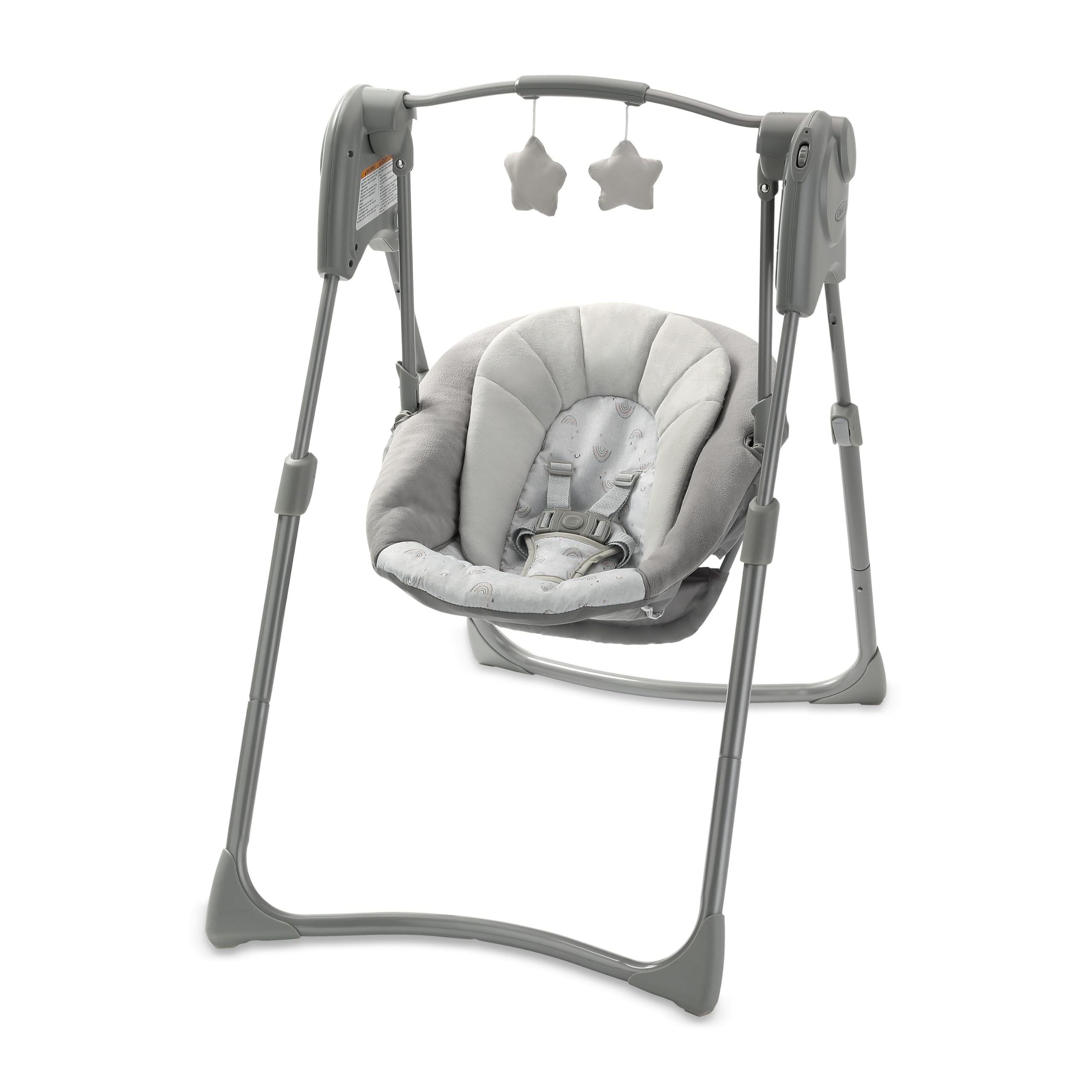
Graco Slim Spaces Swing
Key Features
- Storage: Folds compact with carry handle
- Dimensions: 7.9"D x 14.8"W x 24.49"H
- Weight limit: 25 lb
- Product weight: 12.7 lb
- Price: Midrange
Small rooms are where baby swings go to die: they arrive, take the corner, and stay there long after the baby has lost interest. The Slim Spaces is built around that problem. It folds down compactly enough to stand against a wall between naps, it has a carry handle, and at 12.7 pounds it takes one hand to shift when you want the floor back.
The height-adjustable legs are the detail we appreciated most — they raise the seat toward the couch or the bed you’re sitting on, which saves your back on the lift out of a sleeping baby. The rest is straightforward: an overhead toy bar with two soft toys, adjustable speeds, and a seat rated to 25 pounds. It’s the most space-efficient swing here, and that’s the whole reason to buy it.
It’s the pick for a one-bedroom apartment, a nursery that doubles as an office, or any room where the swing needs to disappear at six in the evening. If the swing will live in one spot and never move, the folding mechanism is money you don’t need to spend.
Pros
- Folds compact with a carry handle
- 12.7 pounds, light enough for one hand
- Height-adjustable legs save your back
Cons
- 25-pound limit stops short of the top pick
The one to buy when floor space decides: it folds down with a handle, moves one-handed at 12.7 pounds, and its legs adjust to your couch height.
Best for Travel and Grandparents
Ingenuity Soothe ‘n Delight Swing
Key Features
- Power: 4 C batteries (not included)
- Swing speeds: 6
- Weight limit: 20 lb
- Product weight: 7 lb
- Price: Budget
Two things make the Soothe ‘n Delight worth its place: the price and the fold. It’s one of the two cheapest swings here, and it folds flat enough to stand behind a door or slide into a trunk — something the bigger swings on this list can’t do.
Setup takes minutes, and the toy bar clips off so you can scoop a baby out one-handed. You get six speeds, music with parent-controlled volume and a timer, a cushioned seat rated to 20 pounds, and a 7-pound body at 22.5 by 28.5 inches.
The seat angle is the catch, and it’s why we stop short of calling this the swing for a brand-new newborn. The seat runs reclined enough that a very small baby can end up slumped toward the front; it fits better once your baby has some head control. As a second swing for a grandparents’ house, a vacation rental, or the trunk of the car, that’s a fair trade for the size and the fold.
Pros
- Folds flat for storage or travel
- Seven pounds, easy to carry
- Six speeds with a parent-controlled timer
- One of the two cheapest swings here
Cons
- Battery-only power from four C cells
- 20-pound weight limit
Seven pounds, a flat fold, and a quick setup make this the swing that travels; the reclined seat suits a baby with head control better than a fresh newborn.
Best for First Swing
Bright Starts Playful Paradise Swing
Key Features
- Power: 4 C batteries (not included)
- Swing speeds: 6
- Weight limit: 20 lb
- Assembled dimensions: 26.77" (H) x 22.64" (W) x 28.74" (D)
- Price: Budget
Four C batteries are the real cost of the Playful Paradise. At the lowest price in this group, the swing itself is cheap and the cells that feed it are not, so order rechargeables at the same time and keep a spare set charged. It’s the difference between a budget swing and a swing that keeps billing you.
What surprised us is how much motion you get for the money. Six speeds, ten melodies, a removable toy bar with two hanging toys, and TrueSpeed weight sensing that holds the pace steady as your baby grows instead of letting the swing slow to a crawl. At 7 pounds it folds and moves between rooms easily, and the sway is genuinely soothing rather than a token rock.
The frame is light, and light means the harness does the containing: strap your baby in every time, even for a two-minute settle. As a first swing for a household that isn’t sure a swing will take, that’s an easy trade — you’re spending the least here to find out.
Pros
- Six speeds with weight-sensing TrueSpeed
- Ten melodies and two hanging toys
- Seven pounds and folds for storage
- Lowest price in this group
Cons
- Seat stays reclined as baby grows
The least expensive way to find out whether your baby is a swing baby, with six speeds and weight-sensing motion that holds its pace.
Best for Porch and Patio
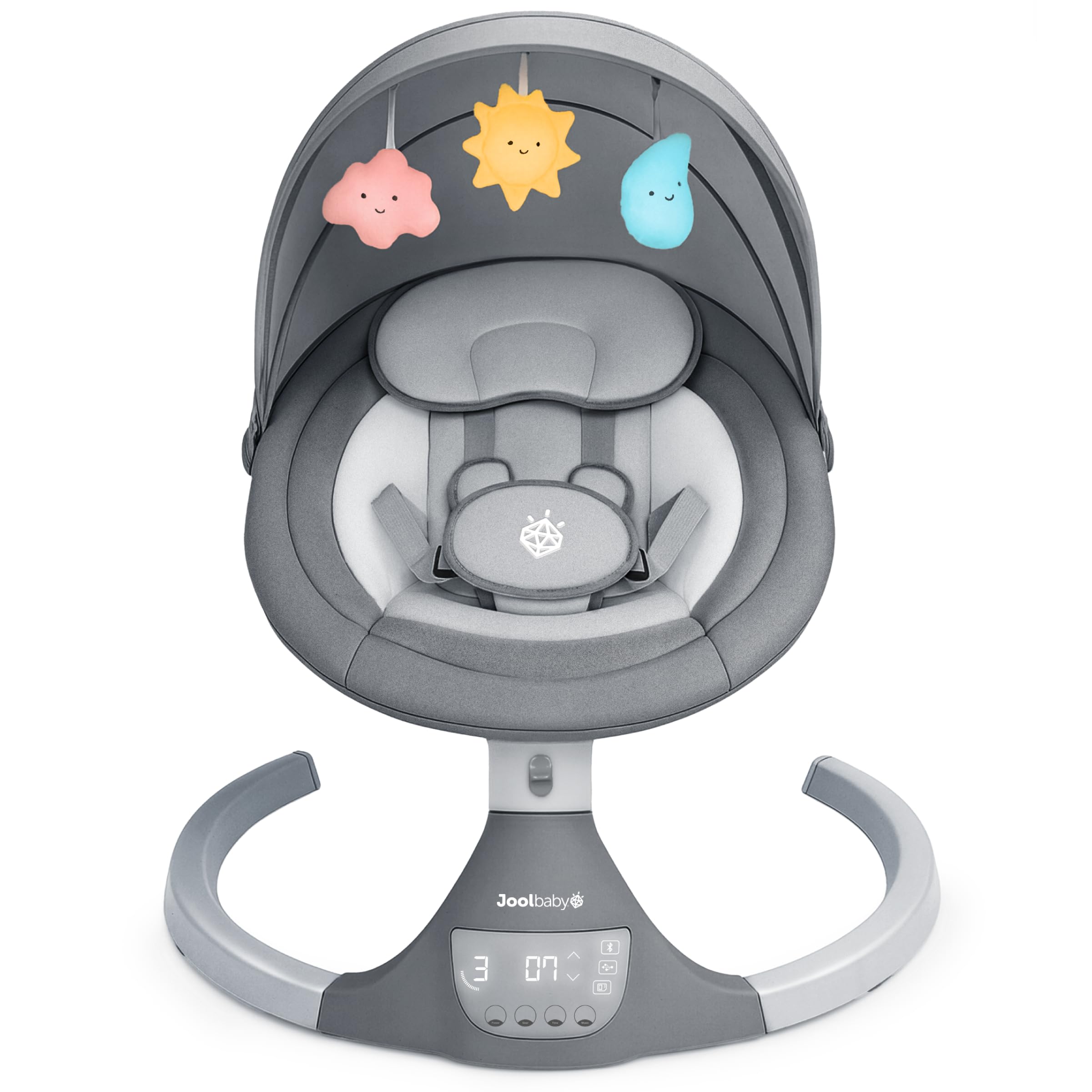
Jool Baby Nova Swing
Key Features
- Canopy: Removable, with netting
- Swing speeds: 5
- Weight limit: 20 lb
- Product weight: 7.25 lb
- Price: Premium
The canopy and netting are what set the Nova apart: clip them on and the swing can move to a porch, a patio, or a shady patch of grass without turning into a bug magnet. We think that’s the real feature here — the Bluetooth speaker and the remote are conveniences for the adult, while the shade is a convenience for the baby.
Underneath it’s a simple side-to-side swing: five levels of gentle motion, ten preset melodies, and a small frame at 25 by 23 by 20 inches that weighs 7.25 pounds and sets up in a few steps.
Carrying it out to the porch is easy at that weight, and the canopy means you’re not chasing shade across the yard. Treat the music as a bonus rather than a reason to buy: babies are soothed by the motion, and the Bluetooth matters more to the adult holding the phone than to the baby in the seat.
Pros
- Removable canopy and netting for outdoor use
- Bluetooth speaker and remote control
- 7.25 pounds with a small footprint
- Five levels of side-to-side motion
Cons
- Side-to-side motion only
- 20-pound limit at a premium price
The swing that goes outside: a canopy and netting for the porch, Bluetooth music, and a 7.25-pound frame that carries easily.
Best for Living Room Style
Munchkin Bluetooth Baby Swing
Key Features
- Seat pad: Machine washable, reversible
- Weight limit: 20 lb
- Sway settings: 5
- Product weight: 8.6 lb
- Price: Midrange
Most swings look like baby gear. This one looks like a piece of design: a white-and-gray frame, a touchscreen in place of a row of buttons, and a footprint of 23.6 inches square, small enough to sit beside a couch instead of in the middle of the room.
The motion is the other half of the pitch — five ranges of a side-to-side sway meant to mimic the way you rock a baby in your arms, plus eight ambient sounds, a set of classical selections, and Bluetooth for your own playlist.
It breaks into two pieces in seconds, which is how it stores under a bed, and the reversible seat pad and head support come off for the wash. It weighs 8.6 pounds and holds a baby up to 20 pounds.
Our reservation is the motor, which is also the interface here. Some units have quit inside the first month, with the motor burning out or the digital mechanism failing, and that’s the risk you accept for the clean look. Register the warranty the day it arrives and keep the box until you’re past the return window.
Pros
- Touchscreen controls and a clean, low-profile look
- Five ranges of gentle side-to-side sway
- Splits into two pieces for storage
- Machine-washable reversible seat pad
Cons
- Speaker is modest for music streaming
- Gentle sway may be too subtle for some babies
If the swing has to live in your living room, this is the one: a touchscreen, a clean white frame, and a sway that stays gentle.
Best for Multi-Direction Motion
Ingenuity SimpleComfort Swing

Key Features
- Power: USB cord; 1 C battery for vibration
- Swing speeds: 6
- Weight limit: 20 lb
- Swing directions: 3
- Price: Midrange
Three swing directions usually sit at the top of the price range. The SimpleComfort is the other way in: the seat rotates 180 degrees and swings front to back, side to side, or somewhere in between, for less than the DuetSoothe asks.
The rest of the package is generous. Six speeds with a timer, eight melodies, three nature sounds and white noise, soothing vibration, an oversized seat with a removable headrest for newborns, a two-position recline, and a mobile with two plush toys. Motion and music run off the included USB cord, so only the vibration needs a battery, and the frame has wheels and a handle so you roll it instead of carrying it.
What you give up is floor space, and we were glad for those wheels because of it: at 34.25 by 29.53 inches this is the widest footprint here, and it wants a permanent corner rather than a closet shelf. If your living room can spare the room, it’s the value route to multi-direction motion.
Pros
- Rotates 180 degrees for three swing directions
- Six speeds with a timer
- Runs from a USB cord, not batteries
- Oversized seat with removable headrest
Cons
- Largest footprint in this group
- Vibration needs its own C battery
Three swing directions for less than the top pick, with a cord and wheels, as long as your living room can give up the floor space.
Best for Remote Control
Larex Electric Baby Swing

Key Features
- Power: Plug-in AC adapter
- Timers: 8/15/30 minutes
- Swing speeds: 5
- Weight limit: 20 lb
- Price: Midrange
The remote is the feature we kept reaching for. Changing speed, sound, and volume from across the room means you don’t have to lean over a sleeping baby and risk the creak that wakes them.
The feature list is long for the money: five side-to-side speeds, timers at 8, 15, and 30 minutes, ten built-in sounds plus Bluetooth streaming, a touch panel, and a wall adapter instead of a battery habit. It weighs just under nine pounds and holds a baby up to 20 pounds.
The motion is gentle to a fault. At the low speeds it’s a slow drift that some babies simply ignore, so plan on the middle of the range and treat the top speed as the useful one.
Larex prints its own warning in the listing — not for sleep or unsupervised use — and that’s the correct rule for every infant swing here, not just this one. Read it as the honest description of what you’re buying: a daytime swing for the newborn stage, with a remote that makes it easier to run from the couch.
Pros
- Remote plus touch-panel controls
- Wall adapter instead of batteries
- 8/15/30-minute timers
- Bluetooth plus ten built-in sounds
Cons
- Three-point harness instead of five-point
- Rated to six months, not nine
Remote control and wall power are genuinely useful conveniences; the three-point harness and six-month rating cap how far they go.
How We Chose and Tested 12 Baby Swings
We started by pulling every swing we could find that was rated for newborns, came from a brand with a track record on infant gear, and was light enough for one adult to move between rooms. That left a shortlist of 12, which we tested over six months in real homes rather than a showroom: living rooms during the five o’clock fussy stretch, kitchens while dinner got made, nurseries at naptime, and the trunk of a car for a weekend at grandma’s.
I assembled each one alone with a stopwatch running and a baby in a carrier at my feet, noting how many steps needed two hands and whether the instructions made sense without squinting. Once running, we set a phone decibel meter beside the motor and logged noise at the lowest and highest speeds, then listened again from across the room with a baby asleep nearby. We nudged each frame mid-swing to see whether it crept across hardwood, and we ran every swing through its full range of speeds and directions, tracking how quickly a fussy baby settled and whether the seat held a small newborn as securely as a heavier six-month-old.
Comfort came down to padding and harness fit, so we checked for red marks and whether a slumped newborn’s head fell forward. Portability got tested by actually folding each swing and carrying it one-handed through a doorway, and the Bluetooth and remote controls were used from the couch while a baby dozed. Over six months we washed seat covers as the manuals instructed and examined seams and fabric for pilling, ran swings on battery power to see how often they needed fresh cells, judged appearance by the only fair standard — whether we minded it in the middle of the living room — and weighed what each one actually gave you for the money.
How to Choose a Baby Swing
The swing that works is the one that fits your room, your baby’s age, and your patience for batteries — the melody count is the last thing that matters.
Start With the Motion
Most swings here move side to side, which mimics the sway of a baby in your arms and suits the majority of newborns. Front-to-back gliding is the other option. A few swings do both — the Graco DuetSoothe and the Ingenuity SimpleComfort are the two here that let you switch directions — and that flexibility is worth paying for if you don’t yet know what settles your baby. If you have already watched your baby calm down to a particular rhythm, buy that motion and keep the money.
Then look at the bottom of the speed range rather than the top. A swing whose slowest setting is still brisk is a swing you won’t use at 2 a.m.
Decide How You’ll Power It
Cells are the hidden cost of a cheap swing. A battery-only model, like the Bright Starts or the Ingenuity Soothe ‘n Delight, keeps costing money in a way the sticker doesn’t show, so buy rechargeables and a spare set in the same order. If the swing will run an hour or more a day, pay for a model that plugs in — the Larex and the Ingenuity SimpleComfort both run from a cord — because a corded swing also holds its speed steady as the batteries would sag.
Battery-only is still the right call for a swing that leaves the house, since you won’t always find an outlet where you’re going.
Fit the Room, Not Just the Baby
Measure the floor space before anything else, then decide whether the swing needs to fold. A swing that folds and carries, like the Graco Slim Spaces at 12.7 pounds, can live in a closet and come out for naps; a two-in-one like the DuetSoothe, at 21 pounds, is furniture and stays where you put it.
One warning about the word portable on a swing listing: it usually means the swing fits in a car trunk, not that you’ll want to carry it one-handed up a flight of stairs. Check the folded dimensions rather than the marketing.
Look at the Seat Through a Newborn’s Eyes
Seat angle is the detail that decides whether a newborn is comfortable, and it’s the one you can’t judge from a photo. A seat that suits a two-month-old can leave a three-week-old slumped toward the front — the Ingenuity Soothe ‘n Delight is the clearest example here, and it fits better once a baby has head control.
Look for removable head support, a recline that holds its position, and a seat deep enough that a baby isn’t hanging out of it. Never add a rolled blanket to fix the angle; the harness and the seat are the only support a swing is designed to give.
Safety Rules That Aren’t Optional
Use the harness every time, including the two-minute settle. Keep the swing on the floor rather than a table or a soft bed, and stay in the room while it runs; the Larex listing says plainly that an infant swing isn’t for unsupervised use, and that applies to every swing on this page.
Stop using it once your baby can sit up and lean forward, whatever the weight rating says. A reclined seat is the wrong shape for a baby who is trying to climb.
Frequently Asked Questions
Can my baby sleep in a swing?
No. A swing is a soothing tool, not a bed, and the Larex listing says so outright: not for sleep or unsupervised use. The same rule holds for every swing here. If your baby nods off in the seat, move them to a firm, flat crib or bassinet.
Use the swing for the stretch when you need both hands, and keep it in the room where you are rather than in a bedroom as an overnight solution.
How long will my baby use a swing?
Most swings here are rated to 20 pounds; the Graco DuetSoothe goes to 30 and the Graco Slim Spaces to 25. In practice 20 pounds tends to arrive somewhere between six and nine months, which is why a swing is a first-year purchase rather than a long-term one.
Watch the scale rather than the age range on the box. A big baby outgrows the seat before the calendar says so.
What’s the difference between a swing and a bouncer?
A bouncer is a seat on a springy frame — it moves because your baby moves, with no motor and no batteries. A swing has a motor and does the work for you, which makes it the better tool for settling a fussy baby and the worse one for a baby who wants to sit up and watch you cook.
Some products blur the line: the seat on the Graco DuetSoothe lifts off as a manual rocker. If you want motion without a motor, a bouncer costs less and takes less floor.
How do I clean a baby swing?
Spit-up is a daily event, so check that the seat pad and head support come off before you buy. The Munchkin’s reversible pad and head support are machine washable, which is the easiest version of this here.
For everything else, a damp cloth on the frame and a spot clean on the harness straps is about all a swing needs. Keep water out of the motor housing.
Final Verdict
If you want one swing to cover the whole first year, buy the Graco DuetSoothe. Three swing directions, a seat that lifts off as a rocker, and a 30-pound limit make it the most useful swing here, and a clicking mechanism is a fair price for that.
If floor space decides for you, the Graco Slim Spaces folds away between naps. And if this is your first swing and you aren’t sure your baby will take to one at all, the Bright Starts costs the least to find out.
