This post contains affiliate links. We may earn a small commission when you buy through our links — at no extra cost to you.
There’s a specific silence that falls over a room when a puppet comes out — toddlers stop mid-sentence and even the adults lean in. It’s the closest thing to a screen you can keep in a toy bin, and it earns its keep in a waiting room, a grocery cart, or the last ten minutes before bed. What a good one fixes is the hard part of playing with kids: it gives you something to do with your hands and a voice to hide behind.
The catch is that plenty of what’s sold as a hand puppet is really a stuffed animal with a hole in the bottom — soft, cute, and impossible to make talk. The details that separate the real ones don’t show up in photos: whether the glove pocket swallows an adult hand or only a preschooler’s, whether the mouth opens wide enough to bite a block, whether the seams hold when two kids argue over who gets to be the shark. We’ve spent four months with 14 of them, and the differences aren’t subtle — the ones below are still getting pulled out of the bin.




Best for All-Around Play
Silly Puppets Tommy
Key Features
- Mouth: Movable
- Height: 14 inches
- Hand Fit: Children and most adults
- Material: Polyester
- Price: Premium
A moving mouth is what turns a hand puppet from a plush figure into a character, and Tommy gets that part right. One hand works the mouth while the other can gesture through the arm openings, so the puppet can nod, argue, and react. At 14 inches and 8 ounces, it leaves room for most adult hands without becoming too heavy for a child. That combination is why it is our top pick.
The body is soft polyester, and the clothes come off. We like removable clothing because it adds a dressing-up layer and makes cleanup easier, and the peach-boy character gives kids a name and a voice to play with. The outfit is detailed enough to feel like a character rather than a generic animal sleeve, which matters when a child is building a story around one puppet.
The hand entry is through the bottom, and the puppet sits securely once your fingers are in the mouth and arm pockets. It is light enough for a child to hold up for a short scene, but the size is clearly aimed at shared play with an adult or an older kid. That makes it a good fit for families who want one puppet that can grow with a child instead of a bin of characters that all do the same thing.
For a family that wants one puppet to lead stories, Tommy is the one we reach for. It gives you a character with a real jaw, a real outfit, and enough room for an adult to perform without handing the job to a child. That is the difference between a puppet bin and a puppet show.
Pros
- Moving mouth and arms for real dialogue
- Fits most adult and child hands
- Removable outfit adds dress-up play
- Light enough for kids to hold
Cons
- Single character, not a full cast
- Hair can shed with rough play
- Mouth and arm work takes practice
Tommy is our top pick for a reason: the moving mouth and adult-friendly fit make it the one puppet here that can carry a whole story.
Best for Story Time
Pete the Cat Hand Puppet
Key Features
- Height: 14.5 inches
- Hand Fit: Kids and adults
- Material: Polyester
- Age Range: 2 to 6 years
- Price: Midrange
Pete the Cat is a 14.5-inch soft puppet built around the book character, right down to the Four Groovy Buttons coat. The polyester body is soft rather than structured, and the size leaves room for an adult or a child to wear it. That makes it a natural read-aloud prop: hold Pete up, turn the page, and let the character take the next line. We like that it works as both a puppet and a cuddle toy, which is not true of every puppet in this group.
Our take: Pete is the pick for story time and cuddle-up play, especially for a child who already knows the books. The character does a lot of the work; you do not need a script to get a reaction. It is less of a performance rig than Tommy, so if you want a mouth that moves and arms that gesture on cue, choose Tommy. If you want a soft character to bring a favorite story to life, Pete is the easier choice. The hand entry is simple, and the soft fabric makes it comfortable for short or long story sessions.
Pros
- Book-character appeal for read-alouds
- 14.5-inch fit for kids and adults
- Soft polyester body for cuddling
- Simple one-hand operation
Cons
- Single character only
Pete earns our recommendation for read-alouds and cuddle-up play, especially when the book character matters more than moving-mouth mechanics.
Best for Older Performers
Melissa & Doug Chef Puppet
Key Features
- Height: 15 inches
- Features: Movable mouth and detachable rod
- Material: Cotton
- Age Range: 3 to 10 years
- Price: Premium
The detachable wooden rod is the detail that makes Chef Al Dente more than a plush head on a hand. Clip it to either arm and you can work the mouth with one hand while the other hand gestures with the rod. At 15 inches, the puppet has enough body for a chef’s coat, scarf, and floppy hat, all of which come off.
We like the performance math here: the mouth gives you dialogue, the rod gives you a way to wave a spoon or reach for an ingredient, and the removable outfit lets a kid reset the character. The rod is also a separate piece, so it needs to be kept track of and kept away from children under 3. The manufacturer recommends this one for ages 3 to 10, and that fits the way it works.
The case for Chef is simple: it is the most expressive puppet here for a kid who wants to put on a show. It is bigger, more structured, and more expensive than the soft animal sets. For a budding performer, that trade is worth it; for a toddler who wants a cuddle toy, the softer sets are a better start.
Pros
- Movable mouth plus rod-controlled arm
- Removable chef coat, scarf, and hat
- 15-inch size fits older kids and adults
- Soft cotton body with detailed outfit
Cons
- Single character only
For older kids who want a moving mouth and a rod-controlled arm, the Chef puppet is the one we recommend.
Best for Group Play
Melissa & Doug 8-Piece Puppet Set
Key Features
- Material: Polyester
- Age Range: 2 to 6 years
- Characters: 4 farm, 4 zoo
- Puppet Count: 8
- Price: Midrange
Eight puppets in one box is the reason this set earns a place. You get four farm animals (sheep, cow, pig, horse) and four zoo animals (tiger, monkey, elephant, giraffe), which is enough for siblings to each take a role or for a classroom to hand out a cast without arguing over the good one.
The fabric is brightly patterned and washable, and the soft stuffed heads make these comfortable for kids to hold. They are glove-style hand puppets, so the play is more about tilting, bouncing, and voicing a character than about intricate mouth work. For a living-room show, that is plenty.
We like the set for group play because the variety does the work: a tiger can chase a zebra, a cow can complain to a horse, and the story can shift without digging through a toy bin. The set is built for kids to wear, so it is at its best when children are the performers.
We recommend this set for siblings, classrooms, and anyone who wants a full cast without hunting down individual animals. It is not the most polished single puppet here, and the fit is the thing to check if you are the one wearing it. For a whole cast, the trade is easy.
Pros
- Eight farm and zoo characters
- Washable patterned fabric
- Soft heads for cuddling
- Enough roles for group play
Cons
- Tight for larger adult hands
We recommend this eight-piece set for siblings and classrooms that need a whole cast of washable animal puppets.
Best for Bluey Fans
Bluey 2-Pack Hand Puppets
Key Features
- Height: 8-9 inches
- Material: Cotton plush
- Age Range: 36 months and up
- Puppet Count: 2
- Price: Budget
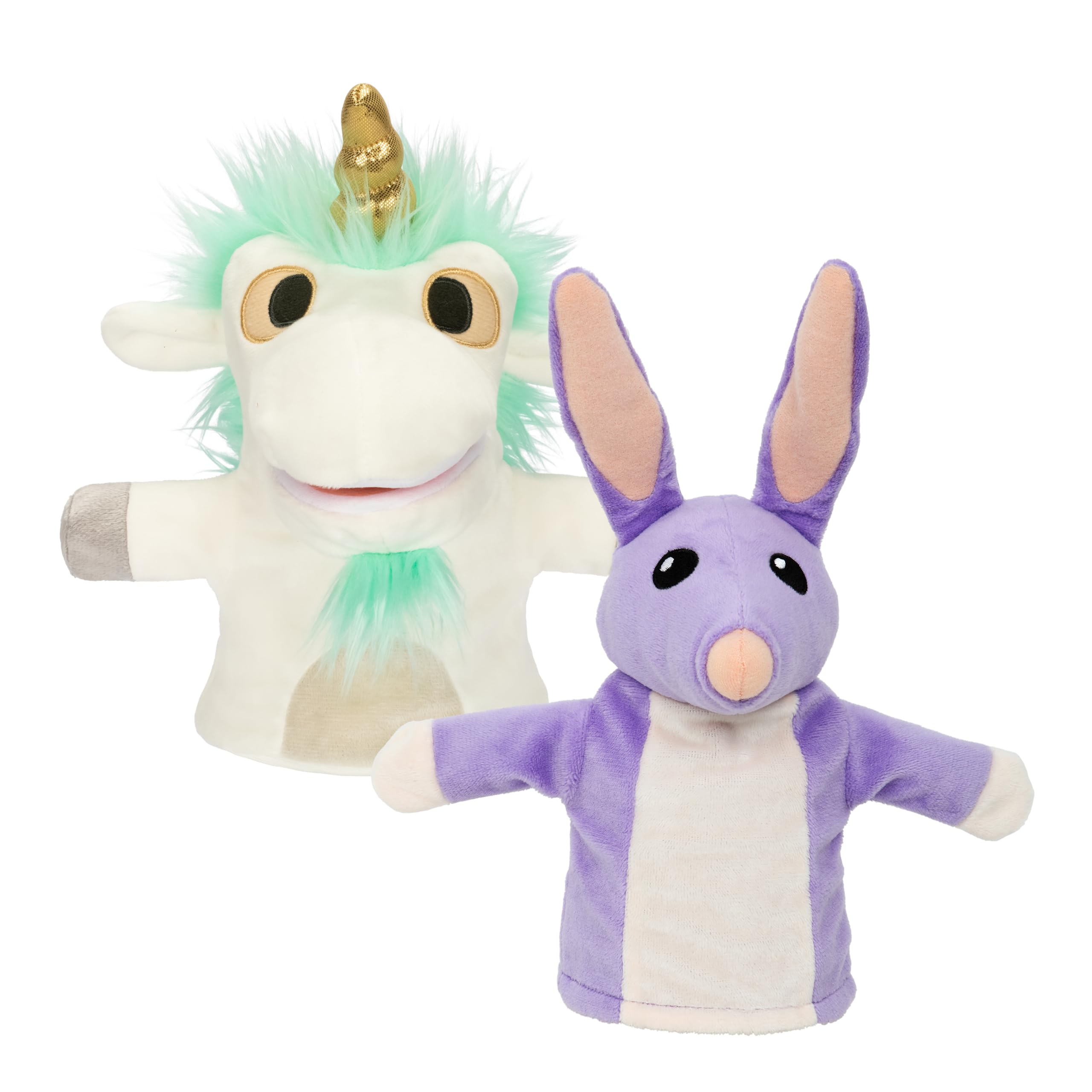
The Bluey pair is the smallest pick here, and that is the point. At 8 to 9 inches, Unicorse and Bob Bilby are sized for toddler hands, with soft plush bodies and embroidered details instead of hard plastic eyes. For a Bluey-obsessed kid, the recognition does a lot of work; these are characters they already know how to voice. We like this pair for small-hand play, car rides, and the kind of storytelling that happens in five-minute bursts.
The two-pack also solves the sharing problem: one puppet for each hand, or one for a sibling. The fabric is soft enough for a cuddle after the show, and the characters are distinct enough to cast them in different roles. They are cuddle-first puppets, so the play is more about voices and snuggles than a full scripted production. If your child already loves Bluey, that is enough.
Pros
- Two recognizable Bluey characters
- Soft embroidered plush details
- Sized for toddler hands
- Easy for car and travel play
Cons
- Tight on adult hands
The Bluey pair is our pick for toddler hands and fan-driven play, not for adult-led shows.
Best for Emotional Learning
hand2mind Feelings Family
Key Features
- Theme: Emotions
- Set Name: Feelings Family
- Recommended Use: Dramatic play and counseling
- Price: Midrange
The Feelings Family puppets are built around a simple idea: give a child a face to point at before they have the words. The set uses different colors and expressions, and the hands can be brought up to the face so sadness can wipe a tear or surprise can cover a mouth. That makes the feelings easier to read than a generic animal puppet.
We like these best for the calm-down corner, the counselor’s office, or a parent who wants to talk about a big feeling without making it a lecture. They are softer and more guided than a rowdy puppet show; the point is the expression, not the plot. For a toddler who is just learning to name emotions, that focus is useful.
The set is more niche than an animal cast, so it will not replace a general puppet bin. It is also the one to inspect at the seams, because the arms are the part that sees the most handling. If your child wants zoo animals and silly voices, the Melissa & Doug eight-piece is broader; if you want a tool for feelings talk, this is the one we reach for.
Pros
- Clear faces for naming emotions
- Hands can act out feelings
- Good for calm-down corners
- Soft, child-friendly construction
Cons
- Arms can tear with rough play
We recommend the Feelings Family for guided feelings play and calm-down corners, not for a rowdy puppet show.
Best for Budget Novelty
Schylling Shark Hand Puppet
Key Features
- Weight: 1.76 oz
- Material: Plastic
- Age Range: 3+
- Dimensions: 4.33 x 5.91 x 2.36 inches
- Price: Budget
The Schylling Shark is the impulse buy of the group: a soft rubber hand puppet with a silly grin and a body small enough for a kid to wear without help. At 4.33 by 5.91 by 2.36 inches and 1.76 ounces, it is more hand-sized than show-sized, which is exactly why kids take to it.
We like it for chase games, bathtub-adjacent nonsense, and the kind of puppet play that lasts about as long as a kid’s attention span. The rubber is soft to the touch and easy to squeeze, and the shark shape gives a child an obvious character to voice. It is not a puppet you build a whole script around, but it is a fun one to have in the bin.
Buy it as a cheap, funny single puppet for a child, not as the centerpiece of a family show. It is a novelty, and it knows it. If you want a puppet that fits your hand and lasts through years of shows, Tommy is the better pick; if you want a quick laugh, the shark earns its place.
Pros
- Low-cost single-puppet option
- Soft, squeezable rubber body
- Silly shark character kids enjoy
- Easy for small hands to wear
Cons
- Too small for adult hands
- Soft rubber can tear or lose color
Buy the Shark as a low-cost, kid-sized novelty, not as the one puppet you build a show around.
Best for Familiar Character
GUND Sesame Street Elmo

Key Features
- Height: 11 inches
- Material: Polyester
- Age Range: 12 months and up
- Character: Elmo
- Price: Midrange
Elmo is the familiar face here, and for a baby that matters more than articulation. At 11 inches, this GUND puppet is small enough for one hand, with soft red plush, big eyes, and the friendly expression kids recognize from the screen. It is also surface-washable, which is the right call for a toy that will be hugged and dragged around.
The 12-month age minimum makes it one of the youngest-friendly picks here. We like it for peekaboo, songs, and the kind of greet-and-cuddle play a baby understands before they can tell a story. It is a comfort object that happens to sit on your hand, and that is a useful thing to have.
Elmo is more cuddle than performance, and that is the right role for a one-year-old. The puppet is at its best when an adult makes Elmo wave, nod, or hide behind a blanket, not when a child is expected to run a conversation. For songs and peekaboo, simple is enough.
Our take: this is the pick for the baby who already lights up at Elmo, not for the family planning a puppet show. If you want a familiar face for songs and peekaboo, it earns its place; if you want a mouth that moves easily, Tommy or Chef is the better buy.
Pros
- Familiar Elmo character for babies
- Soft plush with surface-washable care
- 11-inch size for one hand
- 12-month age minimum
Cons
- Stiff mouth takes effort to work
- Snug on larger adult hands
Elmo is our pick for babies who already know the character, with the caveat that it is more cuddle than performance.
How We Tested 14 Hand Puppets (and What the Kids Did to Them)
We started by pulling every hand puppet we could find off the toy aisle, the big-box shelves, and the catalogs preschool teachers actually order from, then cut the list by specs: whether the glove pocket was sized for an adult hand or a child’s, whether the fabric could be washed, and what you paid per puppet once sets were broken out. That left 14 puppets, run for four months in homes with kids from 2 to 7, plus a few grandparents and a preschool teacher who lent us their hands.
Testing happened where puppets actually live: on the living room rug before bed, in the back seat on a two-hour drive, in a grocery cart at 5 p.m., and in a counselor’s calm-down corner. We handed each one to a 2-year-old and let them try to get it on alone, opened and closed every mouth with a pinch grip to see if it could bite a block, and watched whether arms and fins swung or just drooped. We also noted how the fabric felt against a sweaty wrist after 20 minutes, how long an adult needed to swap puppets mid-story, and what survived a wash cycle and a tug-of-war between siblings.
We logged the small stuff that grows into a bigger deal: fleece that pills, stuffing that migrates out of the fingers, a rod that needs two hands to work. Value got a hard look, since a set costs less per puppet than a single character — but only if your kids actually want all of them. The puppets below were still being picked up in the last week of testing the same way they were on day one.
How to Choose Hand Puppets
The best hand puppet is the one that fits the person wearing it and gives them an easy way to make the character move.
Start With the Hand That Will Wear It
A puppet that fits a toddler can be a tight squeeze for an adult, and the reverse is just as true. The Bluey pair is 8 to 9 inches, sized for small hands; Tommy, Pete, and the Chef puppet run 14 to 15 inches and leave room for a grown-up to perform. If you are the storyteller, put adult fit first and check the hand opening before you fall for the character. For a child, a smaller, lighter puppet is easier to control. Do not assume compact means adult-friendly; the fit is the feature you will notice every time you use it.
Decide How Much Movement You Need
Hand puppets fall into two broad jobs. A soft glove-style puppet is for cuddling, read-alouds, and simple character voices; a moving-mouth puppet is for dialogue, jokes, and shows. Tommy’s moving mouth and arm openings let one hand talk while the other gestures, and the Chef puppet adds a detachable rod for bigger arm movements. If you want a puppet that can argue, sing, or gasp, prioritize a moving mouth. If you want a soft character to bring a book to life, a plush puppet is easier to hold and gentler for a baby.
Choose a Set or a Single Character
A set solves the group-play problem: the Melissa & Doug eight-piece gives you four farm and four zoo animals, enough for siblings or a classroom to share. A single character gives you a better puppet for one performer, with more structure and a stronger point of view. The Chef and Tommy are both one-character purchases; they are the ones to choose when the show matters more than the headcount. If you are buying for a child who mostly plays alone, one expressive puppet can be more useful than a bin of animals.
Check Softness, Cleaning, and Seams
For toddlers, soft fabric matters as much as the character. Look for plush or cotton bodies that feel gentle against the skin, and check whether the care instructions allow surface washing or machine washing. Removable outfits, like the Chef’s coat and hat, are easier to clean but add pieces to keep track of. Run your fingers along the seams, especially at the arms and mouth, before handing a puppet to a child. Loose hair, small accessories, and detachable rods belong out of reach of children under 3.
Match the Age Label to the Child
Age labels are not decoration. GUND Elmo is rated for 12 months and up, the plush animal sets generally start at 2, and the Chef and Shark puppets start at 3. The difference usually comes down to small parts, detachable pieces, and how much hand control the puppet demands. A 2-year-old can enjoy a soft animal puppet with help; a 3-year-old is more likely to work a mouth or a rod without frustration. Buy for the child in front of you, not the one they will be next year.
Frequently Asked Questions
Do hand puppets help toddlers learn to talk?
They give a child a low-pressure reason to take turns, copy sounds, and answer a character. Keep the play simple: have the puppet greet the child, ask a short question, then wait. That pause is where the language practice happens. A puppet is a play aid, not a substitute for speech therapy, but it can make daily talk feel less like a test.
How do you loosen a stiff puppet mouth?
Work the mouth gently with your thumb and fingers before a show, opening and closing it a few times close to the hinge. If it still fights you, use the puppet as a nodding or whispering character instead of a singing one. Soft fabric mouths are usually easier for small hands than stiff plastic ones, so let the child try before you assign them the lead.
Where should hand puppets live between shows?
Keep them dry and loosely packed so the heads do not flatten. A breathable bin or a fabric bag is better than a sealed plastic box, and a little tissue inside a structured head helps it hold shape. After cleaning, let the puppet air-dry completely before storage. If a puppet has a detachable rod or removable clothes, bag those separately so they do not go missing.
Final Verdict
If you want one hand puppet that can carry a story, start with Silly Puppets Tommy. It fits children and most adults, and the moving mouth and arms make it a performing puppet rather than a plush sleeve. For a whole cast on a tighter budget, the Melissa & Doug eight-piece set gives you eight characters for group play, though larger adult hands will feel the squeeze. Buy Tommy first if you are the storyteller; buy the set if the kids will share the show.
